
School Age 6 12 years a period of
- Slides: 32
School Age 6 -12 years a period of Industry and Cognitive Development
The School Age Child Begins w/loss of 1 st tooth & ends w/puberty Average gains: Weight: 5 lbs/yr. Height: 1 -2”/yr Avg 6 yr: 116 cm (45”) – 21 kg (46#) 12 yr: 150 cm (59”) – 40 kg (88#) Slimmer, steadier, lower center of gravity Linear growth: will outgrow shoes first, then pants & shirts Males & females differ little in size
Prepubescence – end of mid childhood; 2 -year period that precedes puberty Girls begin puberty & reach maturity ~ 1. 5 -2 yrs earlier than boys Time of rapid growth; development of secondary sex char. ; wt gain Girls: breast development; pubic hair Boys: penis and scrotum enlarge; ↑ muscle mass
Growth & Maturation Sequence is progressive and predictable Girls Thelarche (breast development) 8 -12. 75 yrs (caucasian); 7 -11 yrs (African American) Pubarche (growth of pubic hair) ~2 -6 mos later Menarche ~ 2 yrs after breast buds appear Boy changes occur between 9. 5 & 14 yrs Initially pubic hair appears, then penile and testicular enlargement Other: voice changes, facial hair, axillary hair Gynecomastia common but temporary (~2 yrs)
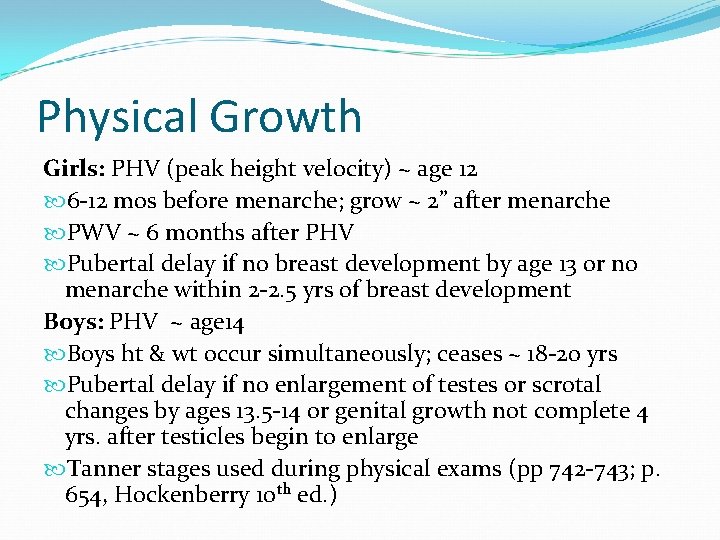
Physical Growth Girls: PHV (peak height velocity) ~ age 12 6 -12 mos before menarche; grow ~ 2” after menarche PWV ~ 6 months after PHV Pubertal delay if no breast development by age 13 or no menarche within 2 -2. 5 yrs of breast development Boys: PHV ~ age 14 Boys ht & wt occur simultaneously; ceases ~ 18 -20 yrs Pubertal delay if no enlargement of testes or scrotal changes by ages 13. 5 -14 or genital growth not complete 4 yrs. after testicles begin to enlarge Tanner stages used during physical exams (pp 742 -743; p. 654, Hockenberry 10 th ed. )
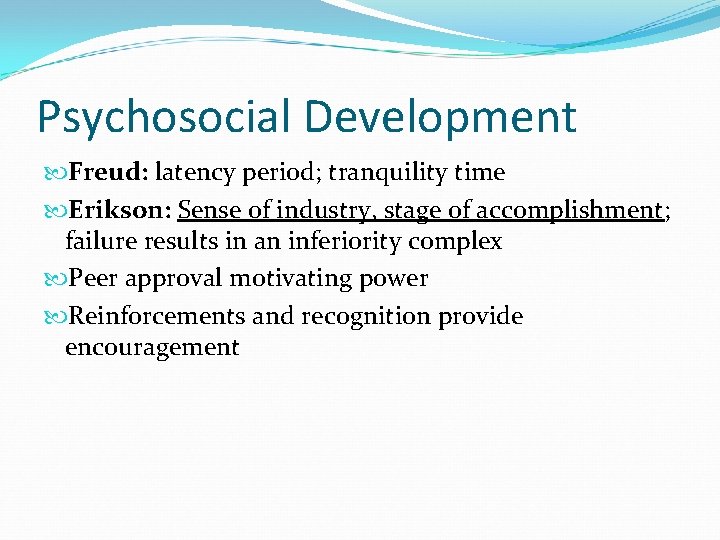
Psychosocial Development Freud: latency period; tranquility time Erikson: Sense of industry, stage of accomplishment; failure results in an inferiority complex Peer approval motivating power Reinforcements and recognition provide encouragement
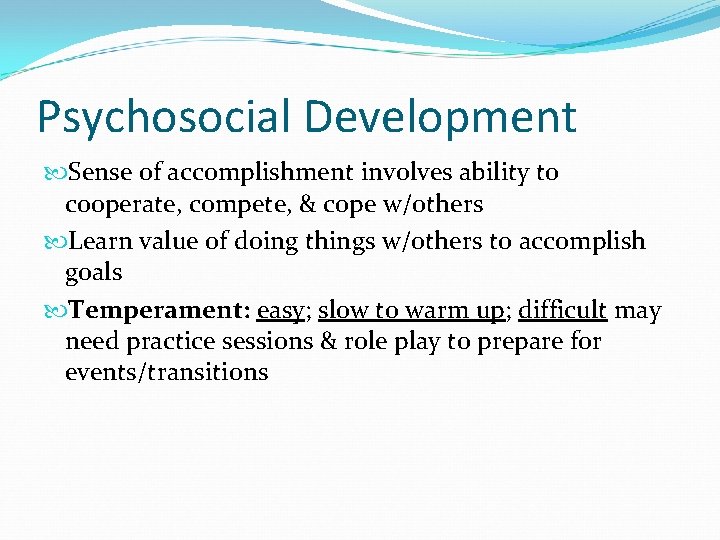
Psychosocial Development Sense of accomplishment involves ability to cooperate, compete, & cope w/others Learn value of doing things w/others to accomplish goals Temperament: easy; slow to warm up; difficult may need practice sessions & role play to prepare for events/transitions
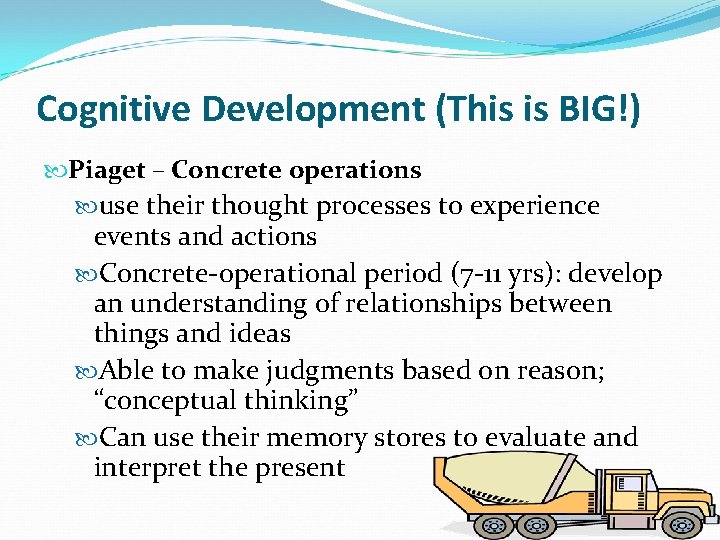
Cognitive Development (This is BIG!) Piaget – Concrete operations use their thought processes to experience events and actions Concrete-operational period (7 -11 yrs): develop an understanding of relationships between things and ideas Able to make judgments based on reason; “conceptual thinking” Can use their memory stores to evaluate and interpret the present
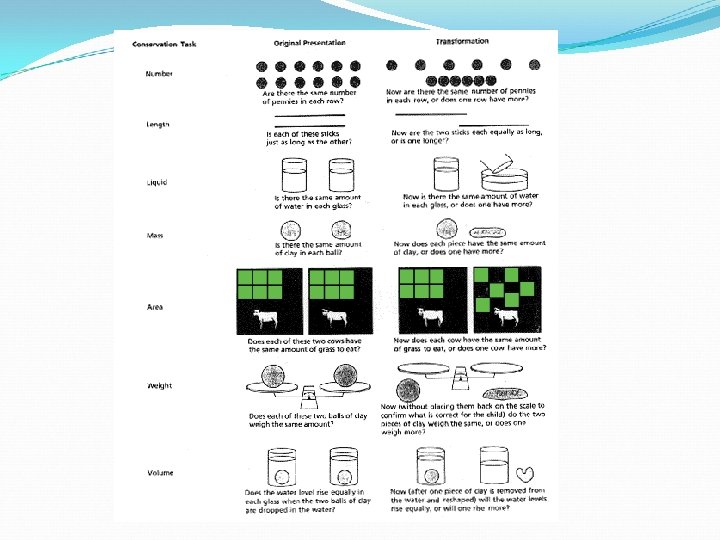
Cognitive Development (cont) Begin to see things from another’s point of view Major cognitive tasks: conservation Numbers 1 st, then substance, vol last Classification skills are BIG – love collections of anything Learn to tell time and manipulate numbers (add, subtract, divide, multiply) Biggest skill: Ability to READ
Moral Development (Kohlberg) Moral Development of conscience & moral standards Age 6 -7: reward & punishment still rules Older: moves to judging an act by intentions that prompted it rather than just consequences Begin to see other’s pt of view so are able to understand concept of treating others as they would like to be treated
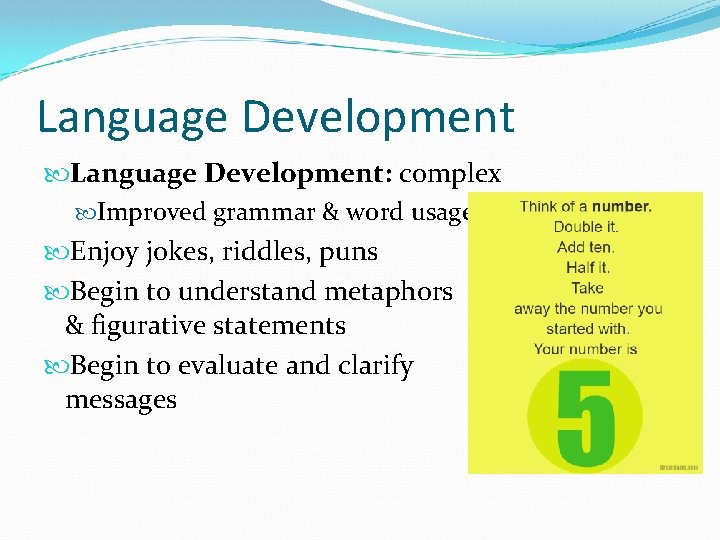
Language Development: complex Improved grammar & word usage Enjoy jokes, riddles, puns Begin to understand metaphors & figurative statements Begin to evaluate and clarify messages
Social Development Identify with peers as gain independence from family More sensitive to social norms and pressures of the peer group Sex-role learning becomes more important with same sex peers Having “best friends” a very big deal Belonging to a group very imp. ; group rules can be very rigid
Social Development Parents still primary influence in shaping their personalities, setting standards for behavior and setting value systems Still need and want parental control and feel secure knowing there is an authority to implement controls and restrictions Need firm, secure parental interest and concern, not just a “pal”
Body Image Acutely aware of their own bodies compared to others Body integrity important Concern re: threat or injury to it Need reassurance about both the uniqueness and sameness of their body If different, may be excluded from groups When teased or criticized abt. being different, effect can be life long & lead to feeling inferior
Perceptions of Death Most realize death is final, universal & inevitable by age 9 -10 Believe they may die but only in distant future; if faced w/death feel loss of control Fear pain associated with death May feel guilt and responsibility about someone’s death – need logical, factual explanations
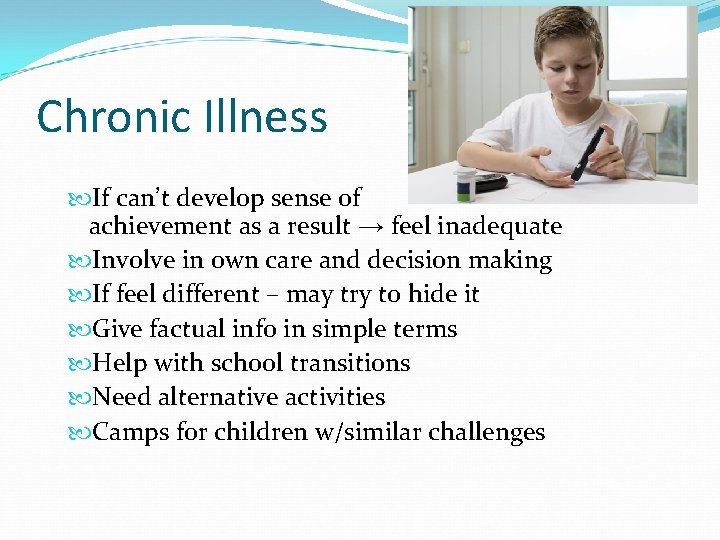
Chronic Illness If can’t develop sense of achievement as a result → feel inadequate Involve in own care and decision making If feel different – may try to hide it Give factual info in simple terms Help with school transitions Need alternative activities Camps for children w/similar challenges
Self Esteem How they view their worth in both pos & neg qualities is based on feedback they receive Adults can make them feel special & successful – shaping self concept Emphasize strengths & positive aspects of behavior Teachers, parents, coaches, etc – big influence Positive self concept leads to feelings of selfrespect, self-confidence, happiness
Sexuality Many experience some sort of sex play out of curiosity prior to adolescence Usually transitory; this should be taken as an opportunity to talk about sexuality; to provide info; use correct terminology; be concrete Ideal time for sex ed presented as normal part of growth and development Provide info on AIDS and dispel myths
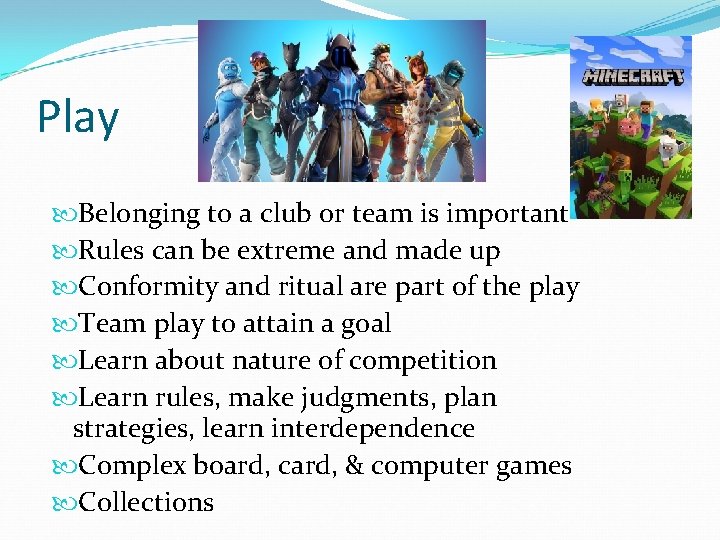
Play Belonging to a club or team is important Rules can be extreme and made up Conformity and ritual are part of the play Team play to attain a goal Learn about nature of competition Learn rules, make judgments, plan strategies, learn interdependence Complex board, card, & computer games Collections
Discipline Now able to understand the effects of their actions on others Reasoning is an effective technique Problem solving is best and children can be included in the process Others: withholding privileges, requiring recompense, imposing penalties, contracting
Dishonest Behavior Lying: all lie sometimes; often d/t role modeled behavior Cheating: most common 5 -6 yr; usually disappear as matures; role model imp. Stealing: bet. 5 -8 yrs sense of property rights is limited; may steal and lie about it or may steal to make up for love or something else they may be lacking
Stress Other concerns: stress (more than previous generations); exposure to violence; school environment; pressures to excel; being over programed by parents; worries about home problems (more divorce), expected to be more mature, Latchkey Children (see p. 665, 9 th ed. ; pp. 589 -590, 10 th ed. ) Box 17 -1, p. 663 (9 th ed. ); Figure 15 -12, p. 590 (10 th ed. ) excellent summary re: common stresses for different ages
Health Promotion Ideal time to take responsibility for their health by end of middle childhood Self-care in hygiene, nutrition, exercise, recreation, sleep, and safety Health education can help them learn abt their bodies; how their beh affects their health; helps them make good decisions Teach them to take active role in relationships with health care providers
Nutrition Junk food more available – fill up on empty calories School lunch – parents don’t know what child really eats even if send own lunch School lunch and breakfast program help meet needs of kids but often are high in fat Increase in obesity; increase in sedentary activities Fast food – major contributor to obesity
Sleep and Rest Amt. is individualized; ~ 9 ½ hrs Need routine and firm bedtime; should not be used as punishment Sleepwalking: 1 st 3 -4 hrs of sleep – no memory; not purposeful; leave alone unless in danger; self limiting Sleep talking- non purposeful; no harm Nightmares: less common; chronic-refer
Physical Activity Fewer resources for PE, playgrounds and after school programs at schools Only IL requires daily PE from K-12 TV: kids have become less active; 26% 4 hrs/day; 67% 2 hr/day Violent TV – increase in aggression, feel desensitized Video games: critics violence, tension, sleeplessness, others improve eye-hand coord.
Dental Health First permanent teeth by 6 yrs 3 rd permanent molars (wisdom) 18 -25 yrs Up until 2 nd grade dexterity to properly brush isn’t there so need supervision Bedtime brushing esp. important Flossing done by parents til ~ 8 -9 Malocclusion – may need orthodontic tx Dental evulsion: replacement or reattachment
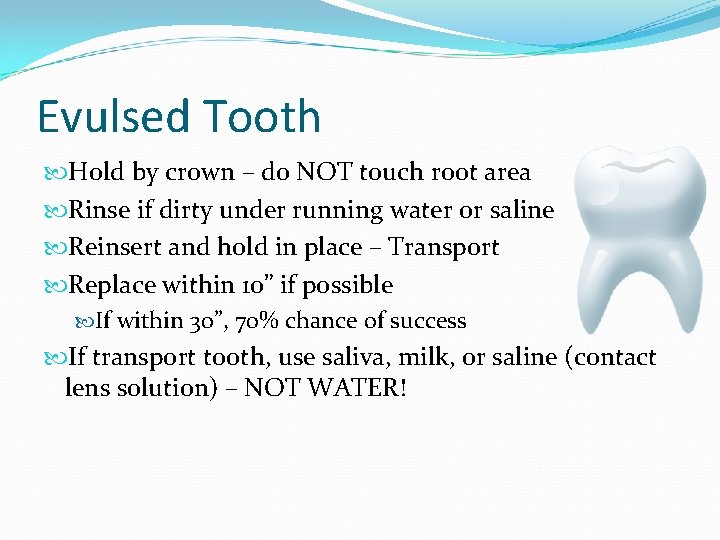
Evulsed Tooth Hold by crown – do NOT touch root area Rinse if dirty under running water or saline Reinsert and hold in place – Transport Replace within 10” if possible If within 30”, 70% chance of success If transport tooth, use saliva, milk, or saline (contact lens solution) – NOT WATER!
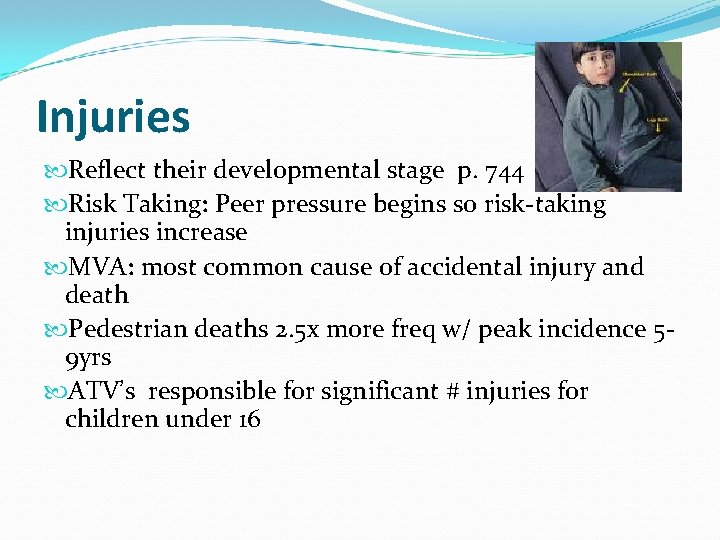
Injuries Reflect their developmental stage p. 744 Risk Taking: Peer pressure begins so risk-taking injuries increase MVA: most common cause of accidental injury and death Pedestrian deaths 2. 5 x more freq w/ peak incidence 59 yrs ATV’s responsible for significant # injuries for children under 16
Injuries (cont) Bike: 500, 000 ER visits, 900 deaths annually; deaths caused by head injuries Skateboards, rollerblades, Ride-on mowers, trampolines, flipping, horseback riding, sledding School: most injuries on the way to & fro Guns: firearm deaths <15 yrs, ~12 x greater than 25 other industrialized countries
That’s it! Aren’t School age kids some of the coolest? ? !!