
SCHOLARLY PUBLISHING ACADEMIC RESOURCES COALITION www sparceurope org
SCHOLARLY PUBLISHING & ACADEMIC RESOURCES COALITION www. sparceurope. org SPARC EUROPE What we can do to promote cheaper and open scientific information? David Prosser • SPARC Europe Director (david. prosser@bodley. ox. ac. uk) 1 1
www. sparceurope. org SPARC Europe Scholarly Publishing & Academic Resources Coalition l l l Formed in 2002 following the success of SPARC (launched in 1998 by the US Association of Research Libraries) Encourages partnership between libraries, academics, societies and responsible publishers Currently focused on STM, but coverage expanding Has over 60 members and is growing By acting together the members can influence the future of scholarly publishing 2 2
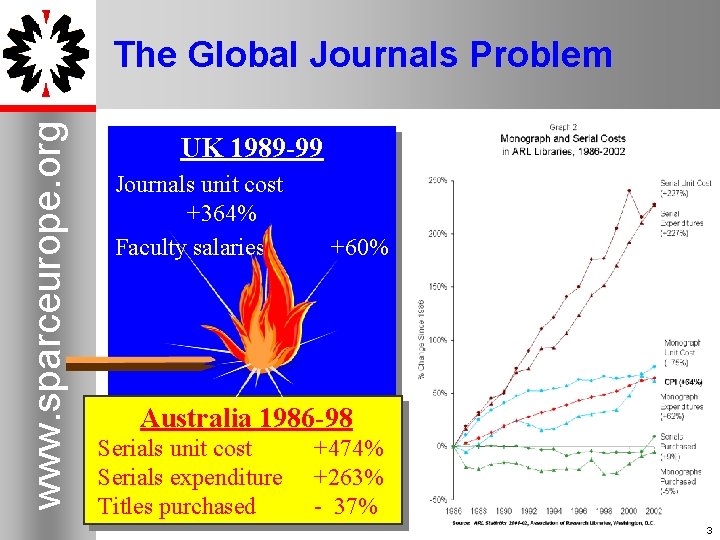
www. sparceurope. org The Global Journals Problem 3 UK 1989 -99 Journals unit cost +364% Faculty salaries +60% Australia 1986 -98 Serials unit cost Serials expenditure Titles purchased +474% +263% - 37% 3
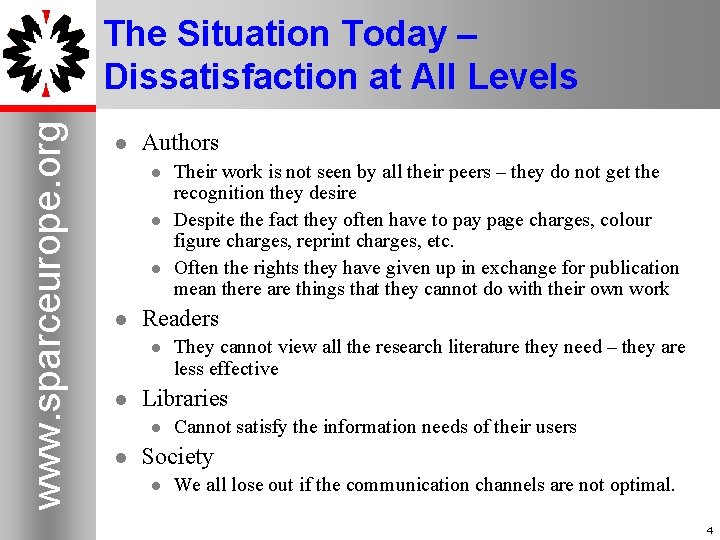
www. sparceurope. org The Situation Today – Dissatisfaction at All Levels l Authors l l Readers l l They cannot view all the research literature they need – they are less effective Libraries l l Their work is not seen by all their peers – they do not get the recognition they desire Despite the fact they often have to pay page charges, colour figure charges, reprint charges, etc. Often the rights they have given up in exchange for publication mean there are things that they cannot do with their own work Cannot satisfy the information needs of their users Society l We all lose out if the communication channels are not optimal. 4 4
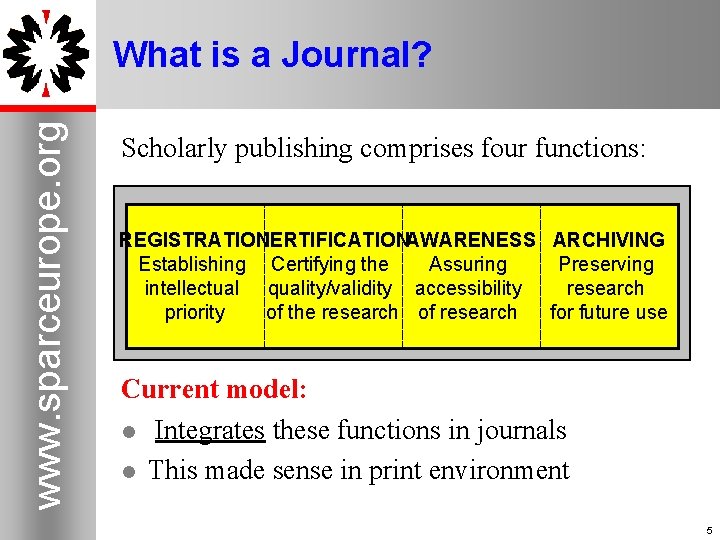
www. sparceurope. org What is a Journal? Scholarly publishing comprises four functions: REGISTRATION CERTIFICATIONAWARENESS ARCHIVING Establishing Certifying the Assuring Preserving intellectual quality/validity accessibility research priority of the research of research for future use Current model: l Integrates these functions in journals l This made sense in print environment 5 5
www. sparceurope. org Budapest Open Access Initiative Two complementary strategies: l Self-Archiving: Scholars should be able to deposit their refereed journal articles in open electronic archives which conform to Open Archives Initiative standards l Open-Access Journals: Journals will not charge subscriptions or fees for online access. Instead, they should look to other sources to fund peer-review and publication (e. g. , publication charges) 6 6
www. sparceurope. org What are institutional repositories (open archives)? Essential elements l l Institutionally defined: Content generated by institutional community Scholarly content: preprints and working papers, published articles, enduring teaching materials, student theses, data-sets, etc. Cumulative & perpetual: preserve ongoing access to material Interoperable & open access: free, online, global 7 7
www. sparceurope. org Why institutional repositories? l For the Individual l l For the Institution l l l Provide a central archive of their work Increase the dissemination and impact of their research Acts as a full CV Increases visibility and prestige Acts as an advertisement to funding sources, potential new faculty and students, etc. For Society l l Provide access to the world’s research Ensures long-term preservation of institutes’ academic output 8 8
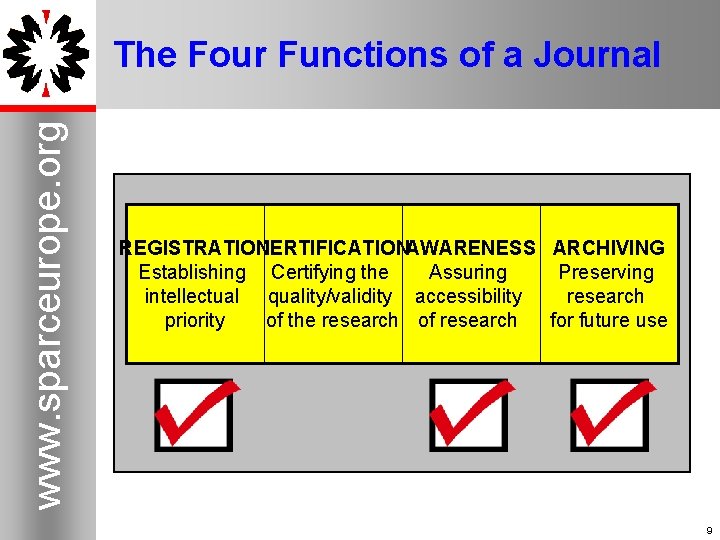
www. sparceurope. org The Four Functions of a Journal REGISTRATION CERTIFICATIONAWARENESS ARCHIVING Establishing Certifying the Assuring Preserving intellectual quality/validity accessibility research priority of the research of research for future use 9 9
www. sparceurope. org Certification l Certification gives: l l l Authors – Validation of their work (important for promotion and grant applications) Readers – Quality filter Journals would provide peer review services for a sub-set of the material in the Institutional Repositories The journals would give a ‘quality stamp’ to the research presented in the Repositories Journals should be open access 10 10
www. sparceurope. org Open Access What is it? Call for free, unrestricted access on the public internet to the literature that scholars give to the world without expectation of payment. Why? Widen dissemination, accelerate research, enrich education, share learning among rich & poor nations, enhance return on taxpayer investment in research. How? Use existing funds to pay for dissemination, not access. 11 11
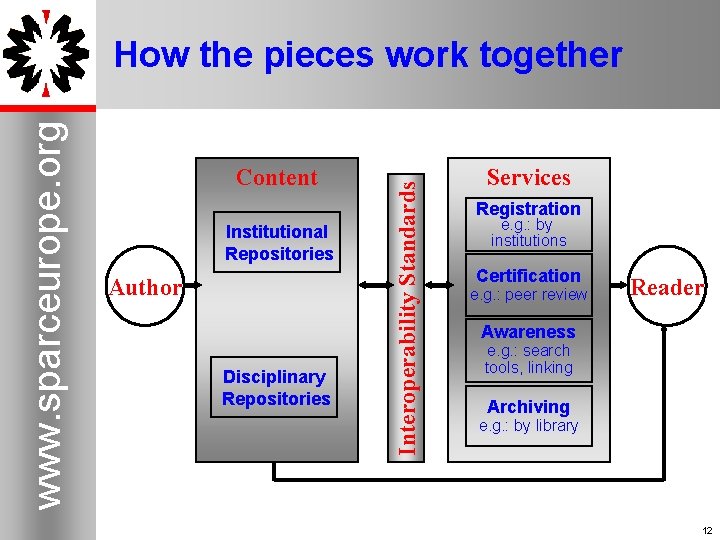
Content Institutional Repositories Author Disciplinary Repositories Interoperability Standards www. sparceurope. org How the pieces work together Services Registration e. g. : by institutions Certification e. g. : peer review Reader Awareness e. g. : search tools, linking Archiving e. g. : by library 12 12
www. sparceurope. org Utopia! l l l All research material freely available in a world-wide network of repositories Peer-reviewed papers receive quality stamp from journals, financed by authors not readers All peer-review papers are freely available to anybody with internet access 13 13
www. sparceurope. org Theory Into Practice - Institutional Repositories 14 l l l l l Eprints. org – Southampton produced software D-Space – MIT Repository, expanding to Cambridge, UK CDSWare – CERN ARNO – Tilburg, Amsterdam, Twente SHERPA – UK DARE – The Netherlands $12 million grant for repositories in Australia Over 200 institutions world-wide have set-up repositories SPARC Resources – (http: //www. arl. org/sparc/core/index. asp? page=m 0) 14
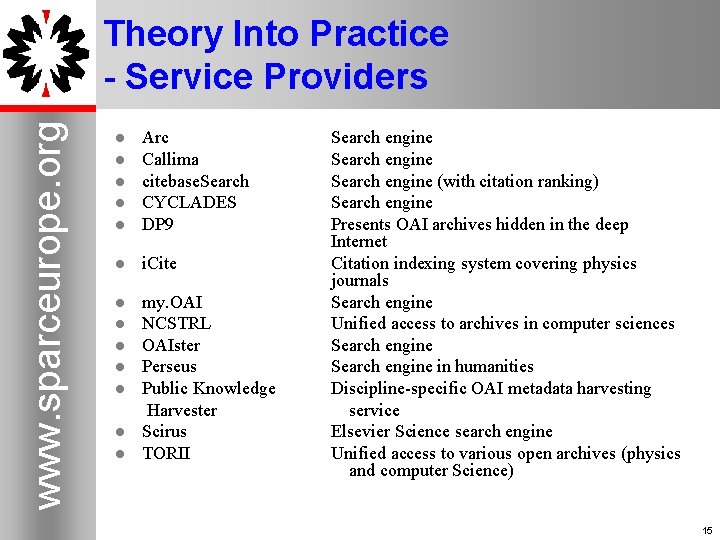
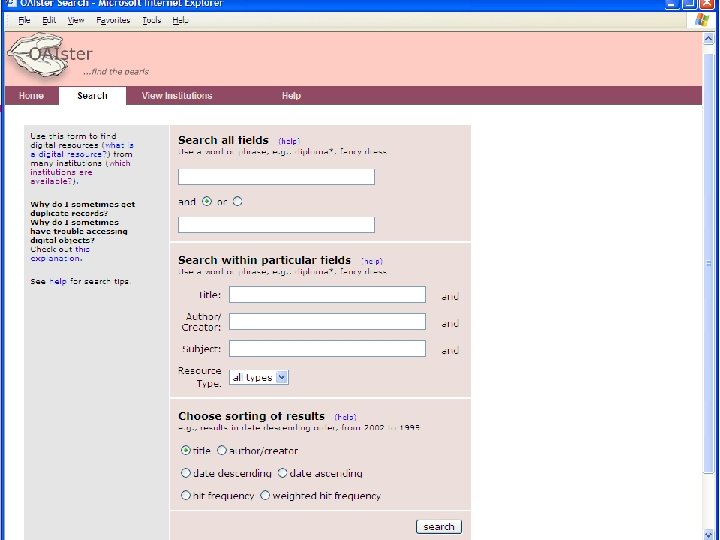
www. sparceurope. org Theory Into Practice - Service Providers l Arc Callima citebase. Search CYCLADES DP 9 l i. Cite l my. OAI NCSTRL OAIster Perseus Public Knowledge Harvester Scirus TORII l l l l l Search engine (with citation ranking) Search engine Presents OAI archives hidden in the deep Internet Citation indexing system covering physics journals Search engine Unified access to archives in computer sciences Search engine in humanities Discipline-specific OAI metadata harvesting service Elsevier Science search engine Unified access to various open archives (physics and computer Science) 15 15
www. sparceurope. org 16 16
www. sparceurope. org Theory Into Practice - Open Access 17 SPARC open access journal partners: l l l l Algebraic and Geometric Topology Bio. Med Central (published 4000+ papers) Documenta Mathematica Calif. Digital Library e. Scholarship Geometry & Topology Journal of Insect Science Journal of Machine Learning Research New Journal of Physics 17
www. sparceurope. org Theory Into Practice - Open Access Journals l l l l Two new journals from the Public Library of Science - PLo. S Biology and PLo. S Medicine Indian Academy of Sciences has made their 11 journals available free online Lund Directory of Open Access Journals (http: //www. doaj. org/) – over 670 peer-reviewed open access journals Sabo – ‘Public Access to Science’ Act UK Science and Technology Committee Inquiry Wellcome Trust support of Open Access Berlin Declaration in Support of Open Access 18 18
www. sparceurope. org Theory Into Practice - Open Access Journals (Cont. ) 19 Berlin Declaration in Support of Open Access: Germany Fraunhofer Society Wissenschaftsrat HRK Max Planck Society Leibniz Association Helmholtz Association German Research Foundation Deutscher Bibliotheksverband France Centre National de la Recherche Scientifique (CNRS) Institut National del la Santé et de la Recherche Médicale (INSERM) Austria FWF Austrian Science Fund (FWF Der Wissenschaftsfonds) Belgium General of the Fund for Scientific Research – Flanders (Fonds voor Wetenschappelijk Onderzoek Vlaanderen) Greece National Hellenic Research Foundation 19
www. sparceurope. org The Power of Open Access – Self Archiving l l For 72% of papers published in the Astrophysical Journal free versions of the paper are available (mainly through Ar. Xiv) These 72% of papers are, on average, cited twice as often as the remaining 28% that do not have free versions. Self-archiving gives authors an advantage, even for journals where ‘everybody already has access’! Figures from Greg Schwarz 20 20
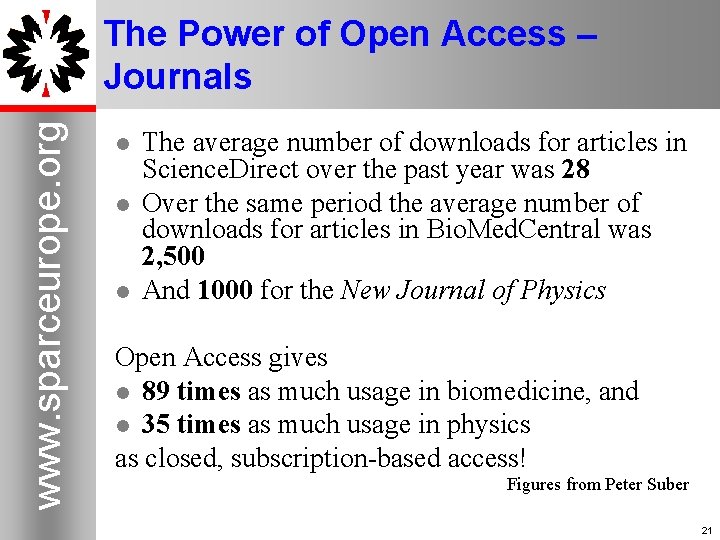
www. sparceurope. org The Power of Open Access – Journals l l l The average number of downloads for articles in Science. Direct over the past year was 28 Over the same period the average number of downloads for articles in Bio. Med. Central was 2, 500 And 1000 for the New Journal of Physics Open Access gives l 89 times as much usage in biomedicine, and l 35 times as much usage in physics as closed, subscription-based access! Figures from Peter Suber 21 21
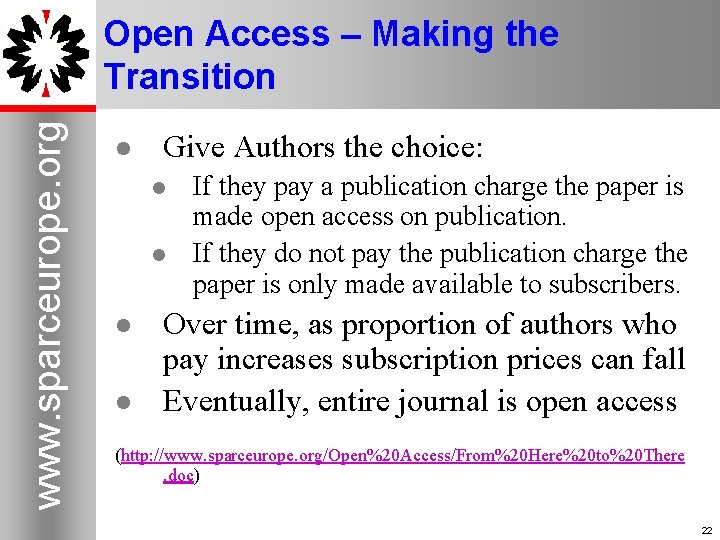
www. sparceurope. org Open Access – Making the Transition l Give Authors the choice: l l If they pay a publication charge the paper is made open access on publication. If they do not pay the publication charge the paper is only made available to subscribers. Over time, as proportion of authors who pay increases subscription prices can fall Eventually, entire journal is open access (http: //www. sparceurope. org/Open%20 Access/From%20 Here%20 to%20 There. doc) 22 22
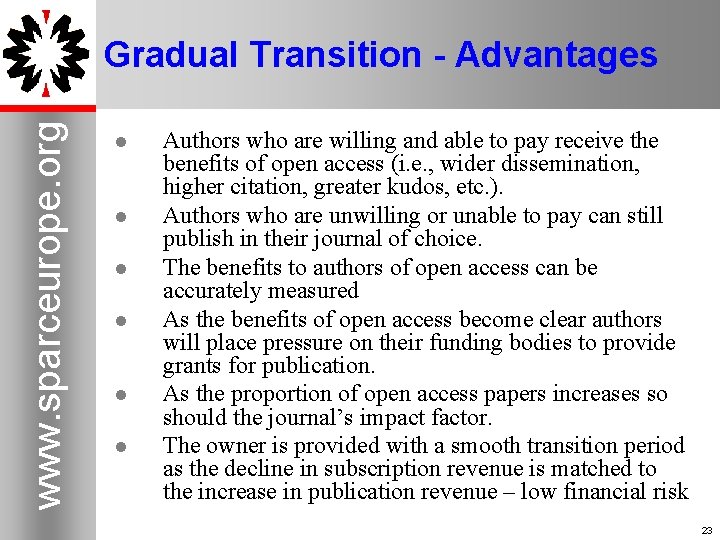
www. sparceurope. org Gradual Transition - Advantages l l l Authors who are willing and able to pay receive the benefits of open access (i. e. , wider dissemination, higher citation, greater kudos, etc. ). Authors who are unwilling or unable to pay can still publish in their journal of choice. The benefits to authors of open access can be accurately measured As the benefits of open access become clear authors will place pressure on their funding bodies to provide grants for publication. As the proportion of open access papers increases so should the journal’s impact factor. The owner is provided with a smooth transition period as the decline in subscription revenue is matched to the increase in publication revenue – low financial risk 23 23
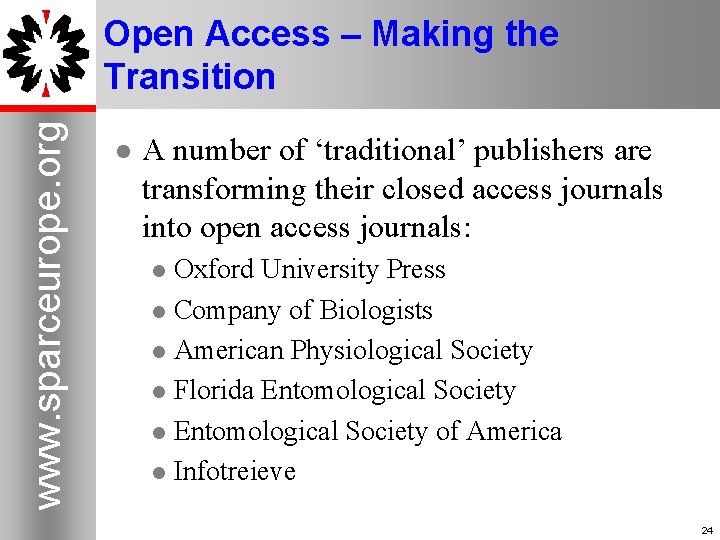
www. sparceurope. org Open Access – Making the Transition l A number of ‘traditional’ publishers are transforming their closed access journals into open access journals: Oxford University Press l Company of Biologists l American Physiological Society l Florida Entomological Society l Entomological Society of America l Infotreieve l 24 24
www. sparceurope. org Practical issues Impediment to formal publication? l Trend for publishers to accept that online posting is not prior publication l Develop discipline-specific policies Intellectual property issues l Repository registration protects priority l Retain rights to e-print l http: //www. lboro. ac. uk/departments/disresea rch/romeo/index. html l No more plagiarism online than offline 25 25
www. sparceurope. org Practical issues Perceived quality l Label & differentiate types of content l Reveal certification methods Rewarding faculty participation l Should institutions reward registration in institutional repository? l Should funding agencies reward institutions and scholars for registration in institutional repositories? 26 26
www. sparceurope. org What Libraries Can Do Self-archiving: l l Maintain institutional repository. Help faculty deposit their research papers, new & old, digitizing if necessary. Open-access journals: l l Help open access journals launched at your institution become known to other libraries, indexing services, potential funders, and potential readers. Make sure scholars at your institution know how to find open access journals and archives in their fields. Set up tools to allow them to access these. 27 27
www. sparceurope. org What Libraries Can Do l l l Support open access journal ‘institutional memberships’ (e. g. Bio. Med. Central) As open access journals proliferate, and as their usage and impact grow, cancel over-priced journals that do not measure up (e. g. Oldenburg, Cornell, University of California) Engage with University administrators and funding bodies to raise the issue of open access Familiarize yourself with the issues – see Create Change at <www. createchange. org>. Support SPARC Europe to multiply your effort. 28 28
www. sparceurope. org What Academics Can Do 29 l l l l Deposit papers in local repository Check Project Ro. MEO page for publishers’ attitudes to self-archiving http: //www. lboro. ac. uk/departments/disresearch/rom eo/index. html Support open access journals, by submitting and reviewing papers, reading and citing articles Launch new open access journals if appropriate If an Editor or Board member discuss publication rights, open access, and reasonable prices with their publisher Discuss with funding bodies and university administrators funding and promotion criteria – ensure that faculty are not penalized for using repositories or publishing in open access journals Lobby funding bodies for specific publication funds 29
www. sparceurope. org Theory Into Practice - Building Momentum l l l Increasing numbers of libraries are taking on role of hosts for institutional repositories Increasing library resistance to the old models (subscriptions, big deals, etc. ) More open access journals proving the feasibility of the business model Open access journals are attracting quality authors, editors, and readers Increasing awareness of authors of need to retain their publishing rights 30 30
www. sparceurope. org Theory Into Practice - Building Momentum (Cont. ) l l l Increasing awareness of Editors and Editorial Board members of their power and responsibilities Increasing awareness amongst funding bodies of publishing issues Increasing awareness at the political level of scholarly communication issues Entry level for new players reduced Membership of SPARC Europe increasing The benefits to authors are becoming apparent 31 31
www. sparceurope. org Open Access – Appealing to All the Major Stakeholders l l l l To the funders of researcher – both as a public service and as an increased return on their investment in research To the authors – as it gives wider dissemination and impact To readers – as it gives them access to all primary literature, making the most important ‘research tool’ more powerful To editors and reviewers – as they feel their work is more valued To the libraries – as it allows them to meet the information needs of their users To the institutions – as it increases their presence and prestige To small and society publishers – as it gives them a survival strategy and fits with their central remit of serving their communities 32 32
www. sparceurope. org Create Change! 33 “Although the battle is being fought over subscription prices, what is really at stake. . . is the scientific process itself. ” New York Times, Dec. 8, 1998 “ An old tradition and a new technology have converged to make possible an unprecedented public good. ” Budapest Open Access Initiative, Feb. 14, 2002 Contact SPARC Europe: david. prosser@bodley. ox. ac. uk 33
- Slides: 33