
Scholarly Communication as a Tool for Social Justice
- Slides: 34
Scholarly Communication as a Tool for Social Justice and Diversity Emily Drabinski, Coordinator of Library Instruction, Long Island University Brooklyn @edrabinski Harrison W. Inefuku, Digital Repository Coordinator, Iowa State University @hnltraveler Charlotte Roh, Scholarly Communications Librarian, University of San Francisco @charlotterock National Diversity in Libraries Conference University of California, Los Angeles #NDLC 16
Making Content and Containers: Perspectives from an Editor Emily Drabinski Coordinator of Library Instruction, Long Island University, Brooklyn emily. drabinski@liu. edu http: //www. emilydrabinski. com @edrabinski
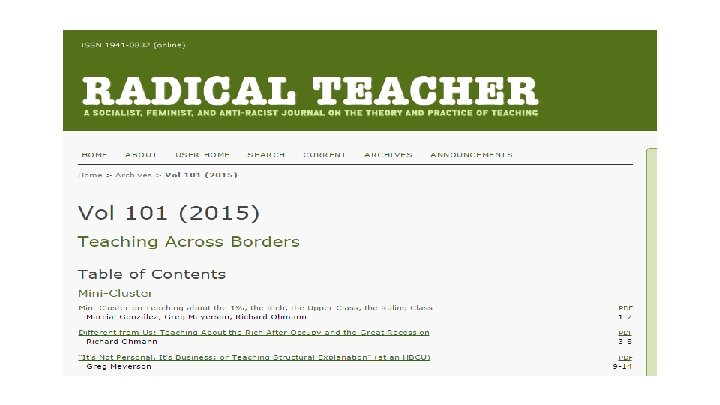
What kinds of thing do I make? I edit a book series, Gender & Sexuality in Information Studies, for Library Juice Press/Litwin Books I work on the Journal of Critical Library and Information Studies, a new open access journal from Library Juice Press I am a member of the editorial board of Radical Teacher, a journal of socialist, feminist, and anti-racist teaching I organize the biennial Gender & Sexuality in Information Studies colloquium I spend a lot of time making structural space for the kinds of scholarship and discourse I see missing from the library field.
Leonard inserting his first title.
Leonard, after we learned how to format pull quotes.
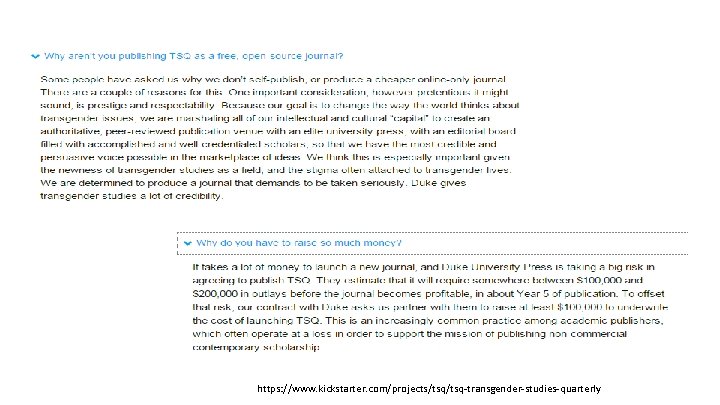
https: //www. kickstarter. com/projects/tsq-transgender-studies-quarterly
Community, Hospitality and Transformation in Social Justice Publishing Harrison W. Inefuku Digital Repository Coordinator, Iowa State University http: //works. bepress. com/hinefuku @hnltraveler
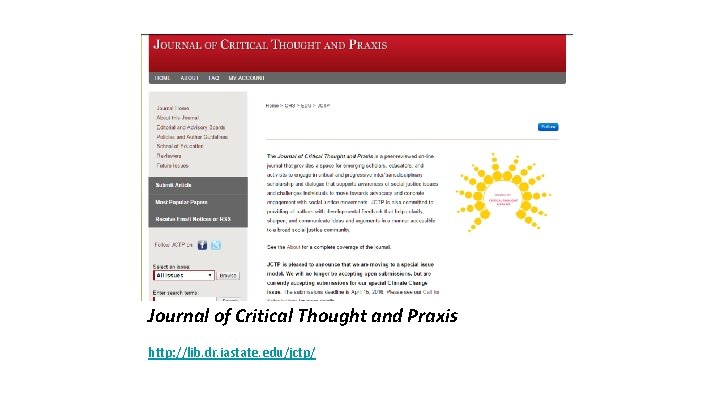
Journal of Critical Thought and Praxis http: //lib. dr. iastate. edu/jctp/
“Our journal is an act of activism; there is no current accessible space for us; our messages won’t be neutral; we are about critical scholarship”
The journal aims to create a community for social justice scholars, as transdisciplinary researchers can be isolated in academia.
“What makes us unique is the fact that we are developmentally aiding emerging scholars; we are also open to unique and transdisciplinary work. ”
The journal is grounded in hospitality to a diversity of voices, including emerging scholars, activists and practitioners.
“If the academy doesn’t change, we will change the academy. ” –Cristobal Salinas, Jr.
How transformational is library publishing?
Inequalities in Publishing Charlotte Roh Scholarly Communications Librarian, University of San Francisco @Charlotte. Rock croh@usfca. edu https: //works. bepress. com/charlotteroh/ Note to self: Don’t forget to mention scholarly communication + social justice book proposal.
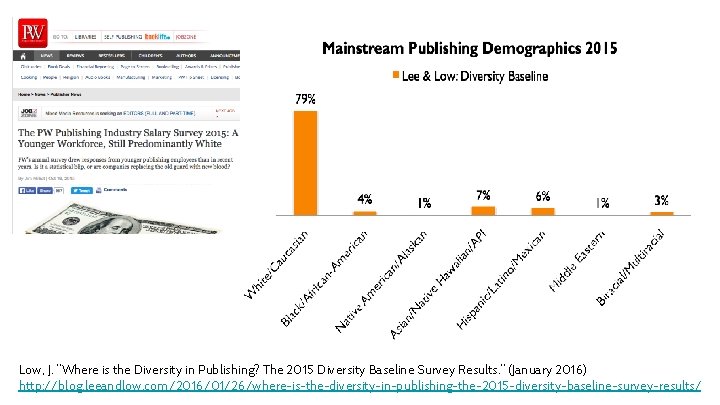
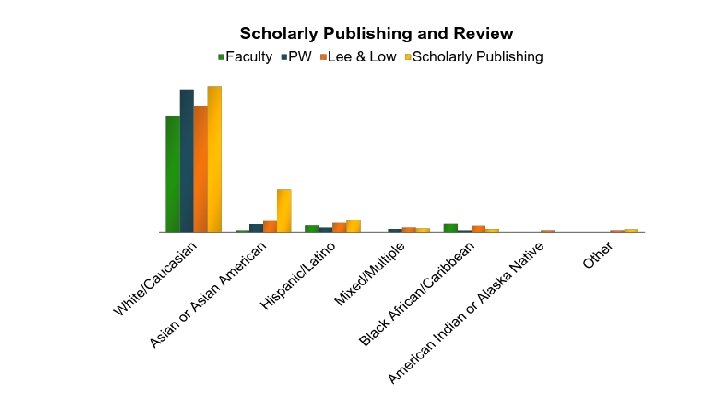
Low, J. “Where is the Diversity in Publishing? The 2015 Diversity Baseline Survey Results. ” (January 2016) http: //blog. leeandlow. com/2016/01/26/where-is-the-diversity-in-publishing-the-2015 -diversity-baseline-survey-results/
Why does this matter? “The dearth of minority employees directly affects the types of books that are published, industry members agreed, and for this issue to be addressed, there needs to be more advocates for books involving people of color throughout the business, including in management, editorial, and marketing executives in publishing houses, as well as among booksellers and librarians. ” - Milliot, J. “Publishing’s Holding Pattern: 2014 Salary Survey” (2014). Publisher’s Weekly. http: //www. publishersweekly. com/pw/by-topic/industry-news/publisher-news/article/64083 publishing-s-holding-pattern-2013 -salary-survey. html
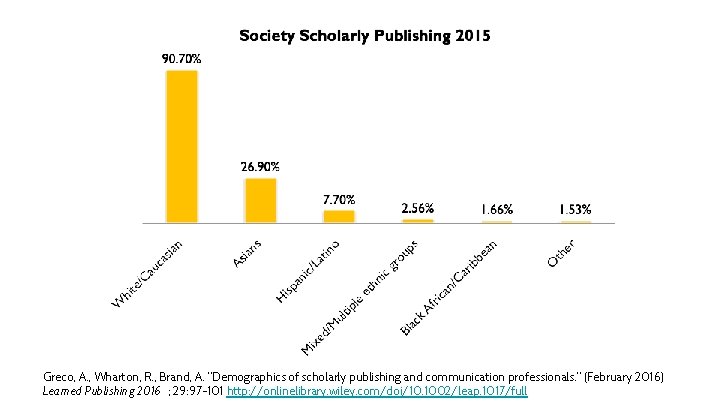
Greco, A. , Wharton, R. , Brand, A. “Demographics of scholarly publishing and communication professionals. ” (February 2016) Learned Publishing 2016 ; 29: 97 -101 http: //onlinelibrary. wiley. com/doi/10. 1002/leap. 1017/full
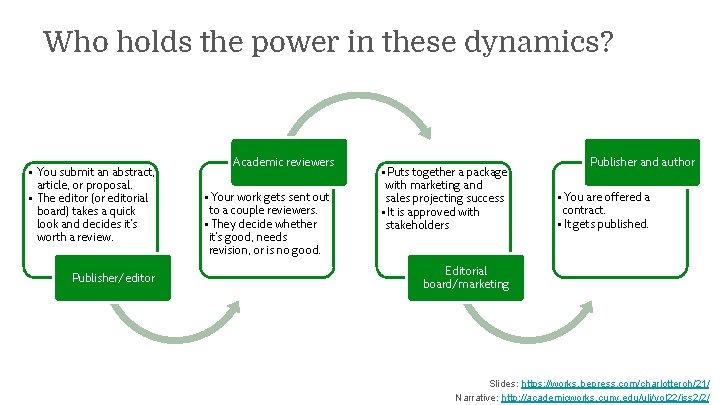
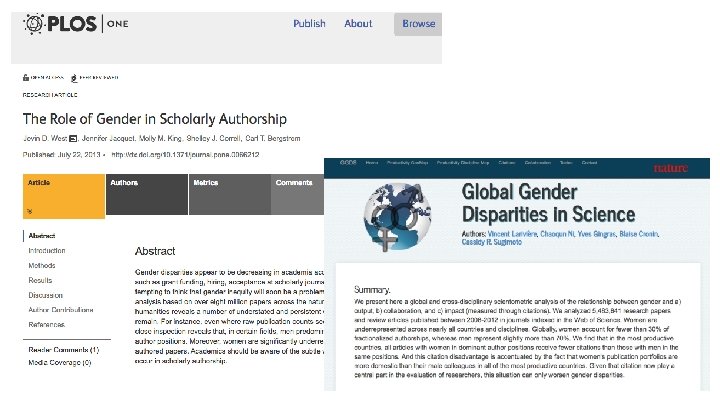
Who holds the power in these dynamics? • You submit an abstract, article, or proposal. • The editor (or editorial board) takes a quick look and decides it’s worth a review. Publisher/editor Academic reviewers • Your work gets sent out to a couple reviewers. • They decide whether it’s good, needs revision, or is no good. • Puts together a package with marketing and sales projecting success • It is approved with stakeholders Publisher and author • You are offered a contract. • It gets published. Editorial board/marketing Slides: https: //works. bepress. com/charlotteroh/21/ Narrative: http: //academicworks. cuny. edu/ulj/vol 22/iss 2/2/
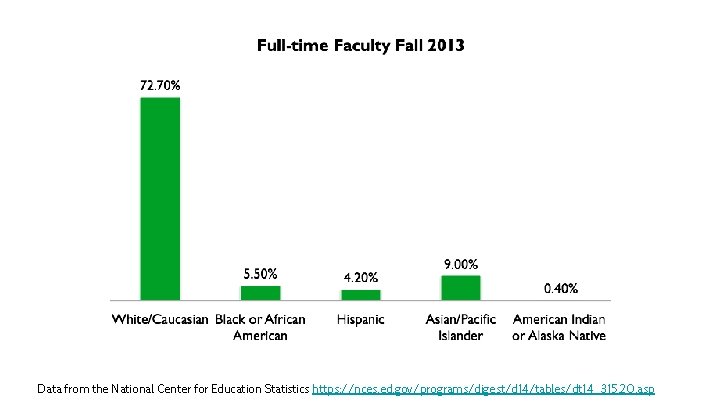
Data from the National Center for Education Statistics https: //nces. ed. gov/programs/digest/d 14/tables/dt 14_315. 20. asp
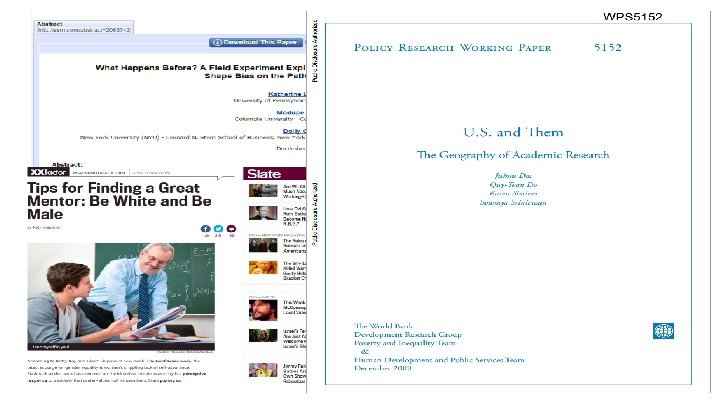
Who are the expert reviewers? More distressingly, contingent academic labor is gendered and raced. Bousquet notes that “the typical faculty member has become a female nontenurable part-timer earning a few thousand dollars a year without health benefits. ” Women still make up the majority of contingent faculty. According to Vitae’s new Job. Tracker, 61 percent of available tenure-track jobs in 2013 -14 went to men. Bousquet points out that nontenurable faculty and nonteaching staff are more likely to “identify themselves as belonging to an ethnic or racial minority than tenure stream faculty. ” Baker, K. (2016, February 23). Academic Waste. Retrieved May 11, 2016, from https: //chroniclevitae. com/news/1301 -academic-waste
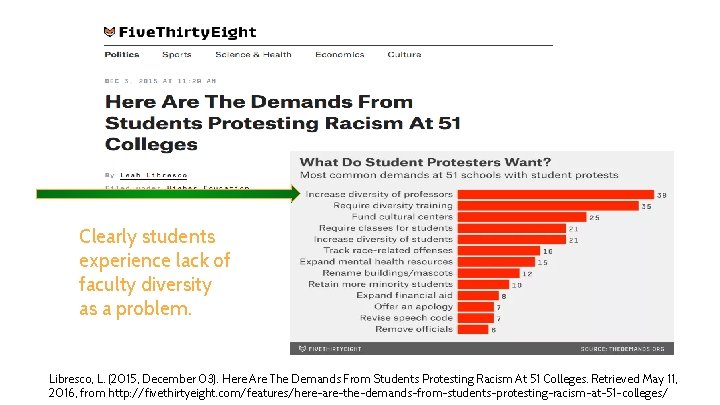
Clearly students experience lack of faculty diversity as a problem. Libresco, L. (2015, December 03). Here Are The Demands From Students Protesting Racism At 51 Colleges. Retrieved May 11, 2016, from http: //fivethirtyeight. com/features/here-are-the-demands-from-students-protesting-racism-at-51 -colleges/
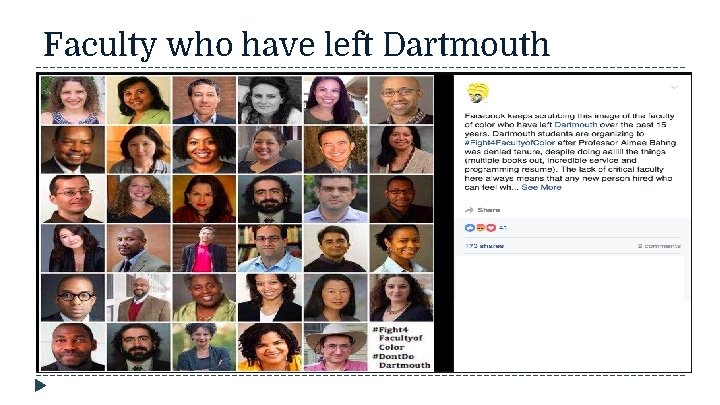
Faculty who have left Dartmouth
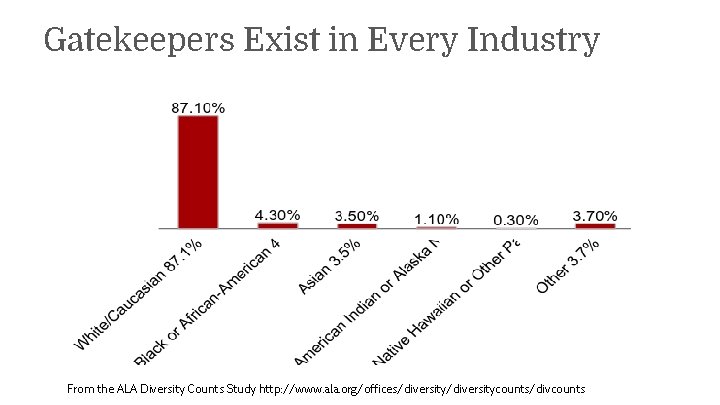
Gatekeepers Exist in Every Industry From the ALA Diversity Counts Study http: //www. ala. org/offices/diversitycounts/divcounts
Scholarly communication is systemically flawed, like everything else. HOW DO WE SOLVE THE PROBLEM?
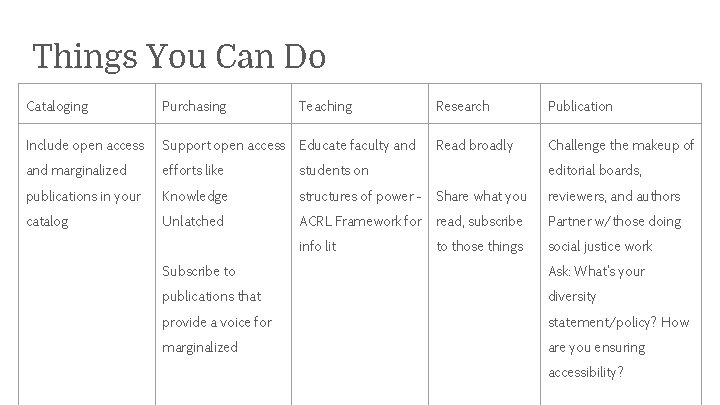
Things You Can Do Cataloging Purchasing Teaching Research Publication Include open access Support open access Educate faculty and Read broadly Challenge the makeup of and marginalized efforts like students on editorial boards, publications in your Knowledge structures of power - Share what you reviewers, and authors catalog Unlatched ACRL Framework for read, subscribe Partner w/those doing info lit to those things social justice work Subscribe to Ask: What’s your publications that diversity provide a voice for statement/policy? How marginalized are you ensuring accessibility?
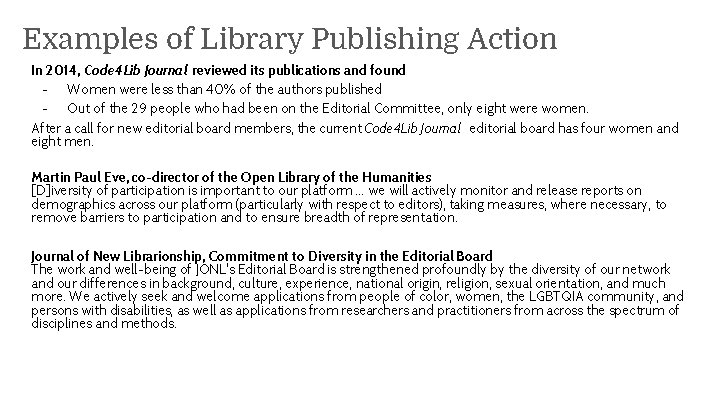
Examples of Library Publishing Action In 2014, Code 4 Lib Journal reviewed its publications and found - Women were less than 40% of the authors published - Out of the 29 people who had been on the Editorial Committee, only eight were women. After a call for new editorial board members, the current Code 4 Lib Journal editorial board has four women and eight men. Martin Paul Eve, co-director of the Open Library of the Humanities [D]iversity of participation is important to our platform … we will actively monitor and release reports on demographics across our platform (particularly with respect to editors), taking measures, where necessary, to remove barriers to participation and to ensure breadth of representation. Journal of New Librarionship, Commitment to Diversity in the Editorial Board The work and well-being of JONL's Editorial Board is strengthened profoundly by the diversity of our network and our differences in background, culture, experience, national origin, religion, sexual orientation, and much more. We actively seek and welcome applications from people of color, women, the LGBTQIA community, and persons with disabilities, as well as applications from researchers and practitioners from across the spectrum of disciplines and methods.
Questions?
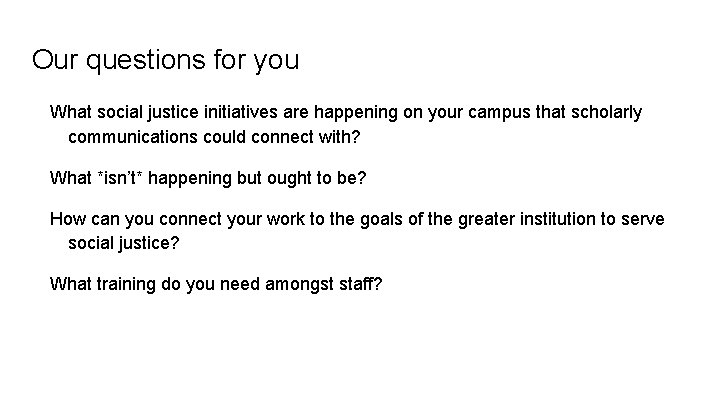
Our questions for you What social justice initiatives are happening on your campus that scholarly communications could connect with? What *isn’t* happening but ought to be? How can you connect your work to the goals of the greater institution to serve social justice? What training do you need amongst staff?