
Schlieren Apparatus for Transparent Gas Flow Visualization Bradley
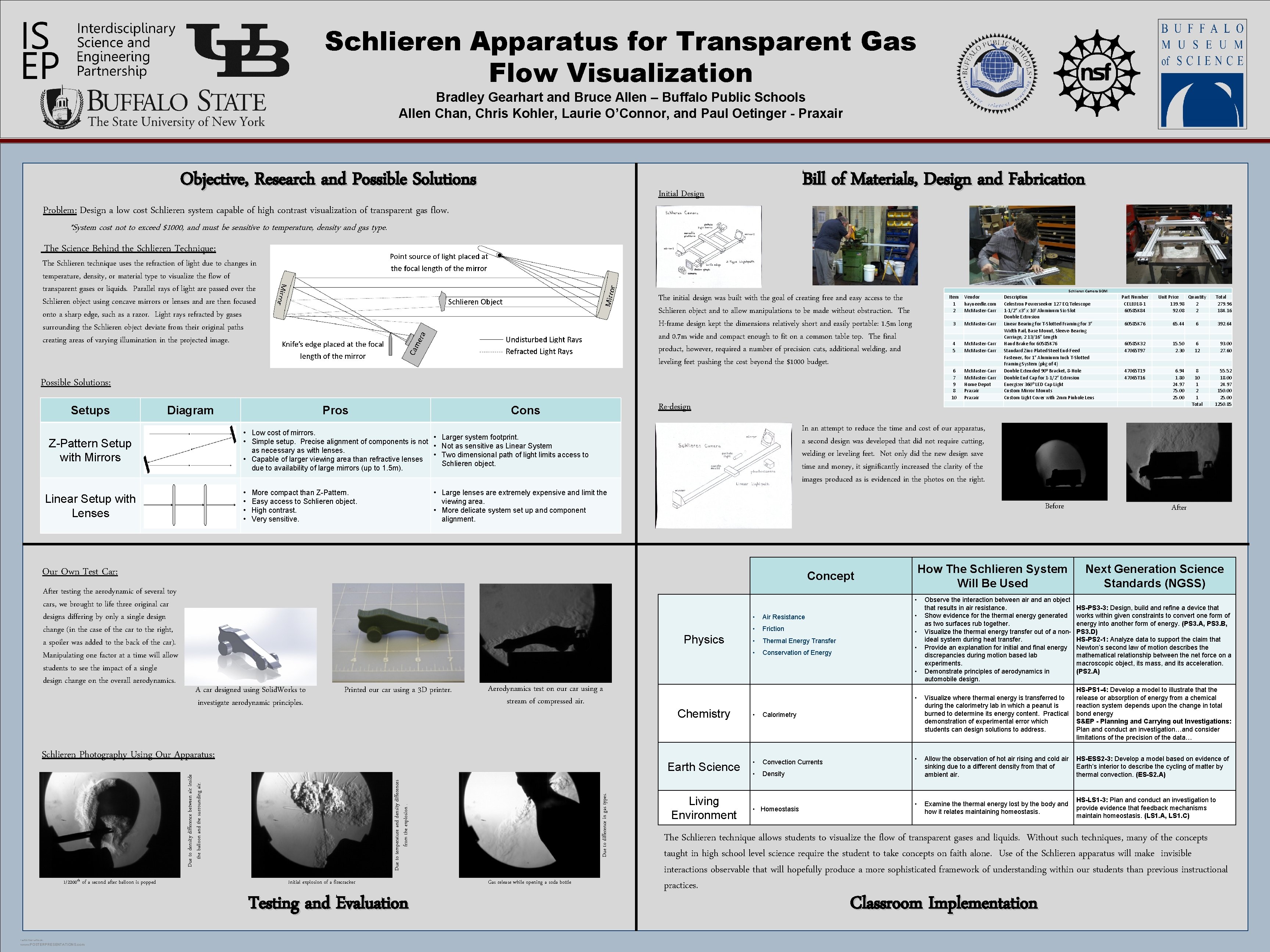
Schlieren Apparatus for Transparent Gas Flow Visualization Bradley Gearhart and Bruce Allen – Buffalo Public Schools Allen Chan, Chris Kohler, Laurie O’Connor, and Paul Oetinger - Praxair Objective, Research and Possible Solutions Bill of Materials, Design and Fabrication Initial Design Problem: Design a low cost Schlieren system capable of high contrast visualization of transparent gas flow. *System cost not to exceed $1000, and must be sensitive to temperature, density and gas type. The Science Behind the Schlieren Technique: The Schlieren technique uses the refraction of light due to changes in temperature, density, or material type to visualize the flow of transparent gases or liquids. Parallel rays of light are passed over the Schlieren object using concave mirrors or lenses and are then focused onto a sharp edge, such as a razor. Light rays refracted by gases surrounding the Schlieren object deviate from their original paths creating areas of varying illumination in the projected image. Schlieren Camera BOM The initial design was built with the goal of creating free and easy access to the Schlieren object and to allow manipulations to be made without obstruction. The H-frame design kept the dimensions relatively short and easily portable: 1. 5 m long and 0. 7 m wide and compact enough to fit on a common table top. The final product, however, required a number of precision cuts, additional welding, and leveling feet pushing the cost beyond the $1000 budget. Possible Solutions: Setups Diagram Pros • • Cons Linear Setup with Lenses • Physics Aerodynamics test on our car using a stream of compressed air. Schlieren Photography Using Our Apparatus: www. POSTERPRESENTATIONS. com Due to difference in gas types. Due to temperature and density differences from the explosion. Initial explosion of a firecracker Testing and Evaluation POSTER TEMPLATES BY: Chemistry Earth Science Due to density difference between air inside the balloon and the surrounding air. 1/2200 th of a second after balloon is popped Gas release while opening a soda bottle Mc. Master-Carr 6 7 9 8 10 Mc. Master-Carr Home Depot Praxair Part Number CELE 018 -1 60585 K 84 Unit Price Quantity 139. 98 2 92. 08 2 Total 279. 96 184. 16 60585 K 76 65. 44 6 392. 64 60585 K 32 47065 T 97 15. 50 2. 30 6 12 93. 00 27. 60 47065 T 19 47065 T 16 6. 94 1. 80 24. 97 75. 00 25. 00 8 10 1 2 1 Total 55. 52 18. 00 24. 97 150. 00 25. 00 1250. 85 • Visualize where thermal energy is transferred to during the calorimetry lab in which a peanut is burned to determine its energy content. Practical demonstration of experimental error which students can design solutions to address. HS-PS 1 -4: Develop a model to illustrate that the release or absorption of energy from a chemical reaction system depends upon the change in total bond energy S&EP - Planning and Carrying out Investigations: Plan and conduct an investigation…and consider limitations of the precision of the data… • Allow the observation of hot air rising and cold air sinking due to a different density from that of ambient air. HS-ESS 2 -3: Develop a model based on evidence of Earth’s interior to describe the cycling of matter by thermal convection. (ES-S 2. A) • Examine thermal energy lost by the body and how it relates maintaining homeostasis. HS-LS 1 -3: Plan and conduct an investigation to provide evidence that feedback mechanisms maintain homeostasis. (LS 1. A, LS 1. C) Air Resistance • • Friction • • Thermal Energy Transfer • Conservation of Energy Living Environment Calorimetry • Convection Currents • Density • Homeostasis Next Generation Science Standards (NGSS) HS-PS 3 -3: Design, build and refine a device that works within given constraints to convert one form of energy into another form of energy. (PS 3. A, PS 3. B, PS 3. D) HS-PS 2 -1: Analyze data to support the claim that Newton’s second law of motion describes the mathematical relationship between the net force on a macroscopic object, its mass, and its acceleration. (PS 2. A) • • After Observe the interaction between air and an object that results in air resistance. Show evidence for thermal energy generated as two surfaces rub together. Visualize thermal energy transfer out of a nonideal system during heat transfer. Provide an explanation for initial and final energy discrepancies during motion based lab experiments. Demonstrate principles of aerodynamics in automobile design. • • Printed our car using a 3 D printer. 4 5 How The Schlieren System Will Be Used Concept A car designed using Solid. Works to investigate aerodynamic principles. Mc. Master-Carr Before Our Own Test Car: After testing the aerodynamic of several toy cars, we brought to life three original car designs differing by only a single design change (in the case of the car to the right, a spoiler was added to the back of the car). Manipulating one factor at a time will allow students to see the impact of a single design change on the overall aerodynamics. 3 Description Celestron Powerseeker 127 EQ Telescope 1 -1/2" x 3" x 10' Aluminum Six-Slot Double Extrusion Linear Bearing for T-Slotted Framing for 3" Width Rail, Base Mount, Sleeve-Bearing Carriage, 2 13/16" Length Hand Brake for 60585 K 76 Standard Zinc-Plated Steel End-Feed Fastener, for 1" Aluminum Inch T-Slotted Framing System (pkg of 4) Double Extended 900 Bracket, 8 -Hole Double End Cap for 1 -1/2" Extrusion Energizer 3600 LED Cap Light Custom Mirror Mounts Custom Light Cover with 2 mm Pinhole Lens In an attempt to reduce the time and cost of our apparatus, a second design was developed that did not require cutting, welding or leveling feet. Not only did the new design save time and money, it significantly increased the clarity of the images produced as is evidenced in the photos on the right. • Large lenses are extremely expensive and limit the viewing area. • More delicate system set up and component alignment. More compact than Z-Pattern. Easy access to Schlieren object. High contrast. Very sensitive. Vendor hayneedle. com Mc. Master-Carr Re-design • Low cost of mirrors. • Larger system footprint. • Simple setup. Precise alignment of components is not • Not as sensitive as Linear System as necessary as with lenses. • Two dimensional path of light limits access to • Capable of larger viewing area than refractive lenses Schlieren object. due to availability of large mirrors (up to 1. 5 m). Z-Pattern Setup with Mirrors Item 1 2 The Schlieren technique allows students to visualize the flow of transparent gases and liquids. Without such techniques, many of the concepts taught in high school level science require the student to take concepts on faith alone. Use of the Schlieren apparatus will make invisible interactions observable that will hopefully produce a more sophisticated framework of understanding within our students than previous instructional practices. Classroom Implementation
- Slides: 1