
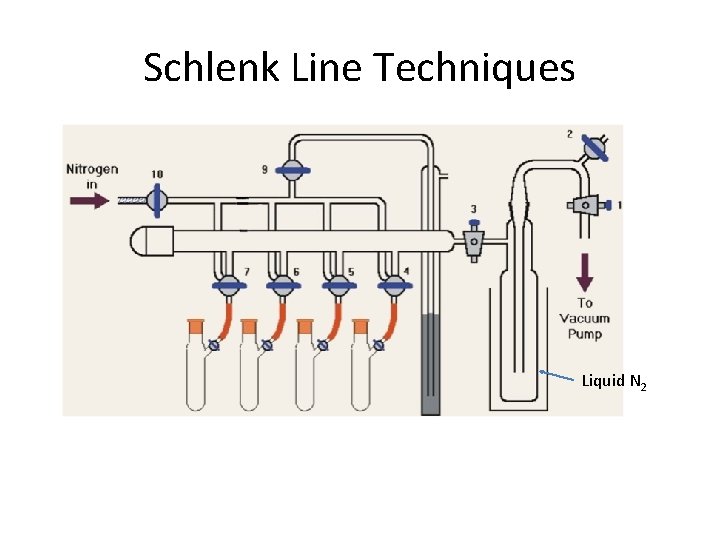
Schlenk Line Techniques Liquid N 2 Dangers GLASS

- Slides: 15
Schlenk Line Techniques Liquid N 2
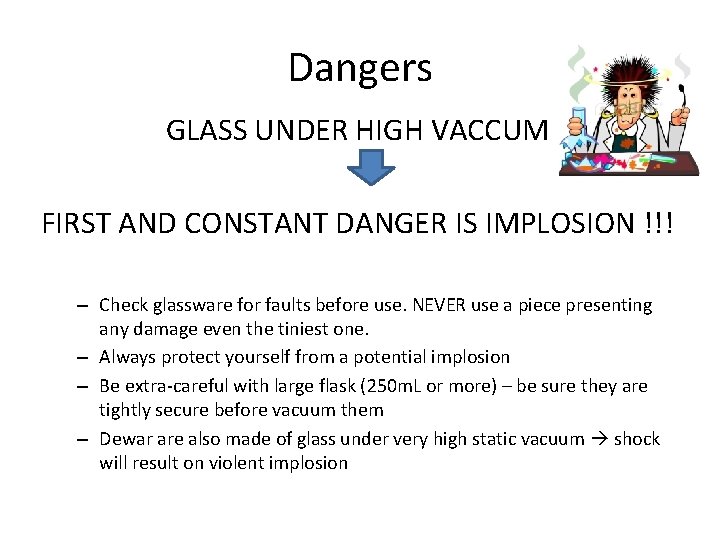
Dangers GLASS UNDER HIGH VACCUM FIRST AND CONSTANT DANGER IS IMPLOSION !!! – Check glassware for faults before use. NEVER use a piece presenting any damage even the tiniest one. – Always protect yourself from a potential implosion – Be extra-careful with large flask (250 m. L or more) – be sure they are tightly secure before vacuum them – Dewar are also made of glass under very high static vacuum shock will result on violent implosion
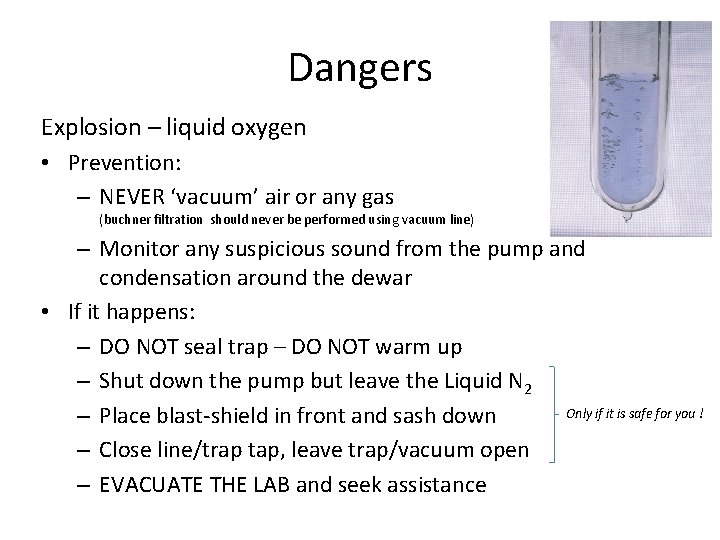
Dangers Explosion – liquid oxygen • Prevention: – NEVER ‘vacuum’ air or any gas (buchner filtration should never be performed using vacuum line) – Monitor any suspicious sound from the pump and condensation around the dewar • If it happens: – DO NOT seal trap – DO NOT warm up – Shut down the pump but leave the Liquid N 2 Only if it is safe for you ! – Place blast-shield in front and sash down – Close line/trap tap, leave trap/vacuum open – EVACUATE THE LAB and seek assistance
Dangers 2 Explosion – Nitrogen pressure – Always be aware of your working pressure – Do not use more than 100 -200 mbar – Be always sure of where the flow goes (= bubbler monitoring) – In general - do NOT heat a sealed system (never with Et 2 O / DCM) – Do not close (entirely) your bubbler – Check regularly your set-up for loose parts.
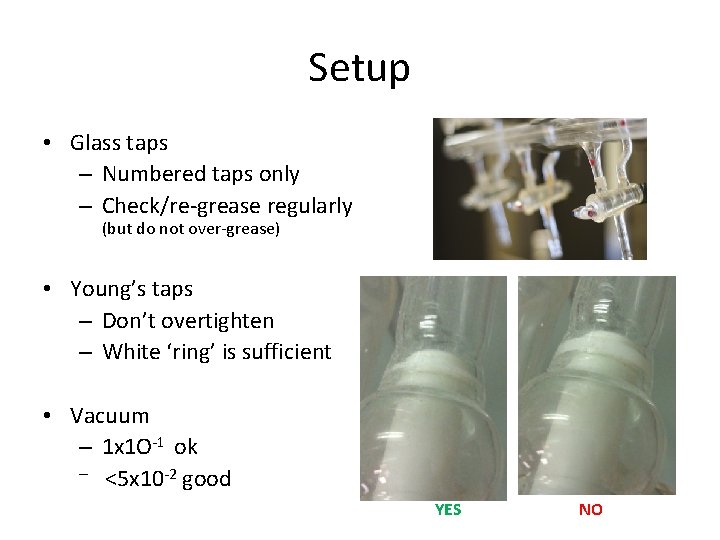
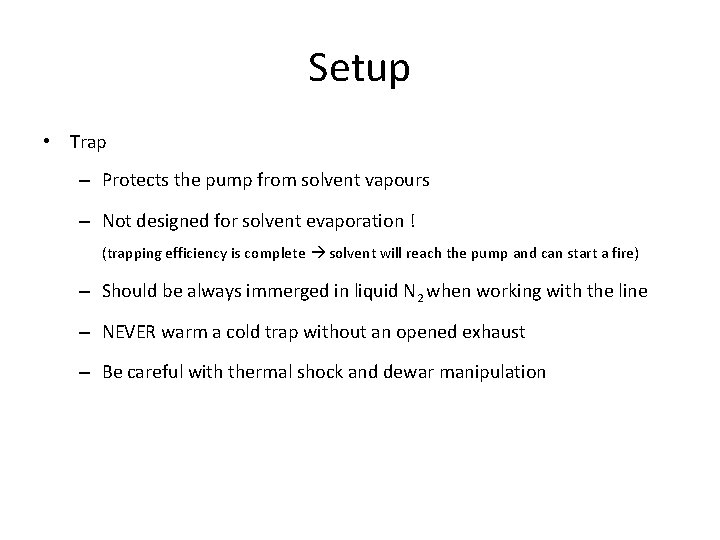
Setup • Glass taps – Numbered taps only – Check/re-grease regularly (but do not over-grease) • Young’s taps – Don’t overtighten – White ‘ring’ is sufficient • Vacuum – 1 x 1 O-1 ok – <5 x 10 -2 good YES NO
Setup • Trap – Protects the pump from solvent vapours – Not designed for solvent evaporation ! (trapping efficiency is complete solvent will reach the pump and can start a fire) – Should be always immerged in liquid N 2 when working with the line – NEVER warm a cold trap without an opened exhaust – Be careful with thermal shock and dewar manipulation
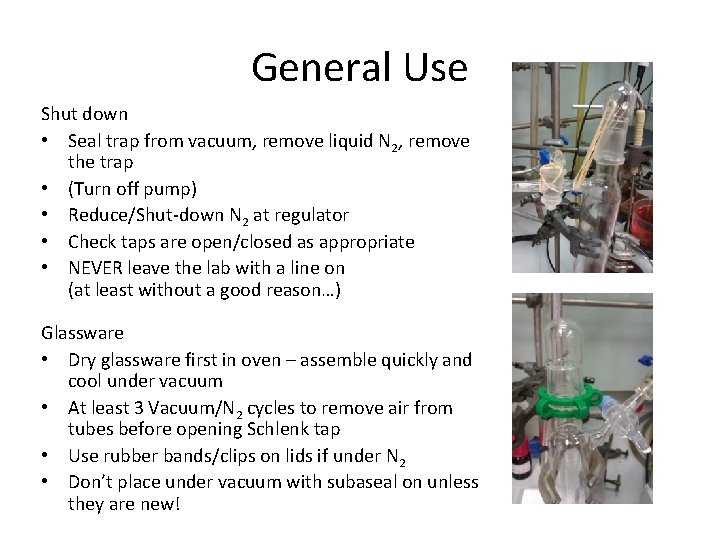
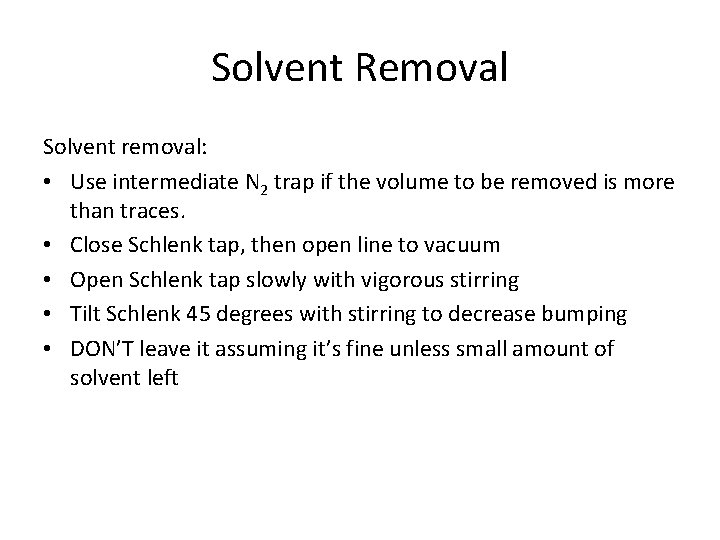
General Use Shut down • Seal trap from vacuum, remove liquid N 2, remove the trap • (Turn off pump) • Reduce/Shut-down N 2 at regulator • Check taps are open/closed as appropriate • NEVER leave the lab with a line on (at least without a good reason…) Glassware • Dry glassware first in oven – assemble quickly and cool under vacuum • At least 3 Vacuum/N 2 cycles to remove air from tubes before opening Schlenk tap • Use rubber bands/clips on lids if under N 2 • Don’t place under vacuum with subaseal on unless they are new!
Solvent Removal Solvent removal: • Use intermediate N 2 trap if the volume to be removed is more than traces. • Close Schlenk tap, then open line to vacuum • Open Schlenk tap slowly with vigorous stirring • Tilt Schlenk 45 degrees with stirring to decrease bumping • DON’T leave it assuming it’s fine unless small amount of solvent left
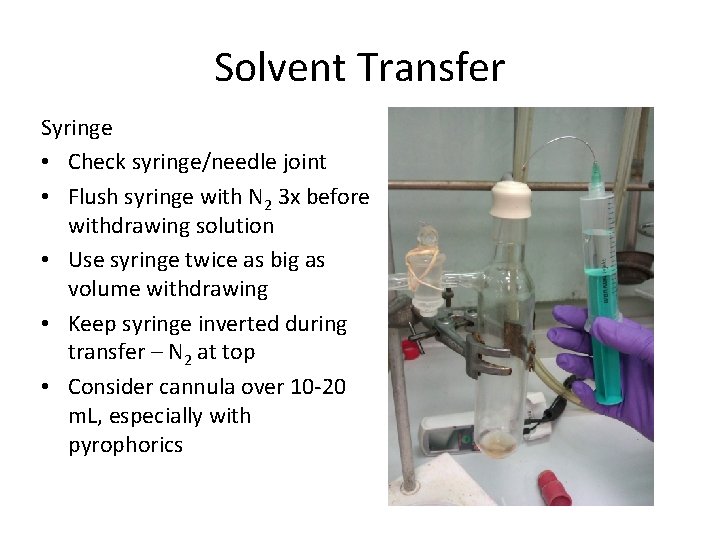
Solvent Transfer Syringe • Check syringe/needle joint • Flush syringe with N 2 3 x before withdrawing solution • Use syringe twice as big as volume withdrawing • Keep syringe inverted during transfer – N 2 at top • Consider cannula over 10 -20 m. L, especially with pyrophorics
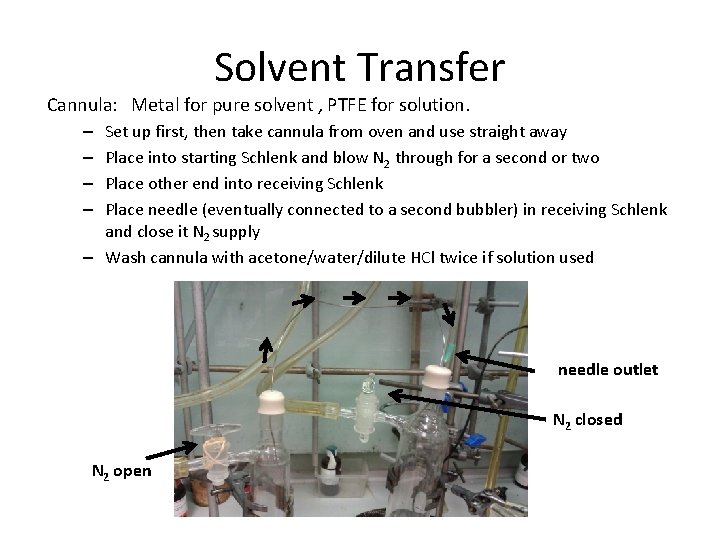
Solvent Transfer Cannula: Metal for pure solvent , PTFE for solution. Set up first, then take cannula from oven and use straight away Place into starting Schlenk and blow N 2 through for a second or two Place other end into receiving Schlenk Place needle (eventually connected to a second bubbler) in receiving Schlenk and close it N 2 supply – Wash cannula with acetone/water/dilute HCl twice if solution used – – needle outlet N 2 closed N 2 open
Solvent Transfer Cannula transfer from sureseal to ampoule – Pierce sureseal with needle connected to N 2 line – Cut off syringe end and place in tubing to do this – Carry out cannula transfer as described before – Use measuring ampoule if volumes important
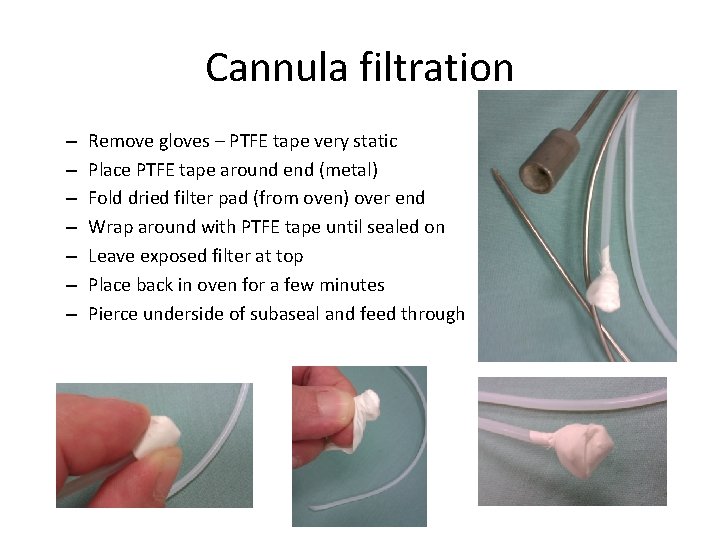
Cannula filtration – – – – Remove gloves – PTFE tape very static Place PTFE tape around end (metal) Fold dried filter pad (from oven) over end Wrap around with PTFE tape until sealed on Leave exposed filter at top Place back in oven for a few minutes Pierce underside of subaseal and feed through
Freeze/Thaw Solvent Degassing Safety - carefully check glassware for cracks - do not fill the ampoule > 60% - ensure that Young’s tap creates an effective seal - use a vacuum gauge - never open the ampoule to argon during freezing General Freeze solvent with liquid N 2 dewar Quickly open/shut vacuum to apply partial vacuum as it is freezing Place under vacuum (monitor with a vacuum gauge to good steady vac) Close vacuum and remove ampoule from liq N 2 – leave tubing under vac and be aware of vac gauge in case of any leak. – Keep the fume cupboard sash lowered as far as possible whilst warming – Repeat x 3 for general needs – Refill with N 2/Ar when at room temperature when finished – –
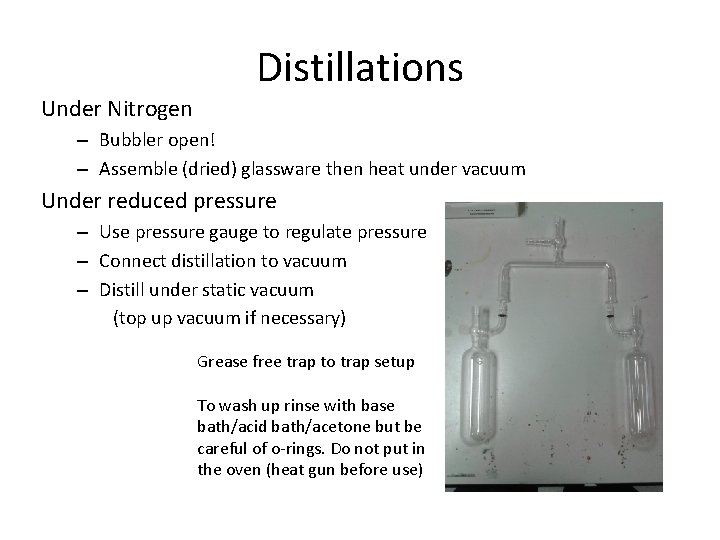
Distillations Under Nitrogen – Bubbler open! – Assemble (dried) glassware then heat under vacuum Under reduced pressure – Use pressure gauge to regulate pressure – Connect distillation to vacuum – Distill under static vacuum (top up vacuum if necessary) Grease free trap to trap setup To wash up rinse with base bath/acid bath/acetone but be careful of o-rings. Do not put in the oven (heat gun before use)
Summary • Check http: //www. stalke. chemie. unigoettingen. de/virtuelles_labor/advanced/en. h tml for videos on most techniques (narrated in German but still easy to follow) • Ask if you aren’t sure!