
Schizophrenia Psychosis Management Dr A C Baldwin Ashley
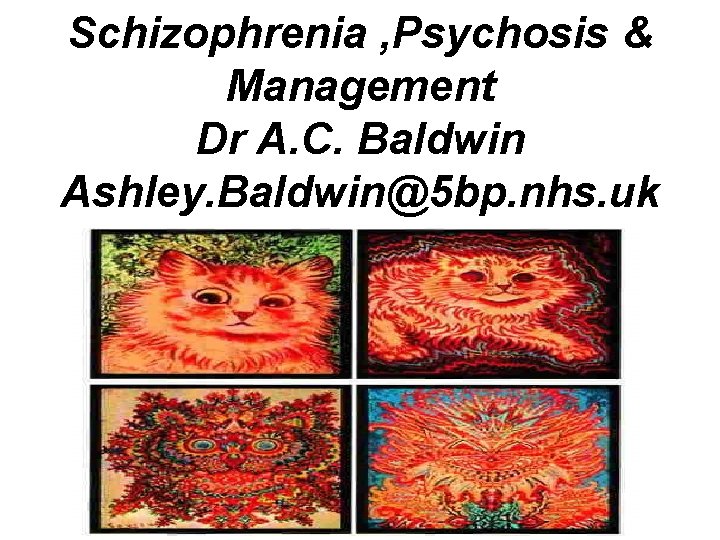
Schizophrenia , Psychosis & Management Dr A. C. Baldwin Ashley. Baldwin@5 bp. nhs. uk
What is Schizophrenia? § Most severe of all adult psychiatric disorders § Interferes with the ability to think, manage emotions, relate to others § A dysconnection syndrome § Abnormalities in information processing
Schizophrenia § A genetic, neurodevelopmental disorder of the cerebral cortex § Substantial biopsychosocial determinants of outcome § Onset in early adult life § Direct costs of health and social care in UK 1998; £ 2. 4 billion
Schizophrenia: The Severe Psychotic Disorder • Chronic, disabling, physical illness i. e. , a severe mental disorder in which thinking , behaviour and emotion are so impaired that the individual is seriously out of contact with reality • Persistent hallucinations, delusions, disordered speech, disorganised or catatonic behaviour • Involves imbalances in dopamine, serotonin, glutamate and gamma-aminobutyric acid (GABA) neurotransmision • Excessive stimulation of dopamine D² in the striatum, deficient stimulation of D¹ in the prefrontal cortex and altered prefrontal connectivity (glutamate)
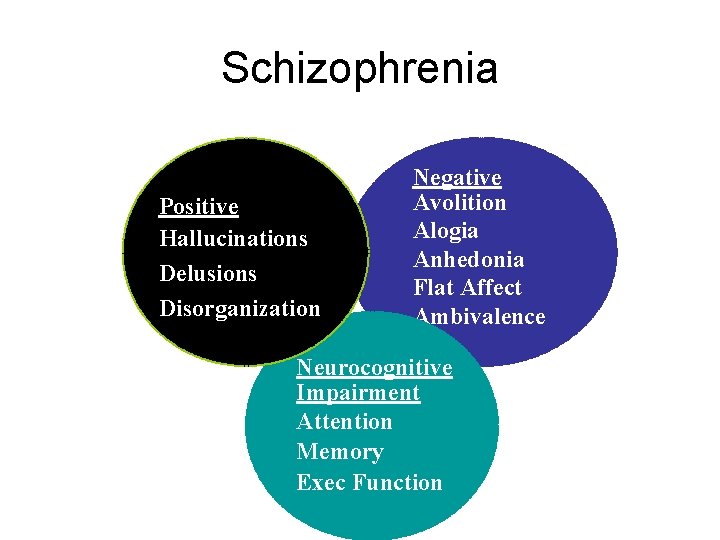
Schizophrenia Positive Hallucinations Delusions Disorganization Negative Avolition Alogia Anhedonia Flat Affect Ambivalence Neurocognitive Impairment Attention Memory Exec Function
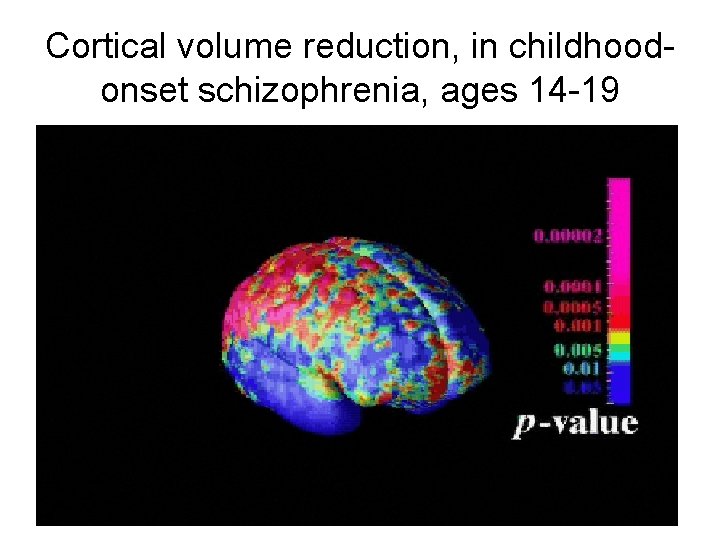
Cortical volume reduction, in childhoodonset schizophrenia, ages 14 -19
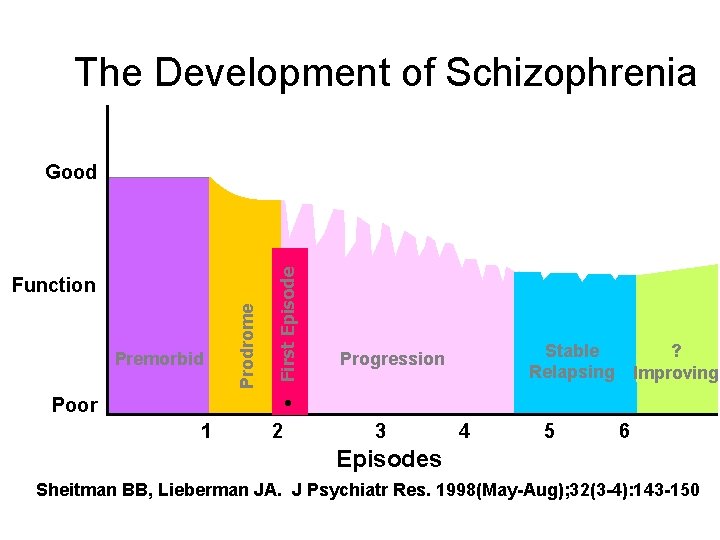
The Development of Schizophrenia Premorbid Poor 1 Prodrome Function • First Episode Good 2 Stable ? Relapsing Improving Progression 3 4 5 6 Episodes Sheitman BB, Lieberman JA. J Psychiatr Res. 1998(May-Aug); 32(3 -4): 143 -150
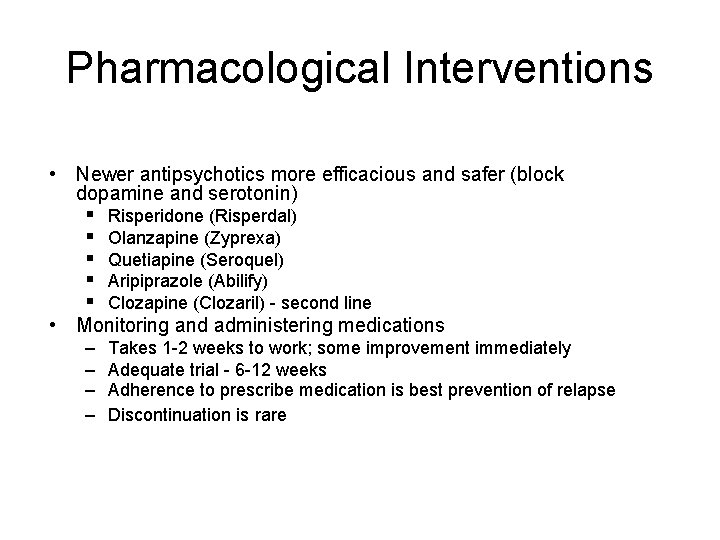
Pharmacological Interventions • Newer antipsychotics more efficacious and safer (block dopamine and serotonin) § Risperidone (Risperdal) § Olanzapine (Zyprexa) § Quetiapine (Seroquel) § Aripiprazole (Abilify) § Clozapine (Clozaril) - second line • Monitoring and administering medications – – Takes 1 -2 weeks to work; some improvement immediately Adequate trial - 6 -12 weeks Adherence to prescribe medication is best prevention of relapse Discontinuation is rare
Choice & Compliance in the Clinical Domain • 20 -30% prescriptions not filed • 50 % patients dont take medication as directed • In total 60% of patients are non compliant
Compliance/Adherence Concordance “The extent and manner to which an individual follows a prescribed cause of action in specific circumstances”
Non Compliance: The Consequences • • • Endangers the well being of patients Wastes (precious) resources Increases Healthcare costs Demoralises Healthcare professionals Leads to clinician/patient conflict



Compliance: What works • • • An Alliance of patients, clinicians and Organisations Emphasises communication & partnership NOT conflict Negotiation “The best workable treatment plan” rather than the ideal Patient is the final arbiter of treatment plan Patients select their own treatment from clinician “advocate” approved menu: Co-equal relationship • Personal experience vs Scientific knowledge • Clinician provides information on outcomes but has “veto” on unreasonable requests • “No treatment” might be best option
Schizophrenia & Rethink • “Rethink”: Drug should be your choice NOT Psychiatrist’s. Patient the expert. • Prepare questions before hand take relative/friend • How does the illness effect you ? • Get the treatment you think suits you best • Don’t be afraid to ask for a second opinion • How to be a patient

Summary • Schizophrenia is an all consuming neurological disorder that also effects: – Thoughts – Feelings – Behaviour • Drug therapy is most common and has – Side effects – Life-long need – Should be negotiated “The patient is the expert” • With current treatments – – About 25% of patients fully recover About 10% have chronic deterioration About 65% have partial recovery REMEMBER COMPLIANCE

Non Compliance • • Not unique/inherent to medicine Is NOT a discrete entity Has multiple causes Seems to be related to individual and personality factors • Past Hx of compliance helpful but avoid of “generalisation” • Beware Paternalism /“Passive Patients” Good, Bad…. Pitiable
Non Compliance • Exists throughout Healthcare affecting 50% patients at any time but : • ALL at risk • Doctors cant spot it • Patients rarely reveal it • Increases treatment failure • Education can work but NOT alone • Motivation to recover not synonymous with motivation to comply • Is NOT a disease ! • Worsened by “ Compliance-driven” physicians
Non Compliance: Management • • • Risk ( everyone) & Recognition Align Patients and Clinicians, Compliance secondary Involve family and community Synchronise the Clinical Organisation Eliminate obstacles to compliance Educate the patient ( to be a patient) Re-educate clinicians ( compliance myths) Clearly communicate instructions Use reminders Target special cases : chronic disorders, high risks/costs


- Slides: 24