
Schistosoma spp By Supervision Prof Dr Magda sanad
Schistosoma spp. By : Supervision : Prof. Dr. Magda sanad Demonstrator : Jawahir alghamdi
Introduction q Unlike all other trematodes, schistosomes are not hermaphroditic but dioecious, forming separate sexes. q The three main species infecting humans are Schistosoma haematobium, Schistosoma mansoni.
Classification of Schistosoma spp. Phylum: Platyhelminthes Class: Trematoda Subclass Digenea Genus &speics: Schistosoma haematobium Schistosoma mansoni.
Transmission q The free swimming infective larval cercariae (forked tail) burrow into human skin when it comes into contact with contaminated water.
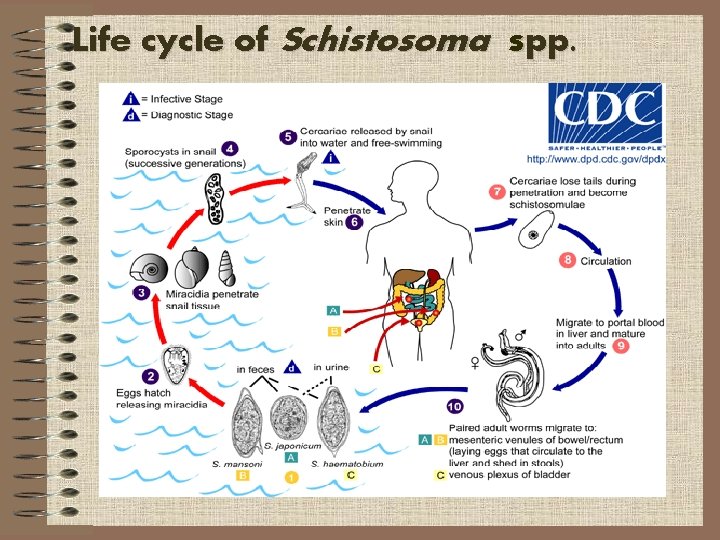
Life cycle of Schistosoma spp.
Life Cycle of Schistosoma spp. cont, q The infective stage for the human → cercaria (forked tail) q Schistosoma Spp. , In the snail (successive generations), the parasites undergo several developmental stages (sporocysts and cercariae ).
Life Cycle of Schistosoma spp. cont, -Eggs are eliminated with feces (S. mansoni ) or urine (S. haematobium). 1 -Eggs of S. mansoni > oval shape + lateral spine. 2 -Egg of S. haematobium >oval shape + terminal spine.
Life Cycle of Schistosoma spp. cont, q Adult worms in humans reside in the mesenteric venules in various locations, which at times seem to be specific for each species. 1 - S. mansoni > in the veins draining the large intestine. 3 - S. haematobium > in the venous of bladder ,
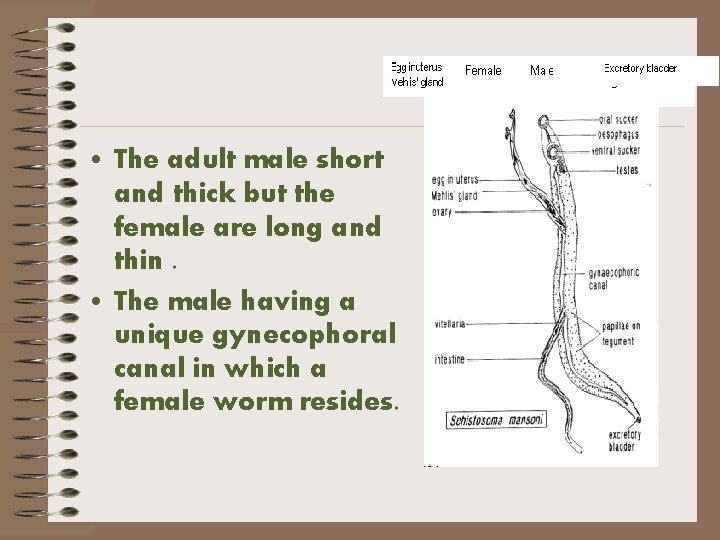
• The adult male short and thick but the female are long and thin. • The male having a unique gynecophoral canal in which a female worm resides.
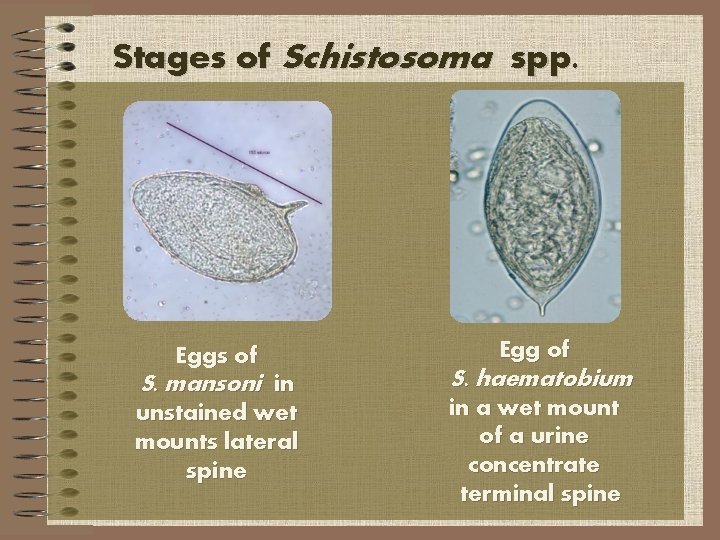
Stages of Schistosoma spp. Eggs of S. mansoni in unstained wet mounts lateral spine Egg of S. haematobium in a wet mount of a urine concentrate terminal spine
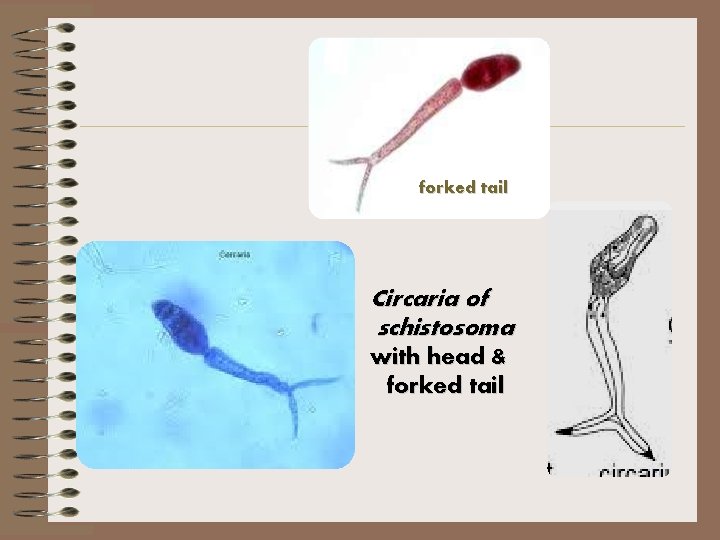
forked tail Circaria of schistosoma with head & forked tail
Diagnosis of Schistosoma SPP. • Stool or urine samples can be examined microscopically for parasite eggs (stool for S. mansoni or S. japonicum eggs and urine for S. haematobium eggs). • The eggs tend to be passed intermittently and in small amounts and may not be detected, so it may be necessary to perform a blood (serologic) test. .
Fasciola spp.
Causal Agents: § The trematodes Fasciola hepatica (the sheep liver fluke) and Fasciola gigantica, parasites of herbivores that can infect humans accidentally.
Classification of Fasciola spp. Phylum: Platyhelminthes Class: Trematoda Fasciolidae ( large flukes, cercariae encyst on aquatic vegetation) Family: Genus & speices: Fasciola hepatica , Fasciola gigantica
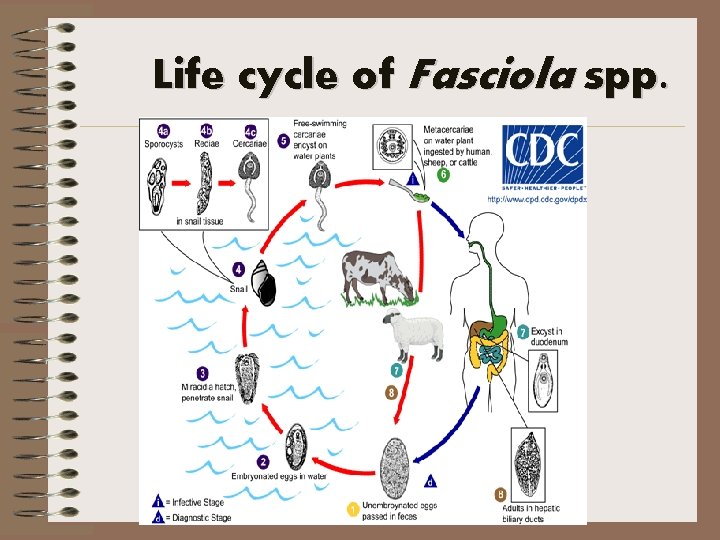
Life cycle of Fasciola spp.
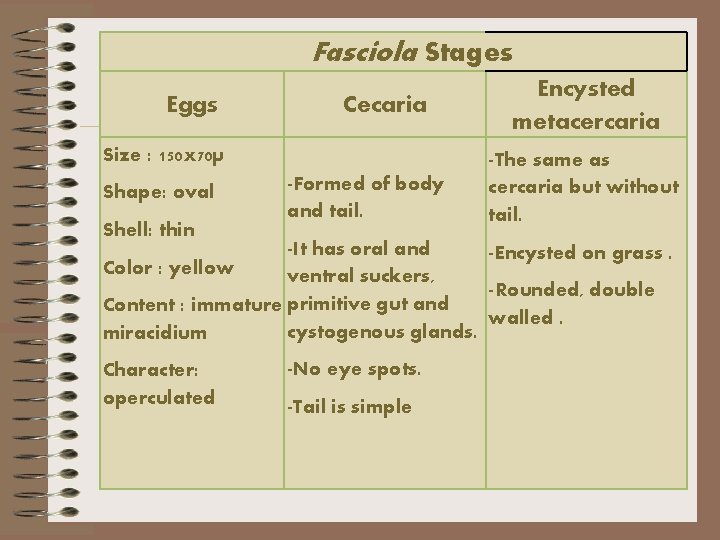
Fasciola Stages Eggs Cecaria Size : 150 x 70µ Shape: oval Shell: thin -Formed of body and tail. Encysted metacercaria -The same as cercaria but without tail. -It has oral and -Encysted on grass. Color : yellow ventral suckers, -Rounded, double Content : immature primitive gut and walled. cystogenous glands. miracidium Character: operculated -No eye spots. -Tail is simple
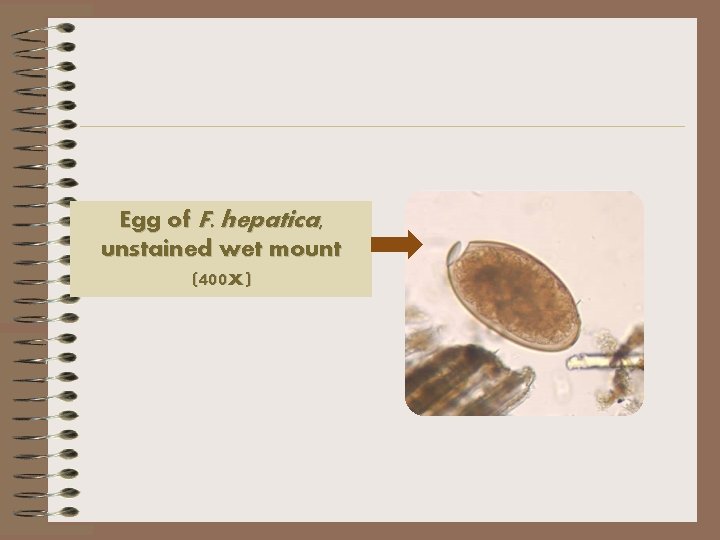
Egg of F. hepatica, unstained wet mount (400 x)
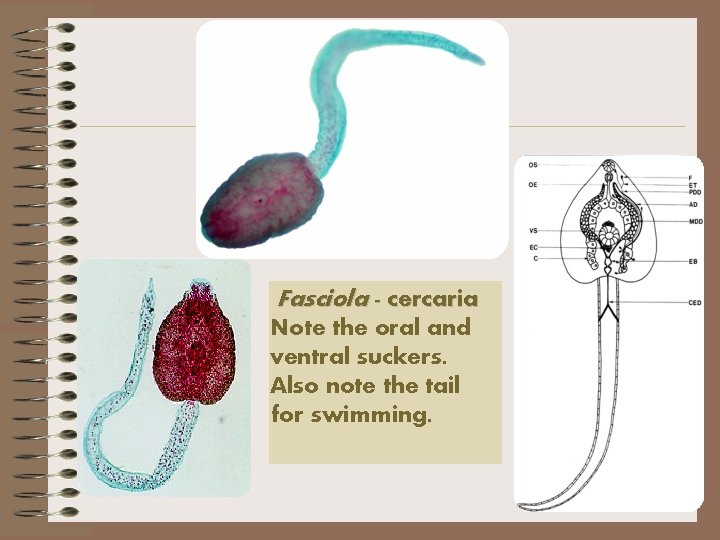
Fasciola - cercaria Note the oral and ventral suckers. Also note the tail for swimming.
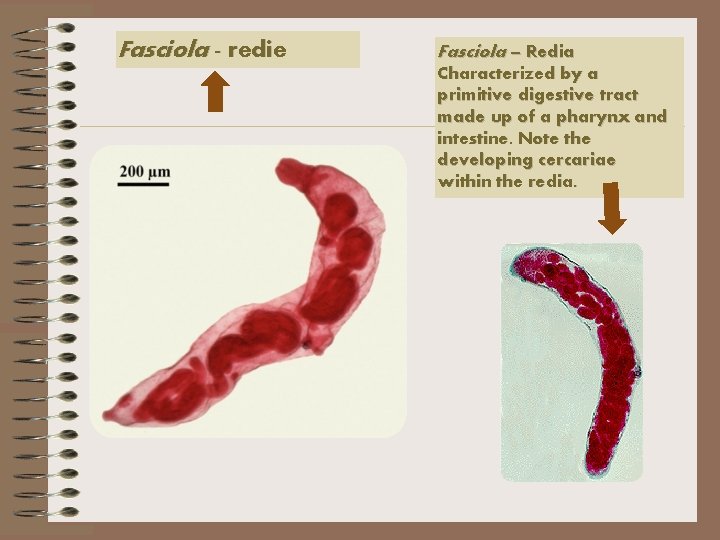
Fasciola - redie Fasciola – Redia Characterized by a primitive digestive tract made up of a pharynx and intestine. Note the developing cercariae within the redia.
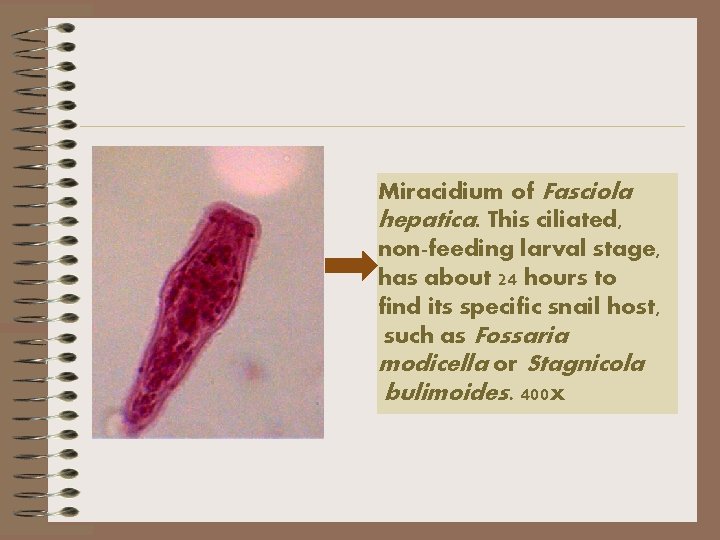
Miracidium of Fasciola hepatica. This ciliated, non-feeding larval stage, has about 24 hours to find its specific snail host, such as Fossaria modicella or Stagnicola bulimoides. 400 x
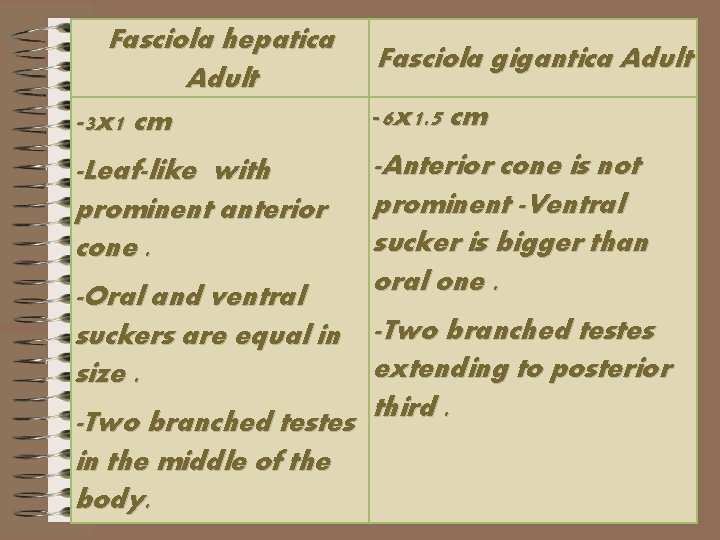
Fasciola hepatica Adult -3 x 1 cm -Leaf-like with prominent anterior cone. -Oral and ventral suckers are equal in size. Fasciola gigantica Adult -6 x 1. 5 cm -Anterior cone is not prominent -Ventral sucker is bigger than oral one. -Two branched testes extending to posterior third. -Two branched testes in the middle of the body.
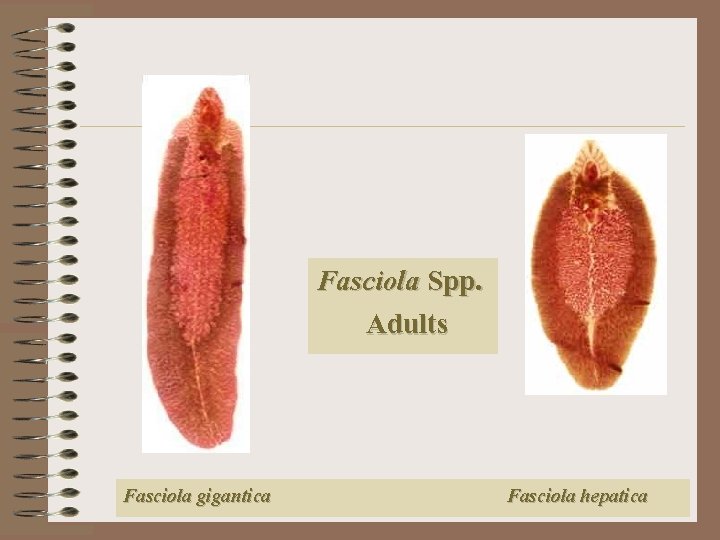
Fasciola Spp. Adults Fasciola gigantica Fasciola hepatica
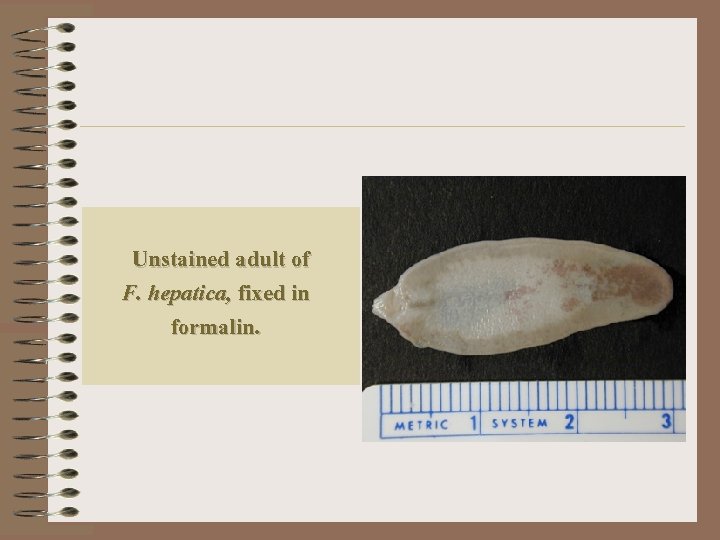
Unstained adult of F. hepatica, fixed in formalin.
Diagnostic findings 1 - Microscopy : identification of eggs is useful in the chronic (adult) stage in the stools. 2 - Antibody detection: enzyme immunoassays (EIA) - ELISA

Thank you
- Slides: 26