
Scheme of a digital safety IC system From

- Slides: 10
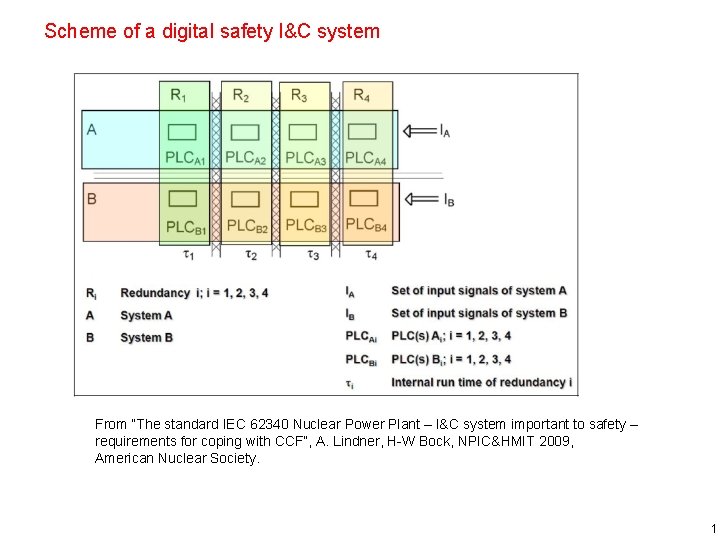
Scheme of a digital safety I&C system From “The standard IEC 62340 Nuclear Power Plant – I&C system important to safety – requirements for coping with CCF”, A. Lindner, H-W Bock, NPIC&HMIT 2009, American Nuclear Society. 1
Scheme of a fourfold redundant safety I&C system comprising two independent I&C systems A and B The channels of independent systems and the systems are spatially separated The systems A and B can be designed by different Programmable Logical Controllers different set signals different I&C functions Replicas have different starting time to avoid failures triggered by the same runtime 2
Fault prevention 3
Fault prevention techniques are intended to keep faults out of the system Prevention of development faults is an an obvious aim for development methodologies both for software and hardware Software quality - Rigorous development process (information hiding, modularization, use of strong typed programming languages, . . . ) Reliable Hw Application of formal methods as fault prevention technique 4
Formal methods are a fault avoidance technique which can increase dependability by removing errors at the requirements, specification and design stages of development can deliver correctness (that is adherence to some requirements) formal methods can deliver correctness in presence of anticipated faults 5
Formal methods /faults /failures in addition to the standard behaviour of the system, faults and failure modes must be modeled Different approaches in the literature - standard process algebras (equivalence relations) - (ad hoc) process algebras and bisimulation relations - model checking - traces and FDR - theorem proving - program transformations - temporal logics - ……. . A. Francalanza, M. Hennessy. “A theory of system behaviour in the presence of node and link failure” Inf. Comput. 206(6): 711 -759, 2008 K. Björkman et al. , Verification of Safety Logic Design by Model Checking, NPIC&HMIT, 2009. 6
Formal methods/faults/ failures Assumption: consider a set of anticipated faults -> study fault tolerance to these faults Problems: - monotonicity having proved that the system tolerates several faults, the system tolerates any combination of them - state explosion - faults and failure modes - module duplication due to fault tolerant techniques 7
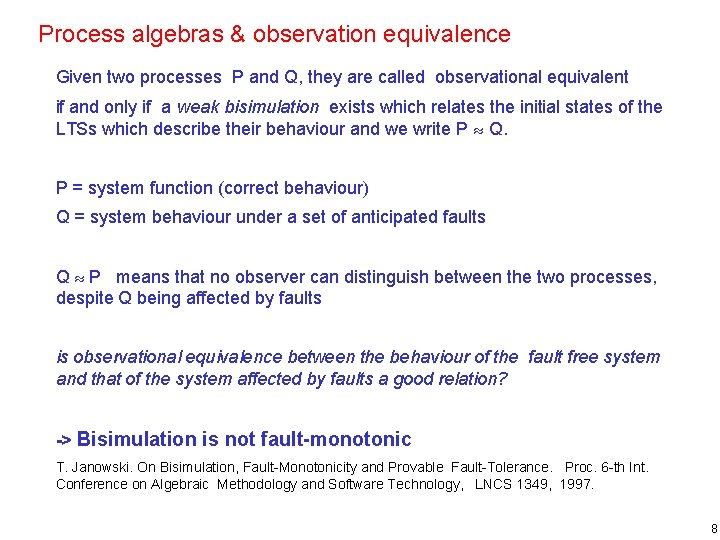
Process algebras & observation equivalence Given two processes P and Q, they are called observational equivalent if and only if a weak bisimulation exists which relates the initial states of the LTSs which describe their behaviour and we write P » Q. P = system function (correct behaviour) Q = system behaviour under a set of anticipated faults Q » P means that no observer can distinguish between the two processes, despite Q being affected by faults is observational equivalence between the behaviour of the fault free system and that of the system affected by faults a good relation? -> Bisimulation is not fault-monotonic T. Janowski. On Bisimulation, Fault-Monotonicity and Provable Fault-Tolerance. Proc. 6 -th Int. Conference on Algebraic Methodology and Software Technology, LNCS 1349, 1997. 8
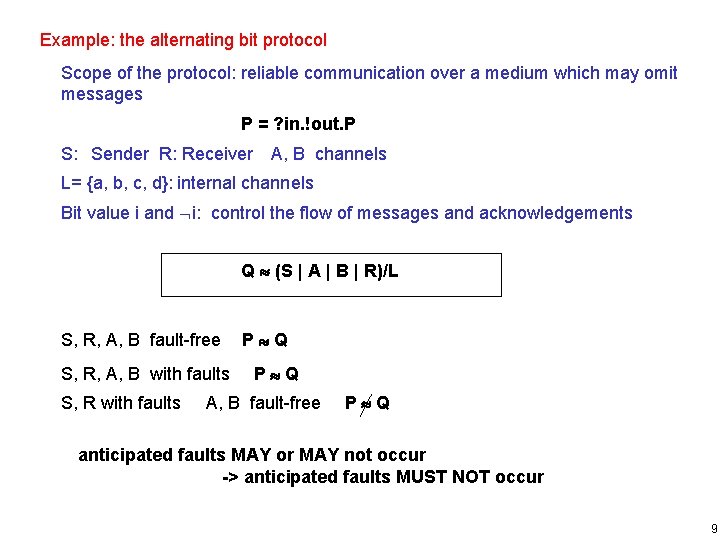
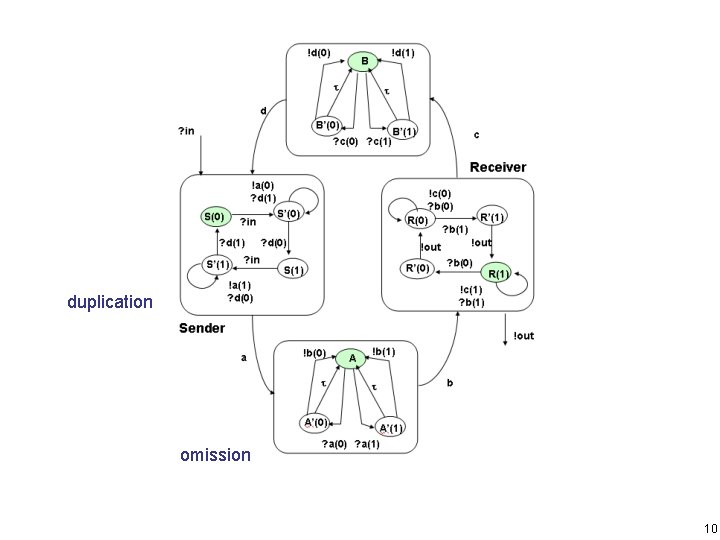
Example: the alternating bit protocol Scope of the protocol: reliable communication over a medium which may omit messages P = ? in. !out. P S: Sender R: Receiver A, B channels L= {a, b, c, d}: internal channels Bit value i and Øi: control the flow of messages and acknowledgements Q » (S | A | B | R)/L S, R, A, B fault-free S, R, A, B with faults S, R with faults P» Q A, B fault-free P» Q anticipated faults MAY or MAY not occur -> anticipated faults MUST NOT occur 9
duplication omission 10