
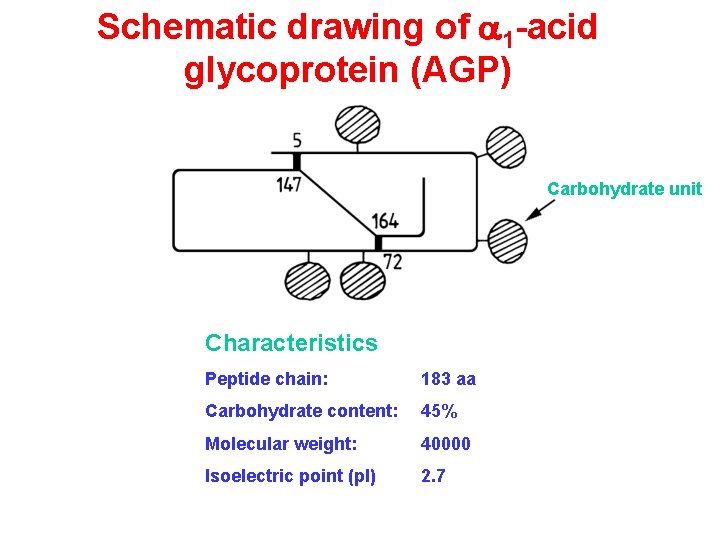
Schematic drawing of a 1 acid glycoprotein AGP

- Slides: 40
Schematic drawing of a 1 -acid glycoprotein (AGP) Carbohydrate unit Characteristics Peptide chain: 183 aa Carbohydrate content: 45% Molecular weight: 40000 Isoelectric point (p. I) 2. 7
The AGP column has a unique property!!! The chiral bonding properties of the stationary phase can be changed dynamically. Enantioselectivity can be induced and improved by simple changes of the mobile phase composition.
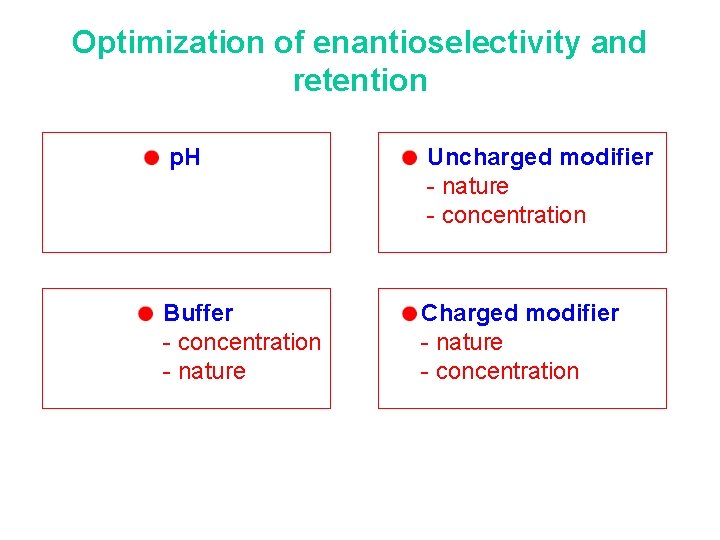
Optimization of enantioselectivity and retention p. H Uncharged modifier - nature - concentration Buffer - concentration - nature Charged modifier - nature - concentration
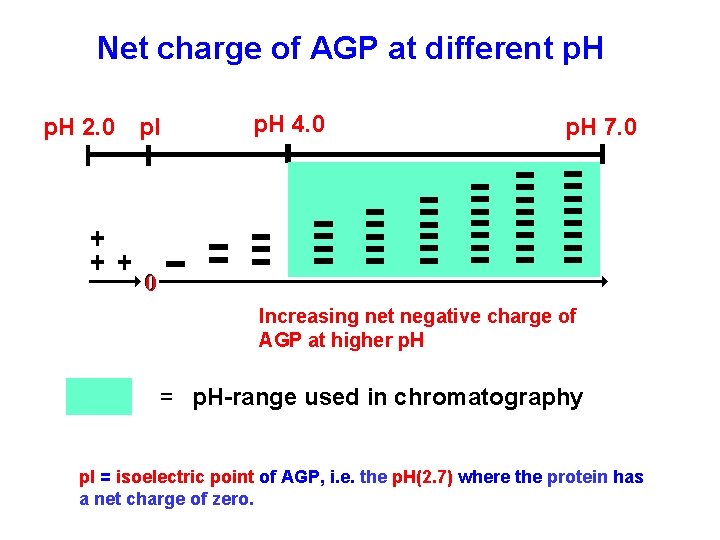
Most important tool in method development : p. H
Net charge of AGP at different p. H 2. 0 p. I p. H 4. 0 p. H 7. 0 0 Increasing net negative charge of AGP at higher p. H = p. H-range used in chromatography p. I = isoelectric point of AGP, i. e. the p. H(2. 7) where the protein has a net charge of zero.
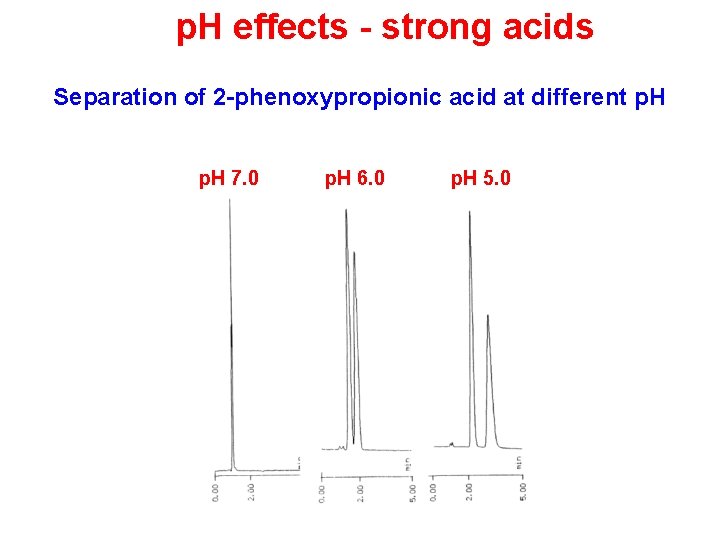
p. H effects - strong acids Separation of 2 -phenoxypropionic acid at different p. H 7. 0 p. H 6. 0 p. H 5. 0
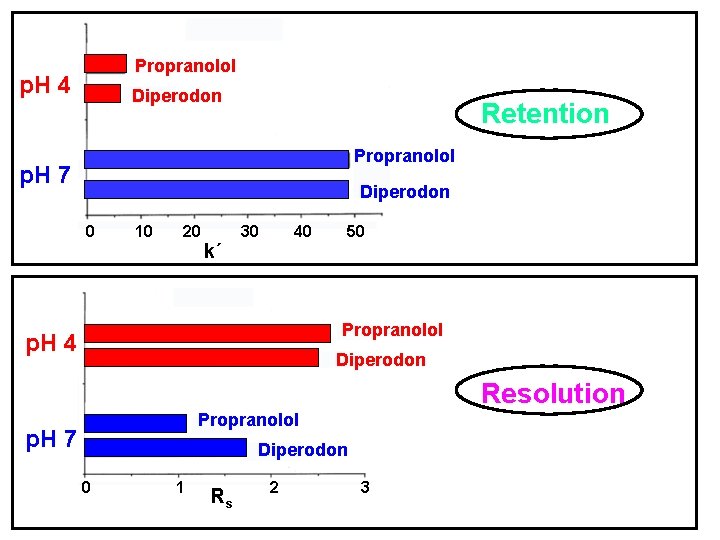
Propranolol p. H 4 Diperodon Retention Propranolol p. H 7 Diperodon 0 10 20 k´ 30 40 50 Propranolol p. H 4 Diperodon Resolution Propranolol p. H 7 Diperodon 0 1 Rs 2 3
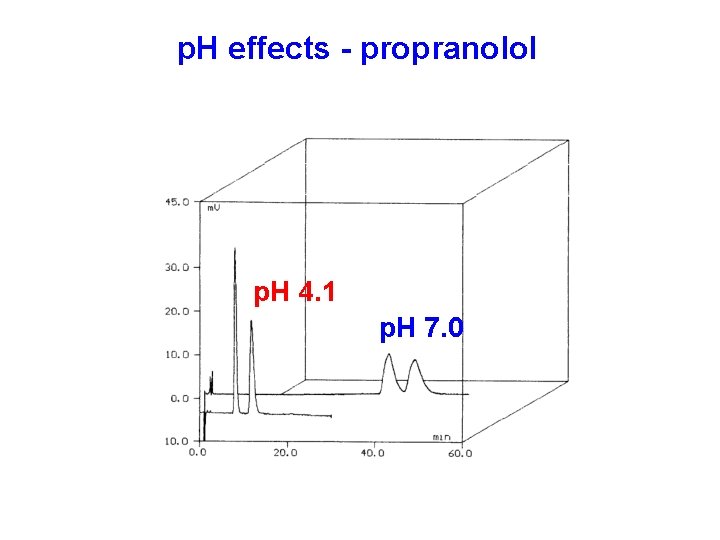
p. H effects - propranolol p. H 4. 1 p. H 7. 0
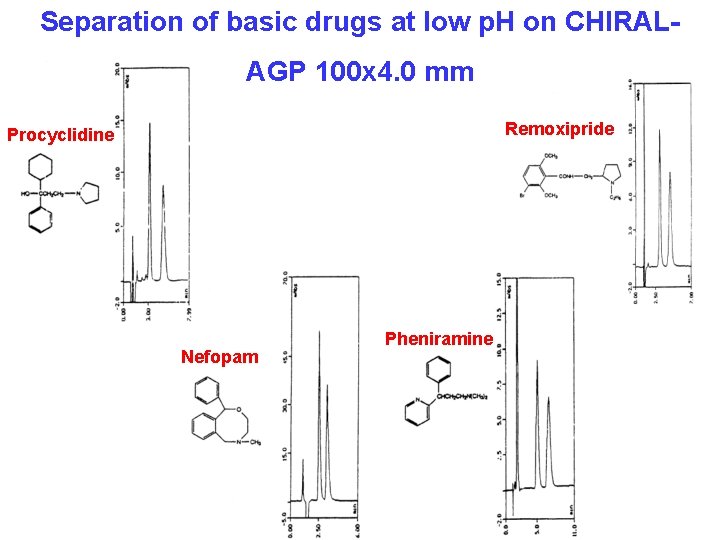
Separation of basic drugs at low p. H on CHIRALAGP 100 x 4. 0 mm Remoxipride Procyclidine Nefopam Pheniramine
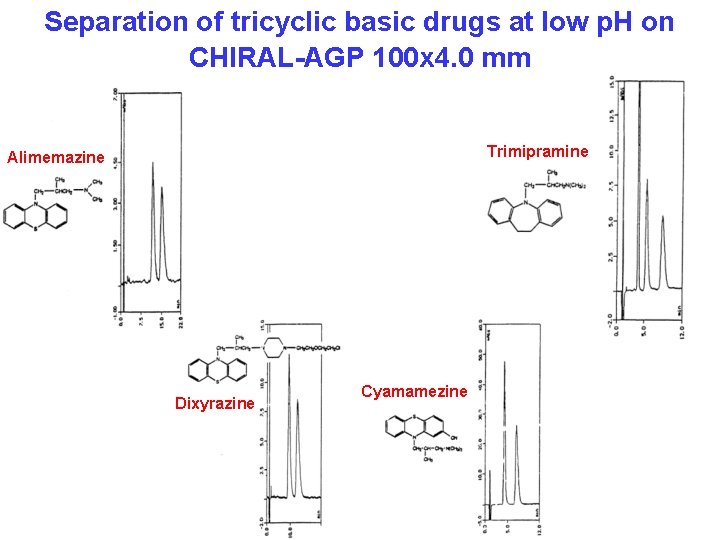
Separation of tricyclic basic drugs at low p. H on CHIRAL-AGP 100 x 4. 0 mm Trimipramine Alimemazine Dixyrazine Cyamamezine
Another important tool in method development on CHIRAL-AGP: Nature and concentration of uncharged organic modifier 2 -propanol, 1 -propanol acetonitrile ethanol, methanol etc.
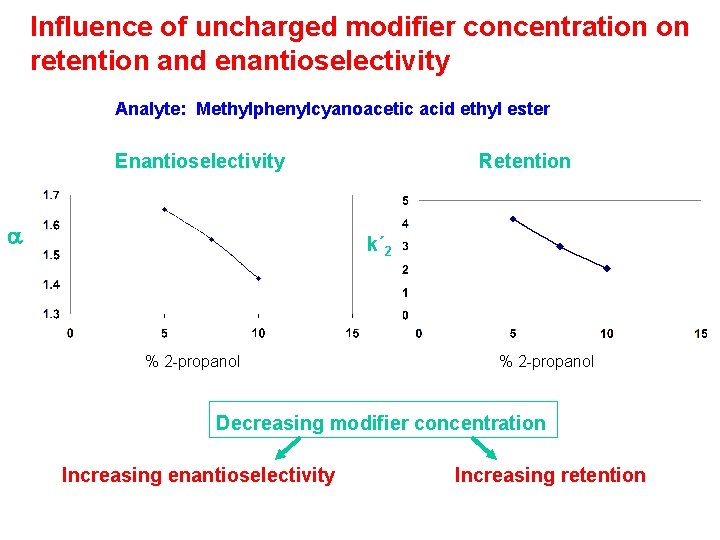
Influence of uncharged modifier concentration on retention and enantioselectivity Analyte: Methylphenylcyanoacetic acid ethyl ester Enantioselectivity a Retention k´ 2 % 2 -propanol Decreasing modifier concentration Increasing enantioselectivity Increasing retention
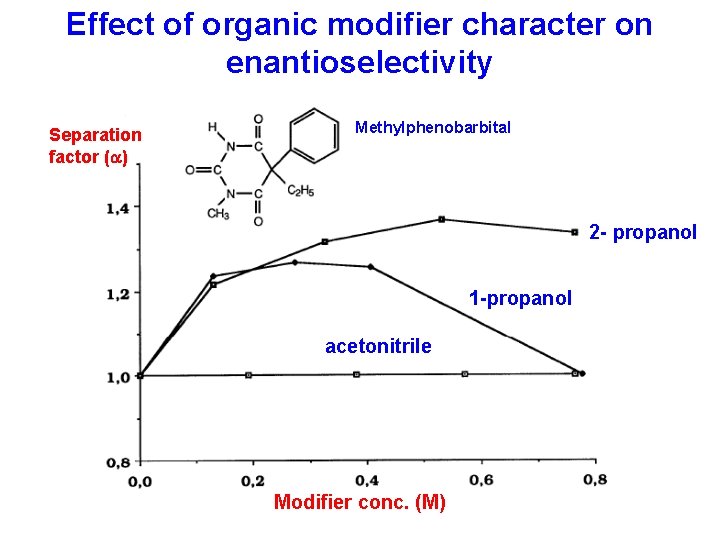
Effect of organic modifier character on enantioselectivity Separation factor (a) Methylphenobarbital 2 - propanol 1 -propanol acetonitrile Modifier conc. (M)
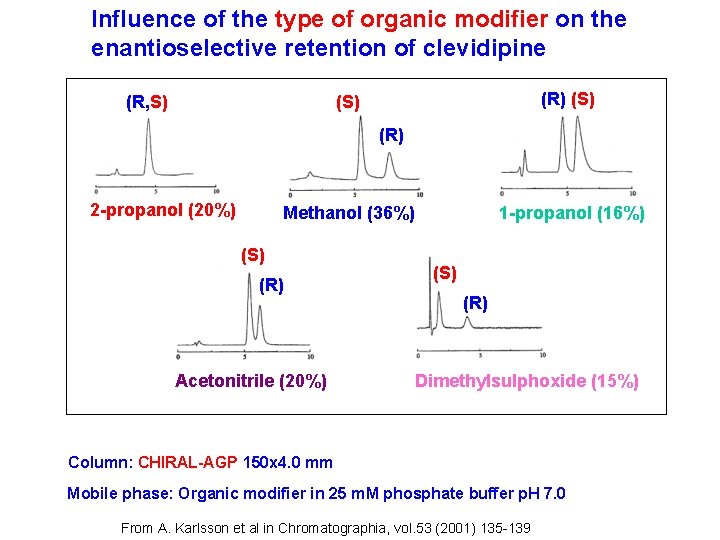
Influence of the type of organic modifier on the enantioselective retention of clevidipine (R, S) (R) (S) (R) 2 -propanol (20%) Methanol (36%) (S) (R) Acetonitrile (20%) 1 -propanol (16%) (S) (R) Dimethylsulphoxide (15%) Column: CHIRAL-AGP 150 x 4. 0 mm Mobile phase: Organic modifier in 25 m. M phosphate buffer p. H 7. 0 From A. Karlsson et al in Chromatographia, vol. 53 (2001) 135 -139
Another important tool in method development on CHIRAL-AGP: Nature and concentration of buffer Acetate Phosphate Citrate Tris Formate etc.
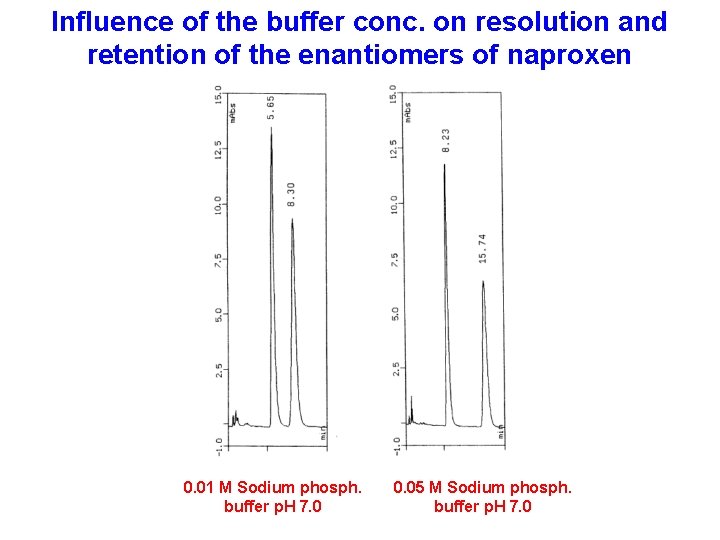
Influence of the buffer conc. on resolution and retention of the enantiomers of naproxen 0. 01 M Sodium phosph. buffer p. H 7. 0 0. 05 M Sodium phosph. buffer p. H 7. 0
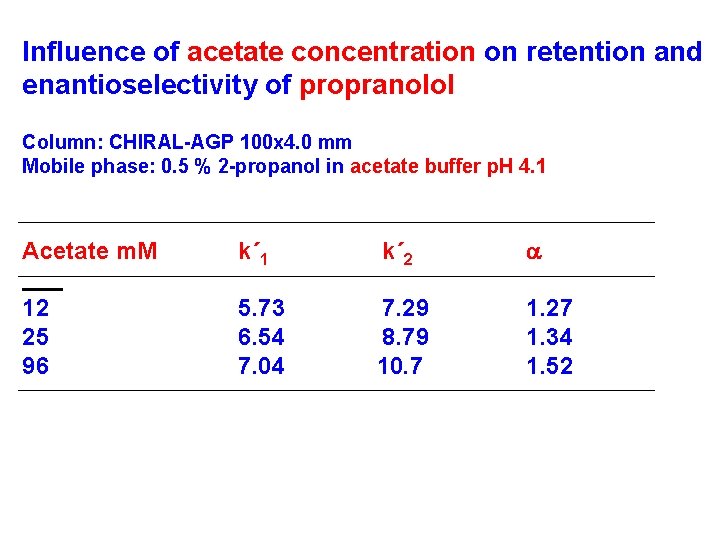
Influence of acetate concentration on retention and enantioselectivity of propranolol Column: CHIRAL-AGP 100 x 4. 0 mm Mobile phase: 0. 5 % 2 -propanol in acetate buffer p. H 4. 1 Acetate m. M k´ 1 k´ 2 a 12 25 96 5. 73 6. 54 7. 04 7. 29 8. 79 10. 7 1. 27 1. 34 1. 52
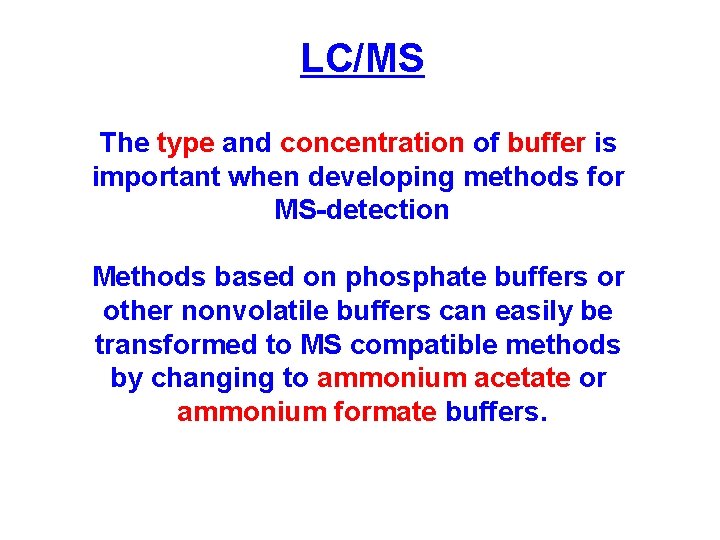
LC/MS The type and concentration of buffer is important when developing methods for MS-detection Methods based on phosphate buffers or other nonvolatile buffers can easily be transformed to MS compatible methods by changing to ammonium acetate or ammonium formate buffers.
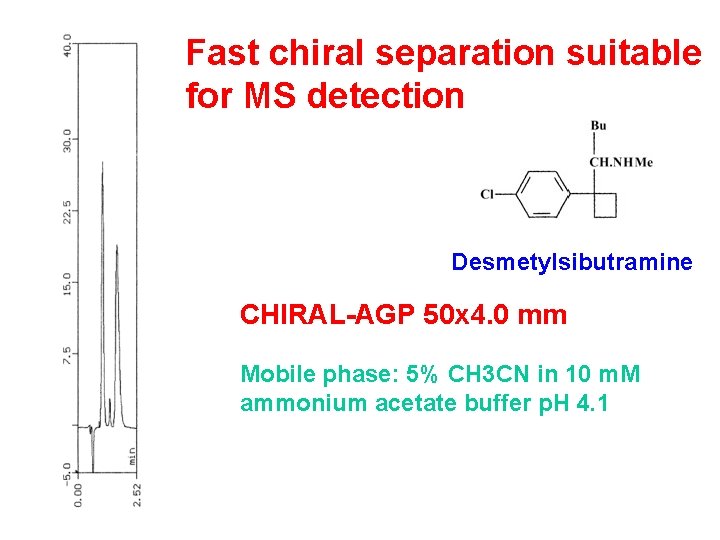
Fast chiral separation suitable for MS detection Desmetylsibutramine CHIRAL-AGP 50 x 4. 0 mm Mobile phase: 5% CH 3 CN in 10 m. M ammonium acetate buffer p. H 4. 1
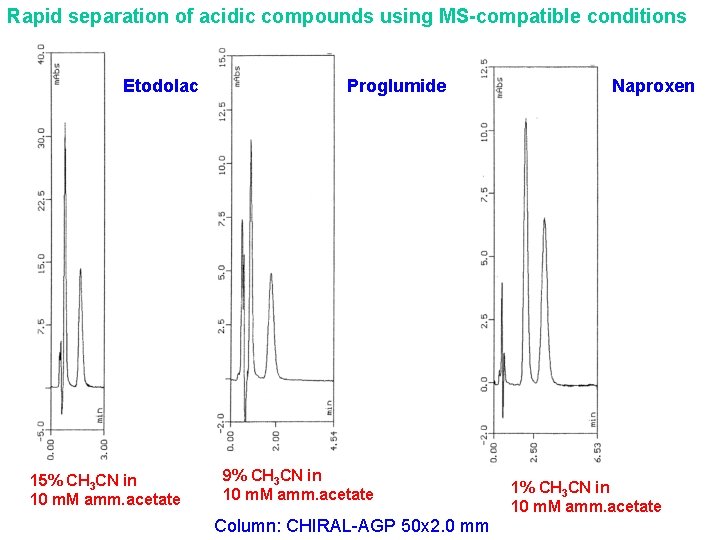
Rapid separation of acidic compounds using MS-compatible conditions Etodolac 15% CH 3 CN in 10 m. M amm. acetate Proglumide 9% CH 3 CN in 10 m. M amm. acetate Column: CHIRAL-AGP 50 x 2. 0 mm Naproxen 1% CH 3 CN in 10 m. M amm. acetate
Charged organic modifiers can be an important tool in method development. They have the most dramatic effects on the enantioselectivity and the retention. Examples of modifiers: Cationic: N, N-dimethyloctylamine (DMOA) and other amines Anionic: Hexanoic- and octanoic acid
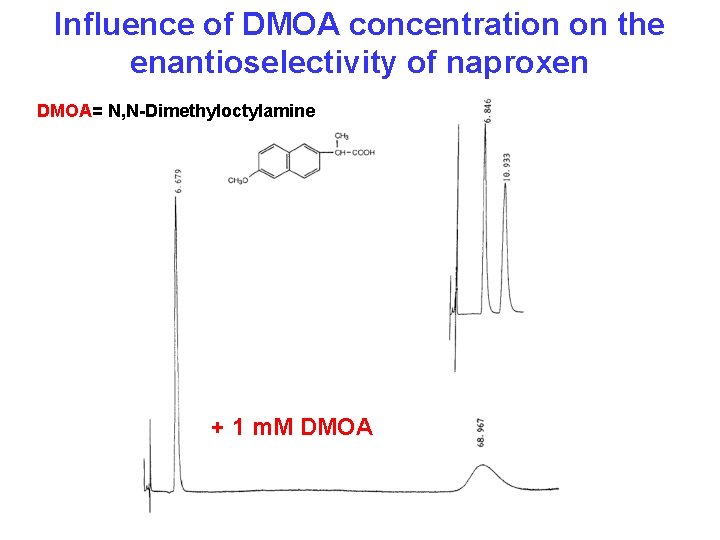
Influence of DMOA concentration on the enantioselectivity of naproxen DMOA= N, N-Dimethyloctylamine + 1 m. M DMOA
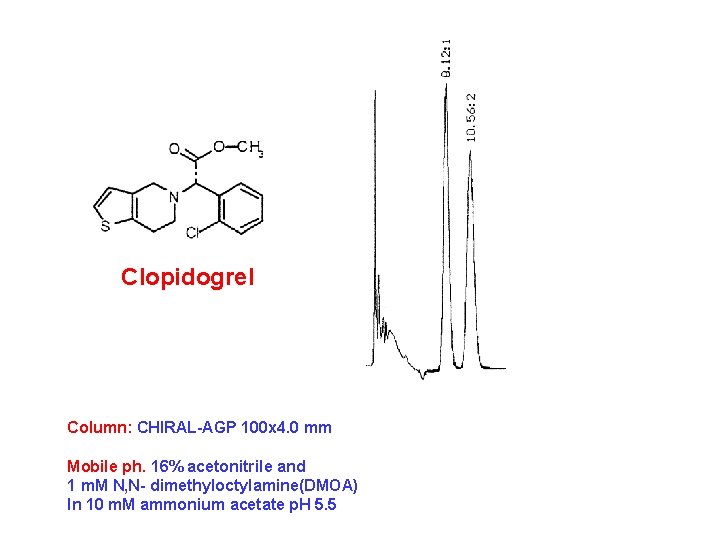
Clopidogrel Column: CHIRAL-AGP 100 x 4. 0 mm Mobile ph. 16% acetonitrile and 1 m. M N, N- dimethyloctylamine(DMOA) In 10 m. M ammonium acetate p. H 5. 5
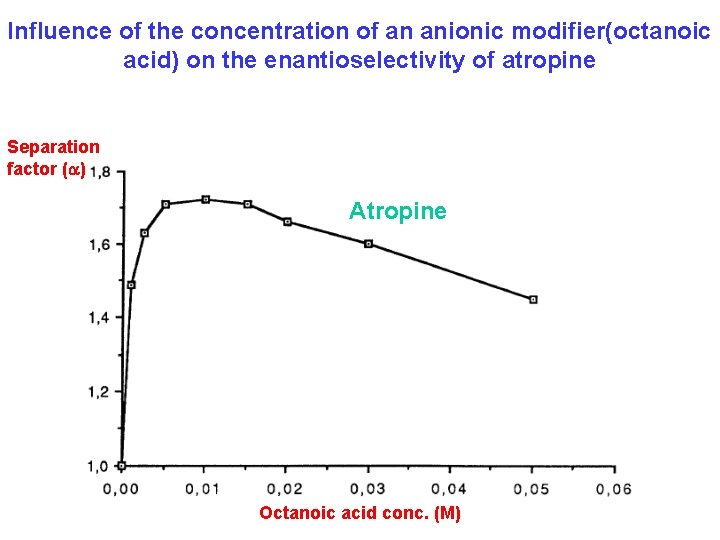
Influence of the concentration of an anionic modifier(octanoic acid) on the enantioselectivity of atropine Separation factor (a) Atropine Octanoic acid conc. (M)
Simple method development strategy
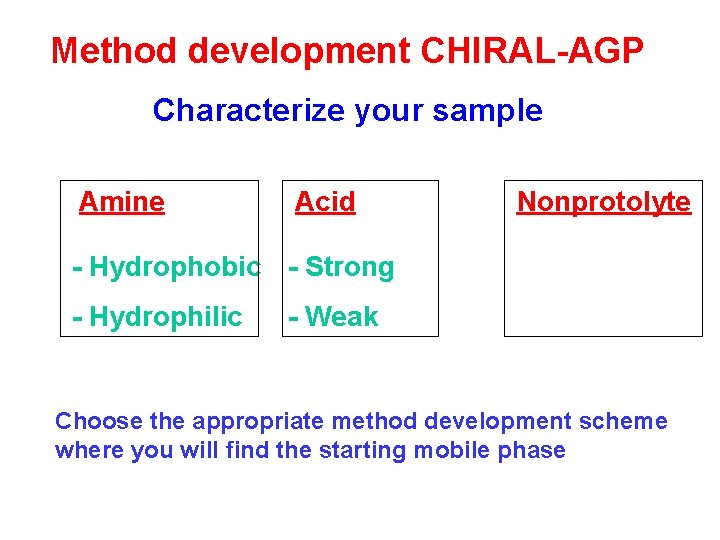
Method development CHIRAL-AGP Characterize your sample Amine Acid Nonprotolyte - Hydrophobic - Strong - Hydrophilic - Weak Choose the appropriate method development scheme where you will find the starting mobile phase
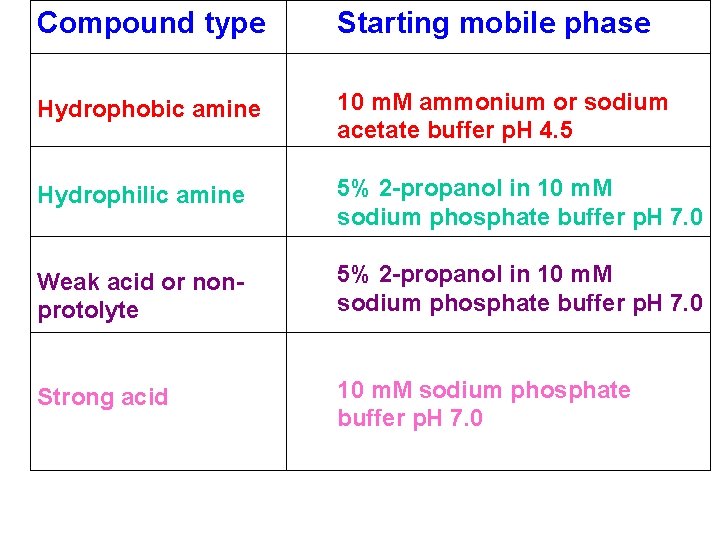
Compound type Starting mobile phase Hydrophobic amine 10 m. M ammonium or sodium acetate buffer p. H 4. 5 Hydrophilic amine 5% 2 -propanol in 10 m. M sodium phosphate buffer p. H 7. 0 Weak acid or nonprotolyte 5% 2 -propanol in 10 m. M sodium phosphate buffer p. H 7. 0 Strong acid 10 m. M sodium phosphate buffer p. H 7. 0
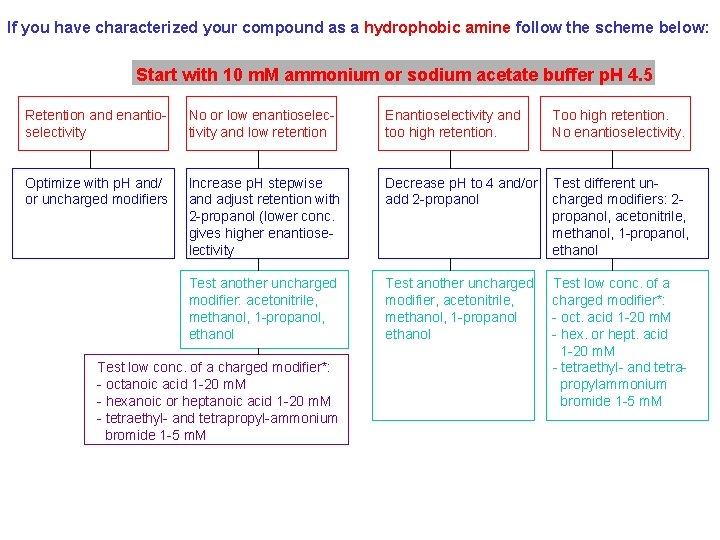
If you have characterized your compound as a hydrophobic amine follow the scheme below: Start with 10 m. M ammonium or sodium acetate buffer p. H 4. 5 Retention and enantioselectivity No or low enantioselectivity and low retention Enantioselectivity and too high retention. Too high retention. No enantioselectivity. Optimize with p. H and/ or uncharged modifiers Increase p. H stepwise and adjust retention with 2 -propanol (lower conc. gives higher enantioselectivity Decrease p. H to 4 and/or add 2 -propanol Test different uncharged modifiers: 2 propanol, acetonitrile, methanol, 1 -propanol, ethanol Test another uncharged modifier: acetonitrile, methanol, 1 -propanol, ethanol Test another uncharged modifier, acetonitrile, methanol, 1 -propanol ethanol Test low conc. of a charged modifier*: - oct. acid 1 -20 m. M - hex. or hept. acid 1 -20 m. M - tetraethyl- and tetrapropylammonium bromide 1 -5 m. M Test low conc. of a charged modifier*: - octanoic acid 1 -20 m. M - hexanoic or heptanoic acid 1 -20 m. M - tetraethyl- and tetrapropyl-ammonium bromide 1 -5 m. M
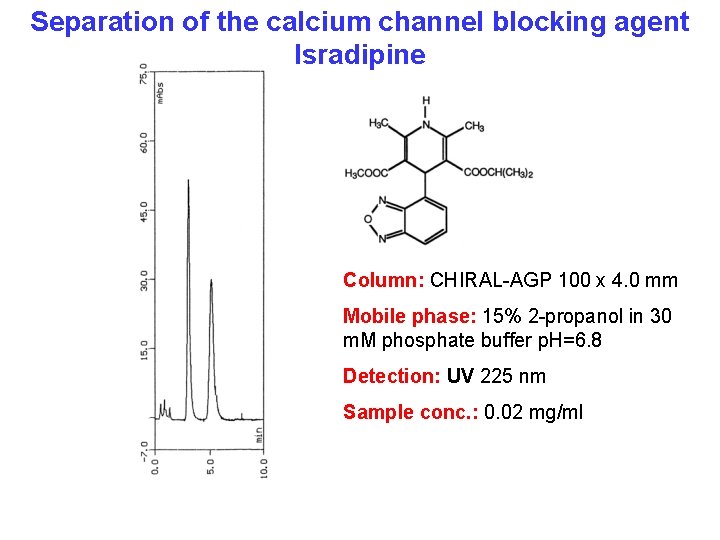
Separation of the calcium channel blocking agent Isradipine Column: CHIRAL-AGP 100 x 4. 0 mm Mobile phase: 15% 2 -propanol in 30 m. M phosphate buffer p. H=6. 8 Detection: UV 225 nm Sample conc. : 0. 02 mg/ml
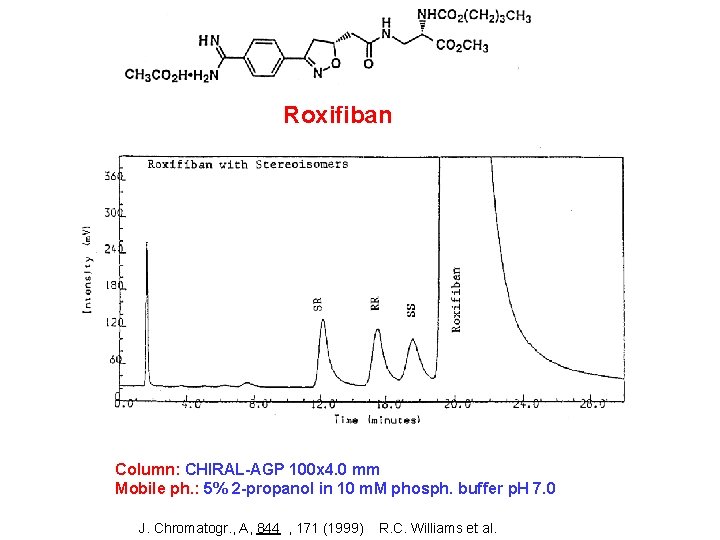
Roxifiban Column: CHIRAL-AGP 100 x 4. 0 mm Mobile ph. : 5% 2 -propanol in 10 m. M phosph. buffer p. H 7. 0 J. Chromatogr. , A, 844 , 171 (1999) R. C. Williams et al.
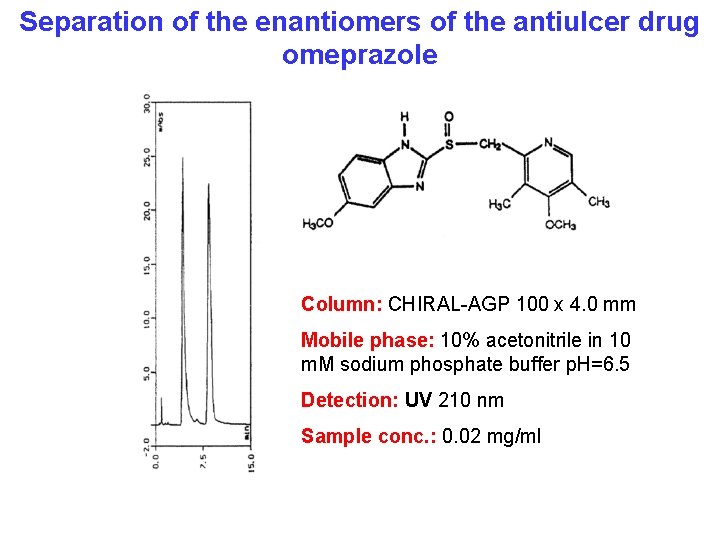
Separation of the enantiomers of the antiulcer drug omeprazole Column: CHIRAL-AGP 100 x 4. 0 mm Mobile phase: 10% acetonitrile in 10 m. M sodium phosphate buffer p. H=6. 5 Detection: UV 210 nm Sample conc. : 0. 02 mg/ml
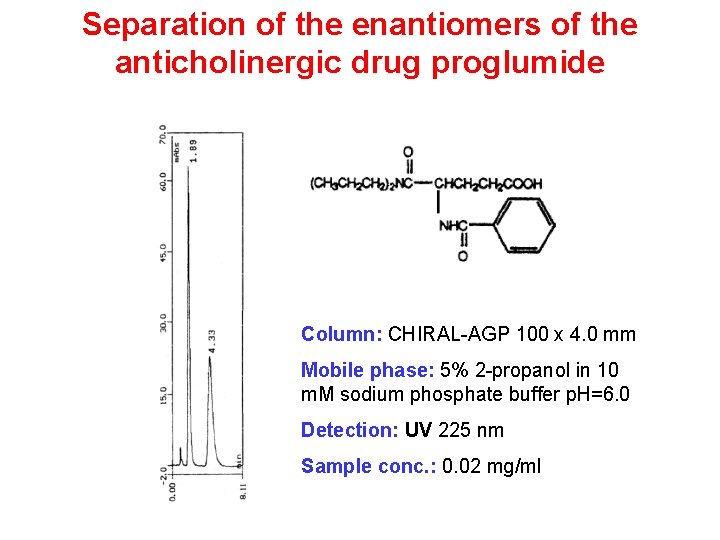
Separation of the enantiomers of the anticholinergic drug proglumide Column: CHIRAL-AGP 100 x 4. 0 mm Mobile phase: 5% 2 -propanol in 10 m. M sodium phosphate buffer p. H=6. 0 Detection: UV 225 nm Sample conc. : 0. 02 mg/ml
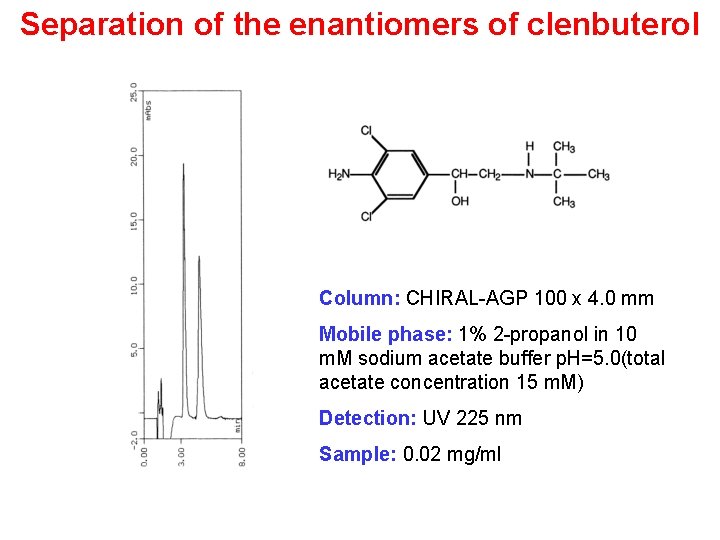
Separation of the enantiomers of clenbuterol Column: CHIRAL-AGP 100 x 4. 0 mm Mobile phase: 1% 2 -propanol in 10 m. M sodium acetate buffer p. H=5. 0(total acetate concentration 15 m. M) Detection: UV 225 nm Sample: 0. 02 mg/ml
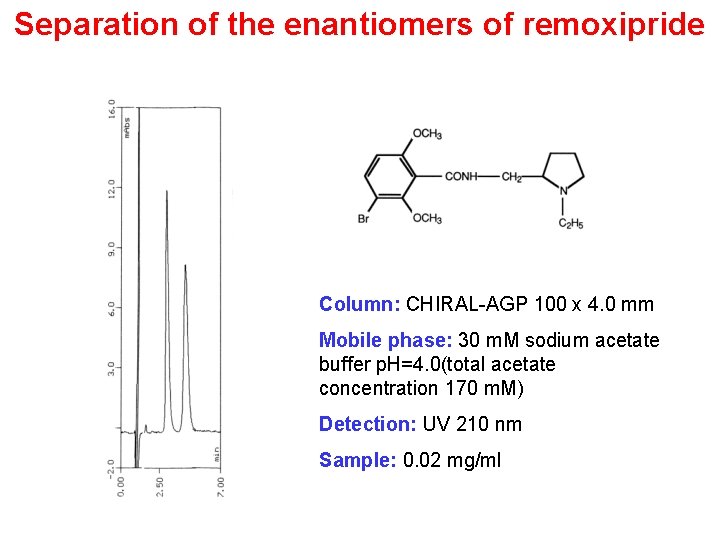
Separation of the enantiomers of remoxipride Column: CHIRAL-AGP 100 x 4. 0 mm Mobile phase: 30 m. M sodium acetate buffer p. H=4. 0(total acetate concentration 170 m. M) Detection: UV 210 nm Sample: 0. 02 mg/ml
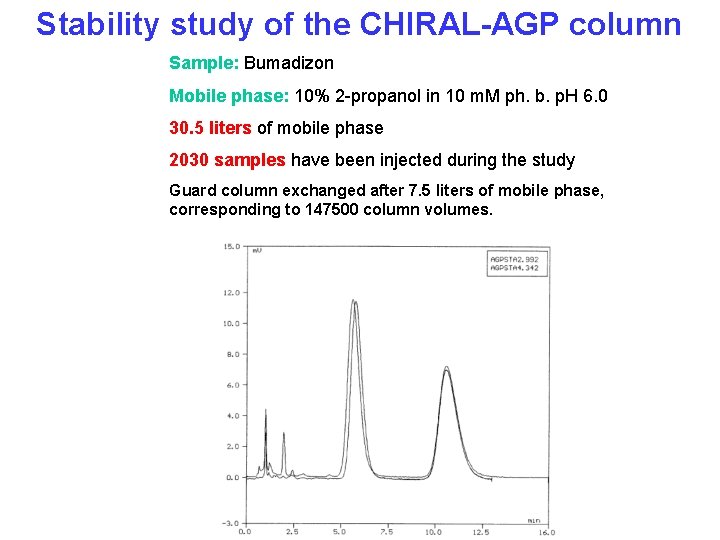
Stability study of the CHIRAL-AGP column Sample: Bumadizon Mobile phase: 10% 2 -propanol in 10 m. M ph. b. p. H 6. 0 30. 5 liters of mobile phase 2030 samples have been injected during the study Guard column exchanged after 7. 5 liters of mobile phase, corresponding to 147500 column volumes.
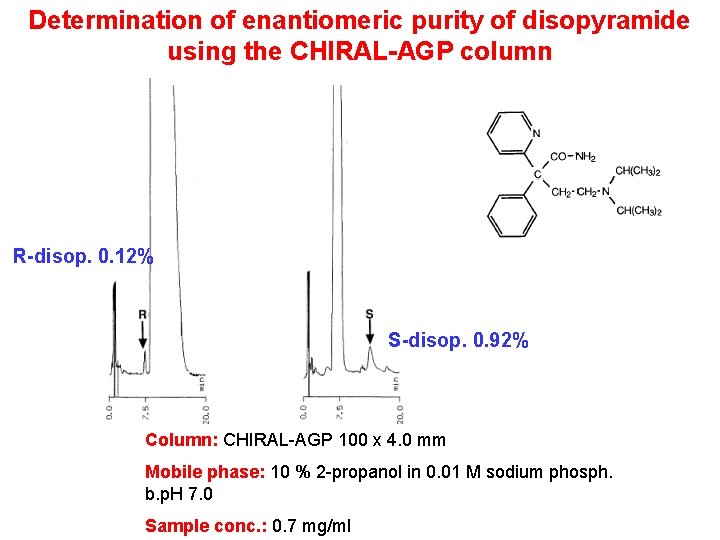
Determination of enantiomeric purity of disopyramide using the CHIRAL-AGP column R-disop. 0. 12% S-disop. 0. 92% Column: CHIRAL-AGP 100 x 4. 0 mm Mobile phase: 10 % 2 -propanol in 0. 01 M sodium phosph. b. p. H 7. 0 Sample conc. : 0. 7 mg/ml
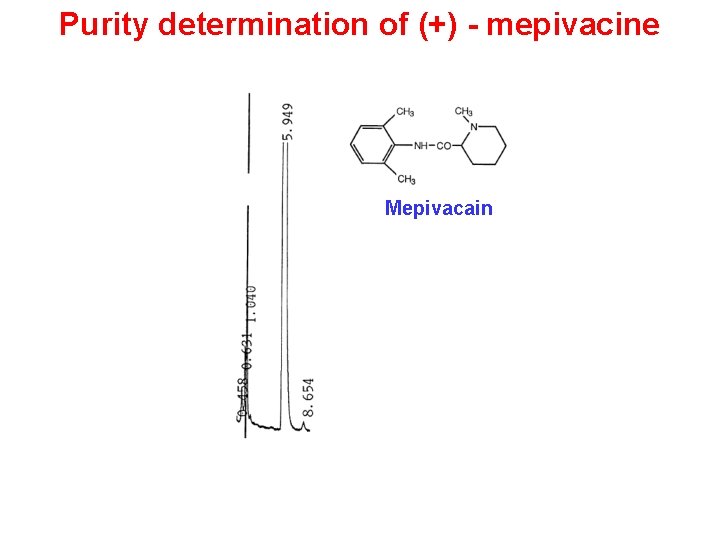
Purity determination of (+) - mepivacine Mepivacain
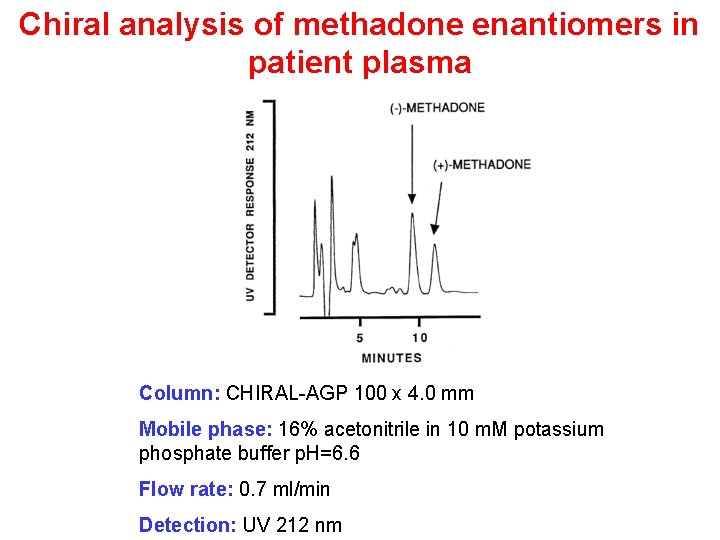
Chiral analysis of methadone enantiomers in patient plasma Column: CHIRAL-AGP 100 x 4. 0 mm Mobile phase: 16% acetonitrile in 10 m. M potassium phosphate buffer p. H=6. 6 Flow rate: 0. 7 ml/min Detection: UV 212 nm
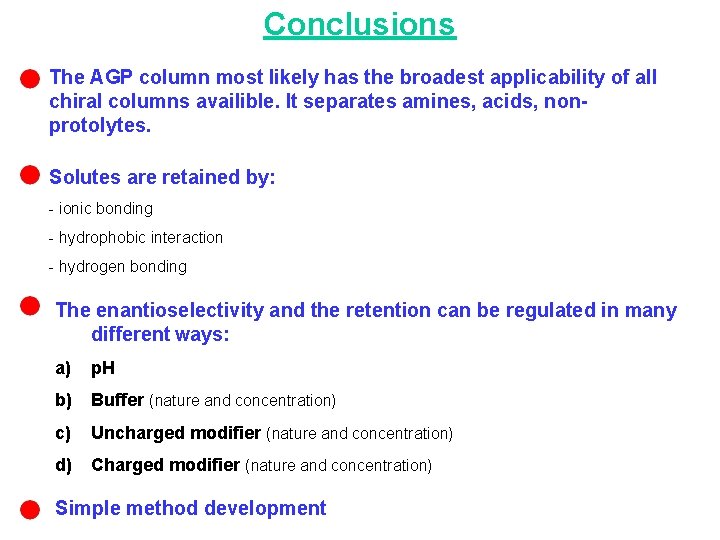
Conclusions The AGP column most likely has the broadest applicability of all chiral columns availible. It separates amines, acids, nonprotolytes. Solutes are retained by: - ionic bonding - hydrophobic interaction - hydrogen bonding The enantioselectivity and the retention can be regulated in many different ways: a) p. H b) Buffer (nature and concentration) c) Uncharged modifier (nature and concentration) d) Charged modifier (nature and concentration) Simple method development
If you are interested in more information please visit our website: www. chromtech. com Hundreds of Applications(all conditions given) Hundreds of literature references For a FREE Chiral Screening Service contact sales@chromtech. com