
Schema Theory There are limitations to both open
Schema Theory § There are limitations to both open and closed loop theories so Schmidt (1975) proposed a “schema” model of learning. § This negates the problem of storage and memory capacity. § Copies of actual movements are not stored in the memory, rather ideas of relationships (schema) are stored to produce different but related movements.
Schema cont. . § Schmidt saw Schema as “a rule or set of rules that serve to provide the basis for a decision” § This solves problem of “how do we store millions of specific motor programmes? ” § “How do we initiate and control fast and more complex movements? ” § “how do we initiate movement in totally new situations that we have never faced before and have no memory of, or programme of movement for? ”
Examples of Schema development § A schema can be adapted for throwing action. § Returning a cricket ball to wicket keeper in cricket. § A long pass in netball/basketball. § A goalkeeper in football throwing long. § Throwing a javelin § Playing darts
Recall and Recognition § Schemas are split into two categories. § Recall schemas: information is stored about determining and producing the desired movement. § Recognition schemas: information is stored enabling evaluation of the movement.
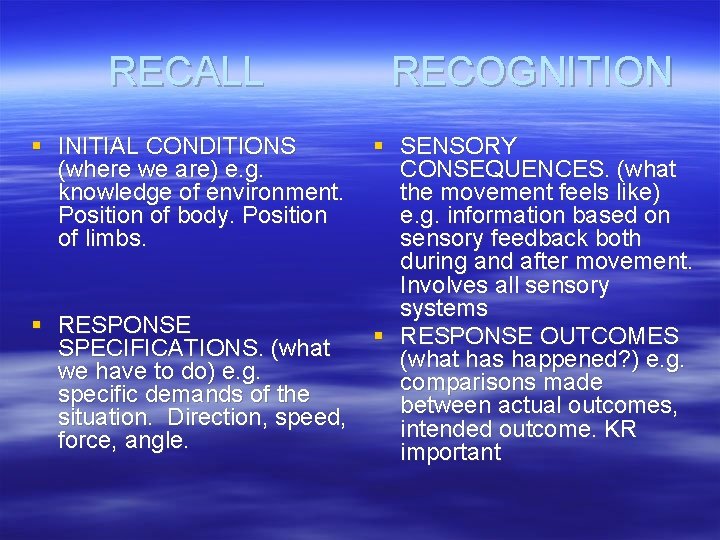
RECALL RECOGNITION § INITIAL CONDITIONS (where we are) e. g. knowledge of environment. Position of body. Position of limbs. § SENSORY CONSEQUENCES. (what the movement feels like) e. g. information based on sensory feedback both during and after movement. Involves all sensory systems § RESPONSE OUTCOMES (what has happened? ) e. g. comparisons made between actual outcomes, intended outcome. KR important § RESPONSE SPECIFICATIONS. (what we have to do) e. g. specific demands of the situation. Direction, speed, force, angle.
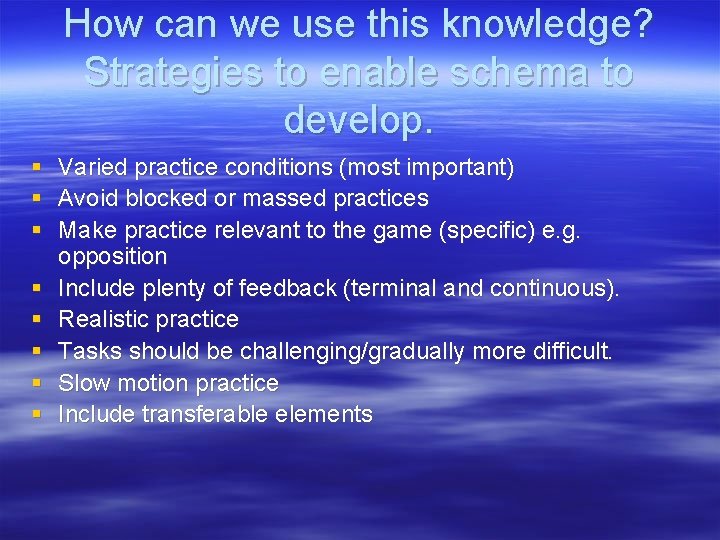
How can we use this knowledge? Strategies to enable schema to develop. § Varied practice conditions (most important) § Avoid blocked or massed practices § Make practice relevant to the game (specific) e. g. opposition § Include plenty of feedback (terminal and continuous). § Realistic practice § Tasks should be challenging/gradually more difficult. § Slow motion practice § Include transferable elements
- Slides: 6