
Scheduling Techniques for GPU Architectures with ProcessingInMemory Capabilities
Scheduling Techniques for GPU Architectures with Processing-In-Memory Capabilities Ashutosh Pattnaik Xulong Tang, Adwait Jog, Onur Kayıran, Asit Mishra, Mahmut Kandemir, Onur Mutlu, Chita Das PACT ‘ 16 Scheduling Techniques for GPU Architectures with Processing-In-Memory Capabilities
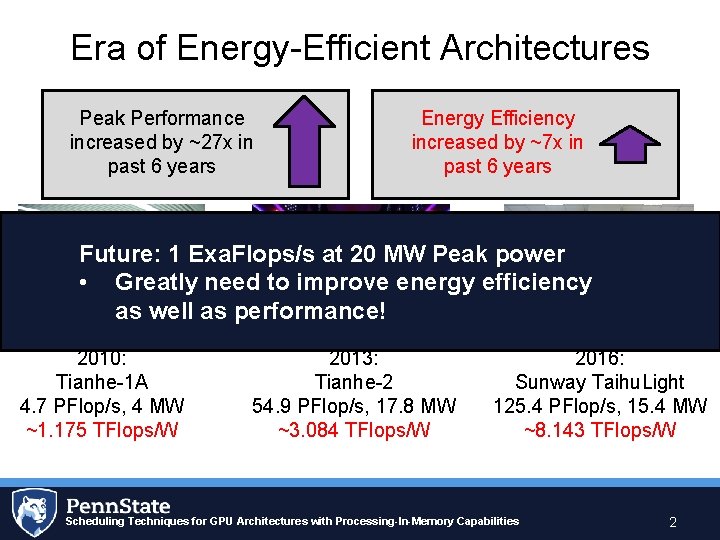
Era of Energy-Efficient Architectures Peak Performance increased by ~27 x in past 6 years Energy Efficiency increased by ~7 x in past 6 years Future: 1 Exa. Flops/s at 20 MW Peak power • Greatly need to improve energy efficiency as well as performance! 2010: Tianhe-1 A 4. 7 PFlop/s, 4 MW ~1. 175 TFlops/W 2013: Tianhe-2 54. 9 PFlop/s, 17. 8 MW ~3. 084 TFlops/W 2016: Sunway Taihu. Light 125. 4 PFlop/s, 15. 4 MW ~8. 143 TFlops/W Scheduling Techniques for GPU Architectures with Processing-In-Memory Capabilities 2
Bottleneck • Continuous energy-efficiency and performance scaling is not easy. • Energy consumed by a floating-point operation is scaling down with technology scaling. • Energy consumption due to data transfer overhead is not scaling down! Scheduling Techniques for GPU Architectures with Processing-In-Memory Capabilities 3
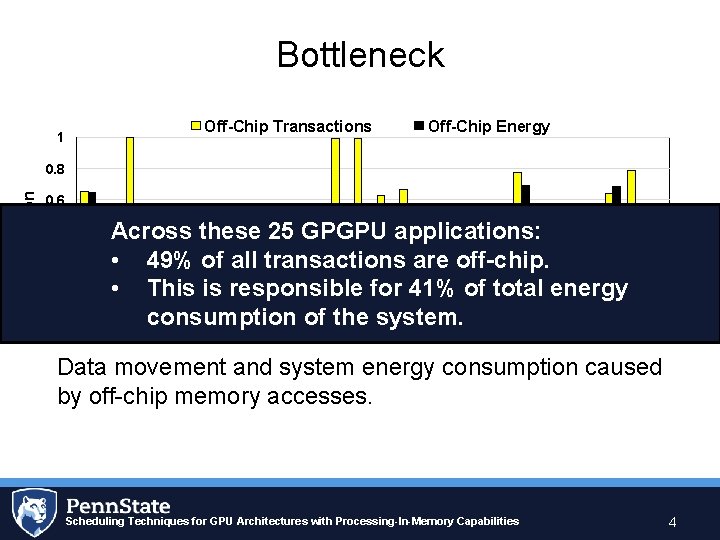
Bottleneck Off-Chip Transactions 1 Off-Chip Energy av A TR SP G B B IC FS 0 LI B M ST PV C 0. 2 Across these 25 GPGPU applications: • 49% of all transactions are off-chip. • This is responsible for 41% of total energy consumption of the system. LK C C C L O N C V O R R FD T G D R A M LU H M VT PR R ED SC P SL ST A R M A PS P C F C D O N S FW G T U PS 0. 4 g 0. 6 B Fraction 0. 8 Data movement and system energy consumption caused by off-chip memory accesses. Scheduling Techniques for GPU Architectures with Processing-In-Memory Capabilities 4
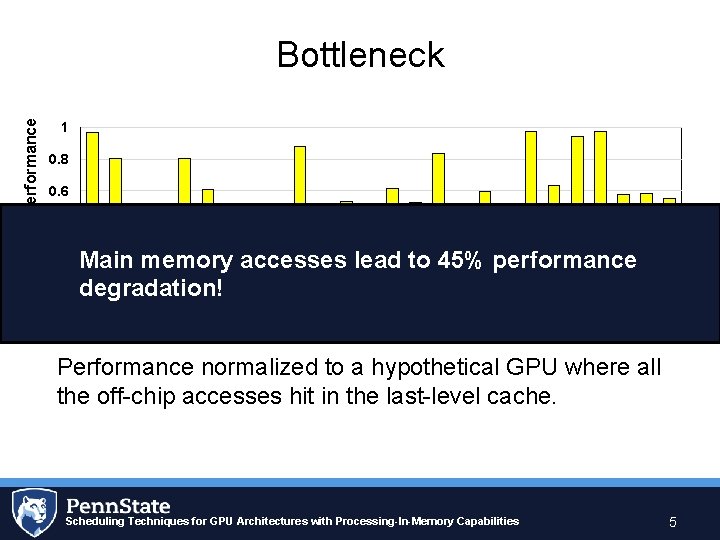
1 0. 8 0. 6 0. 4 g av A TR SP LI B M ST PV C R R FD T G D R A M LU H M VT PR R ED SC P SL ST A R M A PS P C F C D O N S FW G T U PS C O N V L O C C C LK G B B FS 0 Main memory accesses lead to 45% performance degradation! IC 0. 2 B Normalized Performance Bottleneck Performance normalized to a hypothetical GPU where all the off-chip accesses hit in the last-level cache. Scheduling Techniques for GPU Architectures with Processing-In-Memory Capabilities 5
Outline • Introduction and Motivation • Background and Challenges • Design of Kernel Offloading Mechanism • Design of Concurrent Kernel Management • Simulation Setup and Evaluation • Conclusions Scheduling Techniques for GPU Architectures with Processing-In-Memory Capabilities 6

Revisiting Processing-In-Memory (PIM) • It’s a promising approach to minimize data movement. • The concept dates back to the late 1960 s • Technological limitations of integrating fast computational units in memory was a challenge • Significant advances in adoption of 3 D-stacked memory has – enabled tight integration of memory dies and logic layer – brought computational units into the memory stack Scheduling Techniques for GPU Architectures with Processing-In-Memory Capabilities 7
PIM-Assisted GPU architecture • We integrate PIM units to a GPU based system and we call this as “PIM-Assisted GPU architecture”. • At least one 3 D-stacked memory is integrated with PIM units and is placed adjacent to a traditional GPU design. Scheduling Techniques for GPU Architectures with Processing-In-Memory Capabilities 8
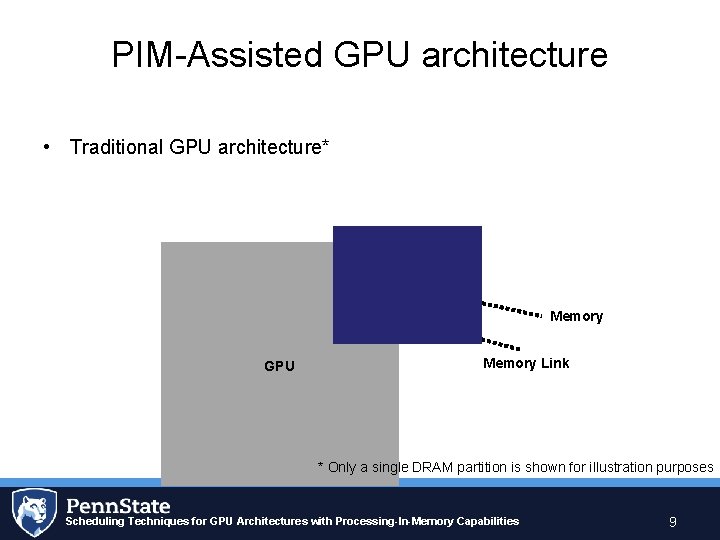
PIM-Assisted GPU architecture • Traditional GPU architecture* Memory GPU Memory Link * Only a single DRAM partition is shown for illustration purposes Scheduling Techniques for GPU Architectures with Processing-In-Memory Capabilities 9

PIM-Assisted GPU architecture • GPU architecture with 3 D-stacked memory on a silicon interposer Memory Dice GPU Memory Link on Interposer Silicon Interposer Scheduling Techniques for GPU Architectures with Processing-In-Memory Capabilities 10
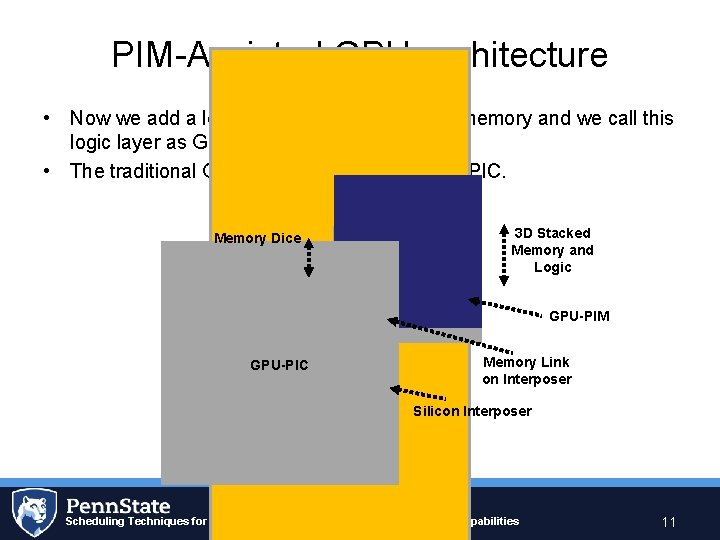
PIM-Assisted GPU architecture • Now we add a logic layer to the 3 D-stacked memory and we call this logic layer as GPU-PIM. • The traditional GPU logic is now called GPU-PIC. Memory Dice 3 D Stacked Memory and Logic GPU-PIM GPU-PIC Memory Link on Interposer Silicon Interposer Scheduling Techniques for GPU Architectures with Processing-In-Memory Capabilities 11
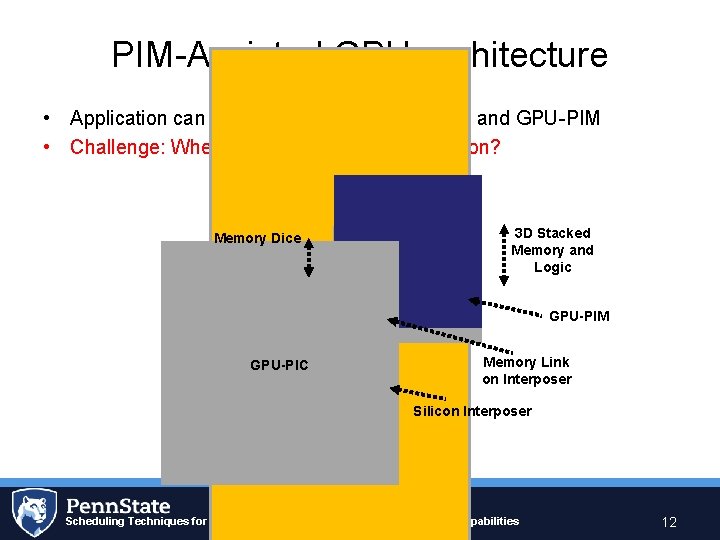
PIM-Assisted GPU architecture • Application can now be run on both GPU-PIC and GPU-PIM • Challenge: Where to execute the application on? Memory Dice 3 D Stacked Memory and Logic GPU-PIM GPU-PIC Memory Link on Interposer Silicon Interposer Scheduling Techniques for GPU Architectures with Processing-In-Memory Capabilities 12

Application Offloading • We evaluate application execution on either GPU-PIC or GPU-PIM Normalized IPC GPU-PIM Best Application Offloading 2. 46 2. 64 1. 5 1. 3 1. 1 0. 9 0. 7 A M ea n G TR SP SP PV B M ST LI S FW T G U PS N C C 5. 95 2. 64 O P FD C PS M A R A ST SL P SC ED R GPU-PIM C 2. 51 1. 3 PR M VT H LU M A R TD G FD C C O O R N R V L C C LK GPU-PIC 1. 5 Best Application Offloading 2. 60 2. 50 2. 1 1. 1 0. 9 0. 7 Scheduling Techniques for GPU Architectures with Processing-In-Memory Capabilities n G M ea A TR PV M ST B LI PS U T G FW S N O FD C C P PS A M ST R A SL P SC ED R PR M VT H LU M A R TD G FD O R R V N O C C LK B G IC B FS 0. 5 B Normalized Energy Efficiency (Inst. /Joule) B G IC B B FS Optimal application offloading scheme provides 16% and 0. 5 28% improvements in performance and energy efficiency, respectively. 13
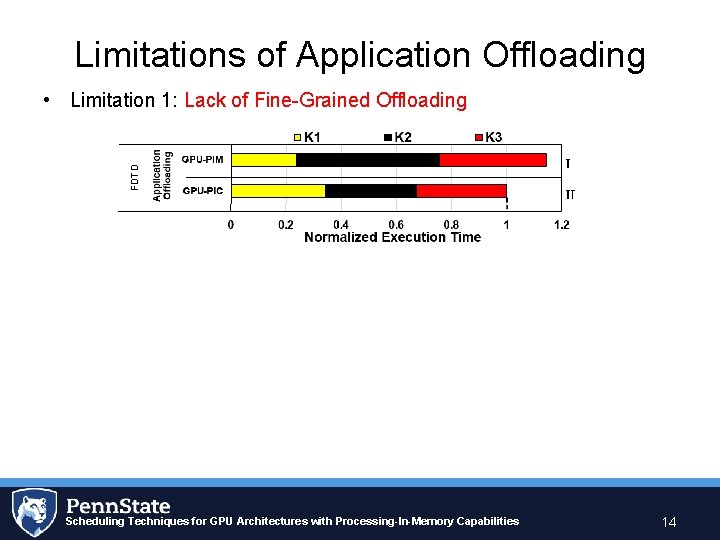
Limitations of Application Offloading FDTD • Limitation 1: Lack of Fine-Grained Offloading Scheduling Techniques for GPU Architectures with Processing-In-Memory Capabilities 14
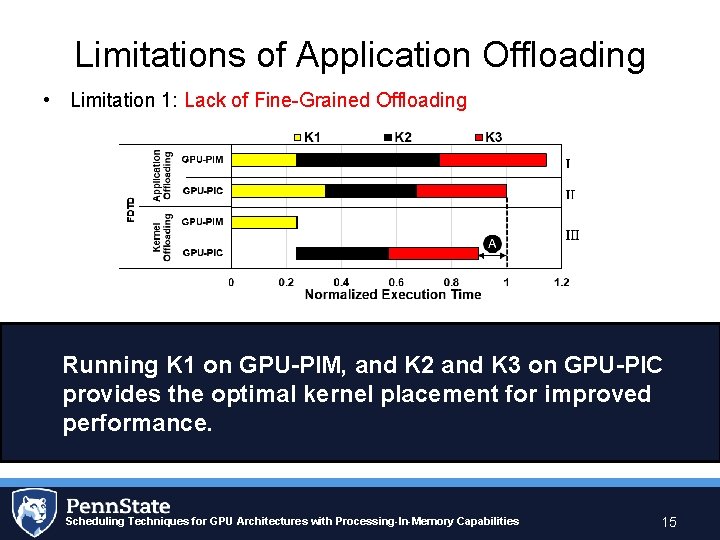
Limitations of Application Offloading • Limitation 1: Lack of Fine-Grained Offloading Running K 1 on GPU-PIM, and K 2 and K 3 on GPU-PIC provides the optimal kernel placement for improved performance. Scheduling Techniques for GPU Architectures with Processing-In-Memory Capabilities 15
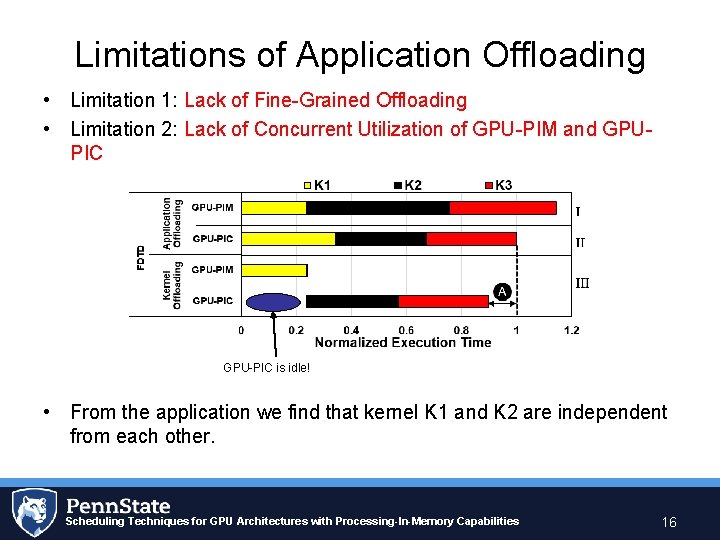
Limitations of Application Offloading • Limitation 1: Lack of Fine-Grained Offloading • Limitation 2: Lack of Concurrent Utilization of GPU-PIM and GPUPIC GPU-PIC is idle! • From the application we find that kernel K 1 and K 2 are independent from each other. Scheduling Techniques for GPU Architectures with Processing-In-Memory Capabilities 16
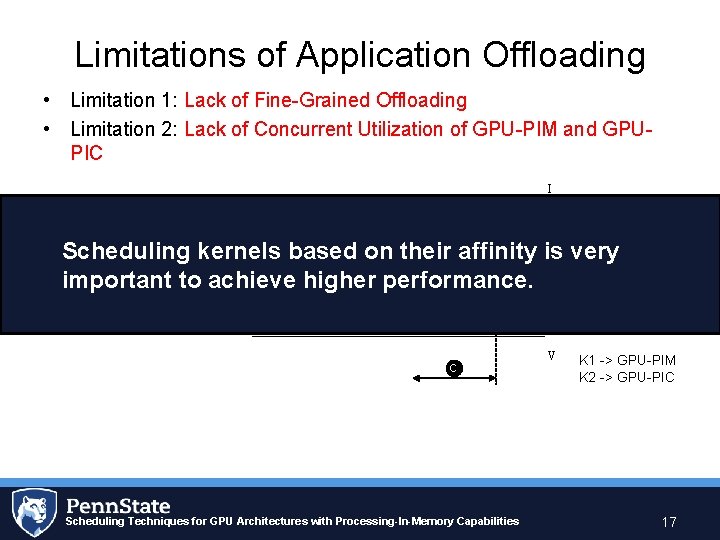
Limitations of Application Offloading • Limitation 1: Lack of Fine-Grained Offloading • Limitation 2: Lack of Concurrent Utilization of GPU-PIM and GPUPIC I II III very Scheduling kernels based on their affinity is A important to achieve higher performance. B IV V C Scheduling Techniques for GPU Architectures with Processing-In-Memory Capabilities K 1 -> GPU-PIC K 2 -> GPU-PIM K 1 -> GPU-PIM K 2 -> GPU-PIC 17
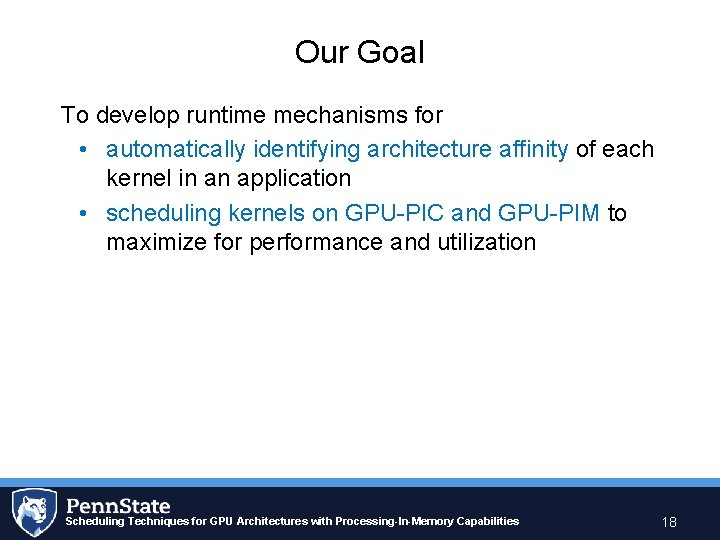
Our Goal To develop runtime mechanisms for • automatically identifying architecture affinity of each kernel in an application • scheduling kernels on GPU-PIC and GPU-PIM to maximize for performance and utilization Scheduling Techniques for GPU Architectures with Processing-In-Memory Capabilities 18
Outline • Introduction and Motivation • Background and Challenges • Design of Kernel Offloading Mechanism • Design of Concurrent Kernel Management • Simulation Setup and Evaluation • Conclusions Scheduling Techniques for GPU Architectures with Processing-In-Memory Capabilities 19
Design of Kernel Offloading Mechanism • Goal: Offload kernels to either GPU-PIC or GPU-PIM to maximize performance • Challenge: Need to know the architecture affinity of the kernels • We build an architecture affinity prediction model Scheduling Techniques for GPU Architectures with Processing-In-Memory Capabilities 20
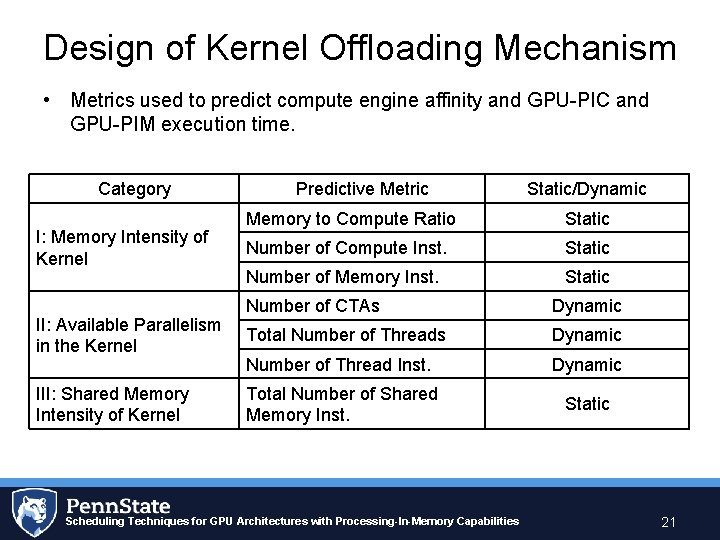
Design of Kernel Offloading Mechanism • Metrics used to predict compute engine affinity and GPU-PIC and GPU-PIM execution time. Category I: Memory Intensity of Kernel II: Available Parallelism in the Kernel III: Shared Memory Intensity of Kernel Predictive Metric Static/Dynamic Memory to Compute Ratio Static Number of Compute Inst. Static Number of Memory Inst. Static Number of CTAs Dynamic Total Number of Threads Dynamic Number of Thread Inst. Dynamic Total Number of Shared Memory Inst. Static Scheduling Techniques for GPU Architectures with Processing-In-Memory Capabilities 21
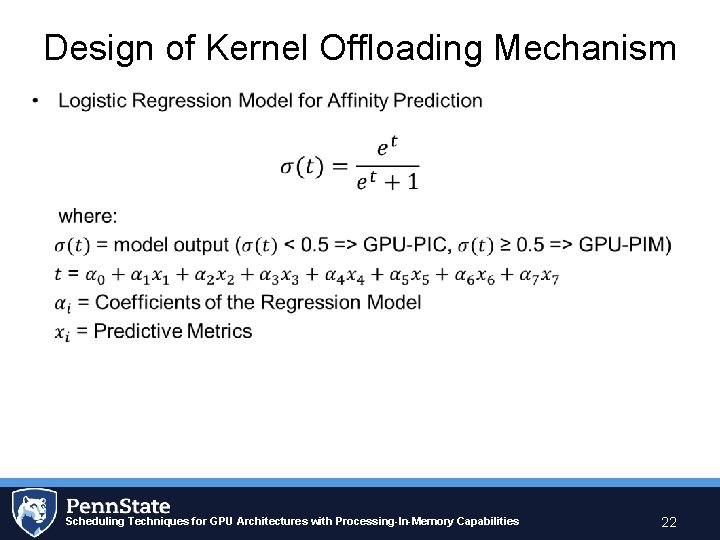
Design of Kernel Offloading Mechanism • Scheduling Techniques for GPU Architectures with Processing-In-Memory Capabilities 22
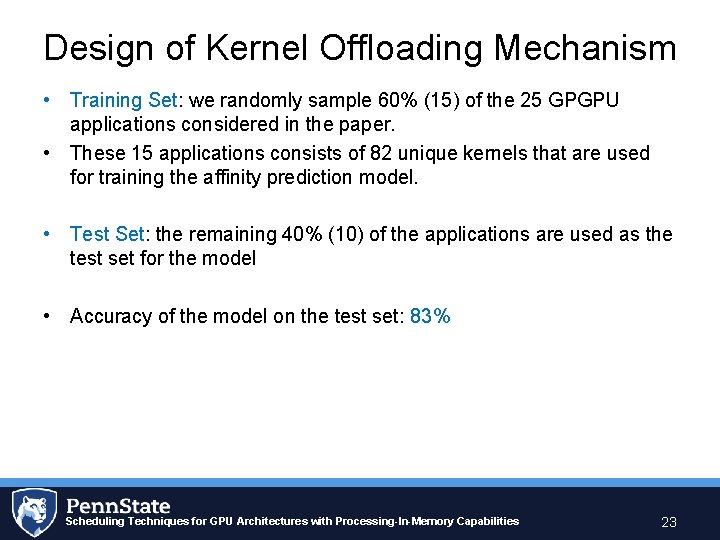
Design of Kernel Offloading Mechanism • Training Set: we randomly sample 60% (15) of the 25 GPGPU applications considered in the paper. • These 15 applications consists of 82 unique kernels that are used for training the affinity prediction model. • Test Set: the remaining 40% (10) of the applications are used as the test set for the model • Accuracy of the model on the test set: 83% Scheduling Techniques for GPU Architectures with Processing-In-Memory Capabilities 23
Outline • Introduction and Motivation • Background and Challenges • Design of Kernel Offloading Mechanism • Design of Concurrent Kernel Management • Simulation Setup and Evaluation • Conclusions Scheduling Techniques for GPU Architectures with Processing-In-Memory Capabilities 24
Design of Concurrent Kernel Management • Goal: Efficiently manage the scheduling of concurrent kernels to improve performance and utilization of the PIM-Assisted GPU architecture • For efficiently managing kernel execution on both GPU-PIM and GPU-PIC, we need – Kernel-level Dependence Information – Architecture Affinity Information – Execution Time Information Scheduling Techniques for GPU Architectures with Processing-In-Memory Capabilities 25
Design of Concurrent Kernel Management • For efficiently managing kernel execution on both GPU-PIM and GPU-PIC, we need – Kernel-level Dependence Information • Obtained through exhaustive analysis to find RAW dependence for all considered applications and input pairs – Architecture Affinity Information – Execution Time Information Scheduling Techniques for GPU Architectures with Processing-In-Memory Capabilities 26
Design of Concurrent Kernel Management • For efficiently managing kernel execution on both GPU-PIM and GPU-PIC, we need – Kernel-level Dependence Information • Obtained through exhaustive analysis to find RAW dependence for all considered applications and input pairs – Architecture Affinity Information • Utilizes the affinity prediction model built for kernel offloading mechanism – Execution Time Information Scheduling Techniques for GPU Architectures with Processing-In-Memory Capabilities 27
Design of Concurrent Kernel Management • For efficiently managing kernel execution on both GPU-PIM and GPU-PIC, we need – Kernel-level Dependence Information • Obtained through exhaustive analysis to find RAW dependence for all considered applications and input pairs – Architecture Affinity Information • Utilizes the affinity prediction model built for kernel offloading mechanism – Execution Time Information • We build linear regression models for execution time prediction on GPU-PIC and GPU-PIM • We use the same “Predictive metrics” and training set used for affinity prediction model Scheduling Techniques for GPU Architectures with Processing-In-Memory Capabilities 28
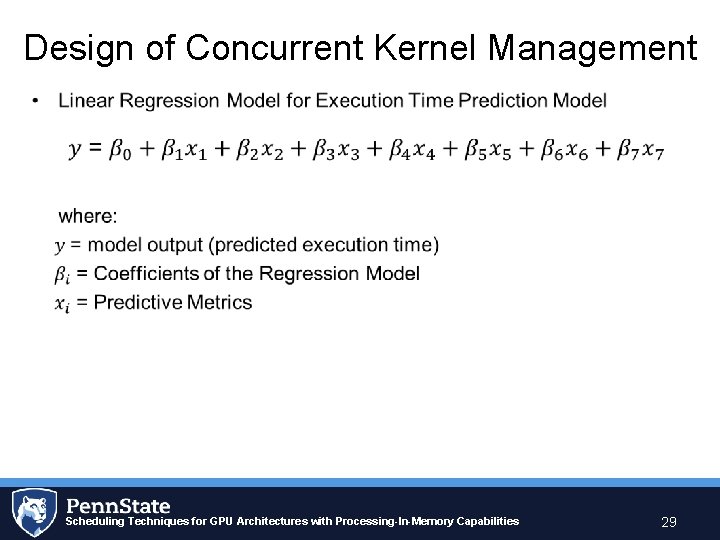
Design of Concurrent Kernel Management • Scheduling Techniques for GPU Architectures with Processing-In-Memory Capabilities 29
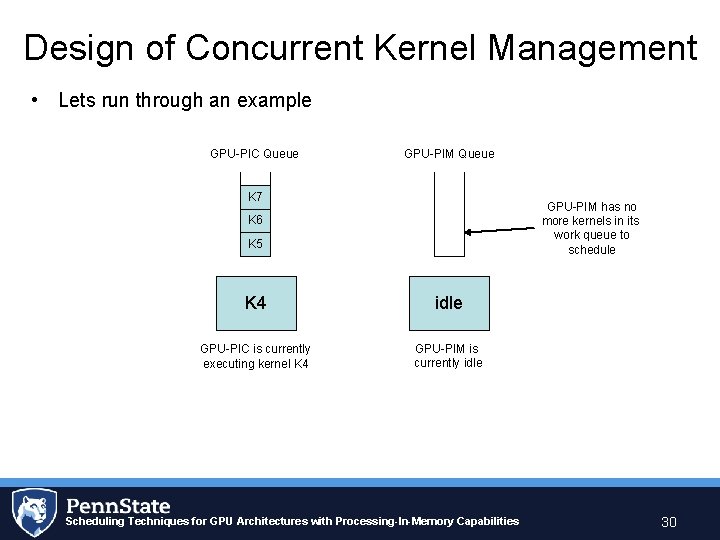
Design of Concurrent Kernel Management • Lets run through an example GPU-PIC Queue GPU-PIM Queue K 7 GPU-PIM has no more kernels in its work queue to schedule K 6 K 5 K 4 idle GPU-PIC is currently executing kernel K 4 GPU-PIM is currently idle Scheduling Techniques for GPU Architectures with Processing-In-Memory Capabilities 30
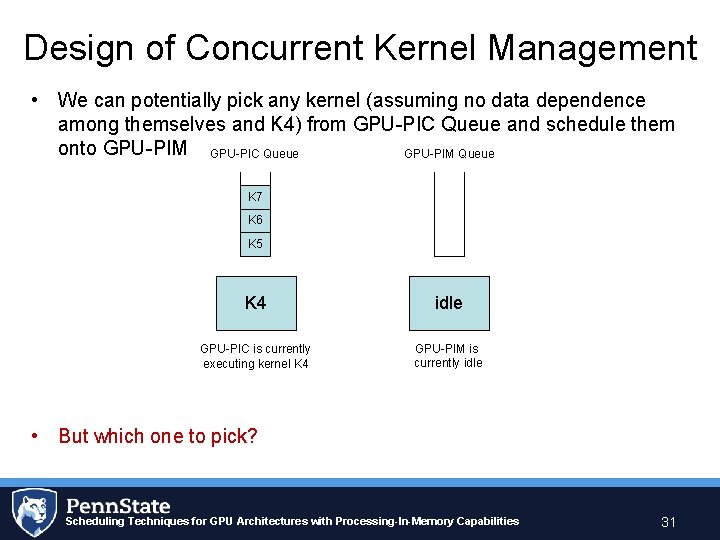
Design of Concurrent Kernel Management • We can potentially pick any kernel (assuming no data dependence among themselves and K 4) from GPU-PIC Queue and schedule them onto GPU-PIM GPU-PIC Queue GPU-PIM Queue K 7 K 6 K 5 K 4 idle GPU-PIC is currently executing kernel K 4 GPU-PIM is currently idle • But which one to pick? Scheduling Techniques for GPU Architectures with Processing-In-Memory Capabilities 31
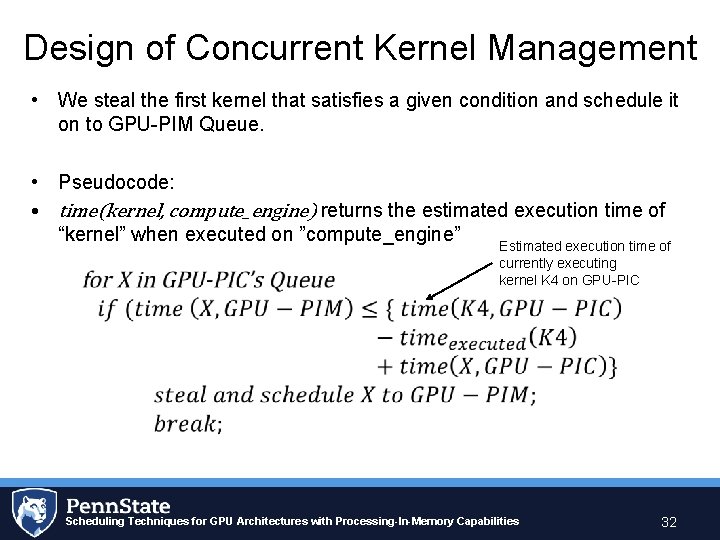
Design of Concurrent Kernel Management • We steal the first kernel that satisfies a given condition and schedule it on to GPU-PIM Queue. • Pseudocode: • time(kernel, compute_engine) returns the estimated execution time of “kernel” when executed on ”compute_engine” Estimated execution time of currently executing kernel K 4 on GPU-PIC Scheduling Techniques for GPU Architectures with Processing-In-Memory Capabilities 32
Outline • Introduction and Motivation • Background and Challenges • Design of Kernel Offloading Mechanism • Design of Concurrent Kernel Management • Simulation Setup and Evaluation • Conclusions Scheduling Techniques for GPU Architectures with Processing-In-Memory Capabilities 33
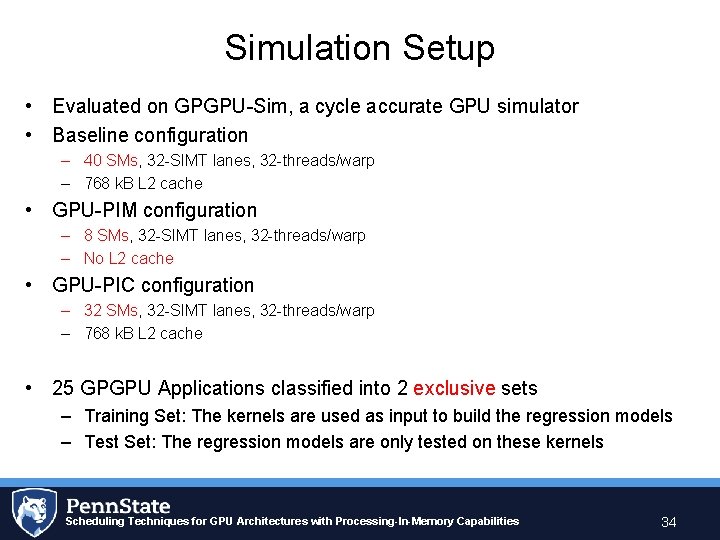
Simulation Setup • Evaluated on GPGPU-Sim, a cycle accurate GPU simulator • Baseline configuration – 40 SMs, 32 -SIMT lanes, 32 -threads/warp – 768 k. B L 2 cache • GPU-PIM configuration – 8 SMs, 32 -SIMT lanes, 32 -threads/warp – No L 2 cache • GPU-PIC configuration – 32 SMs, 32 -SIMT lanes, 32 -threads/warp – 768 k. B L 2 cache • 25 GPGPU Applications classified into 2 exclusive sets – Training Set: The kernels are used as input to build the regression models – Test Set: The regression models are only tested on these kernels Scheduling Techniques for GPU Architectures with Processing-In-Memory Capabilities 34
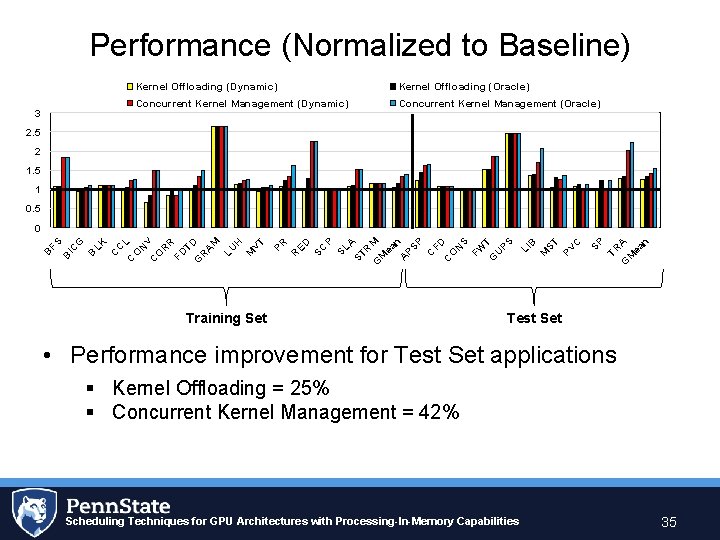
Performance (Normalized to Baseline) 3 Kernel Offloading (Dynamic) Kernel Offloading (Oracle) Concurrent Kernel Management (Dynamic) Concurrent Kernel Management (Oracle) 2. 5 2 1. 5 1 0. 5 Training Set TR G A M ea n SP P A ST R G M M ea n A PS P C FD C O N S FW T G U PS LI B M ST PV C SL SC ED R PR R R FD TD G R A M LU H M VT C O N V L O C C C LK B G IC B B FS 0 Test Set • Performance improvement for Test Set applications § Kernel Offloading = 25% § Concurrent Kernel Management = 42% Scheduling Techniques for GPU Architectures with Processing-In-Memory Capabilities 35
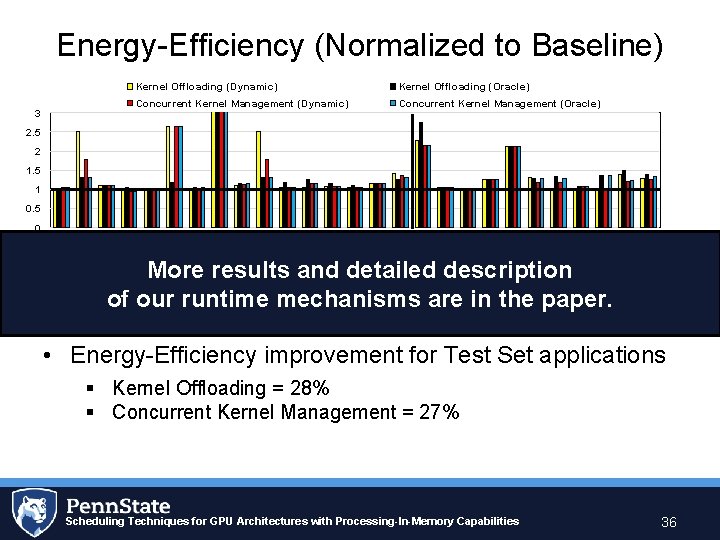
Energy-Efficiency (Normalized to Baseline) 3 Kernel Offloading (Dynamic) Kernel Offloading (Oracle) Concurrent Kernel Management (Dynamic) Concurrent Kernel Management (Oracle) 2. 5 2 1. 5 1 0. 5 TR G A M ea n SP P A ST R G M M ea n A PS P C FD C O N S FW T G U PS LI B M ST PV C SL SC ED R PR R R FD TD G R A M LU H M VT O N V L O C C LK B C More results and detailed description of our runtime mechanisms are in the paper. C G IC B B FS 0 Training Set Test Set • Energy-Efficiency improvement for Test Set applications § Kernel Offloading = 28% § Concurrent Kernel Management = 27% Scheduling Techniques for GPU Architectures with Processing-In-Memory Capabilities 36
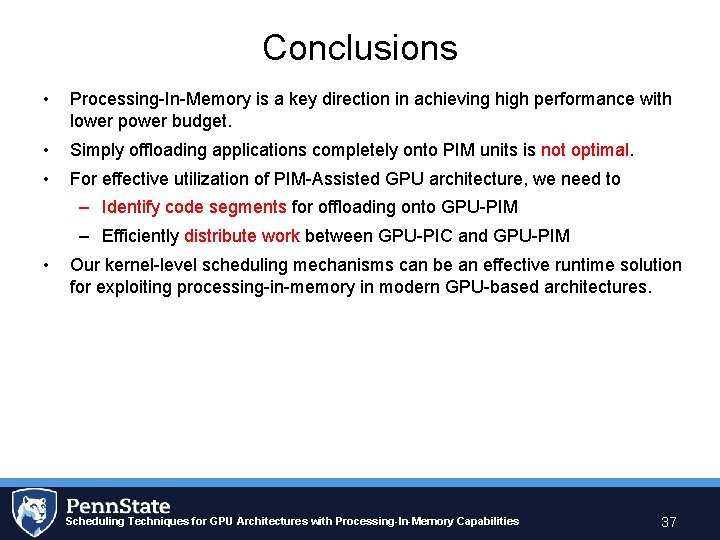
Conclusions • Processing-In-Memory is a key direction in achieving high performance with lower power budget. • Simply offloading applications completely onto PIM units is not optimal. • For effective utilization of PIM-Assisted GPU architecture, we need to – Identify code segments for offloading onto GPU-PIM – Efficiently distribute work between GPU-PIC and GPU-PIM • Our kernel-level scheduling mechanisms can be an effective runtime solution for exploiting processing-in-memory in modern GPU-based architectures. Scheduling Techniques for GPU Architectures with Processing-In-Memory Capabilities 37
Scheduling Techniques for GPU Architectures with Processing-In-Memory Capabilities Ashutosh Pattnaik, Xulong Tang, Adwait Jog, Onur Kayıran, Asit Mishra, Mahmut Kandemir, Onur Mutlu, Chita Das. PACT ‘ 16 Scheduling Techniques for GPU Architectures with Processing-In-Memory Capabilities
- Slides: 38