
Scheduling task with heavy tail distributions Eddie Aronovich

Scheduling task with heavy tail distributions Eddie Aronovich

Heavy tail dist.

Some properties… n Infinitive variance (for infinitive mean) n Tiny fraction (usually < 1%) requests comprise over half of total load !
![Some more properties n Expectation paradox: E[X|X>k] ~ k (declining hazard rate) n Mass-count](http://slidetodoc.com/presentation_image_h2/a8f0511fb3bc8180533a5bb30174120d/image-4.jpg "Some more properties n Expectation paradox: E[X|X>k] ~ k (declining hazard rate) n Mass-count")
Some more properties n Expectation paradox: E[X|X>k] ~ k (declining hazard rate) n Mass-count disparity (for n>2)
What is it good for ? n Files size (in both – file systems & web) & data files transferred over the net n I/O traces of fs, disk etc. n Process time, Session time n Name servers & popularity of web sites
Why are they difficult to deal with ? n M/G/1 queue length is proportional to second moment of service time. n Have no closed form Laplace transformation => systems must be numerically evaluated
Some implementations… n Scheduling web servers n Routing & Switching n Load sensitive routing

How web server works ? n Name resolution n Session establishments n Request Reply End of session n n The network is the bottleneck !
Some important knowledge Each computer is identified by address. n Each application is a computer is identified by port number n Socket = {ip-addr, port number} Session = source socket : dest socket File descriptor – identifies socket / session
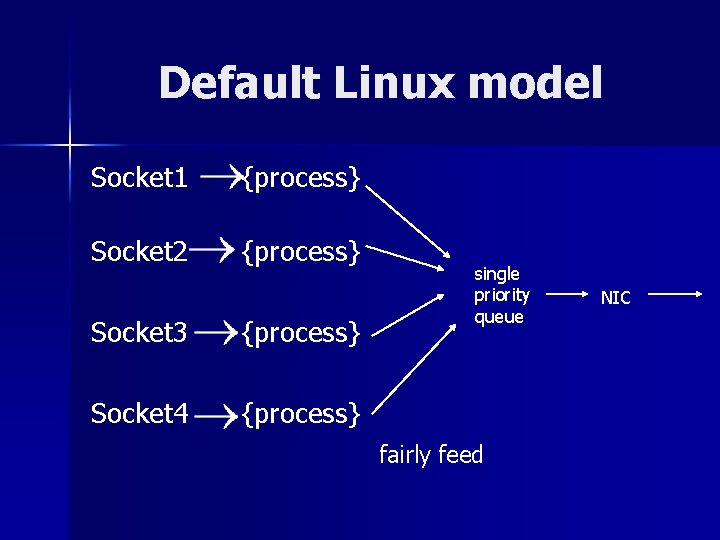
Default Linux model Socket 1 {process} Socket 2 {process} Socket 3 {process} Socket 4 {process} single priority queue fairly feed NIC
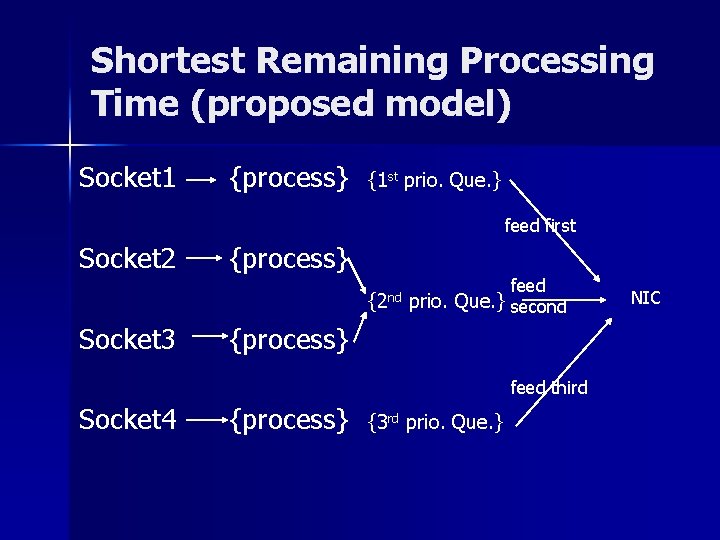
Shortest Remaining Processing Time (proposed model) Socket 1 {process} {1 st prio. Que. } feed first Socket 2 {process} {2 nd Socket 3 feed prio. Que. } second {process} feed third Socket 4 {process} {3 rd prio. Que. } NIC
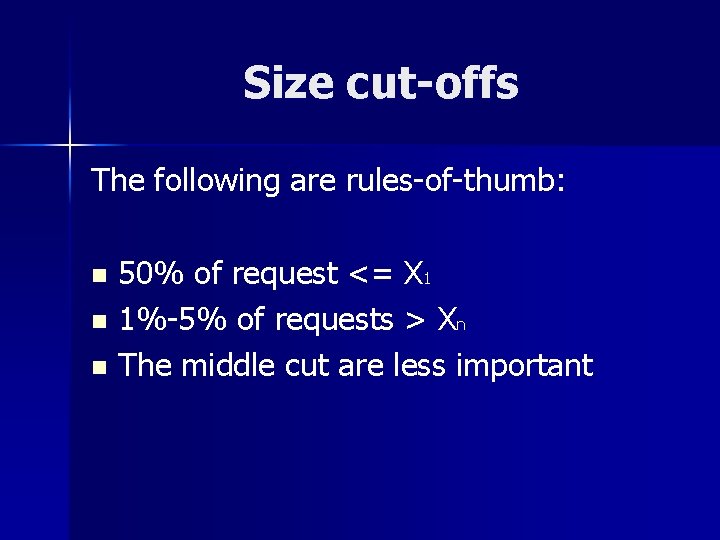
Size cut-offs The following are rules-of-thumb: 50% of request <= X 1 n 1%-5% of requests > Xn n The middle cut are less important n
Evaluated metrics n Mean response time n Mean slowdown (normalized response time) n Mean response time as a function of request size
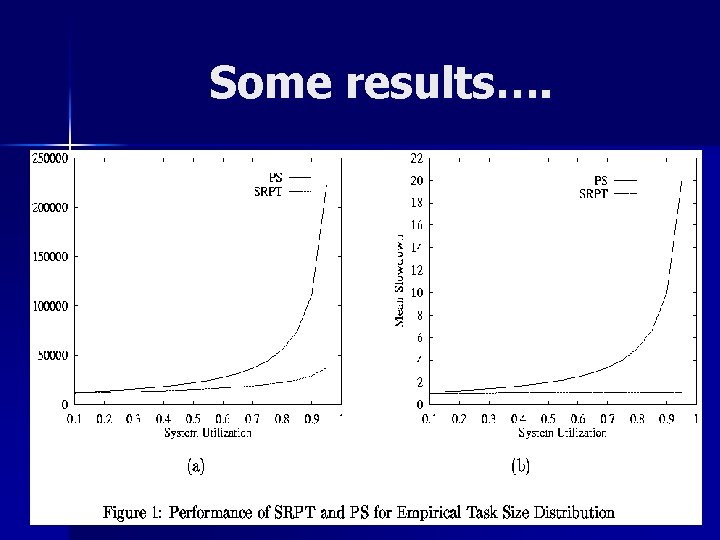
Some results….
Why does it work ? n We know the file size (reply) a-priory n Short requests should wait short time n Linux is easy to be changed
What is next ? n Distributed processing n Task assigment n TAGS
- Slides: 16