
Scheduling Planning with Actions that Require Resources Scheduling
- Slides: 28
Scheduling Planning with Actions that Require Resources Scheduling
Literature l l l Malik Ghallab, Dana Nau, and Paolo Traverso. Automated Planning – Theory and Practice, chapter 15. Elsevier/Morgan Kaufmann, 2004. Michael Pinedo. Scheduling: Theory, Algorithms and Systems, Prentice Hall, 2001. Peter Brucker. Scheduling Algorithms, Springer Verlag, 2004. Scheduling 2
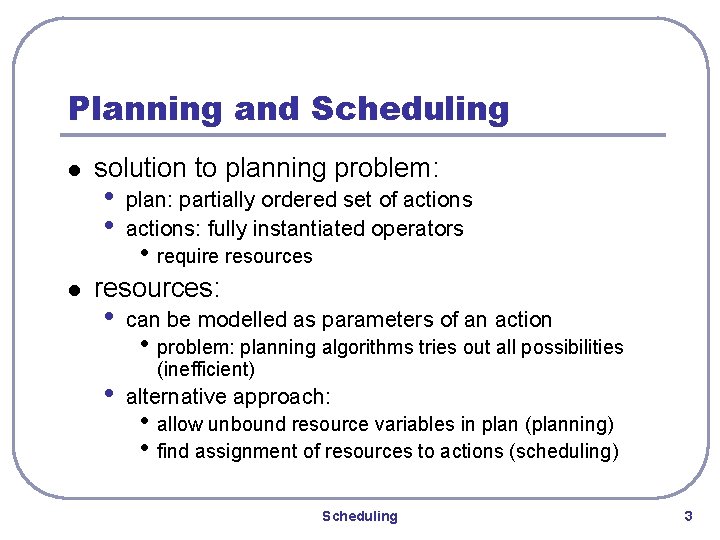
Planning and Scheduling l l solution to planning problem: • • plan: partially ordered set of actions: fully instantiated operators • require resources: • • can be modelled as parameters of an action • problem: planning algorithms tries out all possibilities (inefficient) alternative approach: • allow unbound resource variables in plan (planning) • find assignment of resources to actions (scheduling) Scheduling 3
Overview l Scheduling Problems and Schedules Searching for Schedules Scheduling 4
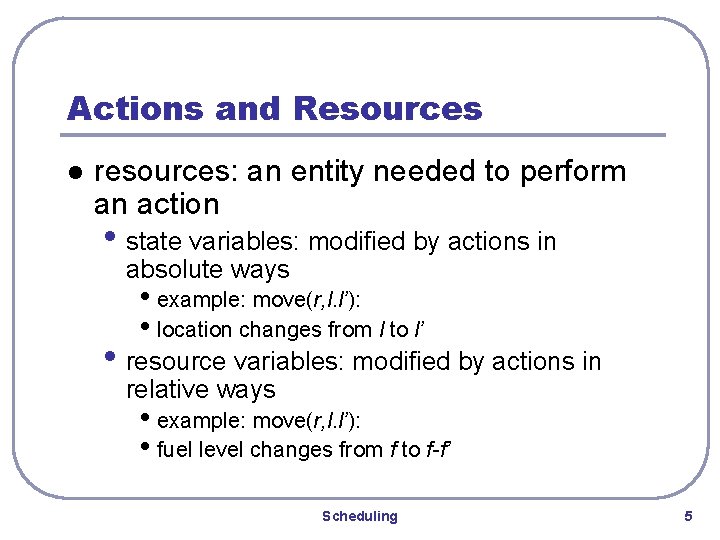
Actions and Resources l resources: an entity needed to perform an action • state variables: modified by actions in absolute ways • example: move(r, l. l’): • location changes from l to l’ • resource variables: modified by actions in relative ways • example: move(r, l. l’): • fuel level changes from f to f-f’ Scheduling 5
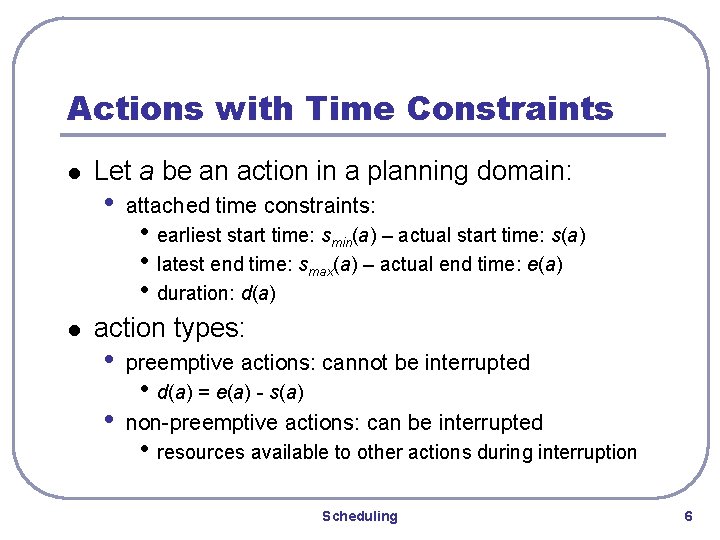
Actions with Time Constraints l l Let a be an action in a planning domain: • attached time constraints: • earliest start time: smin(a) – actual start time: s(a) • latest end time: smax(a) – actual end time: e(a) • duration: d(a) action types: • preemptive actions: cannot be interrupted • non-preemptive actions: can be interrupted • d(a) = e(a) - s(a) • resources available to other actions during interruption Scheduling 6
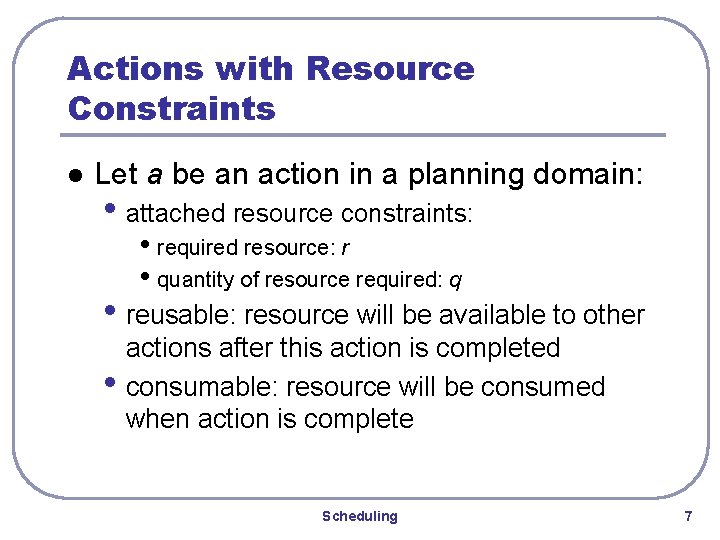
Actions with Resource Constraints l Let a be an action in a planning domain: • attached resource constraints: • required resource: r • quantity of resource required: q • reusable: resource will be available to other • actions after this action is completed consumable: resource will be consumed when action is complete Scheduling 7
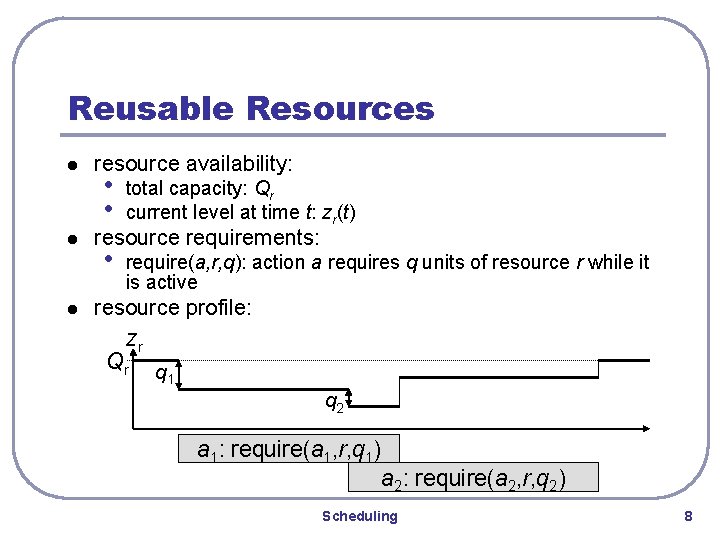
Reusable Resources l l l resource availability: • • total capacity: Qr current level at time t: zr(t) • require(a, r, q): action a requires q units of resource r while it is active resource requirements: resource profile: zr Qr q 1 q 2 a 1: require(a 1, r, q 1) a 2: require(a 2, r, q 2) Scheduling 8
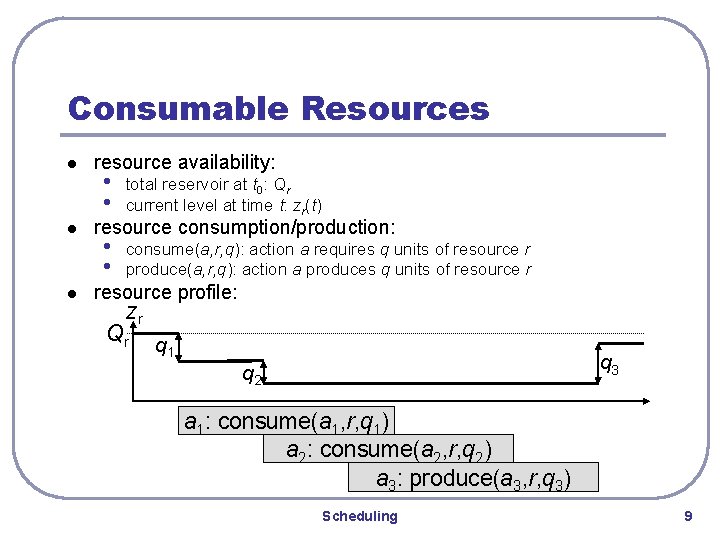
Consumable Resources l l l resource availability: • • total reservoir at t 0: Qr current level at time t: zr(t) • • consume(a, r, q): action a requires q units of resource r produce(a, r, q): action a produces q units of resource r resource consumption/production: resource profile: zr Qr q 1 q 3 q 2 a 1: consume(a 1, r, q 1) a 2: consume(a 2, r, q 2) a 3: produce(a 3, r, q 3) Scheduling 9
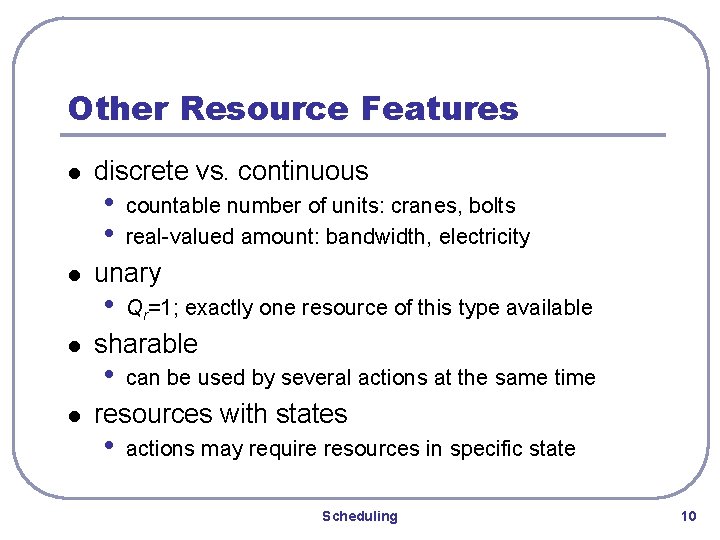
Other Resource Features l l discrete vs. continuous • • countable number of units: cranes, bolts real-valued amount: bandwidth, electricity unary • Qr=1; exactly one resource of this type available sharable • can be used by several actions at the same time resources with states • actions may require resources in specific state Scheduling 10
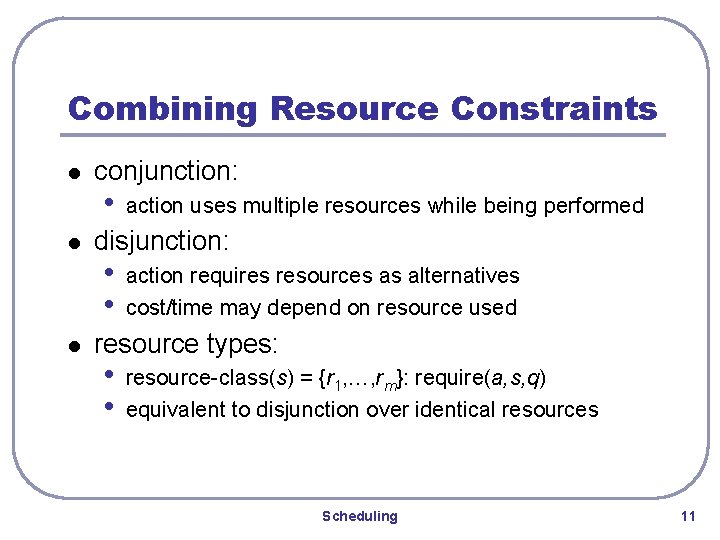
Combining Resource Constraints l l l conjunction: • action uses multiple resources while being performed disjunction: • • action requires resources as alternatives cost/time may depend on resource used resource types: • • resource-class(s) = {r 1, …, rm}: require(a, s, q) equivalent to disjunction over identical resources Scheduling 11
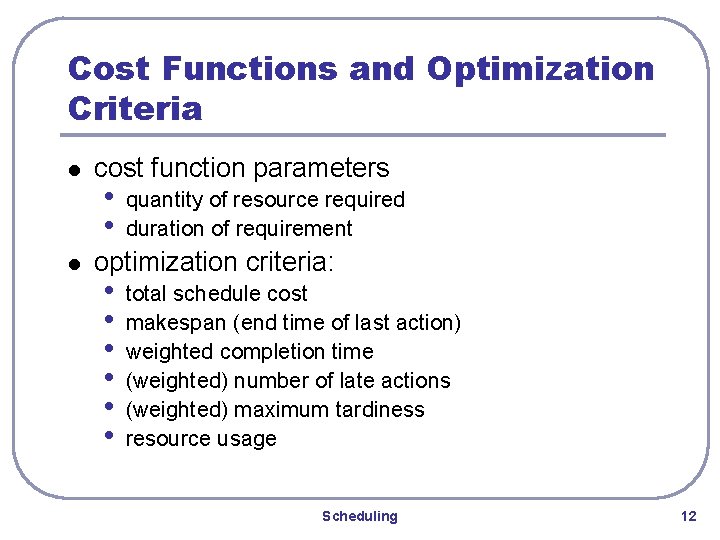
Cost Functions and Optimization Criteria l l cost function parameters • • quantity of resource required duration of requirement optimization criteria: • • • total schedule cost makespan (end time of last action) weighted completion time (weighted) number of late actions (weighted) maximum tardiness resource usage Scheduling 12
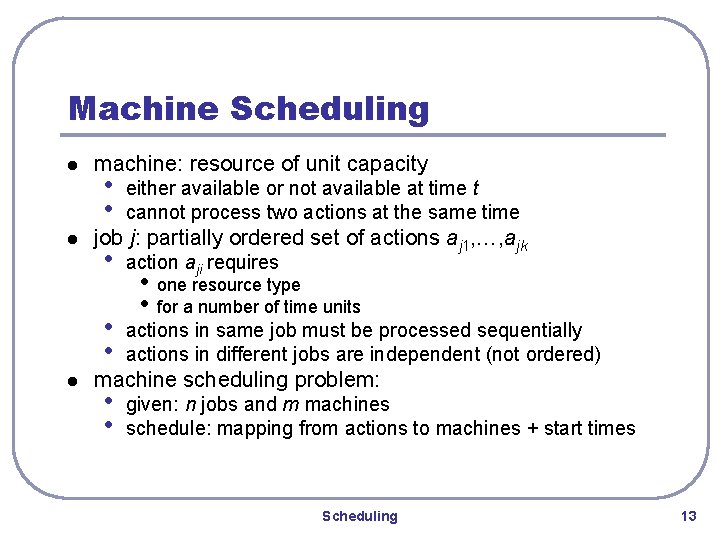
Machine Scheduling l l l machine: resource of unit capacity • • either available or not available at time t cannot process two actions at the same time • action aji requires • • actions in same job must be processed sequentially actions in different jobs are independent (not ordered) • • given: n jobs and m machines schedule: mapping from actions to machines + start times job j: partially ordered set of actions aj 1, …, ajk • • one resource type for a number of time units machine scheduling problem: Scheduling 13
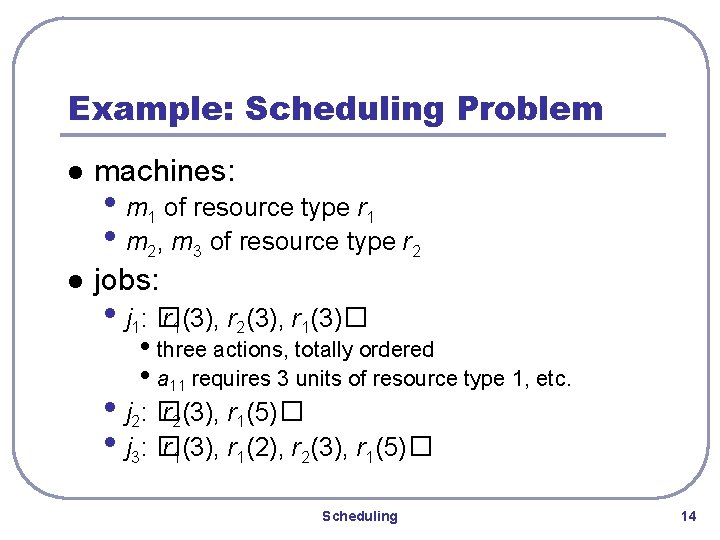
Example: Scheduling Problem l machines: l jobs: • m 1 of resource type r 1 • m 2, m 3 of resource type r 2 • j 1: �r 1(3), r 2(3), r 1(3)� • three actions, totally ordered • a 11 requires 3 units of resource type 1, etc. • j 2: �r 2(3), r 1(5)� • j 3: �r 1(3), r 1(2), r 2(3), r 1(5)� Scheduling 14
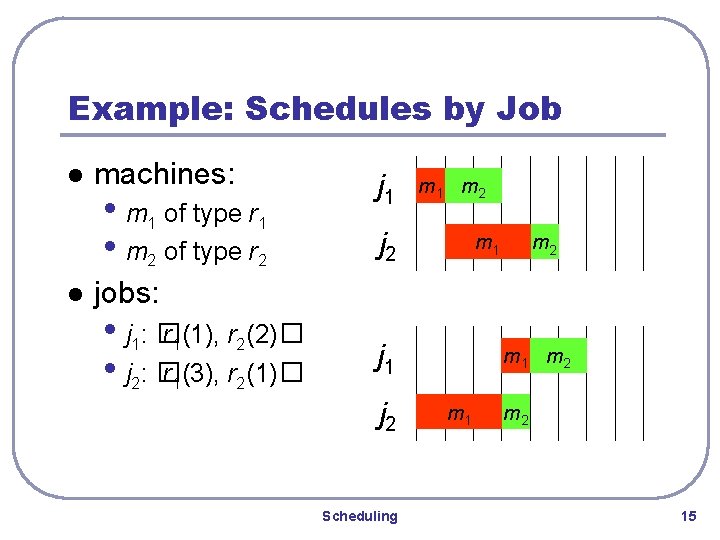
Example: Schedules by Job l l machines: • m 1 of type r 1 • m 2 of type r 2 j 1 m 2 j 2 m 1 m 2 jobs: • j 1: �r 1(1), r 2(2)� • j 2: �r 1(3), r 2(1)� j 1 j 2 Scheduling m 1 m 2 15
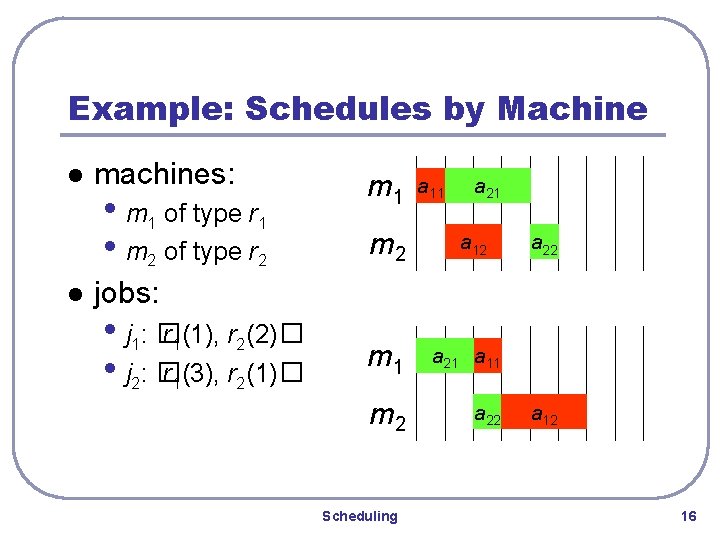
Example: Schedules by Machine l l machines: • m 1 of type r 1 • m 2 of type r 2 m 1 m 2 a 11 a 21 a 12 a 22 jobs: • j 1: �r 1(1), r 2(2)� • j 2: �r 1(3), r 2(1)� m 1 a 21 a 11 m 2 a 22 Scheduling a 12 16
Overview l Scheduling Problems and Schedules Searching for Schedules Scheduling 17
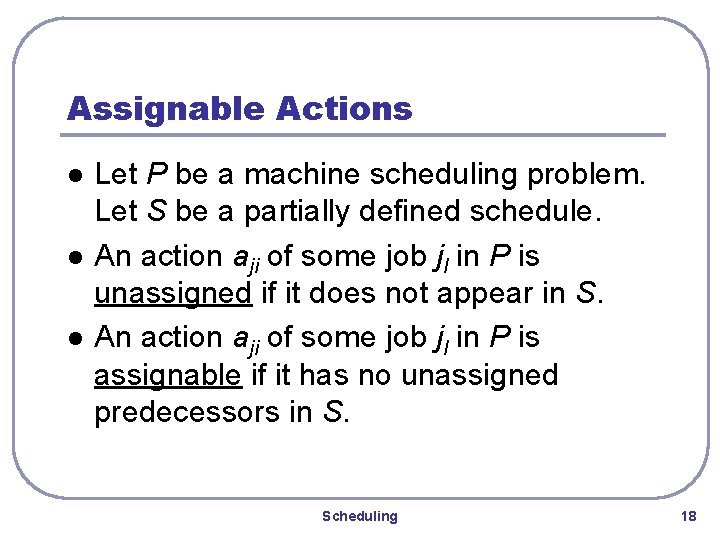
Assignable Actions l l l Let P be a machine scheduling problem. Let S be a partially defined schedule. An action aji of some job jl in P is unassigned if it does not appear in S. An action aji of some job jl in P is assignable if it has no unassigned predecessors in S. Scheduling 18
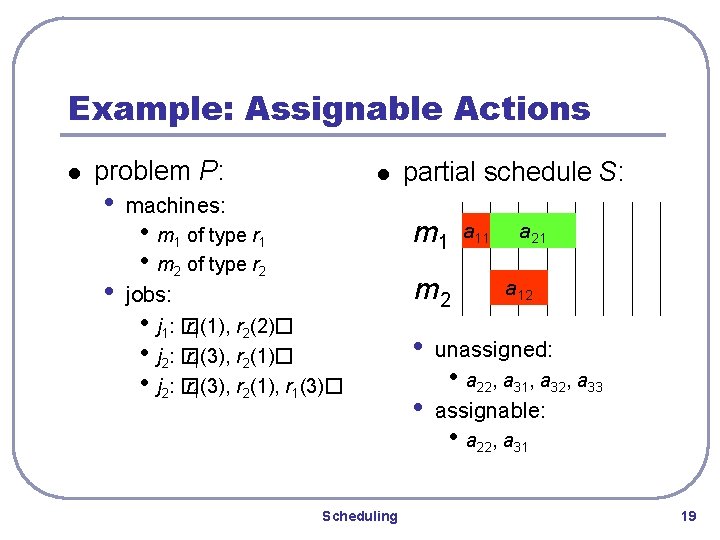
Example: Assignable Actions l problem P: • machines: • jobs: l partial schedule S: m 1 • m 1 of type r 1 • m 2 of type r 2 • j 1: �r 1(1), r 2(2)� • j 2: �r 1(3), r 2(1), r 1(3)� Scheduling m 2 a 11 a 21 a 12 • unassigned: • assignable: • a 22, a 31, a 32, a 33 • a 22, a 31 19
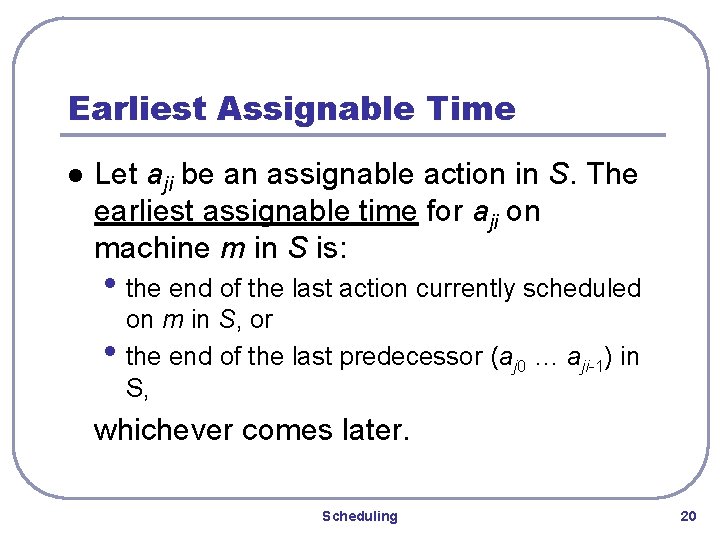
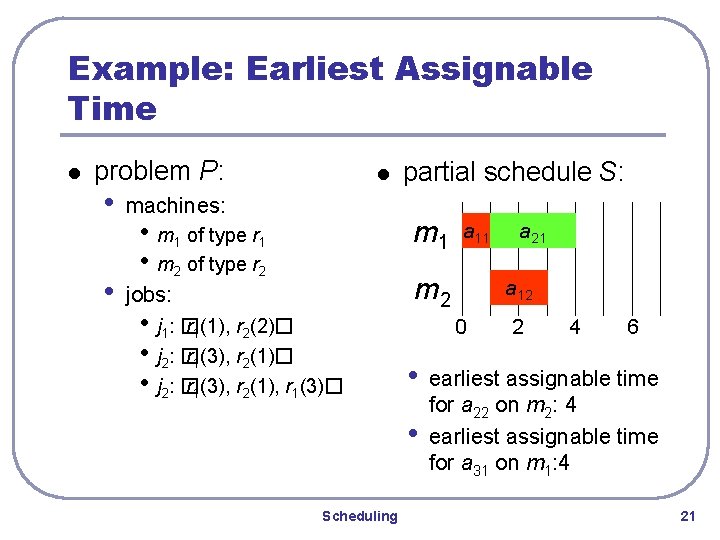
Earliest Assignable Time l Let aji be an assignable action in S. The earliest assignable time for aji on machine m in S is: • the end of the last action currently scheduled • on m in S, or the end of the last predecessor (aj 0 … aji-1) in S, whichever comes later. Scheduling 20
Example: Earliest Assignable Time l problem P: • machines: • jobs: l partial schedule S: m 1 • m 1 of type r 1 • m 2 of type r 2 • j 1: �r 1(1), r 2(2)� • j 2: �r 1(3), r 2(1), r 1(3)� m 2 • a 21 a 12 0 • Scheduling a 11 2 4 6 earliest assignable time for a 22 on m 2: 4 earliest assignable time for a 31 on m 1: 4 21
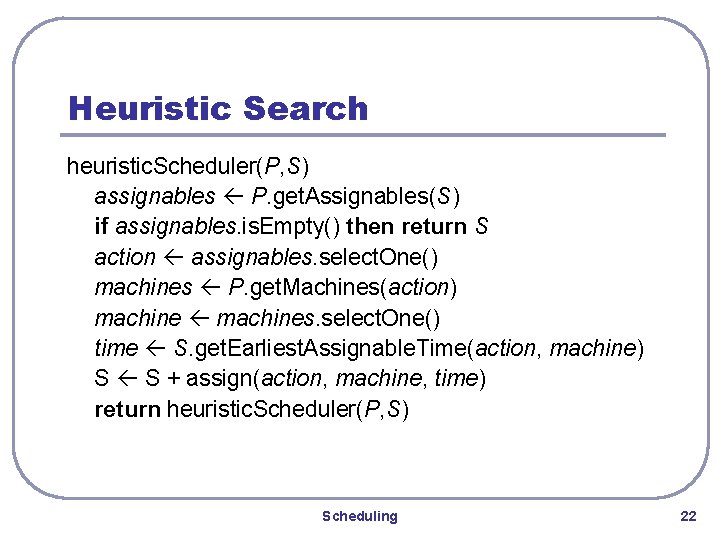
Heuristic Search heuristic. Scheduler(P, S) assignables P. get. Assignables(S) if assignables. is. Empty() then return S action assignables. select. One() machines P. get. Machines(action) machines. select. One() time S. get. Earliest. Assignable. Time(action, machine) S S + assign(action, machine, time) return heuristic. Scheduler(P, S) Scheduling 22
Using Local Search l issues: • representing schedules • generating a random initial schedule • generating neighbours • evaluating neighbours (schedules) Scheduling 23
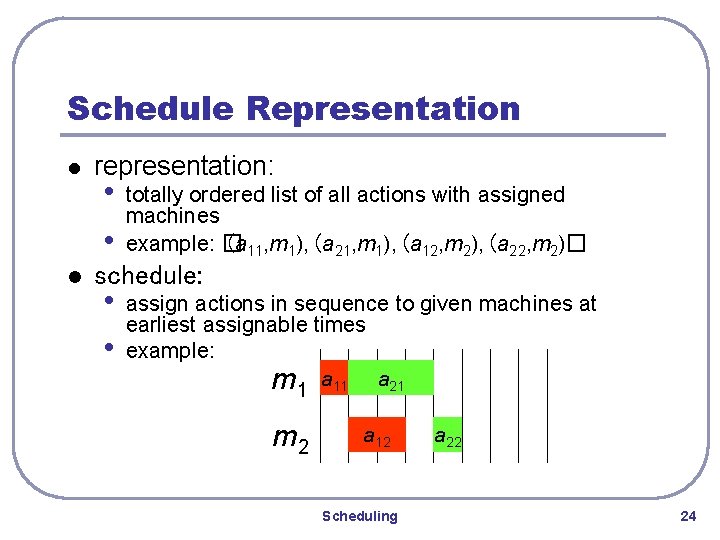
Schedule Representation l l representation: • • totally ordered list of all actions with assigned machines example: � (a 11, m 1), (a 21, m 1), (a 12, m 2), (a 22, m 2)� schedule: • • assign actions in sequence to given machines at earliest assignable times example: m a 11 a 21 1 m 2 a 12 Scheduling a 22 24
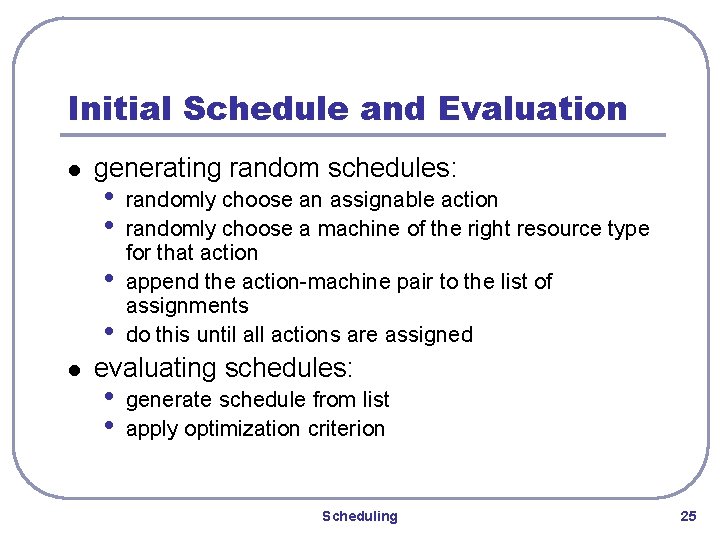
Initial Schedule and Evaluation l generating random schedules: • • l randomly choose an assignable action randomly choose a machine of the right resource type for that action append the action-machine pair to the list of assignments do this until all actions are assigned evaluating schedules: • • generate schedule from list apply optimization criterion Scheduling 25
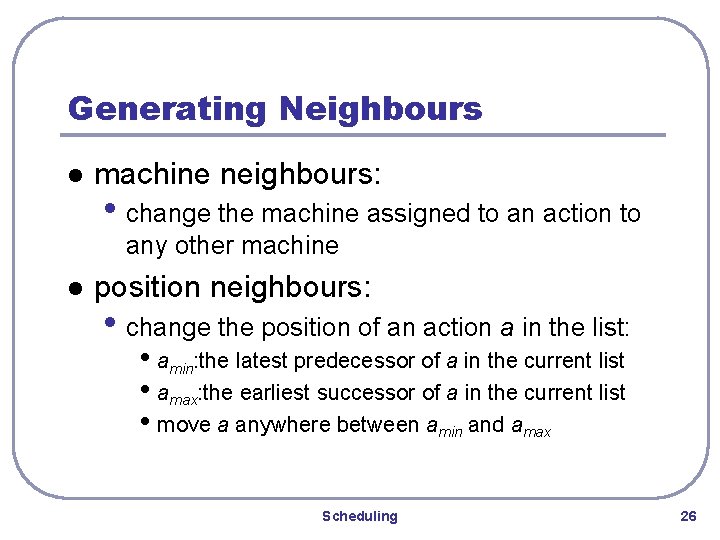
Generating Neighbours l machine neighbours: • change the machine assigned to an action to any other machine l position neighbours: • change the position of an action a in the list: • amin: the latest predecessor of a in the current list • amax: the earliest successor of a in the current list • move a anywhere between amin and amax Scheduling 26
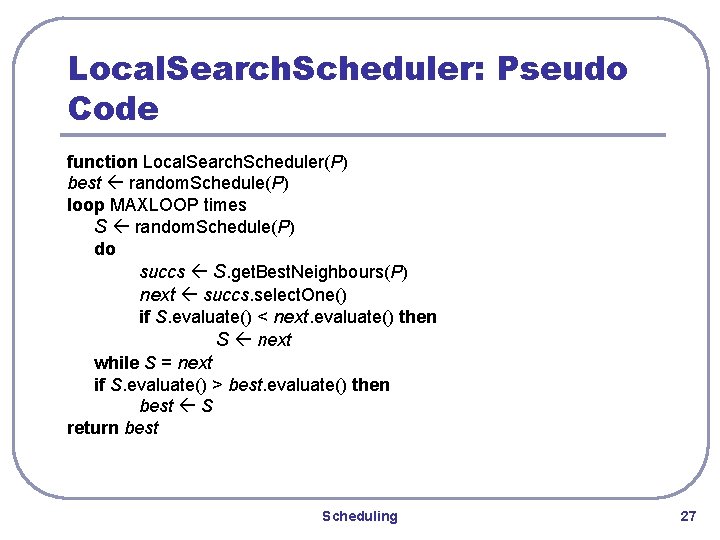
Local. Search. Scheduler: Pseudo Code function Local. Search. Scheduler(P) best random. Schedule(P) loop MAXLOOP times S random. Schedule(P) do succs S. get. Best. Neighbours(P) next succs. select. One() if S. evaluate() < next. evaluate() then S next while S = next if S. evaluate() > best. evaluate() then best S return best Scheduling 27
Overview l l Scheduling Problems and Schedules Searching for Schedules Scheduling 28