
Scheduling Overview Conjunctive Graph Potentials properties and existence
- Slides: 11
Scheduling Overview Conjunctive Graph; Potentials, properties and existence conditions; Methods for scheduling; Potential task method Pert method;
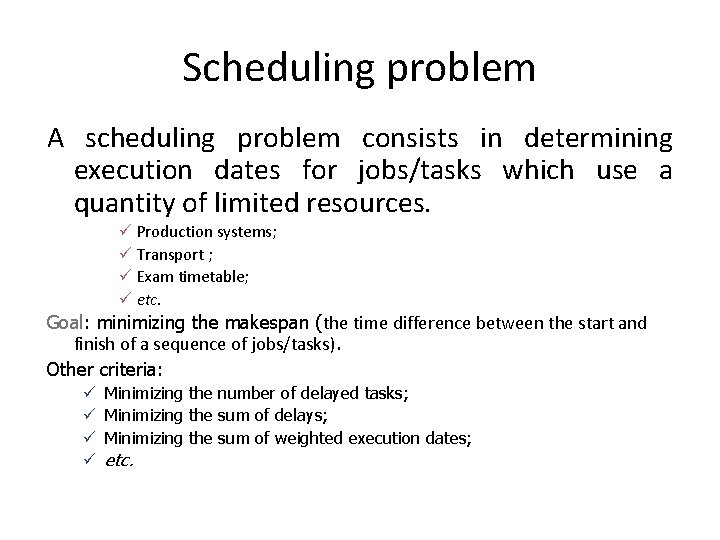
Scheduling problem A scheduling problem consists in determining execution dates for jobs/tasks which use a quantity of limited resources. ü Production systems; ü Transport ; ü Exam timetable; ü etc. Goal: minimizing the makespan (the time difference between the start and finish of a sequence of jobs/tasks). Other criteria: ü ü Minimizing the number of delayed tasks; Minimizing the sum of delays; Minimizing the sum of weighted execution dates; etc.
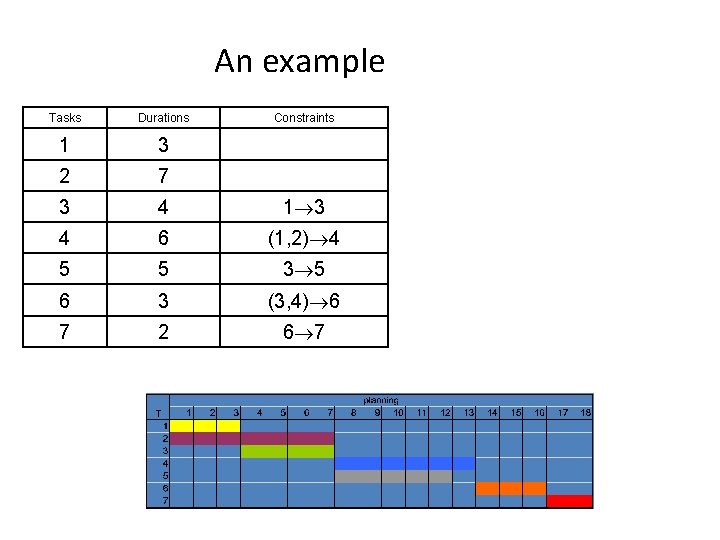
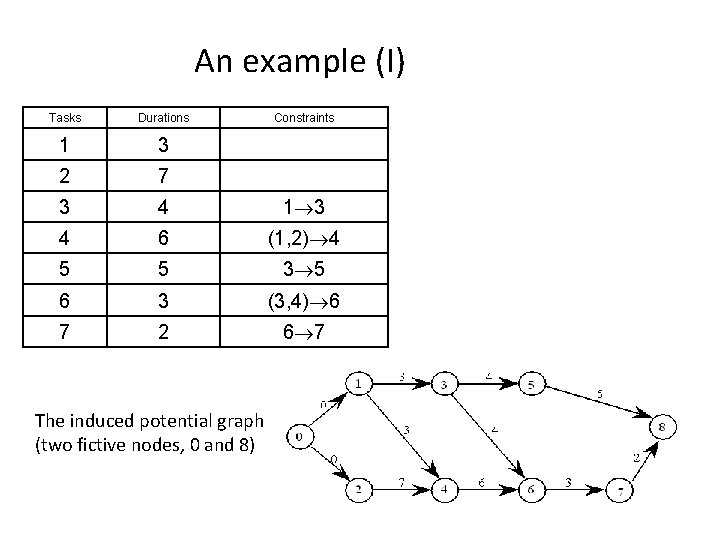
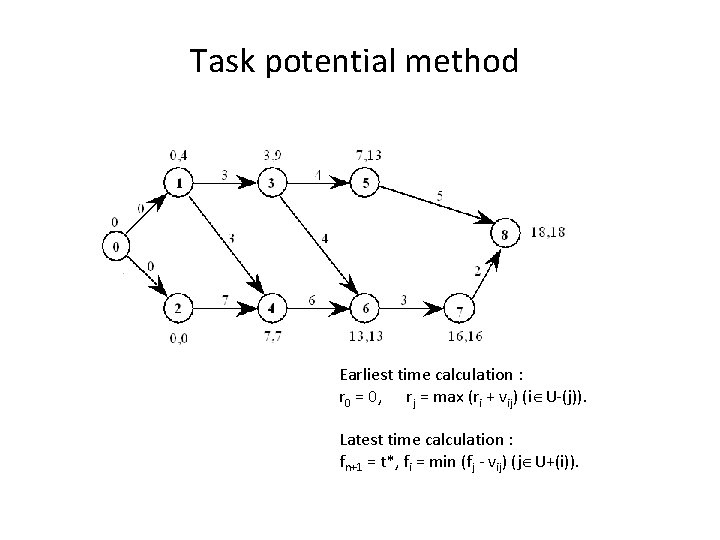
An example Tasks Durations Constraints 1 3 2 7 3 4 1 3 4 6 (1, 2) 4 5 5 3 5 6 3 (3, 4) 6 7 2 6 7
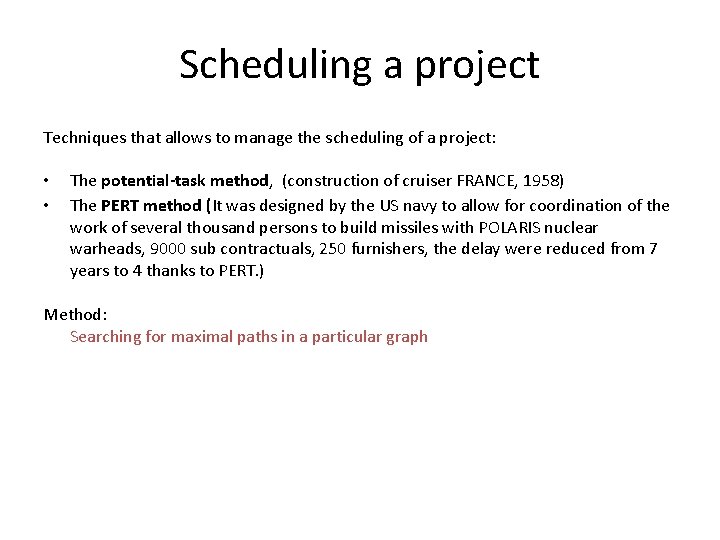
Scheduling a project Techniques that allows to manage the scheduling of a project: • • The potential-task method, (construction of cruiser FRANCE, 1958) The PERT method (It was designed by the US navy to allow for coordination of the work of several thousand persons to build missiles with POLARIS nuclear warheads, 9000 sub contractuals, 250 furnishers, the delay were reduced from 7 years to 4 thanks to PERT. ) Method: Searching for maximal paths in a particular graph
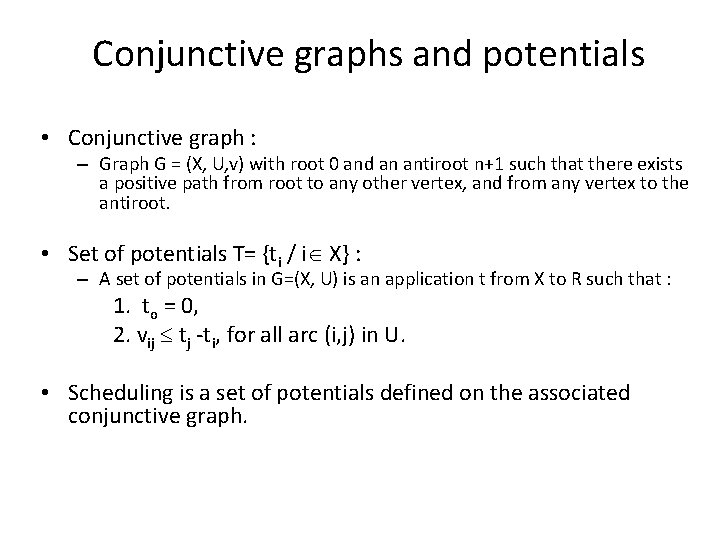
Conjunctive graphs and potentials • Conjunctive graph : – Graph G = (X, U, v) with root 0 and an antiroot n+1 such that there exists a positive path from root to any other vertex, and from any vertex to the antiroot. • Set of potentials T= {ti / iÎ X} : – A set of potentials in G=(X, U) is an application t from X to R such that : 1. to = 0, 2. vij tj -ti, for all arc (i, j) in U. • Scheduling is a set of potentials defined on the associated conjunctive graph.
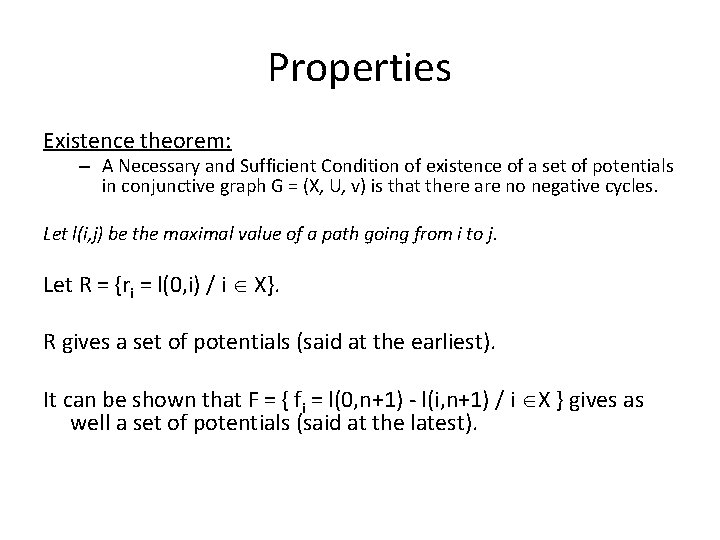
Properties Existence theorem: – A Necessary and Sufficient Condition of existence of a set of potentials in conjunctive graph G = (X, U, v) is that there are no negative cycles. Let l(i, j) be the maximal value of a path going from i to j. Let R = {ri = l(0, i) / i Î X}. R gives a set of potentials (said at the earliest). It can be shown that F = { fi = l(0, n+1) - l(i, n+1) / i ÎX } gives as well a set of potentials (said at the latest).
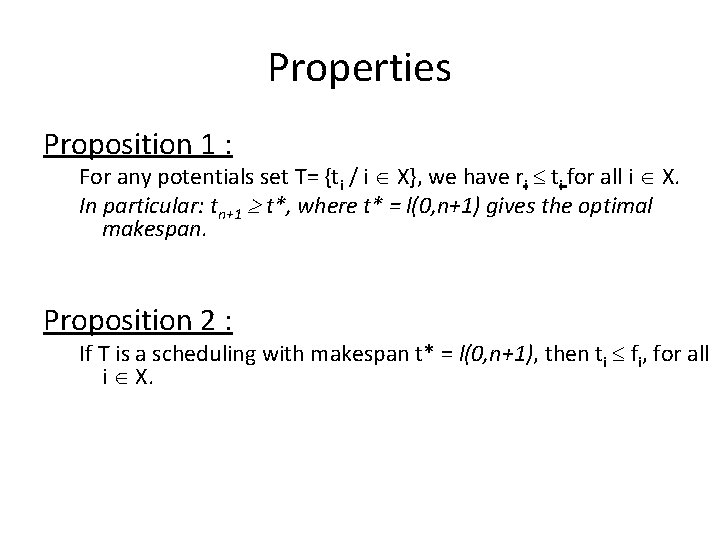
Properties Proposition 1 : For any potentials set T= {ti / i Î X}, we have ri ti for all i Î X. In particular: tn+1 t*, where t* = l(0, n+1) gives the optimal makespan. Proposition 2 : If T is a scheduling with makespan t* = l(0, n+1), then ti fi, for all i Î X.
An example (I) Tasks Durations 1 3 2 7 3 4 1 3 4 6 (1, 2) 4 5 5 3 5 6 3 (3, 4) 6 7 2 6 7 The induced potential graph (two fictive nodes, 0 and 8) Constraints
Task potential method Earliest time calculation : r 0 = 0, rj = max (ri + vij) (iÎU-(j)). Latest time calculation : fn+1 = t*, fi = min (fj - vij) (jÎU+(i)).
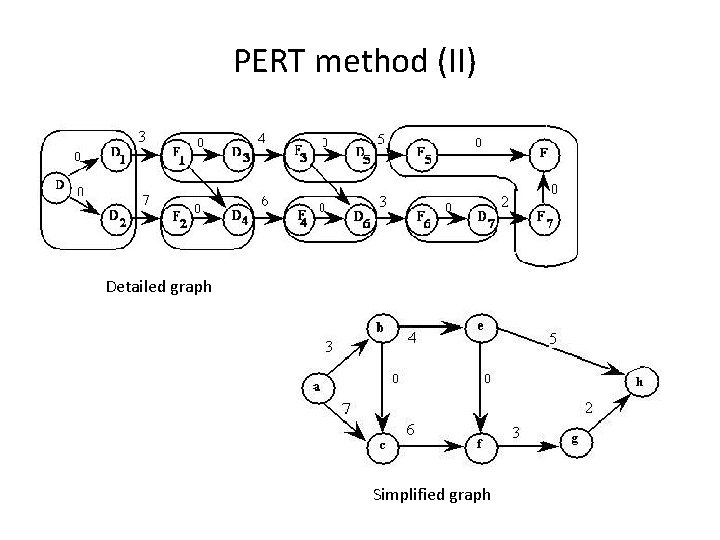
Pert method (I) PERT : Project Evaluation and Review Technique For any task i : An event Di : start of task i An event Fi : end of task i An event D : start of scheduling An event F : end of scheduling The associated conjunctive graph: vertices : set of events arcs : - all tasks, - fictive arcs representing the precedence constraints.
PERT method (II) Detailed graph Simplified graph