
Scheduling of NonRealTime Tasks in Linux SCHEDNORMALSCHEDOTHER David
![Normal Task Priorities Based on niceness levels Levels range from [-20, 19], default is](https://slidetodoc.com/presentation_image_h2/13c89b51c9990128dd51d46b28329ea2/image-7.jpg "Normal Task Priorities Based on niceness levels Levels range from [-20, 19], default is")
- Slides: 13
Scheduling of Non-Real-Time Tasks in Linux (SCHED_NORMAL/SCHED_OTHER) David Ferry, Chris Gill CSE 522 S - Advanced Operating Systems Washington University in St. Louis, MO 63143 1
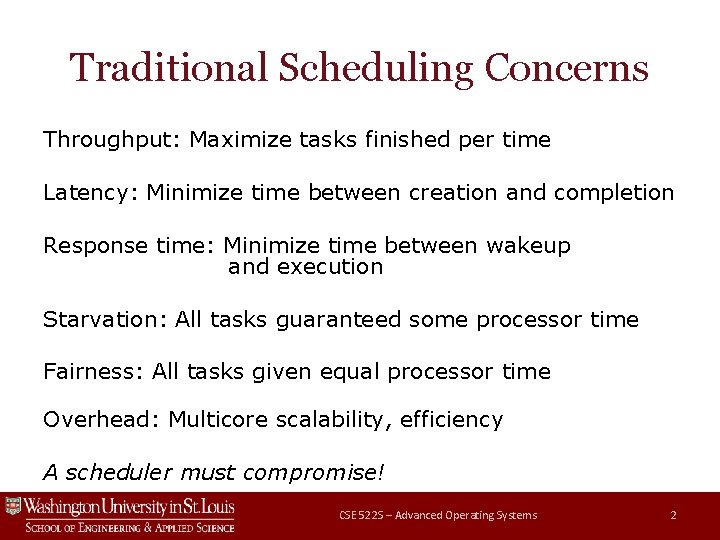
Traditional Scheduling Concerns Throughput: Maximize tasks finished per time Latency: Minimize time between creation and completion Response time: Minimize time between wakeup and execution Starvation: All tasks guaranteed some processor time Fairness: All tasks given equal processor time Overhead: Multicore scalability, efficiency A scheduler must compromise! CSE 522 S – Advanced Operating Systems 2
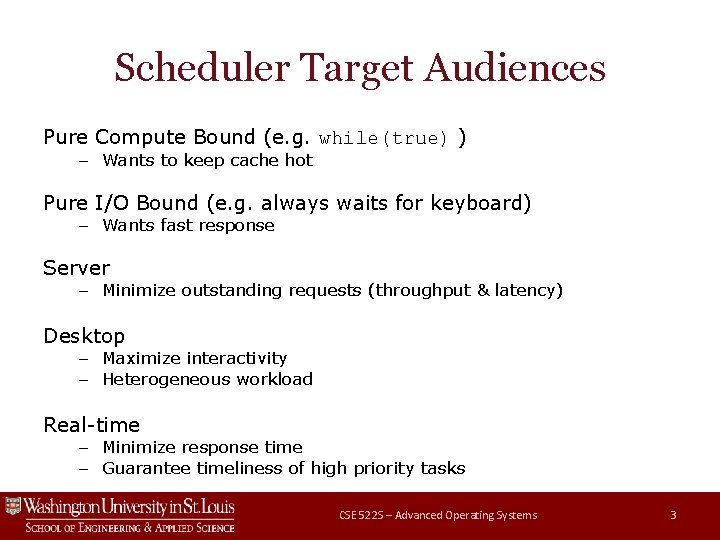
Scheduler Target Audiences Pure Compute Bound (e. g. while(true) ) – Wants to keep cache hot Pure I/O Bound (e. g. always waits for keyboard) – Wants fast response Server – Minimize outstanding requests (throughput & latency) Desktop – Maximize interactivity – Heterogeneous workload Real-time – Minimize response time – Guarantee timeliness of high priority tasks CSE 522 S – Advanced Operating Systems 3
Big Two Scheduling Operations • Which task should run next? • How long should it run (timeslice)? CSE 522 S – Advanced Operating Systems 4
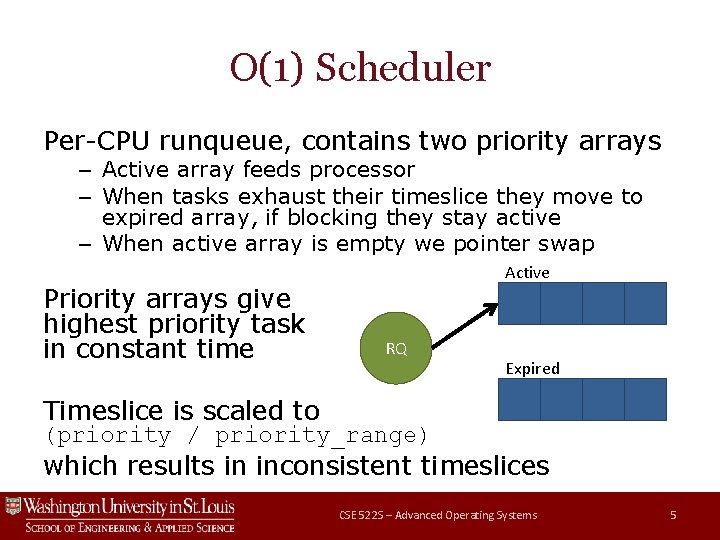
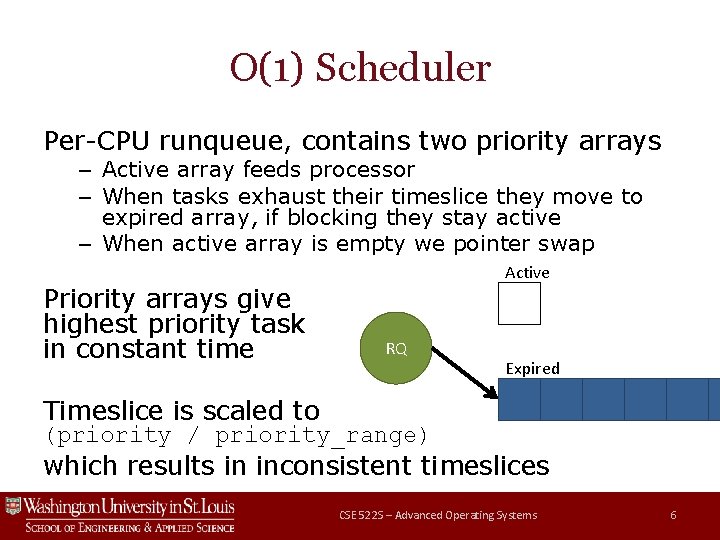
O(1) Scheduler Per-CPU runqueue, contains two priority arrays – Active array feeds processor – When tasks exhaust their timeslice they move to expired array, if blocking they stay active – When active array is empty we pointer swap Priority arrays give highest priority task in constant time Active RQ Expired Timeslice is scaled to (priority / priority_range) which results in inconsistent timeslices CSE 522 S – Advanced Operating Systems 5
O(1) Scheduler Per-CPU runqueue, contains two priority arrays – Active array feeds processor – When tasks exhaust their timeslice they move to expired array, if blocking they stay active – When active array is empty we pointer swap Priority arrays give highest priority task in constant time Active RQ Expired Timeslice is scaled to (priority / priority_range) which results in inconsistent timeslices CSE 522 S – Advanced Operating Systems 6
Normal Task Priorities Based on niceness levels Levels range from [-20, 19], default is 0 “More nice” => “Lower Priority” (higher) “Less nice” => “Higher priority” (lower) Can be adjusted heuristically for interactive and CPU bound tasks CSE 522 S – Advanced Operating Systems 7
Problems with O(1) Scheduler Inconsistent timeslices: • • Nice priorities determine fixed timeslice length Equal priority tasks equally share a processor Two tasks of 0 priority might switch every 100 ms Two tasks of 19 priority might switch every 5 ms Fixed timeslices cause problems: • Large numbers of high priority interactive tasks starve CPU bound tasks • Large numbers of CPU bound background tasks cause large latencies for interactive tasks CSE 522 S – Advanced Operating Systems 8
Completely Fair Scheduler (CFS) Goal: All tasks receive an equal proportion of processor time. – On a system with N tasks, each task should be promised 1/N processor time – I. e. “completely fair” • Allows interactive tasks to run at high priority while sharing CPU equally between CPU bound tasks. • Abandons notion of fixed timeslice and varying fairness for fixed fairness and varying timeslice CSE 522 S – Advanced Operating Systems 9
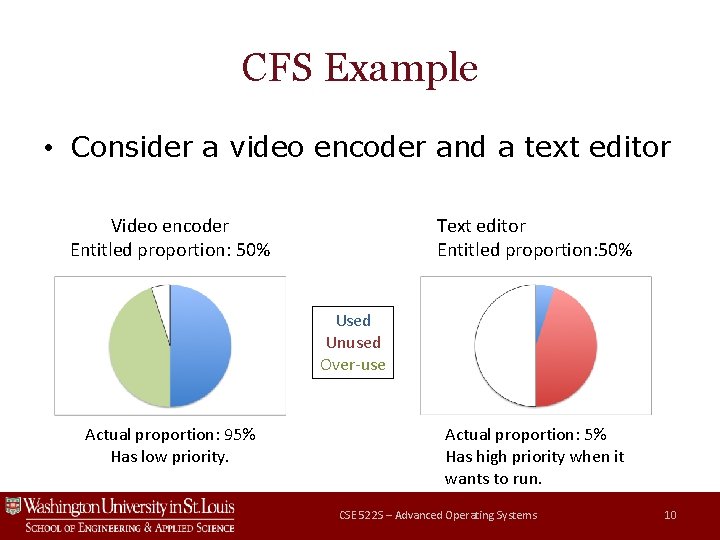
CFS Example • Consider a video encoder and a text editor Video encoder Entitled proportion: 50% Text editor Entitled proportion: 50% Used Unused Over-use Actual proportion: 95% Has low priority. Actual proportion: 5% Has high priority when it wants to run. CSE 522 S – Advanced Operating Systems 10
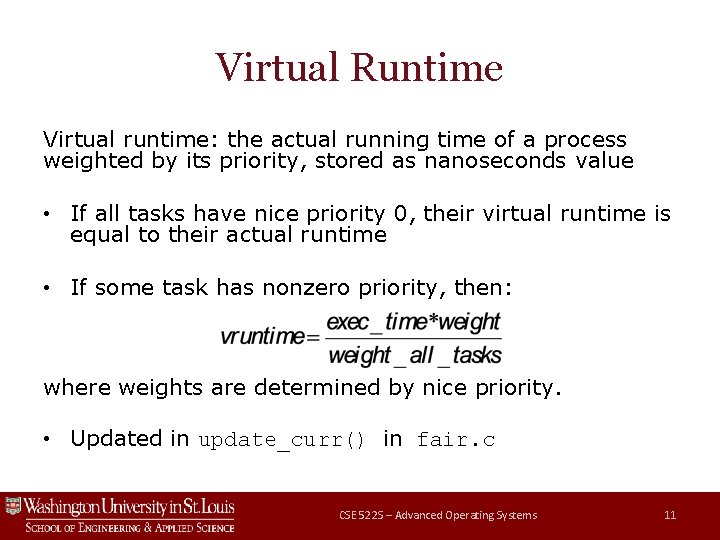
Virtual Runtime Virtual runtime: the actual running time of a process weighted by its priority, stored as nanoseconds value • If all tasks have nice priority 0, their virtual runtime is equal to their actual runtime • If some task has nonzero priority, then: where weights are determined by nice priority. • Updated in update_curr() in fair. c CSE 522 S – Advanced Operating Systems 11
CFS Scheduling Operations Which task? • Pick task with lowest virtual runtime How long to run? • Keeps virtual runtime as fair as possible, so tasks get swapped out each tick • Uses minimum tick length to avoid thrashing CSE 522 S – Advanced Operating Systems 12
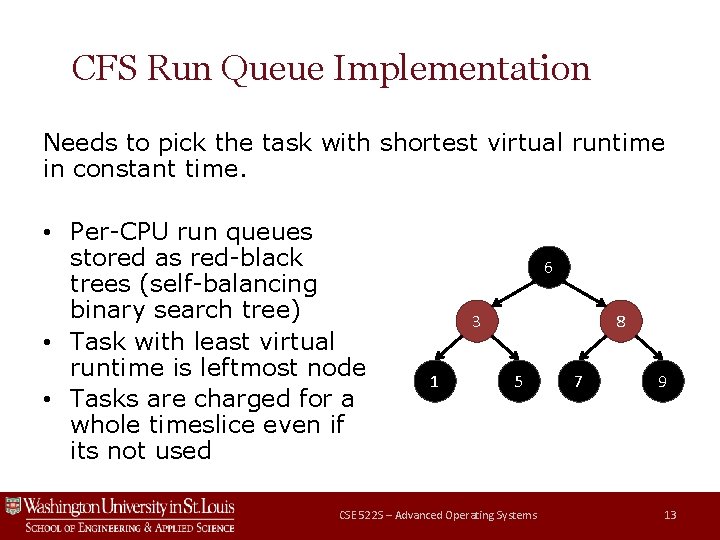
CFS Run Queue Implementation Needs to pick the task with shortest virtual runtime in constant time. • Per-CPU run queues stored as red-black trees (self-balancing binary search tree) • Task with least virtual runtime is leftmost node • Tasks are charged for a whole timeslice even if its not used 6 3 1 8 5 CSE 522 S – Advanced Operating Systems 7 9 13