
Schedules of Reinforcement Thomas G Bowers Ph D
Schedules of Reinforcement Thomas G. Bowers, Ph. D.
How is behavior maintained? b Simplistic to simply think uncomplicated contingencies operate in the day to day environment b Patterns of reinforcement, patterns of conditioning, relate in a complex fashion with the characteristics of the organism

Schedules of Reinforcement b Yield predictable and orderly patterns of behavioral responses b Most patterns of reinforcement are intermittent b More recently, theorists have also attended to the economic aspects of intermittent reinforcement
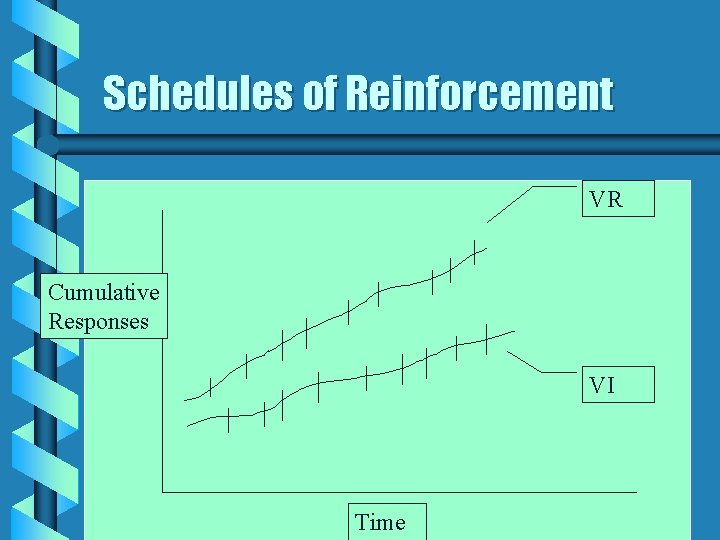
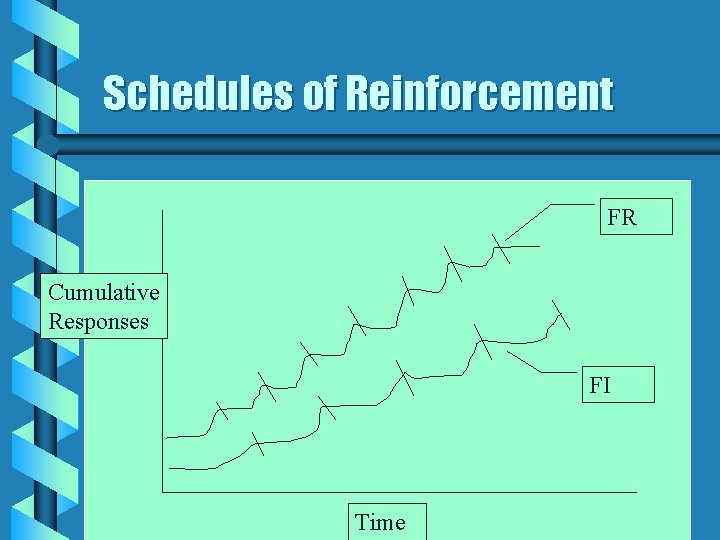
Schedules of Reinforcement b Basic Schedules • 1. Fixed Interval Schedules (FI) – A single response after the passage of a fixed period of time yields reinforcement – Responses during the interval are not reinforced • 2. Variable Interval Schedules (VI) – A single response after a varied passage of time – e. g. VI 2 - after an average passage of 2 minutes

Schedules of Reinforcement b Basic Schedules • 3. Fixed Ratio (FR) – Reinforcement occurs after a fixed number of responses – Passage of time irrelevant • 4. Variable Ratio (VR) – Number of responses required for reinforcement vary from trial to trial – e. g. VR 50 reinforces on the average the 50 th response
Schedules of Reinforcement b Intermittent reinforcement tends to maintain patterns of responding for longer periods of time in extinction • partial reinforcement effect • implies greater response strength
Schedules of Reinforcement VR Cumulative Responses VI Time
Schedules of Reinforcement FR Cumulative Responses FI Time
Schedules of Reinforcement b Some characteristics • 1. Variable schedules tend to develop higher rates of responding relative to fixed schedules • 2. Ratio schedules tend to develop higher rates of responding to interval schedules • 3. Fixed schedules of reinforcement demonstrate a characteristic pause after each reinforcement
Schedules of Reinforcement b Some characteristics • 4. Pause of responding after reinforcement on fixed ratio/interval is described as postreinforcement pause (PRP)
Choice Behaviors b Study of Concurrent Patterns of Reinforcement • How is behavior demonstrated in the situation where there are multiple schedules of reinforcement operating? • Organisms respond in direct proportion of the frequency (or density) of reinforcement offered
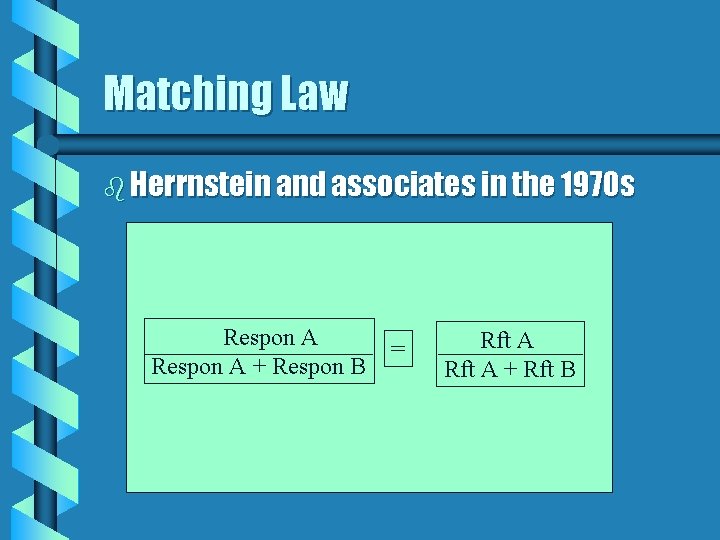
Matching Law b Herrnstein and associates in the 1970 s Respon A + Respon B = Rft A + Rft B
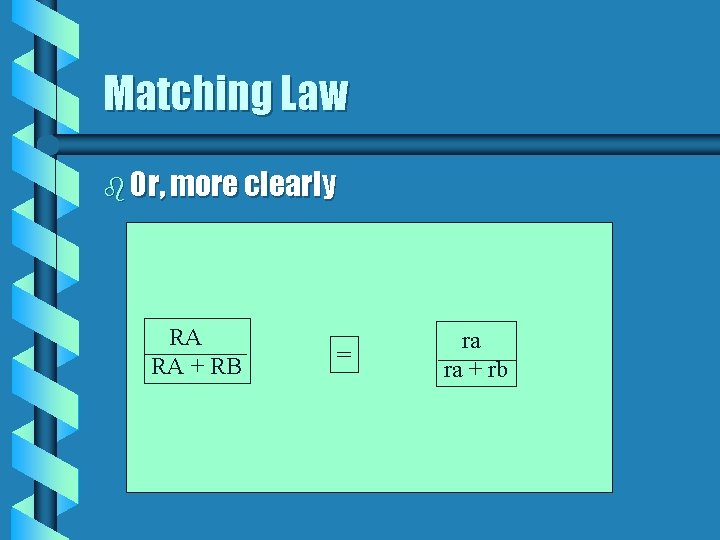
Matching Law b Or, more clearly RA RA + RB = ra ra + rb
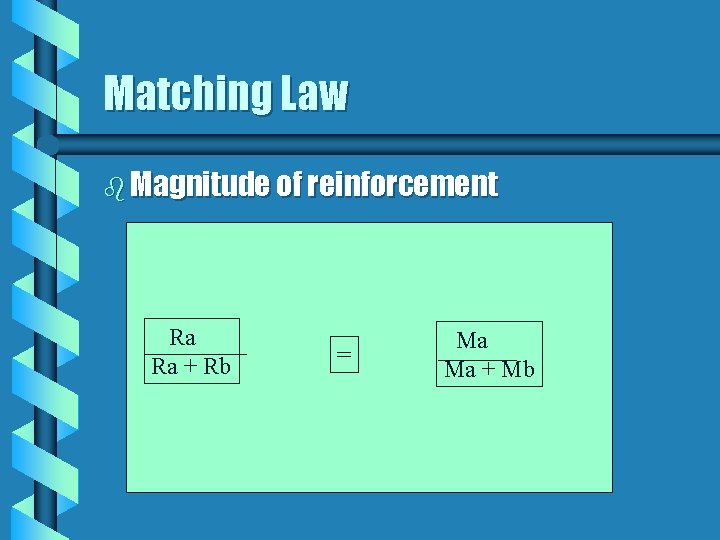
Matching Law b Magnitude of reinforcement Ra Ra + Rb = Ma Ma + Mb
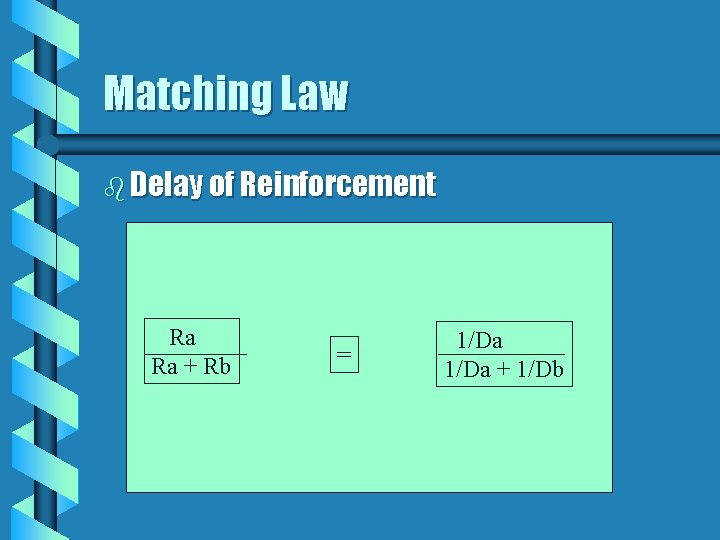
Matching Law b Delay of Reinforcement Ra Ra + Rb = 1/Da + 1/Db
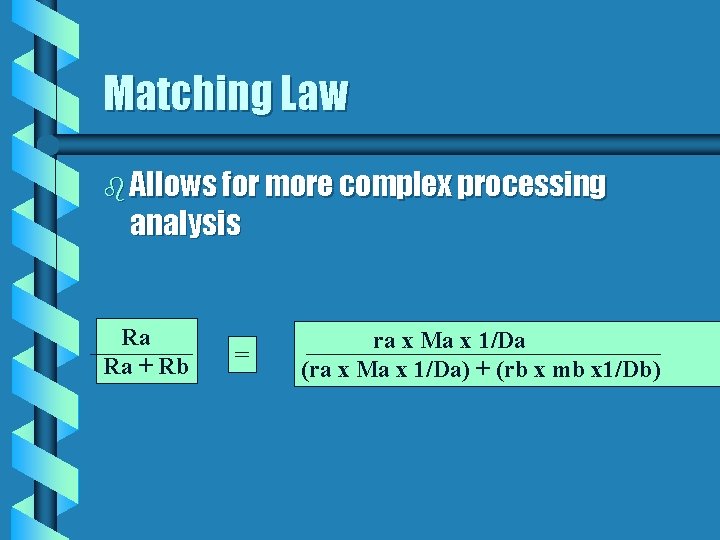
Matching Law b Allows for more complex processing analysis Ra Ra + Rb = ra x Ma x 1/Da (ra x Ma x 1/Da) + (rb x mb x 1/Db)
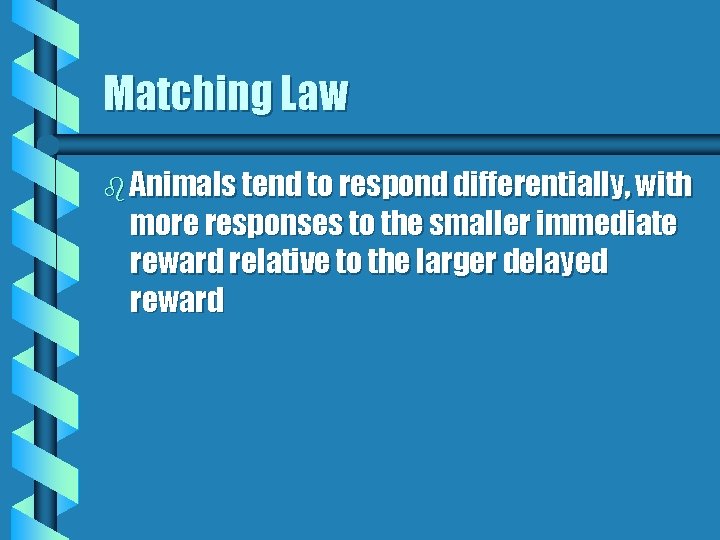
Matching Law b Animals tend to respond differentially, with more responses to the smaller immediate reward relative to the larger delayed reward
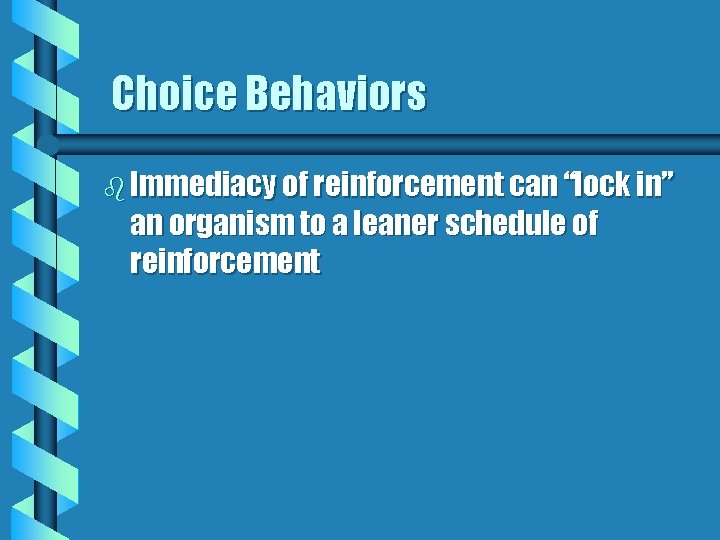
Choice Behaviors b Immediacy of reinforcement can “lock in” an organism to a leaner schedule of reinforcement
Matching and Maximizing b Maximizing suggests the animal will demonstrate the response which maximizes the likelihood of reinforcement b This is somewhat different than predicted by matching predictions
Matching and Maximizing b Animals tend to distribute responses in relation to the density of reinforcement b This is even true when some patterns results in less over all reinforcement
Matching and Maximizing b This effect has been attempted to be explained by optimal foraging theory b Feeding behavior is thought to be sensitive to the amount of energy expended in finding, securing and eating food b There may be adaptive significance to seeking varieties of food sources
Economic Concepts b Demand • Some demands are elastic • Others are inelastic • For example, bread is probably inelastic, while movies may be elastic
Types of Economies b Open versus closed contingent systems • open systems tend to decrease response rates • holds for both FR and VR schedules
Summary b Intermittent schedules of reinforcement leads to greater response strength b Variable schedules of reinforcement yields higher levels of behavior b Ratio schedules of reinforcement also yield higher levels of behavior b Interval schedules demonstrate characteristic patterns of responding
Summary b Organisms tend to match reinforcement probabilities rather than maximize reinforcement b Economic aspects influence patterns of contingent behavior
- Slides: 25