
Schedules and Serializability 17 4 17 5 111297
Schedules and Serializability 17. 4 -17. 5 11/12/97 1
Schedules • A "schedule" is the abstraction of the activity of simultaneous transactions. • Everything is stripped away except: – transaction identifiers (as subscripts) – DB READs and WRITEs and the data they operate on – COMMITs and ABORTs – The order of these operations 11/12/97 2
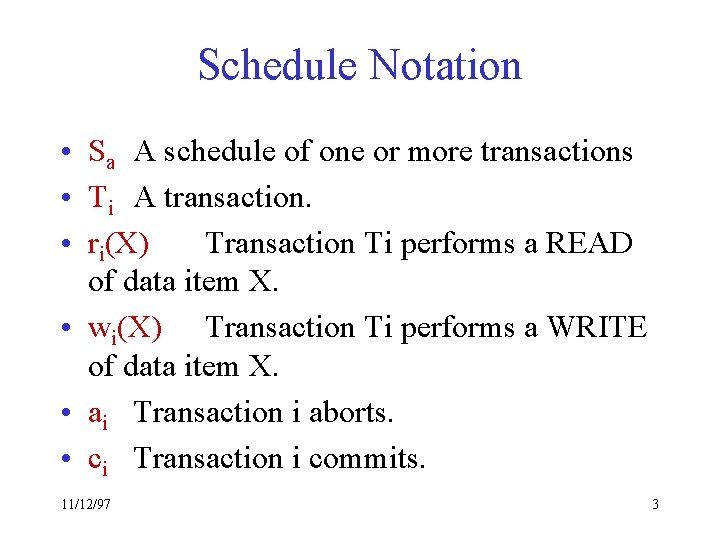
Schedule Notation • Sa A schedule of one or more transactions • Ti A transaction. • ri(X) Transaction Ti performs a READ of data item X. • wi(X) Transaction Ti performs a WRITE of data item X. • ai Transaction i aborts. • ci Transaction i commits. 11/12/97 3
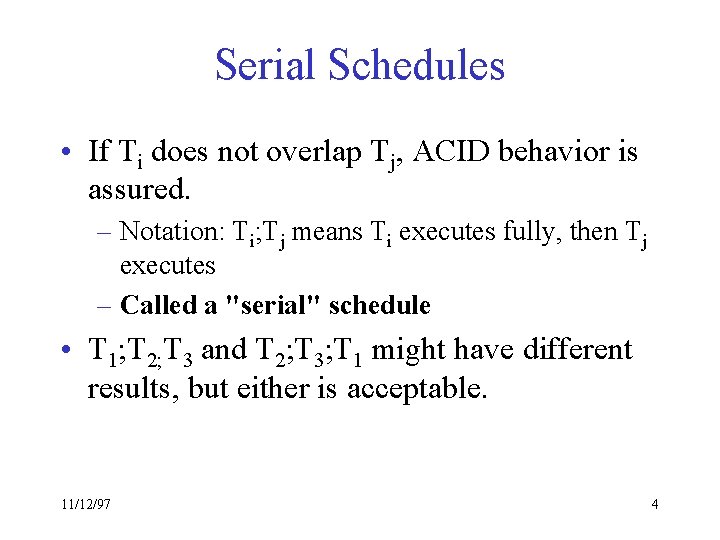
Serial Schedules • If Ti does not overlap Tj, ACID behavior is assured. – Notation: Ti; Tj means Ti executes fully, then Tj executes – Called a "serial" schedule • T 1; T 2; T 3 and T 2; T 3; T 1 might have different results, but either is acceptable. 11/12/97 4
Serializable Schedules • Serial schedules, though safe, are unacceptably costly – Transactions are I/O-bound (most elapsed time is spent waiting for I/O) • Non-serial (overlapped) schedules allow shorter turn-around and better resource utilization • A serializable schedule is one which is equivalent to some serial schedule 11/12/97 5
Schedules and Serializability Theory • Schedules are a major tool in studying concurrent processing of transactions • Goals: – be able to recognize when a schedule is serializable and/or: – be able to force schedules to be serializable and/or – be able to recognize when a schedule is 11/12/97 recoverable if an abort occurs 6
Conflicts • A conflict occurs when one transaction in a schedule WRITEs a data item which another transaction also uses (READs or WRITEs) – Note: no order requirement in this definition – The two operations are said to conflict – The two Ts are also said to conflict – A conflict per se is not a show-stopper 11/12/97 7
Recoverability • The TP monitor must have the power to undo or "rollback" the effect of a transaction. – Example: if a transaction aborts after doing some WRITE • If one transaction in a schedule aborts, it may be necessary to abort and rollback others. – committed transactions should never be rolled back 11/12/97 8
Recoverable Schedules • Ti reads from Tj (with respect to a schedule) if Ti READs some item which had previously been WRITten by Tj. • A schedule is recoverable if no transaction in it COMMITs until all transactions that it READs from have COMMITted. • Stronger: in a strict schedule, a transaction cannot even read or write X until the last transaction which wrote X has 11/12/97 9 COMMITted.
Recognizing Serializability • In general, difficult or impossible – depends on the semantics of the transactions • Some forms of serializability can be detected • Two schedules are conflict equivalent if the order of any two conflicting operations is the same in both schedules. 11/12/97 10
Conflict Serializability • A schedule is conflict serializable if there is some serial schedule with which it is conflict equivalent. • Turns out there's a simple algorithm to test for conflict serializability! – Make a digraph ("precedence graph") of the T's – Directed edges mark conflicts Theorem: schedule is conflict serializable iff graph has no cycles. 11/12/97 11
Granularity Issues • Granularity refers to the size of the data being read or written – whole DB; table; row; one attribute value, etc. • Smaller granularity means more concurrency, but more overhead • DBMSs differ in granularity supported • Transaction semantics may determine needed granularity 11/12/97 12
Not the Final Word • There are schedules which are not conflict serializable, but still serializable – "View serializability" is another definition; harder to check but allows more cases • There are even schedules which are not serializable but nevertheless safe • Serializability is a tool for analysis, not a prescription. 11/12/97 13
- Slides: 13