
Schedulers n Longterm scheduler or job scheduler selects
Schedulers n Long-term scheduler (or job scheduler) – selects which processes should be brought into the ready queue. n Short-term scheduler (or CPU scheduler) – selects which process should be executed next and allocates CPU. Operating System Concepts 6. 1 Silberschatz, Galvin and Gagne 2002
Schedulers (Cont’d) n Short-term scheduler is invoked very frequently (milliseconds) => must be fast n Long-term scheduler is invoked very infrequently (seconds, minutes) => may be slow n The long-term scheduler controls the degree of multiprogramming. Operating System Concepts 6. 2 Silberschatz, Galvin and Gagne 2002
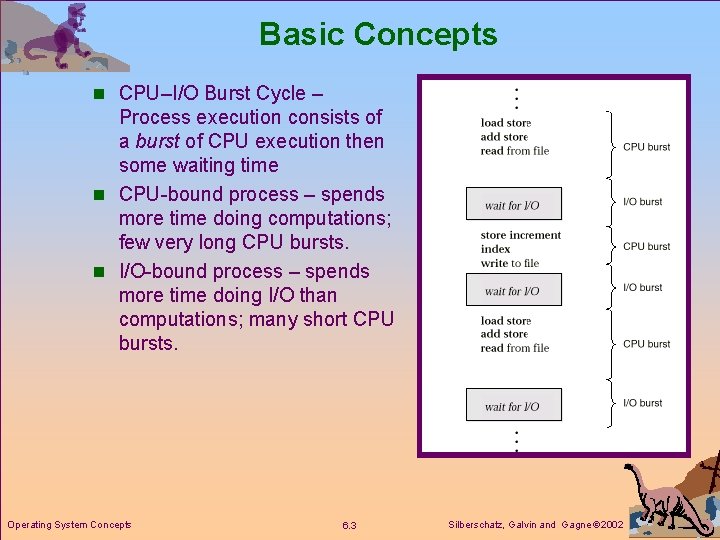
Basic Concepts n CPU–I/O Burst Cycle – Process execution consists of a burst of CPU execution then some waiting time n CPU-bound process – spends more time doing computations; few very long CPU bursts. n I/O-bound process – spends more time doing I/O than computations; many short CPU bursts. Operating System Concepts 6. 3 Silberschatz, Galvin and Gagne 2002
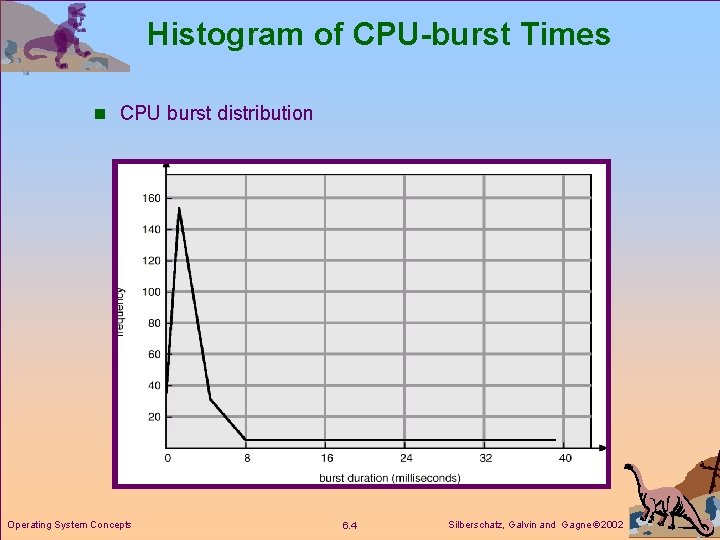
Histogram of CPU-burst Times n CPU burst distribution Operating System Concepts 6. 4 Silberschatz, Galvin and Gagne 2002

CPU Scheduler n Selects from among the ready processes F Highest priority process is selected n Non-preemptive scheduling F Process gives up the CPU voluntarily 4 Waiting for IO activity 4 Yields 4 Terminates F Can be implemented without a CPU clock n Preemptive scheduling F Interrupted process can be replaced 4 Interrupts, including CPU clock 4 Includes arrival of new processes Operating System Concepts 6. 5 Silberschatz, Galvin and Gagne 2002
Scheduling Criteria n CPU utilization – keep the CPU as busy as possible n Throughput – # of processes that complete their execution per time unit n Turnaround time – amount of time to execute a particular process n Response time – amount of time it takes from when a request was submitted until the start of a response (not time for output) (for time-sharing environment) n Waiting time – amount of time a process has been waiting in the ready queue. Quite representative. Operating System Concepts 6. 6 Silberschatz, Galvin and Gagne 2002
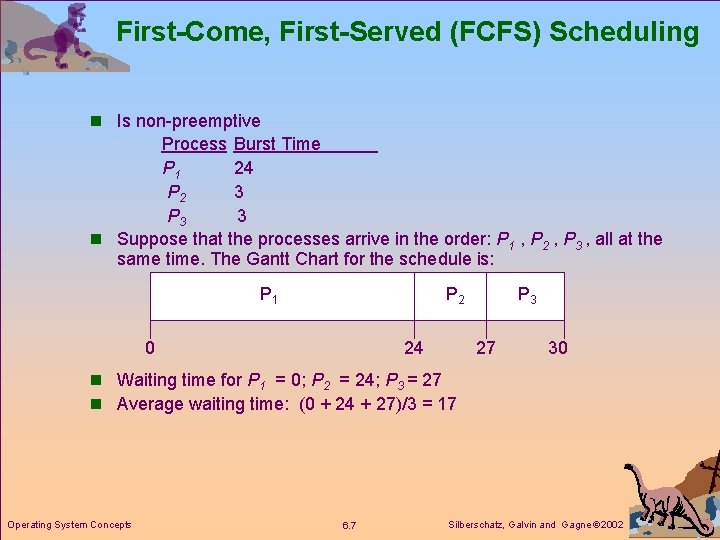
First-Come, First-Served (FCFS) Scheduling n Is non-preemptive Process Burst Time P 1 24 P 2 3 P 3 3 n Suppose that the processes arrive in the order: P 1 , P 2 , P 3 , all at the same time. The Gantt Chart for the schedule is: P 1 P 2 0 24 P 3 27 30 n Waiting time for P 1 = 0; P 2 = 24; P 3 = 27 n Average waiting time: (0 + 24 + 27)/3 = 17 Operating System Concepts 6. 7 Silberschatz, Galvin and Gagne 2002
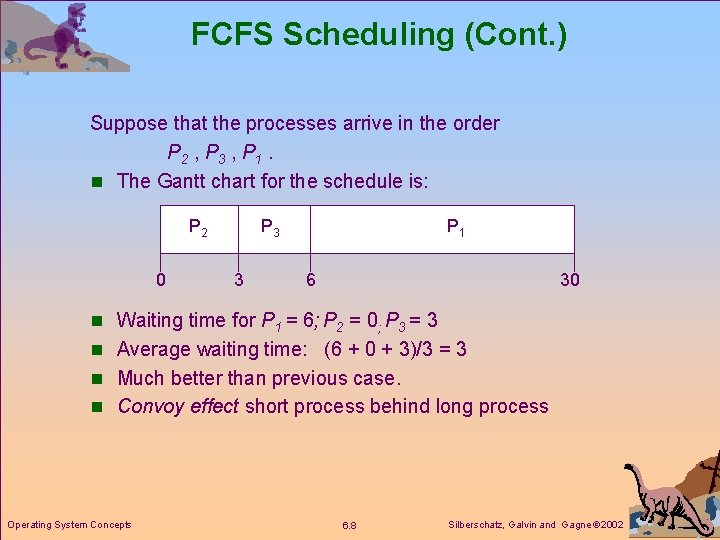
FCFS Scheduling (Cont. ) Suppose that the processes arrive in the order P 2 , P 3 , P 1. n The Gantt chart for the schedule is: P 2 0 P 3 3 P 1 6 30 n Waiting time for P 1 = 6; P 2 = 0; P 3 = 3 n Average waiting time: (6 + 0 + 3)/3 = 3 n Much better than previous case. n Convoy effect short process behind long process Operating System Concepts 6. 8 Silberschatz, Galvin and Gagne 2002
Shortest-Job-First (SJF) Scheduling n Associate with each process the length of its next CPU burst. Use these lengths to schedule the process with the shortest time. n Two schemes: F Non-preemptive – once CPU given to the process it cannot be preempted until completes its CPU burst. F Preemptive – if a new process arrives with CPU burst length less than remaining time of current executing process, preempt. This scheme is know as the Shortest-Remaining-Time-First (SRTF). Operating System Concepts 6. 9 Silberschatz, Galvin and Gagne 2002
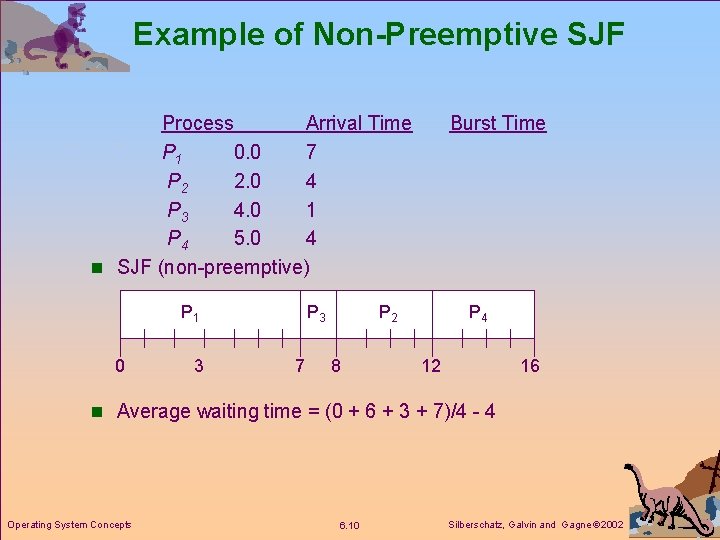
Example of Non-Preemptive SJF Process Arrival Time P 1 0. 0 7 P 2 2. 0 4 P 3 4. 0 1 P 4 5. 0 4 n SJF (non-preemptive) P 1 0 3 P 3 7 Burst Time P 2 8 P 4 12 16 n Average waiting time = (0 + 6 + 3 + 7)/4 - 4 Operating System Concepts 6. 10 Silberschatz, Galvin and Gagne 2002
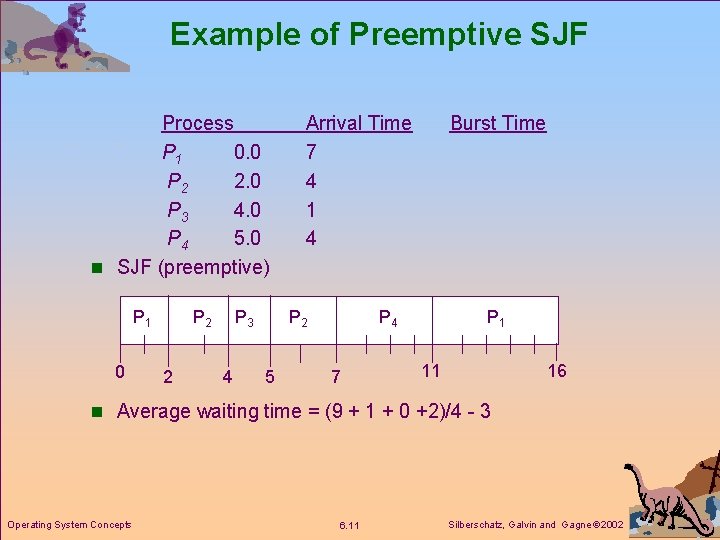
Example of Preemptive SJF Process P 1 0. 0 P 2 2. 0 P 3 4. 0 P 4 5. 0 n SJF (preemptive) P 1 0 P 2 2 P 3 4 Arrival Time 7 4 1 4 P 2 5 Burst Time P 4 7 P 1 11 16 n Average waiting time = (9 + 1 + 0 +2)/4 - 3 Operating System Concepts 6. 11 Silberschatz, Galvin and Gagne 2002
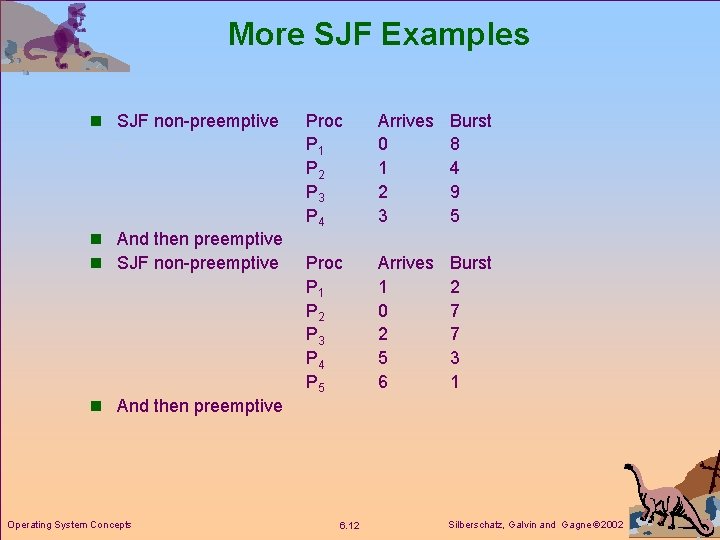
More SJF Examples n SJF non-preemptive n And then preemptive n SJF non-preemptive Proc P 1 P 2 P 3 P 4 Arrives 0 1 2 3 Burst 8 4 9 5 Proc P 1 P 2 P 3 P 4 P 5 Arrives 1 0 2 5 6 Burst 2 7 7 3 1 n And then preemptive Operating System Concepts 6. 12 Silberschatz, Galvin and Gagne 2002
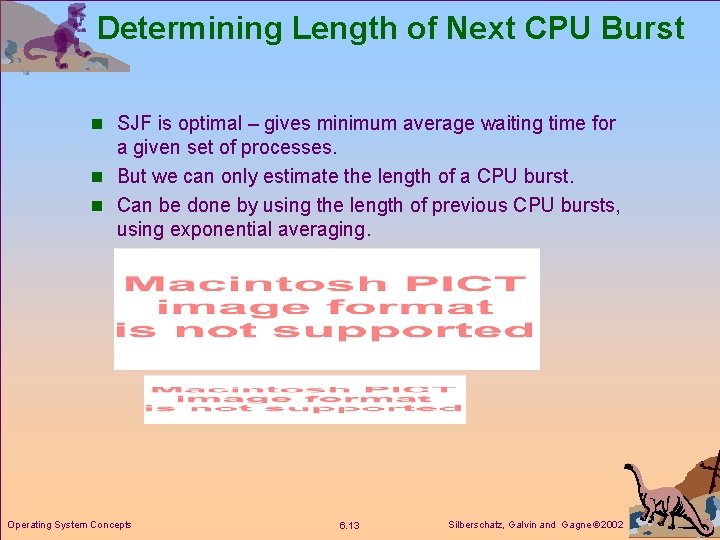
Determining Length of Next CPU Burst n SJF is optimal – gives minimum average waiting time for a given set of processes. n But we can only estimate the length of a CPU burst. n Can be done by using the length of previous CPU bursts, using exponential averaging. Operating System Concepts 6. 13 Silberschatz, Galvin and Gagne 2002
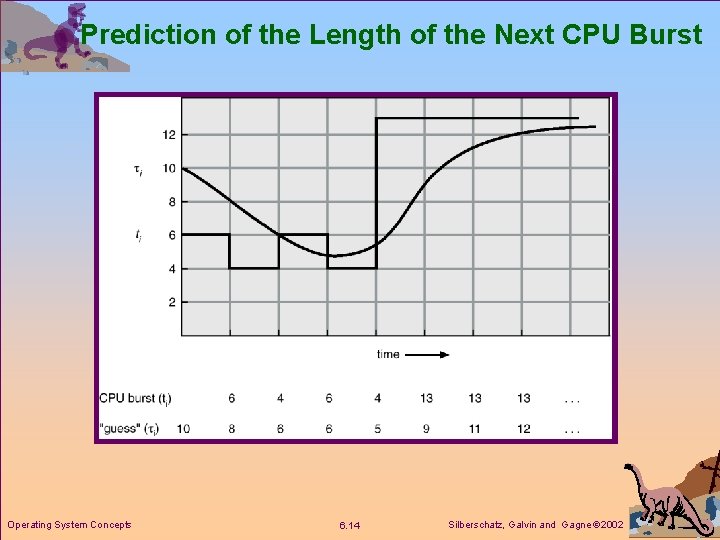
Prediction of the Length of the Next CPU Burst Operating System Concepts 6. 14 Silberschatz, Galvin and Gagne 2002
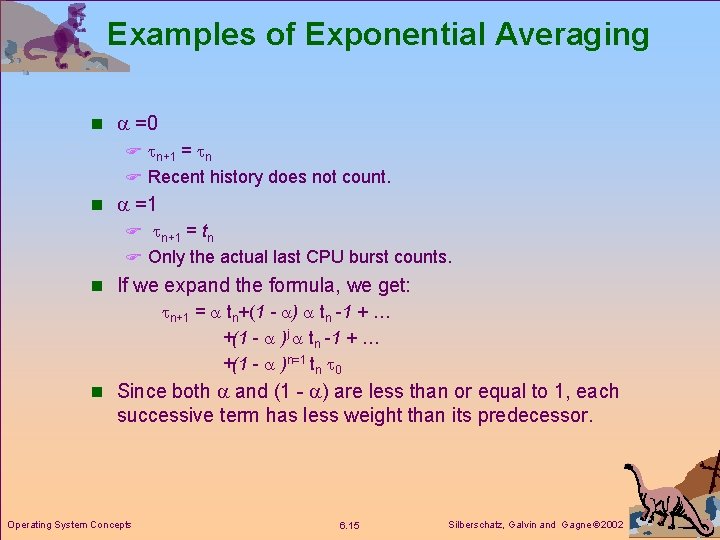
Examples of Exponential Averaging n =0 F n+1 = n F Recent history does not count. n =1 F n+1 = tn F Only the actual last CPU burst counts. n If we expand the formula, we get: n+1 = tn+(1 - ) tn -1 + … +(1 - )j tn -1 + … +(1 - )n=1 tn 0 n Since both and (1 - ) are less than or equal to 1, each successive term has less weight than its predecessor. Operating System Concepts 6. 15 Silberschatz, Galvin and Gagne 2002
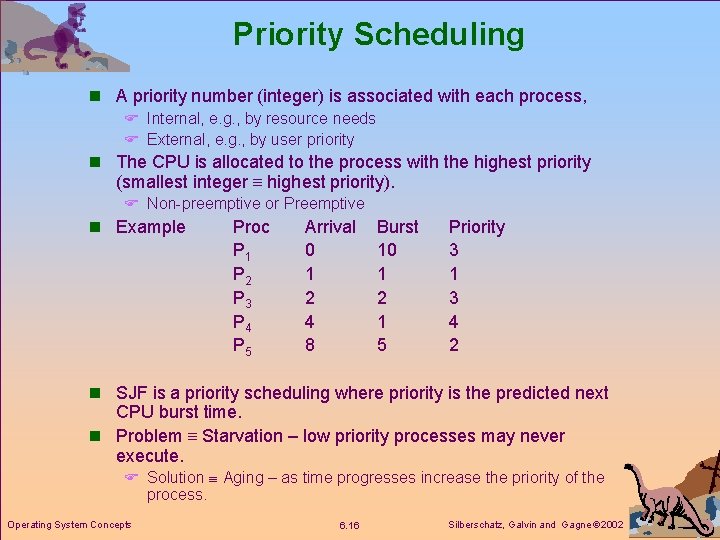
Priority Scheduling n A priority number (integer) is associated with each process, F Internal, e. g. , by resource needs F External, e. g. , by user priority n The CPU is allocated to the process with the highest priority (smallest integer highest priority). F Non-preemptive or Preemptive n Example Proc P 1 P 2 P 3 P 4 P 5 Arrival 0 1 2 4 8 Burst 10 1 2 1 5 Priority 3 1 3 4 2 n SJF is a priority scheduling where priority is the predicted next CPU burst time. n Problem Starvation – low priority processes may never execute. F Solution Aging – as time progresses increase the priority of the process. Operating System Concepts 6. 16 Silberschatz, Galvin and Gagne 2002
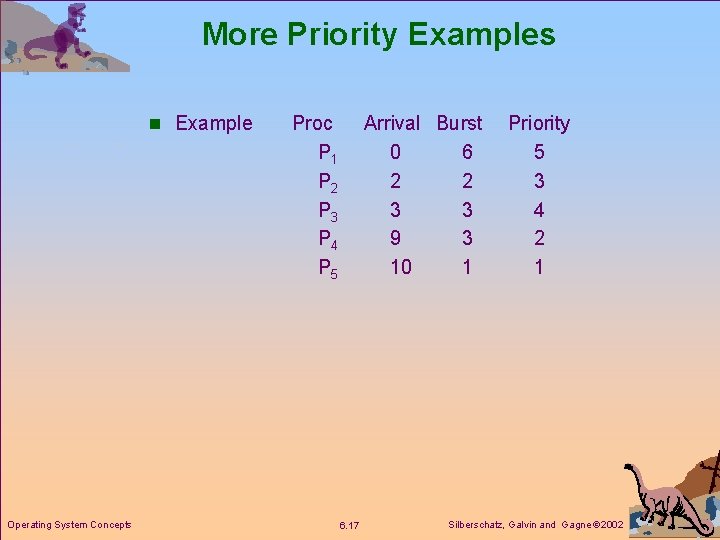
More Priority Examples n Example Operating System Concepts Proc P 1 P 2 P 3 P 4 P 5 Arrival Burst 0 6 2 2 3 3 9 3 10 1 6. 17 Priority 5 3 4 2 1 Silberschatz, Galvin and Gagne 2002
Round Robin (RR) n Each process gets a small unit of CPU time (time quantum), usually 10 -100 milliseconds. After this time has elapsed, the process is preempted and added to the end of the ready queue. n If there are n processes in the ready queue and the time quantum is q, then each process gets 1/n of the CPU time in chunks of at most q time units at once. No process waits more than (n-1)q time units. Operating System Concepts 6. 18 Silberschatz, Galvin and Gagne 2002
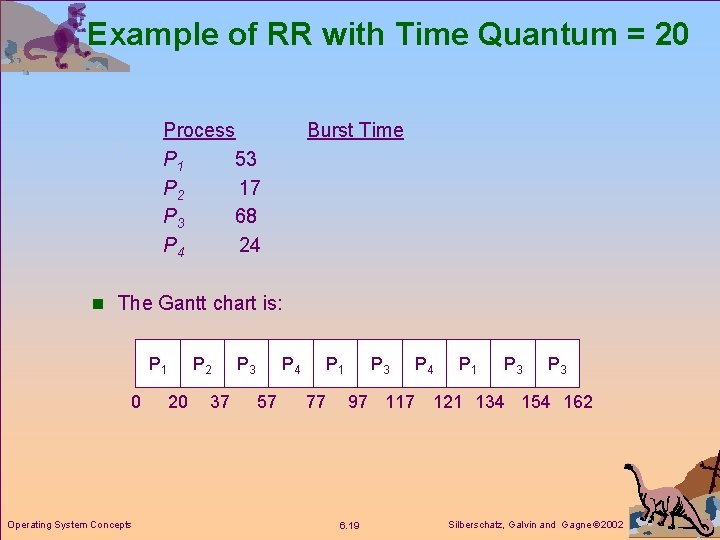
Example of RR with Time Quantum = 20 Process P 1 53 P 2 17 P 3 68 P 4 24 Burst Time n The Gantt chart is: P 1 0 Operating System Concepts P 2 20 37 P 3 P 4 57 P 1 77 P 3 P 4 P 1 P 3 97 117 121 134 154 162 6. 19 Silberschatz, Galvin and Gagne 2002
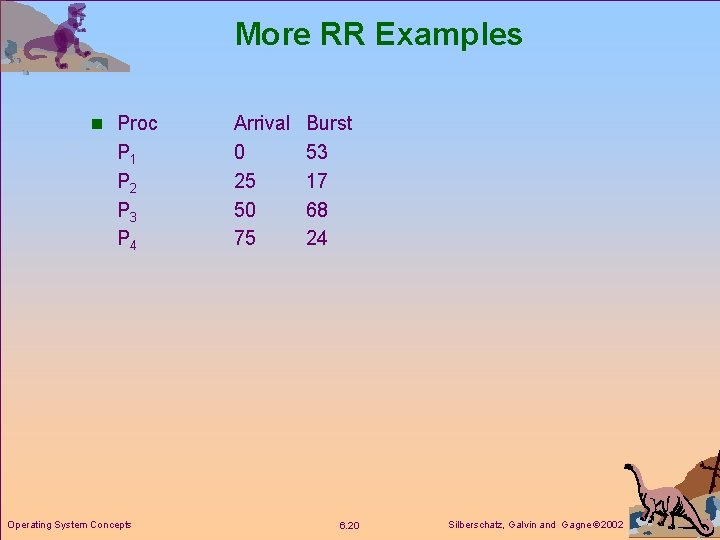
More RR Examples n Proc P 1 P 2 P 3 P 4 Operating System Concepts Arrival 0 25 50 75 Burst 53 17 68 24 6. 20 Silberschatz, Galvin and Gagne 2002
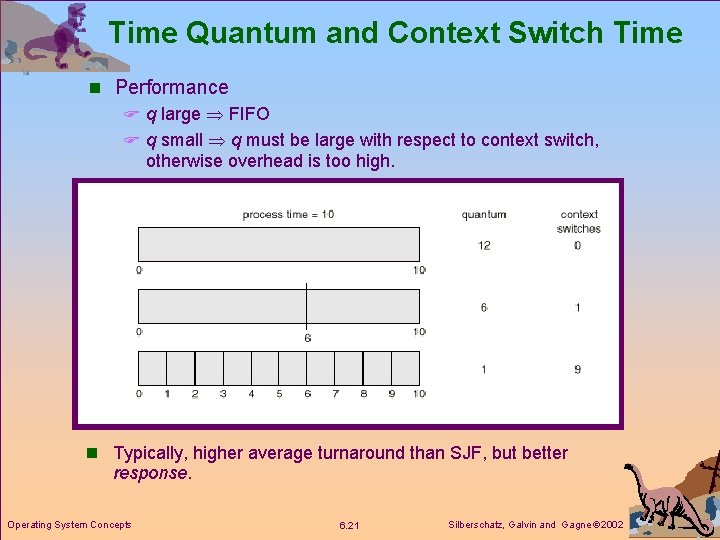
Time Quantum and Context Switch Time n Performance F q large FIFO F q small q must be large with respect to context switch, otherwise overhead is too high. n Typically, higher average turnaround than SJF, but better response. Operating System Concepts 6. 21 Silberschatz, Galvin and Gagne 2002
Multilevel Queue n Ready queue is partitioned into separate queues: F foreground (interactive) F background (batch) n Each queue has its own scheduling algorithm, e. g. , F foreground – RR F background – FCFS n Scheduling must be done between the queues. F Fixed priority scheduling; (i. e. , serve all from foreground then from background). Possibility of starvation. F Time slice – each queue gets a certain amount of CPU time which it can schedule amongst its processes 4 80% to foreground in RR 4 20% to background in FCFS Operating System Concepts 6. 22 Silberschatz, Galvin and Gagne 2002
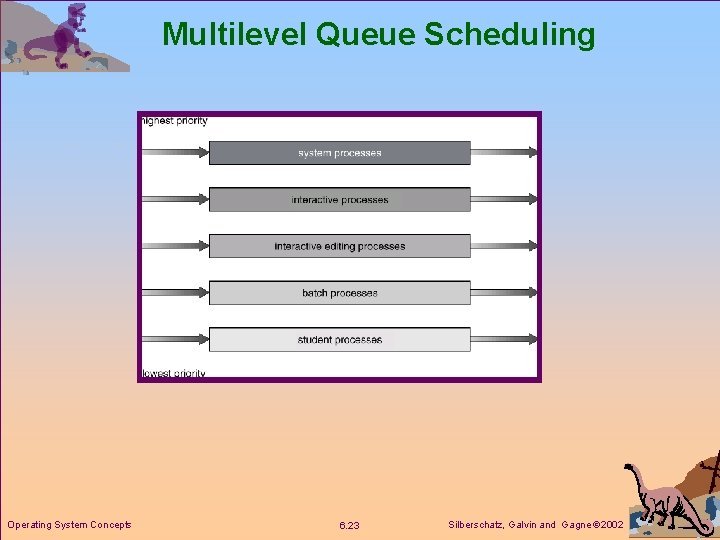
Multilevel Queue Scheduling Operating System Concepts 6. 23 Silberschatz, Galvin and Gagne 2002
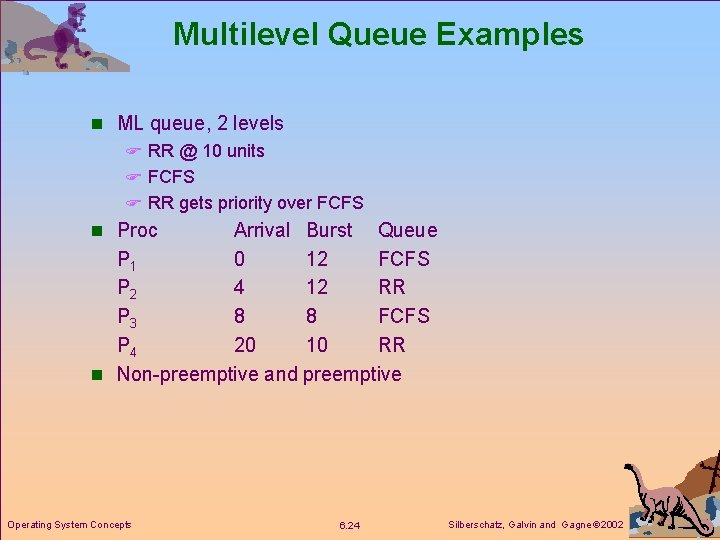
Multilevel Queue Examples n ML queue, 2 levels F RR @ 10 units F FCFS F RR gets priority over FCFS n Proc Arrival Burst Queue P 1 0 12 FCFS P 2 4 12 RR P 3 8 8 FCFS P 4 20 10 RR n Non-preemptive and preemptive Operating System Concepts 6. 24 Silberschatz, Galvin and Gagne 2002
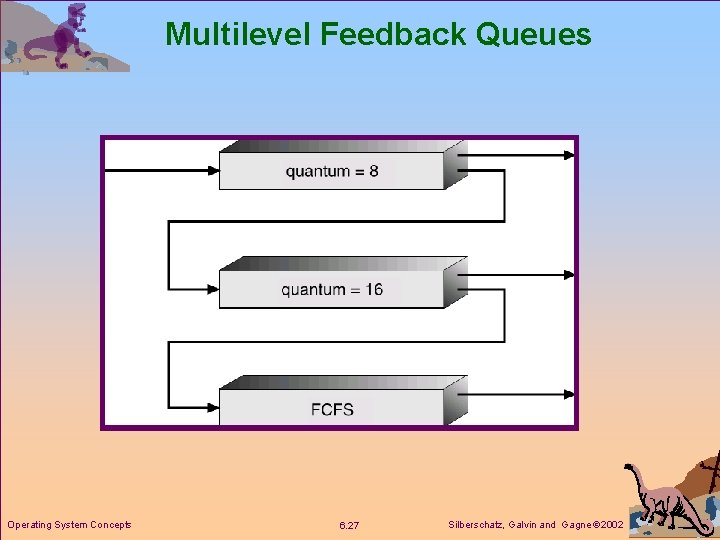
Multilevel Feedback Queue n A process can move between the various queues; aging can be implemented this way. n Multilevel-feedback-queue scheduler defined by the following parameters: F number of queues F scheduling algorithms for each queue F method used to determine which queue a process will enter when that process needs service F method used to determine when to upgrade a process F method used to determine when to demote a process Operating System Concepts 6. 25 Silberschatz, Galvin and Gagne 2002
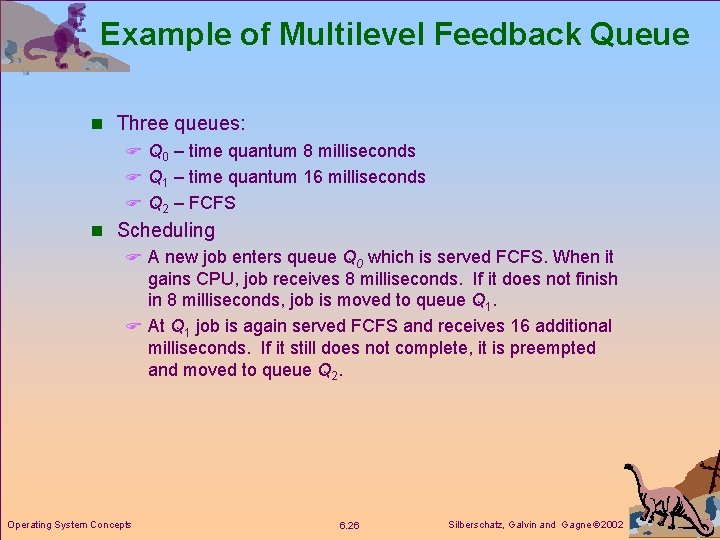
Example of Multilevel Feedback Queue n Three queues: F Q 0 – time quantum 8 milliseconds F Q 1 – time quantum 16 milliseconds F Q 2 – FCFS n Scheduling F A new job enters queue Q 0 which is served FCFS. When it gains CPU, job receives 8 milliseconds. If it does not finish in 8 milliseconds, job is moved to queue Q 1. F At Q 1 job is again served FCFS and receives 16 additional milliseconds. If it still does not complete, it is preempted and moved to queue Q 2. Operating System Concepts 6. 26 Silberschatz, Galvin and Gagne 2002
Multilevel Feedback Queues Operating System Concepts 6. 27 Silberschatz, Galvin and Gagne 2002
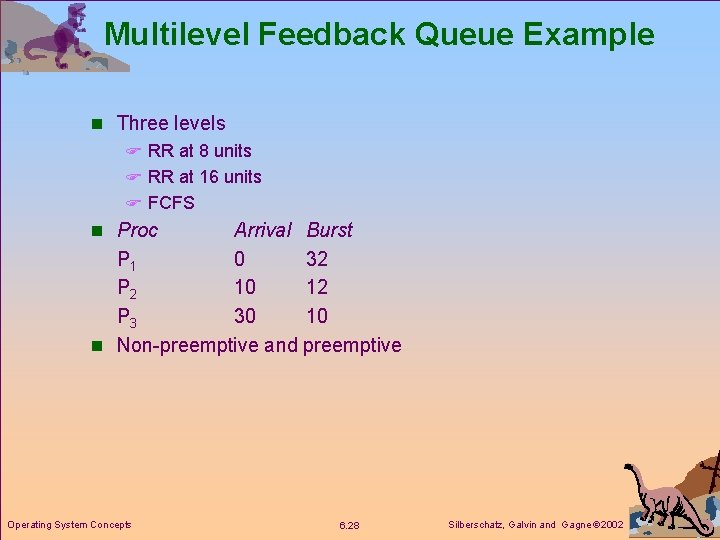
Multilevel Feedback Queue Example n Three levels F RR at 8 units F RR at 16 units F FCFS n Proc Arrival Burst P 1 0 32 P 2 10 12 P 3 30 10 n Non-preemptive and preemptive Operating System Concepts 6. 28 Silberschatz, Galvin and Gagne 2002
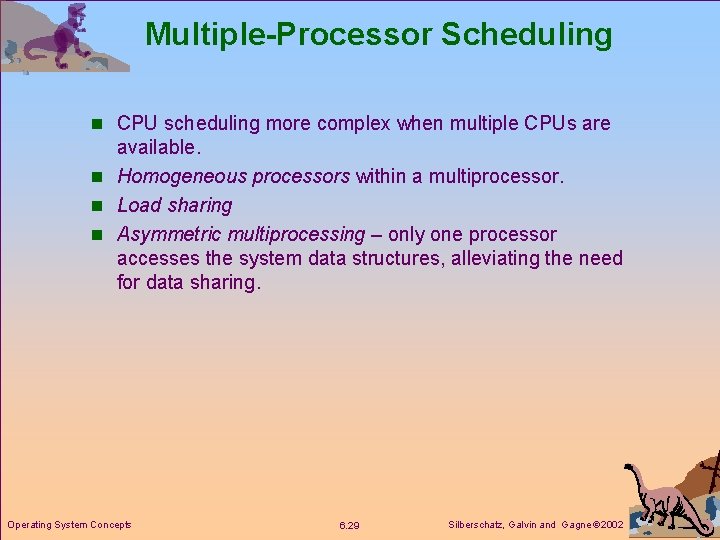
Multiple-Processor Scheduling n CPU scheduling more complex when multiple CPUs are available. n Homogeneous processors within a multiprocessor. n Load sharing n Asymmetric multiprocessing – only one processor accesses the system data structures, alleviating the need for data sharing. Operating System Concepts 6. 29 Silberschatz, Galvin and Gagne 2002
Real-Time Scheduling n Hard real-time systems – required to complete a critical task within a guaranteed amount of time. n Soft real-time computing – requires that critical processes receive priority over less fortunate ones. Operating System Concepts 6. 30 Silberschatz, Galvin and Gagne 2002
- Slides: 30