
Scattering in Planetary Atmospheres Svetlana Berdyugina Kiepenheuer Institut
Scattering in Planetary Atmospheres Svetlana Berdyugina Kiepenheuer Institut für Sonnenphysik, Freiburg, Germany Hot Molecules in Exoplanets and Inner Disks
Content 1. Polarized scattering – 2. Earth Model – – 3. Rayleigh scattering Mie scattering Observations – – Solar system Exoplanets
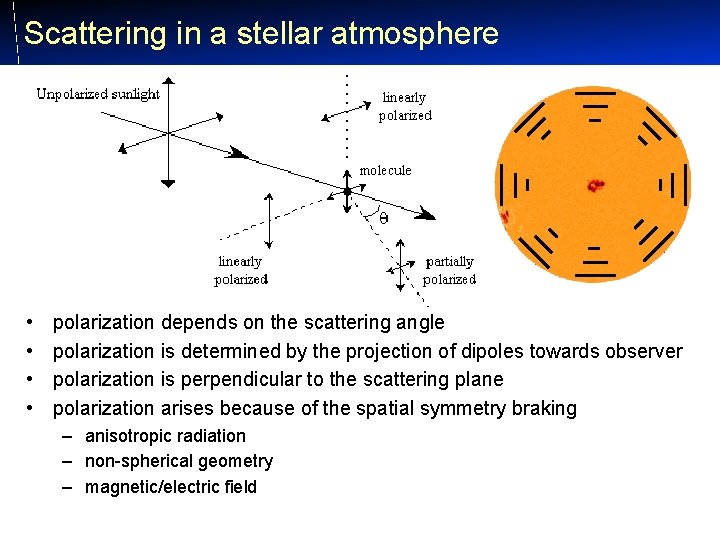
Scattering in a stellar atmosphere • • polarization depends on the scattering angle polarization is determined by the projection of dipoles towards observer polarization is perpendicular to the scattering plane polarization arises because of the spatial symmetry braking – anisotropic radiation – non-spherical geometry – magnetic/electric field
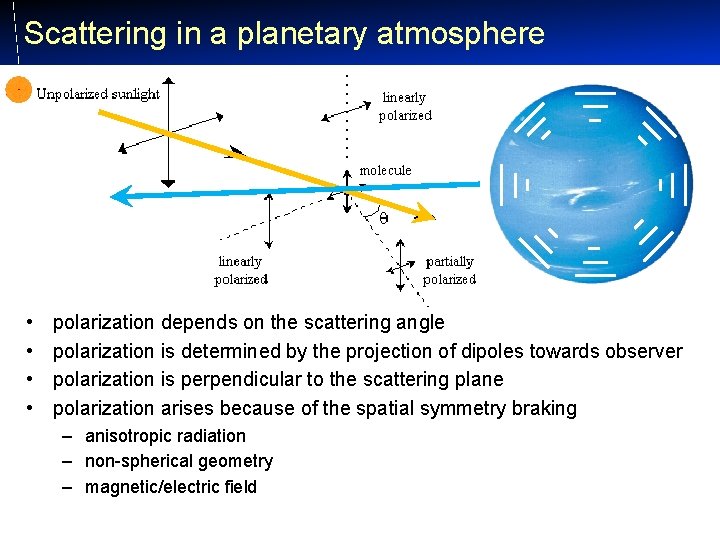
Scattering in a planetary atmosphere • • polarization depends on the scattering angle polarization is determined by the projection of dipoles towards observer polarization is perpendicular to the scattering plane polarization arises because of the spatial symmetry braking – anisotropic radiation – non-spherical geometry – magnetic/electric field
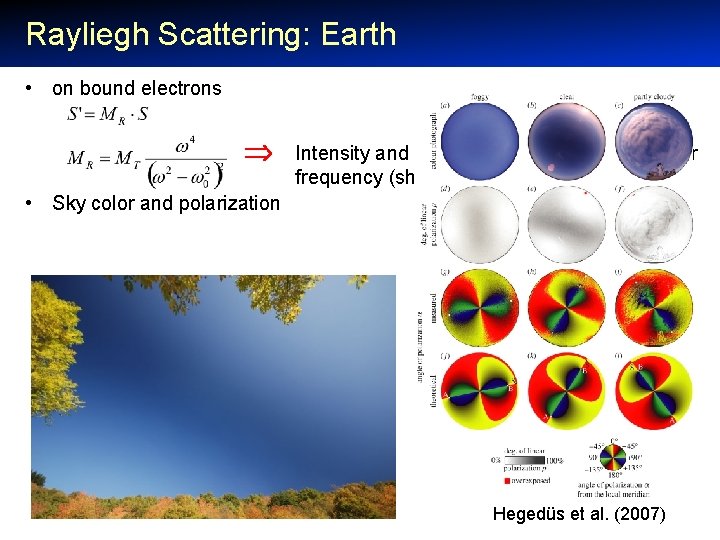
Rayliegh Scattering: Earth • on bound electrons Intensity and polarization are larger for higher frequency (shorter wavelength) light • Sky color and polarization Hegedüs et al. (2007)
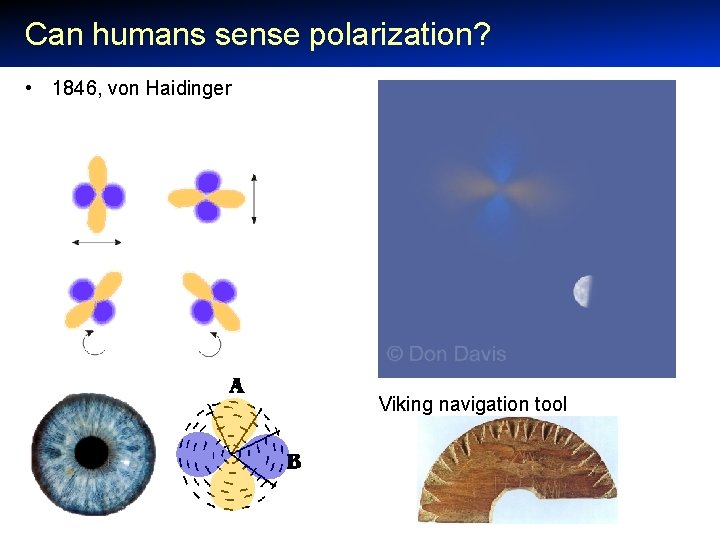
Can humans sense polarization? • 1846, von Haidinger Viking navigation tool
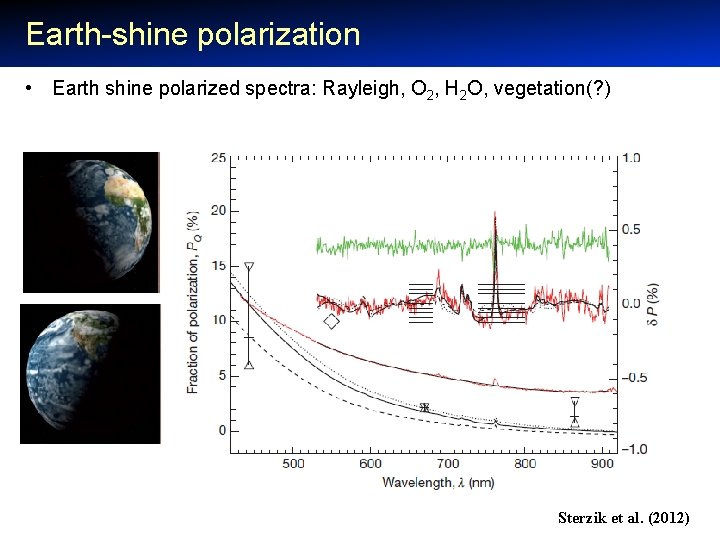
Earth-shine polarization • Earth shine polarized spectra: Rayleigh, O 2, H 2 O, vegetation(? ) Sterzik et al. (2012)
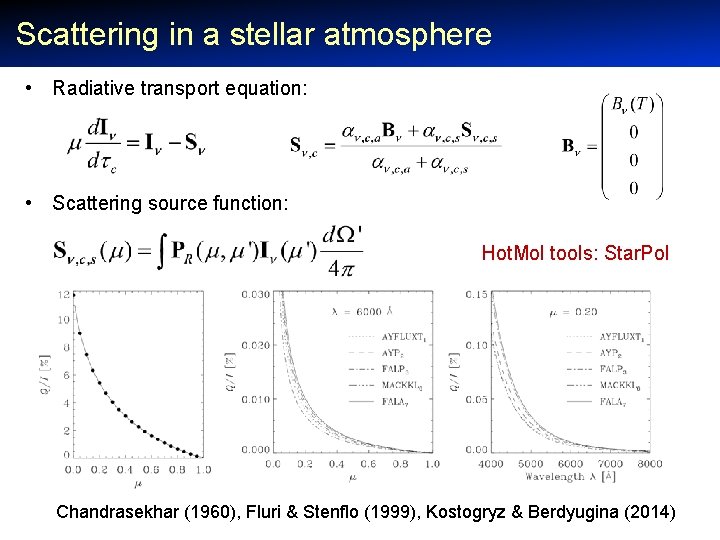
Scattering in a stellar atmosphere • Radiative transport equation: • Scattering source function: Hot. Mol tools: Star. Pol Chandrasekhar (1960), Fluri & Stenflo (1999), Kostogryz & Berdyugina (2014)
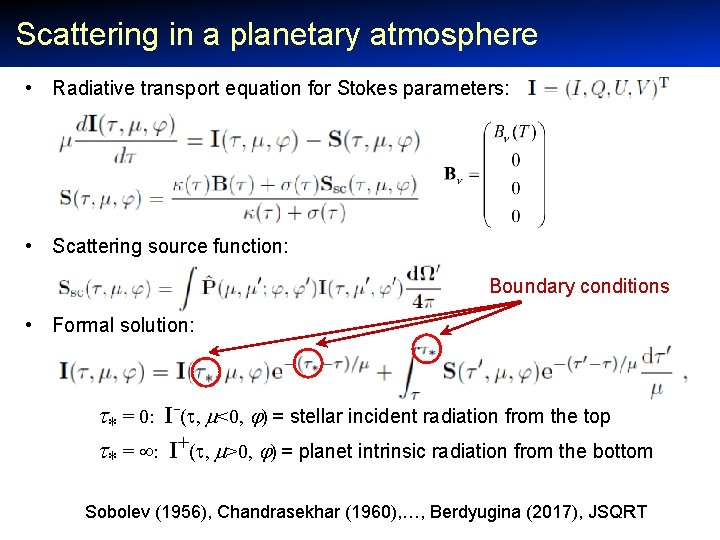
Scattering in a planetary atmosphere • Radiative transport equation for Stokes parameters: • Scattering source function: Boundary conditions • Formal solution: * = 0: I-( , <0, ) = stellar incident radiation from the top * = : I+( , >0, ) = planet intrinsic radiation from the bottom Sobolev (1956), Chandrasekhar (1960), …, Berdyugina (2017), JSQRT
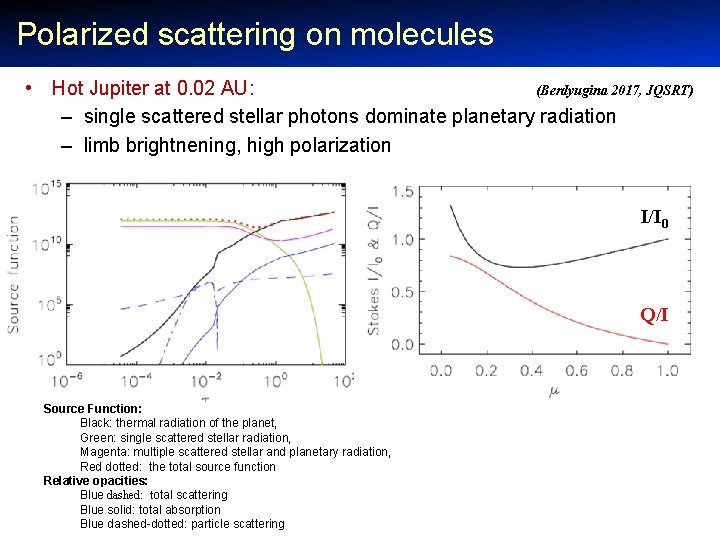
Polarized scattering on molecules • Hot Jupiter at 0. 02 AU: (Berdyugina 2017, JQSRT) – single scattered stellar photons dominate planetary radiation – limb brightnening, high polarization I/I 0 Q/I Source Function: Black: thermal radiation of the planet, Green: single scattered stellar radiation, Magenta: multiple scattered stellar and planetary radiation, Red dotted: the total source function Relative opacities: Blue dashed: total scattering Blue solid: total absorption Blue dashed-dotted: particle scattering
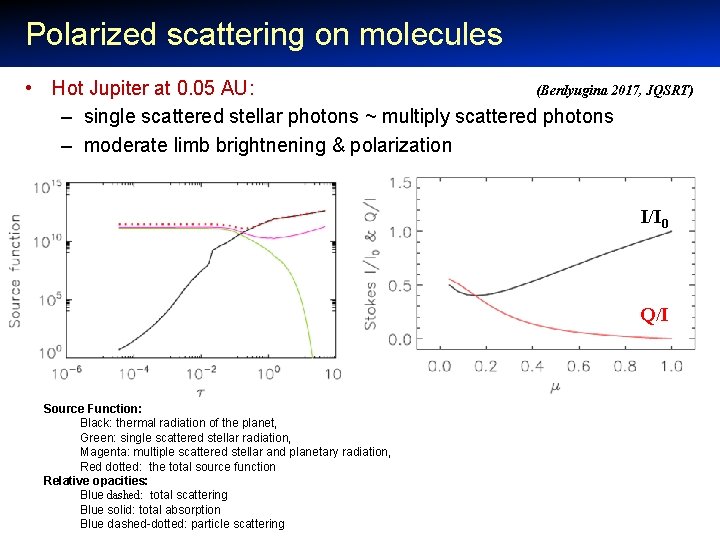
Polarized scattering on molecules • Hot Jupiter at 0. 05 AU: (Berdyugina 2017, JQSRT) – single scattered stellar photons ~ multiply scattered photons – moderate limb brightnening & polarization I/I 0 Q/I Source Function: Black: thermal radiation of the planet, Green: single scattered stellar radiation, Magenta: multiple scattered stellar and planetary radiation, Red dotted: the total source function Relative opacities: Blue dashed: total scattering Blue solid: total absorption Blue dashed-dotted: particle scattering
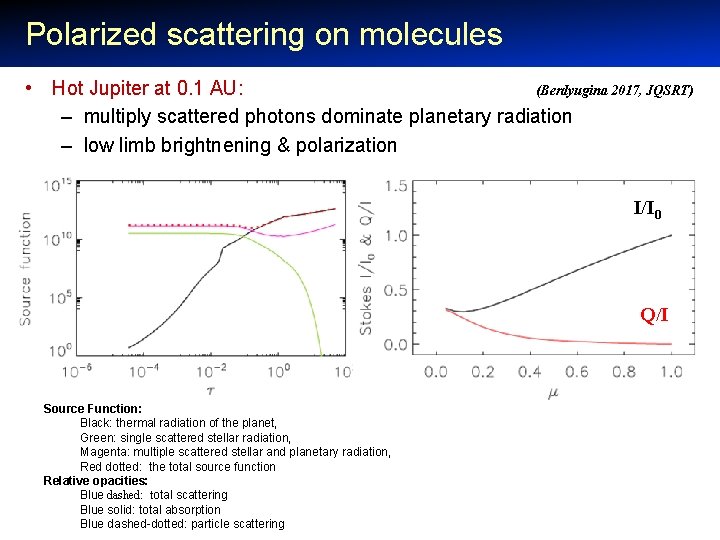
Polarized scattering on molecules • Hot Jupiter at 0. 1 AU: (Berdyugina 2017, JQSRT) – multiply scattered photons dominate planetary radiation – low limb brightnening & polarization I/I 0 Q/I Source Function: Black: thermal radiation of the planet, Green: single scattered stellar radiation, Magenta: multiple scattered stellar and planetary radiation, Red dotted: the total source function Relative opacities: Blue dashed: total scattering Blue solid: total absorption Blue dashed-dotted: particle scattering
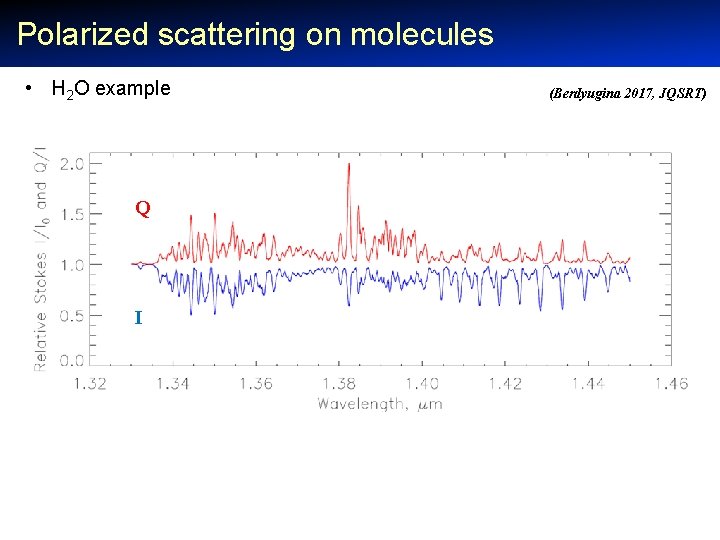
Polarized scattering on molecules • H 2 O example Q I (Berdyugina 2017, JQSRT)
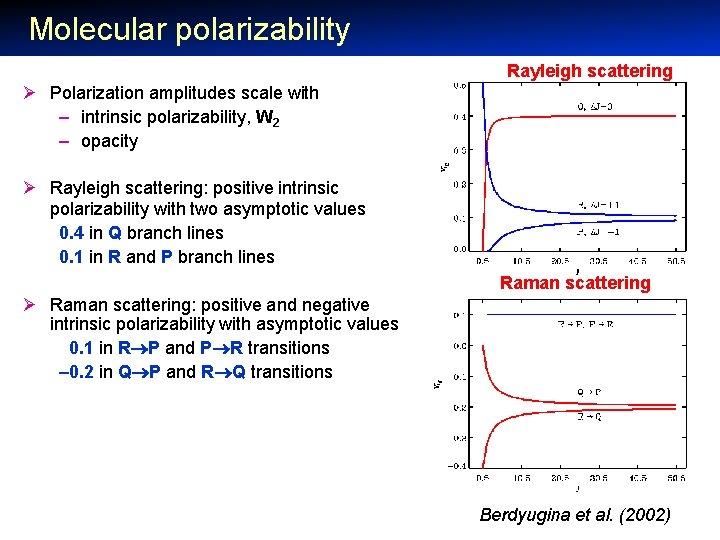
Molecular polarizability Rayleigh scattering Ø Polarization amplitudes scale with – intrinsic polarizability, W 2 – opacity Ø Rayleigh scattering: positive intrinsic polarizability with two asymptotic values 0. 4 in Q branch lines 0. 1 in R and P branch lines Raman scattering Ø Raman scattering: positive and negative intrinsic polarizability with asymptotic values 0. 1 in R P and P R transitions – 0. 2 in Q P and R Q transitions Berdyugina et al. (2002)
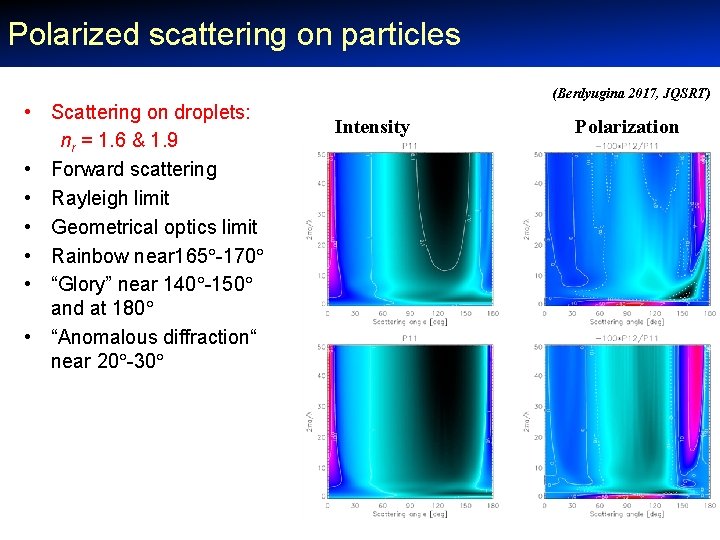
Polarized scattering on particles • Scattering on droplets: nr = 1. 6 & 1. 9 • Forward scattering • Rayleigh limit • Geometrical optics limit • Rainbow near 165 -170 • “Glory” near 140 -150 and at 180 • “Anomalous diffraction“ near 20 -30 (Berdyugina 2017, JQSRT) Intensity Polarization
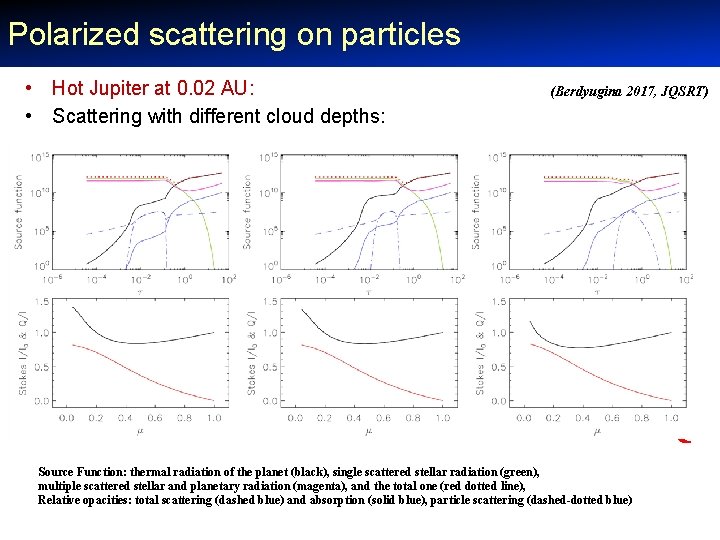
Polarized scattering on particles • Hot Jupiter at 0. 02 AU: • Scattering with different cloud depths: 70 km (Berdyugina 2017, JQSRT) 80 km 90 km I I I Q Q Q Source Function: thermal radiation of the planet (black), single scattered stellar radiation (green), multiple scattered stellar and planetary radiation (magenta), and the total one (red dotted line), Relative opacities: total scattering (dashed blue) and absorption (solid blue), particle scattering (dashed-dotted blue)
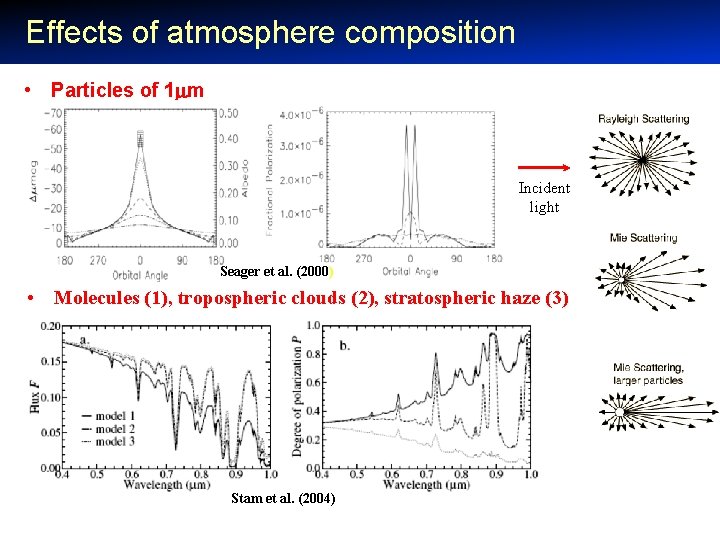
Effects of atmosphere composition • Particles of 1 m Incident light Seager et al. (2000) • Molecules (1), tropospheric clouds (2), stratospheric haze (3) Stam et al. (2004)
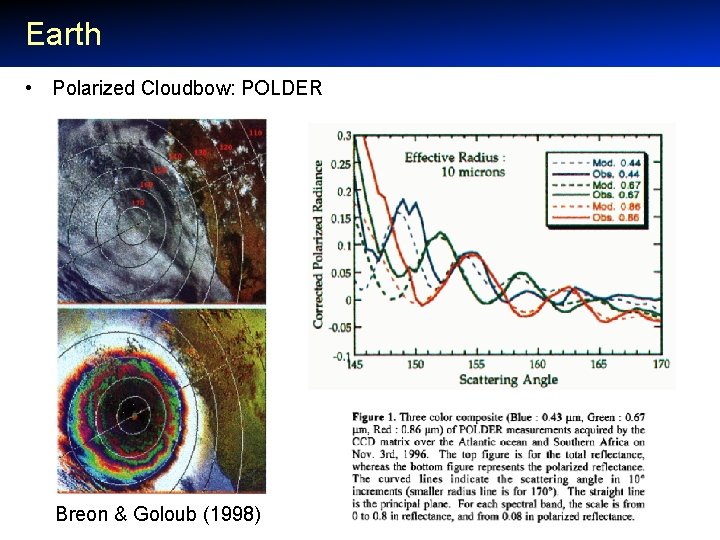
Earth • Polarized Cloudbow: POLDER Breon & Goloub (1998)
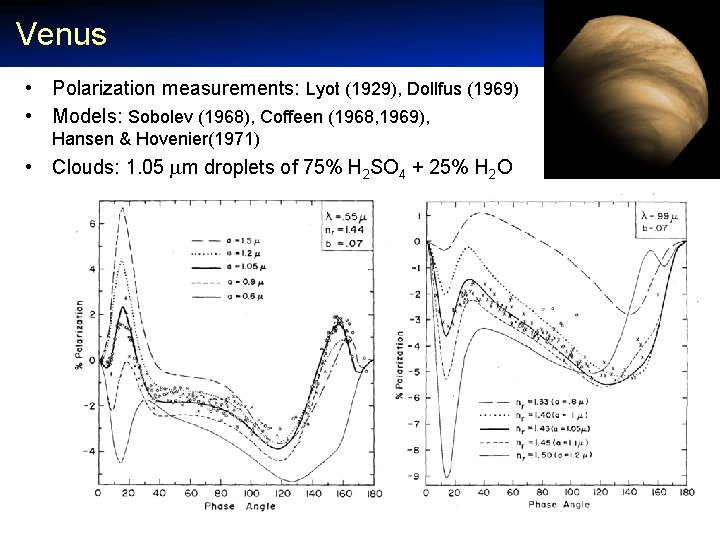
Venus • Polarization measurements: Lyot (1929), Dollfus (1969) • Models: Sobolev (1968), Coffeen (1968, 1969), Hansen & Hovenier(1971) • Clouds: 1. 05 m droplets of 75% H 2 SO 4 + 25% H 2 O
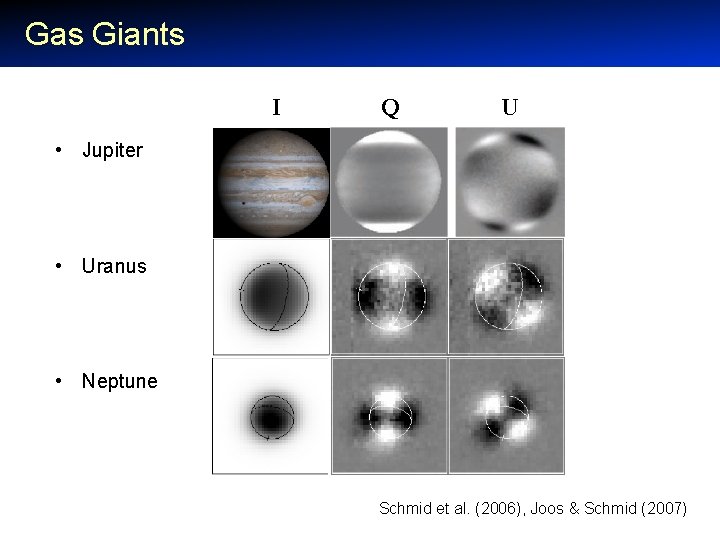
Gas Giants I Q U • Jupiter • Uranus • Neptune Schmid et al. (2006), Joos & Schmid (2007)
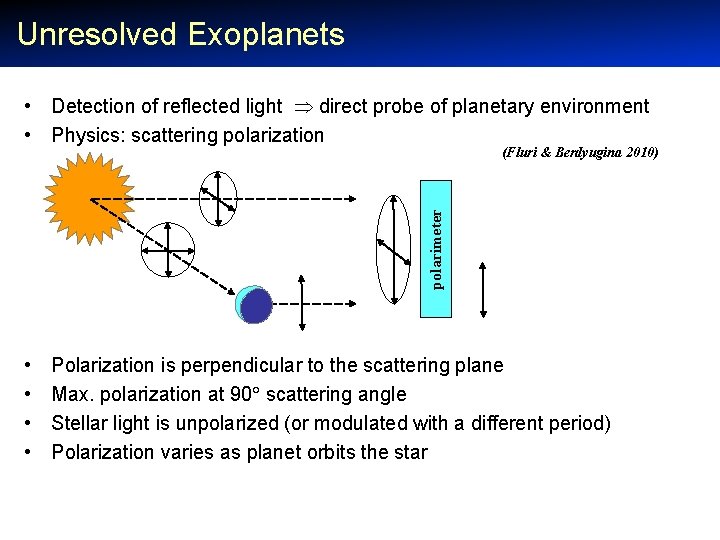
Unresolved Exoplanets • Detection of reflected light direct probe of planetary environment • Physics: scattering polarization polarimeter (Fluri & Berdyugina 2010) • • Polarization is perpendicular to the scattering plane Max. polarization at 90 scattering angle Stellar light is unpolarized (or modulated with a different period) Polarization varies as planet orbits the star
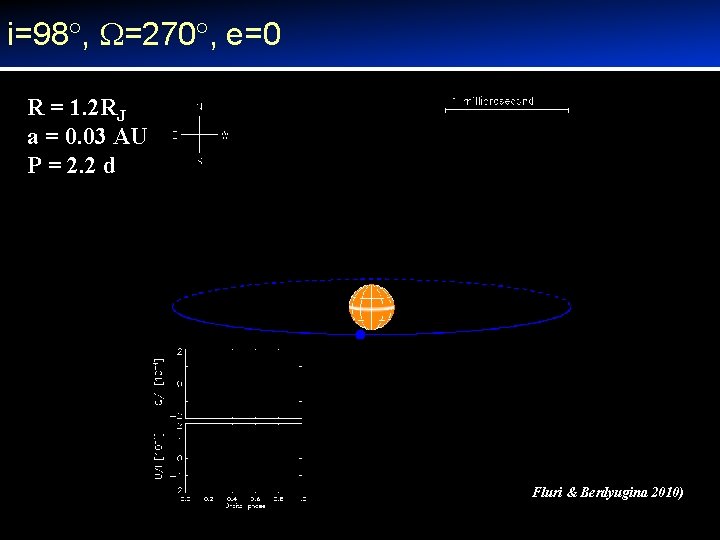
i=98 , =270 , e=0 R = 1. 2 RJ a = 0. 03 AU P = 2. 2 d (Fluri & Berdyugina 2010)
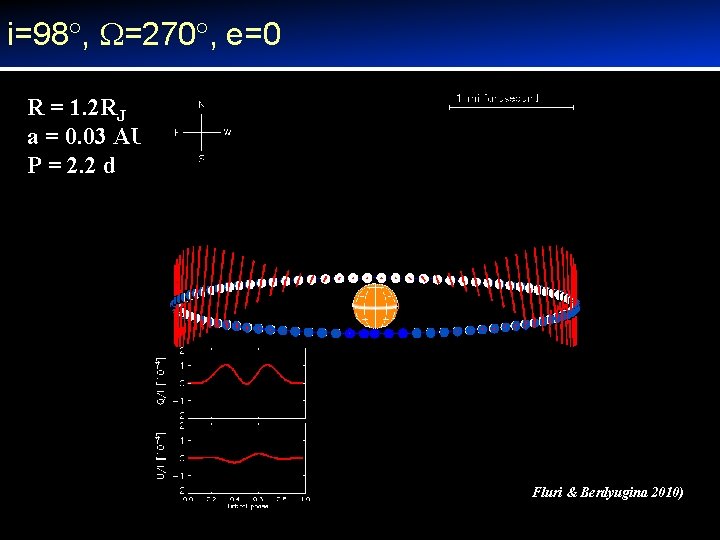
i=98 , =270 , e=0 R = 1. 2 RJ a = 0. 03 AU P = 2. 2 d (Fluri & Berdyugina 2010)
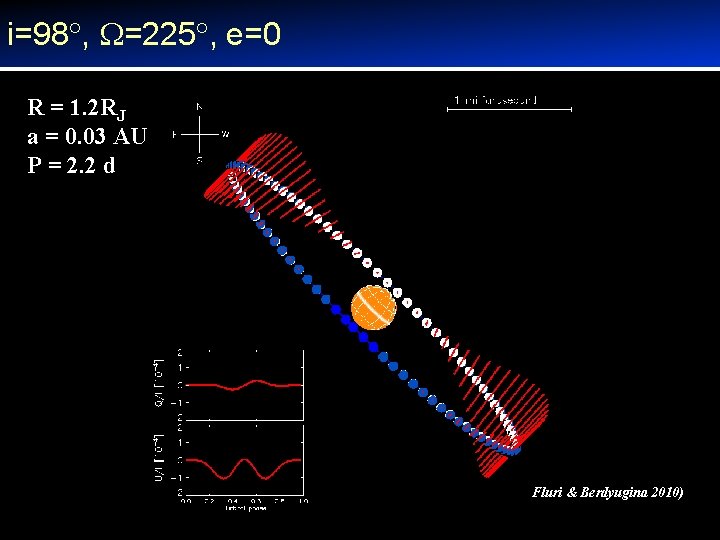
i=98 , =225 , e=0 R = 1. 2 RJ a = 0. 03 AU P = 2. 2 d (Fluri & Berdyugina 2010)
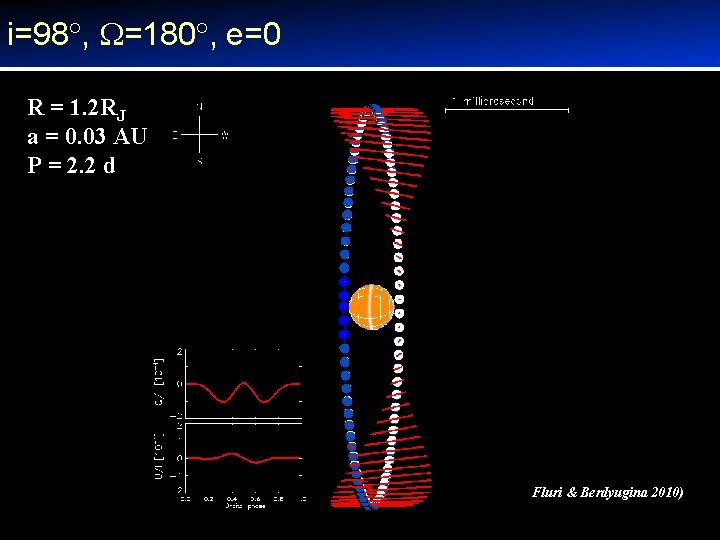
i=98 , =180 , e=0 R = 1. 2 RJ a = 0. 03 AU P = 2. 2 d (Fluri & Berdyugina 2010)

i=135 , =270 , e=0 R = 1. 2 RJ a = 0. 03 AU P = 2. 2 d (Fluri & Berdyugina 2010)
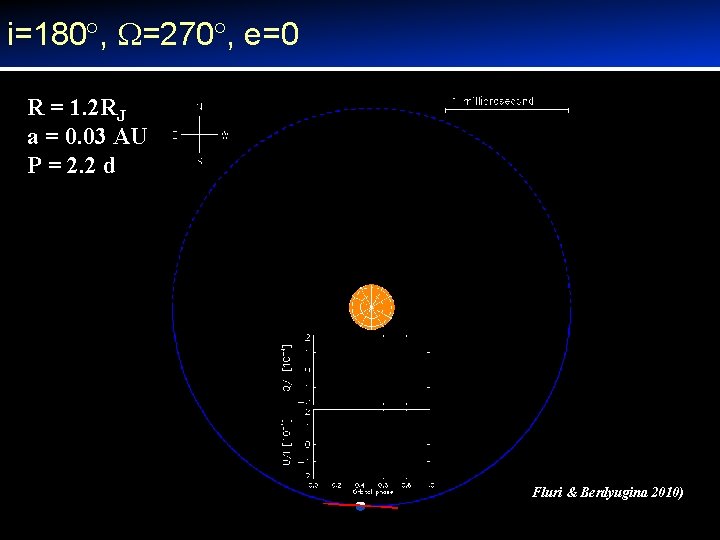
i=180 , =270 , e=0 R = 1. 2 RJ a = 0. 03 AU P = 2. 2 d (Fluri & Berdyugina 2010)
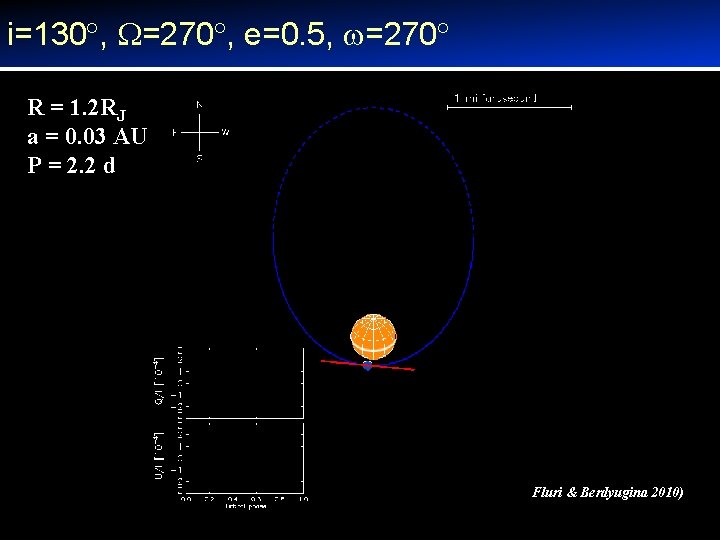
i=130 , =270 , e=0. 5, =270 R = 1. 2 RJ a = 0. 03 AU P = 2. 2 d (Fluri & Berdyugina 2010)
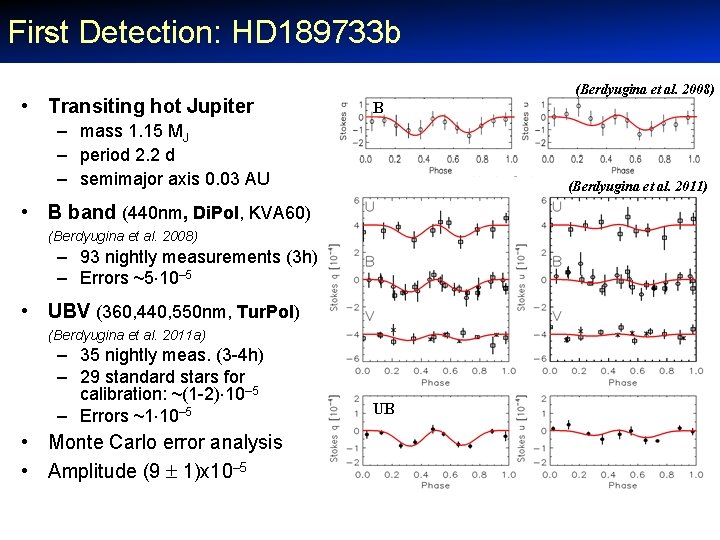
First Detection: HD 189733 b • Transiting hot Jupiter (Berdyugina et al. 2008) B – mass 1. 15 MJ – period 2. 2 d – semimajor axis 0. 03 AU (Berdyugina et al. 2011) • B band (440 nm, Di. Pol, KVA 60) (Berdyugina et al. 2008) – 93 nightly measurements (3 h) – Errors ~5 10– 5 • UBV (360, 440, 550 nm, Tur. Pol) (Berdyugina et al. 2011 a) – 35 nightly meas. (3 -4 h) – 29 standard stars for calibration: ~(1 -2) 10– 5 – Errors ~1 10– 5 • Monte Carlo error analysis • Amplitude (9 1)x 10– 5 UB
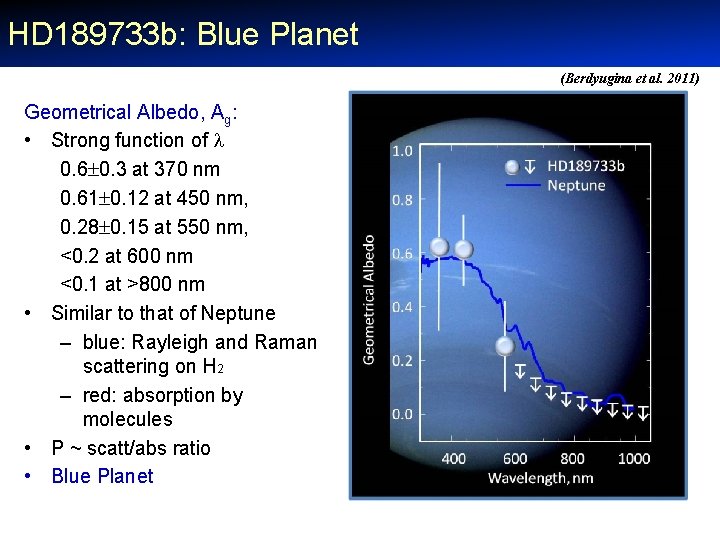
HD 189733 b: Blue Planet (Berdyugina et al. 2011) Geometrical Albedo, Ag: • Strong function of 0. 6 0. 3 at 370 nm 0. 61 0. 12 at 450 nm, 0. 28 0. 15 at 550 nm, <0. 2 at 600 nm <0. 1 at >800 nm • Similar to that of Neptune – blue: Rayleigh and Raman scattering on H 2 – red: absorption by molecules • P ~ scatt/abs ratio • Blue Planet
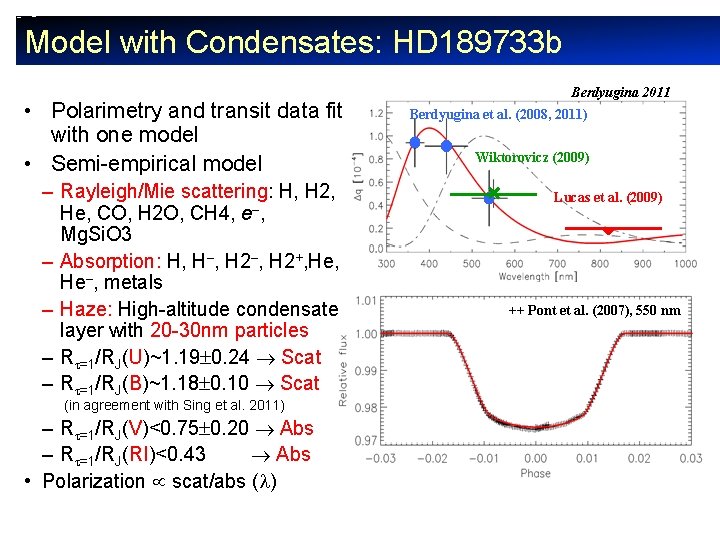
Model with Condensates: HD 189733 b • Polarimetry and transit data fit with one model • Semi-empirical model – Rayleigh/Mie scattering: H, H 2, He, CO, H 2 O, CH 4, e–, Mg. Si. O 3 – Absorption: H, H–, H 2+, He–, metals – Haze: High-altitude condensate layer with 20 -30 nm particles – R =1/RJ(U)~1. 19 0. 24 Scat – R =1/RJ(B)~1. 18 0. 10 Scat (in agreement with Sing et al. 2011) – R =1/RJ(V)<0. 75 0. 20 Abs – R =1/RJ(RI)<0. 43 Abs • Polarization scat/abs ( ) Berdyugina 2011 Berdyugina et al. (2008, 2011) Wiktorovicz (2009) Lucas et al. (2009) ++ Pont et al. (2007), 550 nm
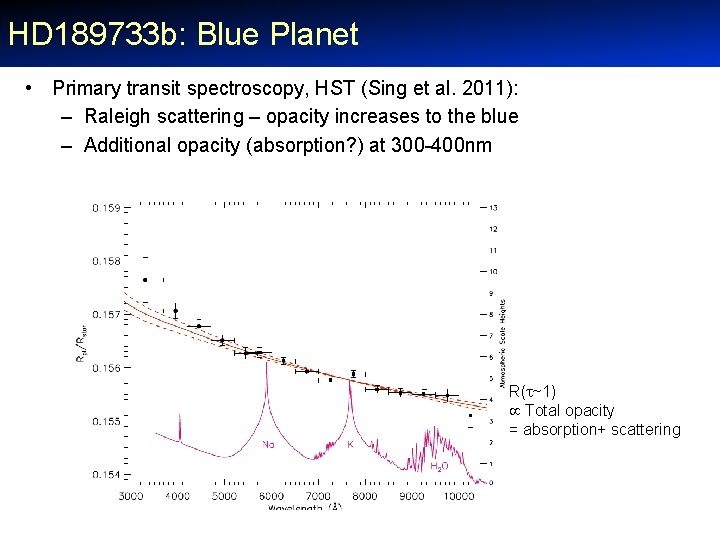
HD 189733 b: Blue Planet • Primary transit spectroscopy, HST (Sing et al. 2011): – Raleigh scattering – opacity increases to the blue – Additional opacity (absorption? ) at 300 -400 nm R( ~1) Total opacity = absorption+ scattering
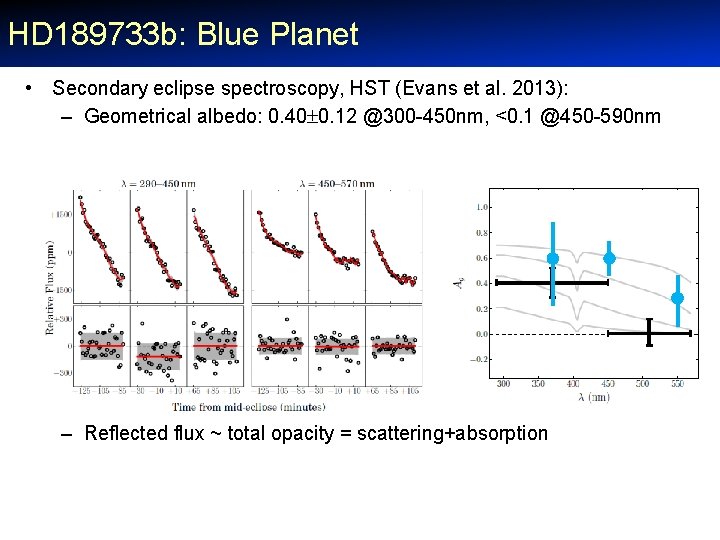
HD 189733 b: Blue Planet • Secondary eclipse spectroscopy, HST (Evans et al. 2013): – Geometrical albedo: 0. 40 0. 12 @300 -450 nm, <0. 1 @450 -590 nm – Reflected flux ~ total opacity = scattering+absorption
What does it mean, blue planet?
New Trend in Hot Jupiter Art • Before: • After:
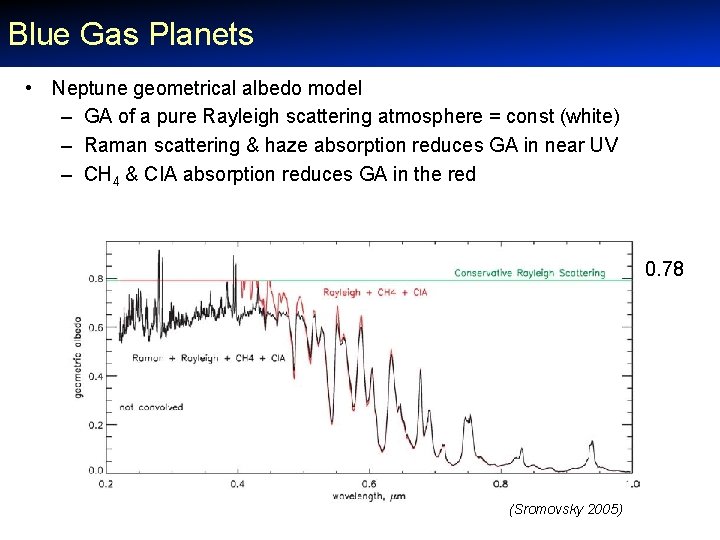
Blue Gas Planets • Neptune geometrical albedo model – GA of a pure Rayleigh scattering atmosphere = const (white) – Raman scattering & haze absorption reduces GA in near UV – CH 4 & CIA absorption reduces GA in the red 0. 78 (Sromovsky 2005)
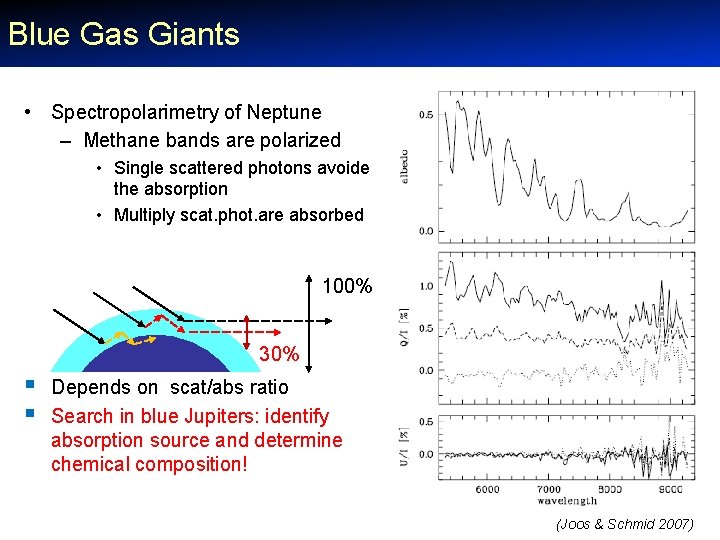
Blue Gas Giants • Spectropolarimetry of Neptune – Methane bands are polarized • Single scattered photons avoide the absorption • Multiply scat. phot. are absorbed 100% 30% § § Depends on scat/abs ratio Search in blue Jupiters: identify absorption source and determine chemical composition! (Joos & Schmid 2007)
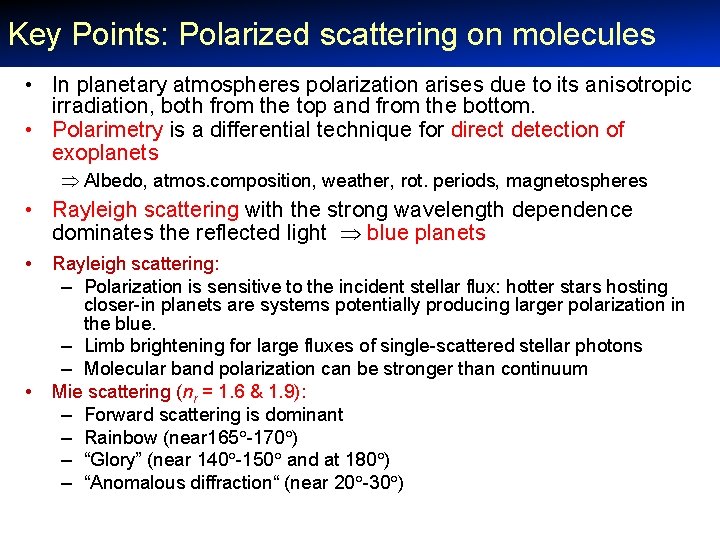
Key Points: Polarized scattering on molecules • In planetary atmospheres polarization arises due to its anisotropic irradiation, both from the top and from the bottom. • Polarimetry is a differential technique for direct detection of exoplanets Albedo, atmos. composition, weather, rot. periods, magnetospheres • Rayleigh scattering with the strong wavelength dependence dominates the reflected light blue planets • • Rayleigh scattering: – Polarization is sensitive to the incident stellar flux: hotter stars hosting closer-in planets are systems potentially producing larger polarization in the blue. – Limb brightening for large fluxes of single-scattered stellar photons – Molecular band polarization can be stronger than continuum Mie scattering (nr = 1. 6 & 1. 9): – Forward scattering is dominant – Rainbow (near 165 -170 ) – “Glory” (near 140 -150 and at 180 ) – “Anomalous diffraction“ (near 20 -30 )
- Slides: 38