
SCATTERED LIGHT IMAGES OF PROTOPLANETARY AND DEBRIS DISKS
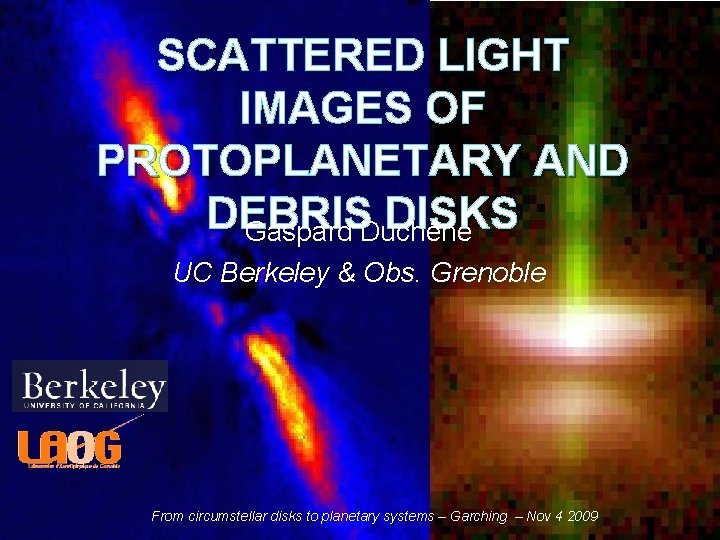
SCATTERED LIGHT IMAGES OF PROTOPLANETARY AND DEBRIS DISKS Gaspard Duchêne UC Berkeley & Obs. Grenoble From circumstellar disks to planetary systems – Garching – Nov 4 2009
Why scattered light imaging? � High spatial resolution can be achieved �Typically better than 0. 1” �Resolve structures down to a few AU � Independent of the star properties �Images scale with illuminating flux; use Fdisk/F★ �Location of star is most important � Available wavelength range: �“Routine”: 0. 4 to 2. 2 μm (best instrumentation) �Challenging but informative: 3 to 10 μm
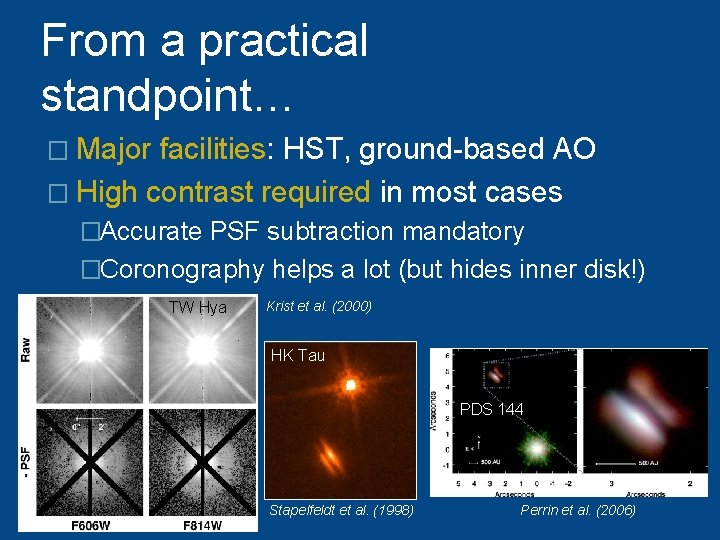
From a practical standpoint… � Major facilities: HST, ground-based AO � High contrast required in most cases �Accurate PSF subtraction mandatory �Coronography helps a lot (but hides inner disk!) TW Hya Krist et al. (2000) HK Tau PDS 144 Stapelfeldt et al. (1998) Perrin et al. (2006)
Scattering 101 � Scattering off dust has dependencies on �the grain size, shape and composition … and λ! � Most sensitive to 0. 1 < a/λ < 10 grains �Fine-tuned probe of grain size distribution �Not sensitive to mm-size pebbles � Single scattering induces linear polarization � Polychromatic, multi-technique approach can be used to solve for ambiguities disk geometry and dust properties
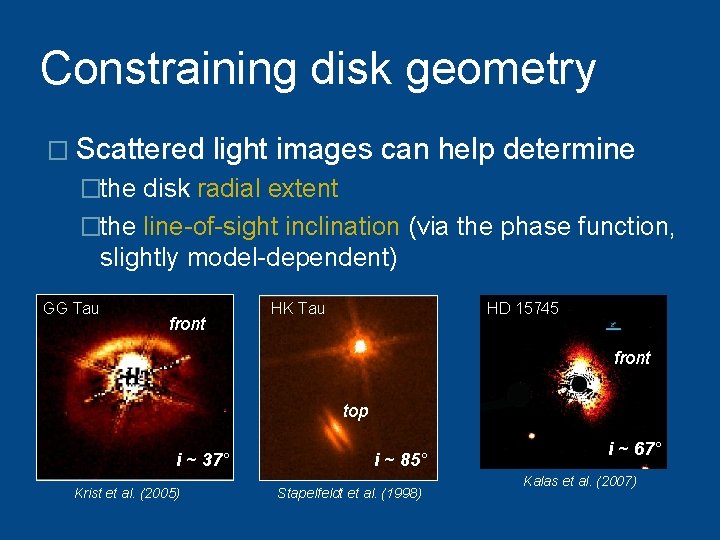
Constraining disk geometry � Scattered light images can help determine �the disk radial extent �the line-of-sight inclination (via the phase function, slightly model-dependent) GG Tau front HK Tau HD 15745 front top i ~ 37° Krist et al. (2005) i ~ 85° Stapelfeldt et al. (1998) i ~ 67° Kalas et al. (2007)
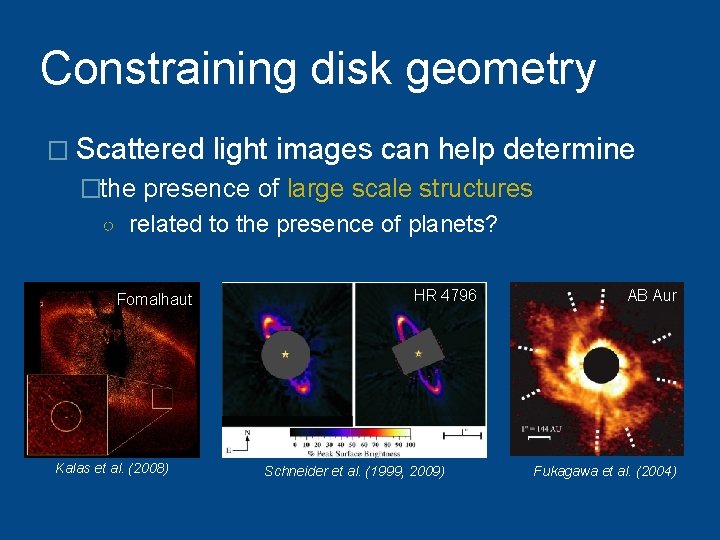
Constraining disk geometry � Scattered light images can help determine �the presence of large scale structures ○ related to the presence of planets? Fomalhaut Kalas et al. (2008) HR 4796 Schneider et al. (1999, 2009) AB Aur Fukagawa et al. (2004)
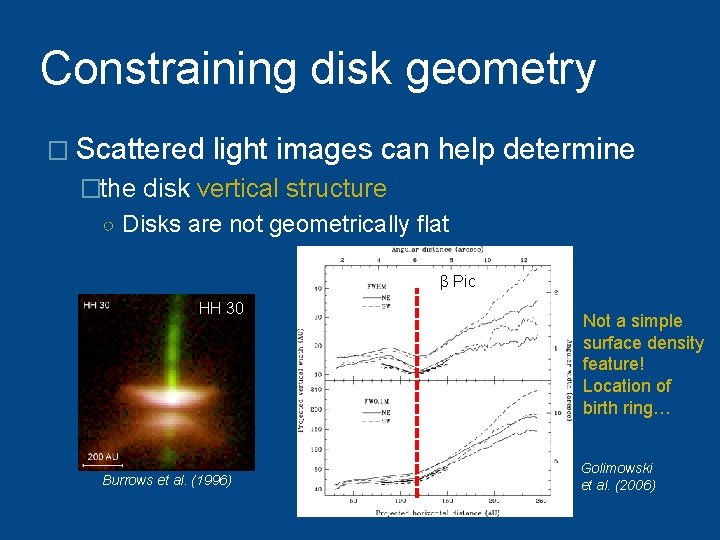
Constraining disk geometry � Scattered light images can help determine �the disk vertical structure ○ Disks are not geometrically flat β Pic HH 30 Burrows et al. (1996) Not a simple surface density feature! Location of birth ring… Golimowski et al. (2006)
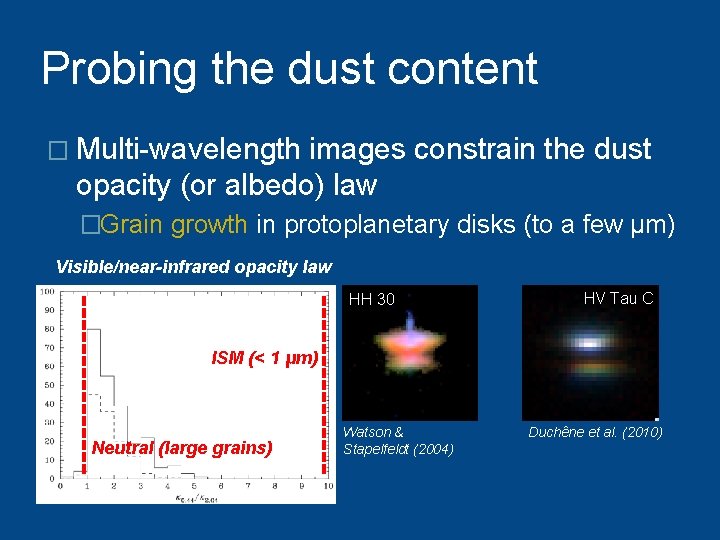
Probing the dust content � Multi-wavelength images constrain the dust opacity (or albedo) law �Grain growth in protoplanetary disks (to a few μm) Visible/near-infrared opacity law HH 30 HV Tau C ISM (< 1 μm) Neutral (large grains) Watson & Stapelfeldt (2004) Duchêne et al. (2010)
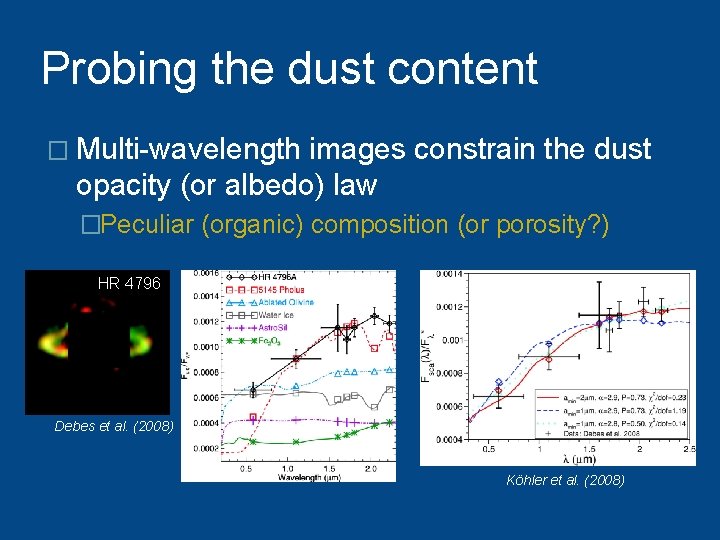
Probing the dust content � Multi-wavelength images constrain the dust opacity (or albedo) law �Peculiar (organic) composition (or porosity? ) HR 4796 Debes et al. (2008) Köhler et al. (2008)
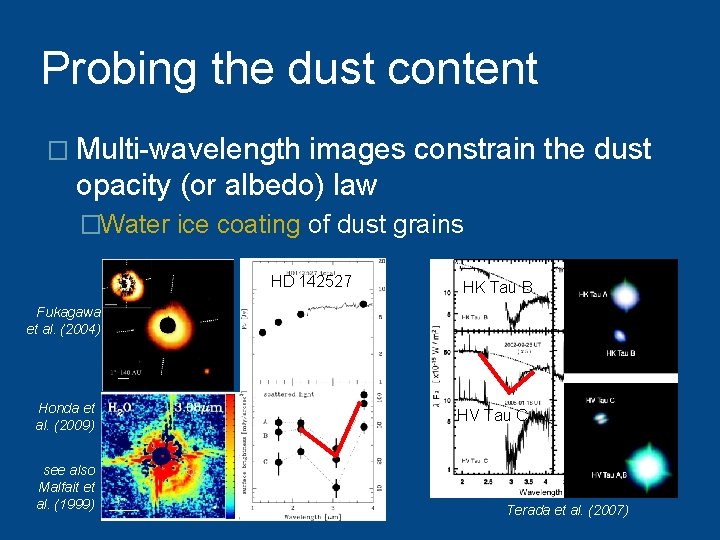
Probing the dust content � Multi-wavelength images constrain the dust opacity (or albedo) law �Water ice coating of dust grains HD 142527 HK Tau B Fukagawa et al. (2004) Honda et al. (2009) see also Malfait et al. (1999) HV Tau C Terada et al. (2007)
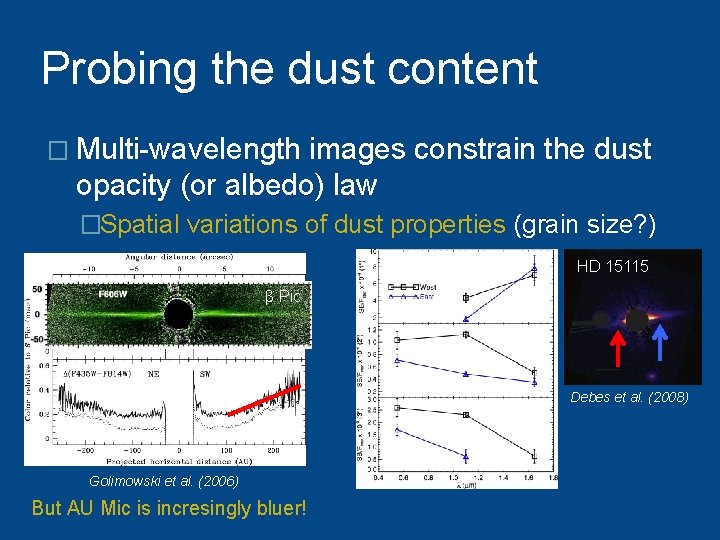
Probing the dust content � Multi-wavelength images constrain the dust opacity (or albedo) law �Spatial variations of dust properties (grain size? ) HD 15115 β Pic Debes et al. (2008) Golimowski et al. (2006) But AU Mic is incresingly bluer!
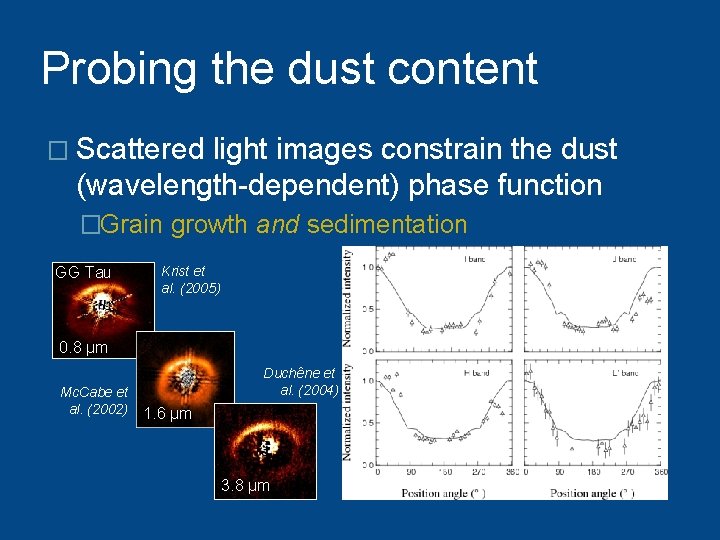
Probing the dust content � Scattered light images constrain the dust (wavelength-dependent) phase function �Grain growth and sedimentation GG Tau Krist et al. (2005) 0. 8 μm Mc. Cabe et al. (2002) Duchêne et al. (2004) 1. 6 μm 3. 8 μm
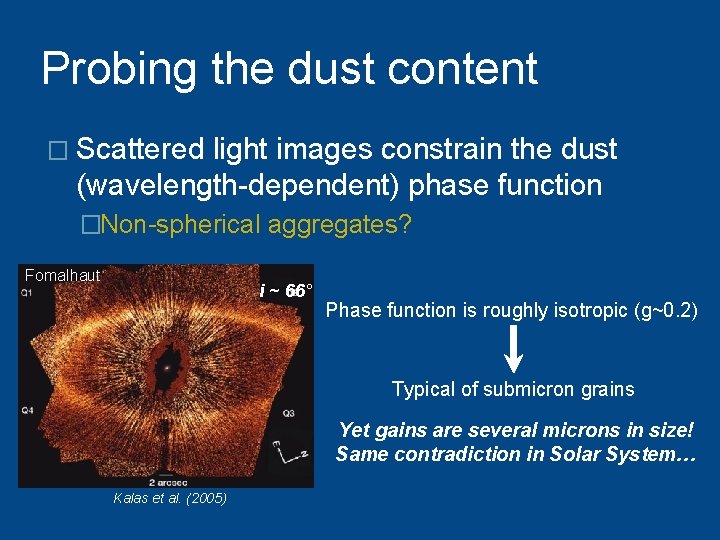
Probing the dust content � Scattered light images constrain the dust (wavelength-dependent) phase function �Non-spherical aggregates? Fomalhaut i ~ 66° Phase function is roughly isotropic (g~0. 2) Typical of submicron grains Yet gains are several microns in size! Same contradiction in Solar System… Kalas et al. (2005)
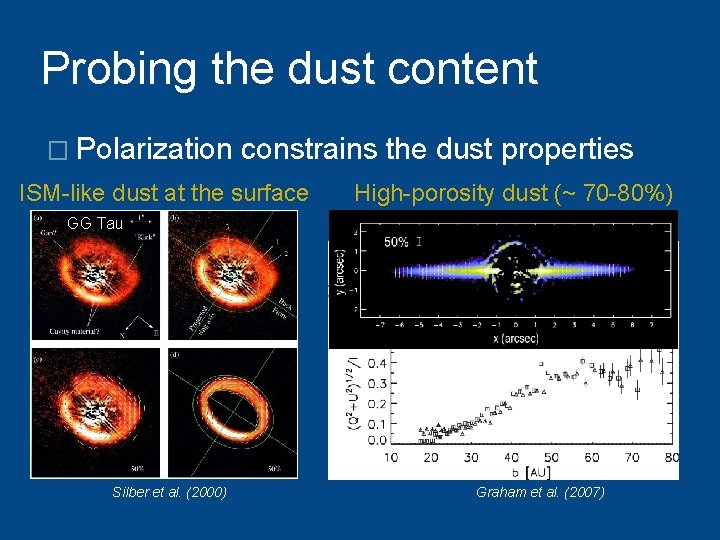
Probing the dust content � Polarization constrains the dust properties ISM-like dust at the surface High-porosity dust (~ 70 -80%) GG Tau Silber et al. (2000) Graham et al. (2007)
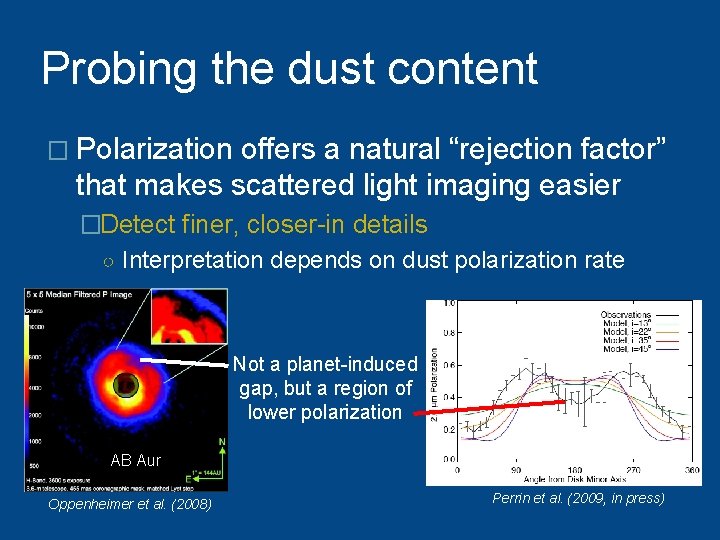
Probing the dust content � Polarization offers a natural “rejection factor” that makes scattered light imaging easier �Detect finer, closer-in details ○ Interpretation depends on dust polarization rate Not a planet-induced gap, but a region of lower polarization AB Aur Oppenheimer et al. (2008) Perrin et al. (2009, in press)
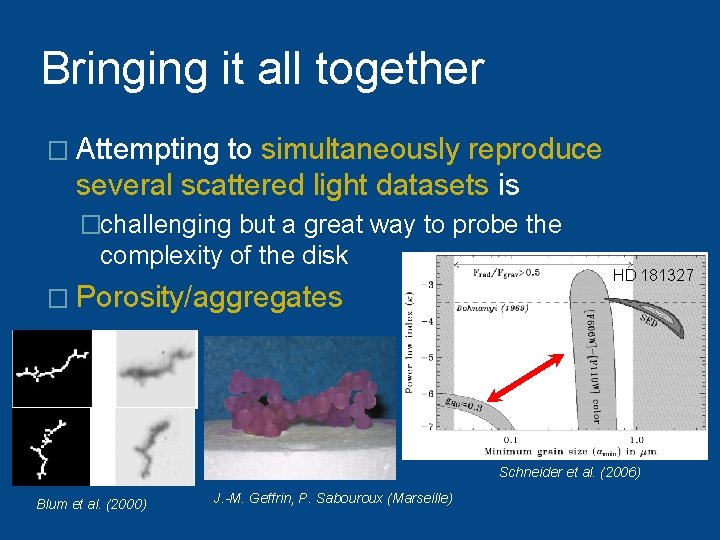
Bringing it all together � Attempting to simultaneously reproduce several scattered light datasets is �challenging but a great way to probe the complexity of the disk � Porosity/aggregates HD 181327 Schneider et al. (2006) Blum et al. (2000) J. -M. Geffrin, P. Sabouroux (Marseille)
Summary & perspective � Scattered light images are great to constrain �the global and fine scale structure of disks �the dust properties ○ Grain sizes (and evolution) ○ Grain composition ○ Grain structure (porosity, aggregates) ○ Spatial differentiation � That information should be merged with input from SED, mm/NIR interferometry, and full radiative transfer modeling
Also at this conference… � Talks by �C. Pinte, P. Kalas, M. Wyatt � Posters �A 24 (Debes et al. ) �A 35 (Fukagawa et al. ) �B 10 (Maness et al. ) � And probably more…
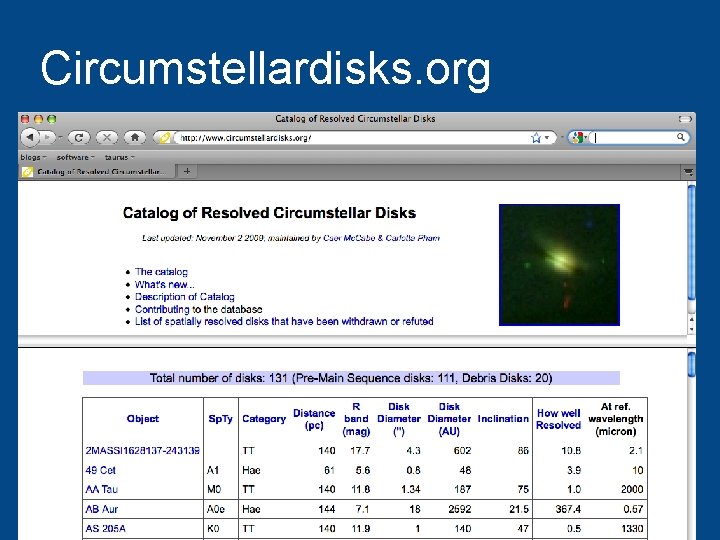
Circumstellardisks. org
- Slides: 19