
SCARCITY AND ABUNDANCE Unit 1 Lesson 2 Unit
SCARCITY AND ABUNDANCE Unit 1 Lesson 2
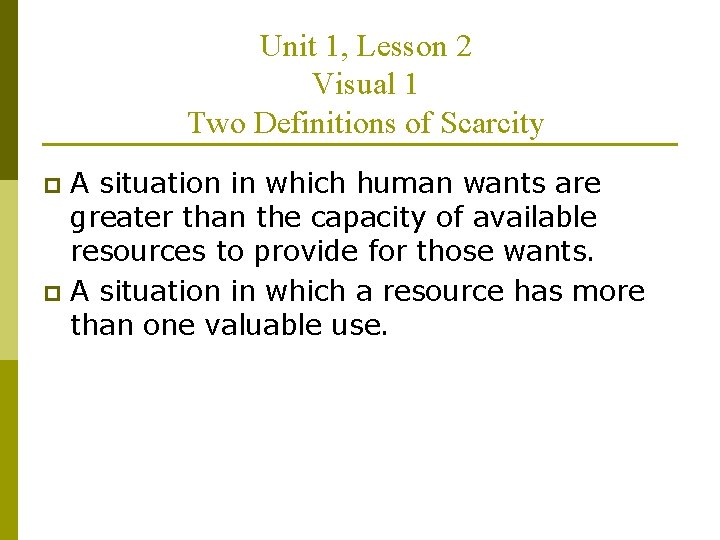
Unit 1, Lesson 2 Visual 1 Two Definitions of Scarcity A situation in which human wants are greater than the capacity of available resources to provide for those wants. p A situation in which a resource has more than one valuable use. p
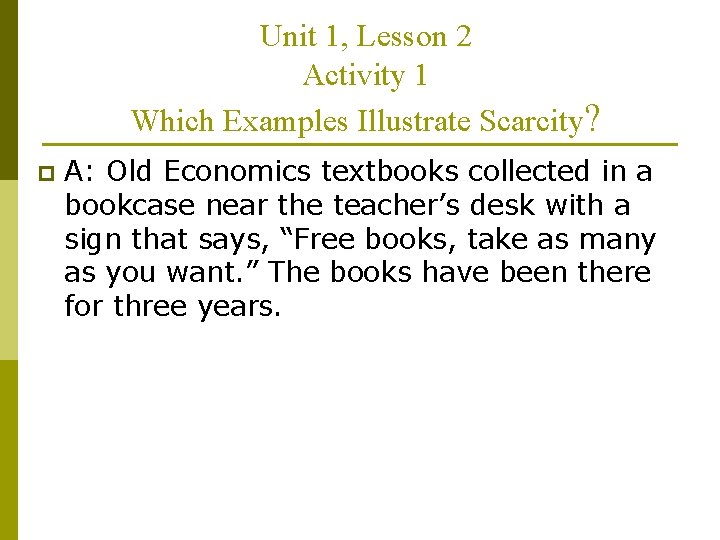
Unit 1, Lesson 2 Activity 1 Which Examples Illustrate Scarcity? p A: Old Economics textbooks collected in a bookcase near the teacher’s desk with a sign that says, “Free books, take as many as you want. ” The books have been there for three years.
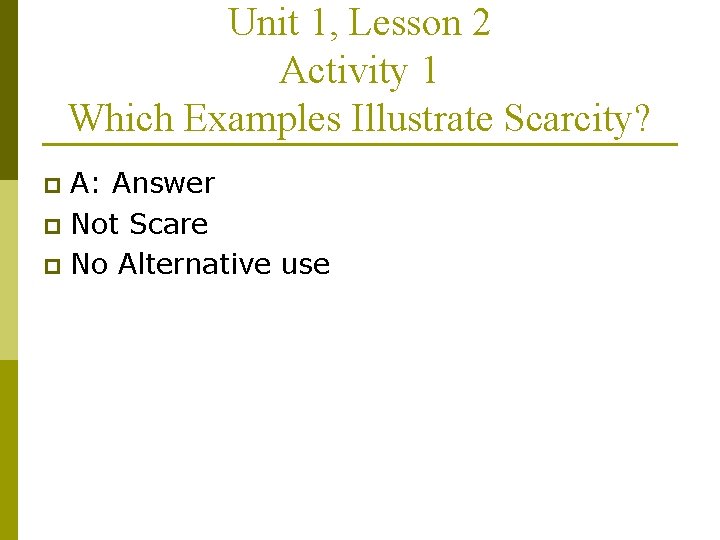
Unit 1, Lesson 2 Activity 1 Which Examples Illustrate Scarcity? A: Answer p Not Scare p No Alternative use p
Unit 1, Lesson 2 Activity 1 Which Examples Illustrates Scarcity? p B: Old economics textbooks collected in a bookcase near the teacher’s desk with a sign that says, “Free books, take as many as you want. ” Another sign posted in the hallway says, “$10 paid for any recycled textbook. Bring books to the Principal’s office. ”
Unit 1, Lesson 2 Activity 1 Which Examples Illustrates Scarcity? B: Answer p Scarce p The books may be read or they may be recycled. Two alternative uses p
Unit 1, Lesson 2 Activity 1 Which Examples Illustrate Scarcity? p C: One economics textbook, five students who wish to do well in the economics course, and an important test in class the next day.
Unit 1, Lesson 2 Activity 1 Which Examples Illustrate Scarcity? C: Answer p Scarce p The one book could be used by five different people; it has alternative uses p
Unit 1, Lesson 2 Activity 1 Which Examples Illustrate Scarcity? p D: One economics textbook, five students who are not taking economics, and an important test in class the next day.
Unit 1, Lesson 2 Activity 1 Which Examples Illustrate Scarcity? D: Answer p Not Scarce p Same number relationship, but the information in the book is not valuable to the five students p
Unit 1, Lesson 2 Activity 1 Which Examples Illustrate Scarcity? p E: Petroleum in Japan, a country without its own oil fields or oil reserves
Unit 1, Lesson 2 Activity 1 Which Examples Illustrate Scarcity? E: Answer p Scarce p Petroleum has many valuable uses in Japan p
Unit 1, Lesson 2 Activity 1 Which Examples Illustrate Scarcity? p F: Patroleum in Saudi Arabia, a country with many oil fields and oil reserves.
Unit 1, Lesson 2 Activity 1 Which Examples Illustrate Scarcity? F: Answer p Scarce p Petroleum has many valuable uses in Saudi Arabia, and it can be sold to people in other countries. Several valuable uses. p
Activity 2 Are People Treating Resources as Scarce A: Water fountains in Rome flow continuously with water carried by viaducts from the Italian mountains. p People walking in Rome quench their thirst by drinking from the fountains. p But most of the water flows into the street and down the drains to a river that passes through the city. p
Activity 2 Are People Treating Resources as Scarce A: Answer p Scarce resources treated as not scarce p The water has other valuable uses, such as irrigation or sewer treatment. p
Activity 2 Are People Treating Resources as Scarce B: At closing time, restaurants in the U. S. are required to throw away all uneaten food. p To meet health standards for food preparation and the safety of consumers, the food cannot be stored for use the next day. p Also, the law prohibits restaurant employees from giving the food to the poor or dispersing it to local food banks. p
Activity 2 Are People Treating Resources as Scarce B: Answer p Scarce resources treated as not scarce p The food could feed the hungry; it could be stored for future consumption; or it could be used as compost to improve soil conditions in gardens p
Activity 2 Are People Treating Resources as Scarce C: Oxygen is taken from the air and stored in containers. p When divers wish to stay underwater for long periods of time, they purchase container-stored oxygen and breathe from it during their underwater activities. p
Activity 2 Are People Treating Resources as Scarce C: Answer p A difficult example p Oxygen in the air around us is not scarce. People acquire it at no cost p Oxygen underwater is scarce, as are the resources needed to capture oxygen and store it in containers for underwater use. p
Activity 2 Are People Treating Resources as Scarce D: Pebbles are taken from a beach to build a walkway in a homeowner's lawn. p No one else wants the pebbles. p The pebbles are not necessary for the lake’s ecosystem or animal habitat. p
Activity 2 Are People Treating Resources as Scarce D: Answer p Scarce resources treated as not scarce p The pebbles have no valuable alternative use. The resources necessary to move the pebbles are scarce. They could be used for other valuable purposes. p
Activity 2 Are People Treating Resources as Scarce E: A farmer has a water irrigation contract that requires the water user to use the entire allocation of water to water crops, whither or not all the water is needed for crop irrigation p If the farmer does not use all the water, he or she will receive a smaller allocation next year p
Activity 2 Are People Treating Resources as Scarce E: Answer p Scarce resources treated as not scarce p The farmer is prohibited from considering other valuable uses for the water. p
- Slides: 24