
Scanning Probe Microscopy Seeing at the nanoscale Copyright
Scanning Probe Microscopy “Seeing” at the nanoscale Copyright © 2005 SRI International

Scanning Probe Microscopes (SPMs) • Monitor the interactions between a probe and a sample surface • What we “see” is really an image • Two types of microscopy we will look at: – Scanning Tunneling Microscope (STM) – Atomic Force Microscope (AFM)

Scanning Tunneling Microscopes (STMs) • Monitors the electron tunneling current between a probe and a sample surface • What is electron tunneling? – Classical versus quantum mechanical model – Occurs over very short distances Scanning Probe Tip and surface and electron tunneling Source: http: //mrsec. wisc. edu/Edetc/modules/Middle. School/SPM/Mappingthe. Unknown. pdf

STM Tips • Tunneling current depends on the distance between the STM probe and the sample Tip Surface Tunneling current depends on distance between tip and surface Source: http: //mechmat. caltech. edu/~kaushik/park/3 -3 -0. htm
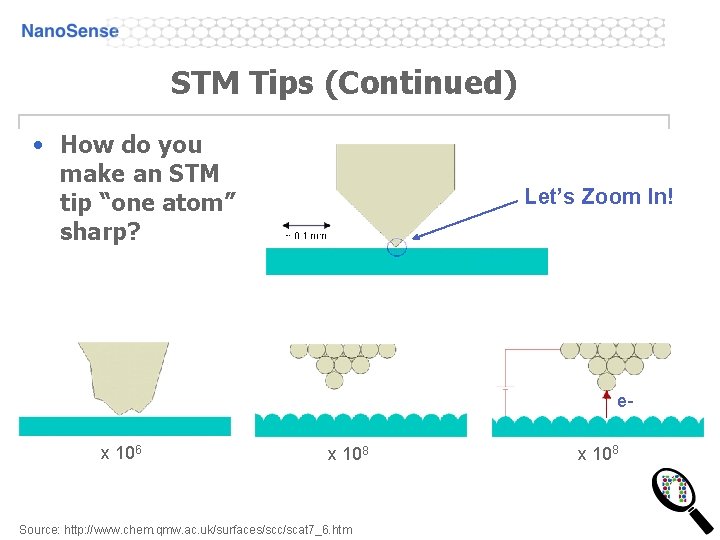
STM Tips (Continued) • How do you make an STM tip “one atom” sharp? Let’s Zoom In! ex 106 x 108 Source: http: //www. chem. qmw. ac. uk/surfaces/scc/scat 7_6. htm x 108
Putting It All Together • The human hand cannot precisely manipulate at the nanoscale level • Therefore, specialized materials are used to control the movement of the tip How an STM works (click to play or see URL below) Source: http: //www. iap. tuwien. ac. at/www/surface/STM_Gallery/stm_animated. gif

Challenges of the STM • Works primarily with conducting materials • Vibrational interference • Contamination – Physical (dust and other pollutants in the air) – Chemical (chemical reactivity)
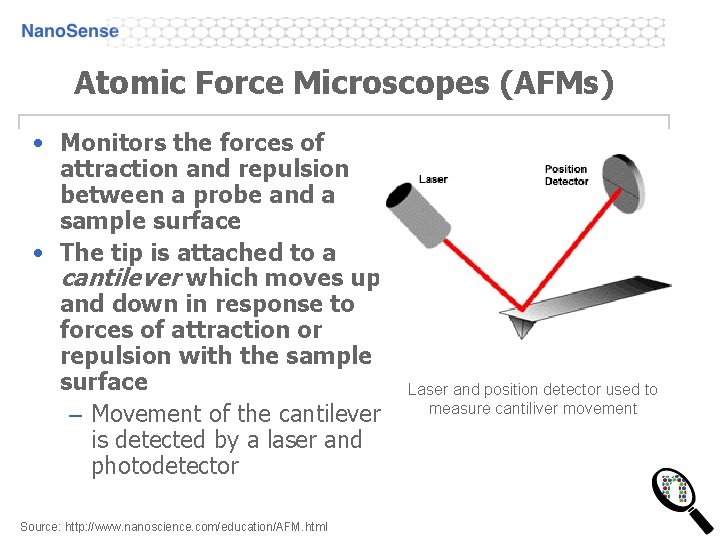
Atomic Force Microscopes (AFMs) • Monitors the forces of attraction and repulsion between a probe and a sample surface • The tip is attached to a cantilever which moves up and down in response to forces of attraction or repulsion with the sample surface – Movement of the cantilever is detected by a laser and photodetector Source: http: //www. nanoscience. com/education/AFM. html Laser and position detector used to measure cantiliver movement
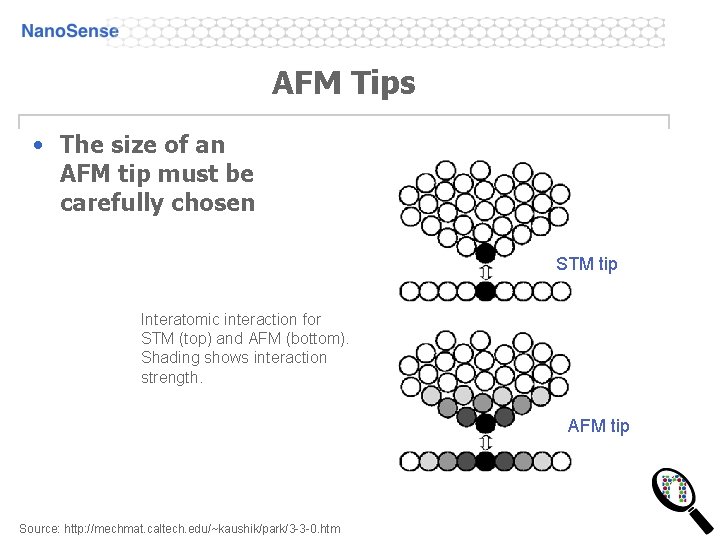
AFM Tips • The size of an AFM tip must be carefully chosen STM tip Interatomic interaction for STM (top) and AFM (bottom). Shading shows interaction strength. AFM tip Source: http: //mechmat. caltech. edu/~kaushik/park/3 -3 -0. htm
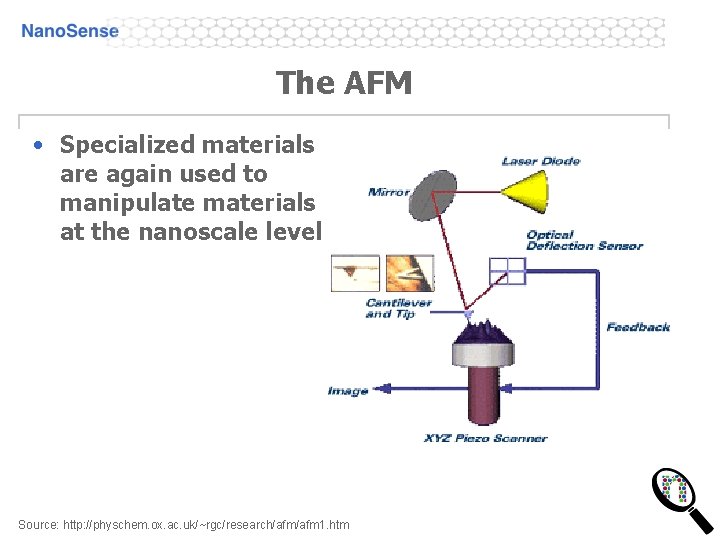
The AFM • Specialized materials are again used to manipulate materials at the nanoscale level Source: http: //physchem. ox. ac. uk/~rgc/research/afm 1. htm
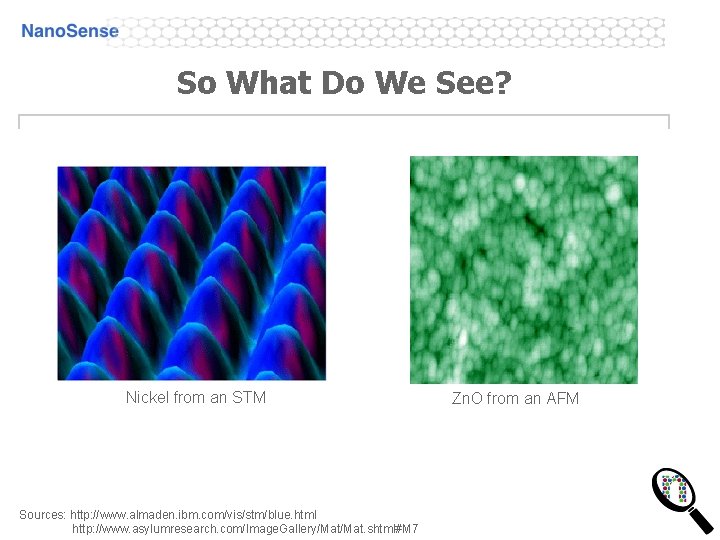
So What Do We See? Nickel from an STM Sources: http: //www. almaden. ibm. com/vis/stm/blue. html http: //www. asylumresearch. com/Image. Gallery/Mat. shtml#M 7 Zn. O from an AFM
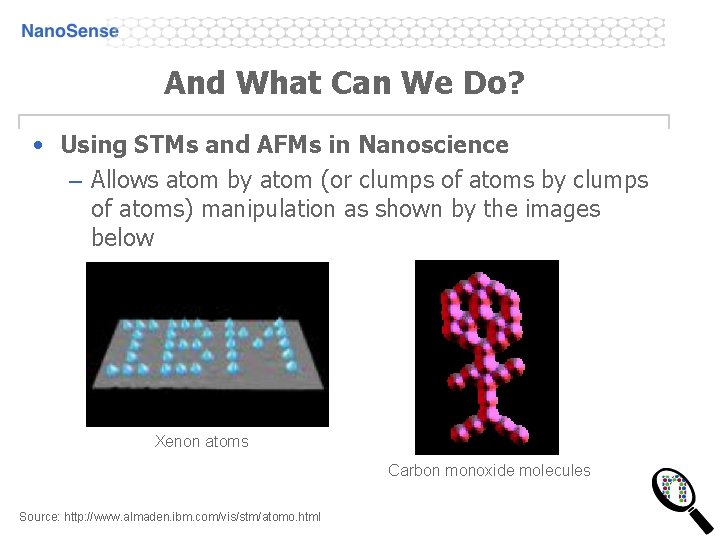
And What Can We Do? • Using STMs and AFMs in Nanoscience – Allows atom by atom (or clumps of atoms by clumps of atoms) manipulation as shown by the images below Xenon atoms Carbon monoxide molecules Source: http: //www. almaden. ibm. com/vis/stm/atomo. html
- Slides: 12