
Scanning Probe Microscopy Basic idea recording of motor
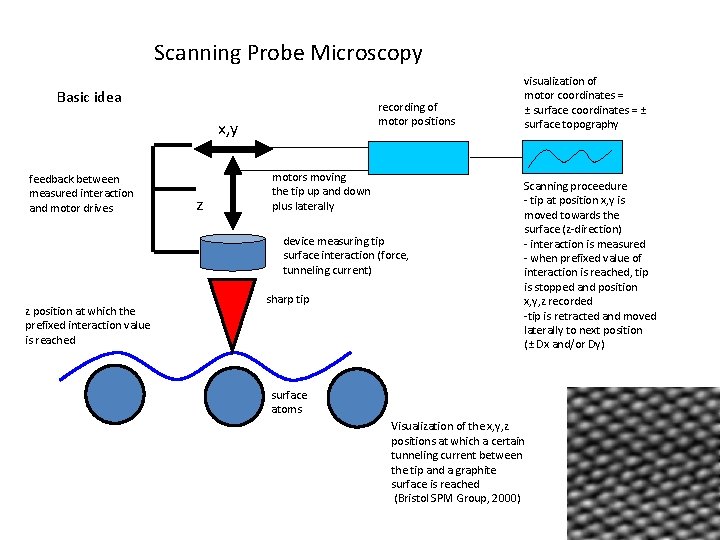
Scanning Probe Microscopy Basic idea recording of motor positions x, y feedback between measured interaction and motor drives z motors moving the tip up and down plus laterally device measuring tip surface interaction (force, tunneling current) z position at which the prefixed interaction value is reached sharp tip visualization of motor coordinates = ± surface topography Scanning proceedure - tip at position x, y is moved towards the surface (z-direction) - interaction is measured - when prefixed value of interaction is reached, tip is stopped and position x, y, z recorded -tip is retracted and moved laterally to next position (± Dx and/or Dy) surface atoms Visualization of the x, y, z positions at which a certain tunneling current between the tip and a graphite surface is reached (Bristol SPM Group, 2000)
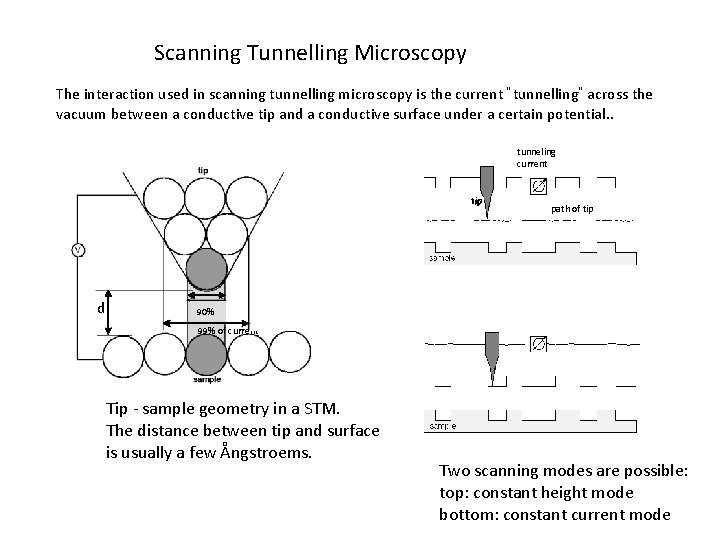
Scanning Tunnelling Microscopy The interaction used in scanning tunnelling microscopy is the current “tunnelling” across the vacuum between a conductive tip and a conductive surface under a certain potential. . tunneling current tip d path of tip 90% 99% of current Tip - sample geometry in a STM. The distance between tip and surface is usually a few Ångstroems. Two scanning modes are possible: top: constant height mode bottom: constant current mode
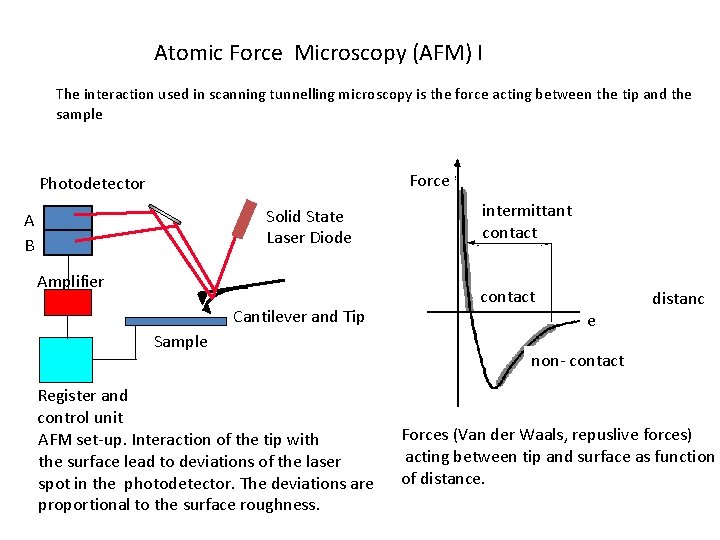
Atomic Force Microscopy (AFM) I The interaction used in scanning tunnelling microscopy is the force acting between the tip and the sample Force Photodetector Solid State Laser Diode A B Amplifier Cantilever and Tip Sample Register and control unit AFM set-up. Interaction of the tip with the surface lead to deviations of the laser spot in the photodetector. The deviations are proportional to the surface roughness. intermittant contact e distanc non- contact Forces (Van der Waals, repuslive forces) acting between tip and surface as function of distance.

Surface analysis Atomic Force Microscopy (AFM) I water drop cantilever tip Commercial AFM microscope Cantilever with There are different operating modes Si 3 N 4 tip for an AFM. In tapping mode (top) the cantilever oscillates. The interaction with the surface changes the oscillation frequency, which is recorded by the photodetector. In contact mode the tip is in contact with the surface.
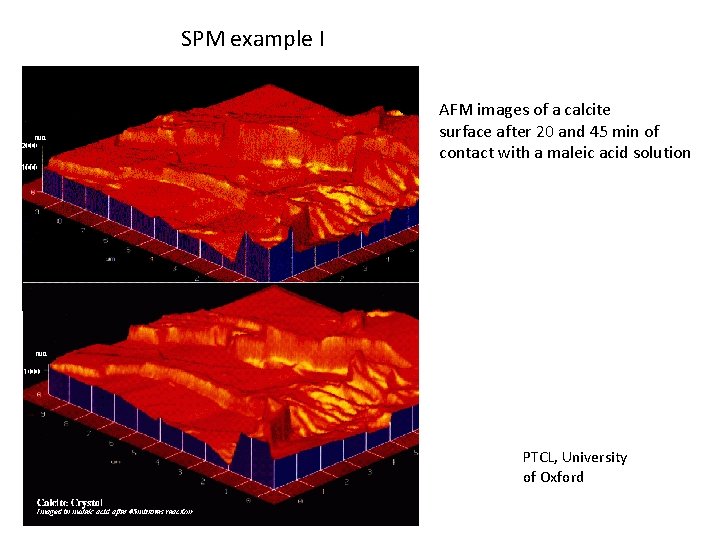
SPM example I AFM images of a calcite surface after 20 and 45 min of contact with a maleic acid solution PTCL, University of Oxford

SPM examples II STM image of a galena (100) surface taken at +200 m. V sample bias and 1. 8 n. A tunnel current under oil. Interpretation ? (Eggleston and Hochella, 1992)

SPM examples III old position STM image of a {001} hematite surfaces in contact with a Cr containing solution The two bright dots on the left image correspond to single Cr atoms. The right image has been taken 30 seconds later. One of the two Cr atoms has moved by approximately a lattice distance. Two new Cr atoms entered the field of view (top middle) (courtesy C. Eggleston)
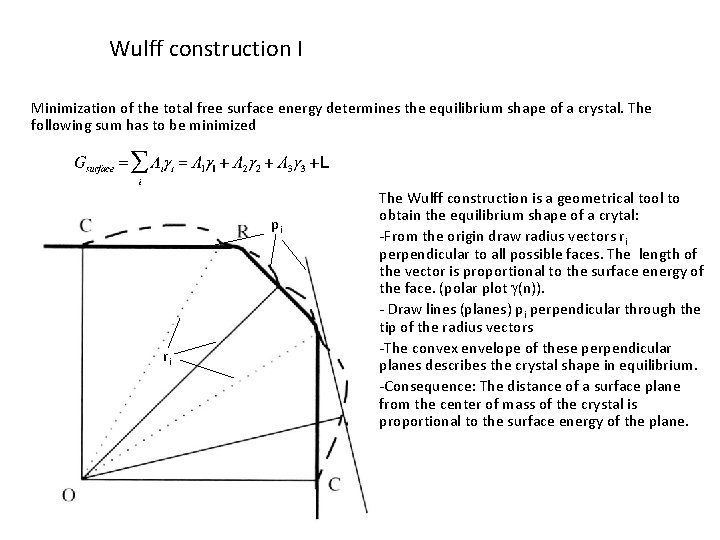
Wulff construction I Minimization of the total free surface energy determines the equilibrium shape of a crystal. The following sum has to be minimized pi ri The Wulff construction is a geometrical tool to obtain the equilibrium shape of a crytal: -From the origin draw radius vectors ri perpendicular to all possible faces. The length of the vector is proportional to the surface energy of the face. (polar plot (n)). - Draw lines (planes) pi perpendicular through the tip of the radius vectors -The convex envelope of these perpendicular planes describes the crystal shape in equilibrium. -Consequence: The distance of a surface plane from the center of mass of the crystal is proportional to the surface energy of the plane.
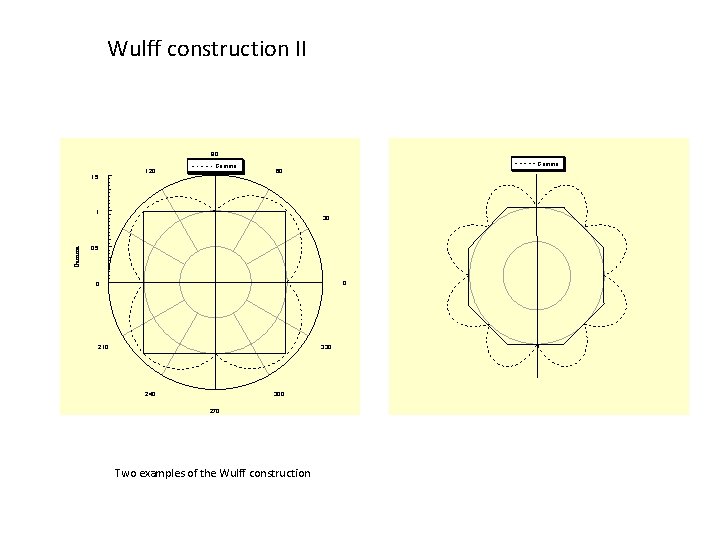
Wulff construction II 90 1. 5 120 Gamma 60 Gamma 1 30 0. 5 0 0 210 330 240 300 270 Two examples of the Wulff construction

Wulff construction III 111 100 SEM image of a lead crystal at 200°C. Anisotropy of surface tensions: The ratio of (hkl) vs. (111) is plotted as function of orientation for different temperature. The distance from the center of the crystal on the SEM image to the crystal face were taken as surface tension proxies.
- Slides: 10