
Scanning Probe Lithography SPL CHEM 7530750 Olivier Nguon
Scanning Probe Lithography (SPL) CHEM *7530/750 Olivier Nguon February 7 th, 2006
Outlines n Definition n Scanning Probe Microscopes (SPMs) n Scanning Probe Lithography n Conclusions
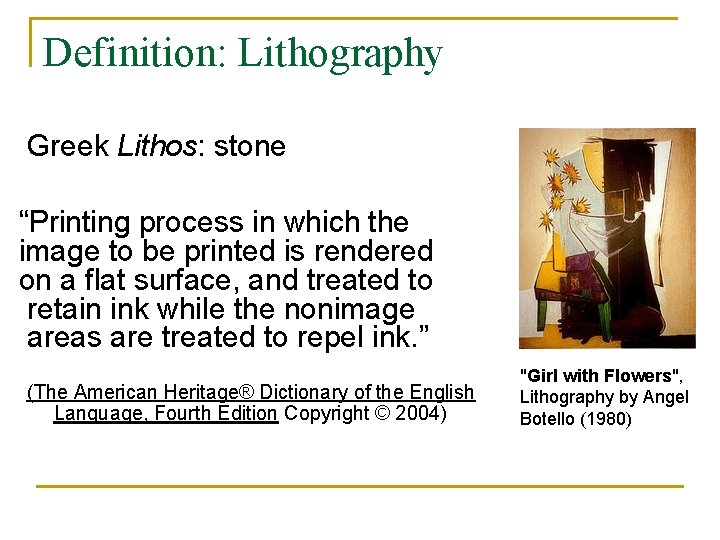
Definition: Lithography Greek Lithos: stone “Printing process in which the image to be printed is rendered on a flat surface, and treated to retain ink while the nonimage areas are treated to repel ink. ” (The American Heritage® Dictionary of the English Language, Fourth Edition Copyright © 2004) "Girl with Flowers", Lithography by Angel Botello (1980)
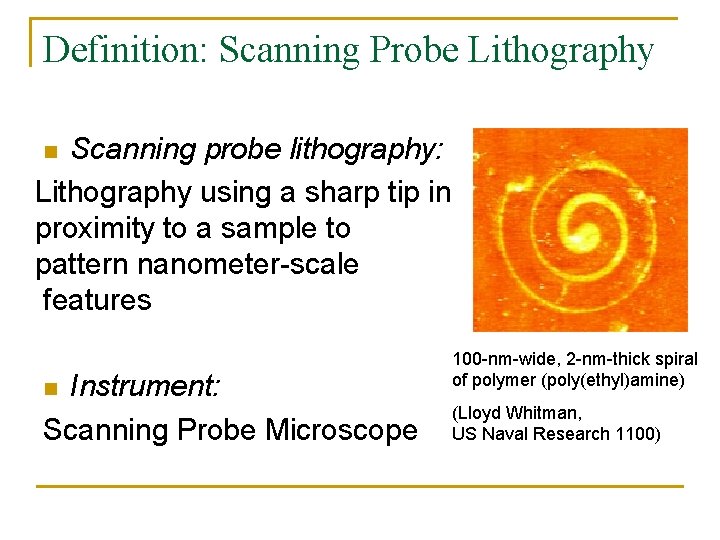
Definition: Scanning Probe Lithography Scanning probe lithography: Lithography using a sharp tip in proximity to a sample to pattern nanometer-scale features n Instrument: Scanning Probe Microscope n 100 -nm-wide, 2 -nm-thick spiral of polymer (poly(ethyl)amine) (Lloyd Whitman, US Naval Research 1100)
Scanning Probe Microscope (SPMs) n Monitor local interactions between a tip and a sample Physical, electrical or chemical information n Types of SPMs: n Scanning Tunneling Microscope Atomic Force Microscope
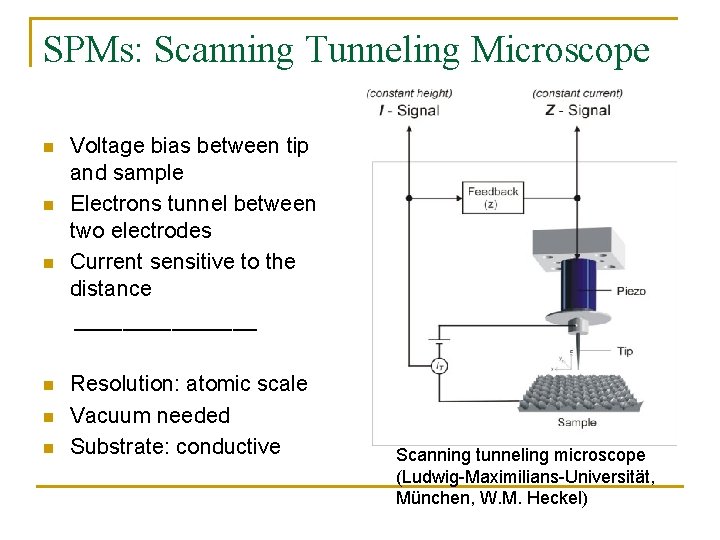
SPMs: Scanning Tunneling Microscope n n n Voltage bias between tip and sample Electrons tunnel between two electrodes Current sensitive to the distance ________ Resolution: atomic scale Vacuum needed Substrate: conductive Scanning tunneling microscope (Ludwig-Maximilians-Universität, München, W. M. Heckel)
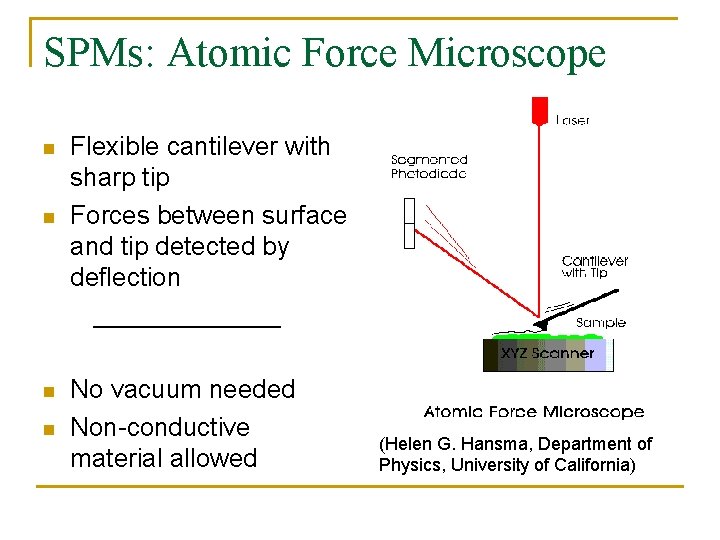
SPMs: Atomic Force Microscope n n Flexible cantilever with sharp tip Forces between surface and tip detected by deflection _______ No vacuum needed Non-conductive material allowed (Helen G. Hansma, Department of Physics, University of California)
Scanning Probe Lithography n SPMs used to modify a sample surface: 1. Atomic Manipulation 2. Mechanical and Termomechanical Pattering 3. Local Oxidation 4. Electron Exposure of Resists
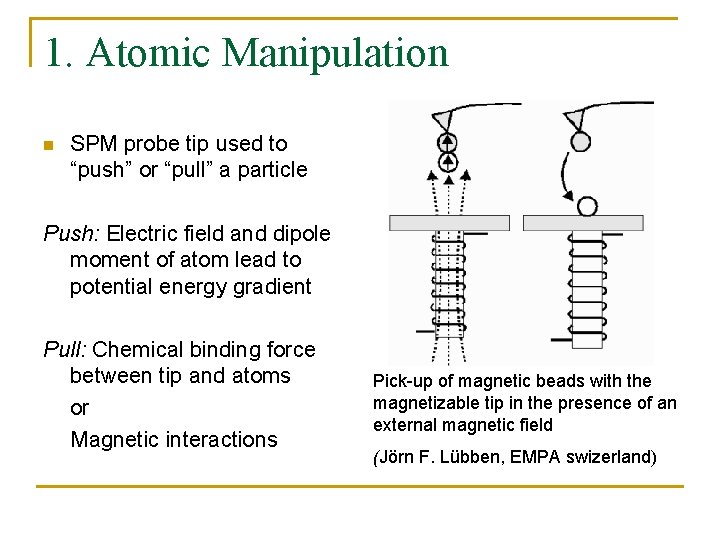
1. Atomic Manipulation n SPM probe tip used to “push” or “pull” a particle Push: Electric field and dipole moment of atom lead to potential energy gradient Pull: Chemical binding force between tip and atoms or Magnetic interactions Pick-up of magnetic beads with the magnetizable tip in the presence of an external magnetic field (Jörn F. Lübben, EMPA swizerland)
2. Local Oxidation n Voltage bias between probe tip and sample n Intense electric field n Local oxidation n Silicon: Growth of silicon oxide from crystal Si Electric-field-enhanced oxidation
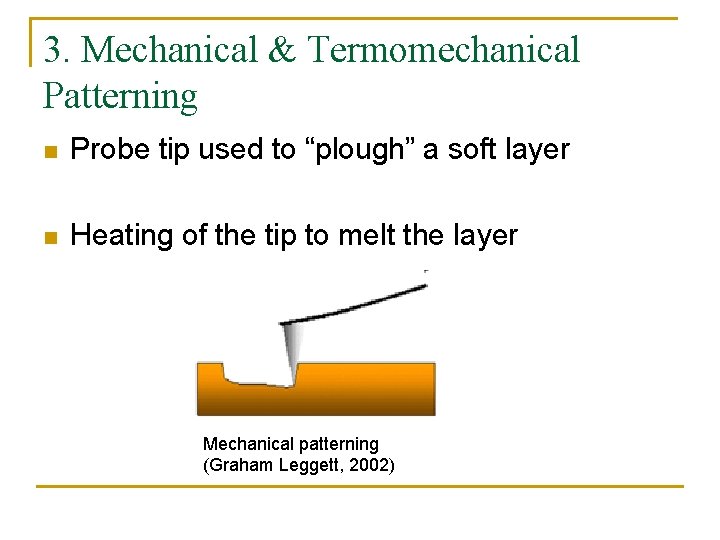
3. Mechanical & Termomechanical Patterning n Probe tip used to “plough” a soft layer n Heating of the tip to melt the layer Mechanical patterning (Graham Leggett, 2002)
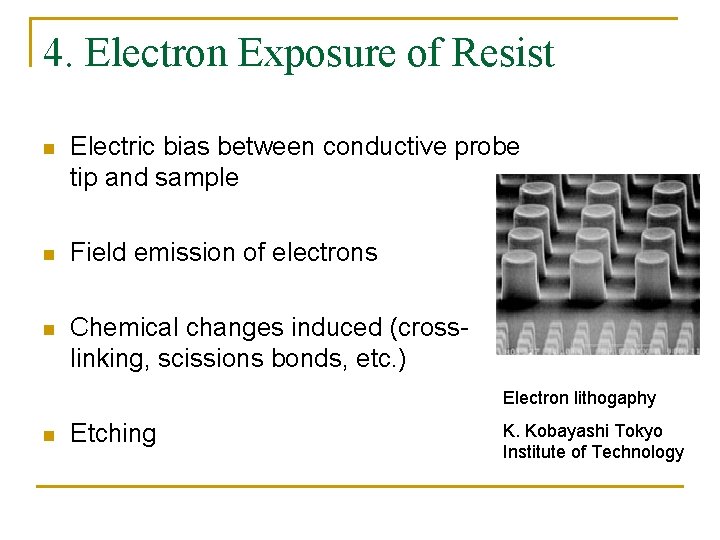
4. Electron Exposure of Resist n Electric bias between conductive probe tip and sample n Field emission of electrons n Chemical changes induced (crosslinking, scissions bonds, etc. ) Electron lithogaphy n Etching K. Kobayashi Tokyo Institute of Technology
Conclusions n n Ability to pattern nanometer-scale features Attracting method to semi-conductor industry Limits Throughput capabilities (coverage rates mm/s >cm/s) n Future evolution Carbon Nanotubes as scanning probes n

References n C. F. Quate, H. Soh, Scanning Probe Lithography, Kluwer Academic Publishers, (2001). TK 7874 S 648 2001 n L. L. Sohn, Appl. Phys. Lett. , 67, 1552 -4 (1995). n J. A. Stroscio, Science, 254, 1319 -26, (1991).
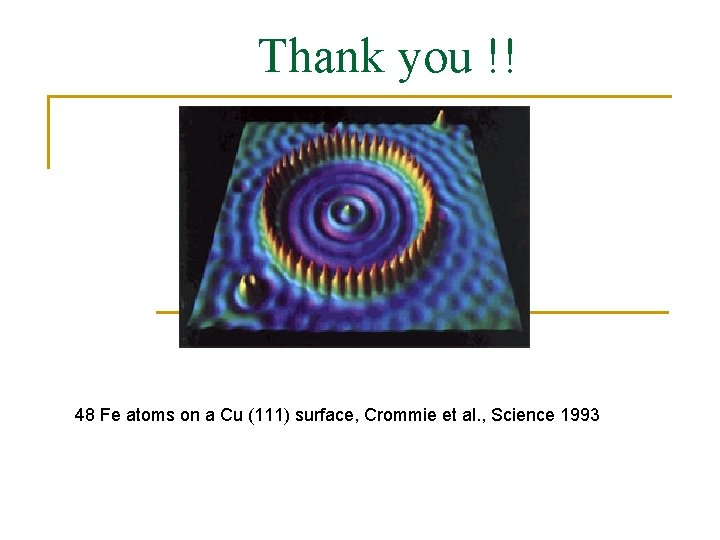
Thank you !! 48 Fe atoms on a Cu (111) surface, Crommie et al. , Science 1993
- Slides: 15