
Scanner 2015 03 16 Front End Source code

- Slides: 21
Scanner 2015. 03. 16
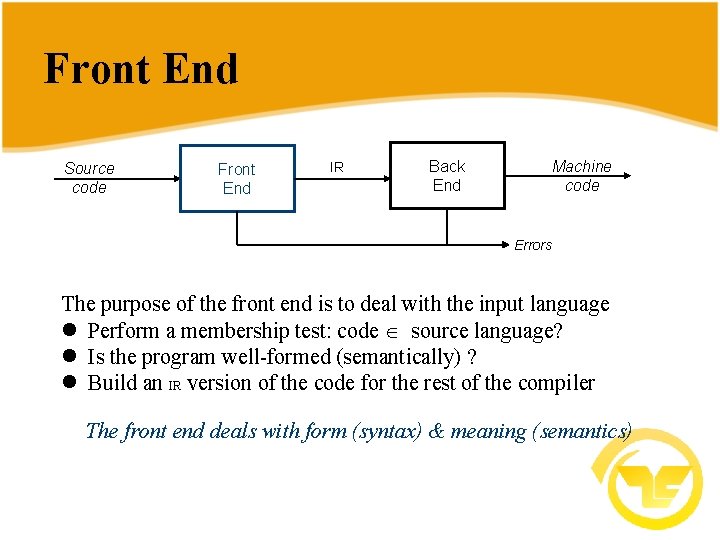
Front End Source code Front End IR Back End Machine code Errors The purpose of the front end is to deal with the input language l Perform a membership test: code source language? l Is the program well-formed (semantically) ? l Build an IR version of the code for the rest of the compiler The front end deals with form (syntax) & meaning (semantics)
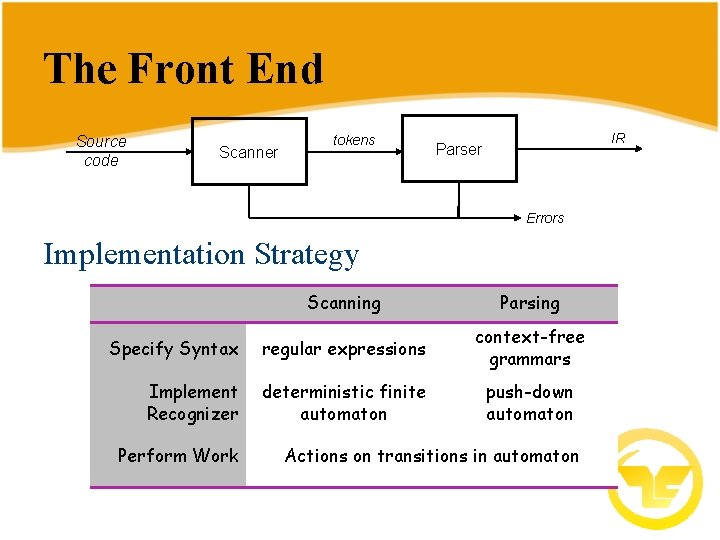
The Front End Source code Scanner tokens IR Parser Errors Implementation Strategy Scanning Parsing Specify Syntax regular expressions context-free grammars Implement Recognizer deterministic finite automaton push-down automaton Perform Work Actions on transitions in automaton
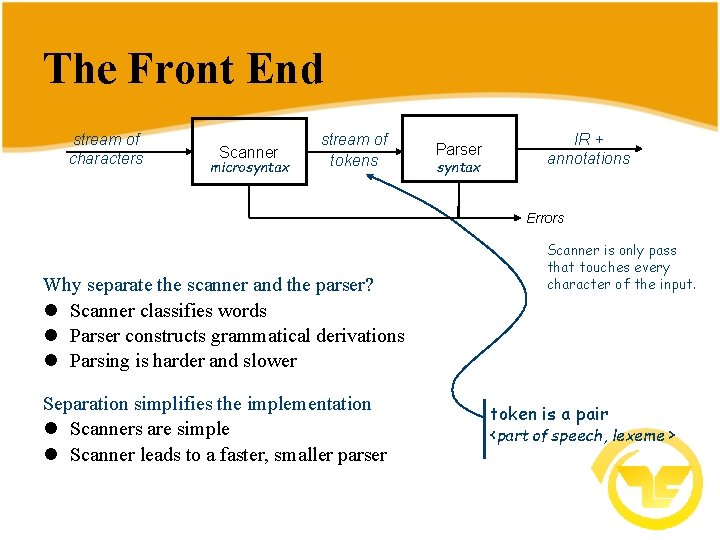
The Front End stream of characters Scanner microsyntax stream of tokens Parser syntax IR + annotations Errors Why separate the scanner and the parser? l Scanner classifies words l Parser constructs grammatical derivations l Parsing is harder and slower Separation simplifies the implementation l Scanners are simple l Scanner leads to a faster, smaller parser Scanner is only pass that touches every character of the input. token is a pair <part of speech, lexeme >
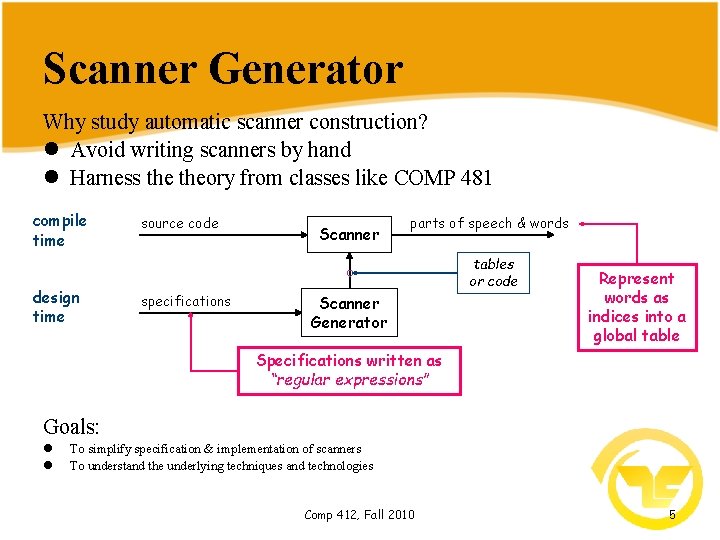
Scanner Generator Why study automatic scanner construction? l Avoid writing scanners by hand l Harness theory from classes like COMP 481 compile time design time source code Scanner parts of speech & words tables or code specifications Scanner Generator Represent words as indices into a global table Specifications written as “regular expressions” Goals: l l To simplify specification & implementation of scanners To understand the underlying techniques and technologies Comp 412, Fall 2010 5
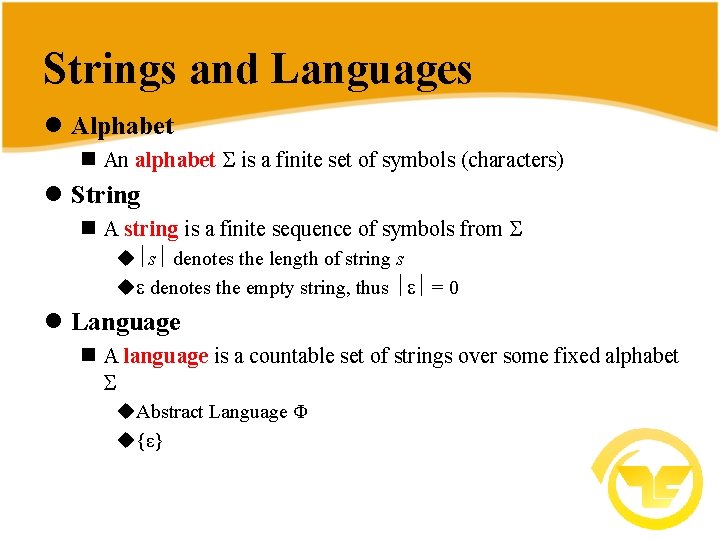
Strings and Languages l Alphabet n An alphabet is a finite set of symbols (characters) l String n A string is a finite sequence of symbols from u s denotes the length of string s u denotes the empty string, thus = 0 l Language n A language is a countable set of strings over some fixed alphabet u. Abstract Language Φ u{ε}
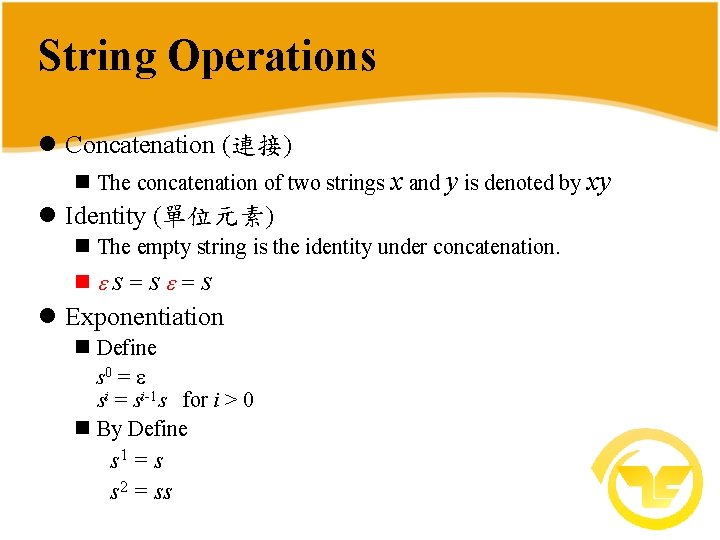
String Operations l Concatenation (連接) n The concatenation of two strings x and y is denoted by xy l Identity (單位元素) n The empty string is the identity under concatenation. n s=s =s l Exponentiation n Define s 0 = si = si-1 s for i > 0 n By Define s 1 = s s 2 = ss
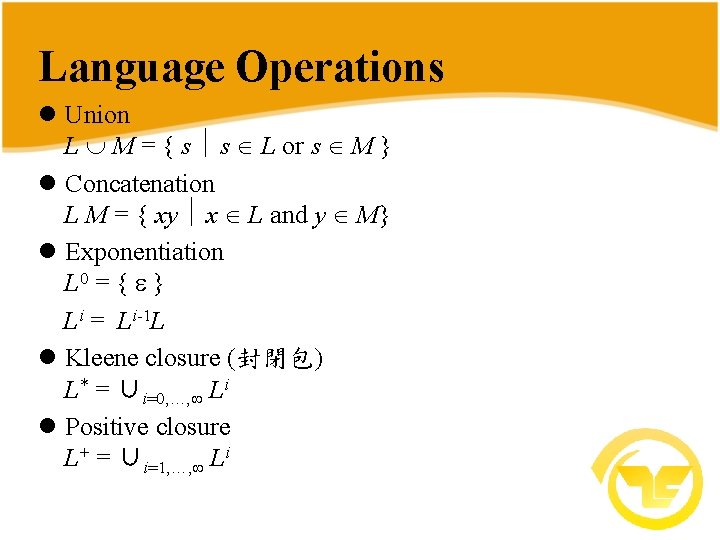
Language Operations l Union L M = { s s L or s M } l Concatenation L M = { xy x L and y M} l Exponentiation L 0 = { } Li = Li-1 L l Kleene closure (封閉包) L* = ∪i=0, …, Li l Positive closure L+ = ∪i=1, …, Li
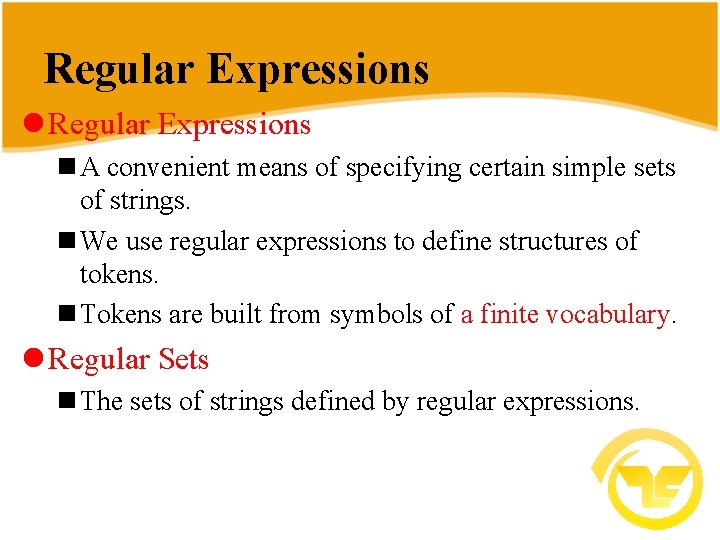
Regular Expressions l Regular Expressions n A convenient means of specifying certain simple sets of strings. n We use regular expressions to define structures of tokens. n Tokens are built from symbols of a finite vocabulary. l Regular Sets n The sets of strings defined by regular expressions.
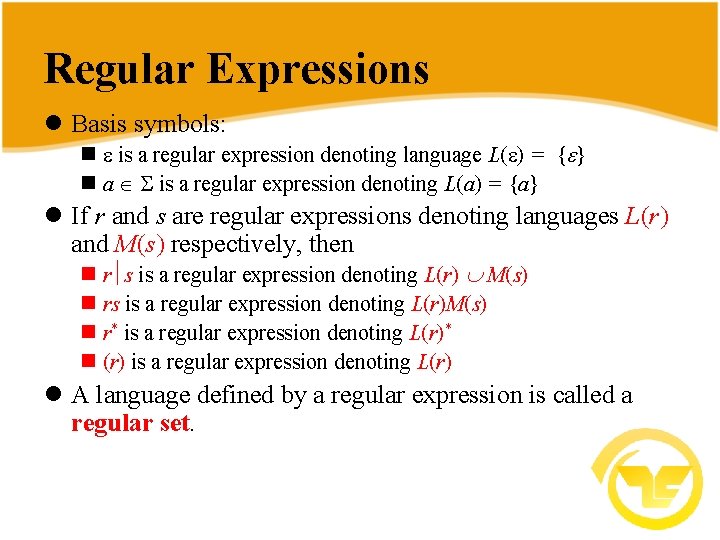
Regular Expressions l Basis symbols: n is a regular expression denoting language L( ) = { } n a is a regular expression denoting L(a) = {a} l If r and s are regular expressions denoting languages L(r) and M(s) respectively, then n r s is a regular expression denoting L(r) M(s) n rs is a regular expression denoting L(r)M(s) n r* is a regular expression denoting L(r)* n (r) is a regular expression denoting L(r) l A language defined by a regular expression is called a regular set.
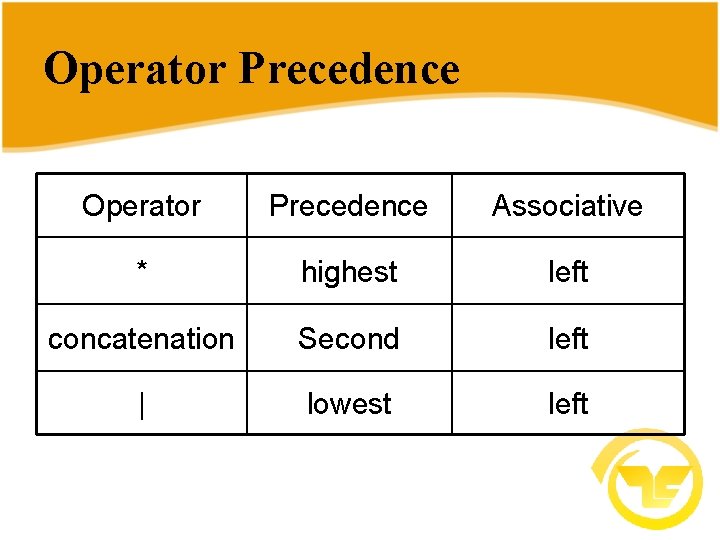
Operator Precedence Associative * highest left concatenation Second left | lowest left
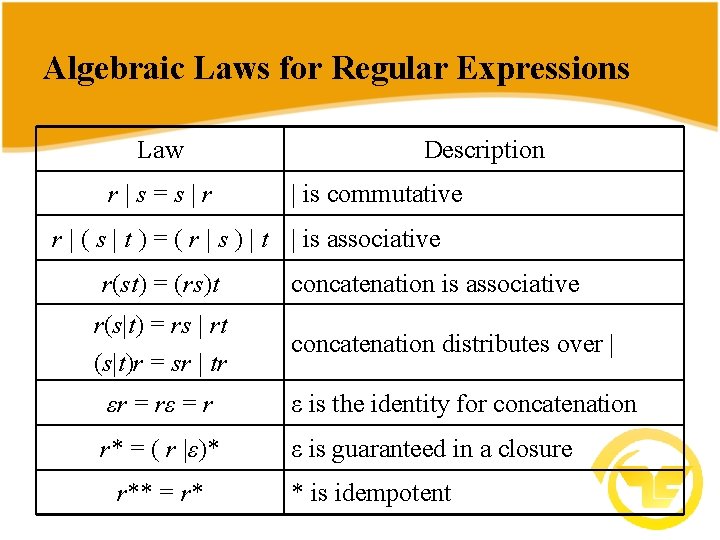
Algebraic Laws for Regular Expressions Law r|s=s|r Description | is commutative r | ( s | t ) = ( r | s ) | t | is associative r(st) = (rs)t r(s|t) = rs | rt (s|t)r = sr | tr concatenation is associative concatenation distributes over | εr = rε = r ε is the identity for concatenation r* = ( r |ε)* ε is guaranteed in a closure r** = r* * is idempotent
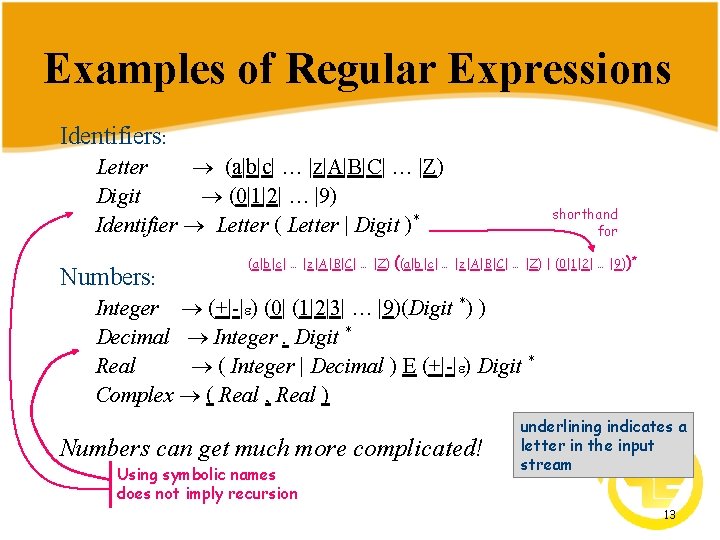
Examples of Regular Expressions Identifiers: Letter (a|b|c| … |z|A|B|C| … |Z) Digit (0|1|2| … |9) Identifier Letter ( Letter | Digit )* Numbers: shorthand for (a|b|c| … |z|A|B|C| … |Z) ((a|b|c| … |z|A|B|C| … |Z) | (0|1|2| … |9))* Integer (+|-| ) (0| (1|2|3| … |9)(Digit *) ) Decimal Integer. Digit * Real ( Integer | Decimal ) E (+|-| ) Digit * Complex ( Real , Real ) Numbers can get much more complicated! Using symbolic names does not imply recursion underlining indicates a letter in the input stream 13
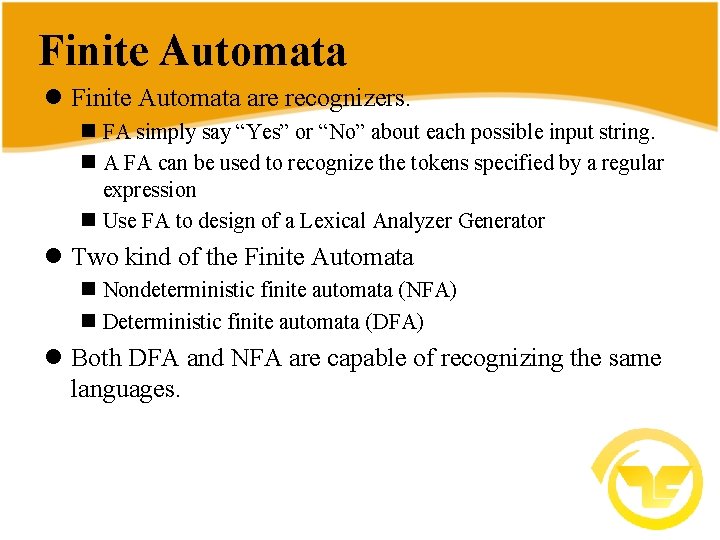
Finite Automata l Finite Automata are recognizers. n FA simply say “Yes” or “No” about each possible input string. n A FA can be used to recognize the tokens specified by a regular expression n Use FA to design of a Lexical Analyzer Generator l Two kind of the Finite Automata n Nondeterministic finite automata (NFA) n Deterministic finite automata (DFA) l Both DFA and NFA are capable of recognizing the same languages.
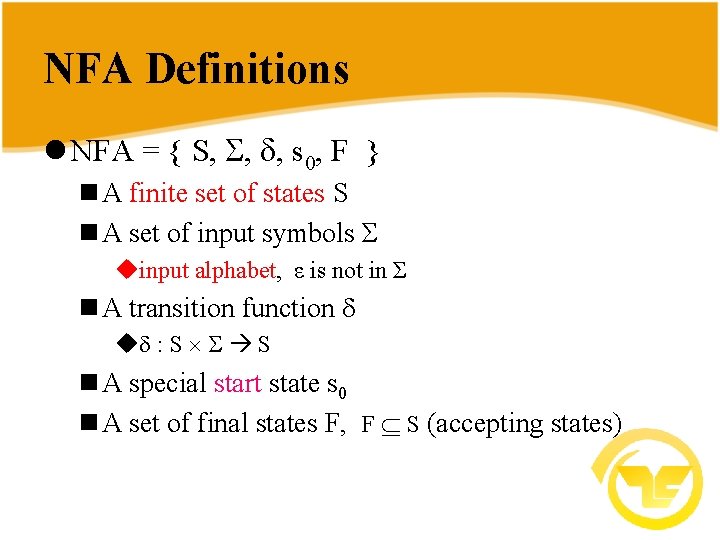
NFA Definitions l NFA = { S, , , s 0, F } n A finite set of states S n A set of input symbols Σ uinput alphabet, ε is not in Σ n A transition function u : S S n A special start state s 0 n A set of final states F, F S (accepting states)
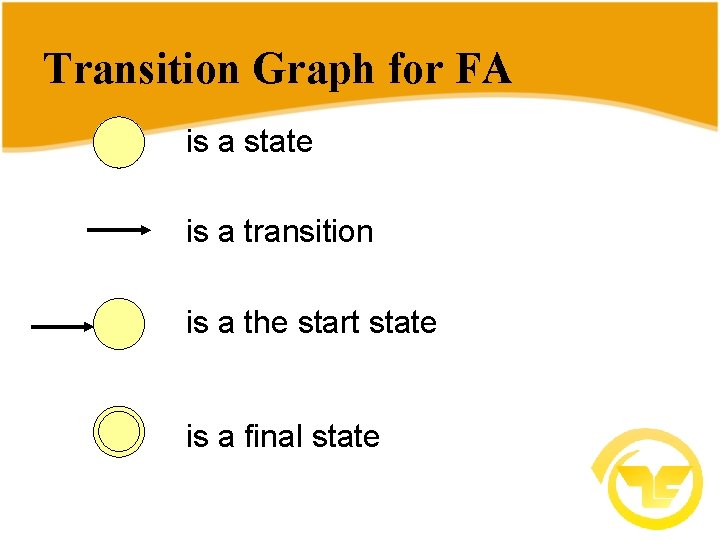
Transition Graph for FA is a state is a transition is a the start state is a final state
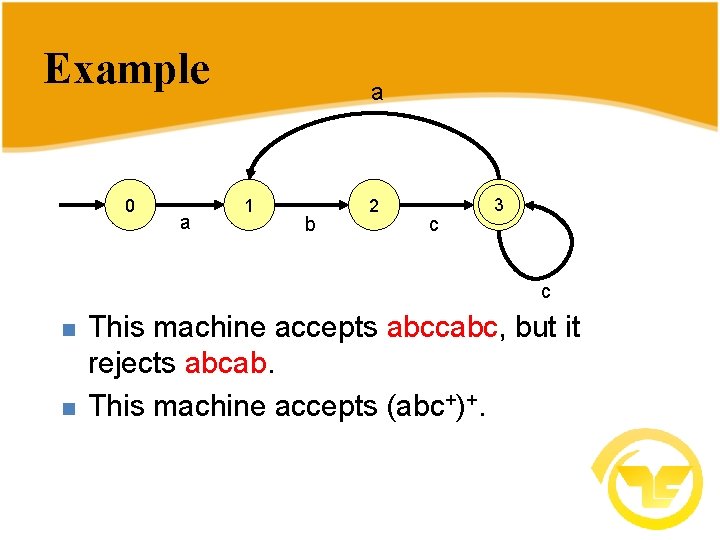
Example 0 a a 1 b 2 c 3 c n n This machine accepts abccabc, but it rejects abcab. This machine accepts (abc+)+.
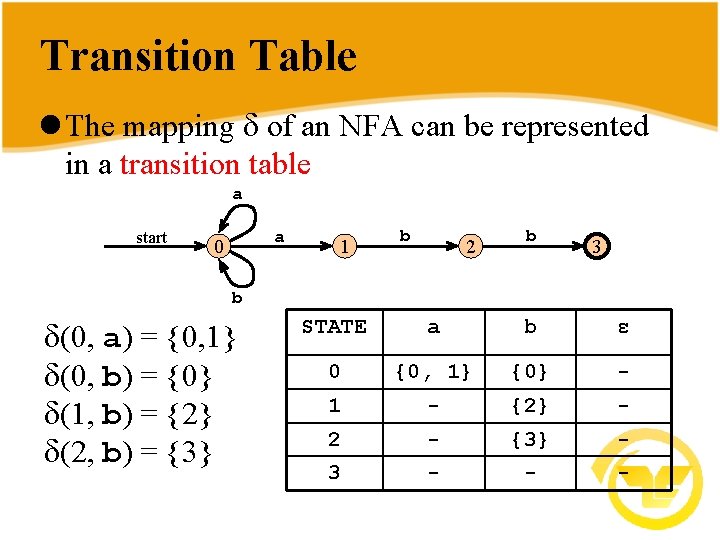
Transition Table l The mapping of an NFA can be represented in a transition table a start a 0 1 b 2 b 3 b (0, a) = {0, 1} (0, b) = {0} (1, b) = {2} (2, b) = {3} STATE a b ε 0 {0, 1} {0} - 1 - {2} - 2 - {3} - 3 - - -
DFA l DFA is a special case of an NFA n There are no moves on input ε n For each state s and input symbol a, there is exactly one edge out of s labeled a. l Both DFA and NFA are capable of recognizing the same languages.
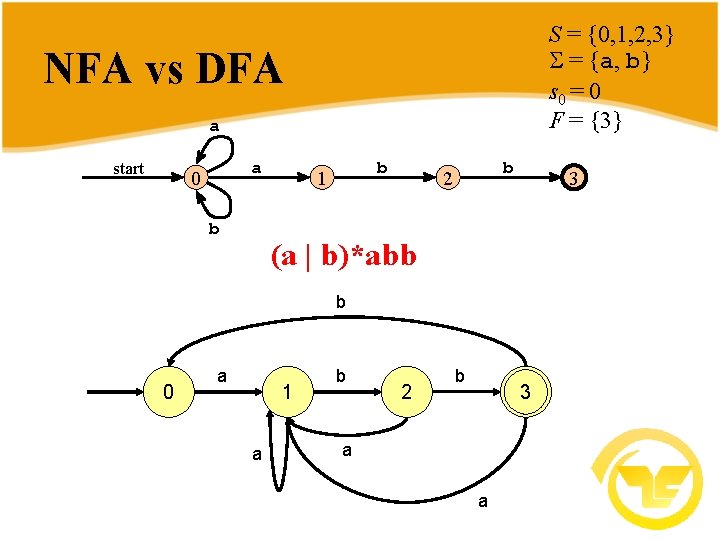
S = {0, 1, 2, 3} = {a, b} s 0 = 0 F = {3} NFA vs DFA a start a 0 b b 1 b 2 3 (a | b)*abb b 0 a 1 a b 2 b 3 a a
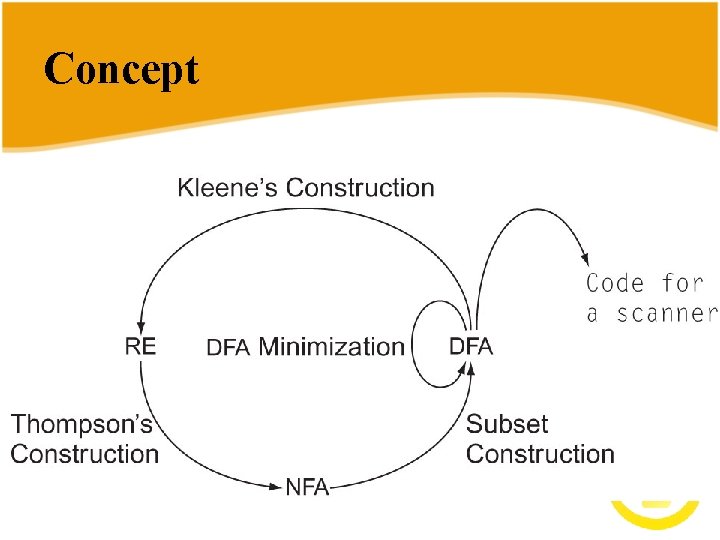
Concept