
Scania Ethanol vehicles Climate change External causes Solar


- Slides: 29
Scania Ethanol vehicles
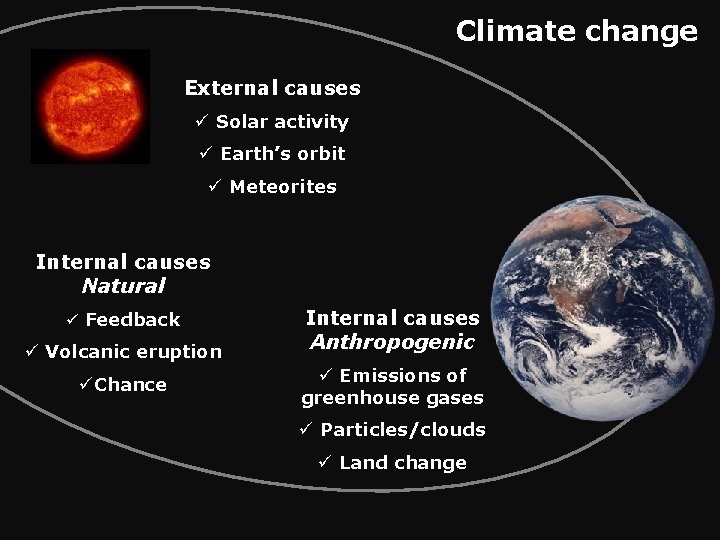
Climate change External causes ü Solar activity ü Earth’s orbit ü Meteorites Internal causes Natural ü Feedback ü Volcanic eruption üChance Internal causes Anthropogenic ü Emissions of greenhouse gases ü Particles/clouds ü Land change
CO 2 emissions still increasing globally … § IPCC: If there is no emission decrease before 2015, global climate will be seriously affected § By 2050, a CO 2 decrease of 80% will be necessary.
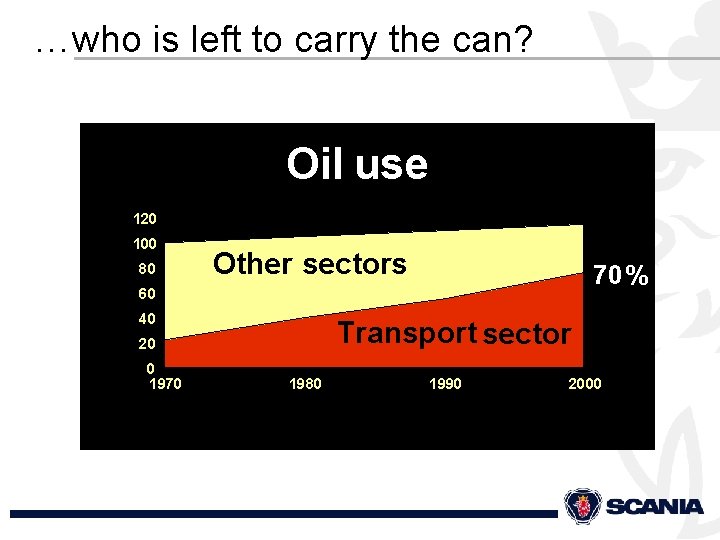
…who is left to carry the can? Oil use 120 100 80 Other sectors 70 % 60 40 Transport sector 20 0 1970 BAFF 1980 1990 2000
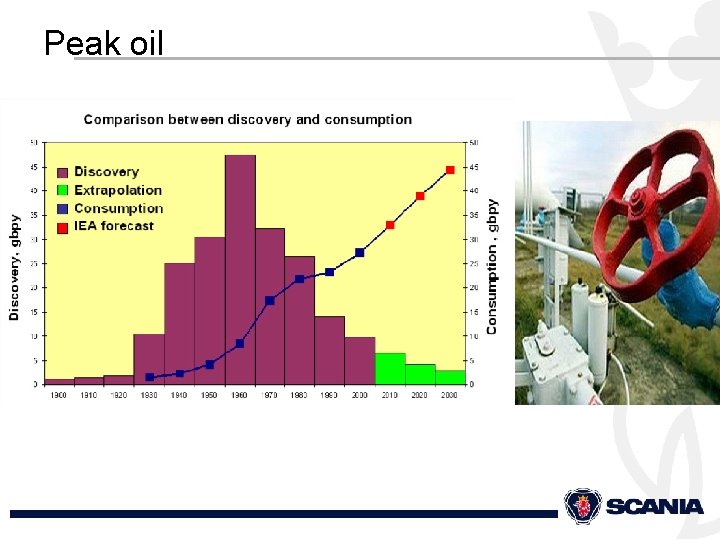
Peak oil
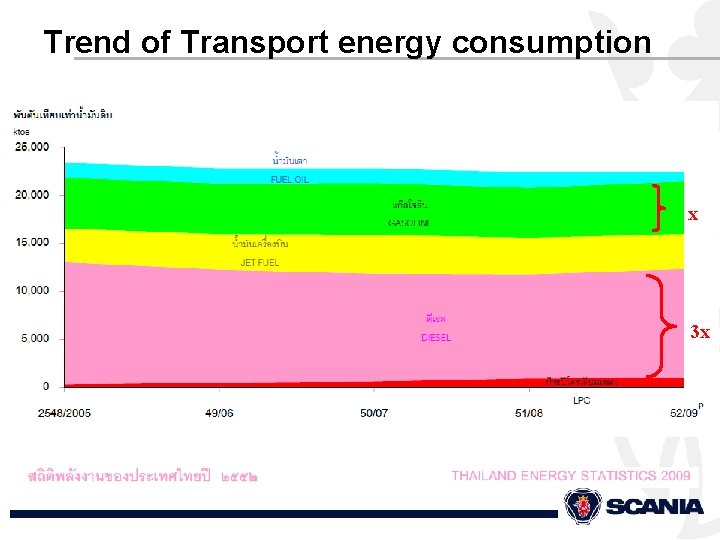
Trend of Transport energy consumption x 3 x
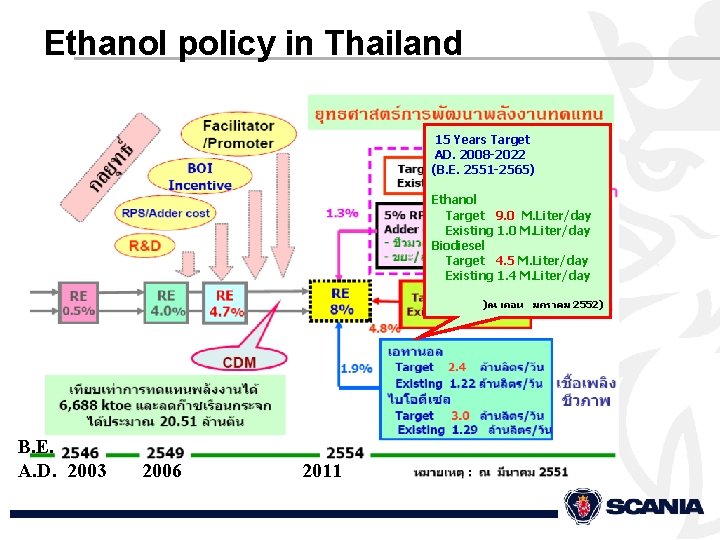
Ethanol policy in Thailand 15 Years Target AD. 2008 -2022 (B. E. 2551 -2565) Ethanol Target 9. 0 M. Liter/day Existing 1. 0 M. Liter/day Biodiesel Target 4. 5 M. Liter/day Existing 1. 4 M. Liter/day )ณ เดอน มกราคม 2552) B. E. A. D. 2003 2006 2011
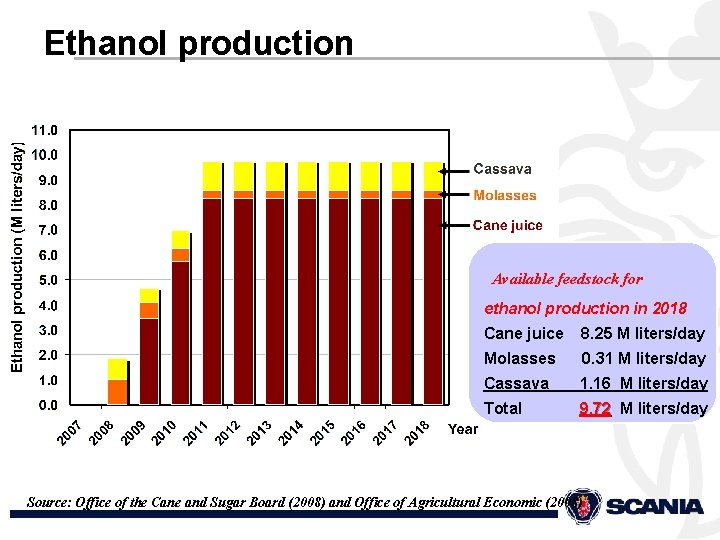
Ethanol production Available feedstock for ethanol production in 2018 Cane juice 8. 25 M liters/day Molasses 0. 31 M liters/day Cassava 1. 16 M liters/day Total 9. 72 M liters/day Source: Office of the Cane and Sugar Board (2008) and Office of Agricultural Economic (2008)
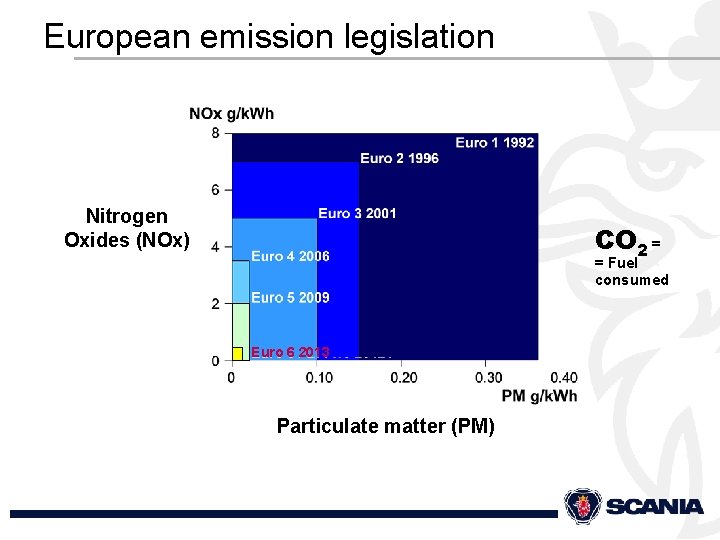
European emission legislation Nitrogen Oxides (NOx) CO 2 = = Fuel consumed Euro 6 2013 Particulate matter (PM)
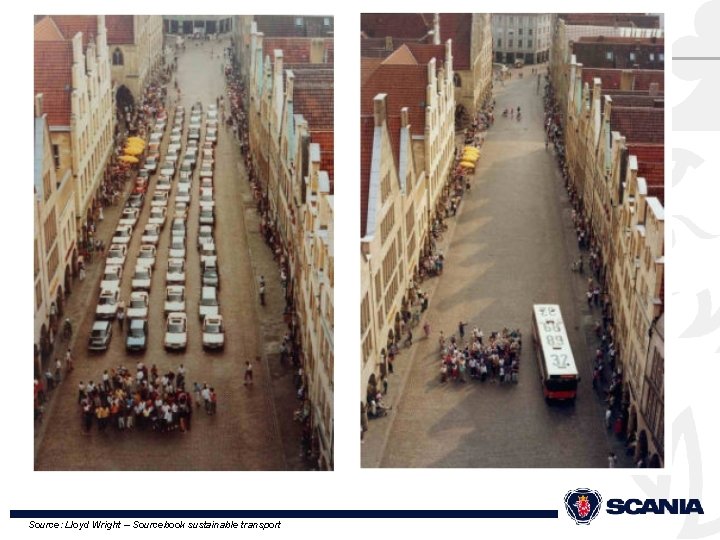
Source: Lloyd Wright – Sourcebook sustainable transport
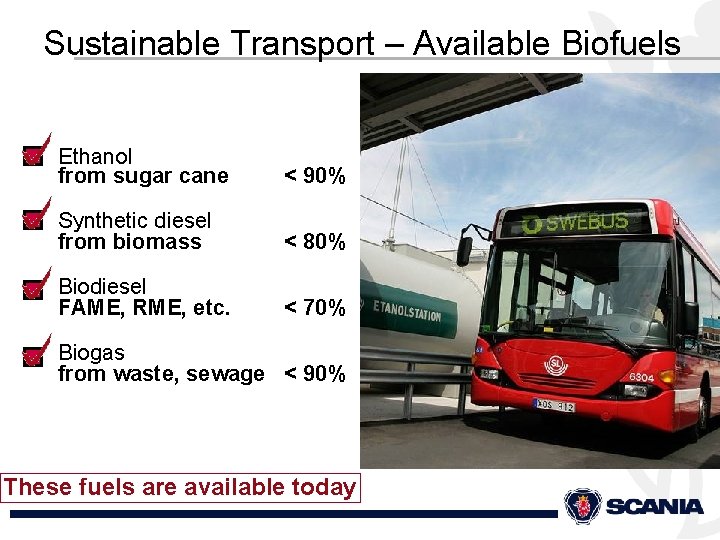
Sustainable Transport – Available Biofuels Ethanol from sugar cane < 90% Synthetic diesel from biomass < 80% Biodiesel FAME, RME, etc. < 70% Biogas from waste, sewage < 90% These fuels are available today
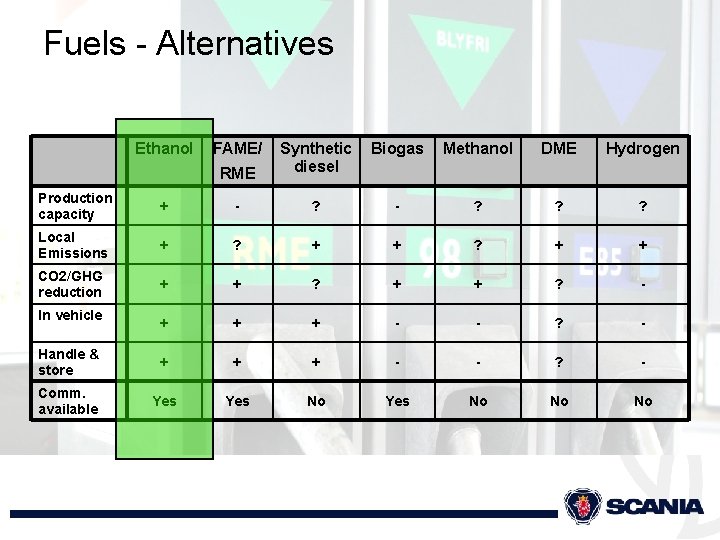
Fuels - Alternatives Ethanol FAME/ Biogas Methanol DME Hydrogen RME Synthetic diesel Production capacity + - ? ? ? Local Emissions + ? + + CO 2/GHG reduction + + ? - + + + - - ? - Handle & store + + + - - ? - Comm. available Yes No No No In vehicle
DC 9 E 02 Ethanol bus engine
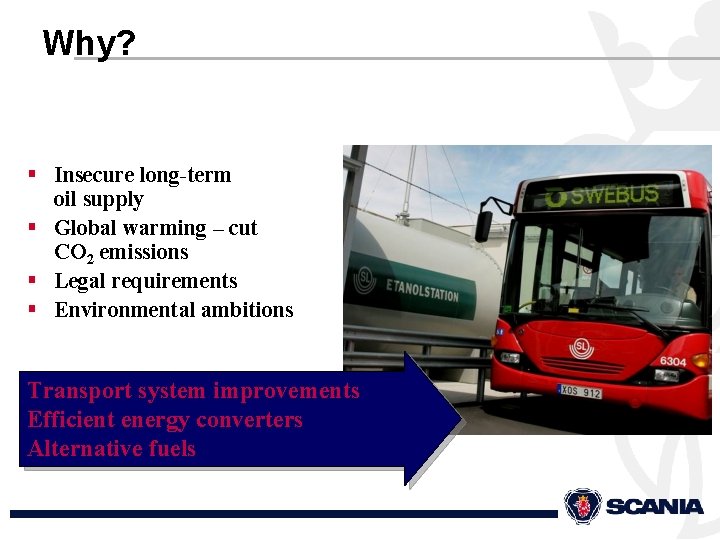
Why? § Insecure long-term oil supply § Global warming – cut CO 2 emissions § Legal requirements § Environmental ambitions Transport system improvements Efficient energy converters Alternative fuels
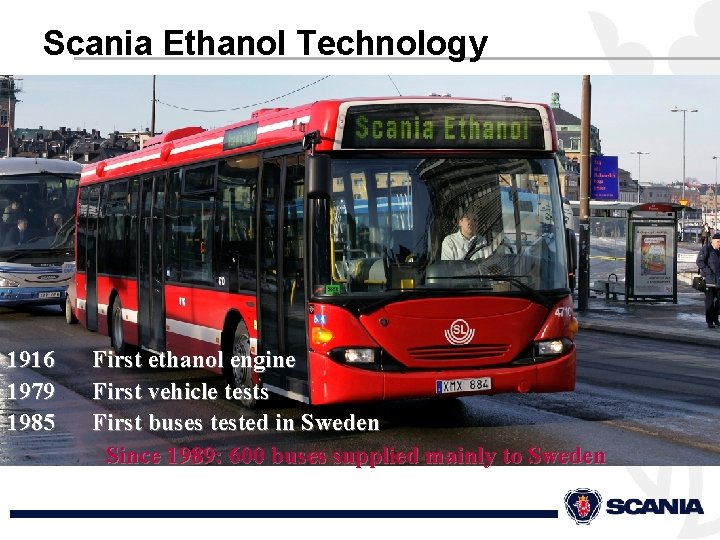
Scania Ethanol Technology 1916 1979 1985 First ethanol engine First vehicle tests First buses tested in Sweden Since 1989: 600 buses supplied mainly to Sweden
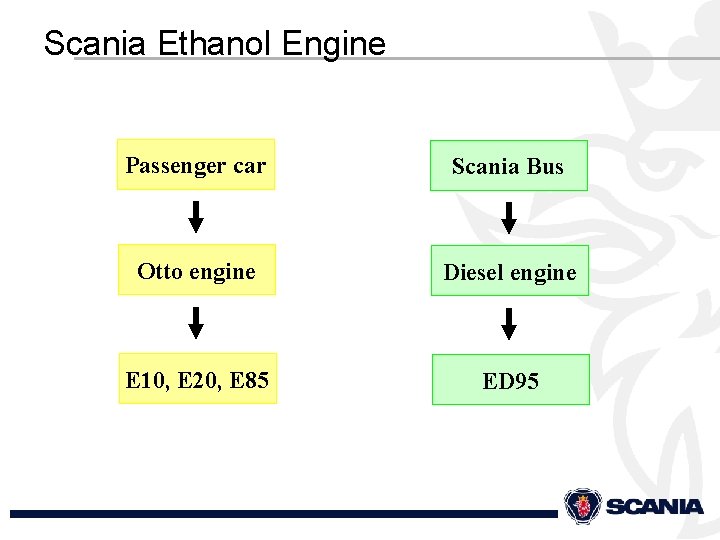
Scania Ethanol Engine Passenger car Scania Bus Otto engine Diesel engine E 10, E 20, E 85 ED 95
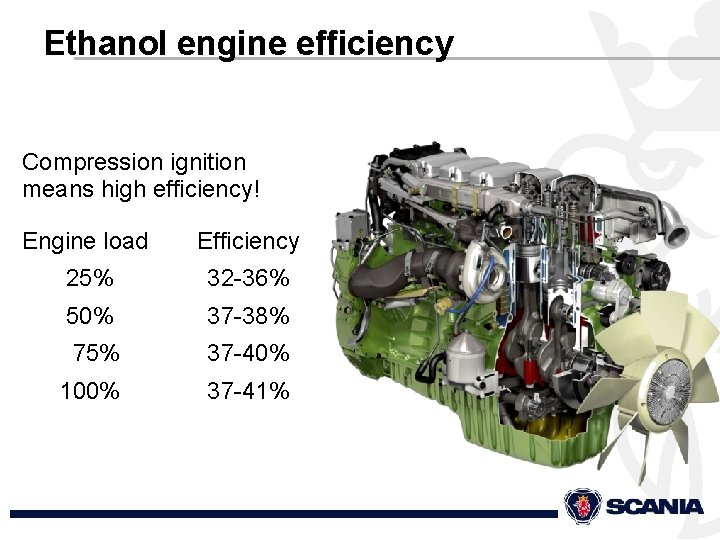
Ethanol engine efficiency Compression ignition means high efficiency! Engine load Efficiency 25% 32 -36% 50% 37 -38% 75% 37 -40% 100% 37 -41%
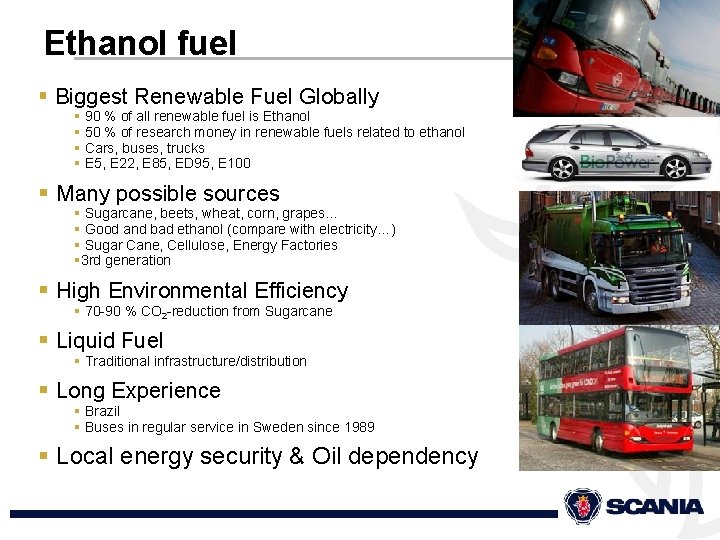
Ethanol fuel § Biggest Renewable Fuel Globally § 90 % of all renewable fuel is Ethanol § 50 % of research money in renewable fuels related to ethanol § Cars, buses, trucks § E 5, E 22, E 85, ED 95, E 100 § Many possible sources § Sugarcane, beets, wheat, corn, grapes… § Good and bad ethanol (compare with electricity…) § Sugar Cane, Cellulose, Energy Factories § 3 rd generation § High Environmental Efficiency § 70 -90 % CO 2 -reduction from Sugarcane § Liquid Fuel § Traditional infrastructure/distribution § Long Experience § Brazil § Buses in regular service in Sweden since 1989 § Local energy security & Oil dependency
Ethanol fuel n Sekab Etamax-D fuel n ED 95 denomination; not to be confused with E 85 (for gasoline engines) n It is an alcohol – no lubrication properties n Effects – Corrosion of plastics on high temperatures – Same tanks but with different ventilation – It’s a fuel – No drinking or washing
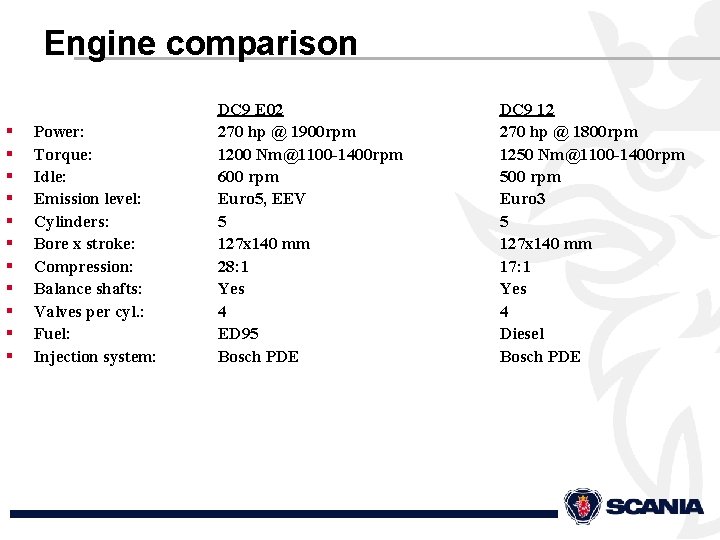
Engine comparison § § § Power: Torque: Idle: Emission level: Cylinders: Bore x stroke: Compression: Balance shafts: Valves per cyl. : Fuel: Injection system: DC 9 E 02 270 hp @ 1900 rpm 1200 Nm@1100 -1400 rpm 600 rpm Euro 5, EEV 5 127 x 140 mm 28: 1 Yes 4 ED 95 Bosch PDE DC 9 12 270 hp @ 1800 rpm 1250 Nm@1100 -1400 rpm 500 rpm Euro 3 5 127 x 140 mm 17: 1 Yes 4 Diesel Bosch PDE
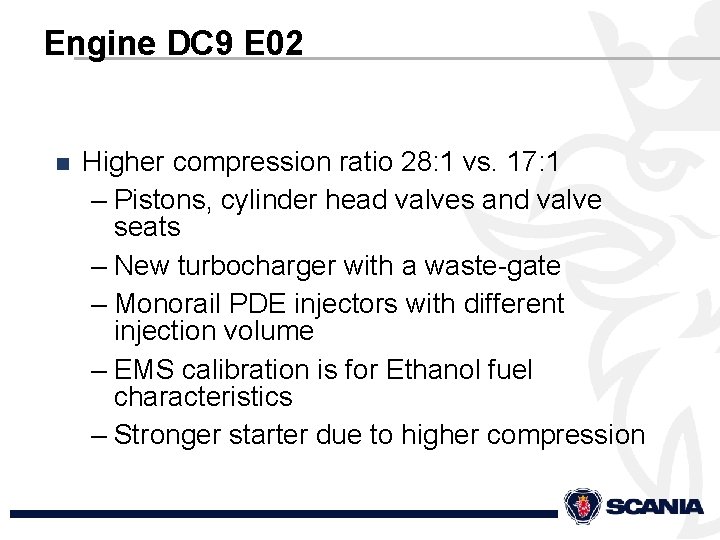
Engine DC 9 E 02 n Higher compression ratio 28: 1 vs. 17: 1 – Pistons, cylinder head valves and valve seats – New turbocharger with a waste-gate – Monorail PDE injectors with different injection volume – EMS calibration is for Ethanol fuel characteristics – Stronger starter due to higher compression
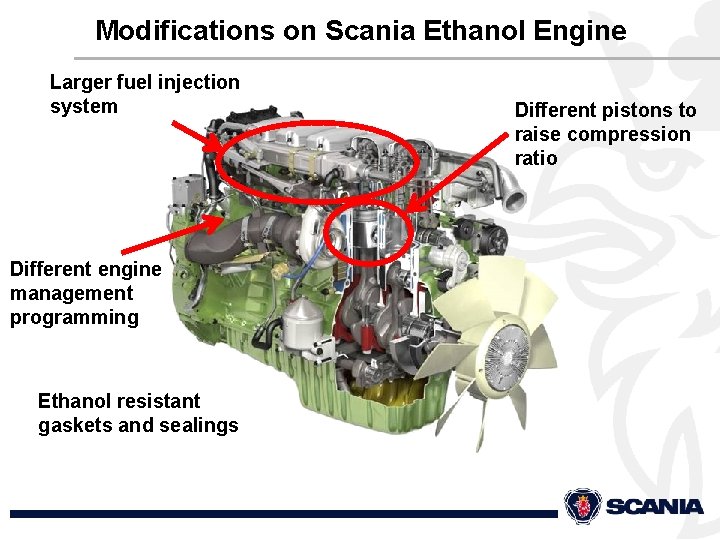
Modifications on Scania Ethanol Engine Larger fuel injection system Different engine management programming Ethanol resistant gaskets and sealings Different pistons to raise compression ratio
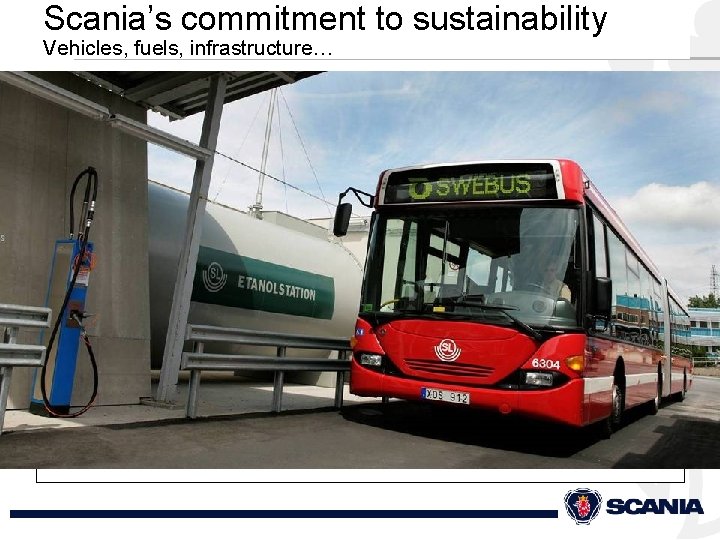
Scania’s commitment to sustainability Vehicles, fuels, infrastructure…
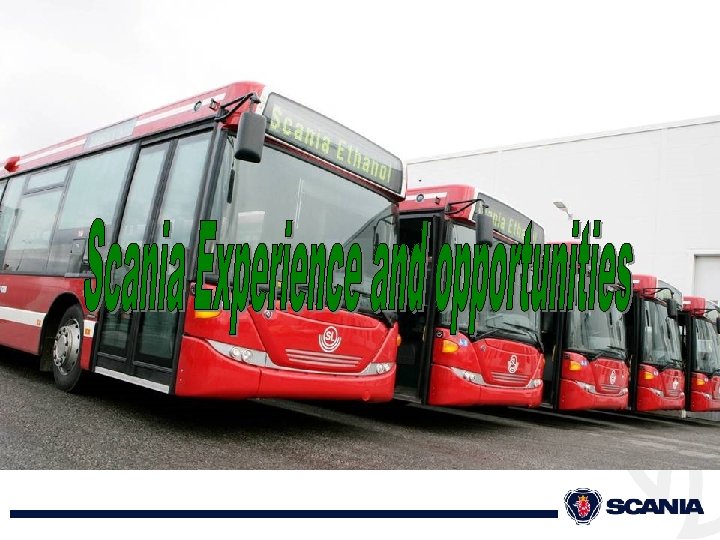
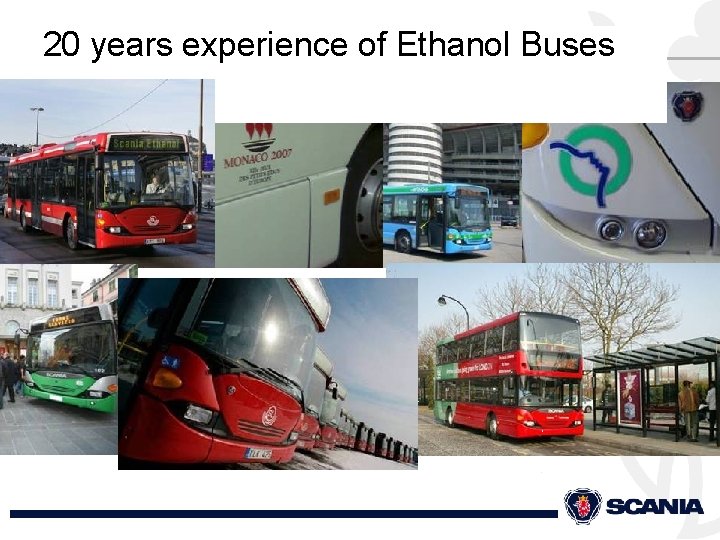
20 years experience of Ethanol Buses
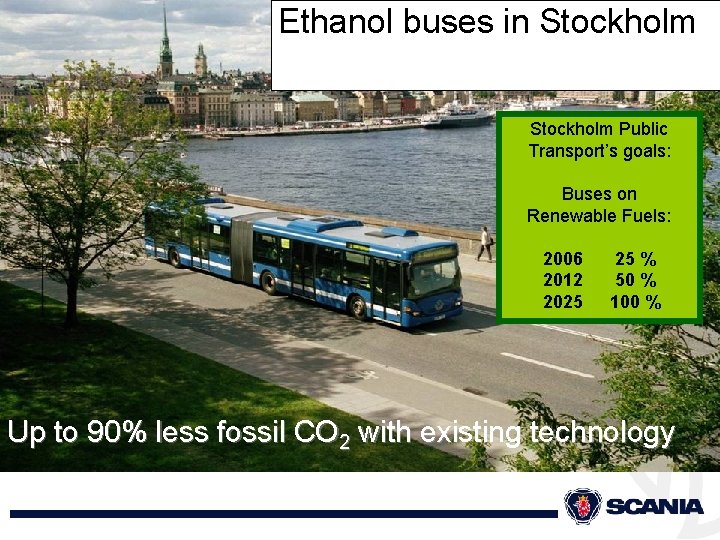
Ethanol buses in Stockholm Public Transport’s goals: Buses on Renewable Fuels: 2006 2012 2025 25 % 50 % 100 % Up to 90% less fossil CO 2 with existing technology
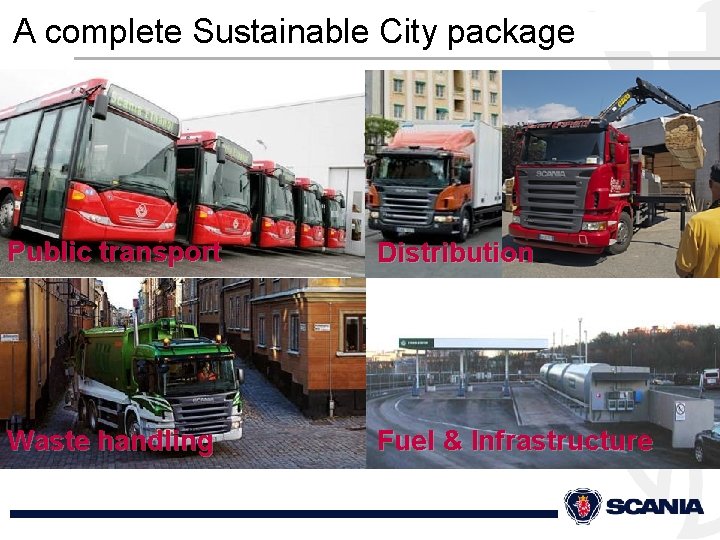
A complete Sustainable City package Public transport Distribution Waste handling Fuel & Infrastructure
…THANK YOU… Q&A