
SCAN A Structural Clustering Algorithm for Networks Authors
- Slides: 64
SCAN : A Structural Clustering Algorithm for Networks Authors : Xiaowei Xu, Nurcan Yuruk, Zhidan Feng (University of Arkansas at Little Rock) Thomas A. J. Schweiger (Acxiom Corporation) From : KDD '07 Proceedings of the 13 th ACM SIGKDD international conference on Knowledge discovery and data mining Citation : 101 (Google Scholar)
Outline • • 1. Introduction 2. Related Work 3. The Notion of Structure-Connected Clusters 4. Algorithm SCAN 5. Complexity Analysis 6. Evaluation 7. Conclusions
Introduction (1/5) • Much data of current interest to the scientific community can be modeled as networks (or graphs). • A network is sets of vertices, representing objects, connected together by edges, representing the relationship between objects.
Introduction (2/5) • The existing network clustering methods tend to cluster networks such that there a dense set of edges within every cluster and few edges between clusters. • For example, Modularity-based algorithms and normalized cut.
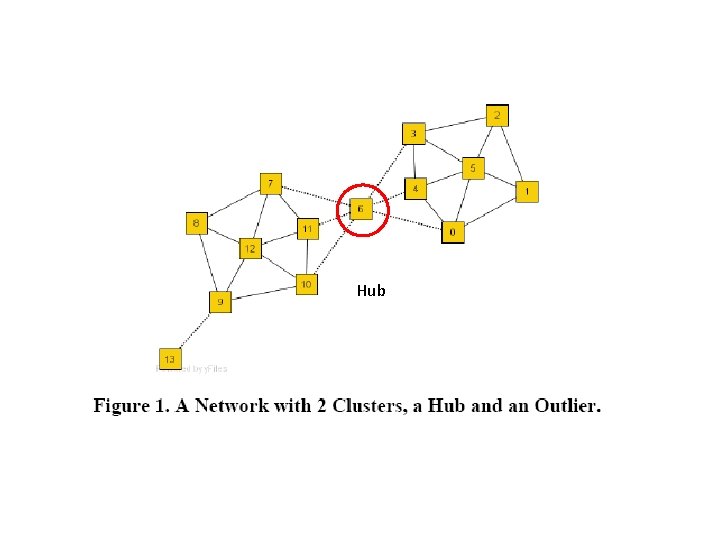
Introduction (3/5) • The identification and isolation of hubs is essential for many applications. • As an example, hubs are believed to play a crucial role in viral marketing [8] and epidemiology [9]. P. Domingos and M. Richardson, “Mining the Network Value of Customers”, Proc. 7 th ACM SIGKDD, pp. 57 – 66, 2001. (C : 87) Y. Wang, D. Chakrabarti, C. Wang and C. Faloutsos, “Epidemic Spreading in Real Networks: An Eigenvalue Viewpoint”, SRDS 2003 (pages 25 -34), Florence, Italy. (C : 203)
Hub
Introduction (4/5) • Use the neighborhood of the vertices as clustering criteria. • Vertices are grouped into the clusters by how they share neighbors. • Two people who share many friends should be clustered in the same community.
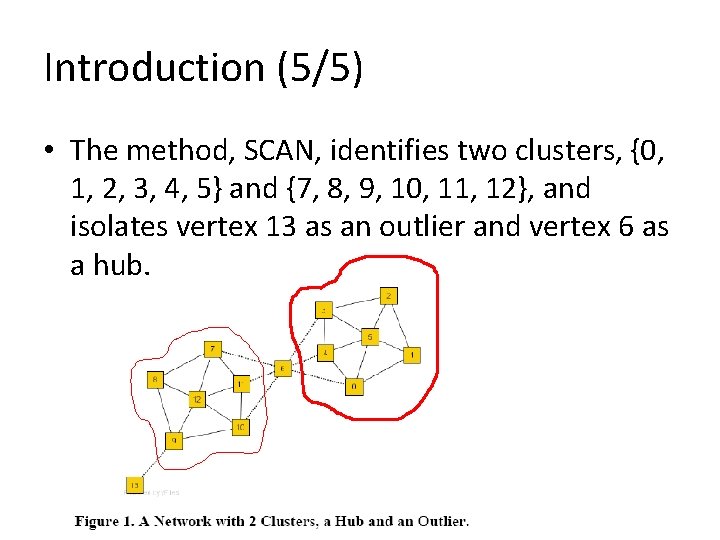
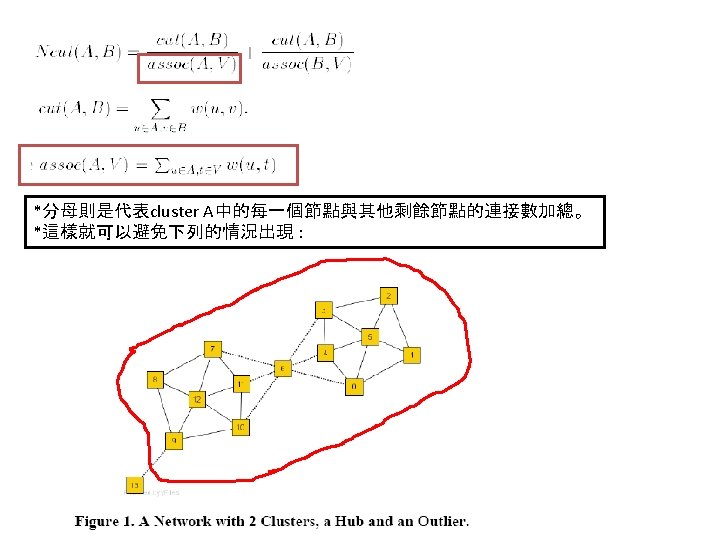
Introduction (5/5) • The method, SCAN, identifies two clusters, {0, 1, 2, 3, 4, 5} and {7, 8, 9, 10, 11, 12}, and isolates vertex 13 as an outlier and vertex 6 as a hub.
Related Work (1/4) • The min-max cut method [4] seeks to partition a graph G={V, E} into two clusters A and B. • The principle of min-max clustering is – Minimizing the number of connections between A and B – Maximizing the number of connections within each. C. Ding, X. He, H. Zha, M. Gu, and H. Simon, “A min-max cut algorithm for graph partitioning and data clustering”, Proc. of ICDM 2001. (C : 396)
Related Work (2/4) • A cut is defined the number of edges that would have to be removed to isolate the vertices in cluster A from those in cluster B. • A pitfall of this method is that, if one cuts out a single vertex from the graph, one will probably achieve the optimum. – Accompanied with some constraint.
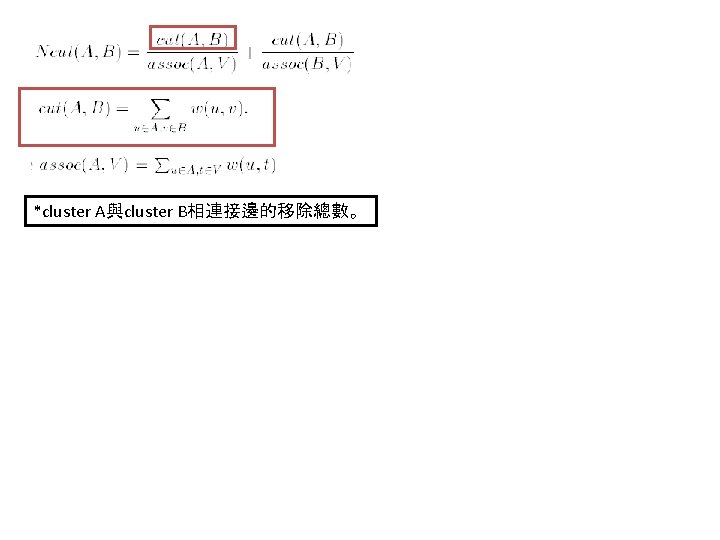
Related Work (3/4) • Normalized cut : normalizes the cut by the total number connections between each cluster to the rest of the graph. J. Shi and J. Malik, “Normalized cuts and image segmentation”, IEEE Transactions on Pattern Analysis and Machine Intelligence, Vol 22, No. 8, 2000. (C : 5106)
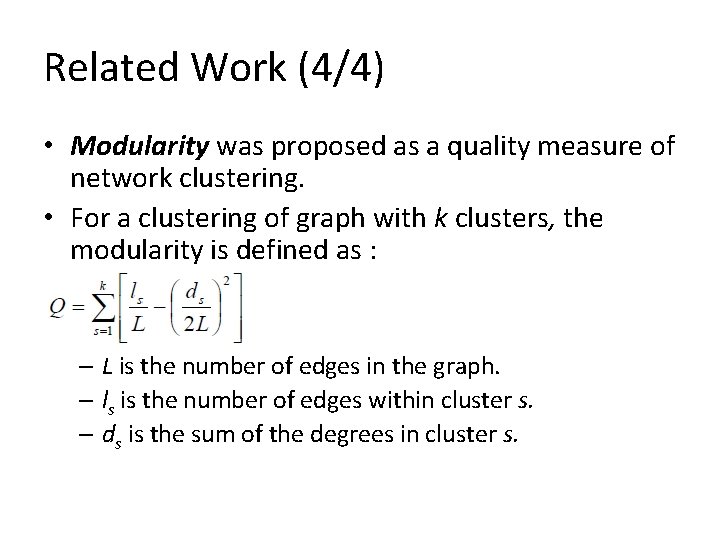
Related Work (4/4) • Modularity was proposed as a quality measure of network clustering. • For a clustering of graph with k clusters, the modularity is defined as : – L is the number of edges in the graph. – ls is the number of edges within cluster s. – ds is the sum of the degrees in cluster s.
The notion of structure-connected clusters Structured-connected Clusters (1/14) • SCAN algorithm is based on common neighbors. • Two vertices are assigned to a cluster according to how they share neighbors. – People who share many friends create a community, and the more friends they have in common, the more intimate the community.
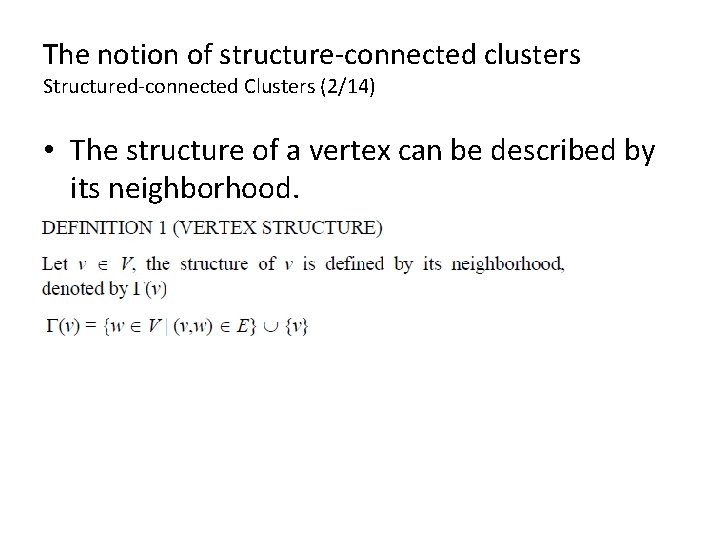
The notion of structure-connected clusters Structured-connected Clusters (2/14) • The structure of a vertex can be described by its neighborhood.
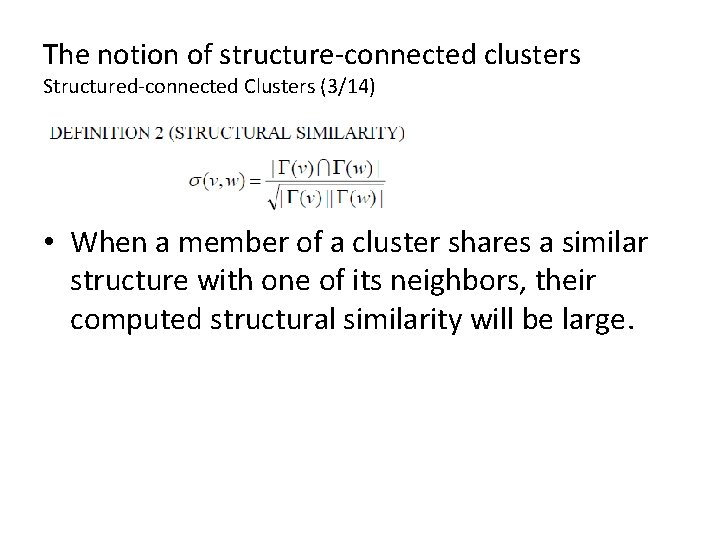
The notion of structure-connected clusters Structured-connected Clusters (3/14) • When a member of a cluster shares a similar structure with one of its neighbors, their computed structural similarity will be large.
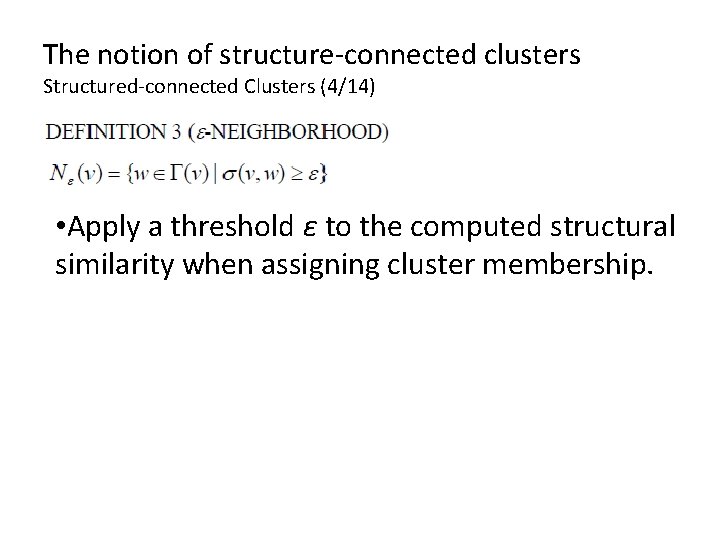
The notion of structure-connected clusters Structured-connected Clusters (4/14) • Apply a threshold ε to the computed structural similarity when assigning cluster membership.
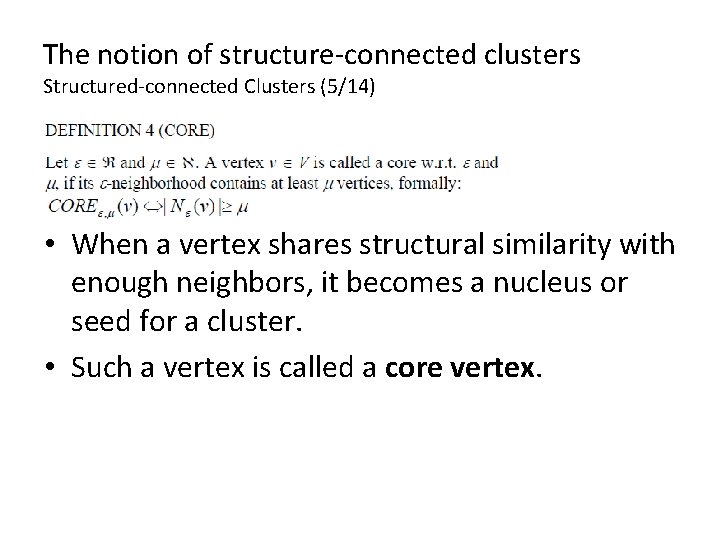
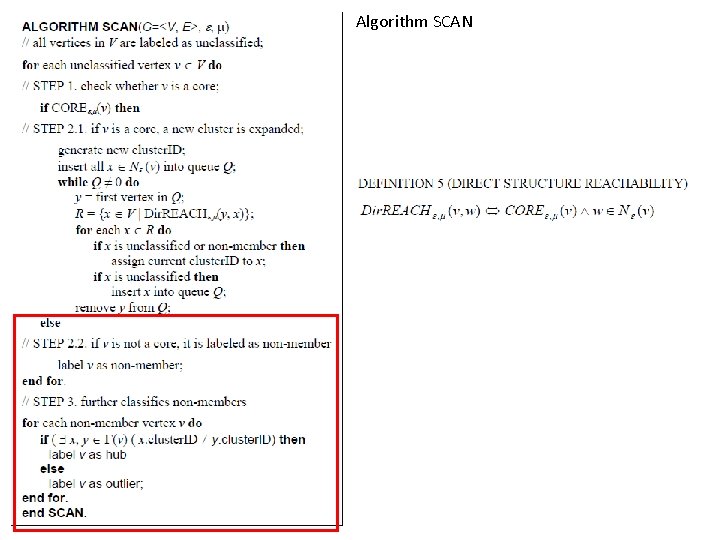
The notion of structure-connected clusters Structured-connected Clusters (5/14) • When a vertex shares structural similarity with enough neighbors, it becomes a nucleus or seed for a cluster. • Such a vertex is called a core vertex.
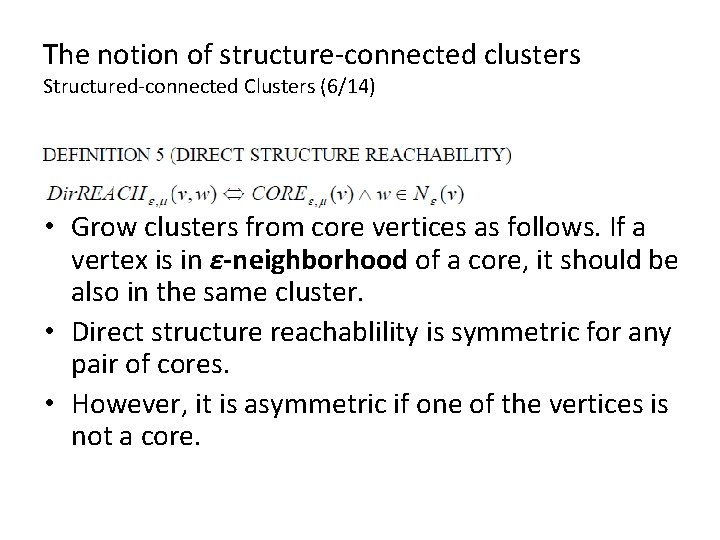
The notion of structure-connected clusters Structured-connected Clusters (6/14) • Grow clusters from core vertices as follows. If a vertex is in ε-neighborhood of a core, it should be also in the same cluster. • Direct structure reachablility is symmetric for any pair of cores. • However, it is asymmetric if one of the vertices is not a core.
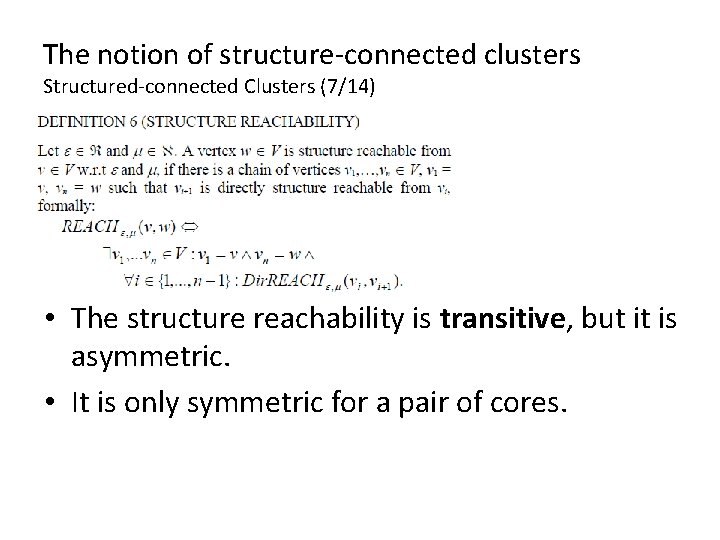
The notion of structure-connected clusters Structured-connected Clusters (7/14) • The structure reachability is transitive, but it is asymmetric. • It is only symmetric for a pair of cores.
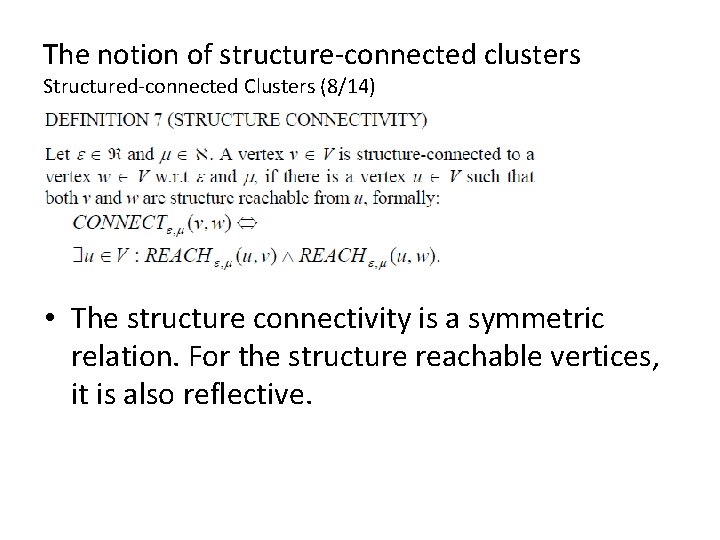
The notion of structure-connected clusters Structured-connected Clusters (8/14) • The structure connectivity is a symmetric relation. For the structure reachable vertices, it is also reflective.
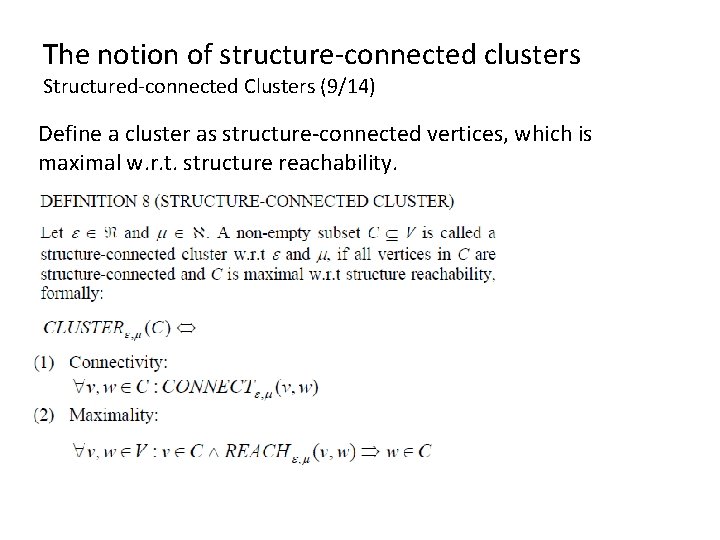
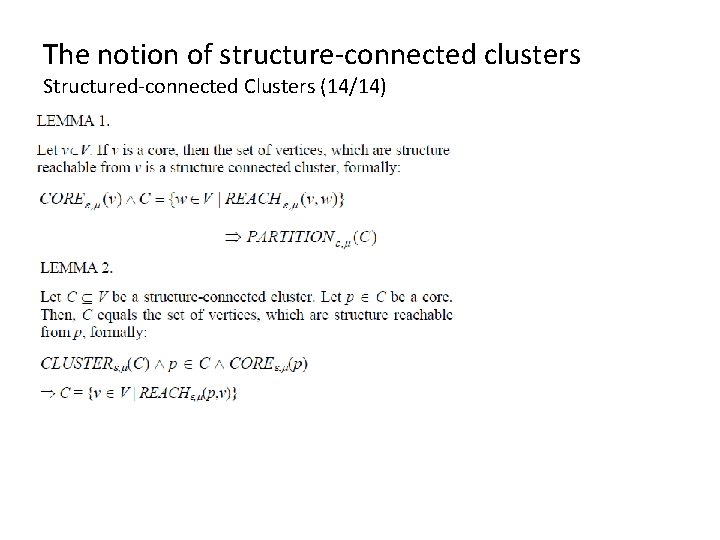
The notion of structure-connected clusters Structured-connected Clusters (9/14) Define a cluster as structure-connected vertices, which is maximal w. r. t. structure reachability.
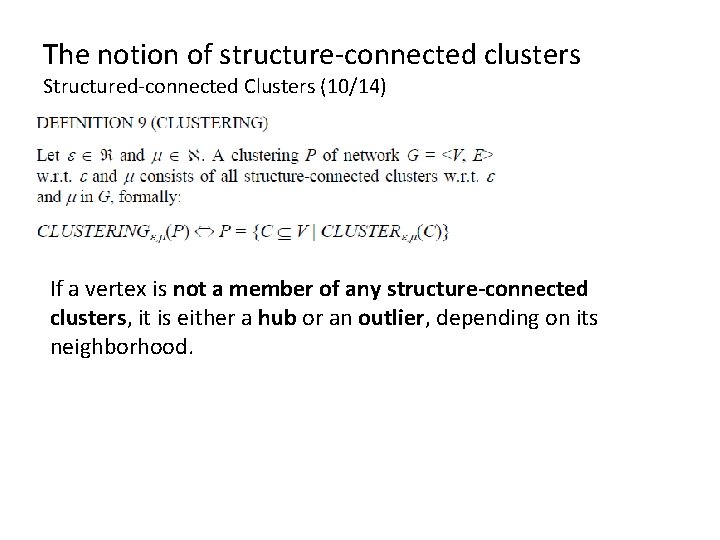
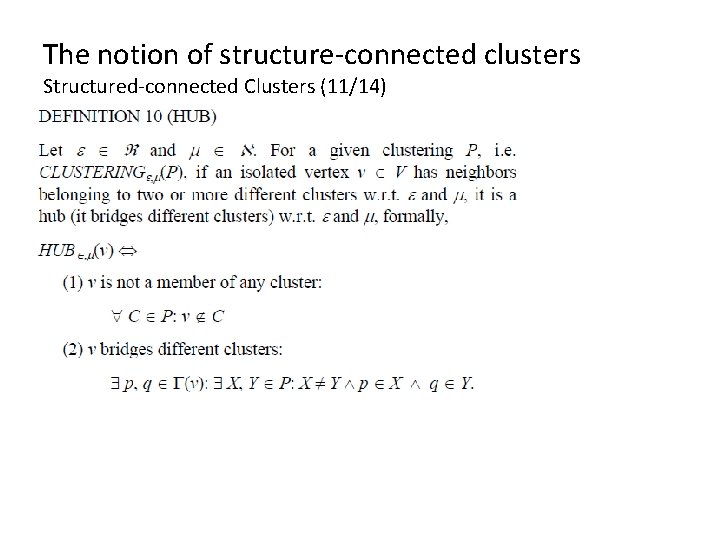
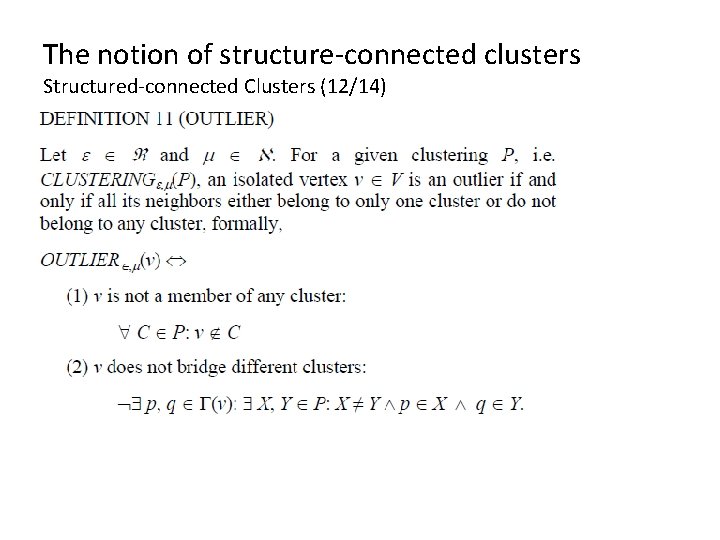
The notion of structure-connected clusters Structured-connected Clusters (10/14) If a vertex is not a member of any structure-connected clusters, it is either a hub or an outlier, depending on its neighborhood.
The notion of structure-connected clusters Structured-connected Clusters (11/14)
The notion of structure-connected clusters Structured-connected Clusters (12/14)
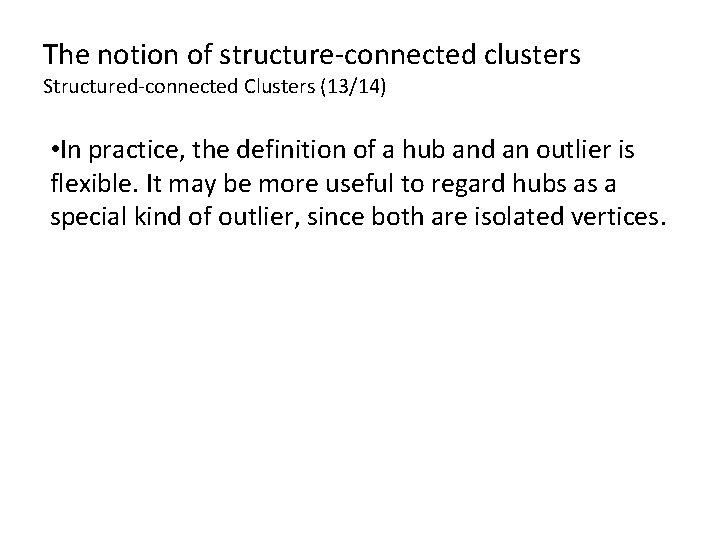
The notion of structure-connected clusters Structured-connected Clusters (13/14) • In practice, the definition of a hub and an outlier is flexible. It may be more useful to regard hubs as a special kind of outlier, since both are isolated vertices.
The notion of structure-connected clusters Structured-connected Clusters (14/14)
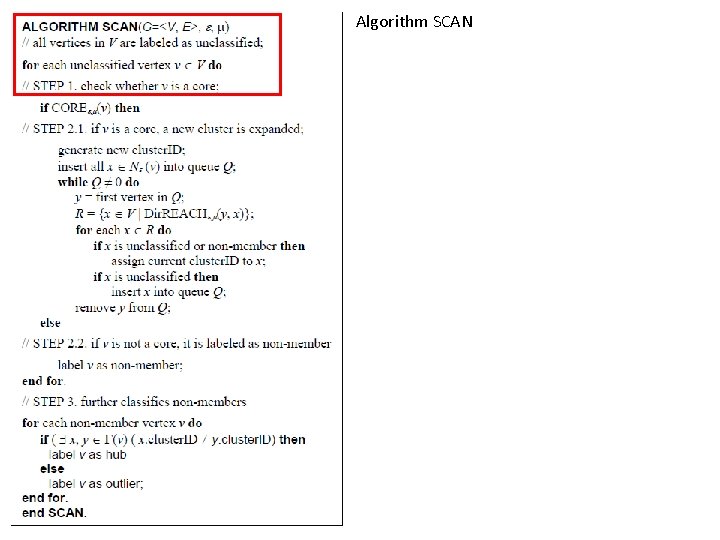
Algorithm SCAN
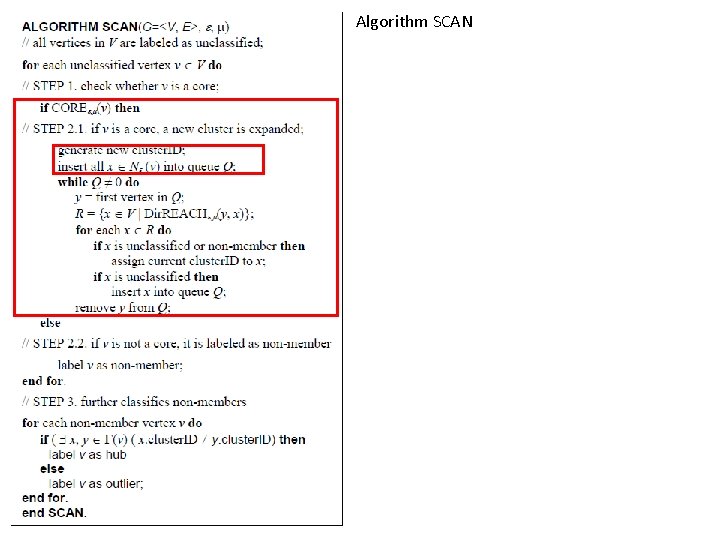
Algorithm SCAN
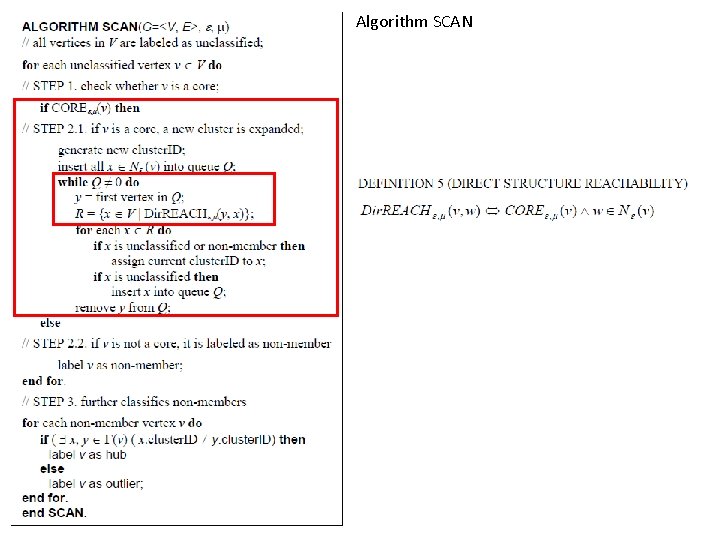
Algorithm SCAN
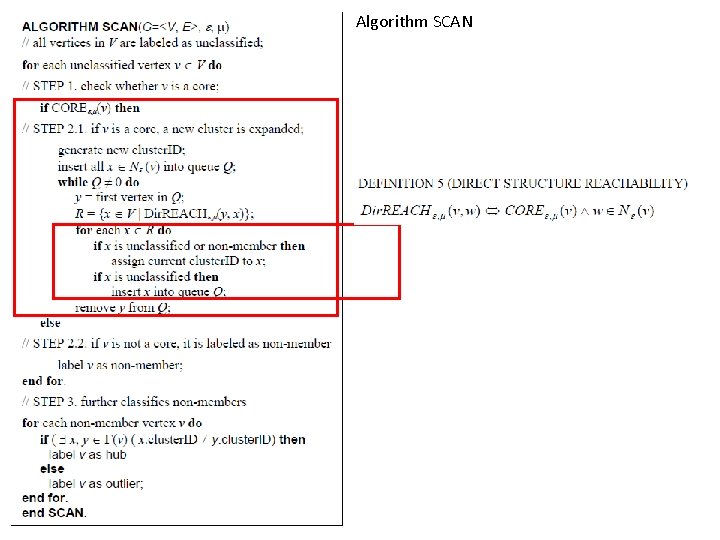
Algorithm SCAN
Algorithm SCAN
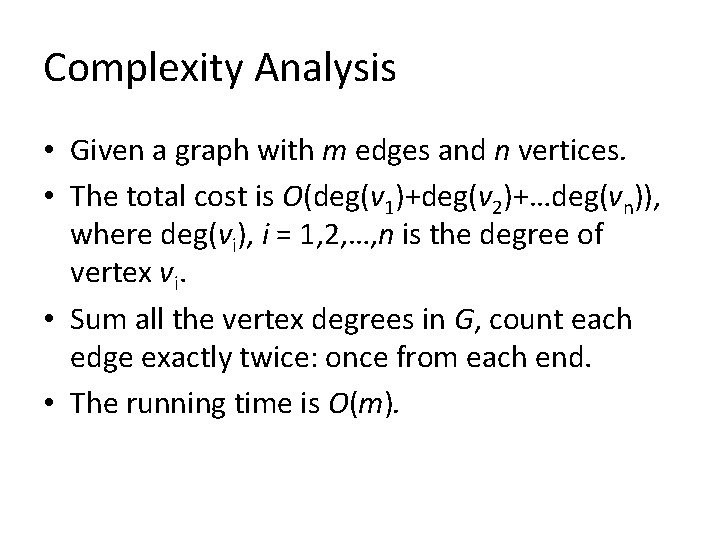
Complexity Analysis • Given a graph with m edges and n vertices. • The total cost is O(deg(v 1)+deg(v 2)+…deg(vn)), where deg(vi), i = 1, 2, …, n is the degree of vertex vi. • Sum all the vertex degrees in G, count each edge exactly twice: once from each end. • The running time is O(m).
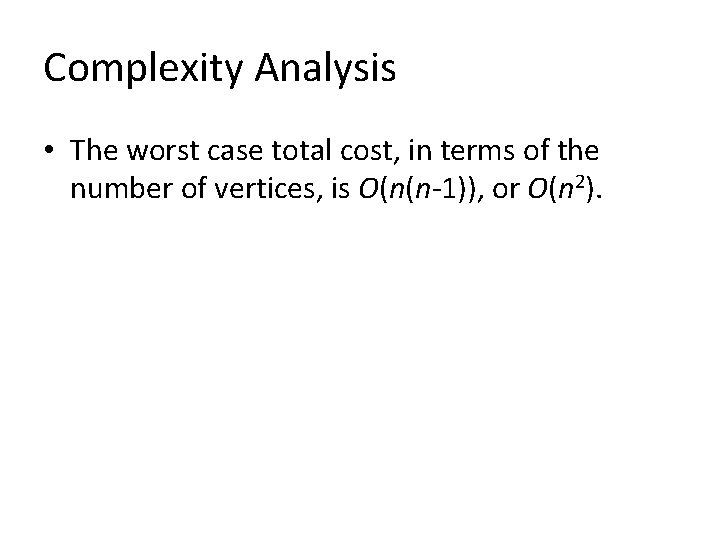
Complexity Analysis • The worst case total cost, in terms of the number of vertices, is O(n(n-1)), or O(n 2).
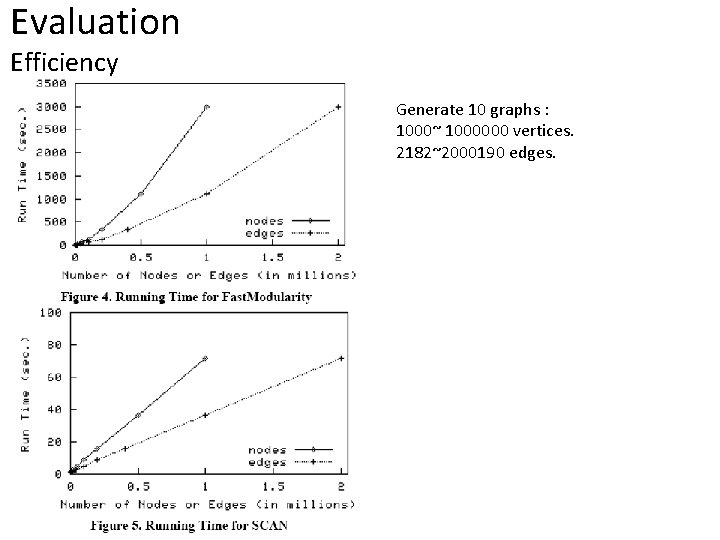
Evaluation • The performance of SCAN is compared with Fast. Modularity, a fast modularity-based network clustering algorithm proposed by Clauset et al. in [12], which is faster than many competing algorithms. A. Clauset, M. E. J. Newman, and C. Moore, “Finding community in very large networks”, Physical Review E 70, 066111 (2004). (C : 1041)
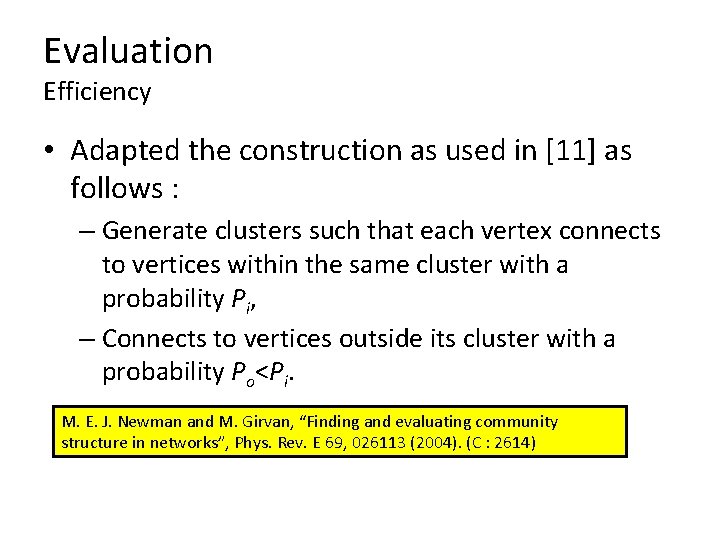
Evaluation Efficiency • Adapted the construction as used in [11] as follows : – Generate clusters such that each vertex connects to vertices within the same cluster with a probability Pi, – Connects to vertices outside its cluster with a probability Po<Pi. M. E. J. Newman and M. Girvan, “Finding and evaluating community structure in networks”, Phys. Rev. E 69, 026113 (2004). (C : 2614)
Evaluation Efficiency Generate 10 graphs : 1000~ 1000000 vertices. 2182~2000190 edges.
Evaluation Effectiveness • Use real datasets whose clusters are known a priori. – American College Football – Books about US politics
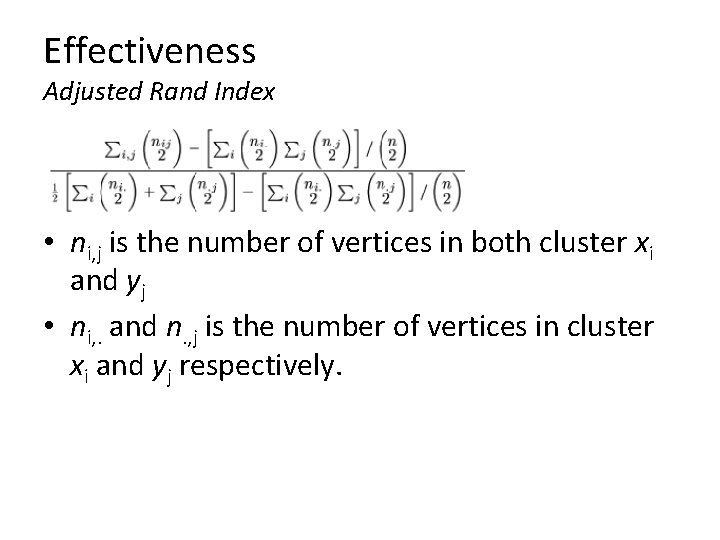
Effectiveness Adjusted Rand Index • ni, j is the number of vertices in both cluster xi and yj • ni, . and n. , j is the number of vertices in cluster xi and yj respectively.
Effectiveness College Football • The first real dataset the authors examine is the 2006 NCAA Football Bowl Subdivision (formerly Division 1 -A) football schedule. • The network contains 180 vertices (119 Bowl Subdivision schools and 61 lower division schools) interconnected by 787 edges.
Effectiveness College Football • Schools in the same conference are clusters. • The four independent schools play teams in many conferences but belong to none; they are hubs. (Army, Navy, Temple and Notre Dame) • The lower division schools are only weakly connected to the clusters in the network; they are outliners.
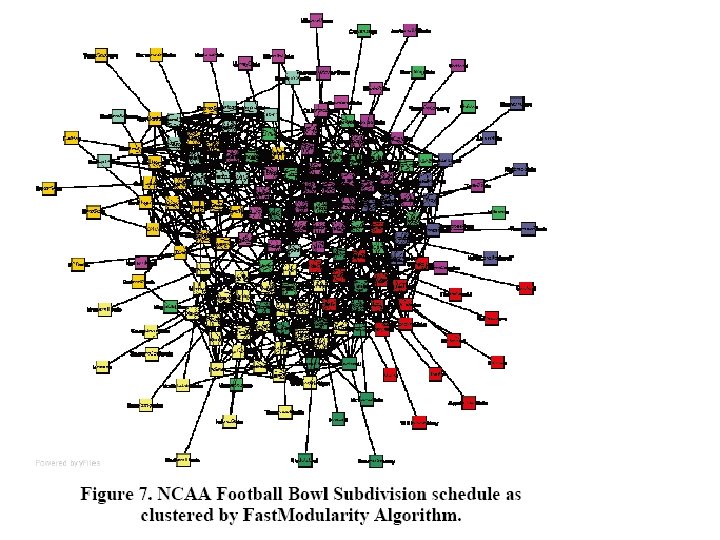
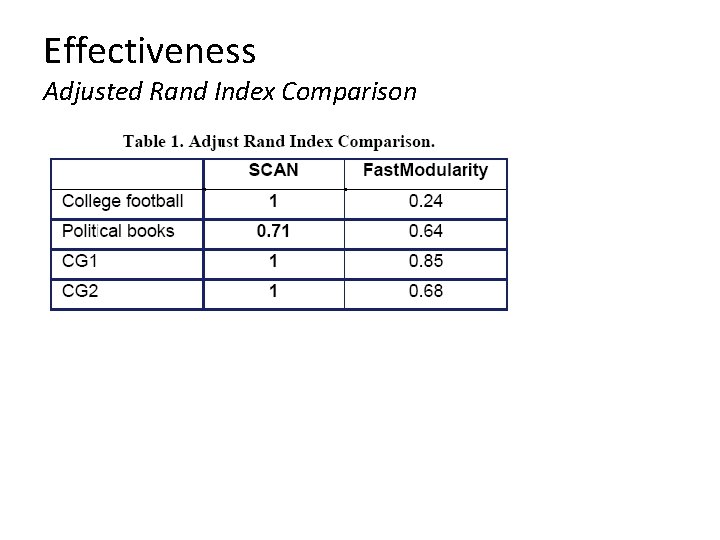
Effectiveness College Football • First, using the Fast. Modularity algorithm. • The results : the modularity is 0. 599. identifying nine clusters. – Two of the conferences are merged – The four independent schools are classified into various conferences despite their hub-like properties. – All lower division teams are assigned to clusters.
Effectiveness College Football • Using the SCAN algorithm, using the parameters (ε = 0. 5, μ = 2). • Eleven clusters are identified, corresponding exactly to the eleven conferences. • The independent schools and the lower division schools are unclassified. • The four independent schools show strong properties as hubs.
Effectiveness Books about US politics • The second example is the classification of books about US politics. • The vertices represent books about US politics sold by the online bookseller Amazon. com. • The edges represent frequent co-purchasing of books by the same buyers, as indicated by the “customers who bought this book also bought these other books. ”
Effectiveness Books about US politics • The vertices have been given values “l”, “n”, or “c” to indicate whether they are “liberal”, “neutral”, or “conservative”. • These alignments were assigned separately by Mark Newman [19] based on a reading of the descriptions and reviews of the books posted on Amazon.
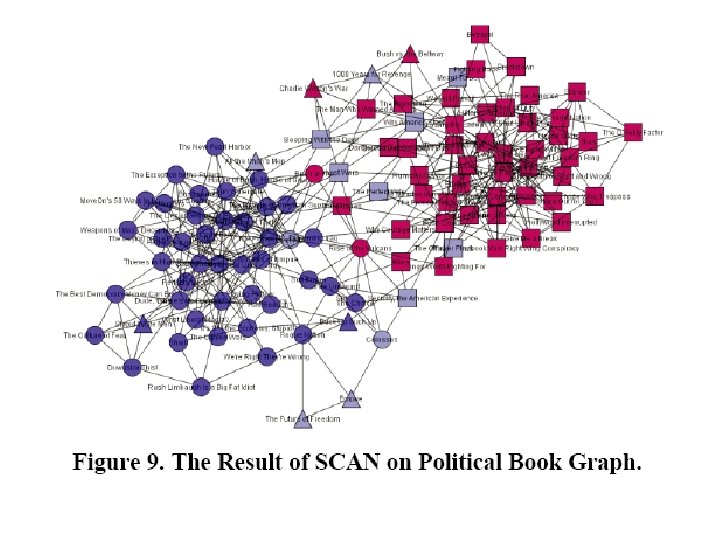
Effectiveness Books about US politics • Apply the SCAN algorithm to the political books graph, using the parameter (ε = 0. 35, μ = 2 ). • The SCAN clusters are illustrated using three different shapes : squares for “conservative” books and triangles for “neutral” books and circles for “liberal” books.
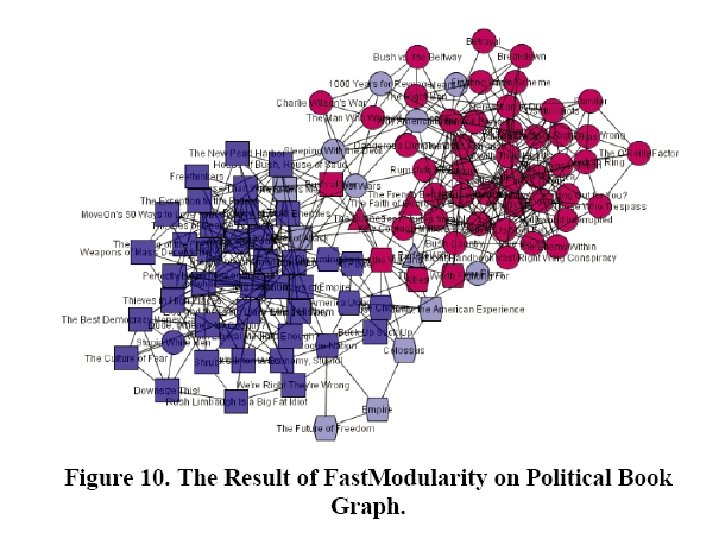
Effectiveness Books about US politics • The result for the Fast. Modularity algorithm is presented in Figure 10. • Align well with the “conservative” and “liberal” classes, the “neutral” class is mostly misclassified.
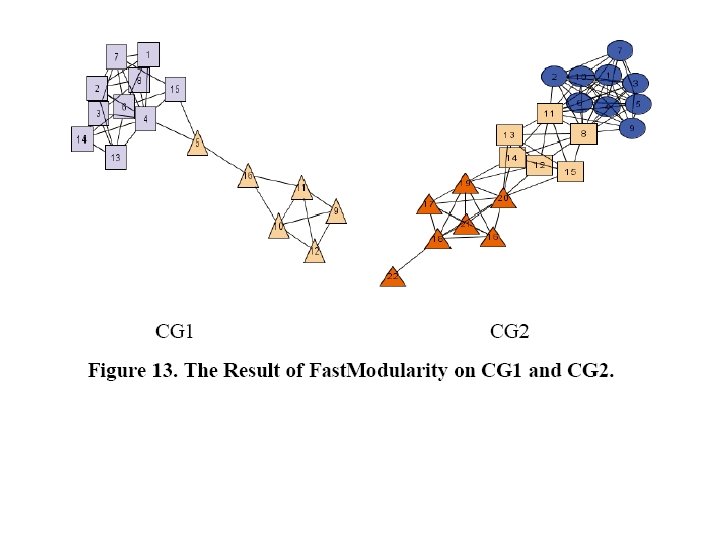
Effectiveness Customer Segmentation • Finally apply network clustering algorithms to detecting groups of records for the same individual, a problem called Customer Data Integration (CDI). • Records consisting of names and addresses are matched against each other using techniques that record with similar information despite variations in the names and addresses.
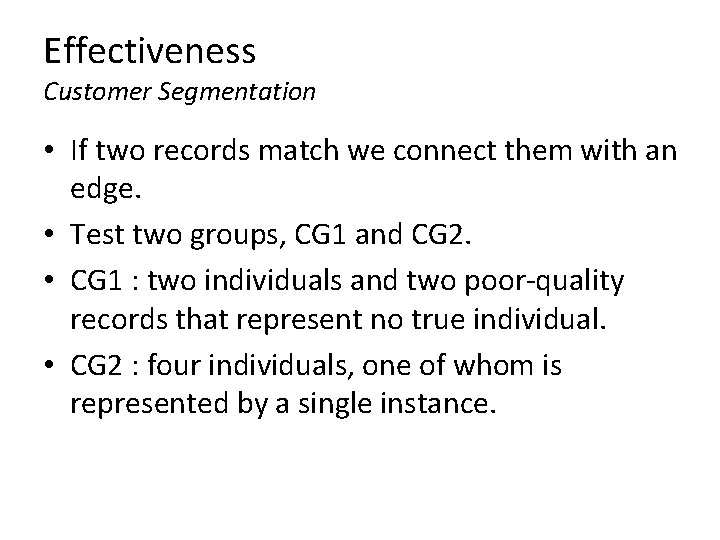
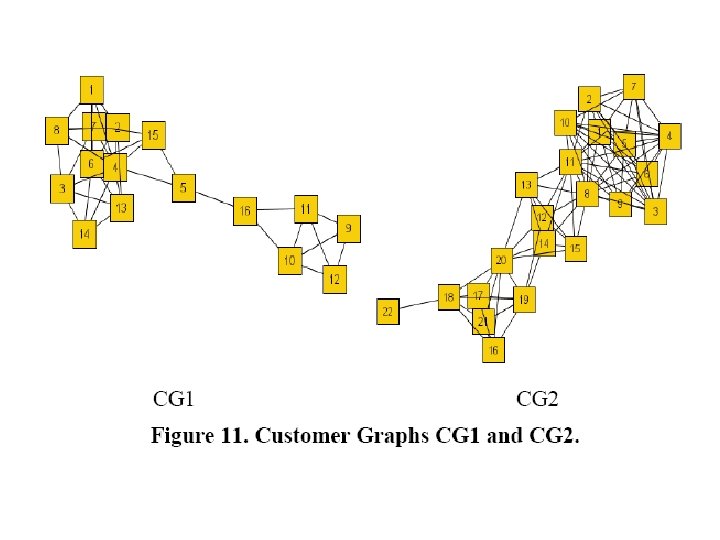
Effectiveness Customer Segmentation • If two records match we connect them with an edge. • Test two groups, CG 1 and CG 2. • CG 1 : two individuals and two poor-quality records that represent no true individual. • CG 2 : four individuals, one of whom is represented by a single instance.
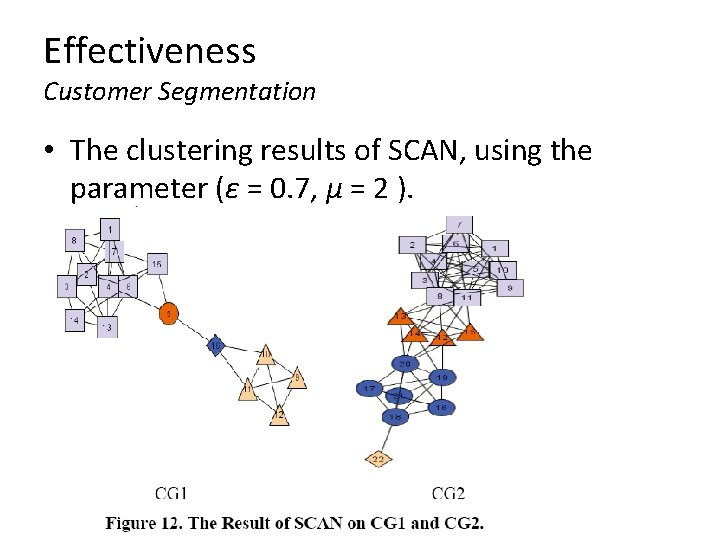
Effectiveness Customer Segmentation • The clustering results of SCAN, using the parameter (ε = 0. 7, μ = 2 ).
Effectiveness Adjusted Rand Index Comparison
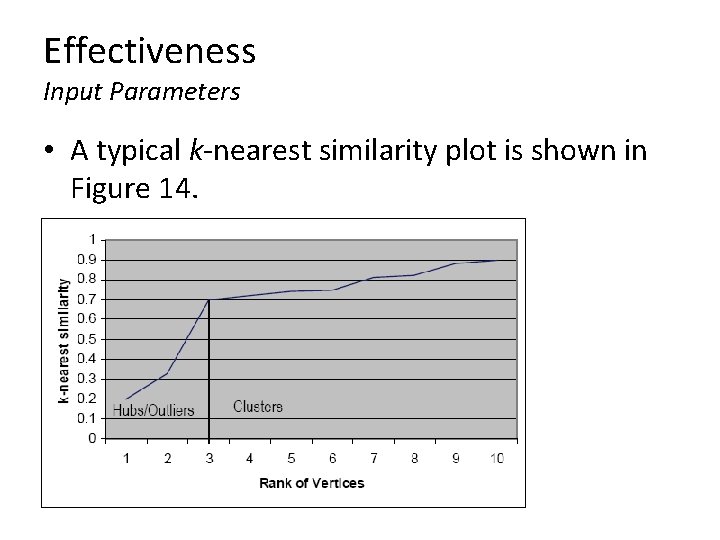
Effectiveness Input Parameters • SCAN algorithm uses two parameters : ε and μ. • To choose them, the authors adapted the heuristic suggested for DBSCAN in [10]. • k-nearest neighbor query for a sample of vertices and noting the nearest structural similarity as defined in Section 3. 1. • The query vertices are then sorted in ascending order of nearest structural similarity.
Effectiveness Input Parameters • A typical k-nearest similarity plot is shown in Figure 14.
Effectiveness Input Parameters • In the absence of such an analysis, an ε value between 0. 5 and 0. 8 is normally sufficient to achieve a good clustering result. • The authors recommend a value for μ, of 2.
Conclusions (1/3) • Min. Max Cut [4] and Normalized Cut [5] and Modularity-based algorithms can successfully detect clusters in networks. • They tend to fail to identify and isolate two kinds of vertices that play special roles – vertices that bridge clusters (hubs) and vertices that are marginally connected to clusters (outliers).
Conclusions (2/3) • Two vertices are assigned to a cluster according to how they share neighbors. • This makes sense when you consider social communities. • People who share many friends create a community, and the more friends they have in common, the more intimate the community.
Conclusions (3/3) • Compared SCAN with the fast modularitybased algorithm in terms of both efficiency and effectiveness. • The theoretical analysis and empirical evaluation demonstrate superior performance over the modularity-based network clustering algorithms.