
Scaling up Nutrition for sustainable results Why and
Scaling up Nutrition for sustainable results Why and how. A focus on prevention
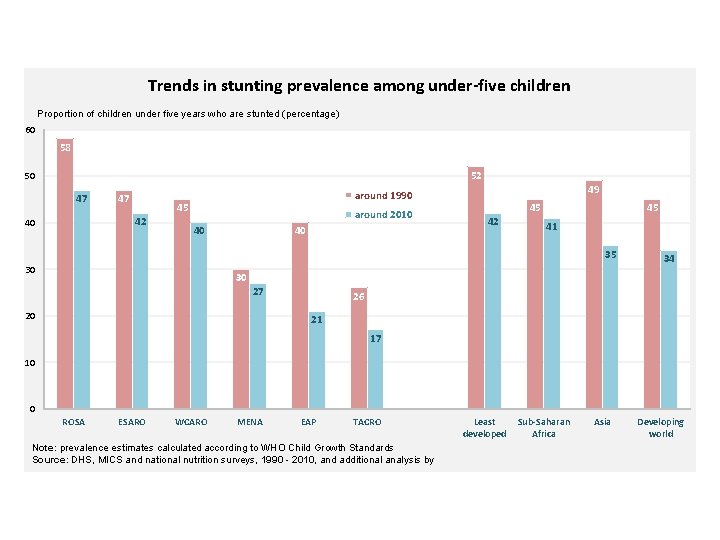
Trends in stunting prevalence among under-five children Proportion of children under five years who are stunted (percentage) 60 58 52 50 47 47 45 42 40 49 around 1990 around 2010 40 40 45 42 45 41 35 30 34 30 27 20 26 21 17 10 0 ROSA ESARO WCARO MENA EAP TACRO Note: prevalence estimates calculated according to WHO Child Growth Standards Source: DHS, MICS and national nutrition surveys, 1990 - 2010, and additional analysis by Least developed Sub-Saharan Africa Asia Developing world
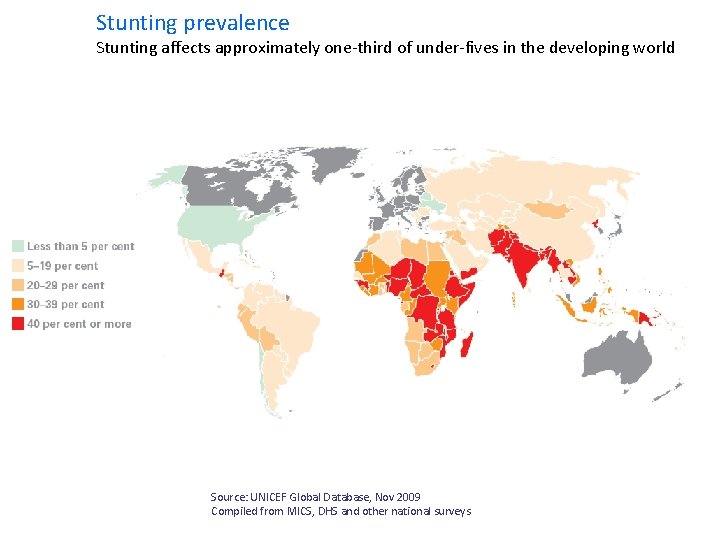
Stunting prevalence Stunting affects approximately one-third of under-fives in the developing world Source: UNICEF Global Database, Nov 2009 Compiled from MICS, DHS and other national surveys
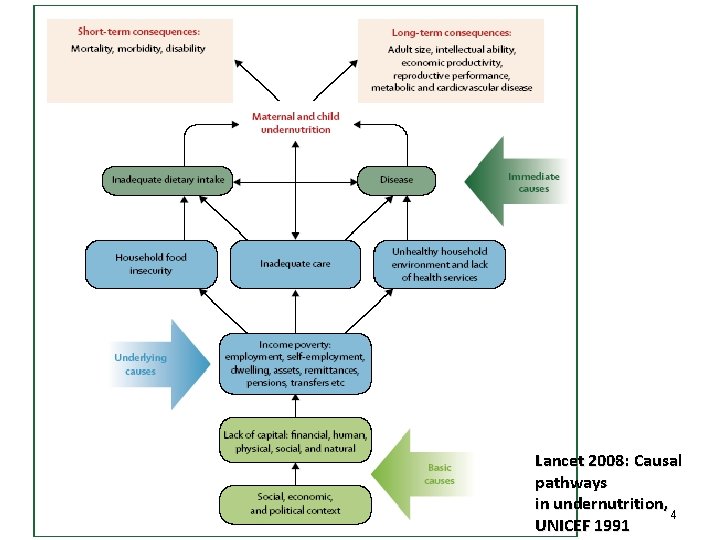
• (UN UNICEF Lancet 2008: Causal pathways in undernutrition, 4 UNICEF 1991
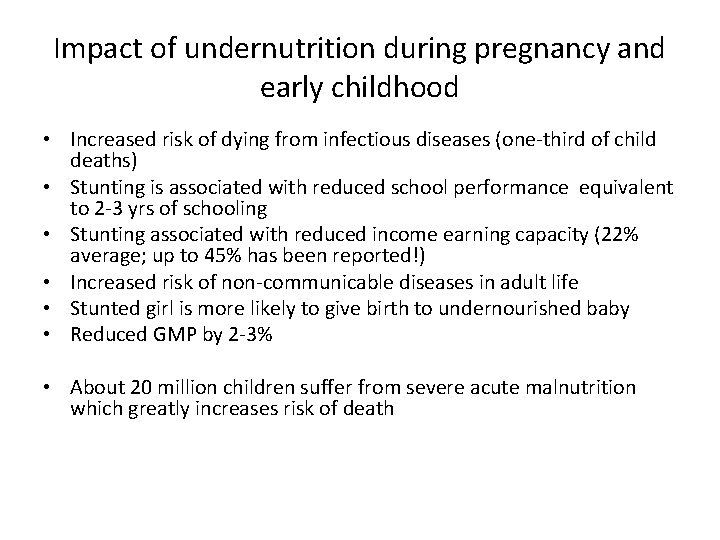
Impact of undernutrition during pregnancy and early childhood • Increased risk of dying from infectious diseases (one-third of child deaths) • Stunting is associated with reduced school performance equivalent to 2 -3 yrs of schooling • Stunting associated with reduced income earning capacity (22% average; up to 45% has been reported!) • Increased risk of non-communicable diseases in adult life • Stunted girl is more likely to give birth to undernourished baby • Reduced GMP by 2 -3% • About 20 million children suffer from severe acute malnutrition which greatly increases risk of death
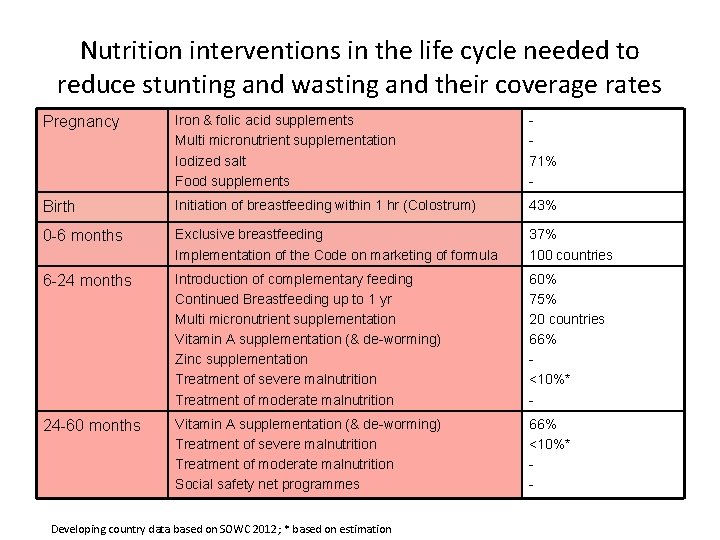
Nutrition interventions in the life cycle needed to reduce stunting and wasting and their coverage rates Pregnancy Iron & folic acid supplements Multi micronutrient supplementation Iodized salt Food supplements 71% - Birth Initiation of breastfeeding within 1 hr (Colostrum) 43% 0 -6 months Exclusive breastfeeding Implementation of the Code on marketing of formula 37% 100 countries 6 -24 months Introduction of complementary feeding Continued Breastfeeding up to 1 yr Multi micronutrient supplementation Vitamin A supplementation (& de-worming) Zinc supplementation Treatment of severe malnutrition Treatment of moderate malnutrition 60% 75% 20 countries 66% <10%* - 24 -60 months Vitamin A supplementation (& de-worming) Treatment of severe malnutrition Treatment of moderate malnutrition Social safety net programmes 66% <10%* - Developing country data based on SOWC 2012; * based on estimation
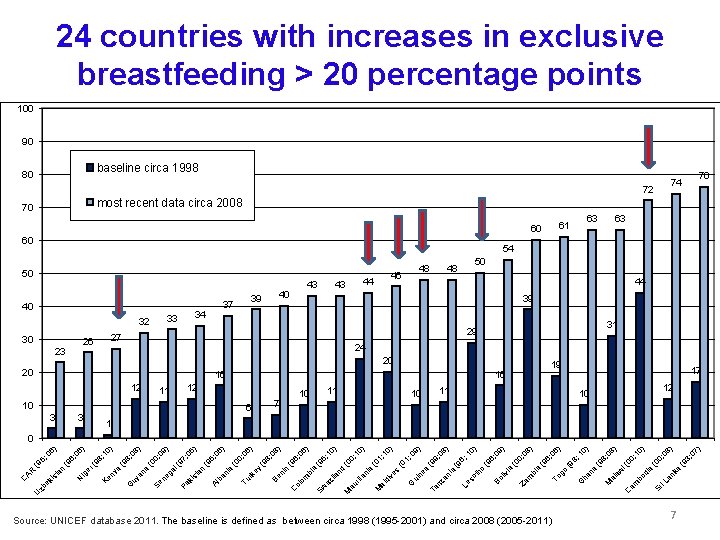
24 countries with increases in exclusive breastfeeding > 20 percentage points 100 90 baseline circa 1998 80 76 74 72 most recent data circa 2008 70 60 63 61 60 63 54 50 40 30 44 43 48 44 39 31 29 27 26 23 34 33 32 39 37 43 40 48 46 50 24 20 20 16 12 12 11 10 3 11 10 7 6 3 19 16 17 11 10 12 10 1 Source: UNICEF database 2011. The baseline is defined as between circa 1998 (1995 -2001) and circa 2008 (2005 -2011) 07 ) (9 3; ; 0 ka an Sr i. L di a (0 0 00 i( bo C am aw al M 8) 0) ; 1 8) (9 8 ; 0 ; 1 ha G To g o na (9 8 (9 6; 06 0) ) ) 08 a bi m Za Bo liv ia (9 6; o th so Le (0 0; 09 10 6; (9 ia an ) ) 08 ) 9; (9 Ta nz G ve di al M ui n s ea (0 (0 a ni M au r ita ila 1; 09 ) 10 ) 1; 10 (0 0; nd (9 a bi om ol C ) 0) 5; 1 ; 0 (9 6 8; ni n Be ke y (9 (0 0 Tu r 6) 08 ) 6) ; 0 6) ni a ba Al Pa ki st an (9 (9 7; 5; 0 05 ) 09 Se ne g al a (0 0; 8; 0 an uy G Ke ny a (9 8; (9 ) 8) ) 10 ) 06 er ig N Sw az U zb ek C is ta AR n (9 5 (9 6; ; 0 6) 0 7
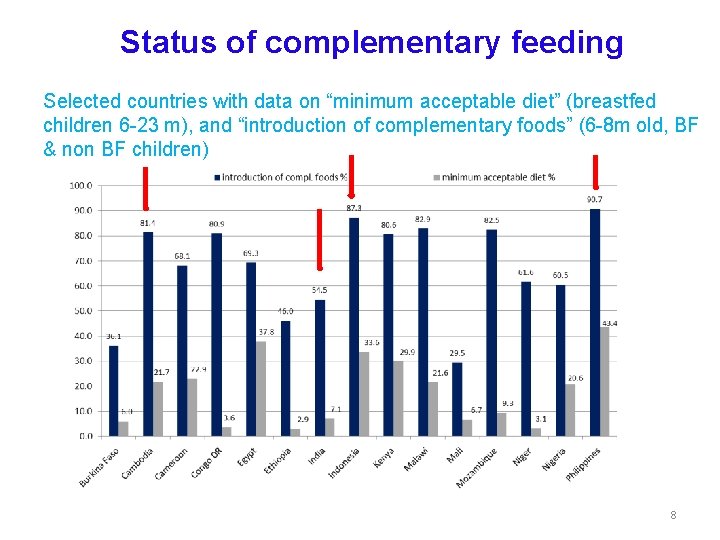
Status of complementary feeding Selected countries with data on “minimum acceptable diet” (breastfed children 6 -23 m), and “introduction of complementary foods” (6 -8 m old, BF & non BF children) 8
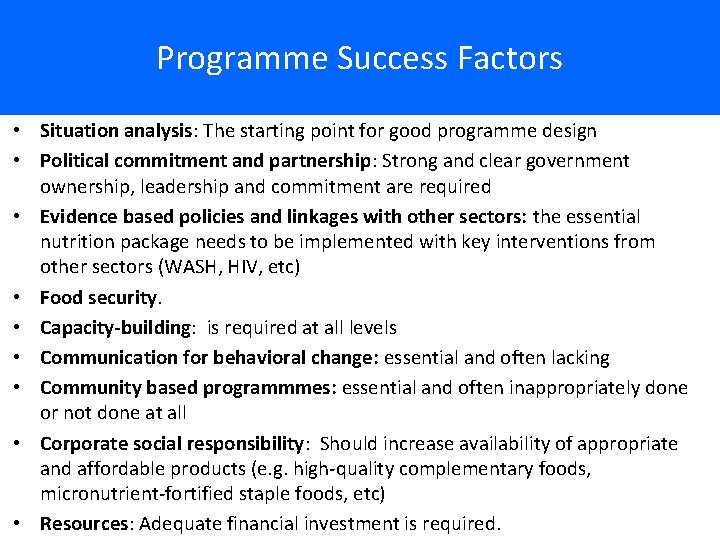
Programme Success Factors • Situation analysis: The starting point for good programme design • Political commitment and partnership: Strong and clear government ownership, leadership and commitment are required • Evidence based policies and linkages with other sectors: the essential nutrition package needs to be implemented with key interventions from other sectors (WASH, HIV, etc) • Food security. • Capacity-building: is required at all levels • Communication for behavioral change: essential and often lacking • Community based programmmes: essential and often inappropriately done or not done at all • Corporate social responsibility: Should increase availability of appropriate and affordable products (e. g. high-quality complementary foods, micronutrient-fortified staple foods, etc) • Resources: Adequate financial investment is required.
- Slides: 9