
Scaling of Union of Intersections for Inference of
![Union of Intersections �The Union of Intersections (Uo. I) framework developed in [1] is](https://slidetodoc.com/presentation_image_h2/1d5724eafd0c8511a10630b19e45b387/image-3.jpg "Union of Intersections �The Union of Intersections (Uo. I) framework developed in [1] is")
![Methods Uo. ILASSO Uo. IVAR[2] Bootstrap parallelization hyperparameter parallelization Distributed LASSO-ADMM [1] Stephen Boyd](https://slidetodoc.com/presentation_image_h2/1d5724eafd0c8511a10630b19e45b387/image-4.jpg "Methods Uo. ILASSO Uo. IVAR[2] Bootstrap parallelization hyperparameter parallelization Distributed LASSO-ADMM [1] Stephen Boyd")
- Slides: 10
Scaling of Union of Intersections for Inference of Granger Causal Networks from Observational Data Mahesh Balasubramanian 1, Trevor Ruiz 2, Brandon Cook 3, Mr Prabhat 3 Sharmodeep Bhattacharyya 2, Aviral Shrivastava 1, Kristofer Bouchard 3 1. Arizona State University, AZ, USA 2. Oregon State University, OR, USA 3. Lawrence Berkeley National Laboratory, CA, USA Email: mbalasubramanian@asu. edu; kebouchard@lbl. gov
Introduction � The growth of the Internet and social media applications has paved the way for the development of highly sophisticated machine learning and statistical data analysis tools. � Further scientific data collection strategies have grown exponentially over the years by innovation in the field of sensors and advanced data collection methods. � Introduced for the analysis of econometric time series, Granger causality is the amount of variance in one time series accounted for by the past of another time series � Vector autoregressive (VAR) models are well suited for inference of Granger causal networks from such high-dimensional, multi-variate observational time series data. � Although VAR models provide a flexible framework and are probabilistically tractable scaling VAR inference to massive data sets is a major challenge due to unfavorable scaling of the problem size with the number of nodes or features in the network. 1
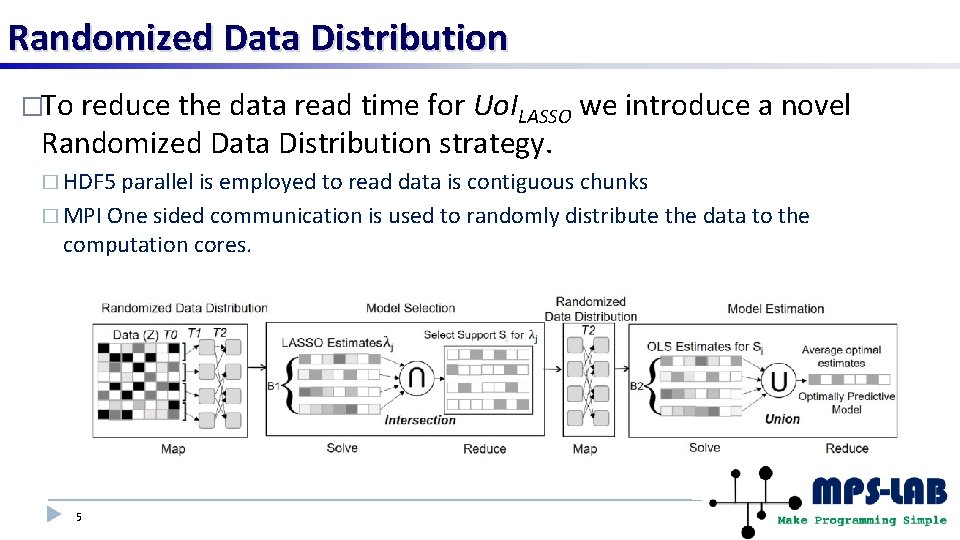
Union of Intersections �The Union of Intersections (Uo. I) framework developed in [1] is a powerful statistical-machine learning framework which has natural algorithmic parallelism. �The main mathematical innovations of Uo. I are � 1) creating a family of potential model supports through an intersection operation for a range of regularization parameters in model selection, and � 2) combining the above-computed supports with a union operation so as to increase prediction accuracy on held out data in model estimation. �Methods based on Uo. I, utilize the notion of stability to perturbations by multiple random resampling of the data. [1] Kristofer E. Bouchard et al. Union of Intersections (Uo. I) for Interpretable Data Driven Discovery and Prediction. In Advances in Neural Information Processing Systems, 2017 2
Methods Uo. ILASSO Uo. IVAR[2] Bootstrap parallelization hyperparameter parallelization Distributed LASSO-ADMM [1] Stephen Boyd et al. Distributed optimization and statistical learning via the alternating direction method of multipliers. Foundations and Trends® in Machine Learning, 3(1): 1– 122, 2011. 3 [2] Trevor Ruiz, Mahesh Balasubramanian, Kristofer E Bouchard, and Sharmodeep Bhattacharyya. Sparse, low -bias, and scalable estimation of high dimensional vector autoregressive models via union of intersections. ar. Xiv preprint ar. Xiv: 1908. 11464, 2019.
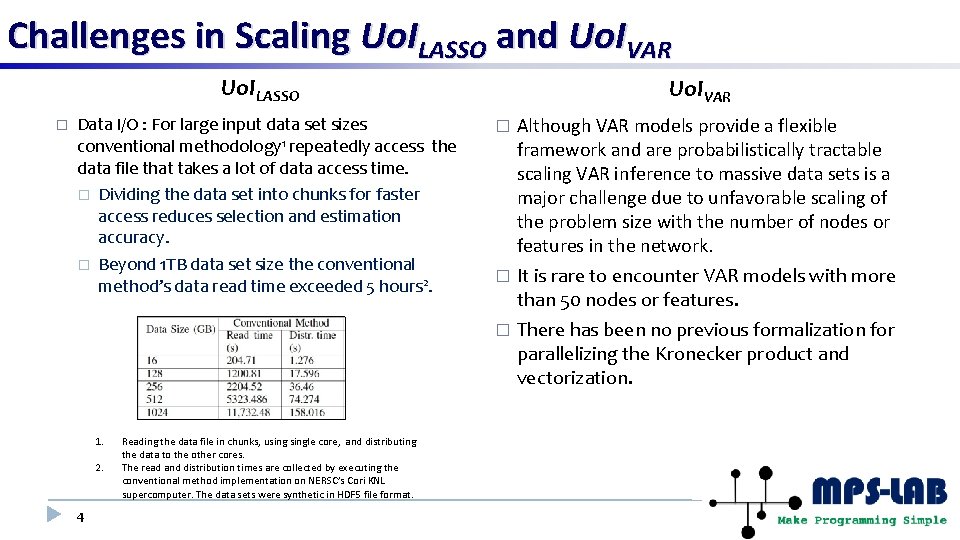
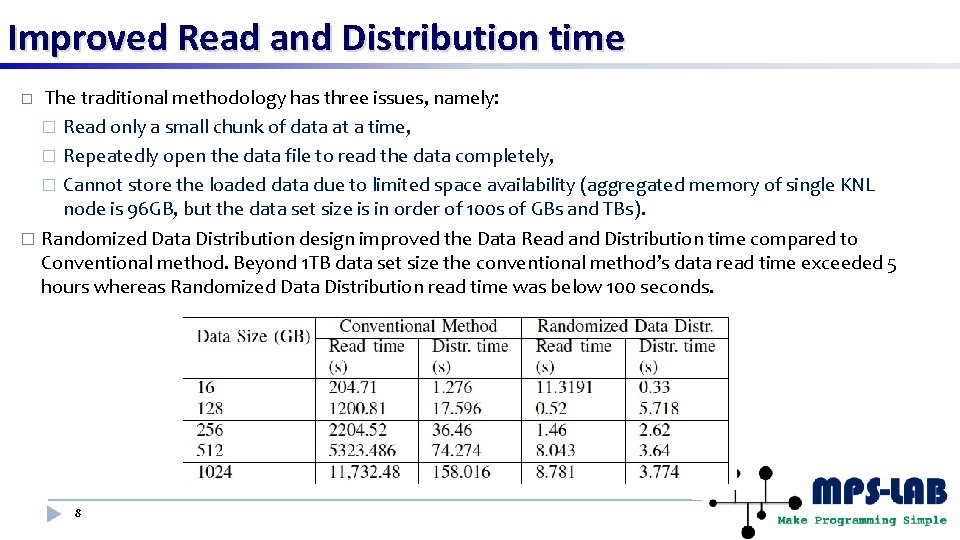
Challenges in Scaling Uo. ILASSO and Uo. IVAR Uo. ILASSO � Data I/O : For large input data set sizes conventional methodology 1 repeatedly access the data file that takes a lot of data access time. � Dividing the data set into chunks for faster access reduces selection and estimation accuracy. � Beyond 1 TB data set size the conventional method’s data read time exceeded 5 hours 2. 1. 2. 4 Reading the data file in chunks, usingle core, and distributing the data to the other cores. The read and distribution times are collected by executing the conventional method implementation on NERSC’s Cori KNL supercomputer. The data sets were synthetic in HDF 5 file format. Uo. IVAR Although VAR models provide a flexible framework and are probabilistically tractable scaling VAR inference to massive data sets is a major challenge due to unfavorable scaling of the problem size with the number of nodes or features in the network. � It is rare to encounter VAR models with more than 50 nodes or features. � There has been no previous formalization for parallelizing the Kronecker product and vectorization. �
Randomized Data Distribution �To reduce the data read time for Uo. ILASSO we introduce a novel Randomized Data Distribution strategy. � HDF 5 parallel is employed to read data is contiguous chunks � MPI One sided communication is used to randomly distribute the data to the computation cores. 5
Distributed Kronecker Product and Vectorization �The input data set size is small (few 10 s of MB), so only a few cores read the data and the problem is created using Kronecker product and vectorization. �Since temporal dependence should be honored for time series model, a block bootstrap approach is implemented by randomly selecting time series blocks for each bootstrap. �The reader cores holding the block bootstraps create windows for MPI one sided communication. �The computation cores then execute the vectorization and Kronecker product routines to get the corresponding cores. �Explicit computation is not required but increases the communication time. 6
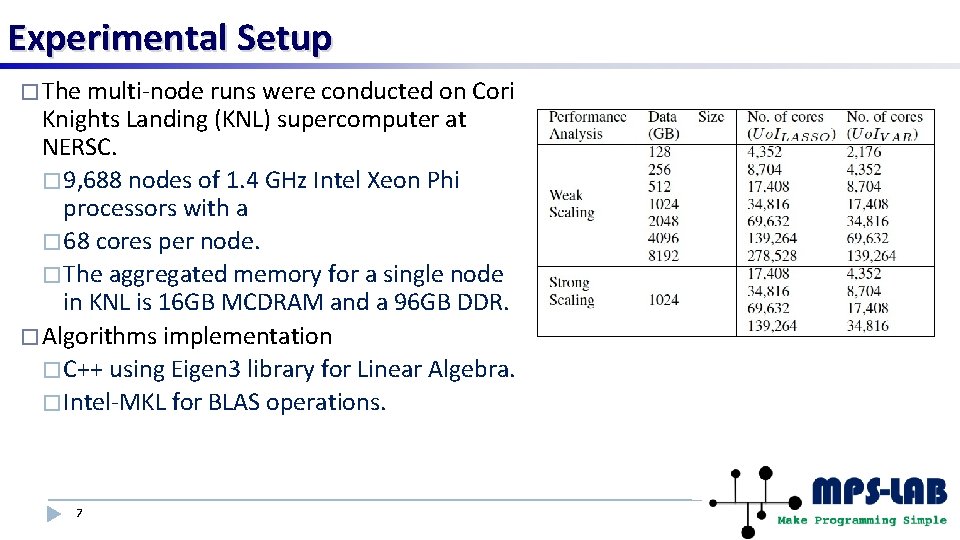
Experimental Setup � The multi-node runs were conducted on Cori Knights Landing (KNL) supercomputer at NERSC. � 9, 688 nodes of 1. 4 GHz Intel Xeon Phi processors with a � 68 cores per node. � The aggregated memory for a single node in KNL is 16 GB MCDRAM and a 96 GB DDR. � Algorithms implementation � C++ using Eigen 3 library for Linear Algebra. � Intel-MKL for BLAS operations. 7
Improved Read and Distribution time The traditional methodology has three issues, namely: � Read only a small chunk of data at a time, � Repeatedly open the data file to read the data completely, � Cannot store the loaded data due to limited space availability (aggregated memory of single KNL node is 96 GB, but the data set size is in order of 100 s of GBs and TBs). � Randomized Data Distribution design improved the Data Read and Distribution time compared to Conventional method. Beyond 1 TB data set size the conventional method’s data read time exceeded 5 hours whereas Randomized Data Distribution read time was below 100 seconds. � 8
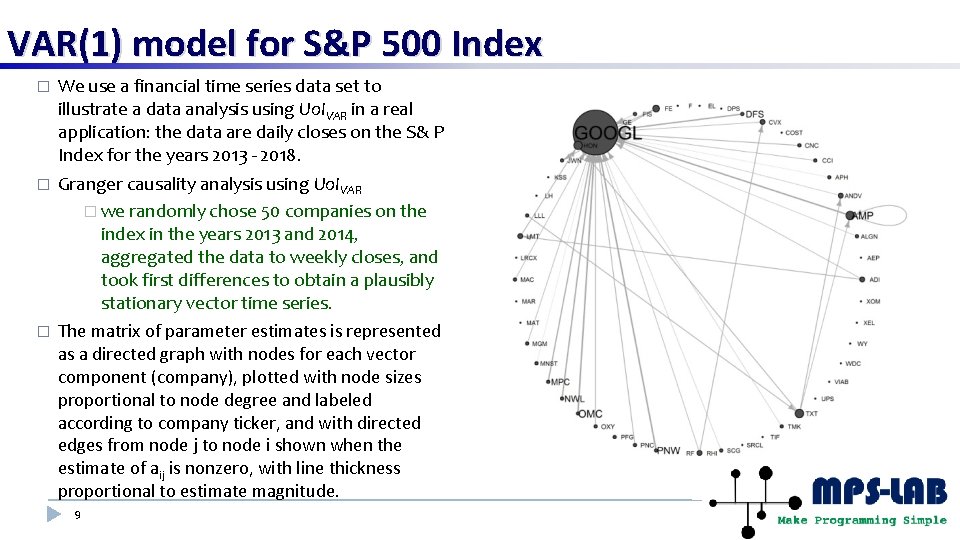
VAR(1) model for S&P 500 Index � We use a financial time series data set to illustrate a data analysis using Uo. IVAR in a real application: the data are daily closes on the S& P Index for the years 2013 - 2018. � Granger causality analysis using Uo. IVAR � we randomly chose 50 companies on the index in the years 2013 and 2014, aggregated the data to weekly closes, and took first differences to obtain a plausibly stationary vector time series. � The matrix of parameter estimates is represented as a directed graph with nodes for each vector component (company), plotted with node sizes proportional to node degree and labeled according to company ticker, and with directed edges from node j to node i shown when the estimate of aij is nonzero, with line thickness proportional to estimate magnitude. 9