
SCALING OF NATURAL AND ARTIFICIAL STRUCTURES EFFECTS OF


- Slides: 20
SCALING OF NATURAL AND ARTIFICIAL STRUCTURES
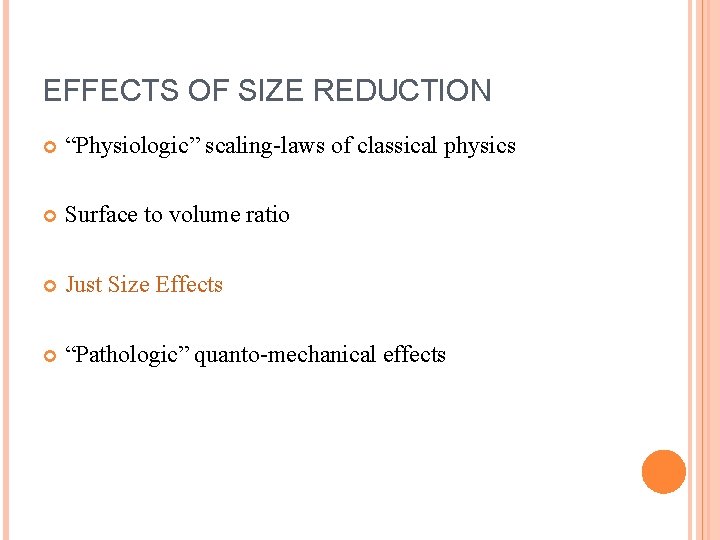
EFFECTS OF SIZE REDUCTION “Physiological scaling” of classical physics Surface to volume ratio Just Size Effects “Pathologic” quanto-mechanical effects
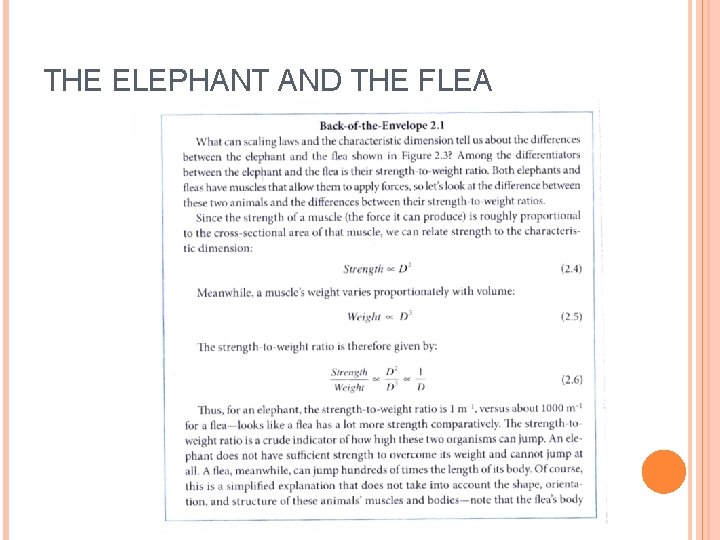
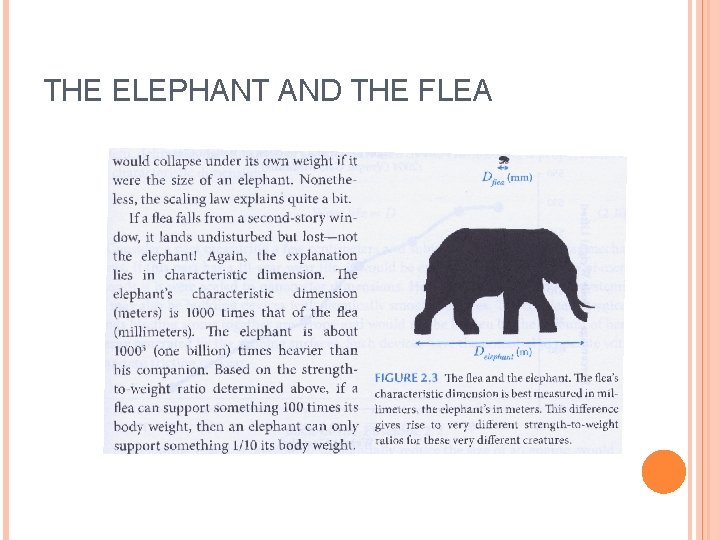
THE ELEPHANT AND THE FLEA
THE ELEPHANT AND THE FLEA
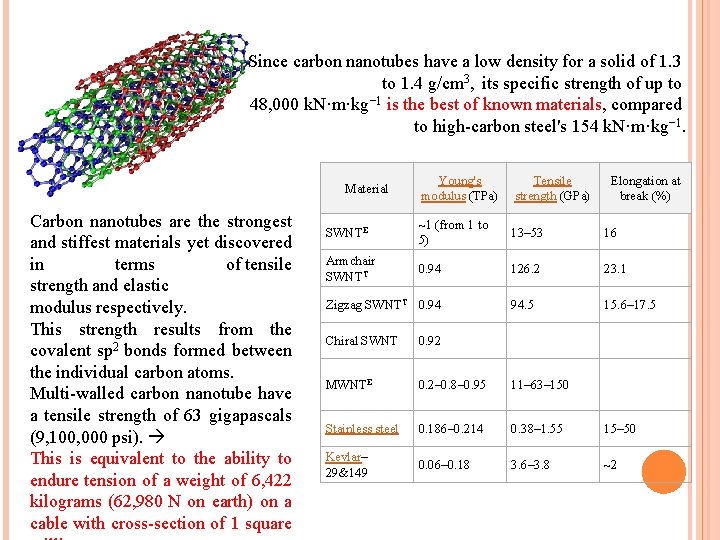
Since carbon nanotubes have a low density for a solid of 1. 3 to 1. 4 g/cm 3, its specific strength of up to 48, 000 k. N·m·kg− 1 is the best of known materials, compared to high-carbon steel's 154 k. N·m·kg− 1. Young's modulus (TPa) Tensile strength (GPa) SWNTE ~1 (from 1 to 5) 13– 53 16 Armchair SWNTT 0. 94 126. 2 23. 1 94. 5 15. 6– 17. 5 Material Carbon nanotubes are the strongest and stiffest materials yet discovered in terms of tensile strength and elastic modulus respectively. This strength results from the covalent sp 2 bonds formed between the individual carbon atoms. Multi-walled carbon nanotube have a tensile strength of 63 gigapascals (9, 100, 000 psi). This is equivalent to the ability to endure tension of a weight of 6, 422 kilograms (62, 980 N on earth) on a cable with cross-section of 1 square Zigzag SWNTT 0. 94 Elongation at break (%) Chiral SWNT 0. 92 MWNTE 0. 2– 0. 8– 0. 95 11– 63– 150 Stainless steel 0. 186– 0. 214 0. 38– 1. 55 15– 50 Kevlar– 29&149 0. 06– 0. 18 3. 6– 3. 8 ~2
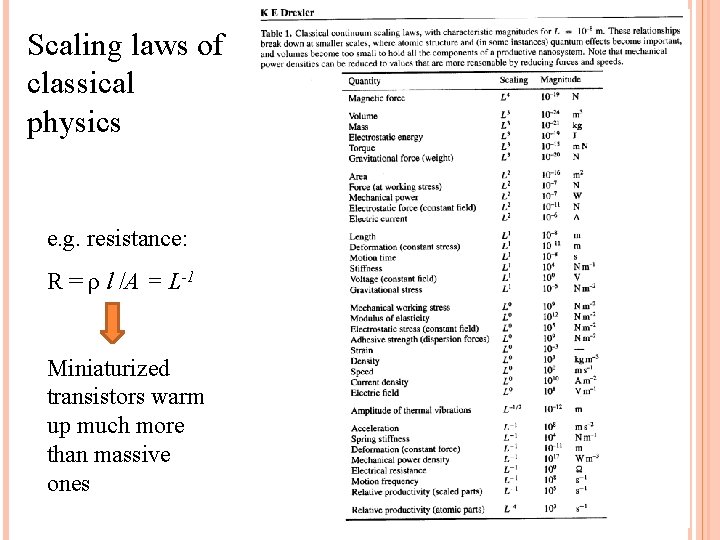
Scaling laws of classical physics e. g. resistance: R = ρ l /A = L-1 Miniaturized transistors warm up much more than massive ones
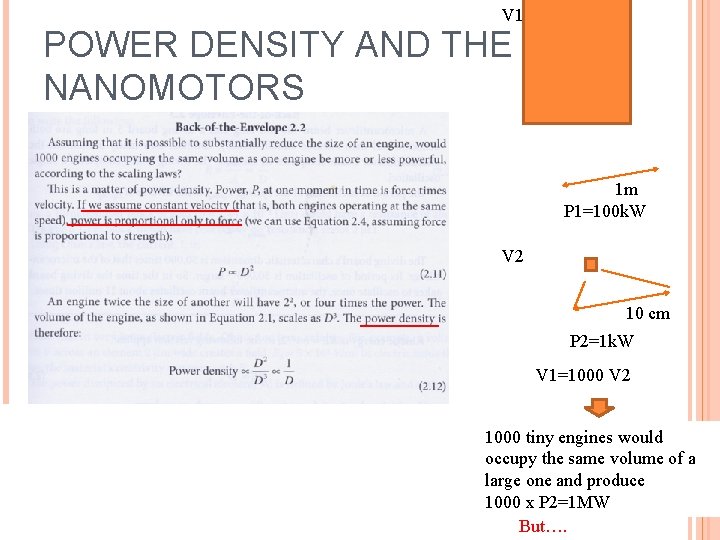
V 1 POWER DENSITY AND THE NANOMOTORS 1 m P 1=100 k. W V 2 10 cm P 2=1 k. W V 1=1000 V 2 1000 tiny engines would occupy the same volume of a large one and produce 1000 x P 2=1 MW But….
EFFECTS OF SIZE REDUCTION “Physiologic” scaling-laws of classical physics Surface to volume ratio (ontop chemical activity) Just Size Effects “Pathologic” quanto-mechanical effects
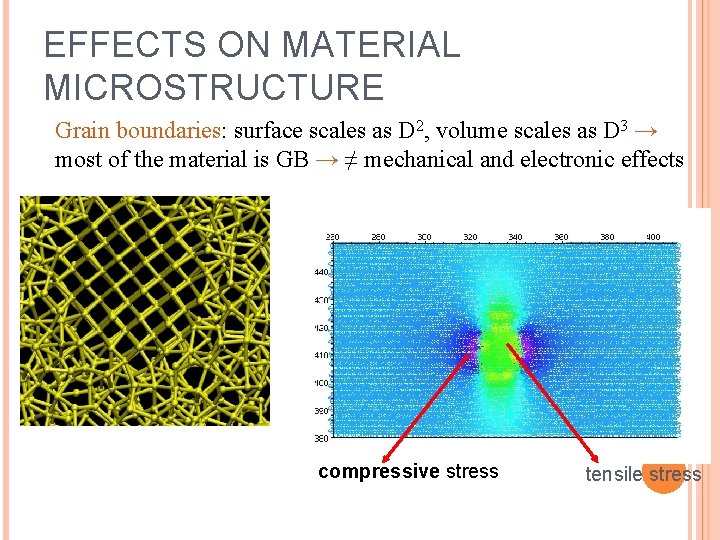
EFFECTS ON MATERIAL MICROSTRUCTURE Grain boundaries: surface scales as D 2, volume scales as D 3 → most of the material is GB → ≠ mechanical and electronic effects compressive stress tensile stress
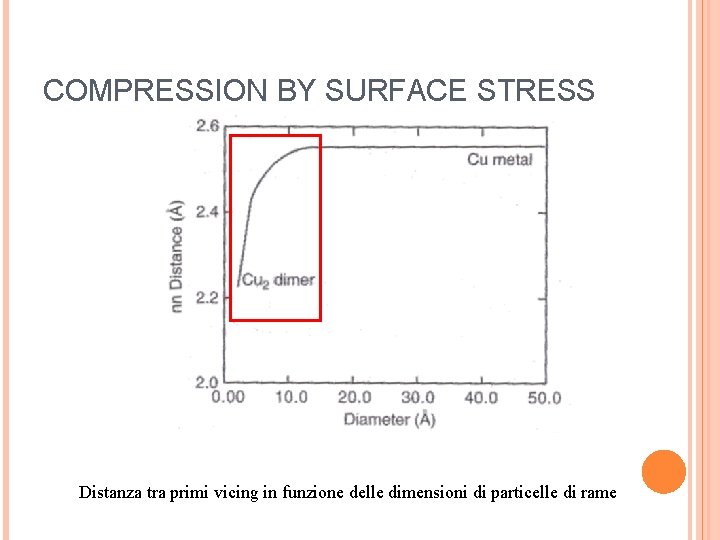
COMPRESSION BY SURFACE STRESS Distanza tra primi vicing in funzione delle dimensioni di particelle di rame
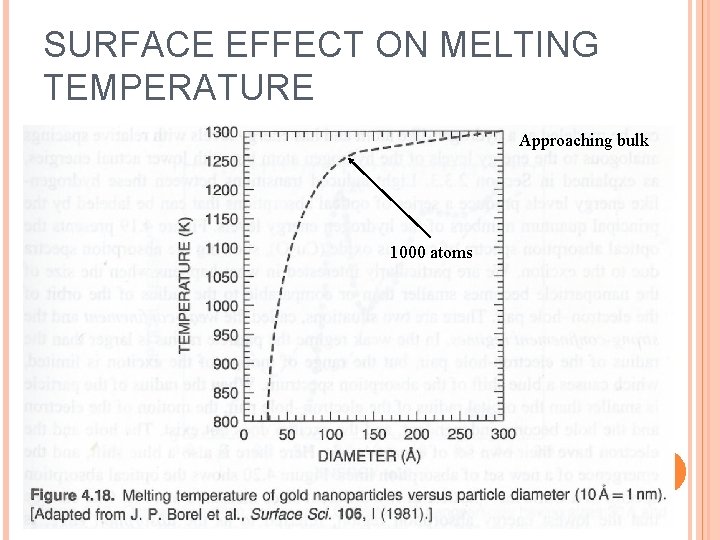
SURFACE EFFECT ON MELTING TEMPERATURE Approaching bulk 1000 atoms
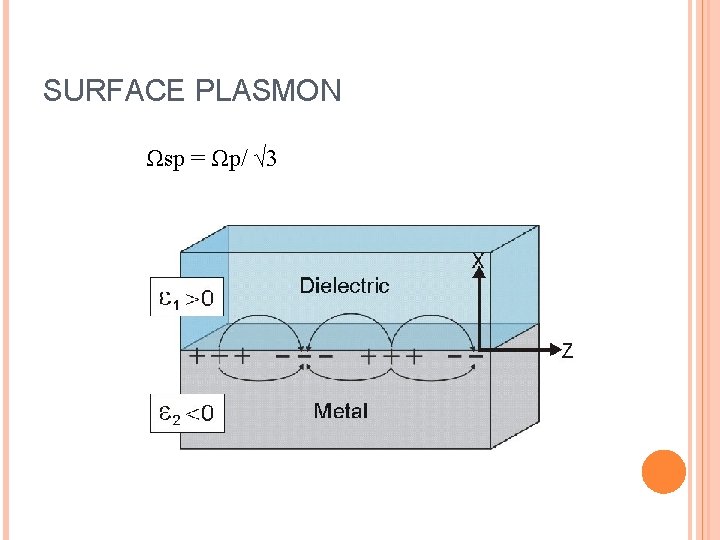
SURFACE PLASMON Ωsp = Ωp/ √ 3
EFFECTS OF SIZE REDUCTION “Physiologic” scaling-laws of classical physics Surface to volume ratio Just Size Effects “Pathologic” quanto-mechanical effects
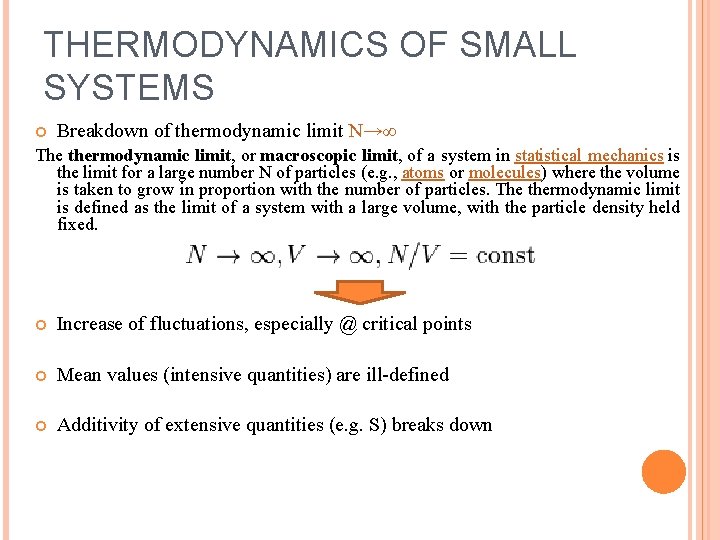
THERMODYNAMICS OF SMALL SYSTEMS Breakdown of thermodynamic limit N→∞ The thermodynamic limit, or macroscopic limit, of a system in statistical mechanics is the limit for a large number N of particles (e. g. , atoms or molecules) where the volume is taken to grow in proportion with the number of particles. The thermodynamic limit is defined as the limit of a system with a large volume, with the particle density held fixed. Increase of fluctuations, especially @ critical points Mean values (intensive quantities) are ill-defined Additivity of extensive quantities (e. g. S) breaks down
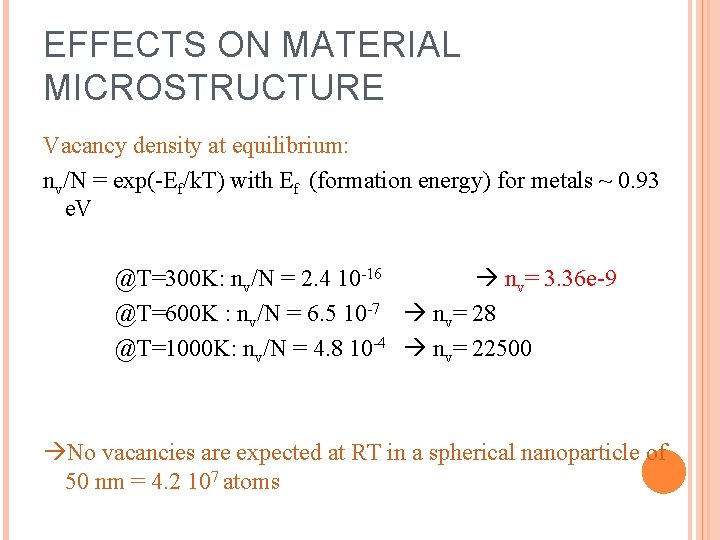
EFFECTS ON MATERIAL MICROSTRUCTURE Vacancy density at equilibrium: nv/N = exp(-Ef/k. T) with Ef (formation energy) for metals ~ 0. 93 e. V @T=300 K: nv/N = 2. 4 10 -16 nv= 3. 36 e-9 @T=600 K : nv/N = 6. 5 10 -7 nv= 28 @T=1000 K: nv/N = 4. 8 10 -4 nv= 22500 No vacancies are expected at RT in a spherical nanoparticle of 50 nm = 4. 2 107 atoms
EFFECTS ON MATERIAL MICROSTRUCTURE Dislocations in nanocrystals: Core energy per unit length is constant with size Deformation energy goes as ln(R/rc), so that it moderately scales with D (3 times smaller from 100μm to 100 nm) → slightly easier to form Space-reduction lowers the gliding and configurational freedom in the entropic term → limited stability Close free surfaces or interfaces expunge dislocations and elastically/plastically relax the system → inner part
EFFECTS OF SIZE REDUCTION “Physiologic” scaling-laws of classical physics Surface to volume ratio Just Size Effects “Pathologic” quanto-mechanical effects
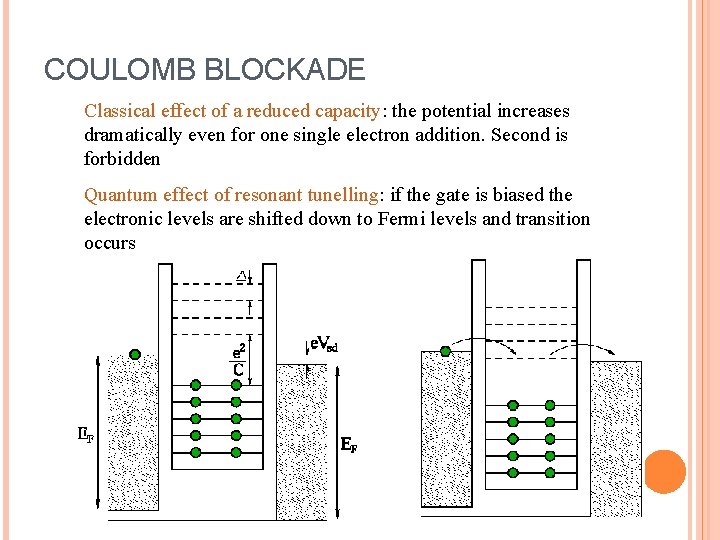
COULOMB BLOCKADE Classical effect of a reduced capacity: the potential increases dramatically even for one single electron addition. Second is forbidden Quantum effect of resonant tunelling: if the gate is biased the electronic levels are shifted down to Fermi levels and transition occurs
QUANTO-MECHANICAL EFFECTS Quantum confinement: energy levels and their spacings scale as 1/L 2. Optical shift with size Tunnelling: current scales as exp (– 2 d/Λ), where d is the thickness of the barrier. Scattering: relaxation-time approximation breaks down if D< λ= v(EF) Δt. Resistivity is ill-defined