
Scaling BIRD Routeservers RIPE 73 Madrid Benedikt Rudolph
Scaling BIRD Routeservers RIPE 73, Madrid Benedikt Rudolph, Sebastian Abt DE-CIX Research and Development
The BIRD Internet Routing Daemon » Dynamic IP routing daemon (BGP, RIP, OSPF, Babel, BFD) » Written in C » Open. Source Software (GNU GPLv 2) » Widely deployed for Route Servers at IXPs » Mid-size to small ones » Few large ones with 〜 1000 BGP neighbors » Flexible configuration file syntax » Reliable and stable operation 2
Motivation and Goals Avoid: • “spiral of death” syndrome – Re-convergence after high churn • performance degradation on protocol reload / maintainance Help: • Scale out to unused CPUs • Reduce load on BIRD processes – Fewer peers/prefixes per PID • Serve more peers Easy to test, deploy and maintain • No client-side configuration changes • No alterations to the Source. Code 3
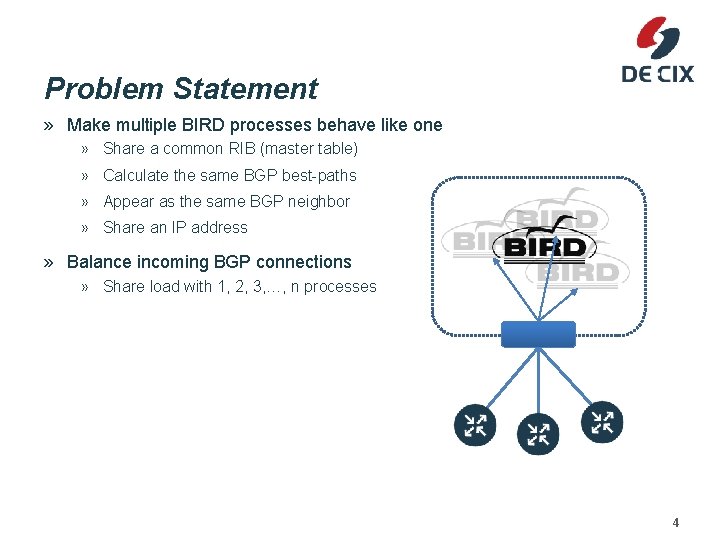
Problem Statement » Make multiple BIRD processes behave like one » Share a common RIB (master table) » Calculate the same BGP best-paths » Appear as the same BGP neighbor » Share an IP address » Balance incoming BGP connections » Share load with 1, 2, 3, …, n processes 4
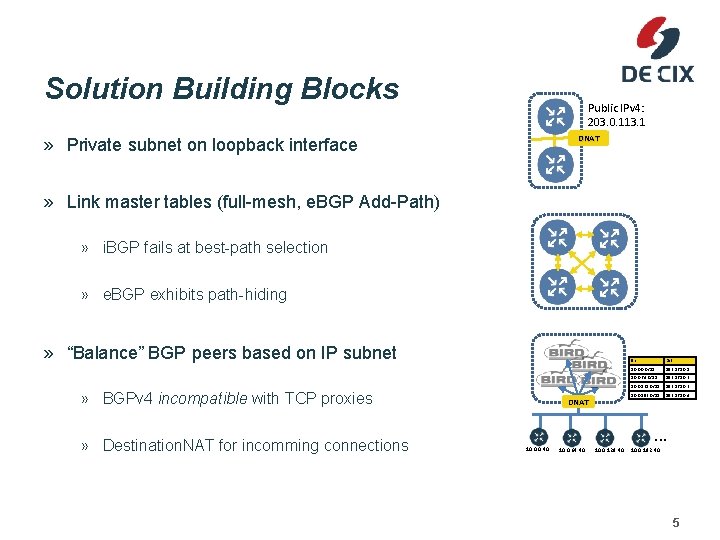
Solution Building Blocks Public IPv 4: 203. 0. 113. 1 DNAT » Private subnet on loopback interface » Link master tables (full-mesh, e. BGP Add-Path) » i. BGP fails at best-path selection » e. BGP exhibits path-hiding » “Balance” BGP peers based on IP subnet » BGPv 4 incompatible with TCP proxies » Destination. NAT for incomming connections DNAT 10. 0. 0. 40 10. 0. 64. 40 10. 0. 128. 40 Src Dst 10. 0/18 192. 168. 0. 1 10. 0. 64. 0/18 192. 168. 0. 2 10. 0. 128. 0/18 192. 168. 0. 3 10. 0. 192. 0/18 192. 168. 0. 4 . . . 10. 0. 192. 40 5
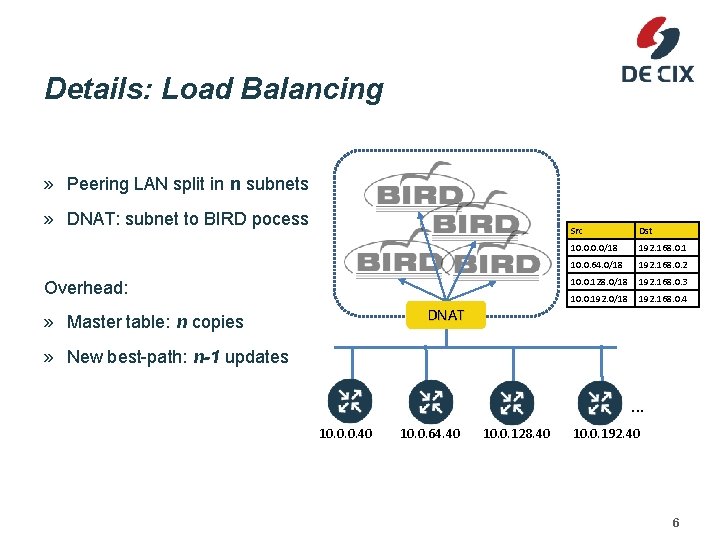
Details: Load Balancing » Peering LAN split in n subnets » DNAT: subnet to BIRD pocess Overhead: Src Dst 10. 0/18 192. 168. 0. 1 10. 0. 64. 0/18 192. 168. 0. 2 10. 0. 128. 0/18 192. 168. 0. 3 10. 0. 192. 0/18 192. 168. 0. 4 DNAT » Master table: n copies » New best-path: n-1 updates . . . 10. 0. 0. 40 10. 0. 64. 40 10. 0. 128. 40 10. 0. 192. 40 6
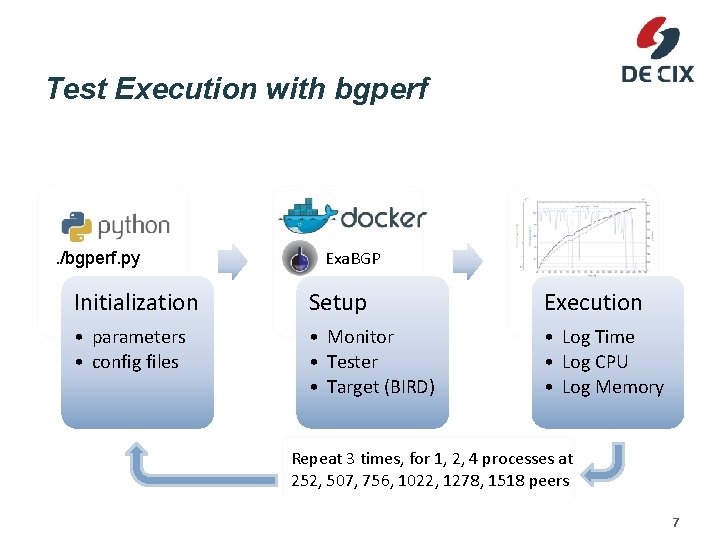
Test Execution with bgperf . /bgperf. py Exa. BGP Initialization Setup Execution • parameters • config files • Monitor • Tester • Target (BIRD) • Log Time • Log CPU • Log Memory Repeat 3 times, for 1, 2, 4 processes at 252, 507, 756, 1022, 1278, 1518 peers 7
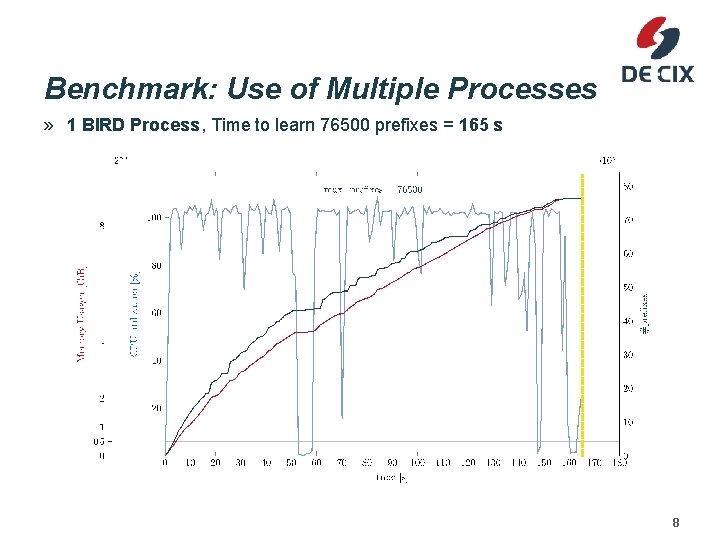
Benchmark: Use of Multiple Processes » 1 BIRD Process, Time to learn 76500 prefixes = 165 s 8
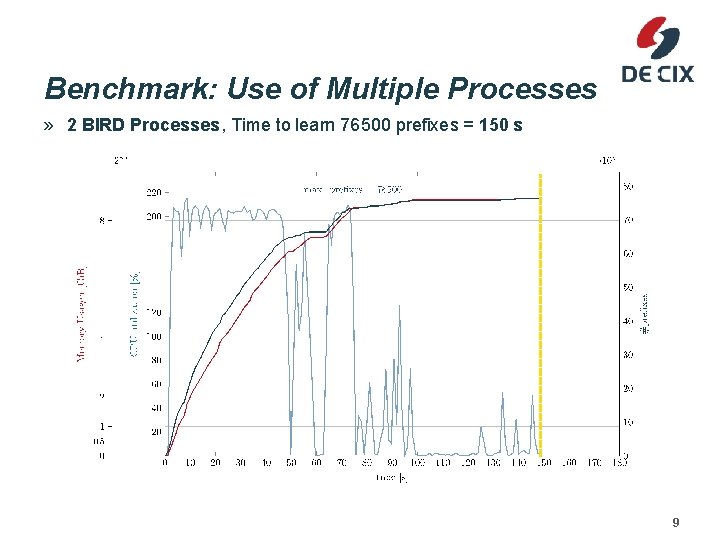
Benchmark: Use of Multiple Processes » 2 BIRD Processes, Time to learn 76500 prefixes = 150 s 9
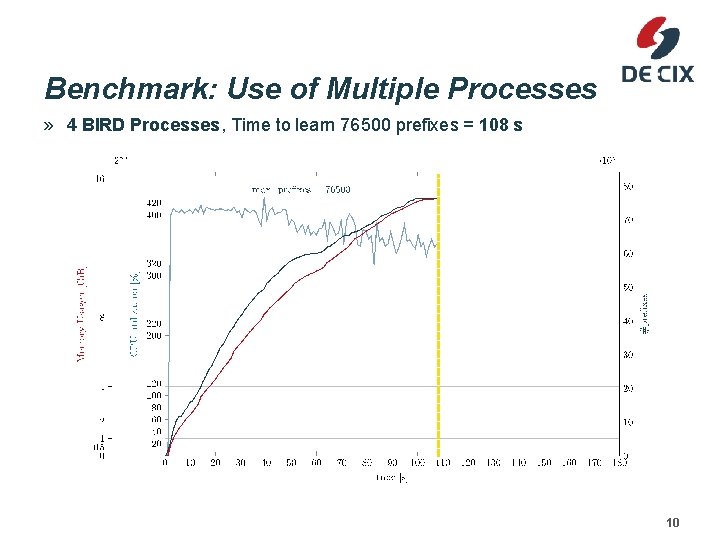
Benchmark: Use of Multiple Processes » 4 BIRD Processes, Time to learn 76500 prefixes = 108 s 10
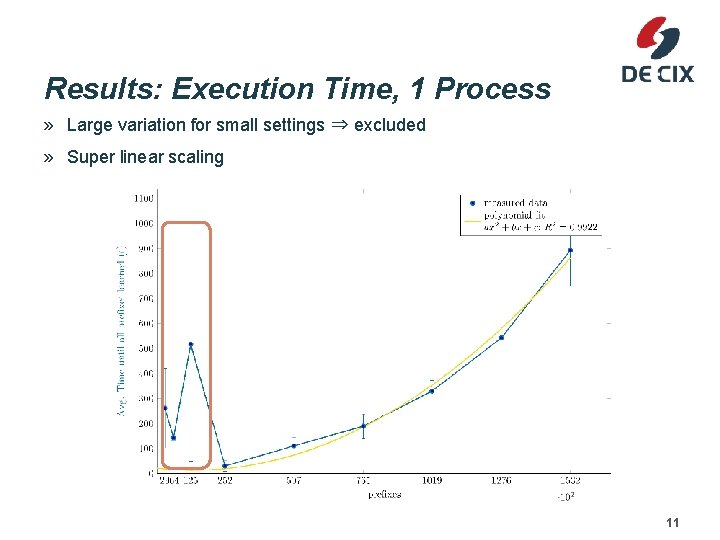
Results: Execution Time, 1 Process » Large variation for small settings ⇒ excluded » Super linear scaling 11
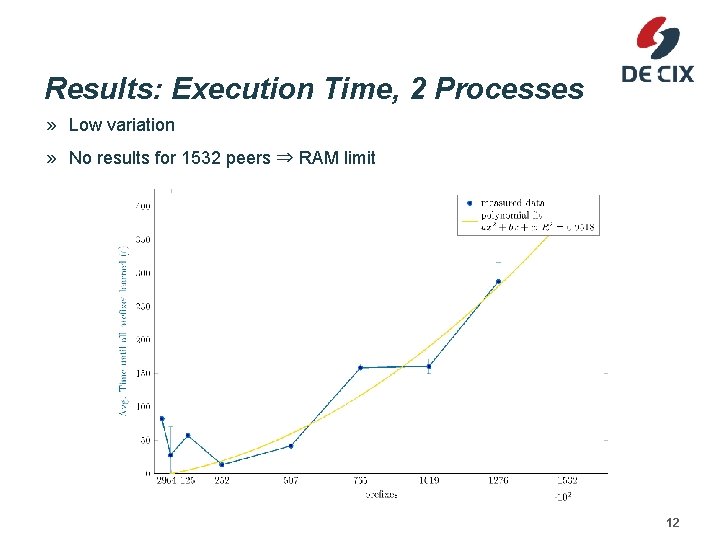
Results: Execution Time, 2 Processes » Low variation » No results for 1532 peers ⇒ RAM limit 12
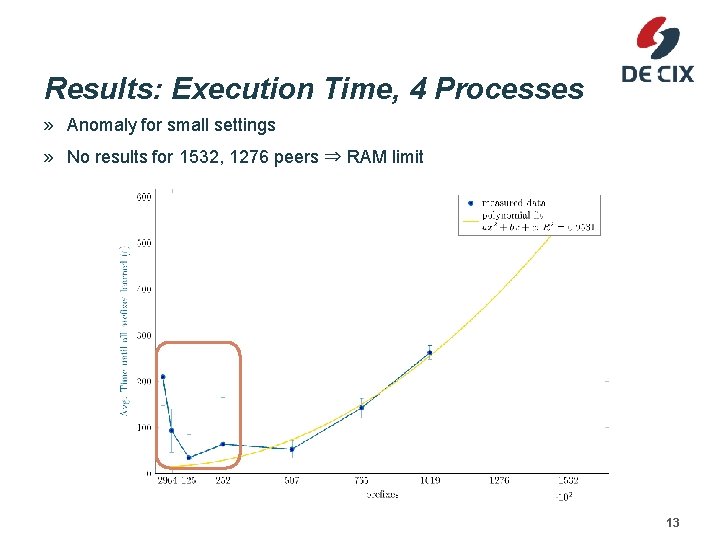
Results: Execution Time, 4 Processes » Anomaly for small settings » No results for 1532, 1276 peers ⇒ RAM limit 13
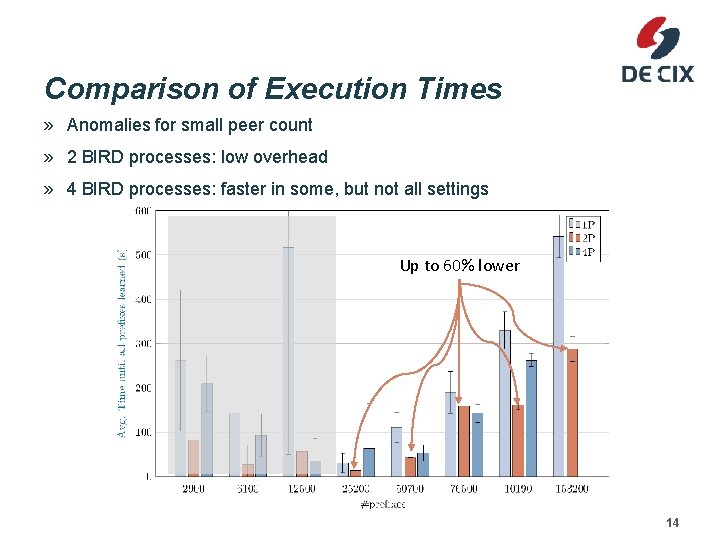
Comparison of Execution Times » Anomalies for small peer count » 2 BIRD processes: low overhead » 4 BIRD processes: faster in some, but not all settings Up to 60% lower 14
Summary and Outlook » Multi-process setup improves response to high load » Increased ressource usage: » Moderate increase in Memory (2 processes) » Memory usage doubles (4 processes) » Speedup is partly egalised by overhead » Replication of Master Table » Internal Communication: TCP over loopback interface (use Sockets) » Possible improvements » Simple multi-threading in BIRD » Use of “realistic” peers » Investigate cause for “waiting“ BIRD processes (System CPU? ) » Use a separate (physical) host for load generation (Tester) » Check overhead with 8 BIRD processes 15

Questions & Answers Talk to us! rnd@de-cix. net Benedikt Rudolph, Sebastian Abt DE-CIX Research and Development
- Slides: 16