
Scaleup and micro reactors Bench scale achieved desired
Scale-up and micro reactors
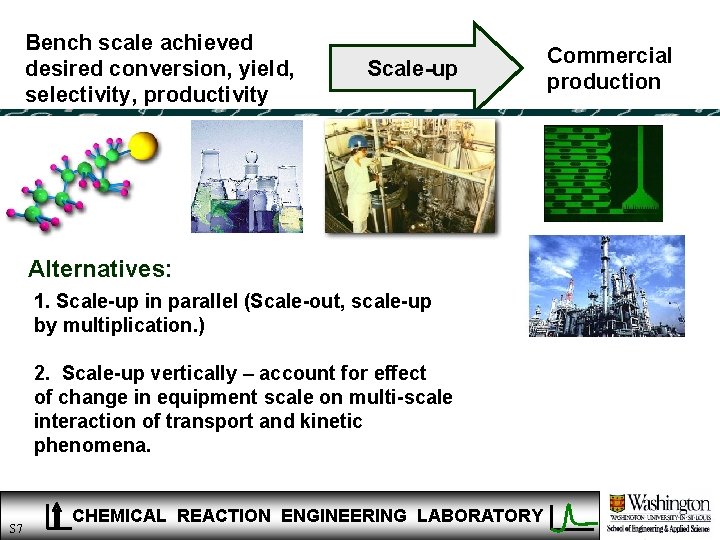
Bench scale achieved desired conversion, yield, selectivity, productivity Scale-up Alternatives: 1. Scale-up in parallel (Scale-out, scale-up by multiplication. ) 2. Scale-up vertically – account for effect of change in equipment scale on multi-scale interaction of transport and kinetic phenomena. S 2 S 7 CHEMICAL REACTION ENGINEERING LABORATORY Commercial production
SOME KEY SCALE-UP REQUIREMENTS • Match mean residence time or mean contact time • Match [or account for the change in] dimensionless variance of residence ( contact) times • Match [or account for change in] covariance of sojourn times in different environments (phases) of the system • Match heat transfer per unit volume, or account for the change with change in scale of equipment

Direct Scale-up of Tubular and Packed Bed Wall. Cooled Reactors: Scale-up by Multiplication Single tube of diameter dt and length L at given feed conditions (Po, To, Co) and given feed rate Q (l/h), produces the desired product at the rate of (mol P/h) and the desired selectivity. S Identical tubes of diameter dt and length L produce then the commercial production rate Fp. C (S = Fp. C ( ), using identical feed conditions and flow rate, at the desired selectivity. Possible Problems: - External heat transfer coefficient - Flow manifold for flow distribution SAME PRINCIPLE USED IN MICROREACTORS

Advantages of Micro reactors ●High surface-to-volume area; enhanced mass and heat transfer; ●high volumetric productivity; ●Laminar flow conditions; low pressure drop • Residence time distribution and extent of back mixing controlled • Low manufacturing, operating, and maintenance costs, and low power consumption • Minimal environmental hazards and increased safety due to small volume • “Scaling-out” or “numbering-up” instead of scaling-up S 2 S 9 CHEMICAL REACTION ENGINEERING LABORATORY

Multiphase Flows in m. Fluidic Systems • • Multiphase flows are important – Reactions – oxidation, hydrogenation, fluorination, … – Materials synthesis – crystallization, nanoparticles, colloids, … – Separation – extraction, gas-liquid separation, …. Performance = f(understanding and ability to manipulate) liquid-solid immiscible liquid-liquid gas-liquid S 10 gas-liquid-solid Klavs Jensen’s group at MIT

Scaling Out Micro reactors Single channel 10 Multi-channel design • Scale-out mg g ton Slug 1 churn bubbly j. L (m/s) Flow regimes, • Interfacial area • Mass transfer slug wavy annular 0. 1 0. 01 m Heatexchangers annular Annular 0. 001 m. Reactors 0. 1 1 10 j G (m/s) 100 • Uniform flow distribution and nature of contacting pattern • Methods for design of multi-phase reactors • Integrated sensors for gas-liquid flows N. de Mas, et al. , Ind. Eng. Chem Research, 42(4); 698 -710 (2003)
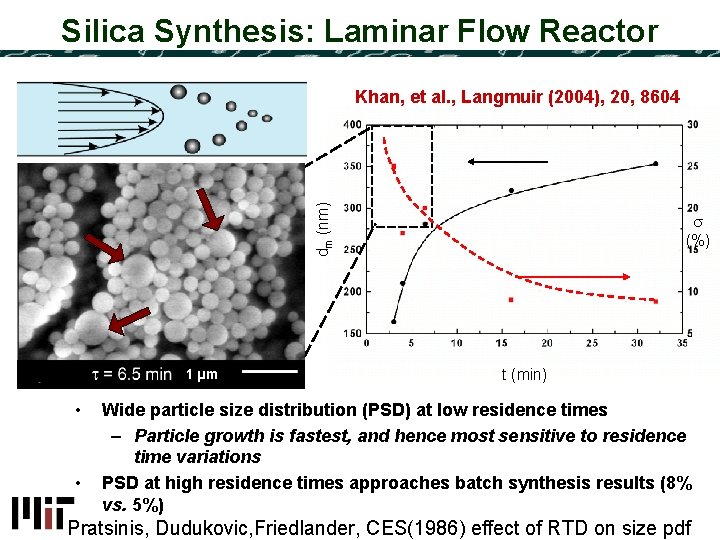
Silica Synthesis: Laminar Flow Reactor dm (nm) Khan, et al. , Langmuir (2004), 20, 8604 1 µm • • (%) t (min) Wide particle size distribution (PSD) at low residence times – Particle growth is fastest, and hence most sensitive to residence time variations PSD at high residence times approaches batch synthesis results (8% vs. 5%) Pratsinis, Dudukovic, Friedlander, CES(1986) effect of RTD on size pdf
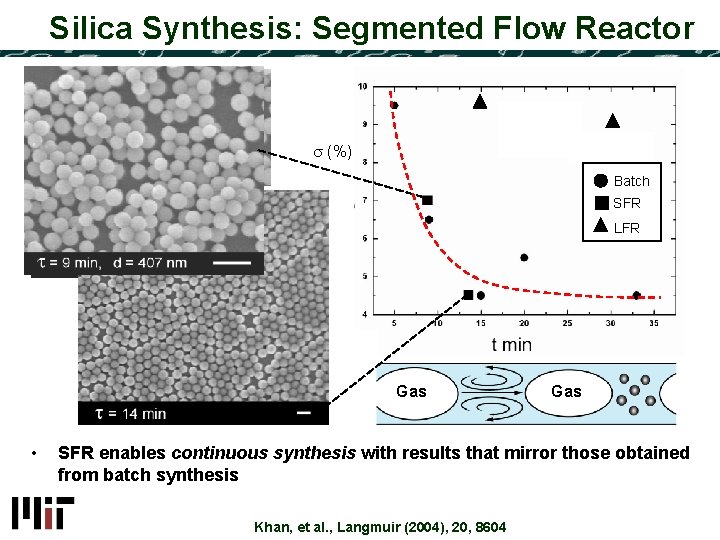
Silica Synthesis: Segmented Flow Reactor (%) Batch SFR LFR Gas 1 µm • SFR enables continuous synthesis with results that mirror those obtained from batch synthesis Khan, et al. , Langmuir (2004), 20, 8604
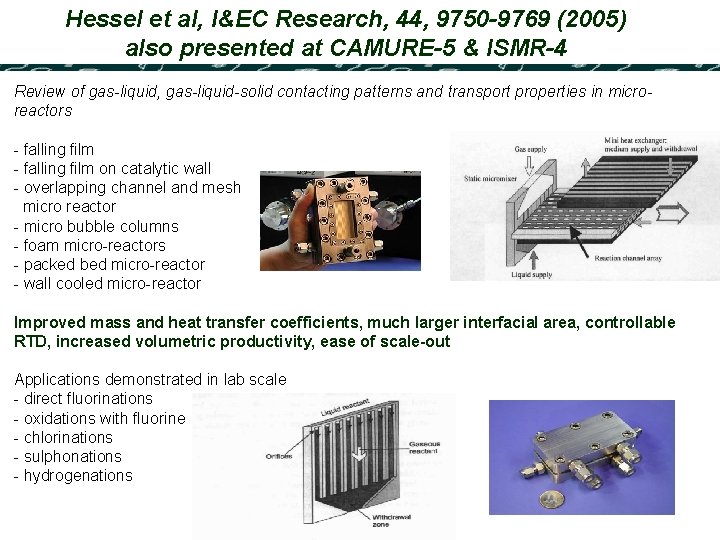
Hessel et al, I&EC Research, 44, 9750 -9769 (2005) also presented at CAMURE-5 & ISMR-4 Review of gas-liquid, gas-liquid-solid contacting patterns and transport properties in microreactors - falling film on catalytic wall - overlapping channel and mesh micro reactor - micro bubble columns - foam micro-reactors - packed bed micro-reactor - wall cooled micro-reactor Improved mass and heat transfer coefficients, much larger interfacial area, controllable RTD, increased volumetric productivity, ease of scale-out Applications demonstrated in lab scale - direct fluorinations - oxidations with fluorine - chlorinations - sulphonations - hydrogenations
Disadvantages of Micro Reactors: • Short residence times require fast reactions • Fast reactions require very active catalysts that are stable (The two most often do not go together) • Catalyst deactivation and frequent reactor repacking or reactivation • Fouling and clogging of channels • Leaks between channels • Malfunctioning of distributors • Reliability for long time on stream Challenge of overcoming inertia of the industry to embrace new technology for old processes Most likely implementation of micro-reactors in the near term: • Consumer products • Distributed small power systems • Healthcare • In situ preparation of hazardous and explosive chemicals
- Slides: 11