
Scalesofofproduction One off production These products are expensive
- Slides: 13
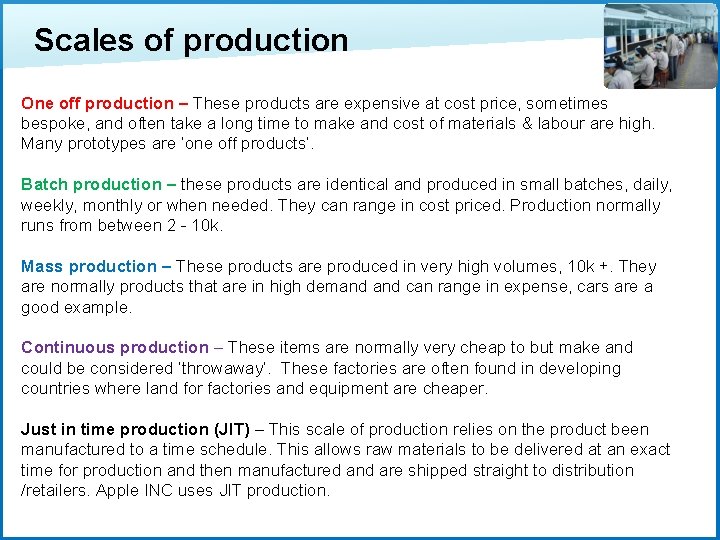
Scalesofofproduction One off production – These products are expensive at cost price, sometimes bespoke, and often take a long time to make and cost of materials & labour are high. Many prototypes are ‘one off products’. Batch production – these products are identical and produced in small batches, daily, weekly, monthly or when needed. They can range in cost priced. Production normally runs from between 2 - 10 k. Mass production – These products are produced in very high volumes, 10 k +. They are normally products that are in high demand can range in expense, cars are a good example. Continuous production – These items are normally very cheap to but make and could be considered ‘throwaway’. These factories are often found in developing countries where land for factories and equipment are cheaper. Just in time production (JIT) – This scale of production relies on the product been manufactured to a time schedule. This allows raw materials to be delivered at an exact time for production and then manufactured and are shipped straight to distribution /retailers. Apple INC uses JIT production.
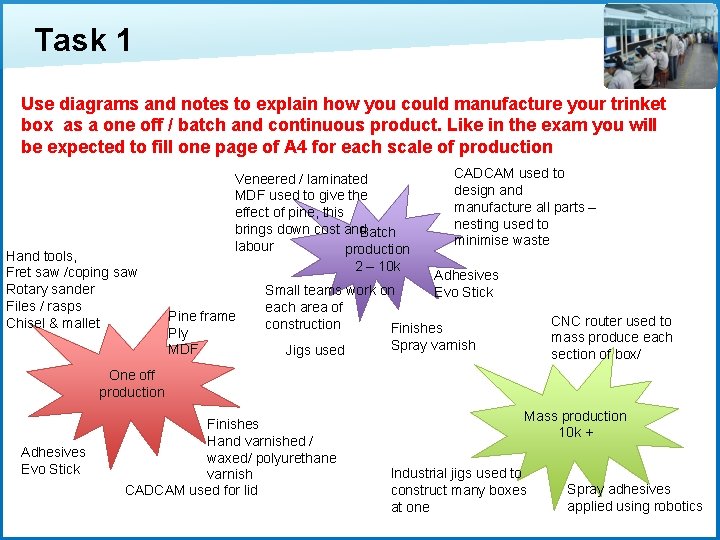
Scales Task 1 of production Use diagrams and notes to explain how you could manufacture your trinket box as a one off / batch and continuous product. Like in the exam you will be expected to fill one page of A 4 for each scale of production Hand tools, Fret saw /coping saw Rotary sander Files / rasps Chisel & mallet Veneered / laminated MDF used to give the effect of pine, this brings down cost and Batch labour production 2 – 10 k Pine frame Ply MDF CADCAM used to design and manufacture all parts – nesting used to minimise waste Adhesives Small teams work on Evo Stick each area of construction Finishes Spray varnish Jigs used CNC router used to mass produce each section of box/ One off production Adhesives Evo Stick Finishes Hand varnished / waxed/ polyurethane varnish CADCAM used for lid Mass production 10 k + Industrial jigs used to construct many boxes at one Spray adhesives applied using robotics
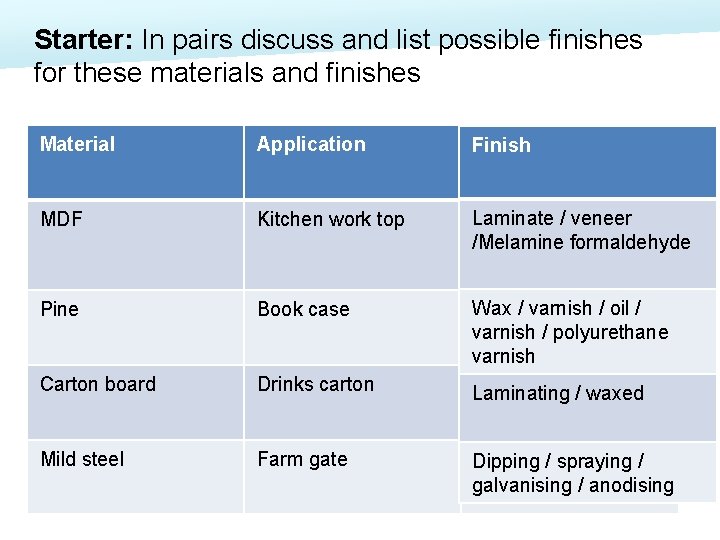
Starter: In pairs discuss and list possible finishes for these materials and finishes Material Application Finish MDF Kitchen work top Laminate / veneer /Melamine formaldehyde Pine Book case Wax / varnish / oil / varnish / polyurethane varnish Carton board Drinks carton Laminating / waxed Mild steel Farm gate Dipping / spraying / galvanising / anodising
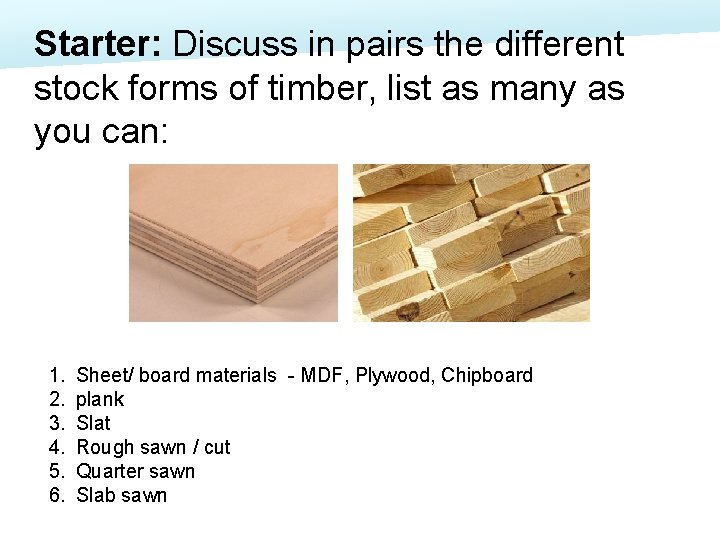
Starter: Discuss in pairs the different stock forms of timber, list as many as you can: 1. 2. 3. 4. 5. 6. Sheet/ board materials - MDF, Plywood, Chipboard plank Slat Rough sawn / cut Quarter sawn Slab sawn
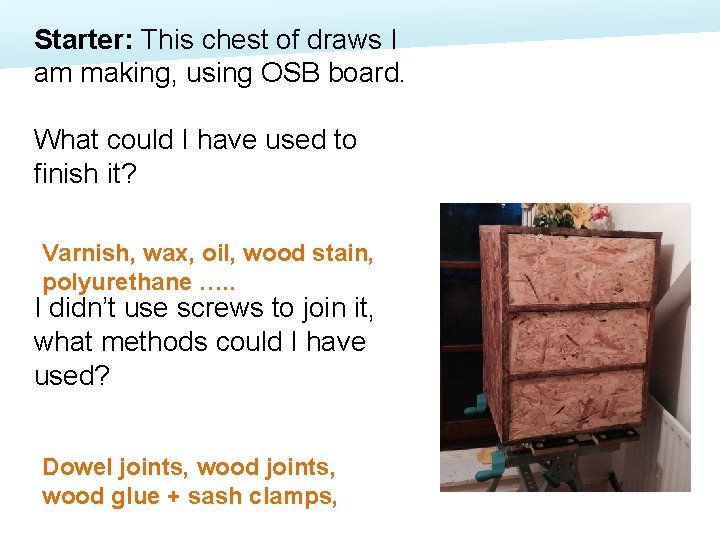
Starter: This chest of draws I am making, using OSB board. What could I have used to finish it? Varnish, wax, oil, wood stain, polyurethane …. . I didn’t use screws to join it, what methods could I have used? Dowel joints, wood glue + sash clamps,
AQA session feedback Start with section C, 40 mark section, as it is generally the most time consuming and you will be fresh and ready for the question. Advised by lead examiner. In some questions getting the first answer wrong means you can lose many marks on the following questions, read questions carefully. Do not use the word ‘cheap’, unless you back it up with a comparison in price to another material. There will be Health and Safety questions. Always make a point, about the material, and then explain the property. On the design question , in section C, you must keep the original idea and modify it.
AQA session feedback You must be able to write a step by step for each manufacturing process, i. e. injection moulding / press forming/ piercing and blanking In sections where they ask you to use diagrams they suggest that you use diagrams over text, as more marks are given because candidates can generally draw their ideas better than explaining them using text. Metals are generally candidates weakest area across the country. Candidates generally preform better in plastics and woods. Ensure you have covered compliant materials in revision, graphics materials. do not use the word cheap, use inexpensive.
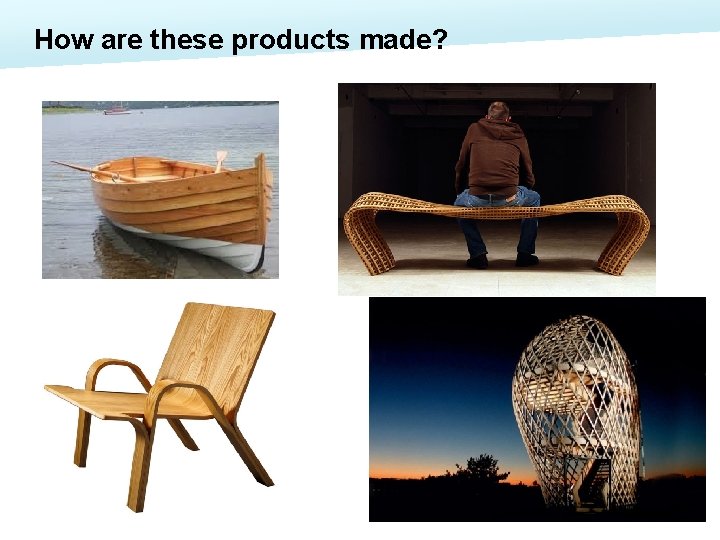
How are these products made?
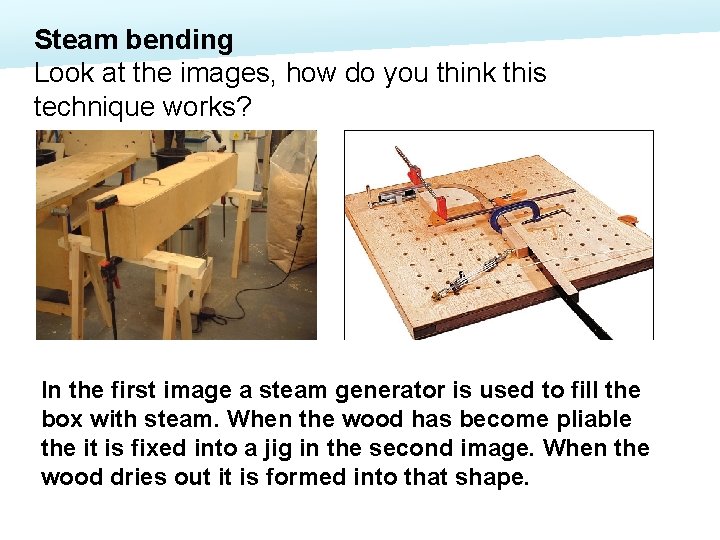
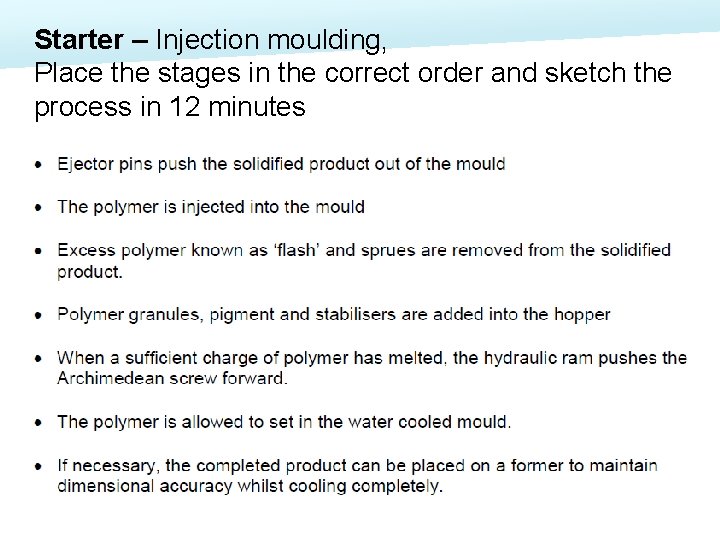
Steam bending Look at the images, how do you think this technique works? In the first image a steam generator is used to fill the box with steam. When the wood has become pliable the it is fixed into a jig in the second image. When the wood dries out it is formed into that shape.
Starter – Injection moulding, Place the stages in the correct order and sketch the process in 12 minutes
Injection moulding process Keywords Hopper Heaters Archimedian screw Hydralic ram Motor Mould flash No. Injection moulding process Ejector pins push the solidified product out of the mould The polymer is injected into the mould Excess polymer known as ‘flash’ and sprues are removed from the solidified product. Polymer granules, pigment and stabilisers are added into the hopper When a sufficient charge of polymer has melted, the hydraulic ram pushes the Archimedean screw forward. The polymer is allowed to set in the water cooled mould. If necessary, the completed product can be placed on a former to maintain dimensional accuracy whilst cooling completely.
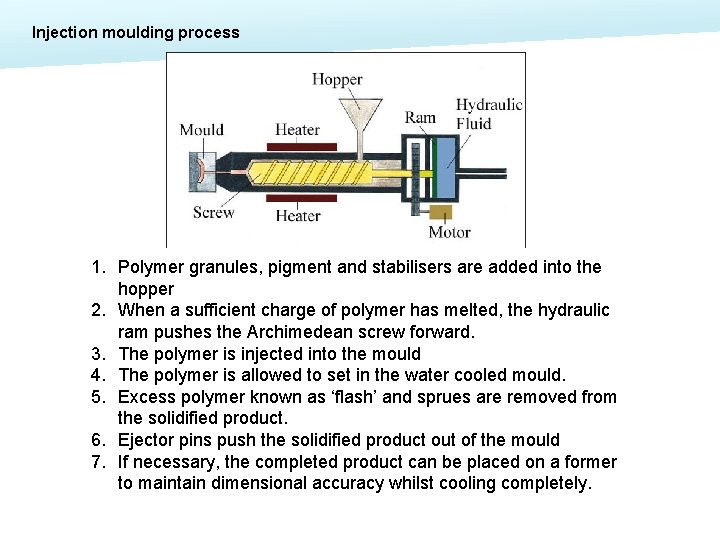
Injection moulding process 1. Polymer granules, pigment and stabilisers are added into the hopper 2. When a sufficient charge of polymer has melted, the hydraulic ram pushes the Archimedean screw forward. 3. The polymer is injected into the mould 4. The polymer is allowed to set in the water cooled mould. 5. Excess polymer known as ‘flash’ and sprues are removed from the solidified product. 6. Ejector pins push the solidified product out of the mould 7. If necessary, the completed product can be placed on a former to maintain dimensional accuracy whilst cooling completely.
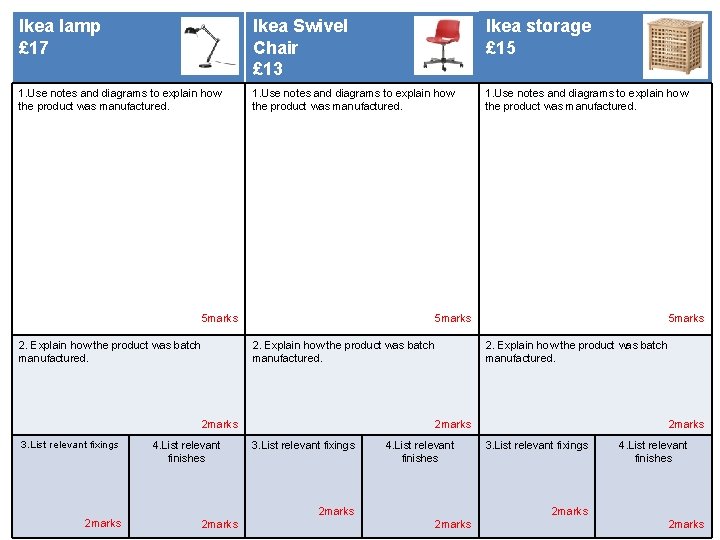
Ikea lamp £ 17 Ikea Swivel Chair £ 13 Ikea storage £ 15 1. Use notes and diagrams to explain how the product was manufactured. 5 marks 2. Explain how the product was batch manufactured. 2 marks 3. List relevant fixings 4. List relevant finishes 2 marks 5 marks 2 marks 3. List relevant fixings 4. List relevant finishes 2 marks