
Scalefree networks Pter Kmr Statistical physics seminar 07102008
- Slides: 27
Scale-free networks Péter Kómár Statistical physics seminar 07/10/2008
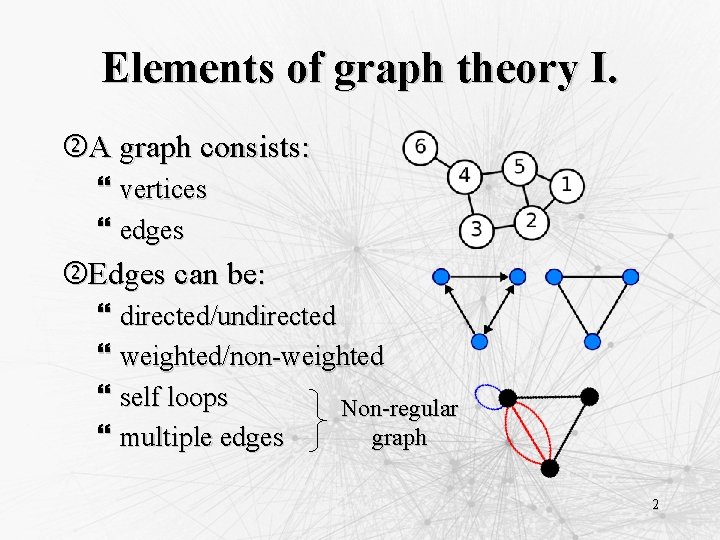
Elements of graph theory I. A graph consists: } vertices } edges Edges can be: } directed/undirected } weighted/non-weighted } self loops Non-regular graph } multiple edges 2
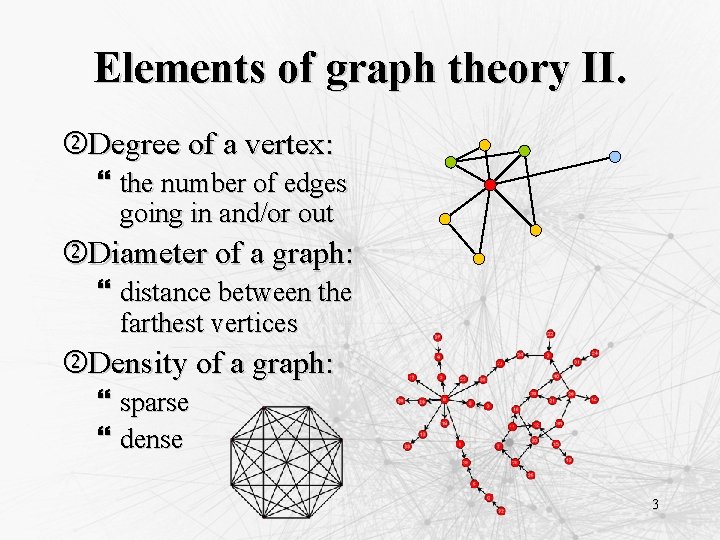
Elements of graph theory II. Degree of a vertex: } the number of edges going in and/or out Diameter of a graph: } distance between the farthest vertices Density of a graph: } sparse } dense 3
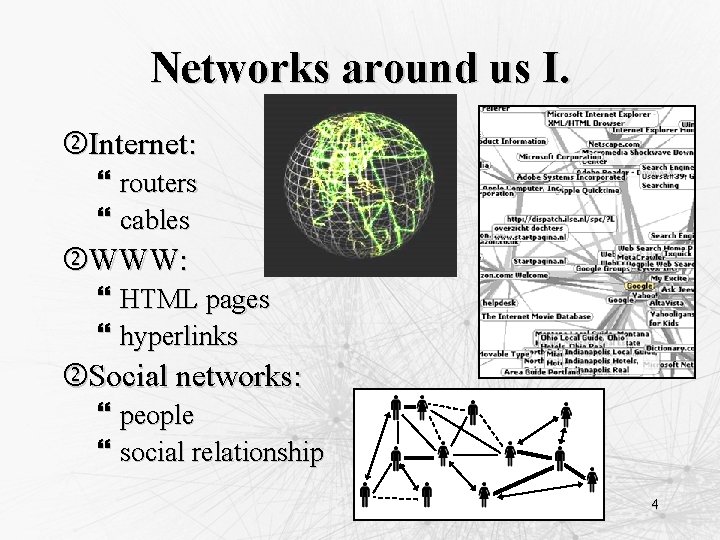
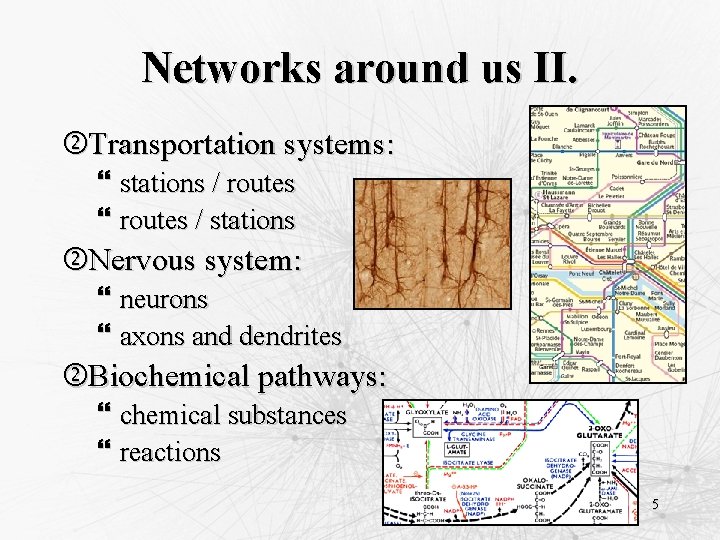
Networks around us I. Internet: } routers } cables WWW: } HTML pages } hyperlinks Social networks: } people } social relationship 4
Networks around us II. Transportation systems: } stations / routes } routes / stations Nervous system: } neurons } axons and dendrites Biochemical pathways: } chemical substances } reactions 5
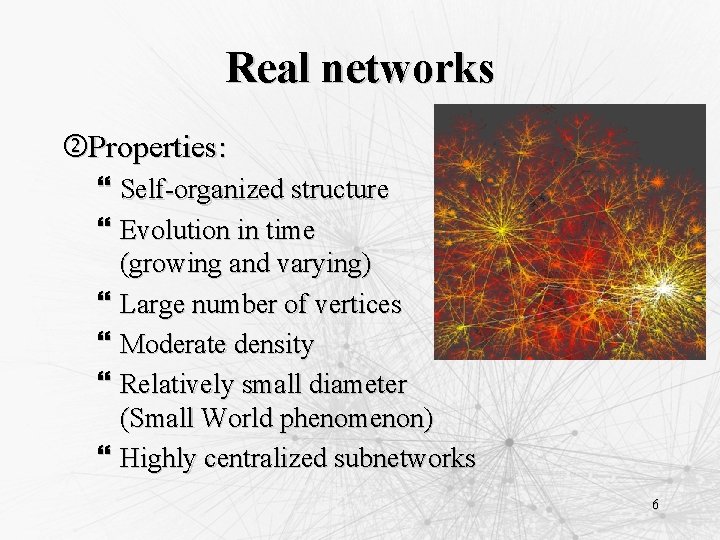
Real networks Properties: } Self-organized structure } Evolution in time (growing and varying) } Large number of vertices } Moderate density } Relatively small diameter (Small World phenomenon) } Highly centralized subnetworks 6
Random networks Measuring real networks: } Relevant state-parameters } Evolution in time Creating models: } Analytical formulas } Growing phenomenon Checking: } ‘Raising’ random networks } Measuring 7
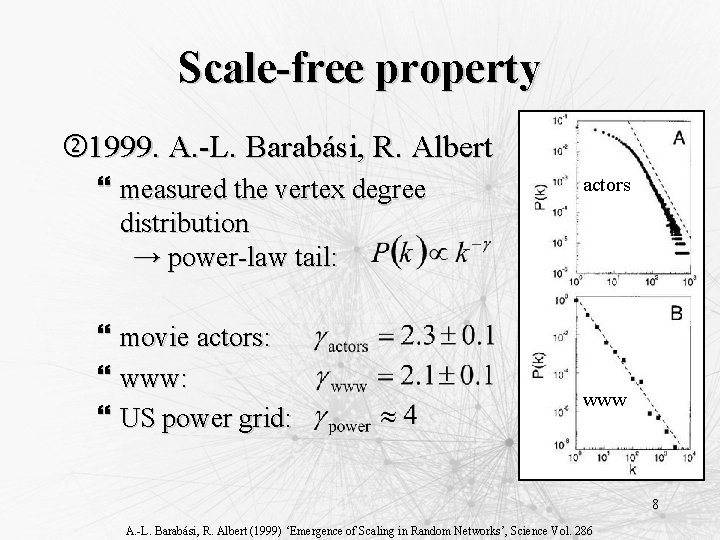
Scale-free property 1999. A. -L. Barabási, R. Albert } measured the vertex degree distribution → power-law tail: } movie actors: } www: } US power grid: actors www 8 A. -L. Barabási, R. Albert (1999) ‘Emergence of Scaling in Random Networks’, Science Vol. 286
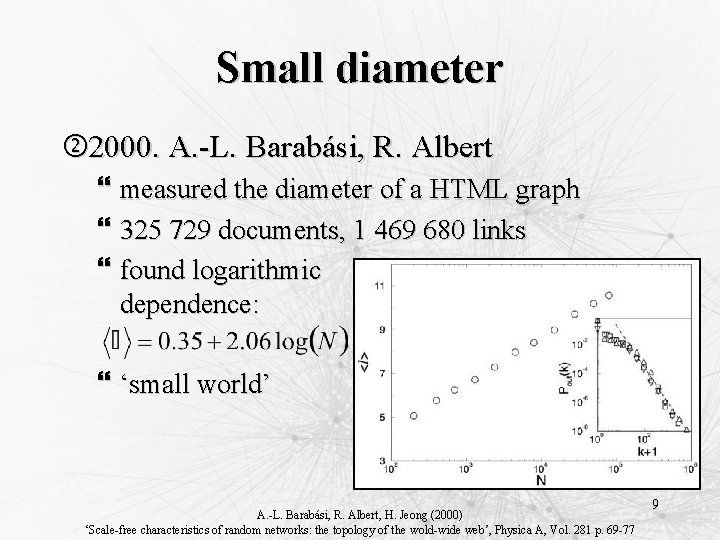
Small diameter 2000. A. -L. Barabási, R. Albert } measured the diameter of a HTML graph } 325 729 documents, 1 469 680 links } found logarithmic dependence: } ‘small world’ A. -L. Barabási, R. Albert, H. Jeong (2000) ‘Scale-free characteristics of random networks: the topology of the wold-wide web’, Physica A, Vol. 281 p. 69 -77 9
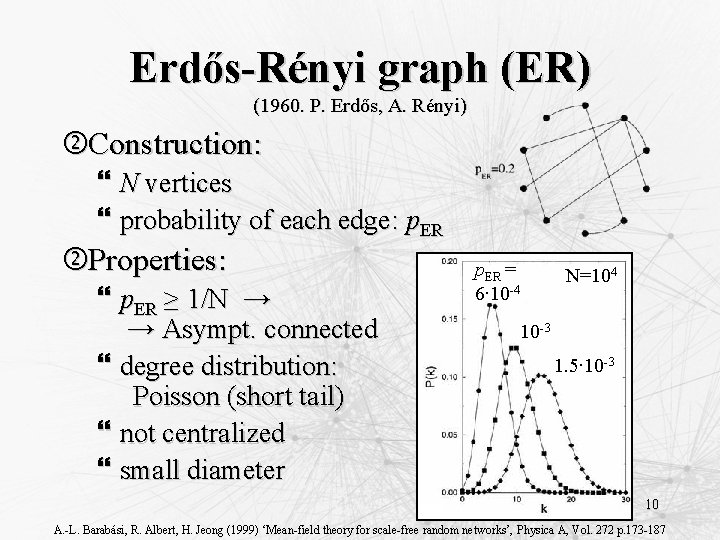
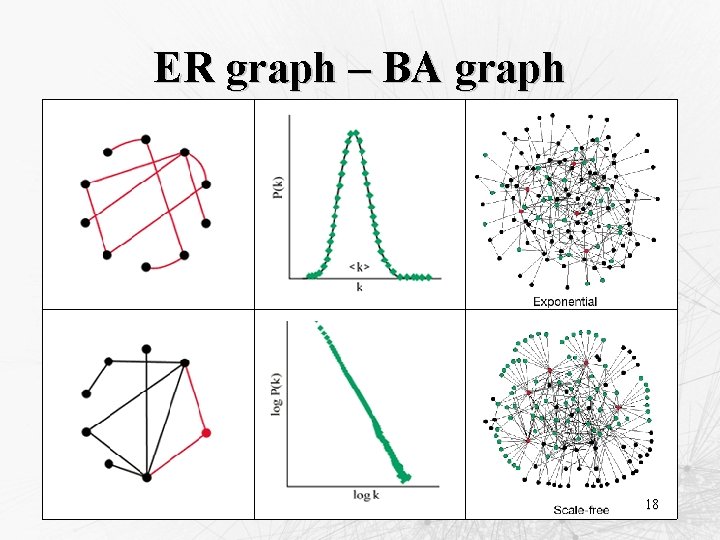
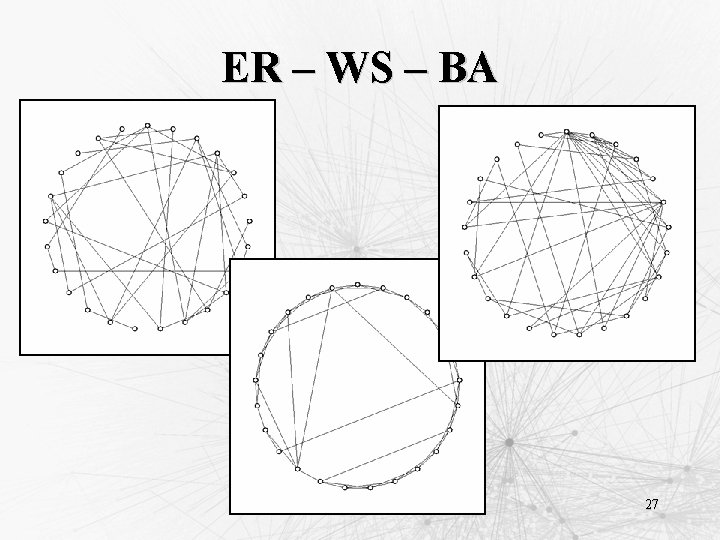
Erdős-Rényi graph (ER) (1960. P. Erdős, A. Rényi) Construction: } N vertices } probability of each edge: p. ER Properties: } p. ER ≥ 1/N → → Asympt. connected } degree distribution: Poisson (short tail) } not centralized } small diameter p. ER = 6∙ 10 -4 N=104 10 -3 1. 5∙ 10 -3 10 A. -L. Barabási, R. Albert, H. Jeong (1999) ‘Mean-field theory for scale-free random networks’, Physica A, Vol. 272 p. 173 -187
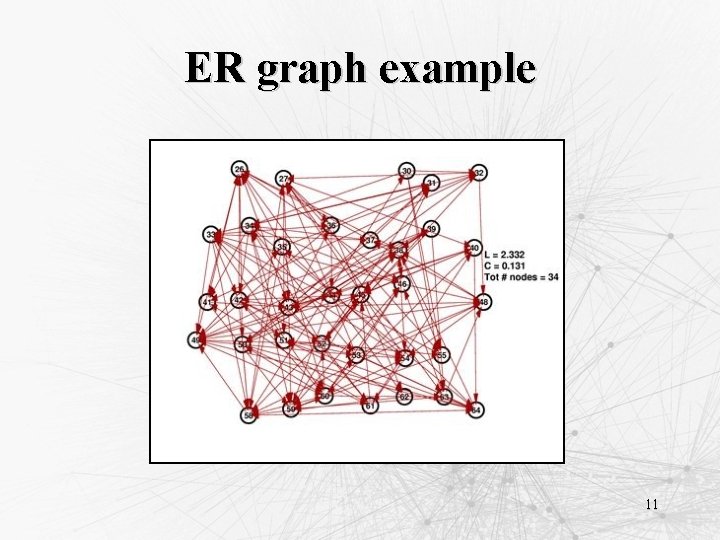
ER graph example 11
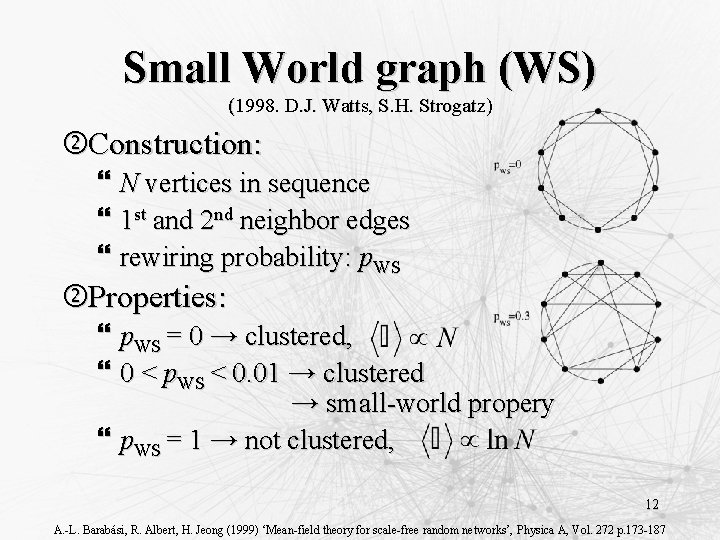
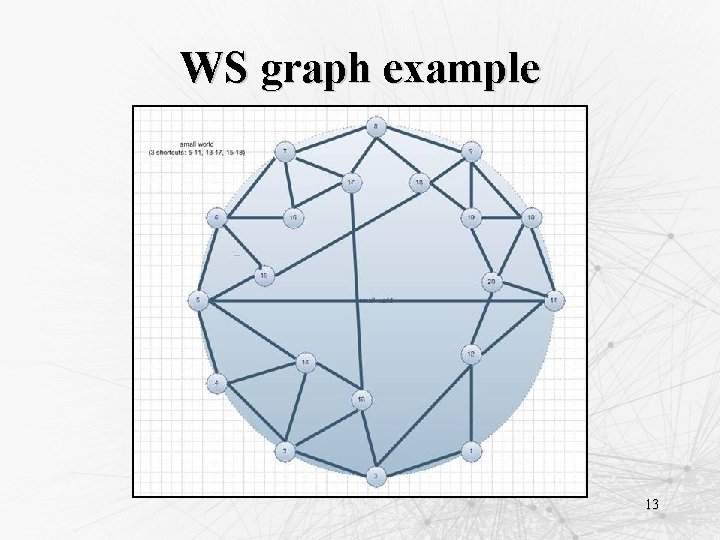
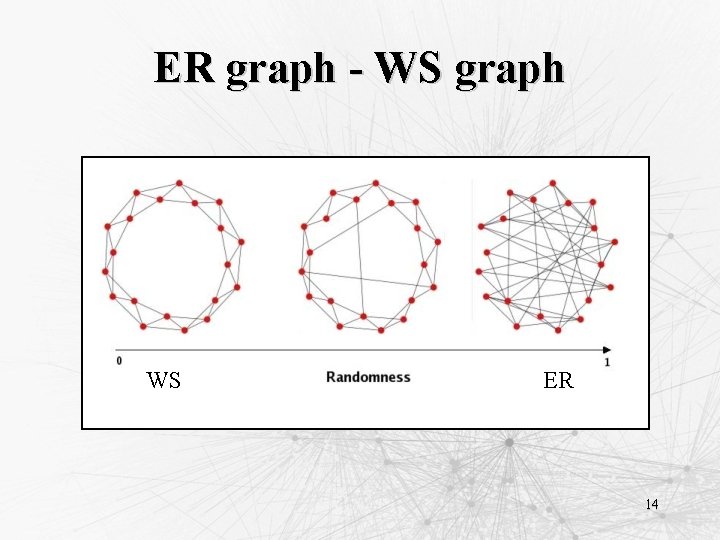
Small World graph (WS) (1998. D. J. Watts, S. H. Strogatz) Construction: } N vertices in sequence } 1 st and 2 nd neighbor edges } rewiring probability: p. WS Properties: } p. WS = 0 → clustered, } 0 < p. WS < 0. 01 → clustered → small-world propery } p. WS = 1 → not clustered, 12 A. -L. Barabási, R. Albert, H. Jeong (1999) ‘Mean-field theory for scale-free random networks’, Physica A, Vol. 272 p. 173 -187
WS graph example 13
ER graph - WS graph WS ER 14
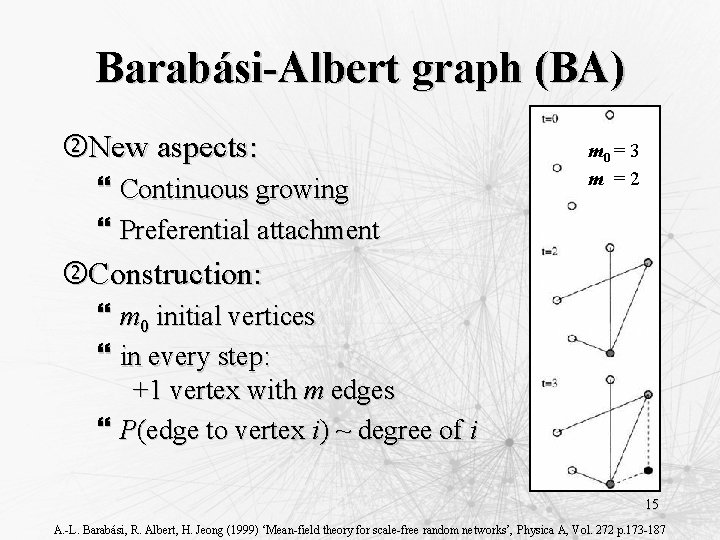
Barabási-Albert graph (BA) New aspects: } Continuous growing } Preferential attachment m 0 = 3 m =2 Construction: } m 0 initial vertices } in every step: +1 vertex with m edges } P(edge to vertex i) ~ degree of i 15 A. -L. Barabási, R. Albert, H. Jeong (1999) ‘Mean-field theory for scale-free random networks’, Physica A, Vol. 272 p. 173 -187
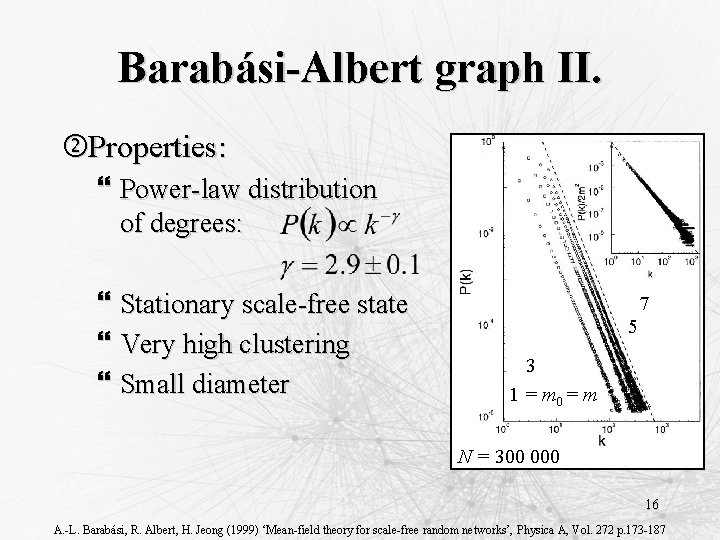
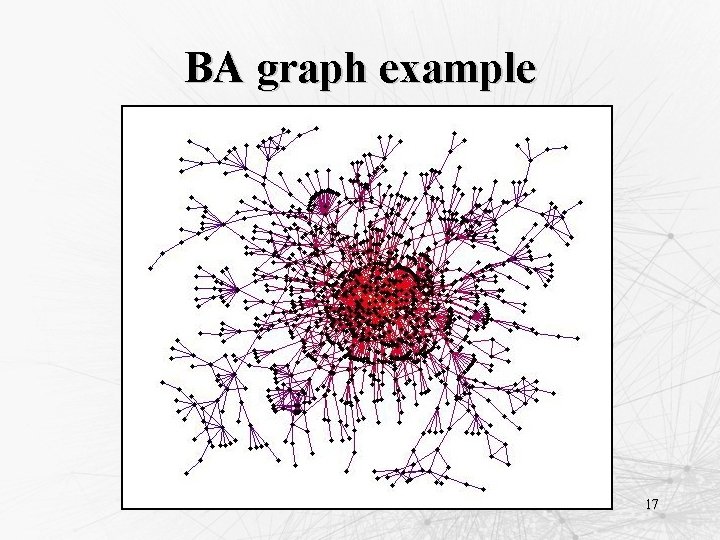
Barabási-Albert graph II. Properties: } Power-law distribution of degrees: } Stationary scale-free state } Very high clustering } Small diameter 7 5 3 1 = m 0 = m N = 300 000 16 A. -L. Barabási, R. Albert, H. Jeong (1999) ‘Mean-field theory for scale-free random networks’, Physica A, Vol. 272 p. 173 -187
BA graph example 17
ER graph – BA graph 18
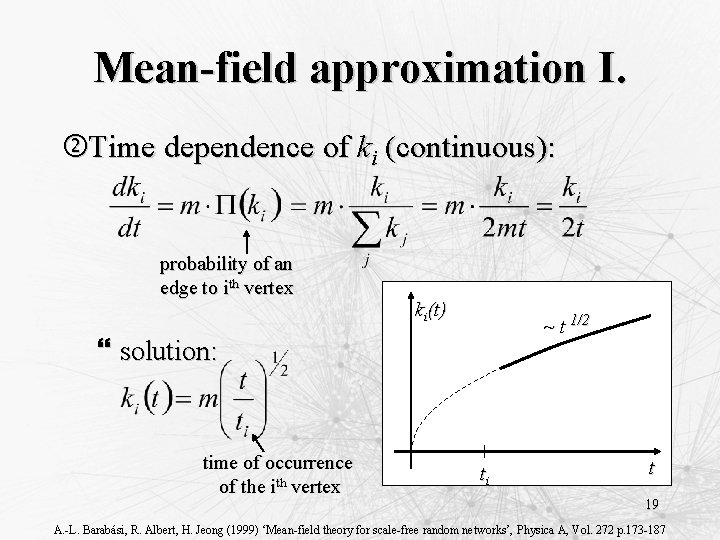
Mean-field approximation I. Time dependence of ki (continuous): probability of an edge to ith vertex ki(t) ~ t 1/2 } solution: time of occurrence of the ith vertex ti t 19 A. -L. Barabási, R. Albert, H. Jeong (1999) ‘Mean-field theory for scale-free random networks’, Physica A, Vol. 272 p. 173 -187
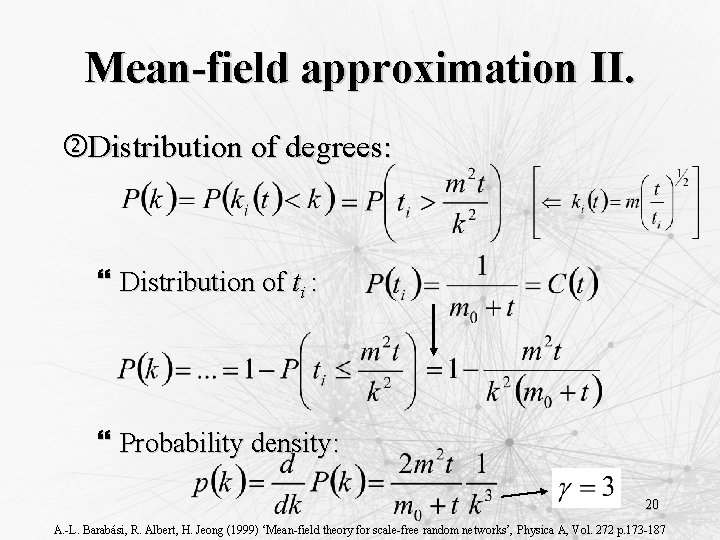
Mean-field approximation II. Distribution of degrees: } Distribution of ti : } Probability density: 20 A. -L. Barabási, R. Albert, H. Jeong (1999) ‘Mean-field theory for scale-free random networks’, Physica A, Vol. 272 p. 173 -187
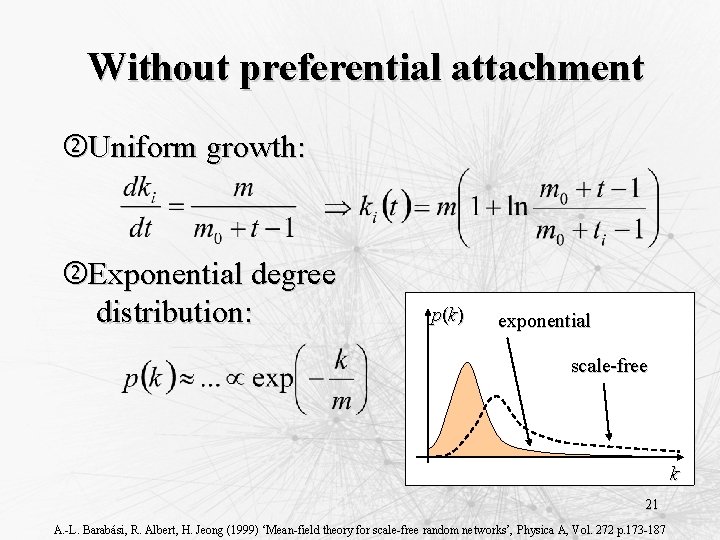
Without preferential attachment Uniform growth: Exponential degree distribution: p(k) exponential scale-free k 21 A. -L. Barabási, R. Albert, H. Jeong (1999) ‘Mean-field theory for scale-free random networks’, Physica A, Vol. 272 p. 173 -187
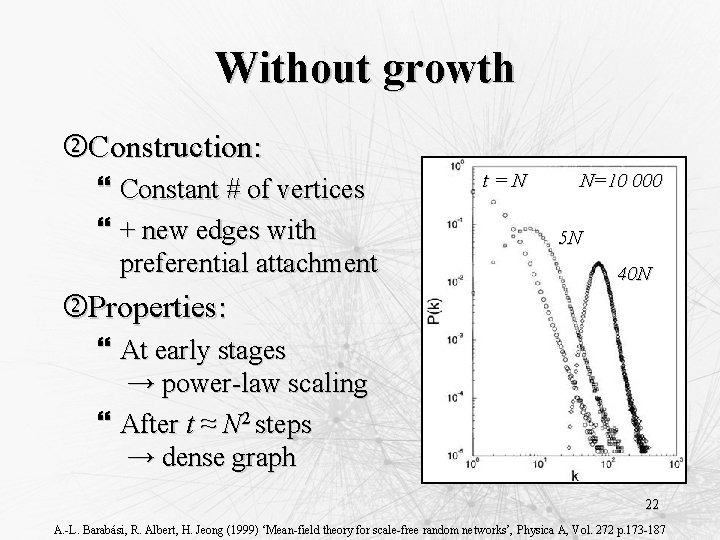
Without growth Construction: } Constant # of vertices } + new edges with preferential attachment t=N N=10 000 5 N 40 N Properties: } At early stages → power-law scaling } After t ≈ N 2 steps → dense graph 22 A. -L. Barabási, R. Albert, H. Jeong (1999) ‘Mean-field theory for scale-free random networks’, Physica A, Vol. 272 p. 173 -187
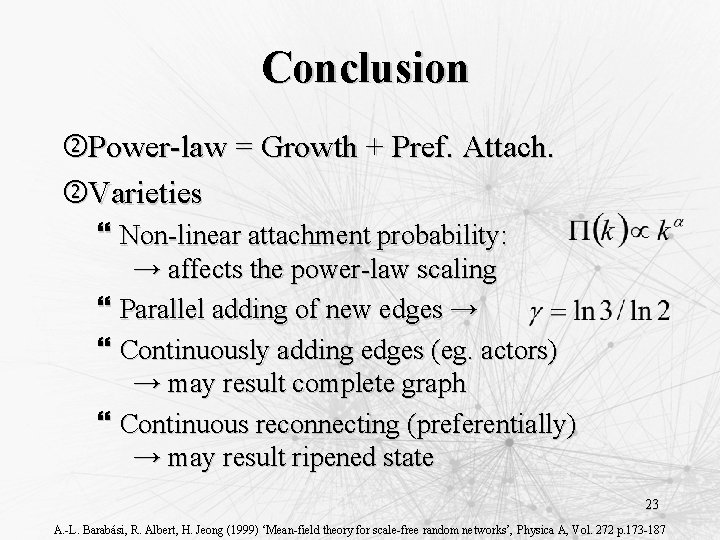
Conclusion Power-law = Growth + Pref. Attach. Varieties } Non-linear attachment probability: → affects the power-law scaling } Parallel adding of new edges → } Continuously adding edges (eg. actors) → may result complete graph } Continuous reconnecting (preferentially) → may result ripened state 23 A. -L. Barabási, R. Albert, H. Jeong (1999) ‘Mean-field theory for scale-free random networks’, Physica A, Vol. 272 p. 173 -187
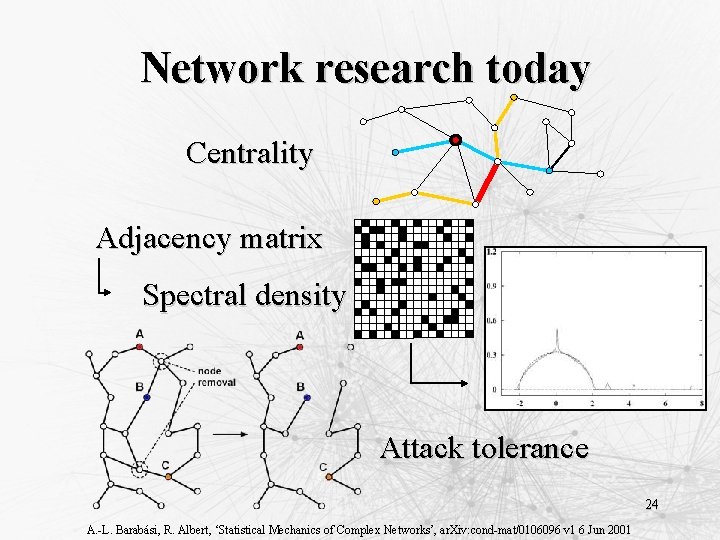
Network research today Centrality Adjacency matrix Spectral density Attack tolerance 24 A. -L. Barabási, R. Albert, ‘Statistical Mechanics of Complex Networks’, ar. Xiv: cond-mat/0106096 v 1 6 Jun 2001
Thank you for the attention!
26
ER – WS – BA 27