
Scalable Parallel Computer Architectures What is Cluster What
Scalable Parallel Computer Architectures • • What is Cluster? What is cluster computing? Components of Cluster Computers Cluster classification Cluster Computer Architecture Benefits of Clustering Comparison of Clusters with MPP and Distributed Systems
Clusters • Poor’s man supercomputer “…Collection of interconnected stand-alone computers working together as a single, integrated computing resource”–R. Buyya • Cluster consists of: – Nodes – Network – OS – Cluster middleware • Standard components – Avoiding expensive proprietary components

What is cluster computing? • A computer cluster is a group of linked computers, working together closely so that in many respects they form a single computer. The components of a cluster are commonly, but not always, connected to each other through fast local area networks. Clusters are usually deployed to improve performance and/or availability over that provided by a single computer, while typically being much more cost-effective than single computers of comparable speed or availability. Cluster consists of: Ø Nodes(master+computing) Ø Network Ø OS Ø Cluster middleware: Middleware such as MPI which permits compute clustering programs to be portable to a wide variety of clusters APP APP … High Speed Local Network CPU … Cluster CPU

Prominent Components of Cluster Computers • Multiple High Performance Computers – PCs – Workstations – SMPs (CLUMPS) – Distributed HPC Systems leading to Metacomputing
Cluster classification • High performance clusters (HPC) – Parallel, tightly coupled applications • High throughput clusters (HTC) – Large number of independent tasks • High availability clusters (HA) – Mission critical applications • Load balancing clusters – Web servers, mail servers, … • Hybrid clusters – Example: HPC+HA
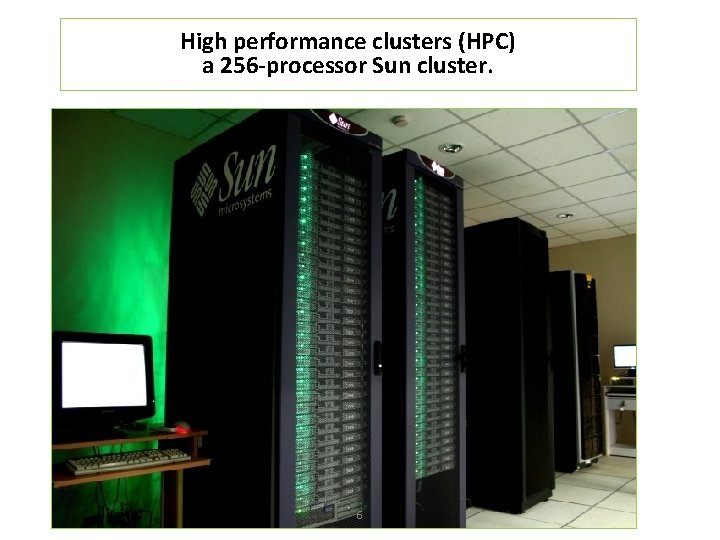
High performance clusters (HPC) a 256 -processor Sun cluster. 6
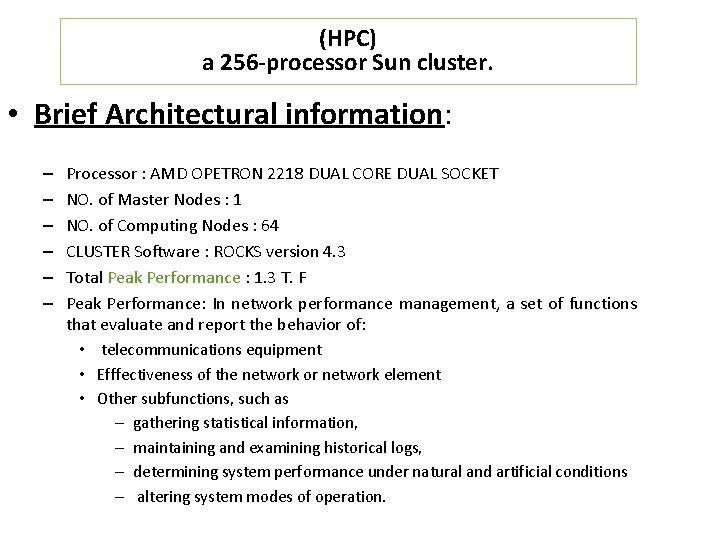
(HPC) a 256 -processor Sun cluster. • Brief Architectural information: – – – Processor : AMD OPETRON 2218 DUAL CORE DUAL SOCKET NO. of Master Nodes : 1 NO. of Computing Nodes : 64 CLUSTER Software : ROCKS version 4. 3 Total Peak Performance : 1. 3 T. F Peak Performance: In network performance management, a set of functions that evaluate and report the behavior of: • telecommunications equipment • Efffectiveness of the network or network element • Other subfunctions, such as – gathering statistical information, – maintaining and examining historical logs, – determining system performance under natural and artificial conditions – altering system modes of operation.
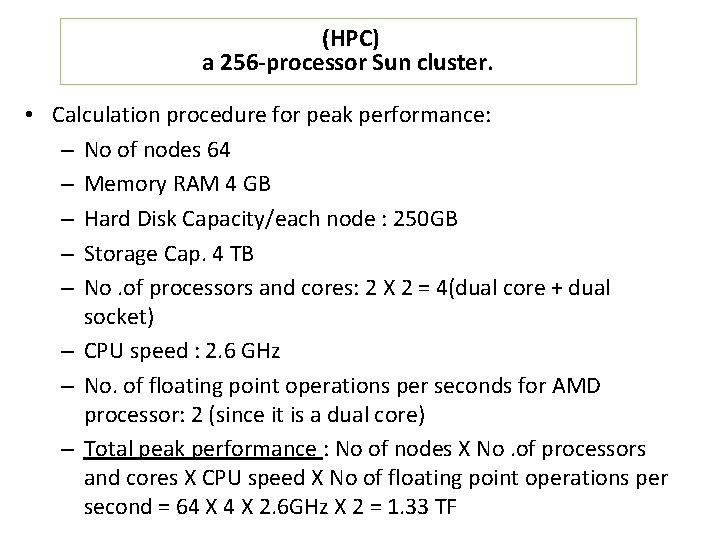
(HPC) a 256 -processor Sun cluster. • Calculation procedure for peak performance: – No of nodes 64 – Memory RAM 4 GB – Hard Disk Capacity/each node : 250 GB – Storage Cap. 4 TB – No. of processors and cores: 2 X 2 = 4(dual core + dual socket) – CPU speed : 2. 6 GHz – No. of floating point operations per seconds for AMD processor: 2 (since it is a dual core) – Total peak performance : No of nodes X No. of processors and cores X CPU speed X No of floating point operations per second = 64 X 2. 6 GHz X 2 = 1. 33 TF
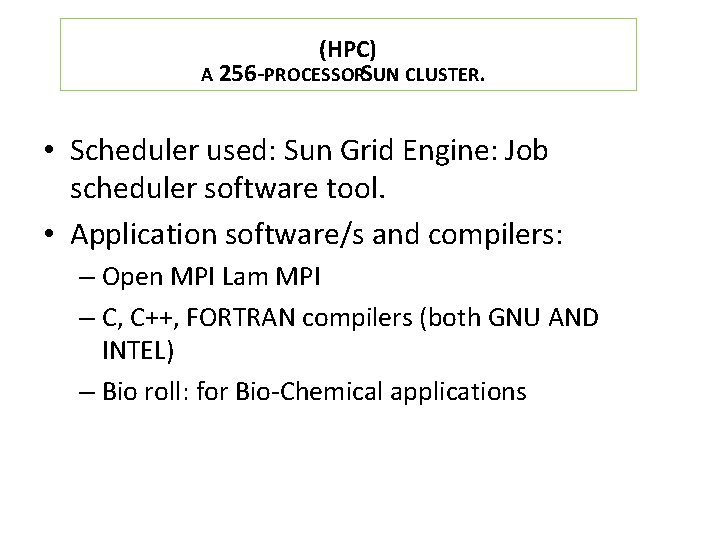
(HPC) A 256 -PROCESSORSUN CLUSTER. • Scheduler used: Sun Grid Engine: Job scheduler software tool. • Application software/s and compilers: – Open MPI Lam MPI – C, C++, FORTRAN compilers (both GNU AND INTEL) – Bio roll: for Bio-Chemical applications
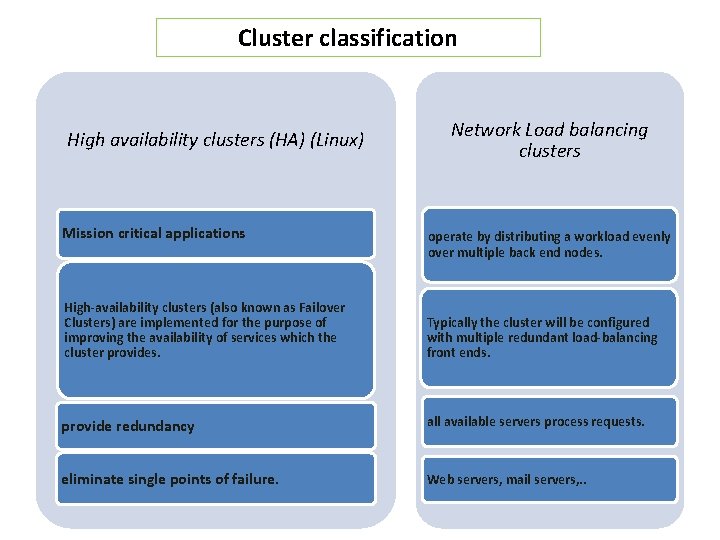
Cluster classification High availability clusters (HA) (Linux) Mission critical applications Network Load balancing clusters operate by distributing a workload evenly over multiple back end nodes. High-availability clusters (also known as Failover Clusters) are implemented for the purpose of improving the availability of services which the cluster provides. Typically the cluster will be configured with multiple redundant load-balancing front ends. provide redundancy all available servers process requests. eliminate single points of failure. Web servers, mail servers, . .
Cluster Computer and its Architecture • A cluster is a type of parallel or distributed processing system, which consists of a collection of interconnected stand-alone computers cooperatively working together as a single, integrated computing resource • A node – a single or multiprocessor system with memory, I/O facilities, & OS – generally 2 or more computers (nodes) connected together – in a single cabinet, or physically separated & connected via a LAN – appear as a single system to users and applications – provide a cost-effective way to gain features and benefits
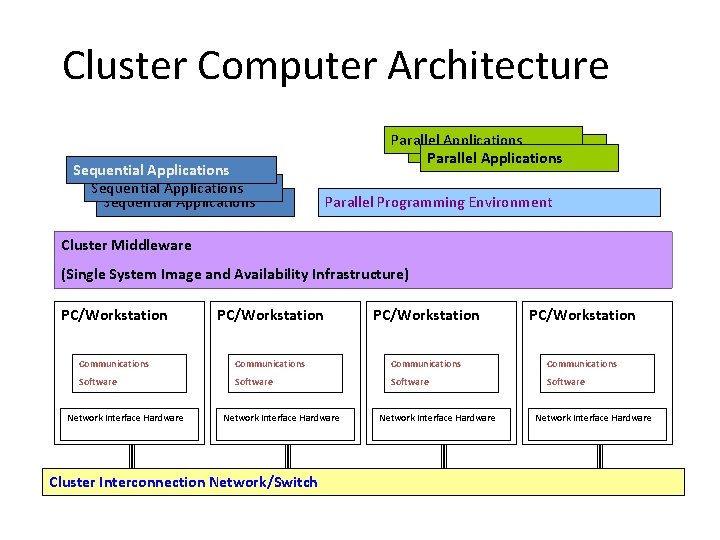
Cluster Computer Architecture Sequential Applications Parallel Applications Parallel Programming Environment Cluster Middleware (Single System Image and Availability Infrastructure) PC/Workstation Communications Software Network Interface Hardware Cluster Interconnection Network/Switch Network Interface Hardware
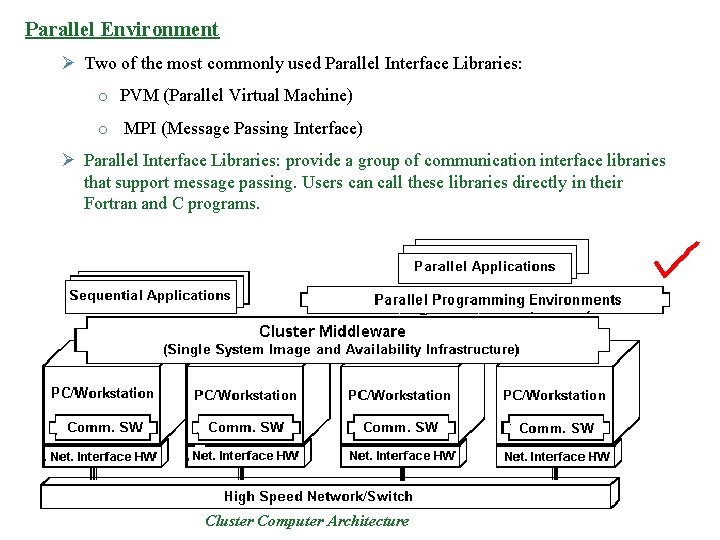
Parallel Environment Ø Two of the most commonly used Parallel Interface Libraries: o PVM (Parallel Virtual Machine) o MPI (Message Passing Interface) Ø Parallel Interface Libraries: provide a group of communication interface libraries that support message passing. Users can call these libraries directly in their Fortran and C programs. Cluster Computer Architecture
Key Operational Benefits of Clustering • • High Performance Expandability and Scalability High Throughput High Availability
Cluster Middleware & SSI • SSI – Supported by a middleware layer that resides between the OS and user-level environment – Middleware consists of essentially 2 sublayers of SW infrastructure • SSI infrastructure – Glue together OSs on all nodes to offer unified access to system resources • System availability infrastructure – Enable cluster services such as checkpointing, automatic failover, recovery from failure, & fault-tolerant support among all nodes of the cluster
Who Uses HPC ? • Scientific & Engineering Applications • Simulation of physical phenomena • Virtual Prototyping (Modeling) • Data analysis • Business/ Industry Applications • • • Data warehousing for financial sectors E-governance Medical Imaging Web servers, Search Engines, Digital libraries …etc …. . • All face similar problems • Not enough computational resources • Remote facilities – Network becomes the bottleneck • Heterogeneous and fast changing systems
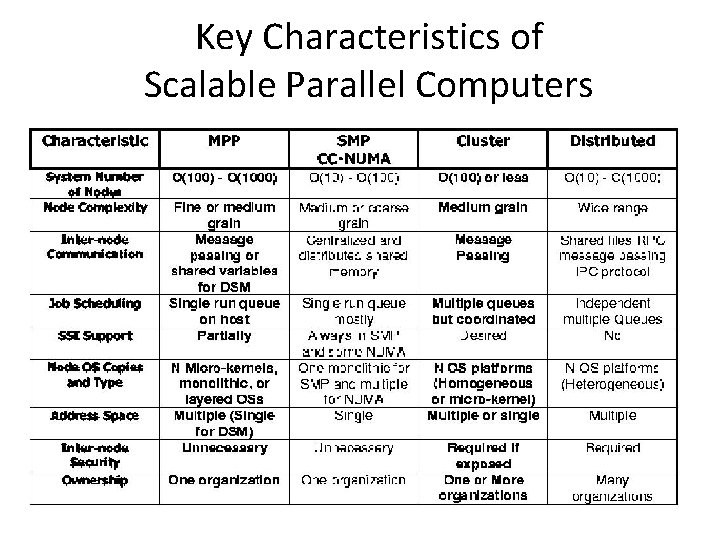
Key Characteristics of Scalable Parallel Computers
- Slides: 17