
Scalable Methods for the Analysis of NetworkBased Data
Scalable Methods for the Analysis of Network-Based Data MURI Project: University of California, Irvine Project Meeting August 25 th 2009 Principal Investigator: Padhraic Smyth

Goals for Today’s Meeting • Introductions and brief review of our project • Technical presentations and discussion – MURI-related research, different research groups – Important to leave time for questions and discussion Butts • 30 minute talks: finish in 25 mins • 15 minute talks: finish in 12 mins – Goal is to spur discussion and interaction • End of day – Open discussion: research, collaboration – Organizational items: date of November meeting – Wrap–up and action items P. Smyth: Networks MURI Project Meeting, Aug 25 2009: 2
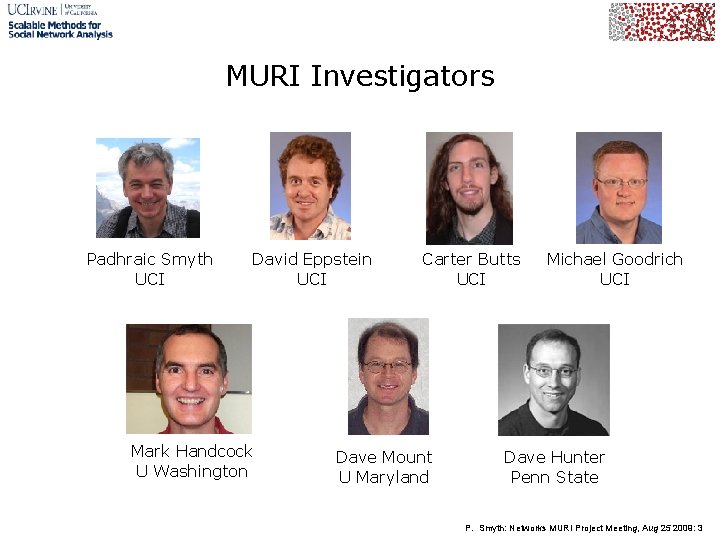
MURI Investigators Padhraic Smyth UCI David Eppstein UCI Mark Handcock U Washington Carter Butts UCI Dave Mount U Maryland Michael Goodrich UCI Dave Hunter Penn State P. Smyth: Networks MURI Project Meeting, Aug 25 2009: 3
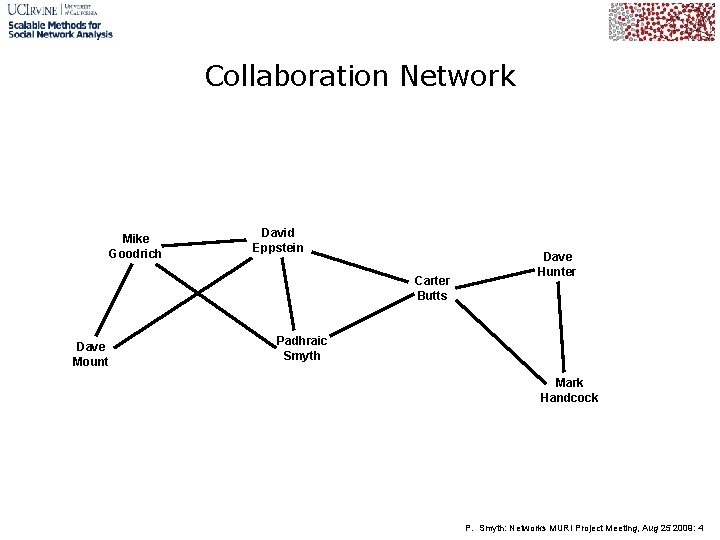
Collaboration Network Mike Goodrich David Eppstein Carter Butts Dave Mount Dave Hunter Padhraic Smyth Mark Handcock P. Smyth: Networks MURI Project Meeting, Aug 25 2009: 4
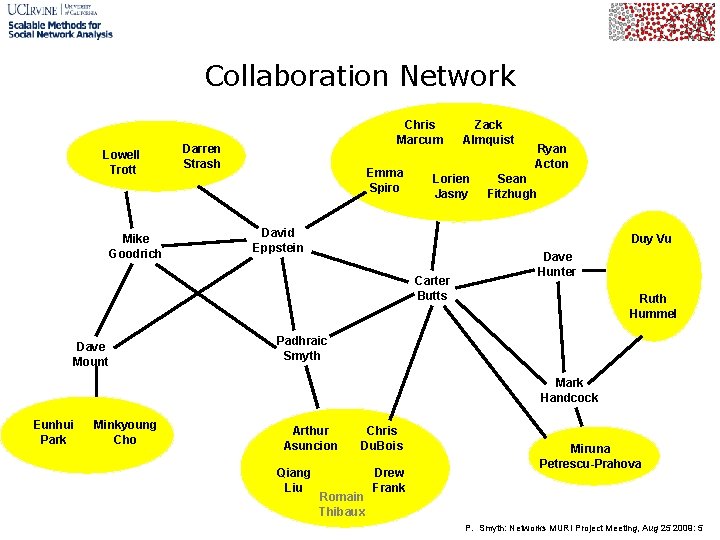
Collaboration Network Lowell Trott Mike Goodrich Chris Marcum Darren Strash Emma Spiro Lorien Jasny David Eppstein Ryan Acton Sean Fitzhugh Duy Vu Carter Butts Dave Mount Zack Almquist Dave Hunter Ruth Hummel Padhraic Smyth Mark Handcock Eunhui Park Minkyoung Cho Arthur Asuncion Qiang Liu Chris Du. Bois Romain Thibaux Drew Frank Miruna Petrescu-Prahova P. Smyth: Networks MURI Project Meeting, Aug 25 2009: 5
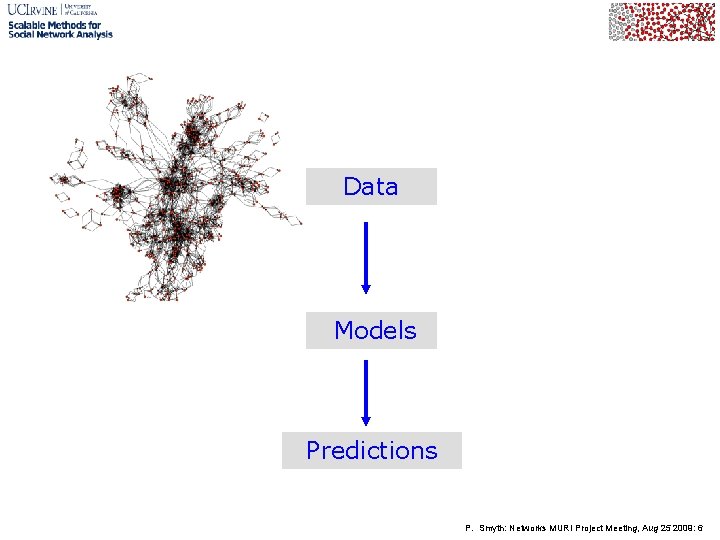
Data Models Predictions P. Smyth: Networks MURI Project Meeting, Aug 25 2009: 6
Statistical Modeling of Network Data Statistics = principled approach for inference from noisy data Basis for optimal prediction • computation of conditional probabilities/expectation Principles for handling noisy measurements • e. g. , noisy and missing edges Integration of different sources of information • e. g. , combining edge information with node covariates Quantification of uncertainty • e. g. , how likely is it that network behavior has changed? P. Smyth: Networks MURI Project Meeting, Aug 25 2009: 7
Limitations of Existing Methods • Network data over time – Relatively little work on dynamic network data • Heterogeneous data – e. g. , few techniques for incorporating text, spatial information, etc, into network models • Computational tractability – Many network modeling algorithms scale exponentially in the number of nodes N P. Smyth: Networks MURI Project Meeting, Aug 25 2009: 8
Example • G = {V, E} V = set of N nodes E = set of directed binary edges • Exponential random graph (ERG) model P(G | q) = f( G ; q ) / normalization constant The normalization constant = sum over all possible graphs How many graphs? 2 e. g. , N N(N-1) = 20, we have 2380 ~ 1038 graphs to sum over P. Smyth: Networks MURI Project Meeting, Aug 25 2009: 9
P. Smyth: Networks MURI Project Meeting, Aug 25 2009: 10
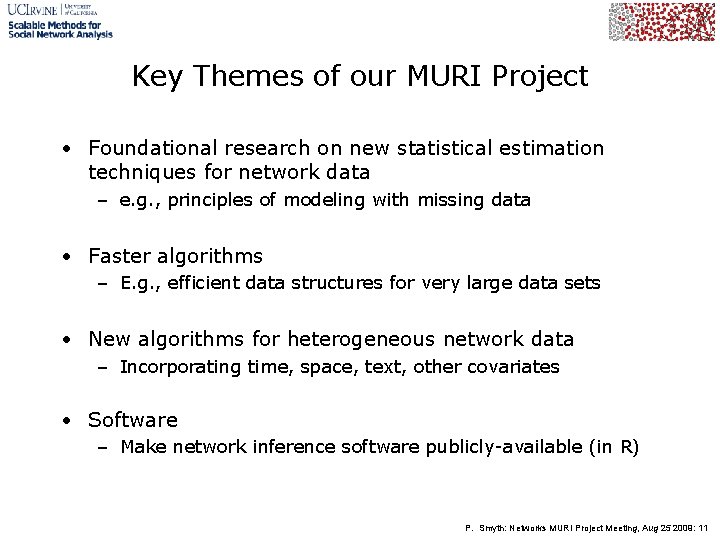
Key Themes of our MURI Project • Foundational research on new statistical estimation techniques for network data – e. g. , principles of modeling with missing data • Faster algorithms – E. g. , efficient data structures for very large data sets • New algorithms for heterogeneous network data – Incorporating time, space, text, other covariates • Software – Make network inference software publicly-available (in R) P. Smyth: Networks MURI Project Meeting, Aug 25 2009: 11
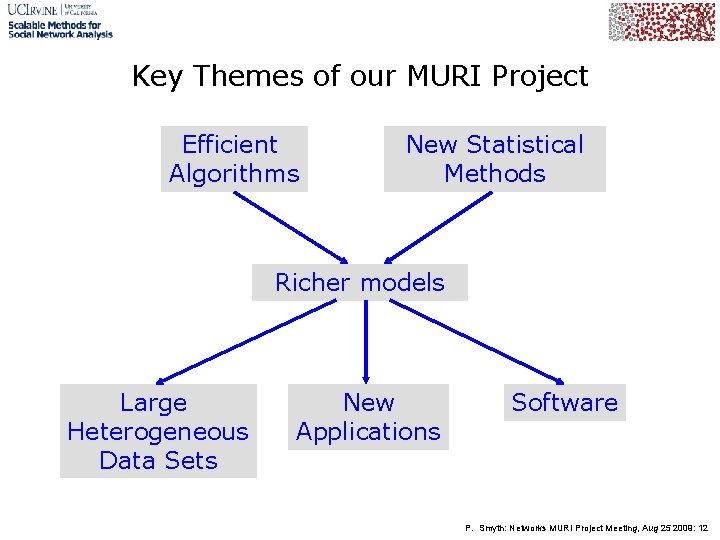
Key Themes of our MURI Project Efficient Algorithms New Statistical Methods Richer models Large Heterogeneous Data Sets New Applications Software P. Smyth: Networks MURI Project Meeting, Aug 25 2009: 12
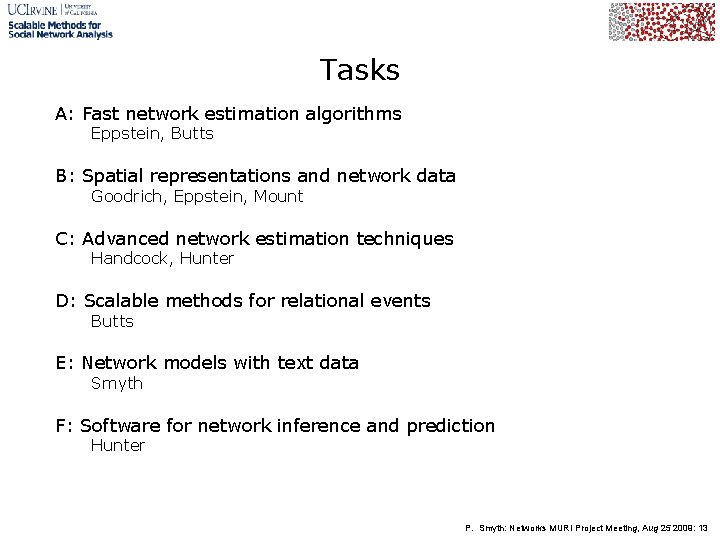
Tasks A: Fast network estimation algorithms Eppstein, Butts B: Spatial representations and network data Goodrich, Eppstein, Mount C: Advanced network estimation techniques Handcock, Hunter D: Scalable methods for relational events Butts E: Network models with text data Smyth F: Software for network inference and prediction Hunter P. Smyth: Networks MURI Project Meeting, Aug 25 2009: 13
Task A: Fast Network Estimation Algorithms Investigators: Eppstein, Butts • Problem: – Statistical inference algorithms can be slow because of repeated computation of various statistics on graphs • Goal – Leverage ideas from computational graph algorithms to enable much faster computation – also enabling computation of more complex and realistic statistics • Projects – Dynamic graph methods for change-score computation – Rapid subgraph automorphism detection for feature counting – Dynamic connectivity P. Smyth: Networks MURI Project Meeting, Aug 25 2009: 14
Task B: Spatial Representations and Network Data Investigators: Goodrich, Eppstein, Mount • Problem: – Spatial representations of network data can be quite useful (both latent embeddings and actual spatial information) but current statistical modeling algorithms scale poorly • Goal – Build on recent efficient geometric data indexing techniques in computer science to develop much faster and efficient algorithms • Projects – Improved algorithms for latent-space embeddings – Fast implementations for high-dimensional latent space models – Techniques for integrating actual and latent space geometry P. Smyth: Networks MURI Project Meeting, Aug 25 2009: 15
Task C: Advanced Estimation Techniques Investigators: Handcock, Hunter • Problem: – Current statistical network inference models often make unrealistic assumptions, e. g. , • Assume complete (non-missing) data • Assume that exact computation is possible • Goal – Develop new theories and techniques that relax these assumptions, i. e. , methods for handing missing data and techniques for approximate inference • Projects – Inference with partially observed network data – Approximation methods • Approximate likelihood techniques • Approximate MCMC algorithms – Will leverage new techniques developed in Tasks A and B P. Smyth: Networks MURI Project Meeting, Aug 25 2009: 16
Task D: Scalable Temporal Models Investigator: Butts • Problem: – Few statistical methods for modeling temporal sequences of events among a network of actors • Goal – Develop new statistical relational event models to handle an evolving set of events over time in a network context • Projects – – – Specification of relational event statistics Rapid likelihood computation for relational event models Predictive event system queries Interventions, forecasting, and “network steering” Can build on ideas from Tasks A, B, C P. Smyth: Networks MURI Project Meeting, Aug 25 2009: 17
Task E: Network Models and Text Data Investigator: Smyth • Problem: – Lack of statistical techniques that can combine network and text data within a single framework (e. g. , email communication) • Goal – Leverage recent advances in both statistical text mining and statistical network modeling to create new combined models • Projects – – – Latent variable models for text and network data Text as exogenous data for statistical network models Modeling of text and network data over time Fast algorithms for statistical modeling of text/networks Can build on ideas from Tasks A, B, C and D P. Smyth: Networks MURI Project Meeting, Aug 25 2009: 19
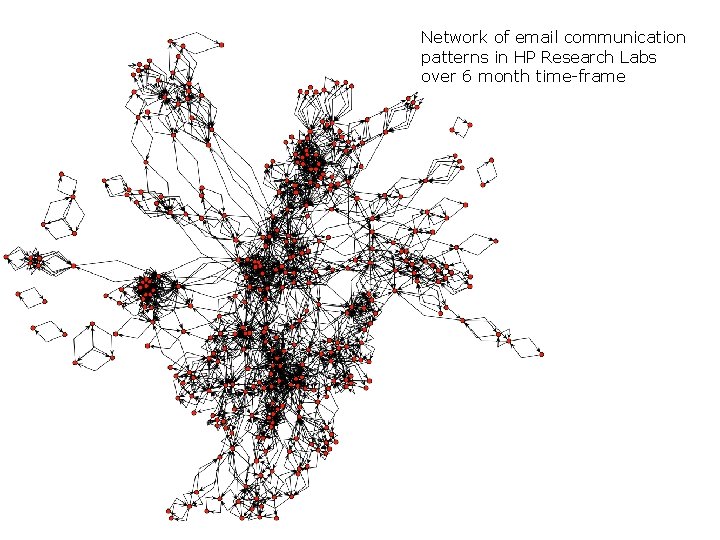
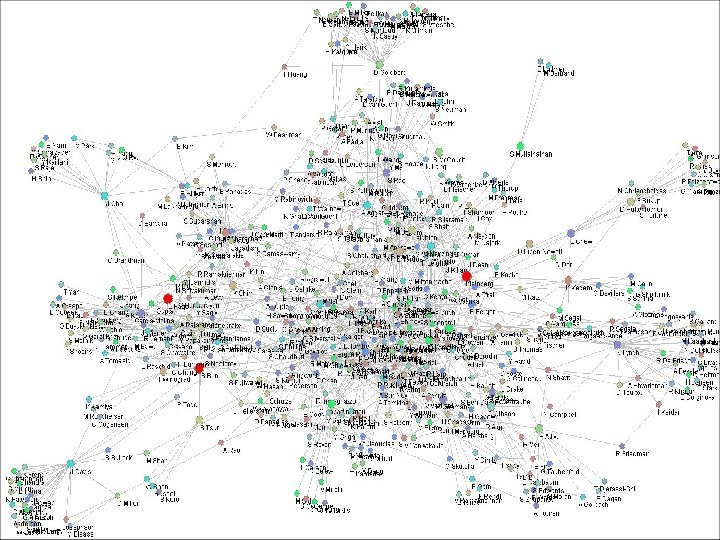
Network of email communication patterns in HP Research Labs over 6 month time-frame
Task F: Software for Network Inference and Prediction Investigator: Hunter • Goal – Disseminate algorithms and software to research and practitioner communities • How? – By incorporating our new algorithms into the R statistical package – R = open source language for stat computing/graphics – MURI team has significant prior experience with developing statistical network modeling packages in R • • network (Butts et al, 2007) latentnet (Handcock et al, 2004) ergm (Handcock et al, 2003) sna (Butts, 2000) • Will integrate algorithms and techniques from other tasks P. Smyth: Networks MURI Project Meeting, Aug 25 2009: 21
ONR Interests (adapted from presentation/discussion by Martin Kruger, ONR) • How does one select the features in an ERG model? • How can one uniquely characterize a person or a network? • Can a statistical model (e. g. , a relational event model) be used to characterize the trajectory of an individual or a network over time? • Can one do “activity recognition” in a network? • Can one model the effect of exogenous changes (e. g. , “shocks”) to a network over time? • Importance of understanding social science aspect of network modeling: what are human motivations and goals driving network behavior? P. Smyth: Networks MURI Project Meeting, Aug 25 2009: 22
Timelines and Funding • 3 -year project, possible extension to 5 years – Start date: May 1 2008 – End date: April 30 2011/2013 • Funding installment 1: – First 5 months of funding, intended for May-Sept 2008 – Arrived at UCI in Sept 2008 – Largely spent by March 2008 • Funding installment 2: – 12 months of funding, intended for Oct 1 08 to Sep 30 09 – Arrived at UCI mid-march 2009 – Plan to spend current funding by March 2010 • Anticipate next installment will arrive in early 2010 P. Smyth: Networks MURI Project Meeting, Aug 25 2009: 23
Project Meetings • All-Hands Meeting, November 2008 – Researchers + ONR program manager (Martin Kruger) + other Do. D folks • Working Meeting, April 2009 – Researchers • Working Meeting, August 2009 – Researchers + Julie Howell and Joan Kaina (Navy, San Diego) • All-Hands Meeting, November 2009 – Researchers + program manager + other Do. D folks – Exact date TBD P. Smyth: Networks MURI Project Meeting, Aug 25 2009: 24
Research Examples • Statistical modeling of network data with missing observations – Mark Handcock and Krista Gile – Systematic statistical methodologies for handling missing edge information in observed network data • Decision-theoretic foundations for network modeling – Carter Butts – Network formation via stochastic choice processes and links to exponential random graph (ERG) models • Fast computation of graph change scores in large networks – David Eppstein and Emma Spiro – New data structure that significantly speeds up the evaluation of change-score statistics in ERG estimation P. Smyth: Networks MURI Project Meeting, Aug 25 2009: 25
Sample Publications • C. T. Butts, Revisiting the foundations of network analysis, Science, 325, 414 -416, 2009 • R. Hummel, M. Handcock, D. Hunter, A steplength algorithm for fitting ERGMS, winner of the American Statistical Association (Statistical Computing and Statistical Graphics Section) student paper award, presented at the ASA Joint Statistical Meeting, 2009. • D. Eppstein and E. S. Spiro, The h-index of a graph and its application to dynamic subgraph statistics, Algorithms and Data Structures Symposium, Banff, Canada, August 2009 • D. Newman, A. Asuncion, P. Smyth, M. Welling, Distributed algorithms for topic models, Journal of Machine Learning Research, in press, 2009 P. Smyth: Networks MURI Project Meeting, Aug 25 2009: 26
Sample Publications (ctd. ) • M. Gjoka, M. Kurant, C. T. Butts, A. Markopoulou, A walk in Facebook: uniform sampling of users in online social networks, electronic preprint, ar. Xiv: 0906. 0060, 2009 • M. Cho, D. M. Mount, and E. Park, Maintaining nets and net trees under incremental motion, submitted, 2009 • R. M. Hummel, M. S. Handcock, D. R. Hunter, A steplength algorithm for fitting ERGMs, submitted, 2009 • C. T. Butts, A behavioral micro-foundation for cross-sectional network models, preprint, 2009 P. Smyth: Networks MURI Project Meeting, Aug 25 2009: 27
Morning Session I 9: 30 Foundational aspects of network analysis Carter Butts (UCI) 9: 45 Comparison of estimation methods for exponential random graph models Mark Handcock (UW) 10: 15 Sampling algorithms for data collection in online networks Carter Butts (UCI) 10: 30 Break P. Smyth: Networks MURI Project Meeting, Aug 25 2009: 28
Morning Session II 10: 45 Egocentric network models for event data over time Chris Marcum, Lorien Jasny, Carter Butts (UCI) 11: 15 Dynamic extensions of network brokerage models Ryan Acton, Emma Spiro, Carter Butts (UCI) 11: 30 Statistical approaches to joint modeling of text and network data Arthur Asuncion, Qiang Liu, Padhraic Smyth (UCI) 12: 00 Lunch for all at University Club P. Smyth: Networks MURI Project Meeting, Aug 25 2009: 29
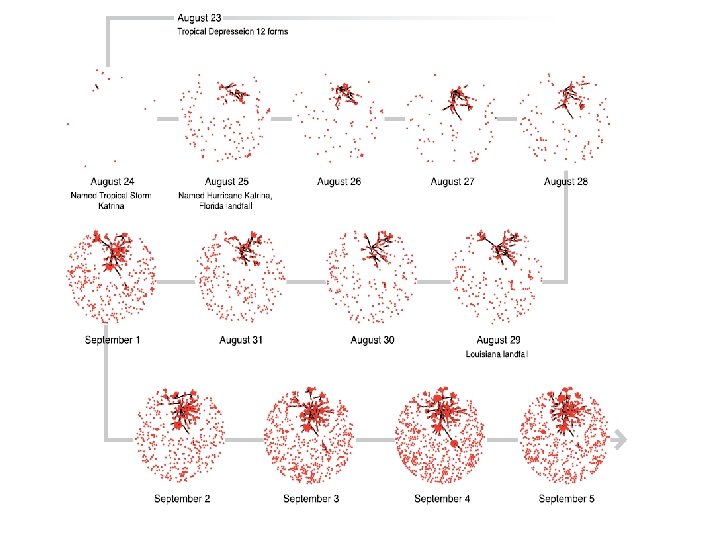
Afternoon Session I 1: 30 The crossroads of geography and networks Michael Goodrich (UCI) 2: 00 Maintaining nets and net trees under incremental motion Minkyoung Cho, Eunhui Park, Dave Mount (U Maryland) 2: 30 Simulation of spatially-embedded network data Carter Butts (UCI) 3: 00 A proposal for the analysis of disaster-related network data, Miruna Petrescu-Prahova (UW) 3: 30 Break P. Smyth: Networks MURI Project Meeting, Aug 25 2009: 30
Afternoon Session II 3: 45 Approximate inference techniques with applications to spatial network models Drew Frank, Alex Ihler, Padhraic Smyth (UCI) 4: 15 Update on project data organization, assembly, and collection Emma Spiro (UCI) 4: 30 Discussion and Wrap-up - date of AHM meeting in November - collaborative activities - action items 5: 00 Adjourn P. Smyth: Networks MURI Project Meeting, Aug 25 2009: 31
Logistics • Meals – Lunch at University Club - for everyone – Refreshment breaks at 10: 30 and 3: 30 • Wireless – Should be able to get 24 -hour guest access from UCI network • Online Slides and Schedule www. datalabl. uci. edu/TBD • Reminder to speakers: leave time for questions and discussion! P. Smyth: Networks MURI Project Meeting, Aug 25 2009: 32
- Slides: 32