
Scalable Maximum Margin Factorization by Active Riemannian Subspace

Scalable Maximum Margin Factorization by Active Riemannian Subspace search Yan, Mingkui Tan, Ivor W. Tsang, Yi Yang, Chengqi Zhang and Qinfeng Shi QCIS, University of Technology, Sydney ACVT, The University
Outline • Introduction • The Proposed Model • Experiments • Conclusion
Collaborative filtering for recommendation systems • Goal • Recover missing ratings by low-rank matrix completion • Real world applications • Recommend TV shows/movies on Netflix • Recommend artists/music tracks on Xiami • Recommend products on Taobao… • Data that can be used • Partially observed rating data from users on items • A specific output of recommendation systems • The predicted ranking scores of users on unseen items
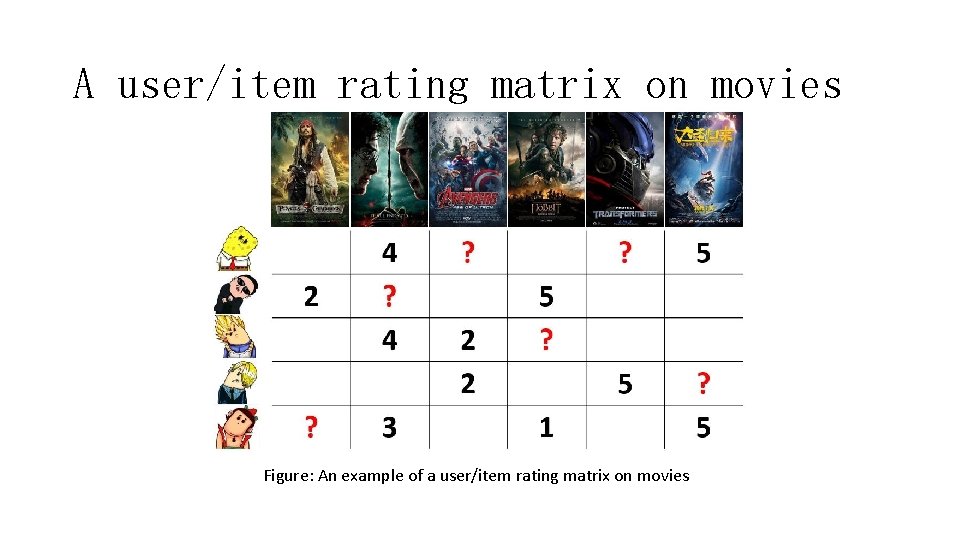
A user/item rating matrix on movies Figure: An example of a user/item rating matrix on movies

Problem setup of matrix completion • Reconstruct the rating matrix X with a low-rank constraint • Y is the observed matrix • The problem is NP-hard • Approach: matrix factorization
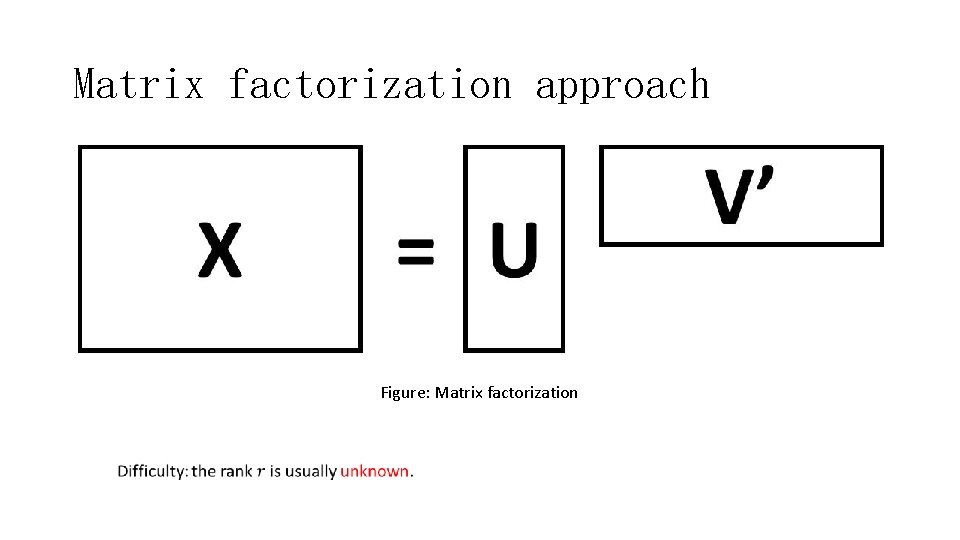
Matrix factorization approach Figure: Matrix factorization
Challenges • Real world rating data are in discrete values • Maximum margin matrix factorization • Existing methods usually requires repetitive SVDs • Our optimization avoids repetitive SVDs and applies cheaper QR • The latent variable r is usually unknown and can be different among various datasets • A automatic method to detect the rank
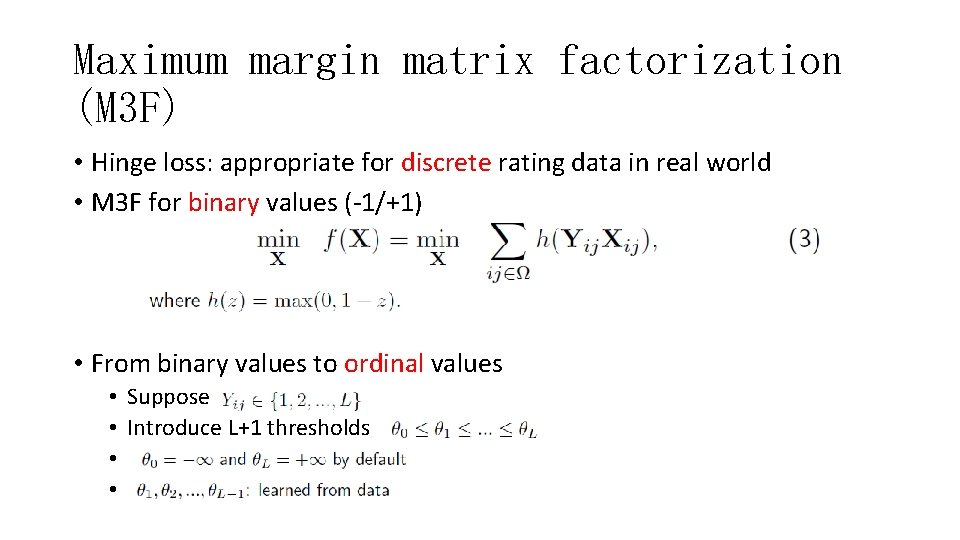
Maximum margin matrix factorization (M 3 F) • Hinge loss: appropriate for discrete rating data in real world • M 3 F for binary values (-1/+1) • From binary values to ordinal values • • Suppose Introduce L+1 thresholds
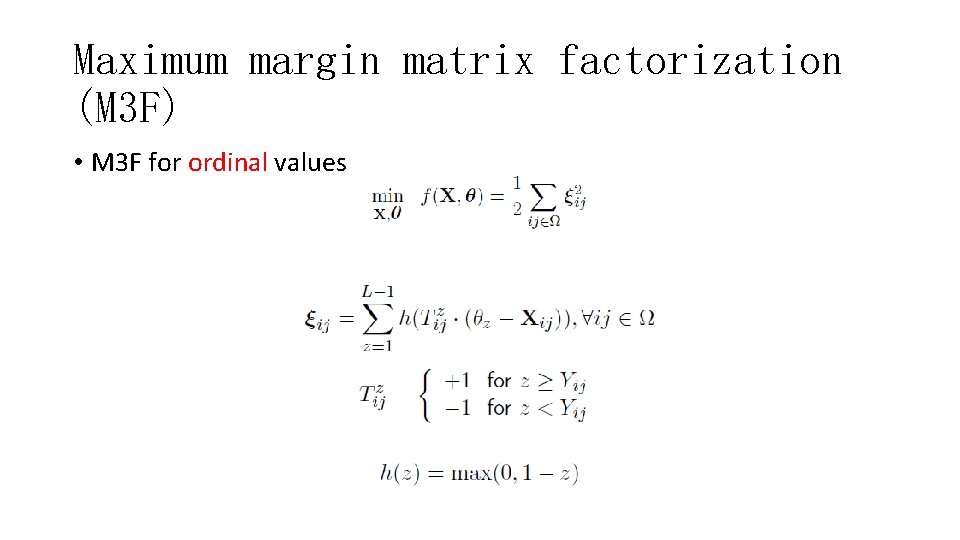
Maximum margin matrix factorization (M 3 F) • M 3 F for ordinal values
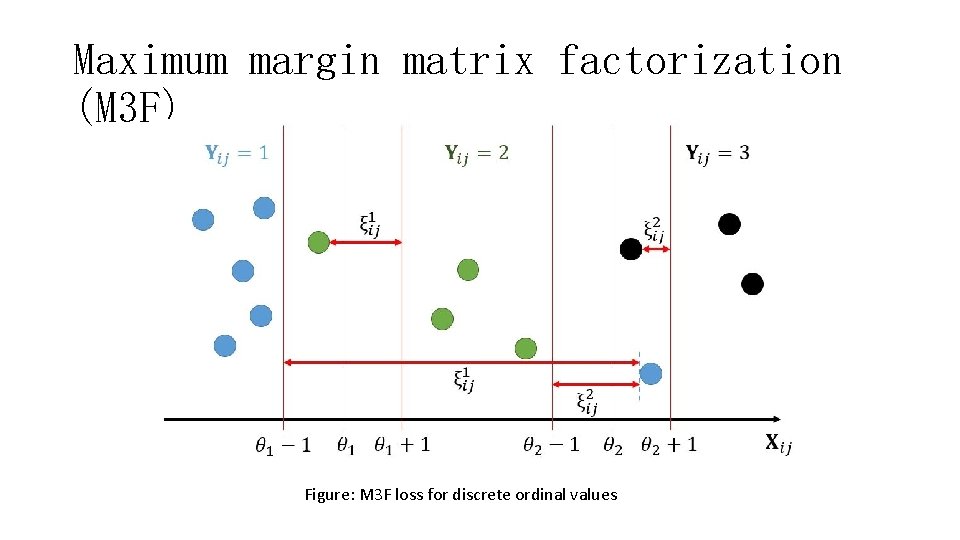
Maximum margin matrix factorization (M 3 F) Figure: M 3 F loss for discrete ordinal values
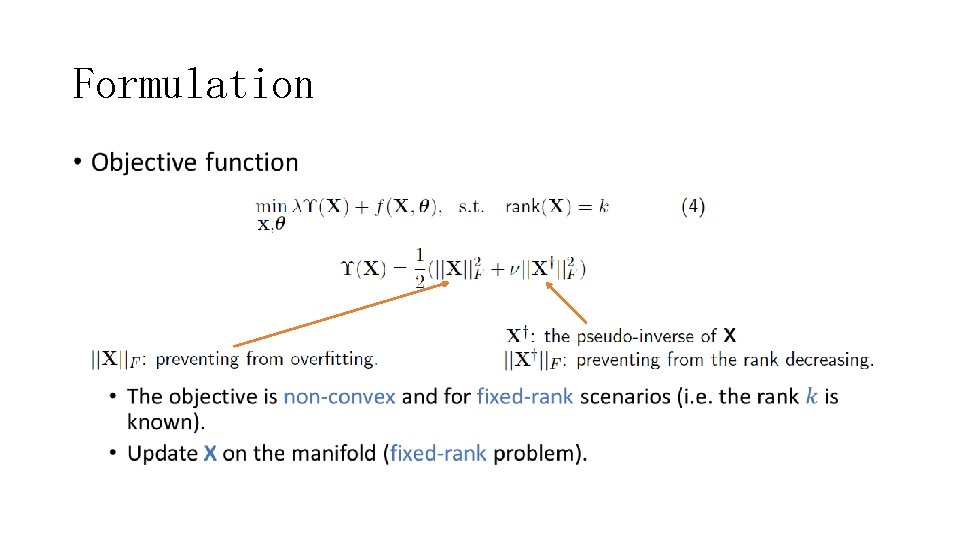
Formulation •
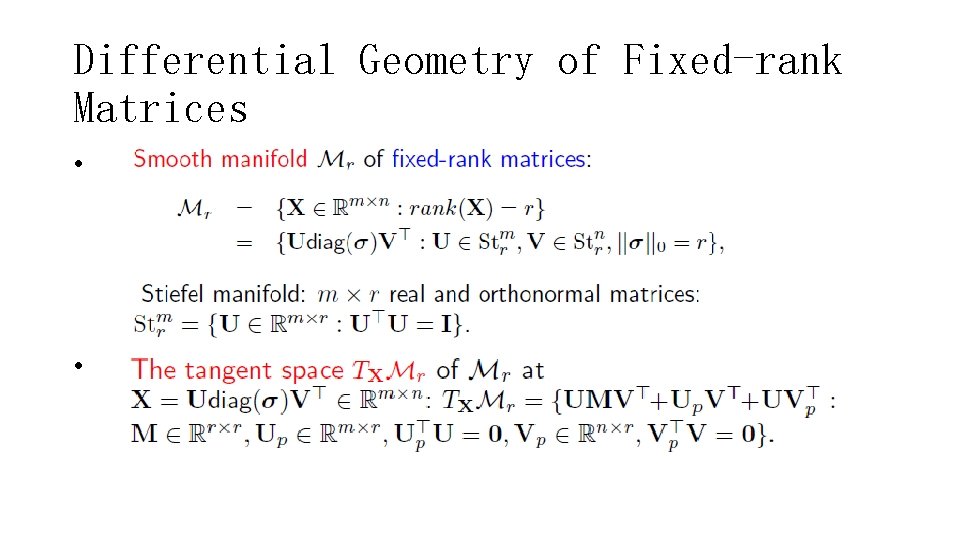
Differential Geometry of Fixed-rank Matrices • •
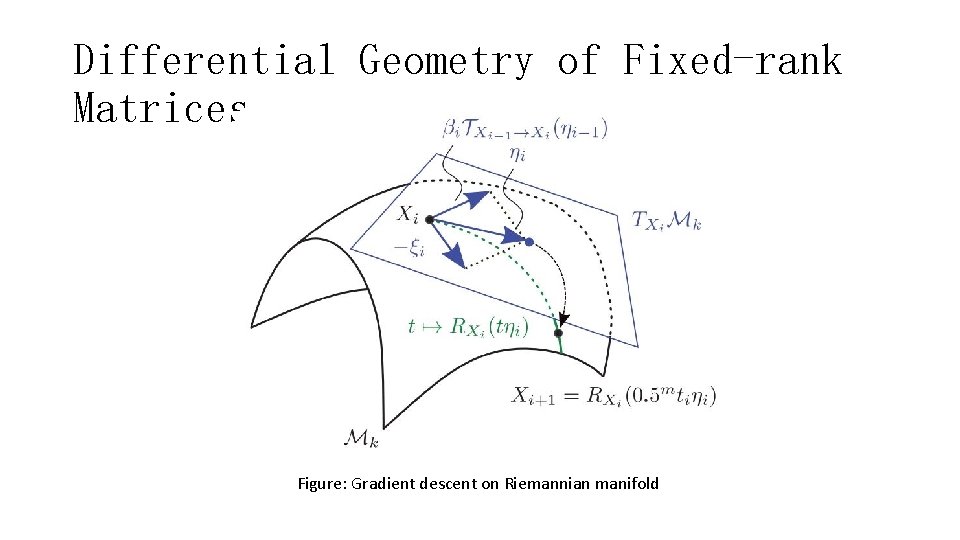
Differential Geometry of Fixed-rank Matrices Figure: Gradient descent on Riemannian manifold
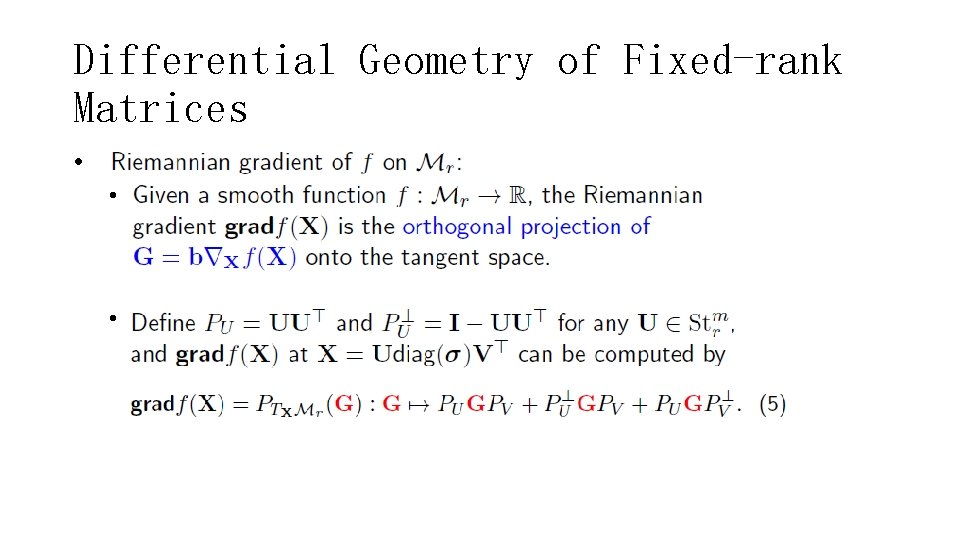
Differential Geometry of Fixed-rank Matrices • • •
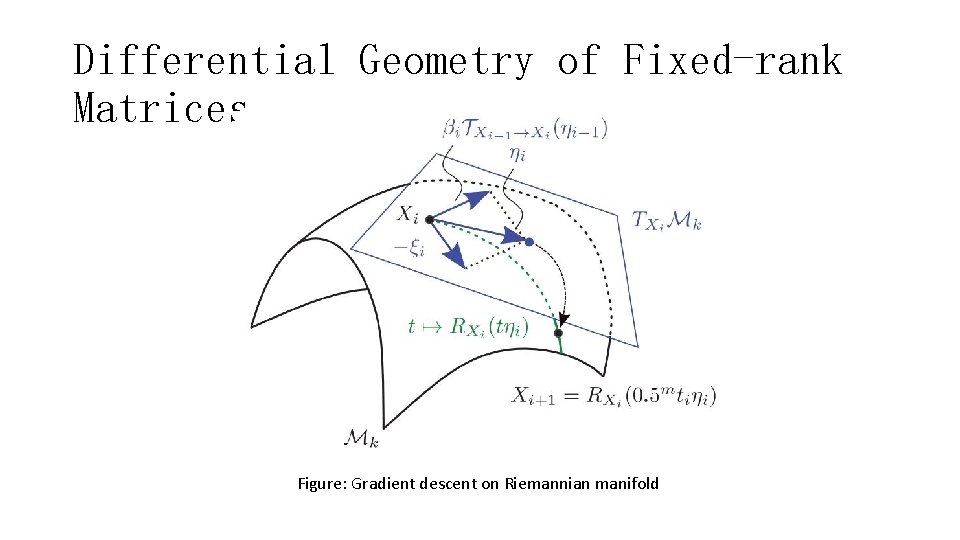
Differential Geometry of Fixed-rank Matrices Figure: Gradient descent on Riemannian manifold
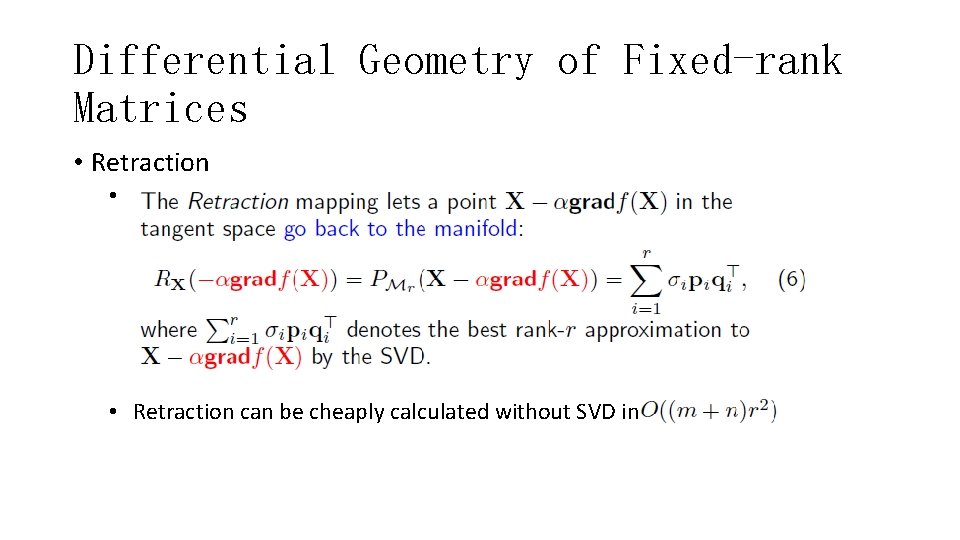
Differential Geometry of Fixed-rank Matrices • Retraction • • Retraction can be cheaply calculated without SVD in
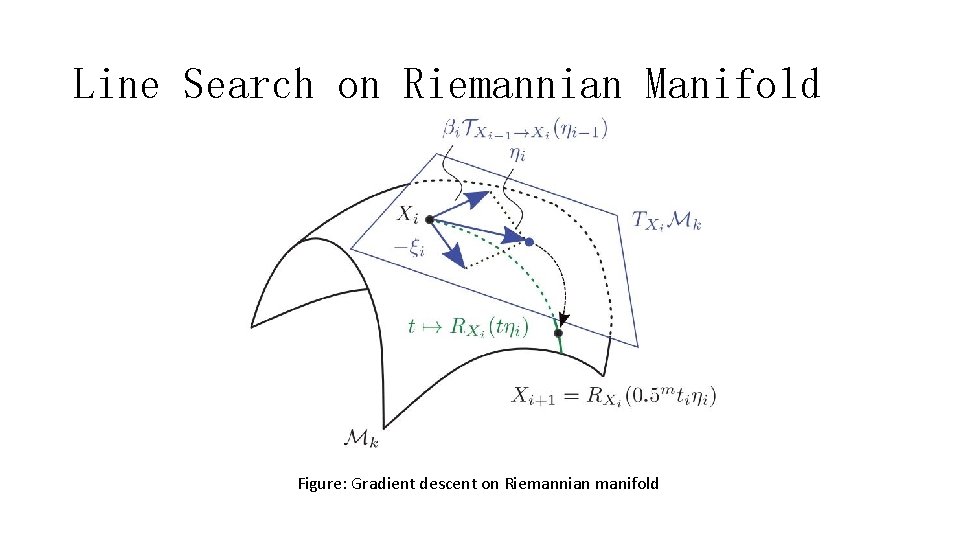
Line Search on Riemannian Manifold Figure: Gradient descent on Riemannian manifold
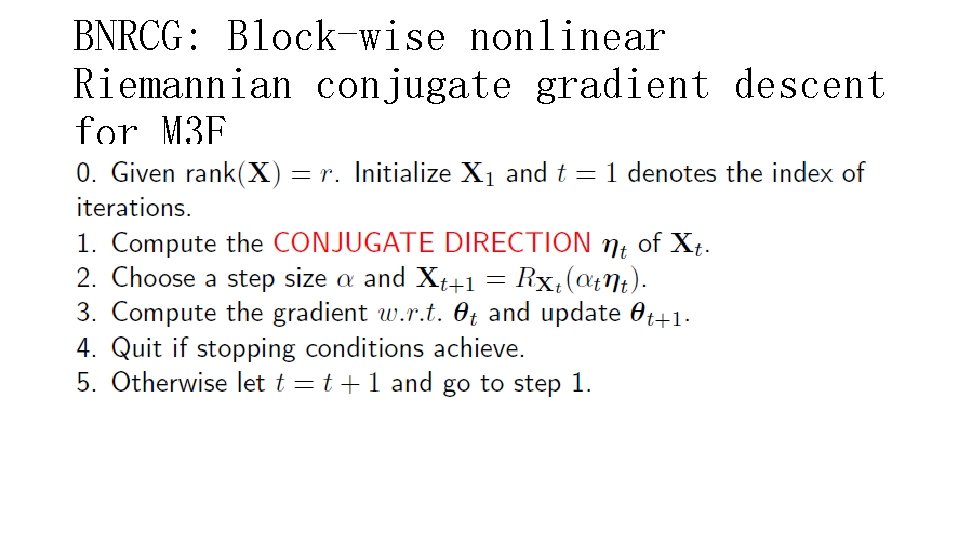
BNRCG: Block-wise nonlinear Riemannian conjugate gradient descent for M 3 F
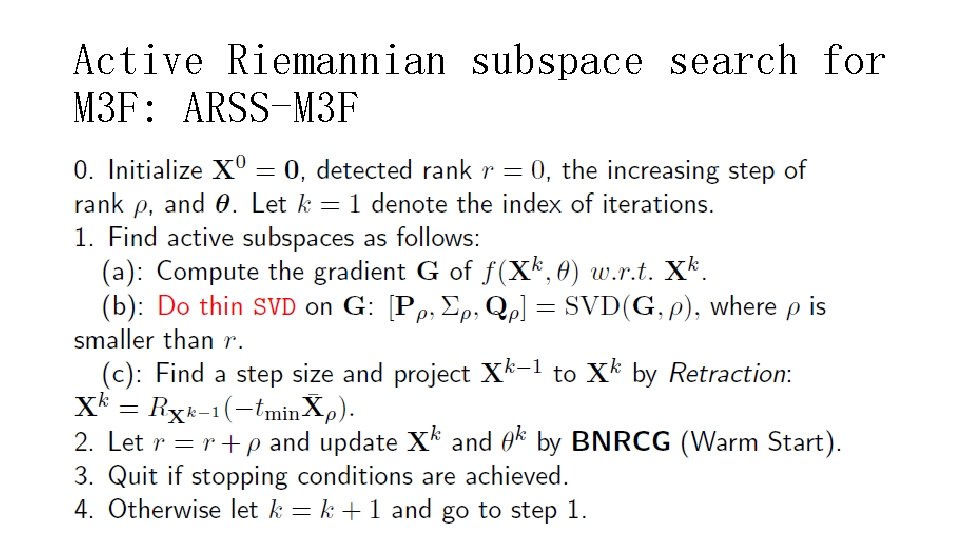
Active Riemannian subspace search for M 3 F: ARSS-M 3 F
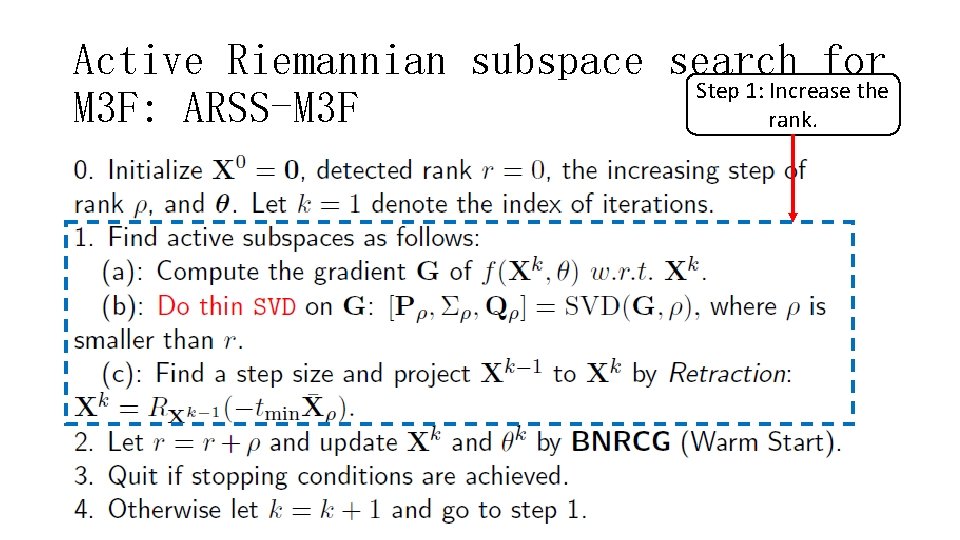
Active Riemannian subspace search for Step 1: Increase the M 3 F: ARSS-M 3 F rank.
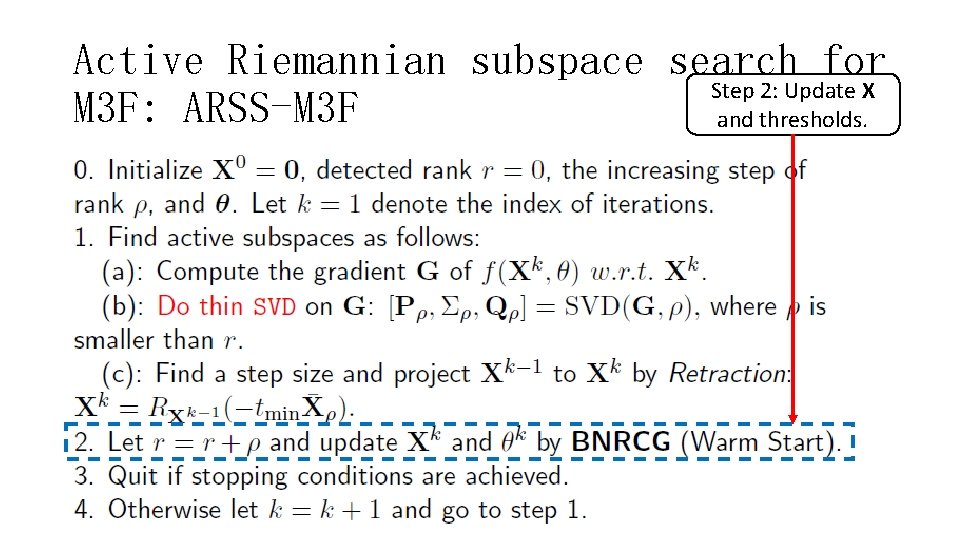
Active Riemannian subspace search for Step 2: Update X M 3 F: ARSS-M 3 F and thresholds.
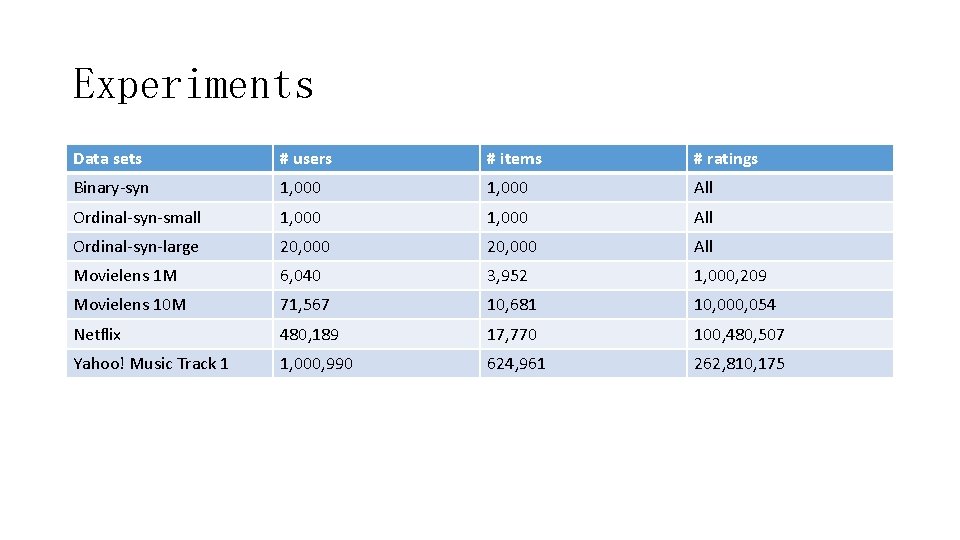
Experiments Data sets # users # items # ratings Binary-syn 1, 000 All Ordinal-syn-small 1, 000 All Ordinal-syn-large 20, 000 All Movielens 1 M 6, 040 3, 952 1, 000, 209 Movielens 10 M 71, 567 10, 681 10, 000, 054 Netflix 480, 189 17, 770 100, 480, 507 Yahoo! Music Track 1 1, 000, 990 624, 961 262, 810, 175
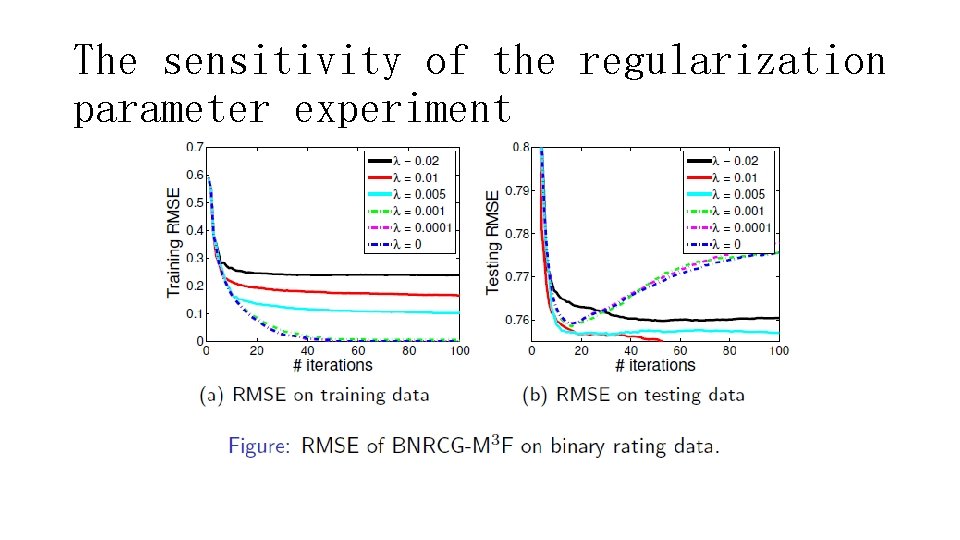
The sensitivity of the regularization parameter experiment
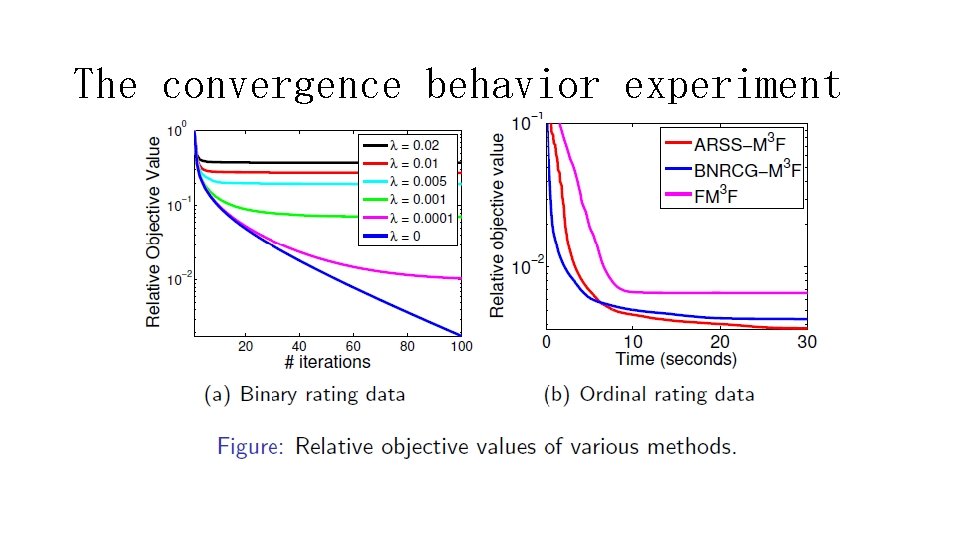
The convergence behavior experiment
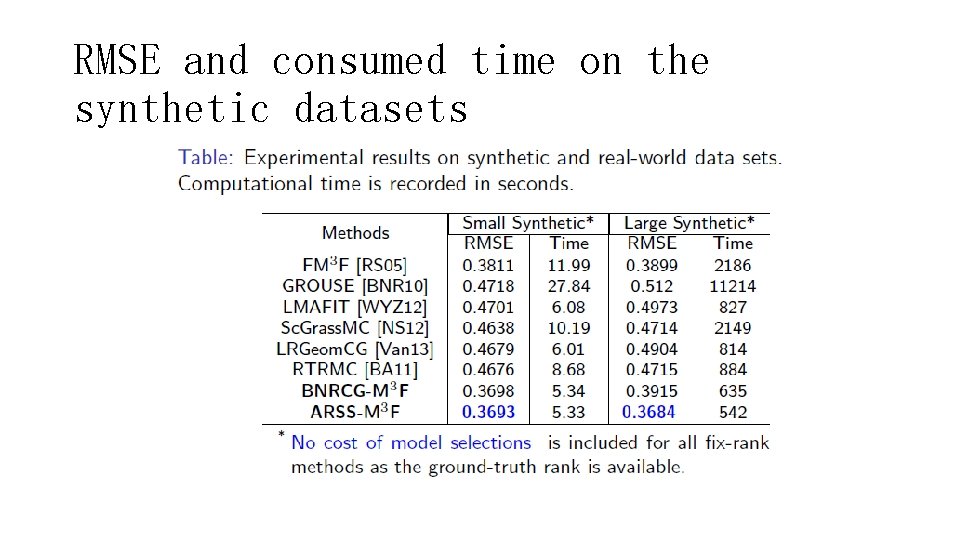
RMSE and consumed time on the synthetic datasets
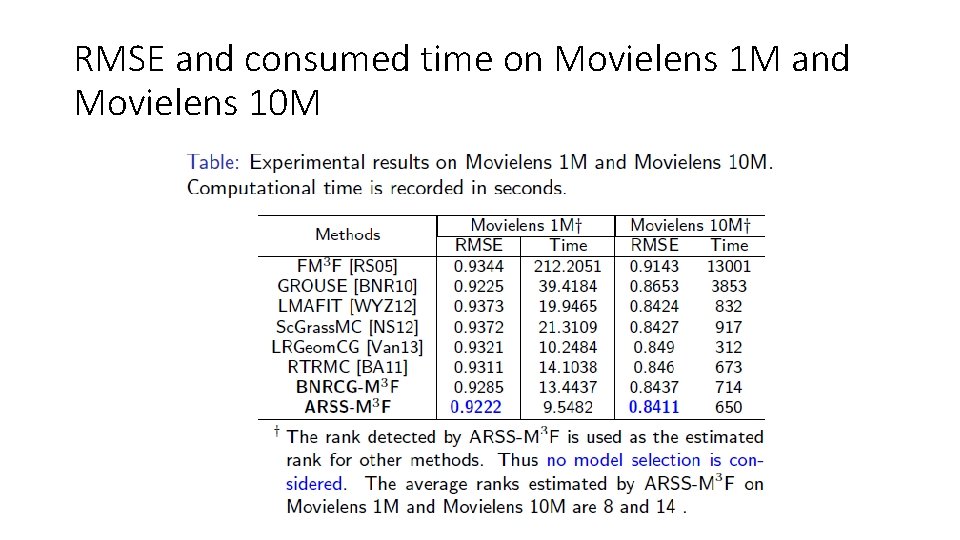
RMSE and consumed time on Movielens 1 M and Movielens 10 M
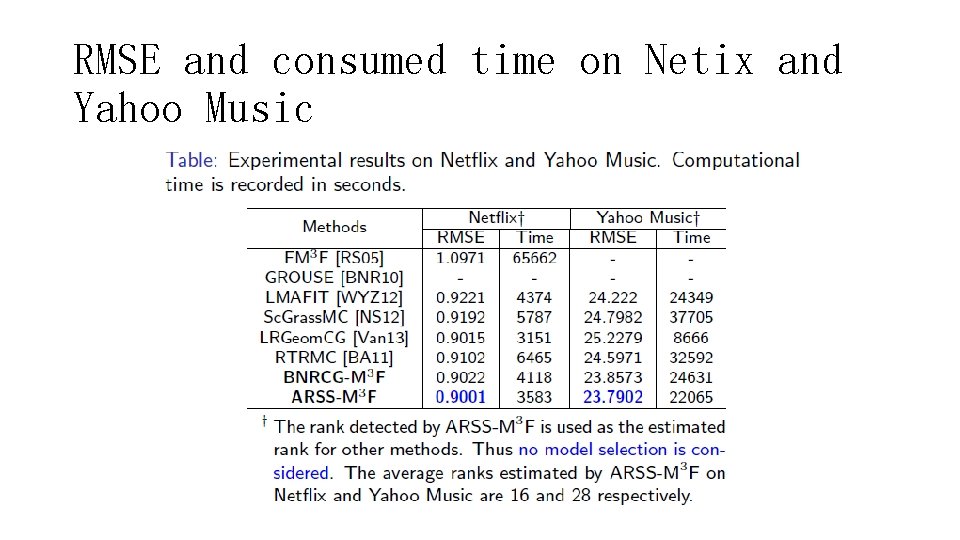
RMSE and consumed time on Netix and Yahoo Music
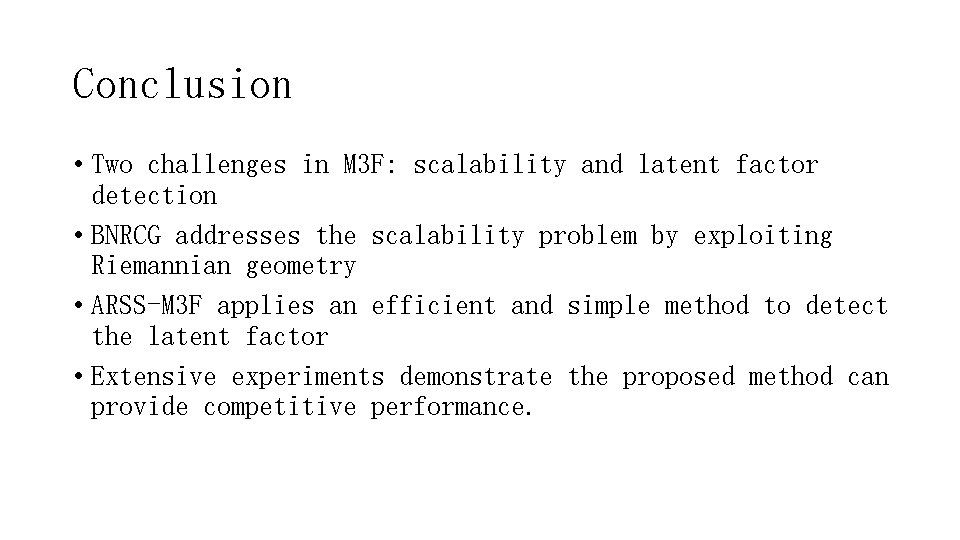
Conclusion • Two challenges in M 3 F: scalability and latent factor detection • BNRCG addresses the scalability problem by exploiting Riemannian geometry • ARSS-M 3 F applies an efficient and simple method to detect the latent factor • Extensive experiments demonstrate the proposed method can provide competitive performance.

Thank you!
- Slides: 29