
Scalable Learning of Collective Behavior based on Sparse

Scalable Learning of Collective Behavior based on Sparse Social Dimensions Lei Tang and Huan Liu Data Mining and Machine Learning Laboratory Computer Science & Engineering Arizona State University The 18 th ACM International Conference on Information and Knowledge Management CIKM, Hong Kong, Nov. 5 th, 2009
Collective Behavior n Examples of Behavior ¡ ¡ n Collective Behavior ¡ ¡ n Joining a sports club Buying some products Becoming interested in a topic Voting for a presidential candidate Behavior in a social network environment Behavior correlation between connected actors Particularly in social media
Behavior in Social Media n n Social media encourage user interaction, leading to social networks between users Problem: How to exploit social network information for behavior prediction? n Can benefit n n n Targeting Advertising Policy analysis Sentimental analysis Trend Tracking Behavioral Study
Collective Behavior Prediction n n User behavior or preference can be represented by labels (+/-) • Click on an ad • Interested in certain topics • Subscribe to certain political views • Like/Dislike a product Given: • • n A social network (i. e. , connectivity information) Some actors with identified labels Output: • Labels of other actors within the same network
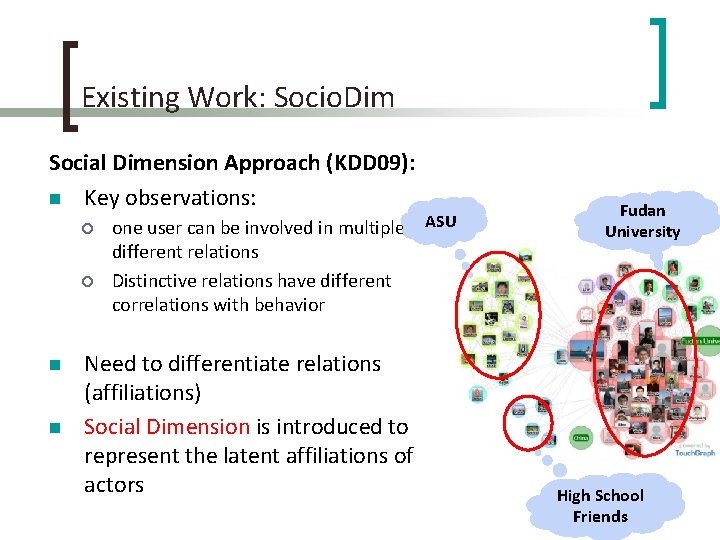
Existing Work: Socio. Dim Social Dimension Approach (KDD 09): n Key observations: ¡ ¡ n n one user can be involved in multiple different relations Distinctive relations have different correlations with behavior Need to differentiate relations (affiliations) Social Dimension is introduced to represent the latent affiliations of actors ASU Fudan University High School Friends
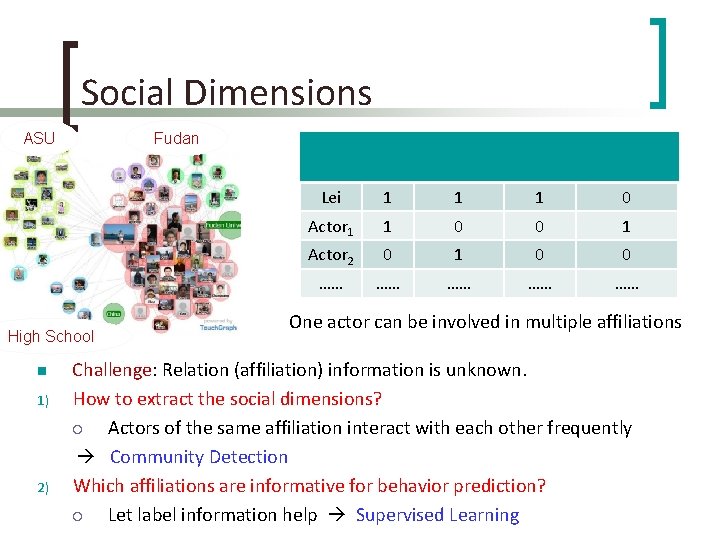
Social Dimensions ASU Fudan High School n 1) 2) ASU Fudan University High School Yahoo! Inc. Lei 1 1 1 0 Actor 1 1 0 0 1 Actor 2 0 1 0 0 …… …… …… One actor can be involved in multiple affiliations Challenge: Relation (affiliation) information is unknown. How to extract the social dimensions? ¡ Actors of the same affiliation interact with each other frequently Community Detection Which affiliations are informative for behavior prediction? ¡ Let label information help Supervised Learning
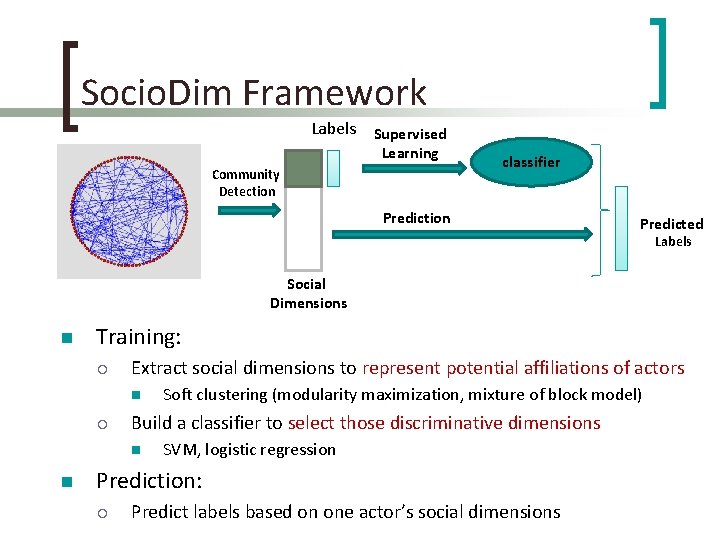
Socio. Dim Framework Labels Supervised Learning Community Detection classifier Prediction Predicted Labels Social Dimensions n Training: ¡ Extract social dimensions to represent potential affiliations of actors n ¡ Build a classifier to select those discriminative dimensions n n Soft clustering (modularity maximization, mixture of block model) SVM, logistic regression Prediction: ¡ Predict labels based on one actor’s social dimensions
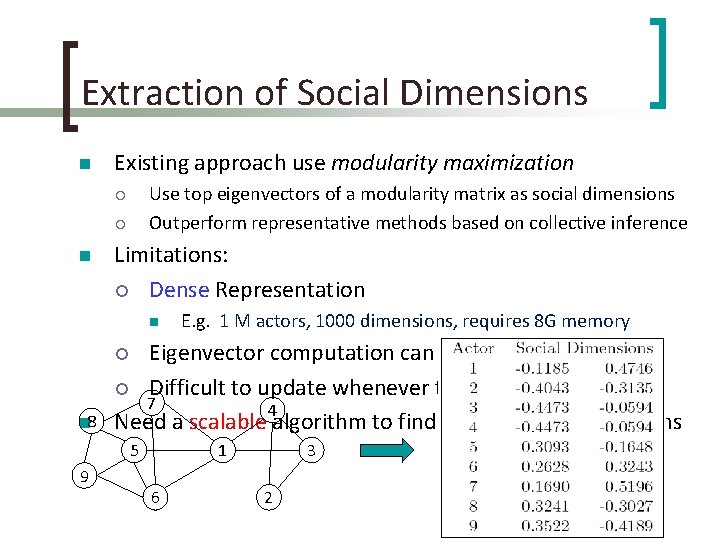
Extraction of Social Dimensions n Existing approach use modularity maximization Use top eigenvectors of a modularity matrix as social dimensions Outperform representative methods based on collective inference ¡ ¡ n Limitations: ¡ Dense Representation n E. g. 1 M actors, 1000 dimensions, requires 8 G memory Eigenvector computation can be expensive ¡ Difficult to update whenever the network changes 7 4 Need a scalable algorithm to find sparse social dimensions ¡ n 8 5 9 1 6 3 2
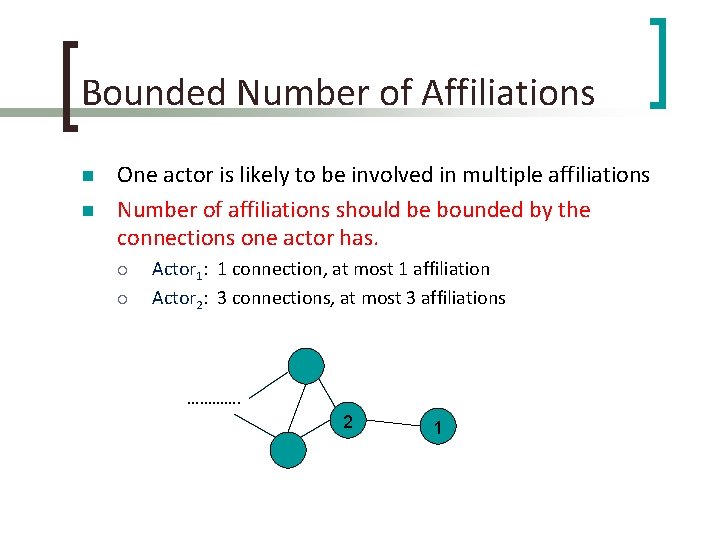
Bounded Number of Affiliations n n One actor is likely to be involved in multiple affiliations Number of affiliations should be bounded by the connections one actor has. ¡ ¡ Actor 1: 1 connection, at most 1 affiliation Actor 2: 3 connections, at most 3 affiliations …………. 2 1
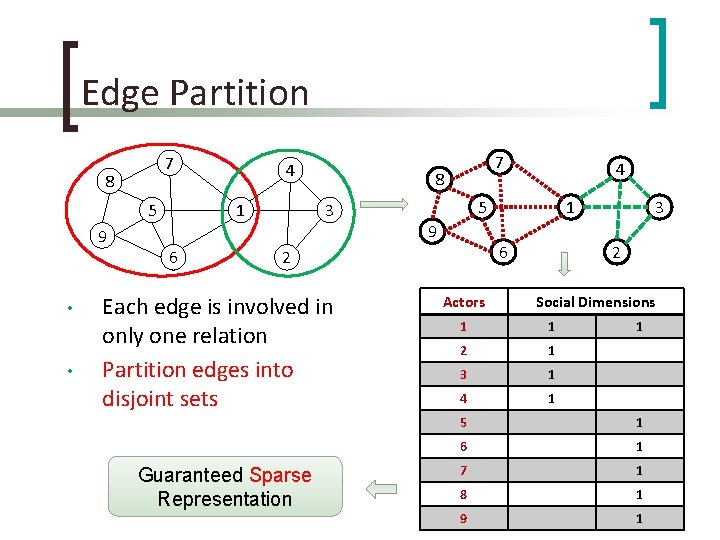
Edge Partition 7 8 5 9 • • 4 1 6 7 8 3 5 9 Guaranteed Sparse Representation 1 6 2 Each edge is involved in only one relation Partition edges into disjoint sets 4 Actors 3 2 Social Dimensions 1 1 2 1 3 1 4 1 1 5 1 6 1 7 1 8 1 9 1
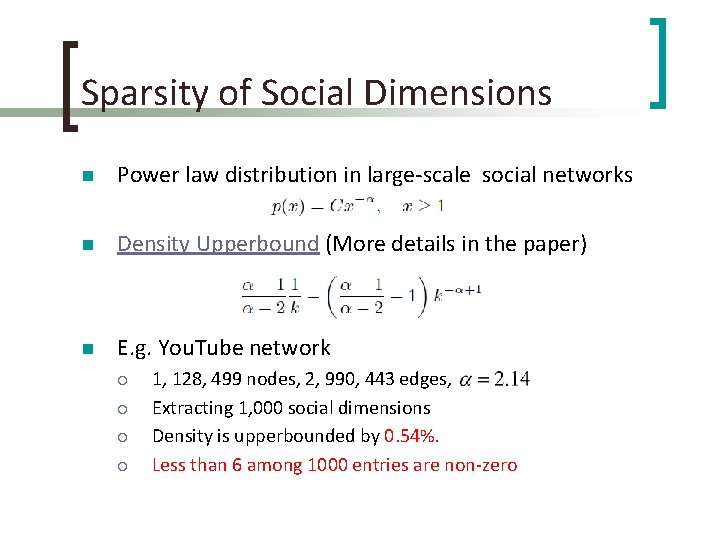
Sparsity of Social Dimensions n Power law distribution in large-scale social networks n Density Upperbound (More details in the paper) n E. g. You. Tube network ¡ ¡ 1, 128, 499 nodes, 2, 990, 443 edges, Extracting 1, 000 social dimensions Density is upperbounded by 0. 54%. Less than 6 among 1000 entries are non-zero
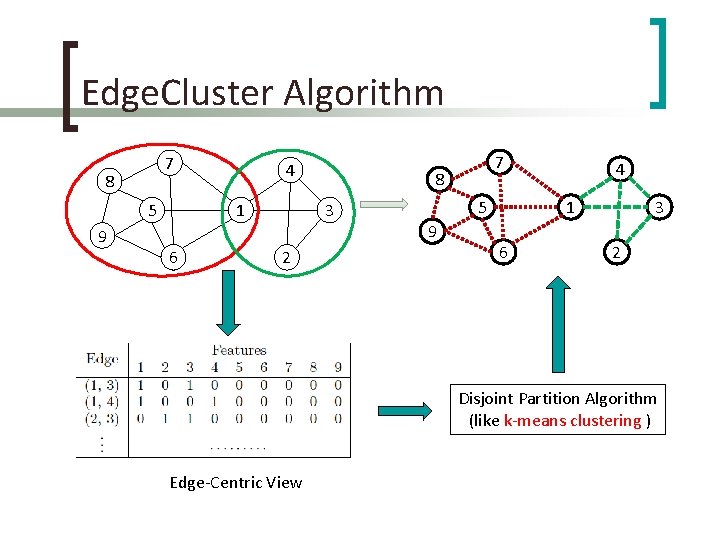
Edge. Cluster Algorithm 7 8 5 9 4 1 6 8 3 2 7 5 9 4 1 6 3 2 Disjoint Partition Algorithm (like k-means clustering ) Edge-Centric View
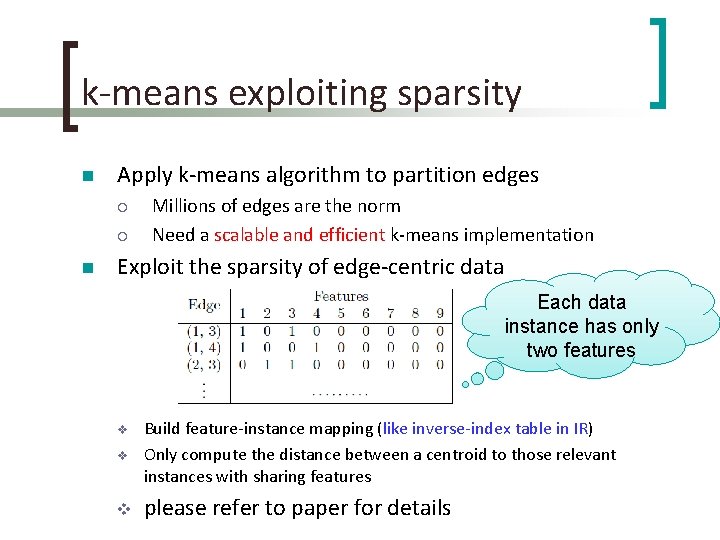
k-means exploiting sparsity n Apply k-means algorithm to partition edges ¡ ¡ n Millions of edges are the norm Need a scalable and efficient k-means implementation Exploit the sparsity of edge-centric data Each data instance has only two features v Build feature-instance mapping (like inverse-index table in IR) Only compute the distance between a centroid to those relevant instances with sharing features v please refer to paper for details v
Overview of Edge. Cluster Algorithm n Apply k-means algorithm to partition edges into disjoint sets 1. 2. 3. 4. One actor can be assigned to multiple affiliations Sparse (Theoretically Guaranteed) Scalable via k-means variant n Space: O(n+m) n Time: O(m) Easy to update with new edges and nodes n Simply update the centroids
Experiments n Questions to investigate: ¡ ¡ ¡ n Social Media Data Sets ¡ ¡ ¡ n Comparable performance with existing methods (dense social dimensions) ? Sparsity of social dimensions? Scalability? Blog Catalog: 10 K nodes, 333 K links Flickr: 80 K nodes, 6 M links You. Tube: 1. 1 M nodes, 3 M links Use blog category or group subscriptions as behavior labels
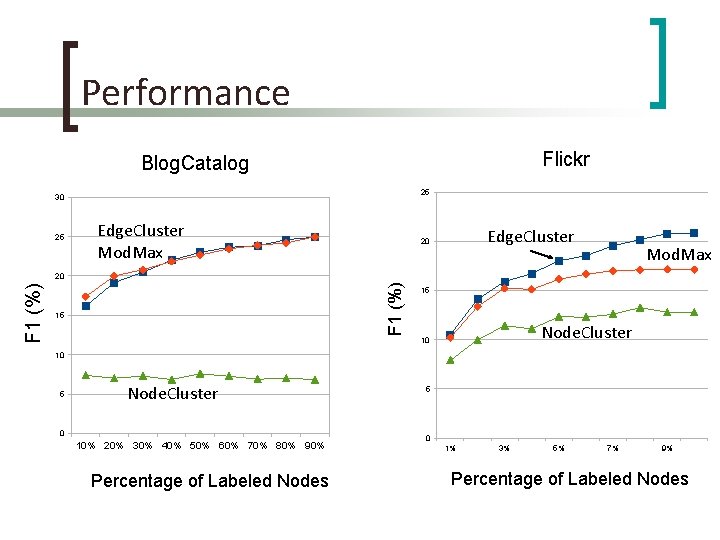
Performance Flickr Blog. Catalog 25 30 25 Edge. Cluster Mod. Max Edge. Cluster 20 Mod. Max F 1 (%) 20 15 15 Node. Cluster 10 10 5 Node. Cluster 0 10% 20% 30% 40% 50% 60% 70% 80% 90% Percentage of Labeled Nodes 5 0 1% 3% 5% 7% 9% Percentage of Labeled Nodes
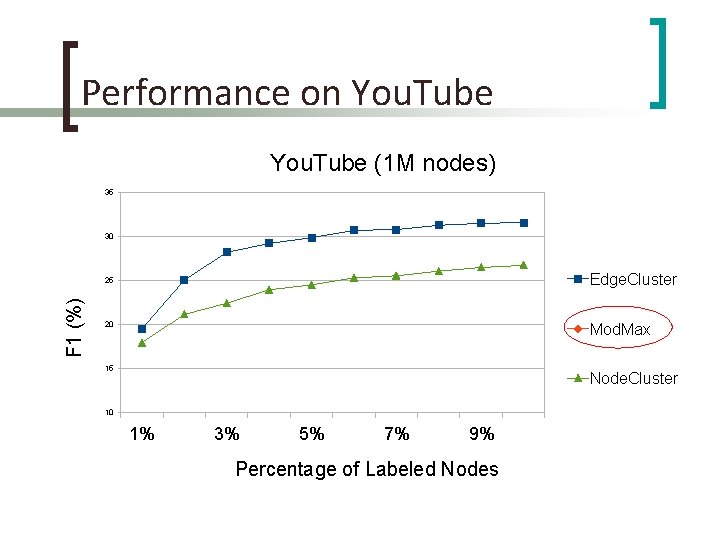
Performance on You. Tube (1 M nodes) 35 30 Edge. Cluster F 1 (%) 25 20 Mod. Max 15 Node. Cluster 10 1% 3% 5% 7% 9% Percentage of Labeled Nodes
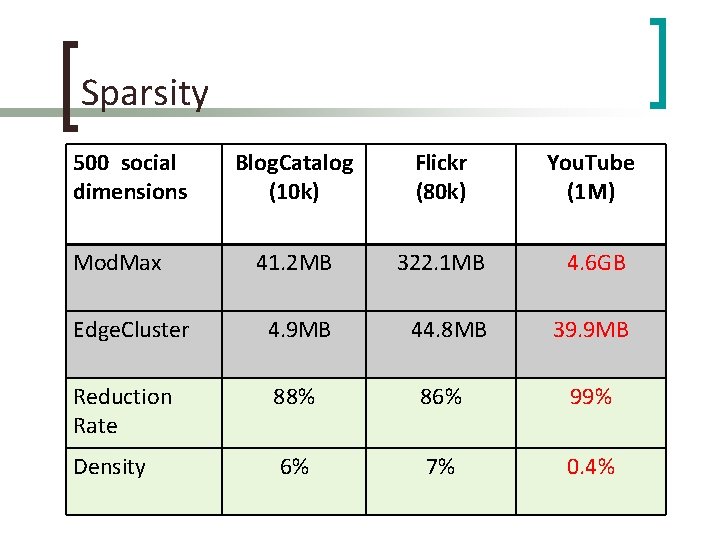
Sparsity 500 social dimensions Blog. Catalog (10 k) Flickr (80 k) You. Tube (1 M) 41. 2 MB 322. 1 MB 4. 6 GB Edge. Cluster 4. 9 MB 44. 8 MB 39. 9 MB Reduction Rate 88% 86% 99% Density 6% 7% 0. 4% Mod. Max
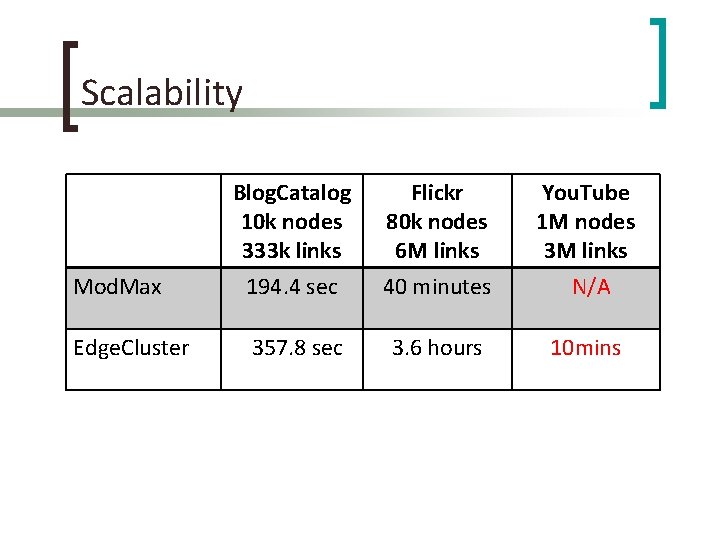
Scalability Mod. Max Edge. Cluster Blog. Catalog 10 k nodes 333 k links 194. 4 sec Flickr 80 k nodes 6 M links 40 minutes You. Tube 1 M nodes 3 M links N/A 357. 8 sec 3. 6 hours 10 mins
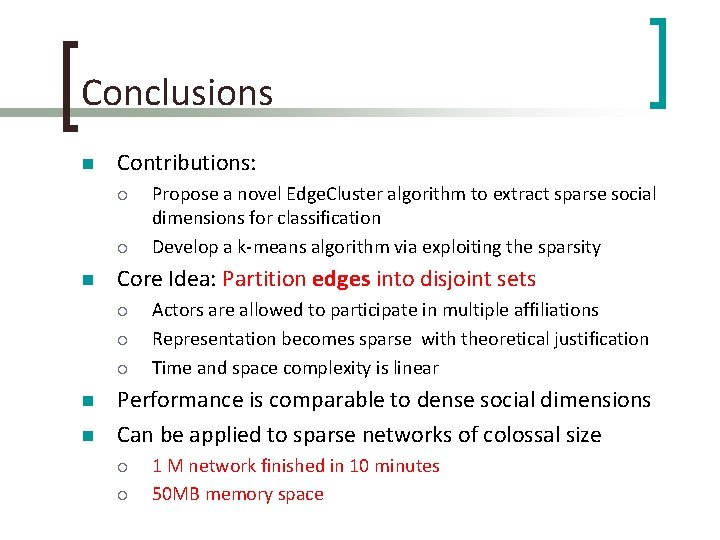
Conclusions n Contributions: ¡ ¡ n Core Idea: Partition edges into disjoint sets ¡ ¡ ¡ n n Propose a novel Edge. Cluster algorithm to extract sparse social dimensions for classification Develop a k-means algorithm via exploiting the sparsity Actors are allowed to participate in multiple affiliations Representation becomes sparse with theoretical justification Time and space complexity is linear Performance is comparable to dense social dimensions Can be applied to sparse networks of colossal size ¡ ¡ 1 M network finished in 10 minutes 50 MB memory space
Questions? Data sets and code are available at Lei Tang’s homepage. http: //www. public. asu. edu/~ltang 9/ (or Just search Lei Tang) Acknowledgement: AFOSR
References n n Lei Tang and Huan Liu. Scalable Learning of Collective Behavior based on Sparse Social Dimensions. In CIKM’ 09, 2009. Lei Tang and Huan Liu. Relational Learning via Latent Social Dimensions. In KDD’ 09, Pages 817– 826, 2009. Macskassy, S. A. and Provost, F. Classification in Networked Data: A Toolkit and a Univariate Case Study. J. Mach. Learn. Res. 8 (Dec. 2007), 935 -983. 2007 Neville, J. and Jensen, D. 2005. Leveraging relational autocorrelation with latent group models. In Proceedings of the 4 th international Workshop on Multi. Relational Mining, 2005.
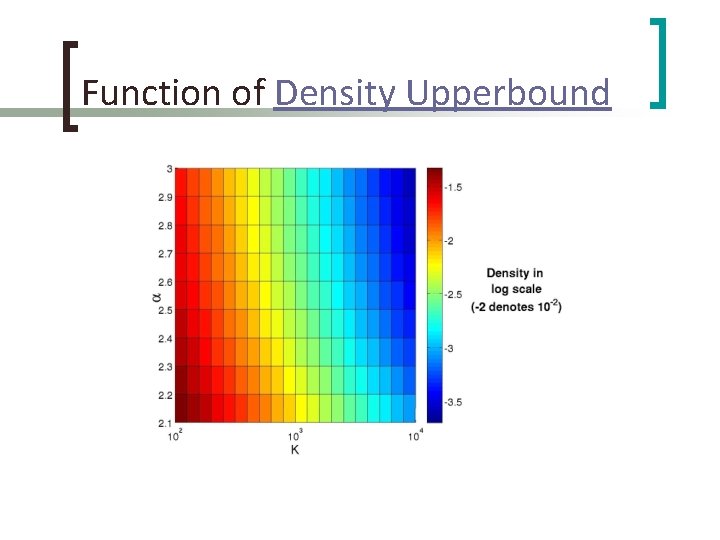
Function of Density Upperbound
- Slides: 23