
Scalable High Performance Main Memory System Using PCM
Scalable High Performance Main Memory System Using PCM Technology Moinuddin K. Qureshi Viji Srinivasan and Jude Rivers IBM T. J. Watson Research Center, Yorktown Heights, NY International Symposium on Computer Architecture (ISCA-2009) 1/9/2022 © 2007 IBM Corporation

Main Memory Capacity Wall More cores in system More concurrency Larger working set Demand for main memory capacity continues to increase Main Memory System consisting of DRAM are hitting: 1. Cost wall: Major % of cost of large servers is main memory 2. Scaling wall: DRAM scaling to small technology is challenge 3. Power wall: IBM P 670 Server Processor Memory Small (4 proc, 16 GB) 384 Watts 314 Watts Large (16 proc, 128 GB) 840 Watts 1223 Watts Source: Lefurgy et al. IEEE Computer 2003 Need a practical solution to increase main-memory capacity 2 © 2007 IBM Corporation
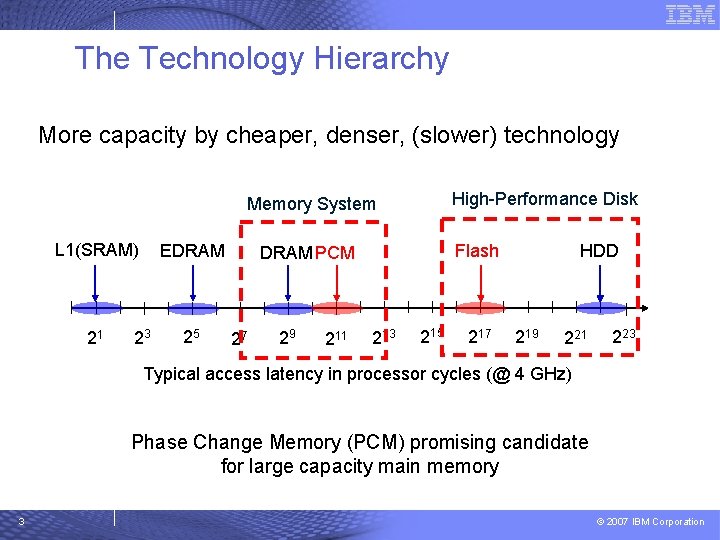
The Technology Hierarchy More capacity by cheaper, denser, (slower) technology High-Performance Disk Memory System L 1(SRAM) 21 EDRAM 23 25 27 29 211 HDD Flash DRAM PCM 213 215 217 219 221 223 Typical access latency in processor cycles (@ 4 GHz) Phase Change Memory (PCM) promising candidate for large capacity main memory 3 © 2007 IBM Corporation
Outline q q q 4 Introduction What is PCM ? Hybrid Memory System Evaluation Lifetime Analysis Summary © 2007 IBM Corporation
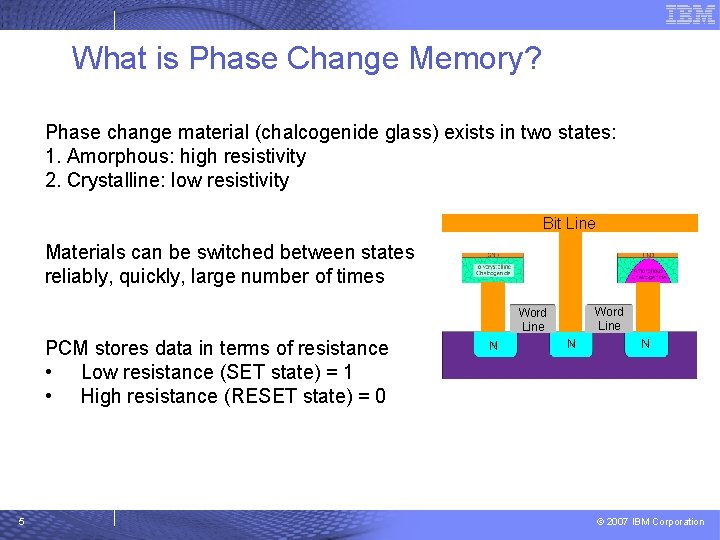
What is Phase Change Memory? Phase change material (chalcogenide glass) exists in two states: 1. Amorphous: high resistivity 2. Crystalline: low resistivity Bit Line Materials can be switched between states reliably, quickly, large number of times Word Line PCM stores data in terms of resistance • Low resistance (SET state) = 1 • High resistance (RESET state) = 0 5 N N N I © 2007 IBM Corporation
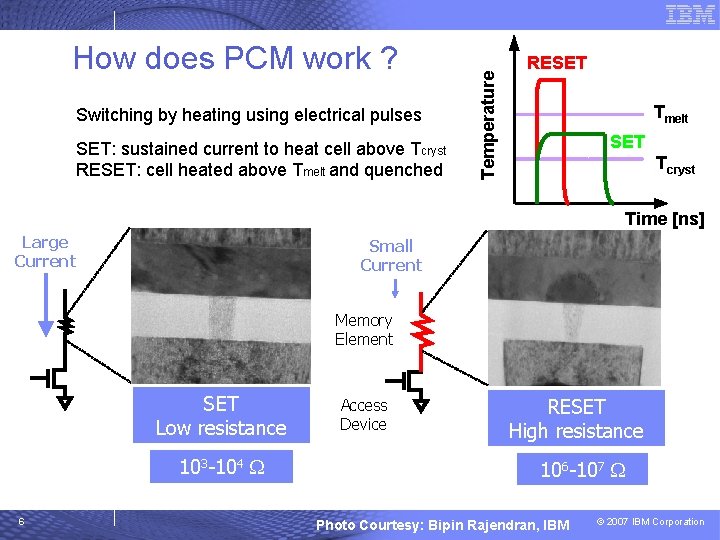
Switching by heating using electrical pulses SET: sustained current to heat cell above Tcryst RESET: cell heated above Tmelt and quenched Temperature How does PCM work ? RESET Tmelt SET Tcryst Time [ns] Large Current Small Current Memory Element SET Low resistance 103 -104 W 6 Access Device RESET High resistance 106 -107 W Photo Courtesy: Bipin Rajendran, IBM © 2007 IBM Corporation
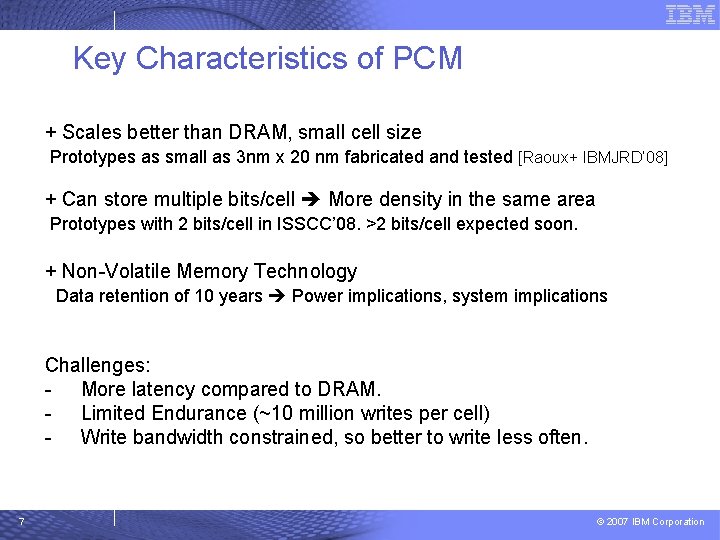
Key Characteristics of PCM + Scales better than DRAM, small cell size Prototypes as small as 3 nm x 20 nm fabricated and tested [Raoux+ IBMJRD’ 08] + Can store multiple bits/cell More density in the same area Prototypes with 2 bits/cell in ISSCC’ 08. >2 bits/cell expected soon. + Non-Volatile Memory Technology Data retention of 10 years Power implications, system implications Challenges: - More latency compared to DRAM. - Limited Endurance (~10 million writes per cell) - Write bandwidth constrained, so better to write less often. 7 © 2007 IBM Corporation
Outline q q q 8 Introduction What is PCM ? Hybrid Memory System Evaluation Lifetime Analysis Summary © 2007 IBM Corporation
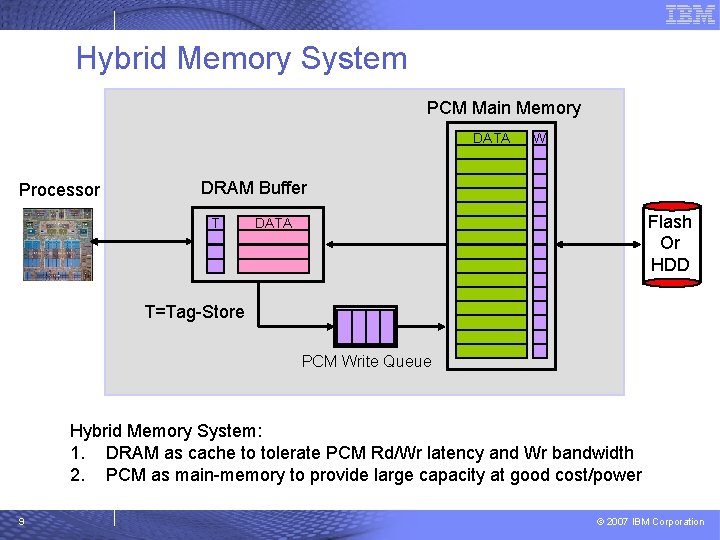
Hybrid Memory System PCM Main Memory DATA Processor W DRAM Buffer T Flash Or HDD DATA T=Tag-Store PCM Write Queue Hybrid Memory System: 1. DRAM as cache to tolerate PCM Rd/Wr latency and Wr bandwidth 2. PCM as main-memory to provide large capacity at good cost/power 9 © 2007 IBM Corporation
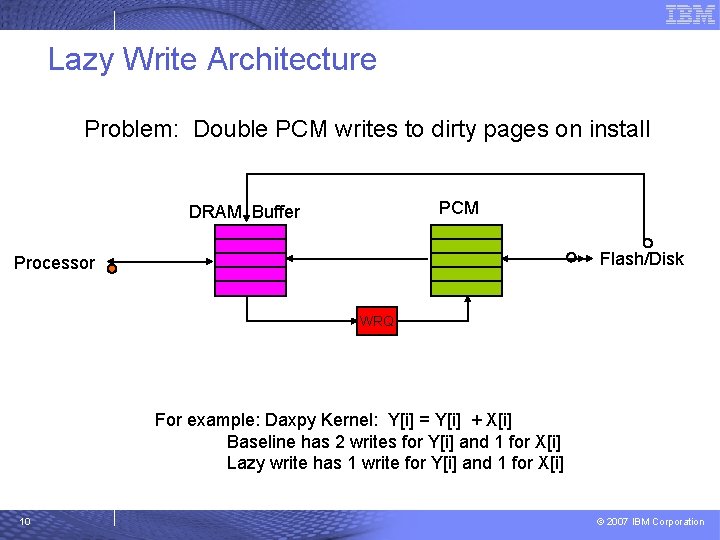
Lazy Write Architecture Problem: Double PCM writes to dirty pages on install PCM DRAM Buffer Flash/Disk Processor WRQ For example: Daxpy Kernel: Y[i] = Y[i] + X[i] Baseline has 2 writes for Y[i] and 1 for X[i] Lazy write has 1 write for Y[i] and 1 for X[i] 10 © 2007 IBM Corporation
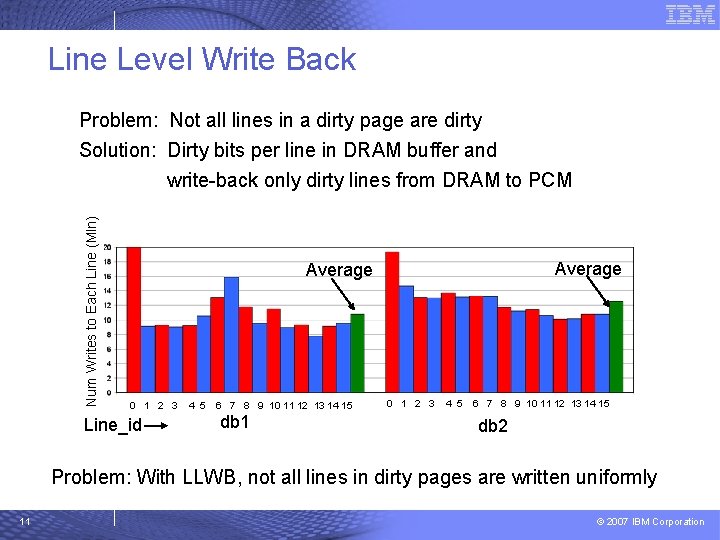
Line Level Write Back Num Writes to Each Line (Mln) Problem: Not all lines in a dirty page are dirty Solution: Dirty bits per line in DRAM buffer and write-back only dirty lines from DRAM to PCM Average 0 1 2 3 Line_id 4 5 6 7 8 9 10 11 12 13 14 15 db 1 0 1 2 3 4 5 6 7 8 9 10 11 12 13 14 15 db 2 Problem: With LLWB, not all lines in dirty pages are written uniformly 11 © 2007 IBM Corporation
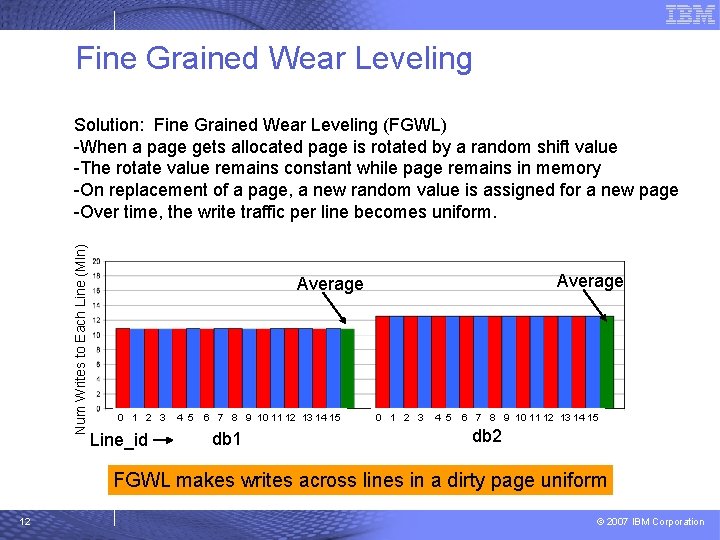
Fine Grained Wear Leveling Num Writes to Each Line (Mln) Solution: Fine Grained Wear Leveling (FGWL) -When a page gets allocated page is rotated by a random shift value -The rotate value remains constant while page remains in memory -On replacement of a page, a new random value is assigned for a new page -Over time, the write traffic per line becomes uniform. Average 0 1 2 3 Line_id 4 5 6 7 8 9 10 11 12 13 14 15 db 1 0 1 2 3 4 5 6 7 8 9 10 11 12 13 14 15 db 2 FGWL makes writes across lines in a dirty page uniform 12 © 2007 IBM Corporation
Outline q q q 13 Introduction What is PCM ? Hybrid Memory System Evaluation Lifetime Analysis Summary © 2007 IBM Corporation
Evaluation Framework Trace Driven Simulator: 16 -core system (simple core), 8 GB DRAM main-memory at 320 cycles HDD (2 ms) with Flash (32 us) with Flash hit-rate of 99% Workloads: Database workloads & Data parallel kernels 1. Database workloads: db 1 and db 2 2. Unix utilities: qsort and binary search 3. Data Mining : K-means and Gauss Seidal 4. Streaming: DAXPY and Vector Dot Product Assumption: PCM 4 X denser & 4 X slower than DRAM 32 GB @ 1280 cycle read latency 14 © 2007 IBM Corporation
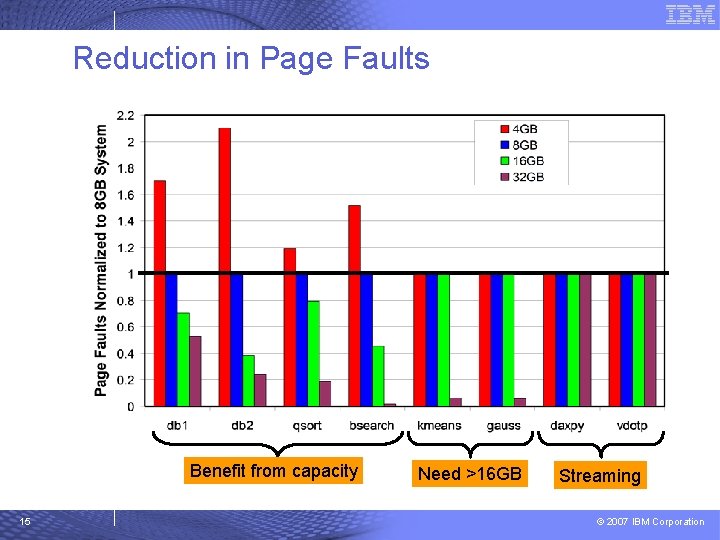
Reduction in Page Faults Benefit from capacity 15 Need >16 GB Streaming © 2007 IBM Corporation
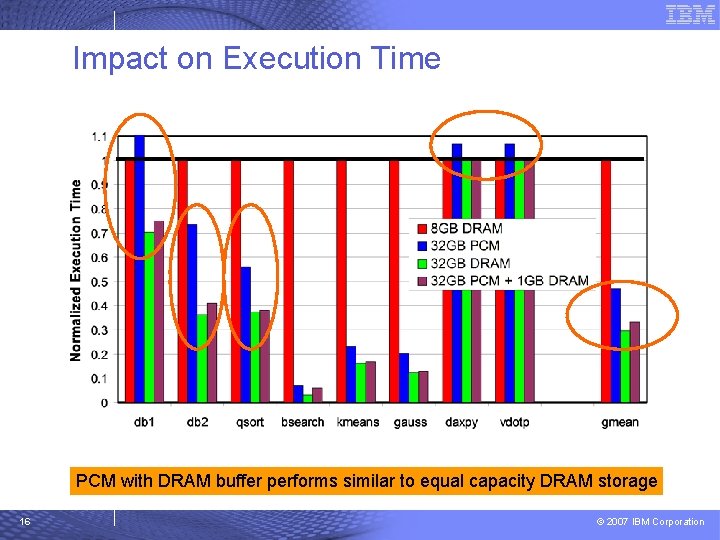
Impact on Execution Time PCM with DRAM buffer performs similar to equal capacity DRAM storage 16 © 2007 IBM Corporation
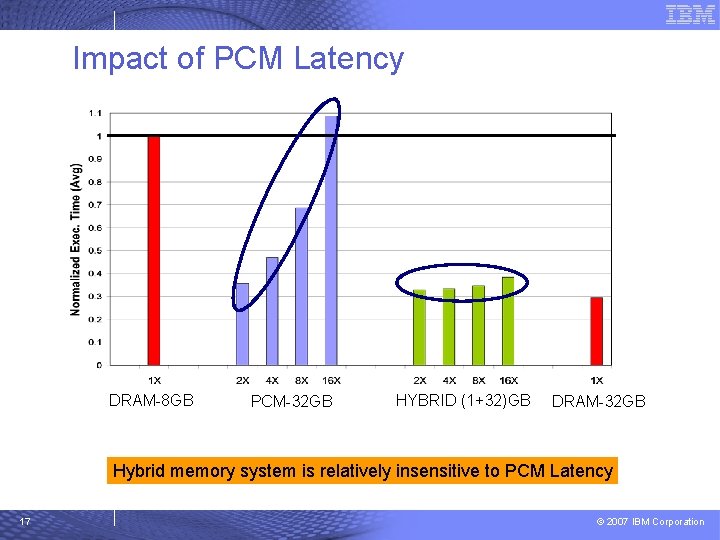
Impact of PCM Latency DRAM-8 GB PCM-32 GB HYBRID (1+32)GB DRAM-32 GB Hybrid memory system is relatively insensitive to PCM Latency 17 © 2007 IBM Corporation
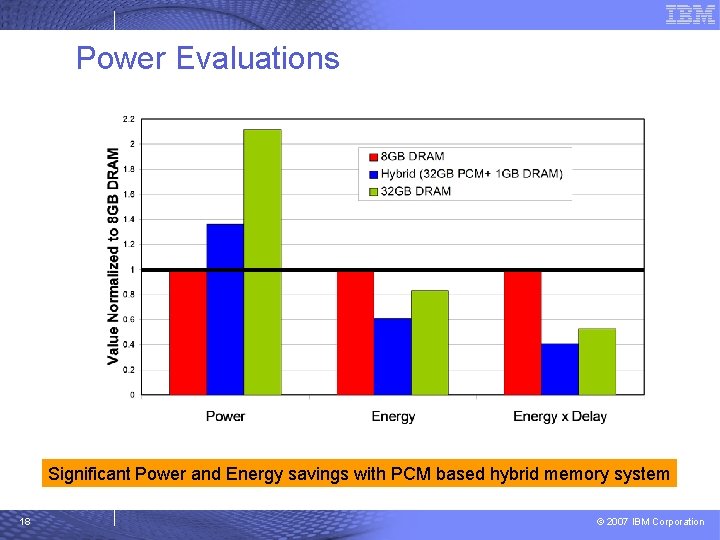
Power Evaluations Significant Power and Energy savings with PCM based hybrid memory system 18 © 2007 IBM Corporation
Outline q q q 19 Introduction What is PCM ? Hybrid Memory System Evaluation Lifetime Analysis Summary © 2007 IBM Corporation
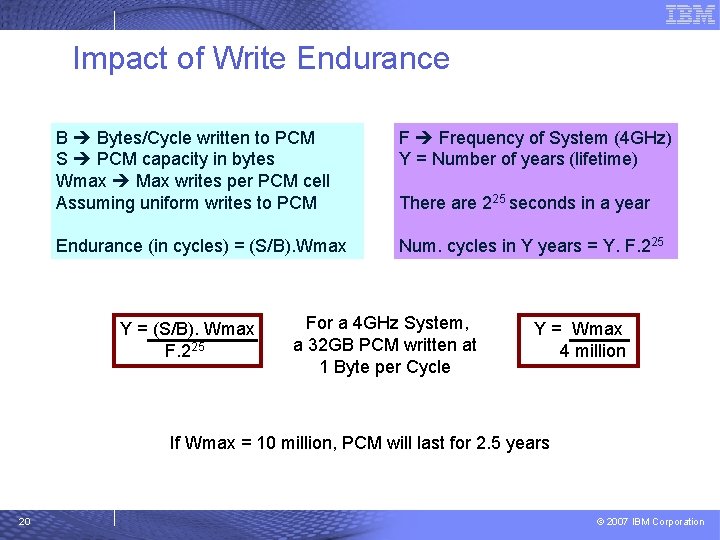
Impact of Write Endurance B Bytes/Cycle written to PCM S PCM capacity in bytes Wmax Max writes per PCM cell Assuming uniform writes to PCM F Frequency of System (4 GHz) Y = Number of years (lifetime) Endurance (in cycles) = (S/B). Wmax Num. cycles in Y years = Y. F. 225 Y = (S/B). Wmax F. 225 There are 225 seconds in a year For a 4 GHz System, a 32 GB PCM written at 1 Byte per Cycle Y = Wmax 4 million If Wmax = 10 million, PCM will last for 2. 5 years 20 © 2007 IBM Corporation
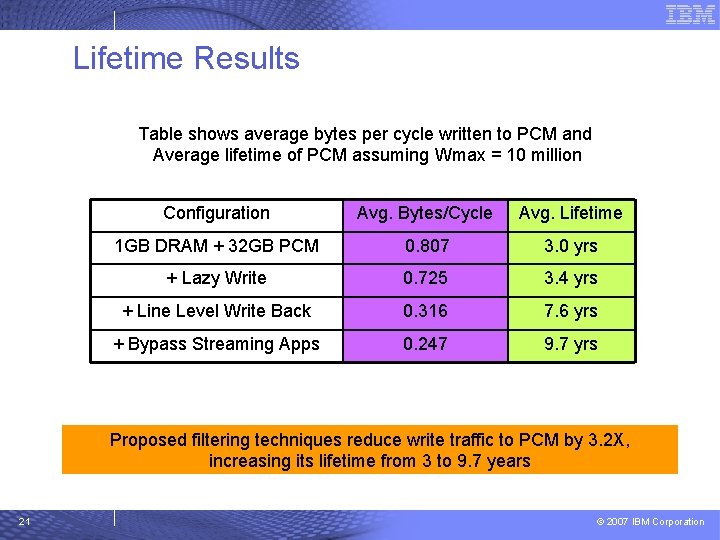
Lifetime Results Table shows average bytes per cycle written to PCM and Average lifetime of PCM assuming Wmax = 10 million Configuration Avg. Bytes/Cycle Avg. Lifetime 1 GB DRAM + 32 GB PCM 0. 807 3. 0 yrs + Lazy Write 0. 725 3. 4 yrs + Line Level Write Back 0. 316 7. 6 yrs + Bypass Streaming Apps 0. 247 9. 7 yrs Proposed filtering techniques reduce write traffic to PCM by 3. 2 X, increasing its lifetime from 3 to 9. 7 years 21 © 2007 IBM Corporation
Outline q q q 22 Introduction What is PCM ? Hybrid Memory System Evaluation Lifetime Analysis Summary © 2007 IBM Corporation
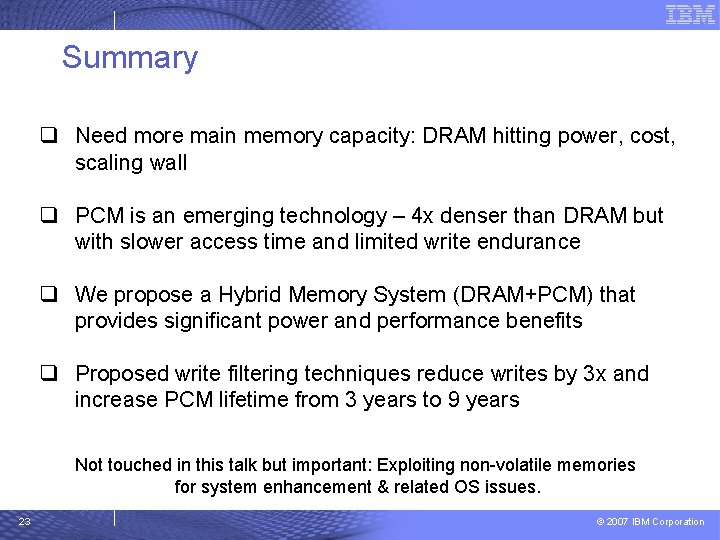
Summary q Need more main memory capacity: DRAM hitting power, cost, scaling wall q PCM is an emerging technology – 4 x denser than DRAM but with slower access time and limited write endurance q We propose a Hybrid Memory System (DRAM+PCM) that provides significant power and performance benefits q Proposed write filtering techniques reduce writes by 3 x and increase PCM lifetime from 3 years to 9 years Not touched in this talk but important: Exploiting non-volatile memories for system enhancement & related OS issues. 23 © 2007 IBM Corporation

Thanks! 24 © 2007 IBM Corporation
- Slides: 24