
Scalable Distributed Memory Multiprocessors Outline Scalability physical bandwidth
Scalable Distributed Memory Multiprocessors
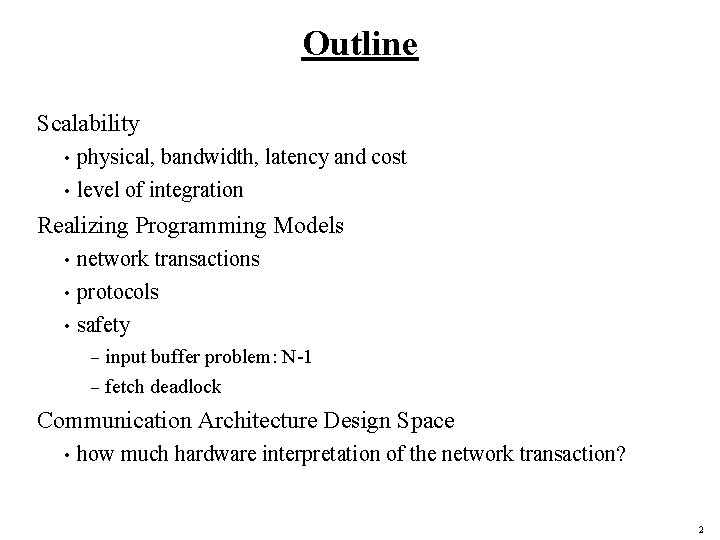
Outline Scalability physical, bandwidth, latency and cost • level of integration • Realizing Programming Models network transactions • protocols • safety • input buffer problem: N-1 – fetch deadlock – Communication Architecture Design Space • how much hardware interpretation of the network transaction? 2
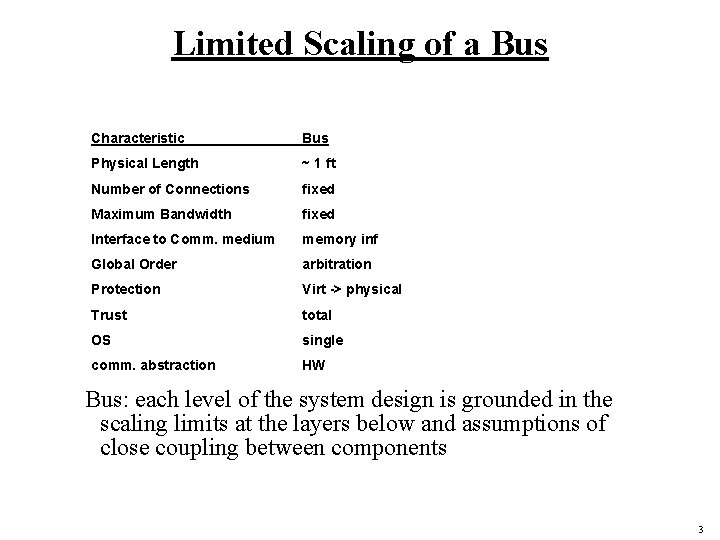
Limited Scaling of a Bus Characteristic Bus Physical Length ~ 1 ft Number of Connections fixed Maximum Bandwidth fixed Interface to Comm. medium memory inf Global Order arbitration Protection Virt -> physical Trust total OS single comm. abstraction HW Bus: each level of the system design is grounded in the scaling limits at the layers below and assumptions of close coupling between components 3
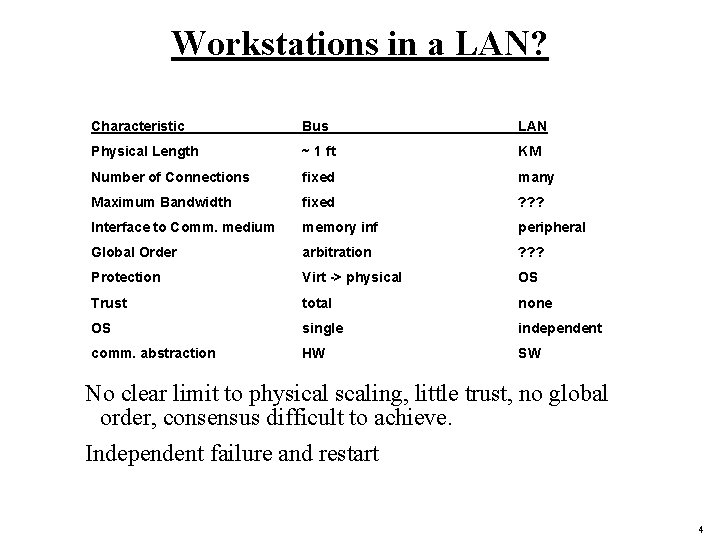
Workstations in a LAN? Characteristic Bus LAN Physical Length ~ 1 ft KM Number of Connections fixed many Maximum Bandwidth fixed ? ? ? Interface to Comm. medium memory inf peripheral Global Order arbitration ? ? ? Protection Virt -> physical OS Trust total none OS single independent comm. abstraction HW SW No clear limit to physical scaling, little trust, no global order, consensus difficult to achieve. Independent failure and restart 4
Scalable Machines What are the design trade-offs for the spectrum of machines between? specialize or commodity nodes? • capability of node-to-network interface • supporting programming models? • What does scalability mean? avoids inherent design limits on resources • bandwidth increases with P • latency does not • cost increases slowly with P • 5
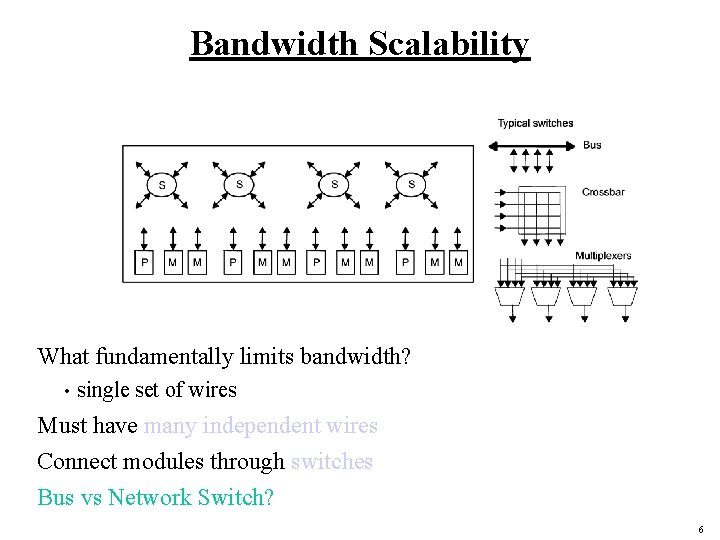
Bandwidth Scalability What fundamentally limits bandwidth? • single set of wires Must have many independent wires Connect modules through switches Bus vs Network Switch? 6
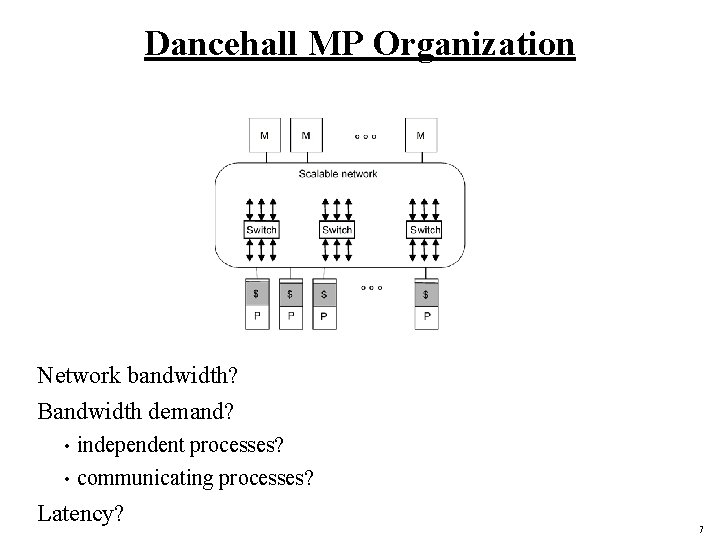
Dancehall MP Organization Network bandwidth? Bandwidth demand? independent processes? • communicating processes? • Latency? 7
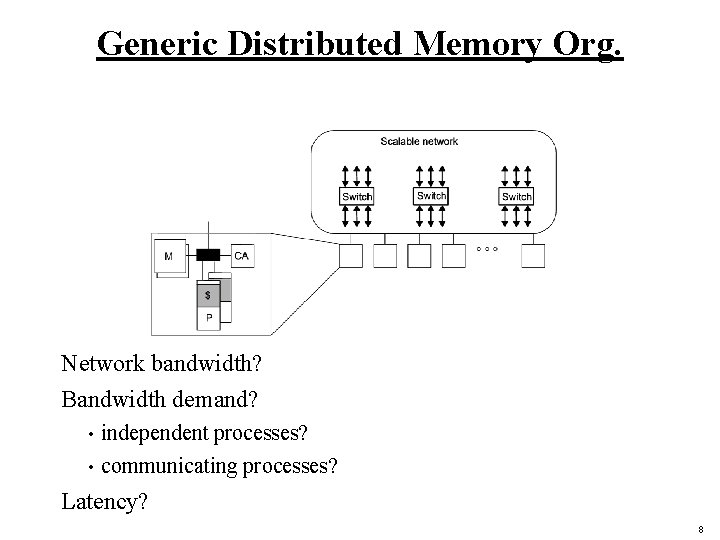
Generic Distributed Memory Org. Network bandwidth? Bandwidth demand? independent processes? • communicating processes? • Latency? 8
Key Property Large number of independent communication paths between nodes => allow a large number of concurrent transactions using different wires initiated independently no global arbitration effect of a transaction only visible to the nodes involved • effects propagated through additional transactions 9
Latency Scaling T(n) = Overhead + Channel Time + Routing Delay Overhead? Channel Time(n) = n/B --- BW at bottleneck Routing. Delay(h, n) 10
Typical example max distance: log n number of switches: a n log n overhead = 1 us, BW = 64 MB/s, 200 ns per hop Pipelined T 64(128) = 1. 0 us + 2. 0 us + 6 hops * 0. 2 us/hop = 4. 2 us T 1024(128) = 1. 0 us + 2. 0 us + 10 hops * 0. 2 us/hop = 5. 0 us Store and Forward T 64 sf(128) = 1. 0 us + 6 hops * (2. 0 + 0. 2) us/hop = 14. 2 us T 1024 sf(128) = 1. 0 us + 10 hops * (2. 0 + 0. 2) us/hop = 23 us 11
Cost Scaling cost(p, m) = fixed cost + incremental cost (p, m) Bus Based SMP? Ratio of processors : memory : network : I/O ? Parallel efficiency(p) = Speedup(P) / P Costup(p) = Cost(p) / Cost(1) Cost-effective: speedup(p) > costup(p) Is super-linear speedup 12
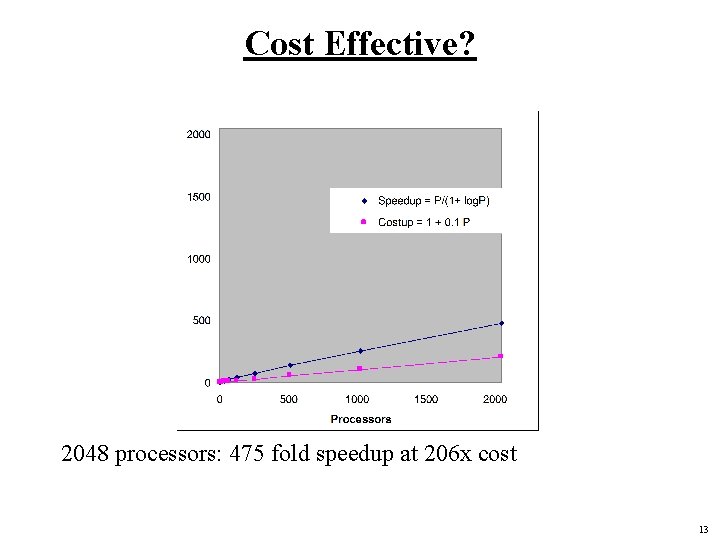
Cost Effective? 2048 processors: 475 fold speedup at 206 x cost 13
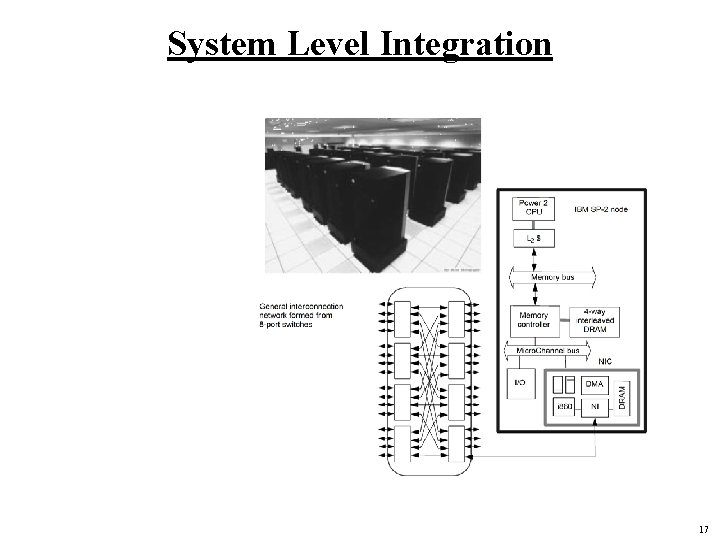
Physical Scaling Chip-level integration Board-level System level 14
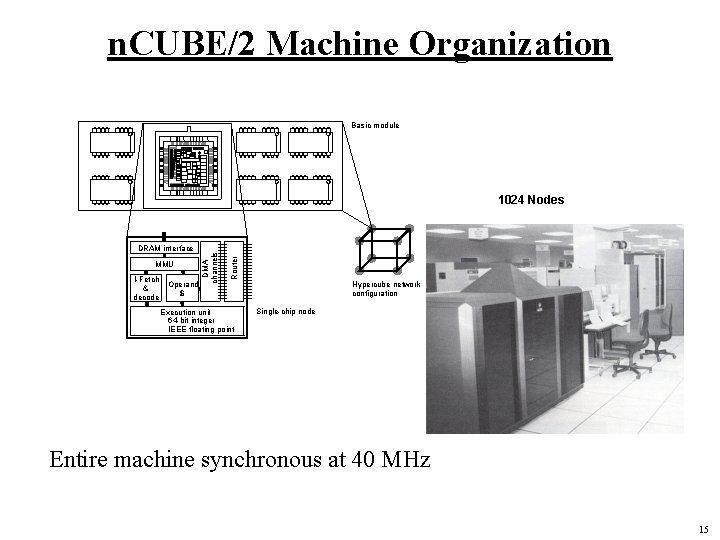
n. CUBE/2 Machine Organization Basic module MMU I-Fetch & decode Operand $ Router DRAM interface DMA channels 1024 Nodes Execution unit 64 -bit integer IEEE floating point Hypercube network configuration Single-chip node Entire machine synchronous at 40 MHz 15
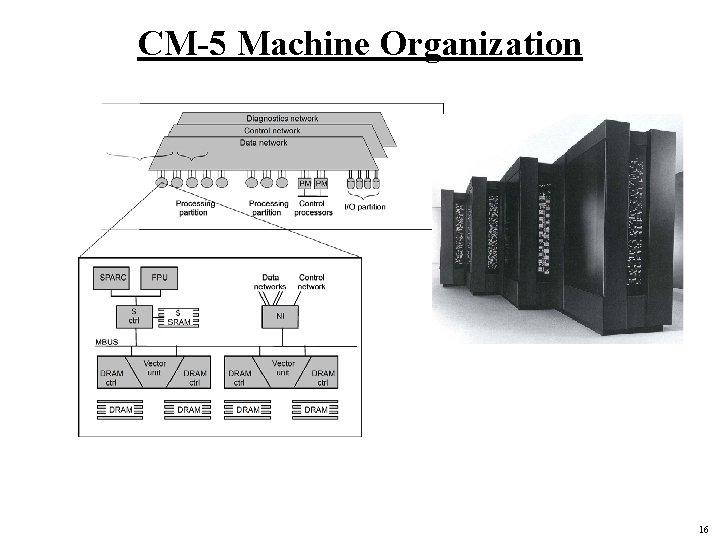
CM-5 Machine Organization 16
System Level Integration 17
Outline Scalability physical, bandwidth, latency and cost • level of integration • Realizing Programming Models network transactions • protocols • safety • input buffer problem: N-1 – fetch deadlock – Communication Architecture Design Space • how much hardware interpretation of the network transaction? 18
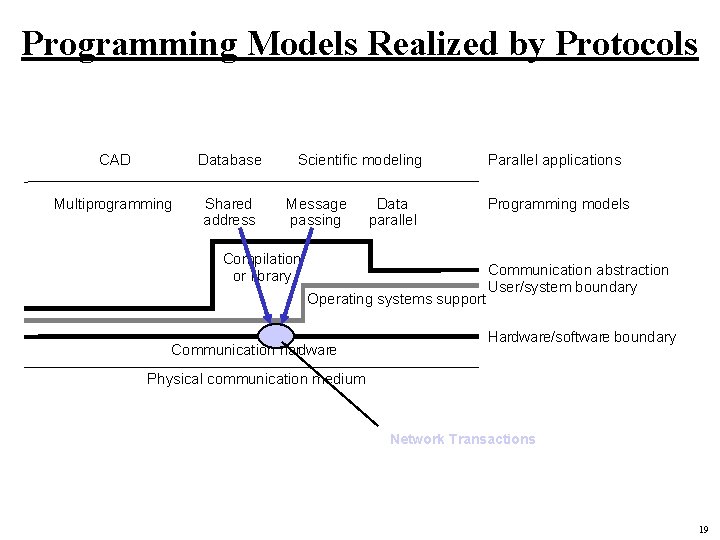
Programming Models Realized by Protocols CAD Database Multiprogramming Shared address Scientific modeling Message passing Data parallel Compilation or library Operating systems support Communication hardware Parallel applications Programming models Communication abstraction User/system boundary Hardware/software boundary Physical communication medium Network Transactions 19
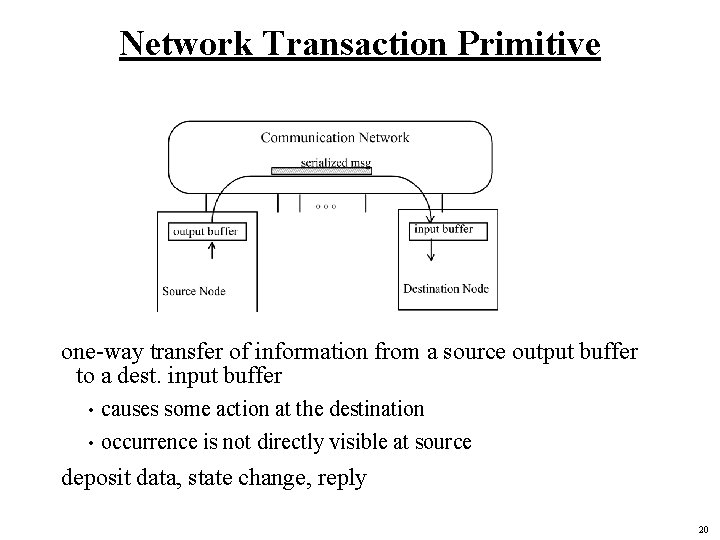
Network Transaction Primitive one-way transfer of information from a source output buffer to a dest. input buffer causes some action at the destination • occurrence is not directly visible at source • deposit data, state change, reply 20
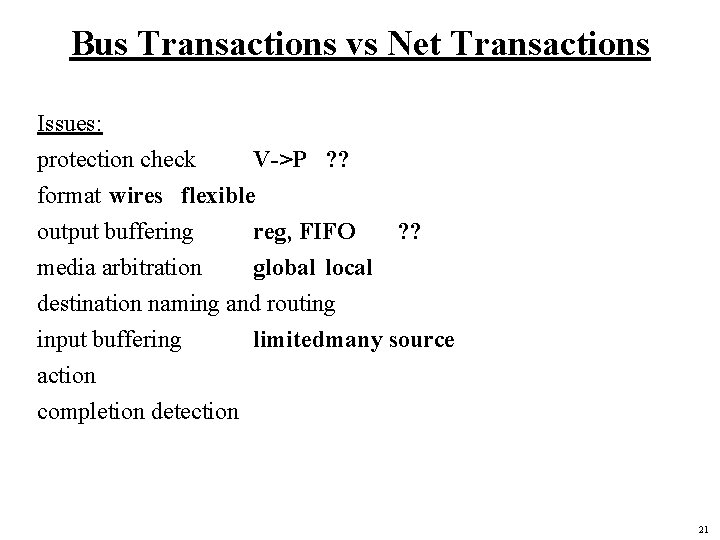
Bus Transactions vs Net Transactions Issues: protection check V->P ? ? format wires flexible output buffering reg, FIFO ? ? media arbitration global local destination naming and routing input buffering limitedmany source action completion detection 21
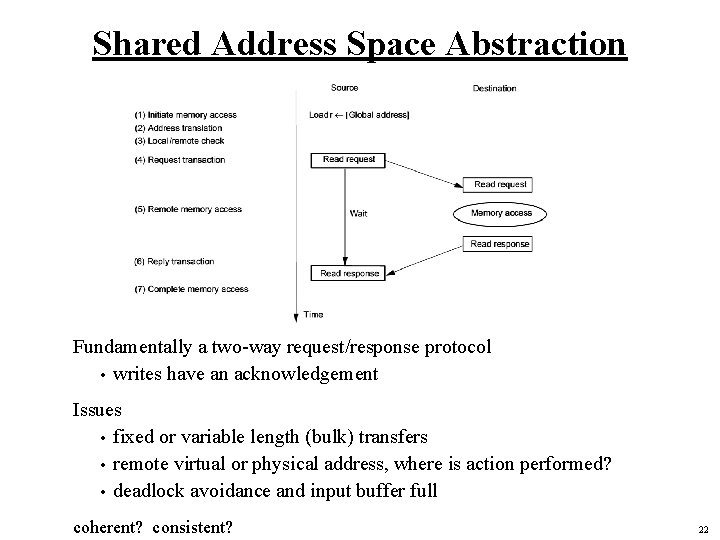
Shared Address Space Abstraction Fundamentally a two-way request/response protocol • writes have an acknowledgement Issues • fixed or variable length (bulk) transfers • remote virtual or physical address, where is action performed? • deadlock avoidance and input buffer full coherent? consistent? 22
The Fetch Deadlock Problem Even if a node cannot issue a request, it must sink network transactions. Incoming transaction may be a request, which will generate a response. Closed system (finite buffering) 23
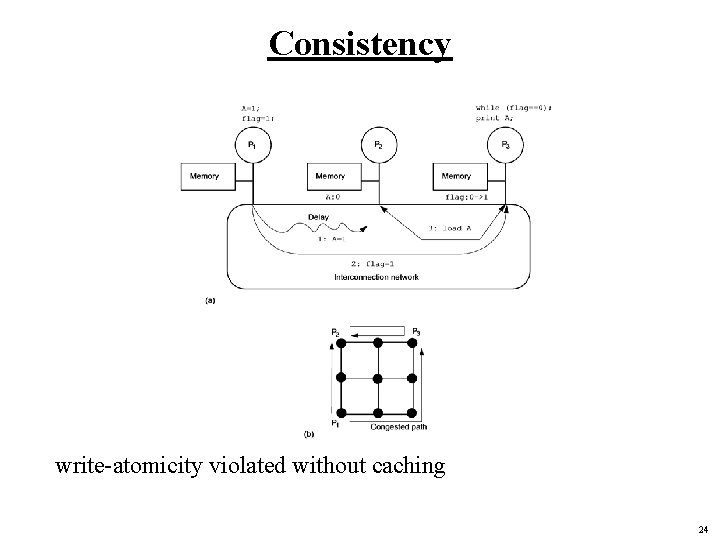
Consistency write-atomicity violated without caching 24
Key Properties of SAS Abstraction Source and destination data addresses are specified by the source of the request • a degree of logical coupling and trust no storage logically “outside the application address space(s)” – may employ temporary buffers for transport Operations are fundamentally request response Remote operation can be performed on remote memory • logically does not require intervention of the remote processor 25
Message passing Bulk transfers Complex synchronization semantics more complex protocols • More complex action • Synchronous Send completes after matching recv and source data sent • Receive completes after data transfer complete from matching send • Asynchronous • Send completes after send buffer may be reused 26
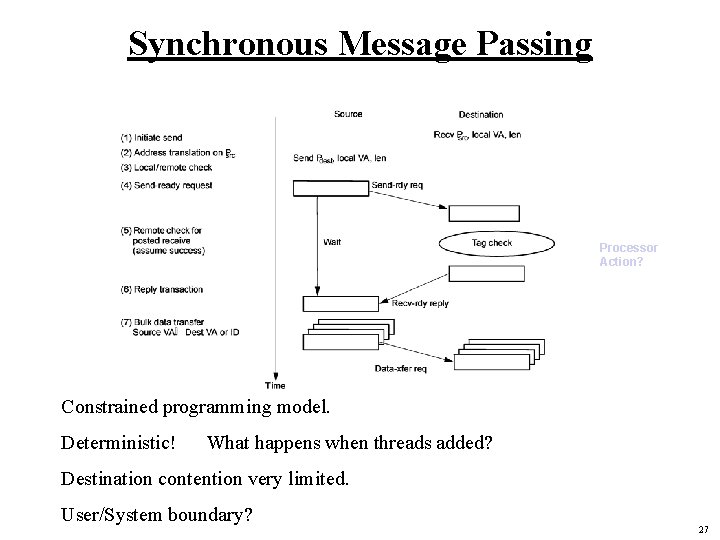
Synchronous Message Passing Processor Action? Constrained programming model. Deterministic! What happens when threads added? Destination contention very limited. User/System boundary? 27
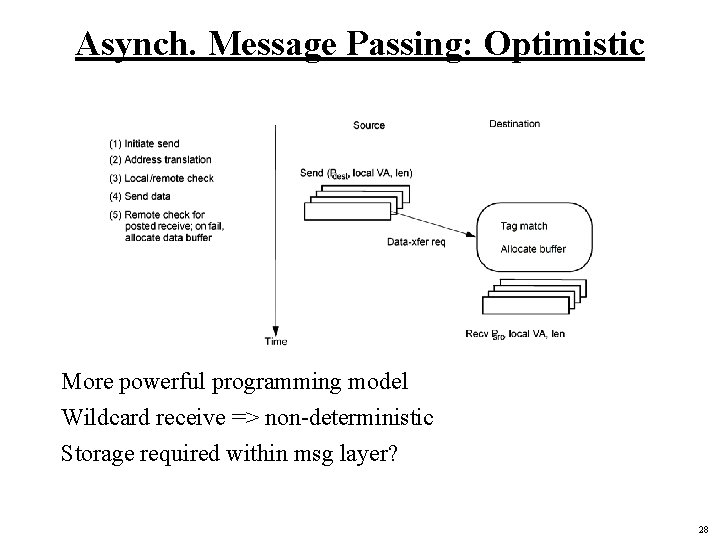
Asynch. Message Passing: Optimistic More powerful programming model Wildcard receive => non-deterministic Storage required within msg layer? 28
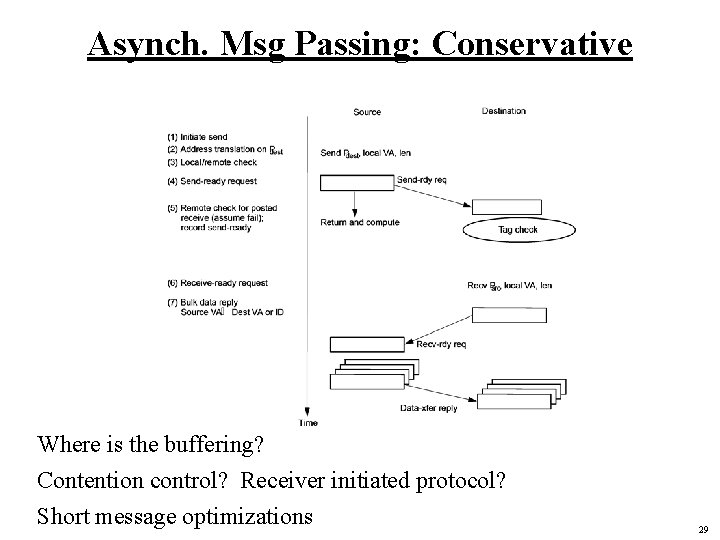
Asynch. Msg Passing: Conservative Where is the buffering? Contention control? Receiver initiated protocol? Short message optimizations 29
Key Features of Msg Passing Abstraction Source knows send data address, dest. knows receive data address • after handshake they both know both Arbitrary storage “outside the local address spaces” may post many sends before any receives • non-blocking asynchronous sends reduces the requirement to an arbitrary number of descriptors • – fine print says these are limited too Fundamentally a 3 -phase transaction includes a request / response • can use optimisitic 1 -phase in limited “Safe” cases • – credit scheme 30
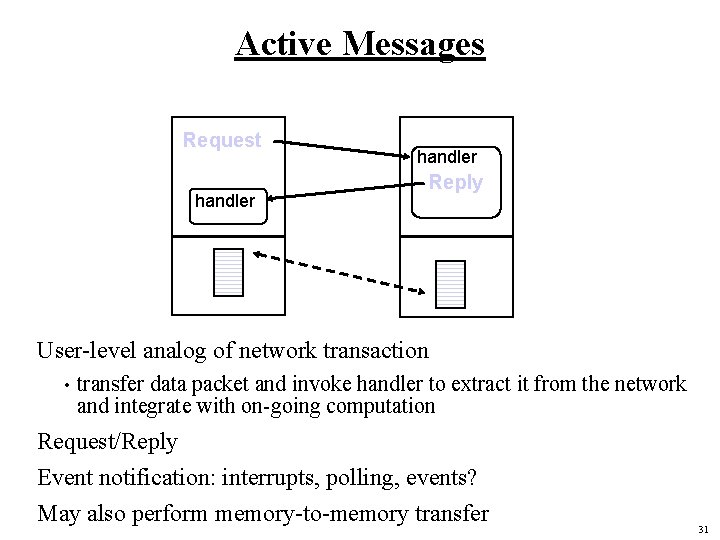
Active Messages Request handler Reply User-level analog of network transaction • transfer data packet and invoke handler to extract it from the network and integrate with on-going computation Request/Reply Event notification: interrupts, polling, events? May also perform memory-to-memory transfer 31
Common Challenges Input buffer overflow N-1 queue over-commitment => must slow sources • reserve space per source (credit) • – • when available for reuse? • Ack or Higher level Refuse input when full backpressure in reliable network – tree saturation – deadlock free – what happens to traffic not bound for congested dest? – Reserve ack back channel • drop packets • Utilize higher-level semantics of programming model • 32
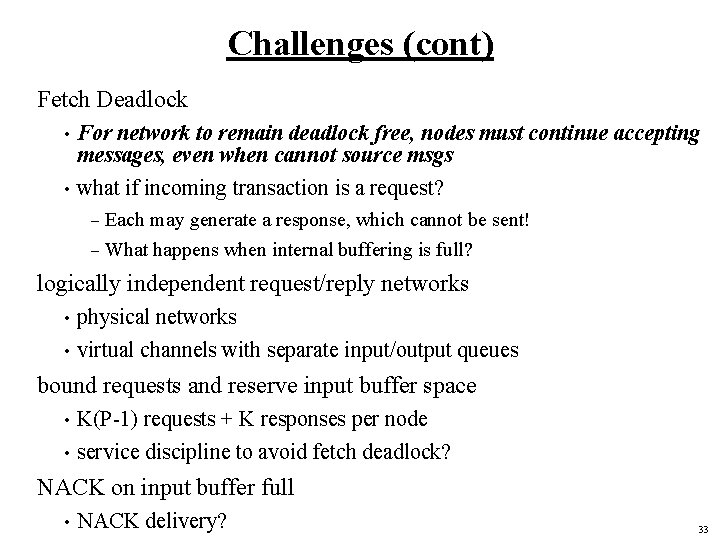
Challenges (cont) Fetch Deadlock For network to remain deadlock free, nodes must continue accepting messages, even when cannot source msgs • what if incoming transaction is a request? • Each may generate a response, which cannot be sent! – What happens when internal buffering is full? – logically independent request/reply networks physical networks • virtual channels with separate input/output queues • bound requests and reserve input buffer space K(P-1) requests + K responses per node • service discipline to avoid fetch deadlock? • NACK on input buffer full • NACK delivery? 33
Challenges in Realizing Prog. Models in the Large One-way transfer of information No global knowledge, nor global control • barriers, scans, reduce, global-OR give fuzzy global state Very large number of concurrent transactions Management of input buffer resources • many sources can issue a request and over-commit destination before any see the effect Latency is large enough that you are tempted to “take risks” optimistic protocols • large transfers • dynamic allocation • Many more degrees of freedom in design and engineering of these system 34
Summary Scalability physical, bandwidth, latency and cost • level of integration • Realizing Programming Models network transactions • protocols • safety • input buffer problem: N-1 – fetch deadlock – Communication Architecture Design Space • how much hardware interpretation of the network transaction? 35
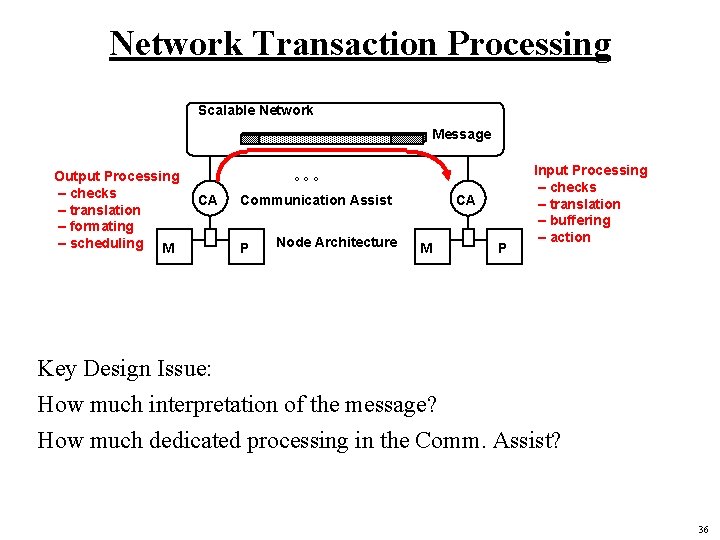
Network Transaction Processing Scalable Network Message Output Processing – checks – translation – formating – scheduling M CA °°° Communication Assist P Node Architecture CA M P Input Processing – checks – translation – buffering – action Key Design Issue: How much interpretation of the message? How much dedicated processing in the Comm. Assist? 36
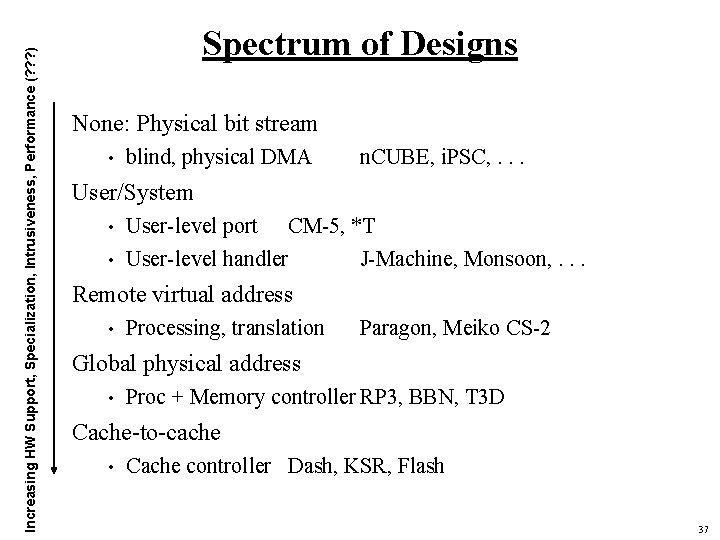
Increasing HW Support, Specialization, Intrusiveness, Performance (? ? ? ) Spectrum of Designs None: Physical bit stream • blind, physical DMA n. CUBE, i. PSC, . . . User/System User-level port CM-5, *T • User-level handler J-Machine, Monsoon, . . . • Remote virtual address • Processing, translation Paragon, Meiko CS-2 Global physical address • Proc + Memory controller RP 3, BBN, T 3 D Cache-to-cache • Cache controller Dash, KSR, Flash 37
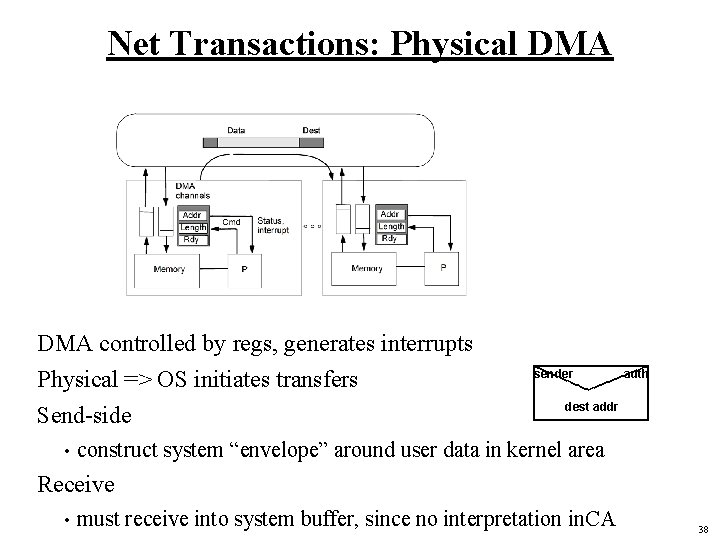
Net Transactions: Physical DMA controlled by regs, generates interrupts Physical => OS initiates transfers Send-side • sender auth dest addr construct system “envelope” around user data in kernel area Receive • must receive into system buffer, since no interpretation in. CA 38
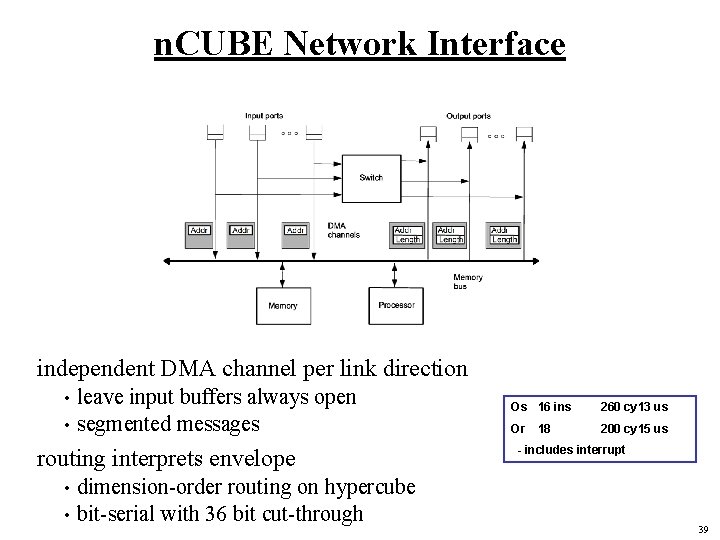
n. CUBE Network Interface independent DMA channel per link direction • • leave input buffers always open segmented messages routing interprets envelope • • dimension-order routing on hypercube bit-serial with 36 bit cut-through Os 16 ins 260 cy 13 us Or 200 cy 15 us 18 - includes interrupt 39
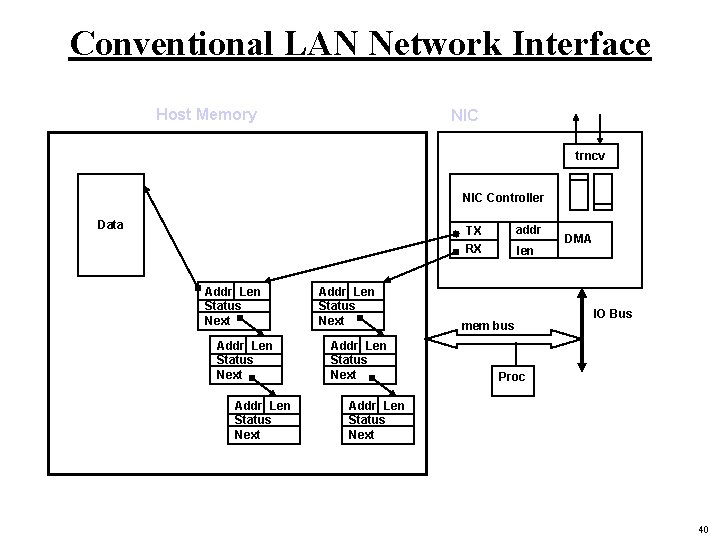
Conventional LAN Network Interface Host Memory NIC trncv NIC Controller Data addr TX RX Addr Len Status Next Addr Len Status Next len mem bus DMA IO Bus Proc Addr Len Status Next 40
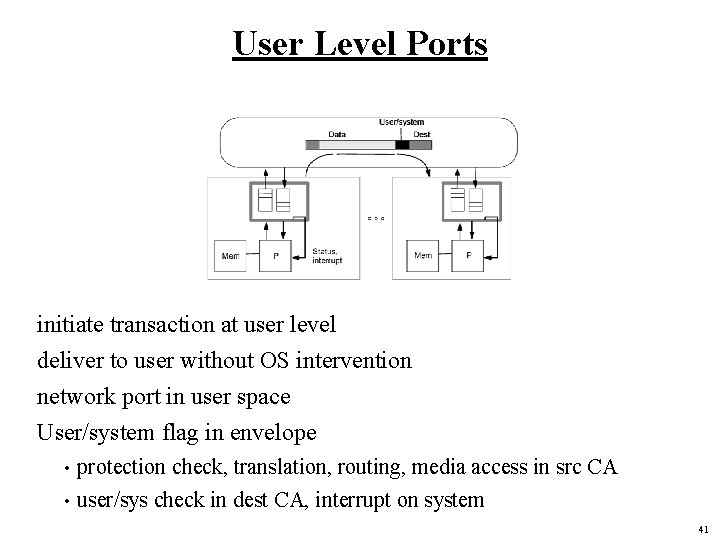
User Level Ports initiate transaction at user level deliver to user without OS intervention network port in user space User/system flag in envelope protection check, translation, routing, media access in src CA • user/sys check in dest CA, interrupt on system • 41
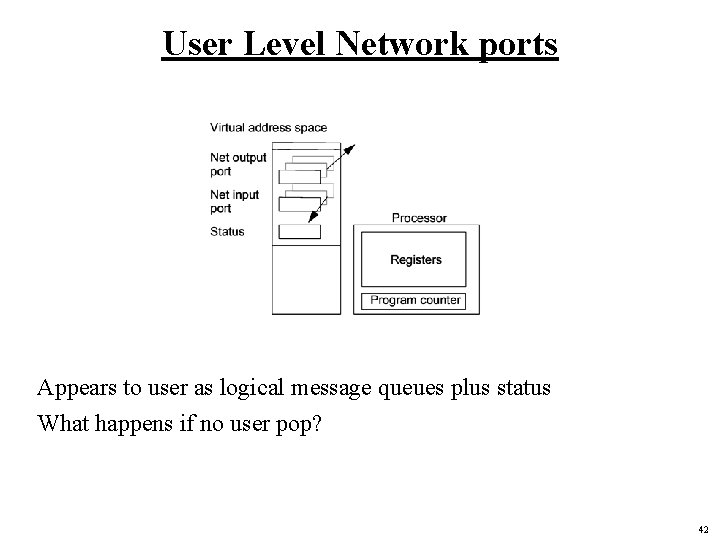
User Level Network ports Appears to user as logical message queues plus status What happens if no user pop? 42
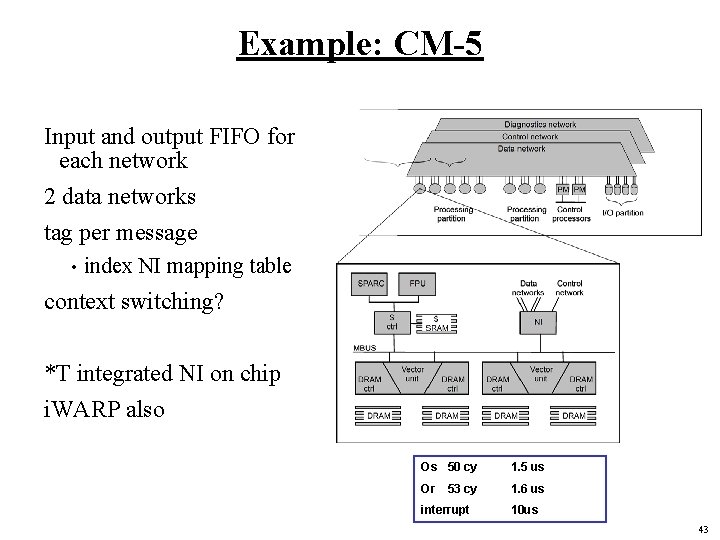
Example: CM-5 Input and output FIFO for each network 2 data networks tag per message • index NI mapping table context switching? *T integrated NI on chip i. WARP also Os 50 cy 1. 5 us Or 1. 6 us 53 cy interrupt 10 us 43
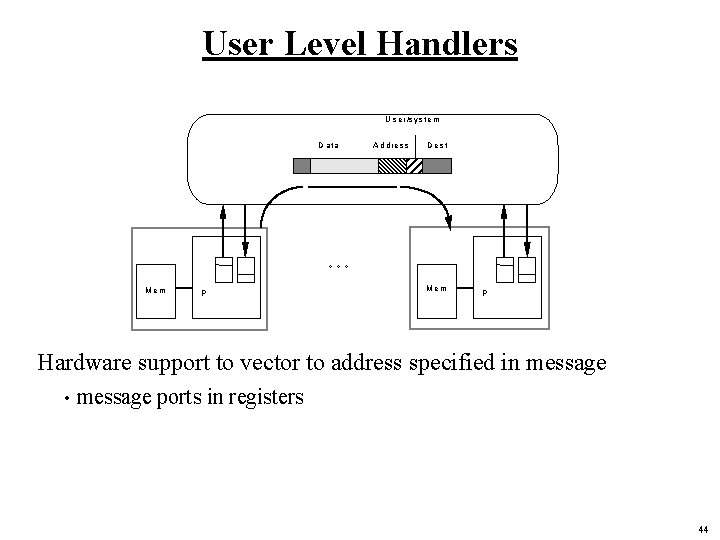
User Level Handlers U s e r /s y s te m D a ta A d d re s s D e st °° ° M em P Mem P Hardware support to vector to address specified in message • message ports in registers 44
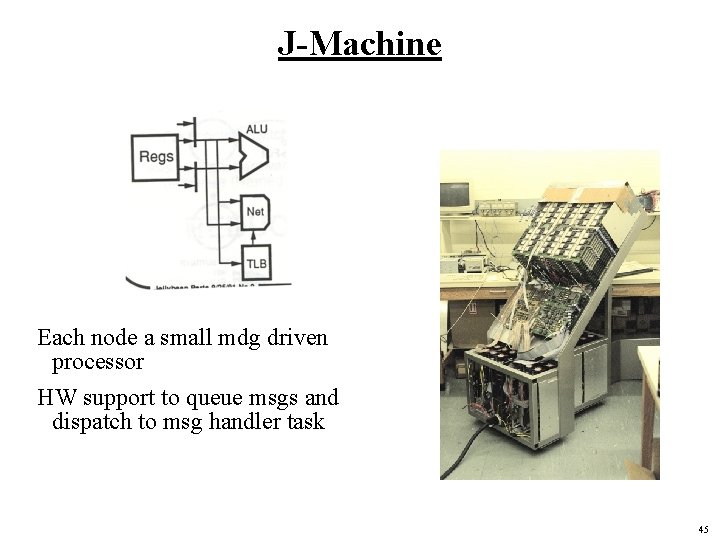
J-Machine Each node a small mdg driven processor HW support to queue msgs and dispatch to msg handler task 45
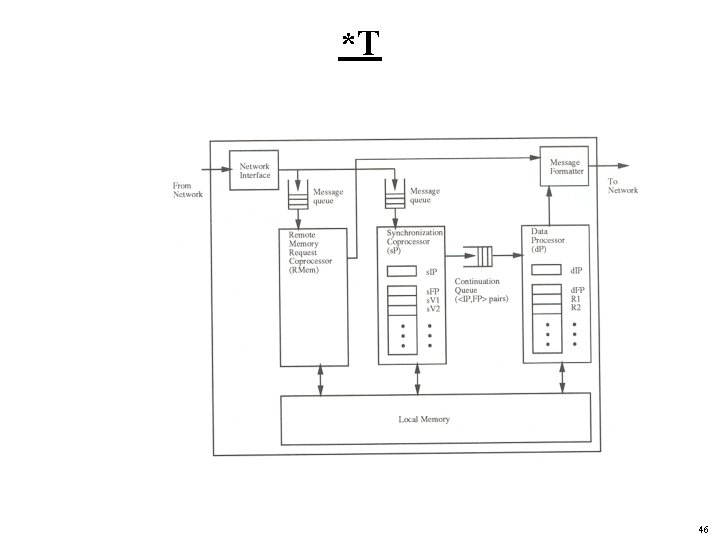
*T 46
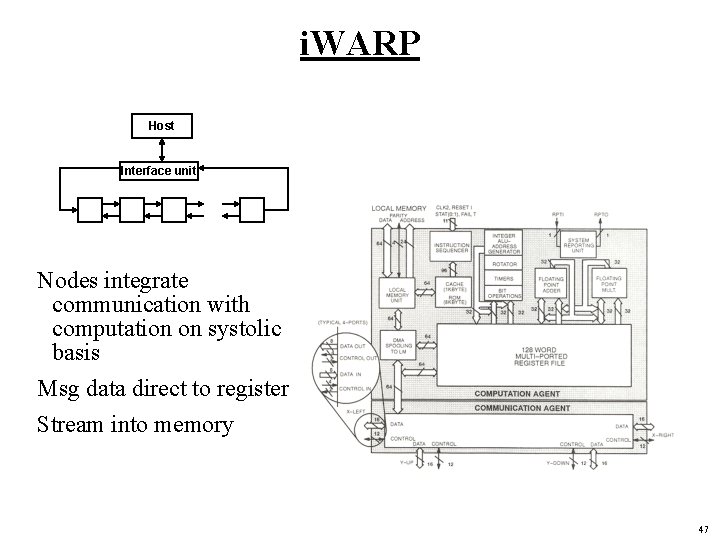
i. WARP Host Interface unit Nodes integrate communication with computation on systolic basis Msg data direct to register Stream into memory 47
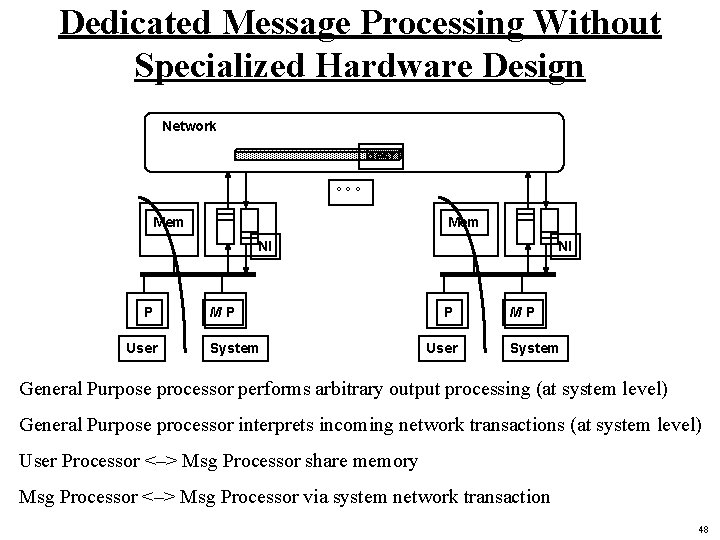
Dedicated Message Processing Without Specialized Hardware Design Network dest °°° Mem NI P User MP System General Purpose processor performs arbitrary output processing (at system level) General Purpose processor interprets incoming network transactions (at system level) User Processor <–> Msg Processor share memory Msg Processor <–> Msg Processor via system network transaction 48
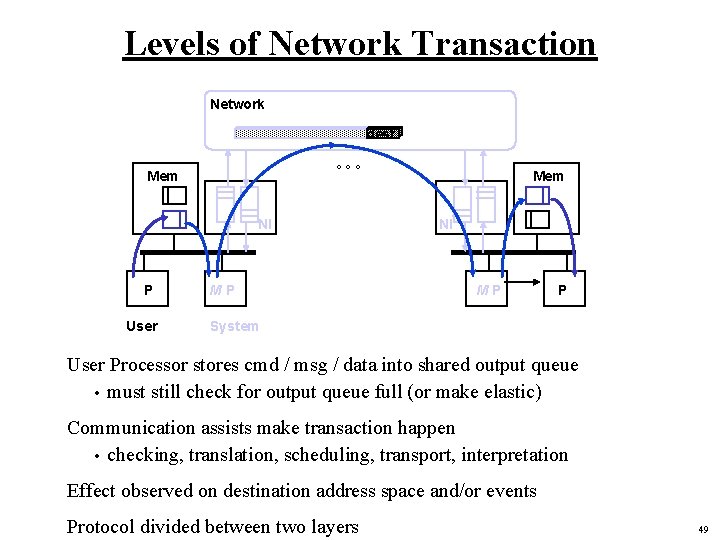
Levels of Network Transaction Network dest °°° Mem NI P User MP Mem NI MP P System User Processor stores cmd / msg / data into shared output queue • must still check for output queue full (or make elastic) Communication assists make transaction happen • checking, translation, scheduling, transport, interpretation Effect observed on destination address space and/or events Protocol divided between two layers 49
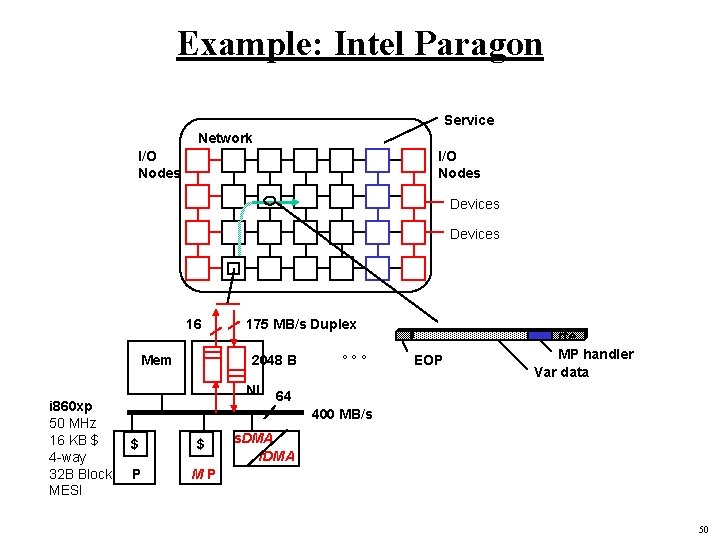
Example: Intel Paragon Service Network I/O Nodes Devices 16 Mem 175 MB/s Duplex 2048 B NI i 860 xp 50 MHz 16 KB $ 4 -way 32 B Block MESI °°° EOP rte MP handler Var data 64 400 MB/s $ $ P MP s. DMA r. DMA 50
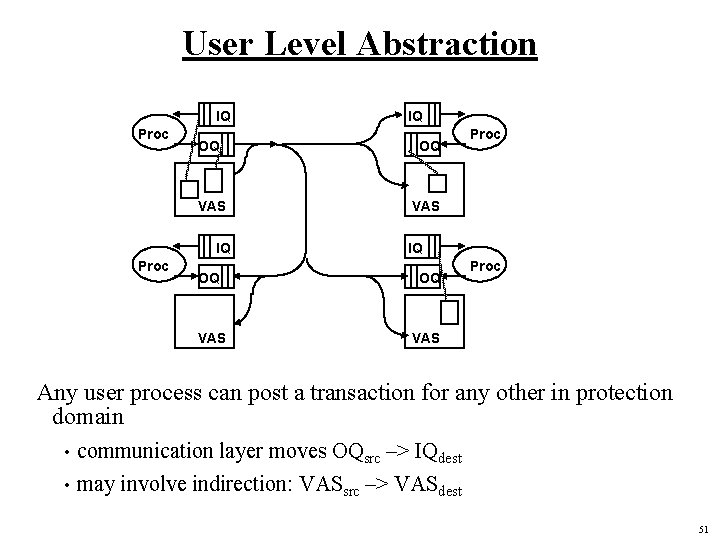
User Level Abstraction IQ Proc OQ OQ VAS IQ Proc IQ OQ OQ VAS Proc Any user process can post a transaction for any other in protection domain communication layer moves OQsrc –> IQdest • may involve indirection: VASsrc –> VASdest • 51
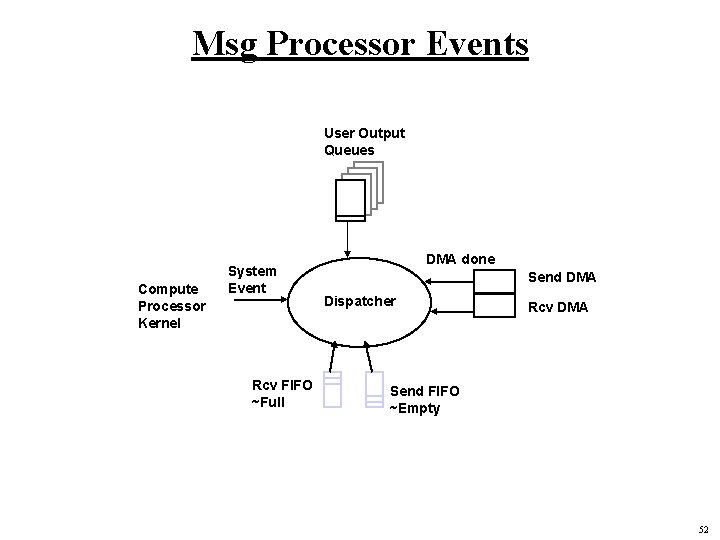
Msg Processor Events User Output Queues Compute Processor Kernel System Event Rcv FIFO ~Full DMA done Send DMA Dispatcher Rcv DMA Send FIFO ~Empty 52
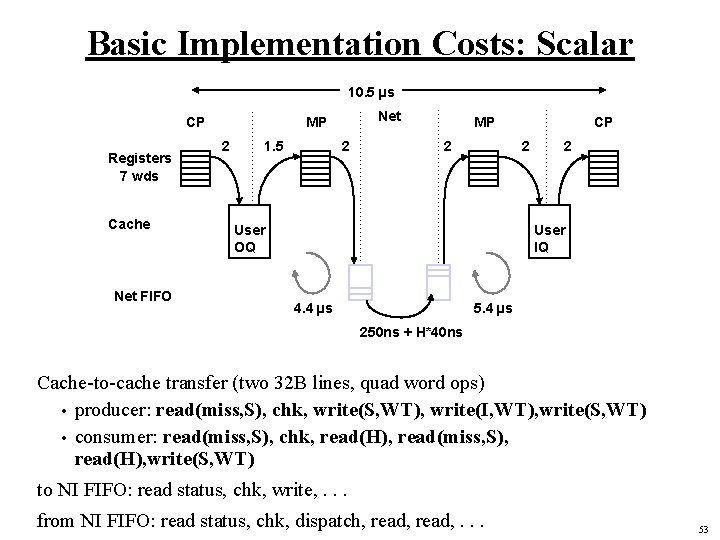
Basic Implementation Costs: Scalar 10. 5 µs CP Registers 7 wds Cache Net FIFO Net MP 2 1. 5 2 MP 2 CP 2 User OQ 2 User IQ 4. 4 µs 5. 4 µs 250 ns + H*40 ns Cache-to-cache transfer (two 32 B lines, quad word ops) • producer: read(miss, S), chk, write(S, WT), write(I, WT), write(S, WT) • consumer: read(miss, S), chk, read(H), read(miss, S), read(H), write(S, WT) to NI FIFO: read status, chk, write, . . . from NI FIFO: read status, chk, dispatch, read, . . . 53
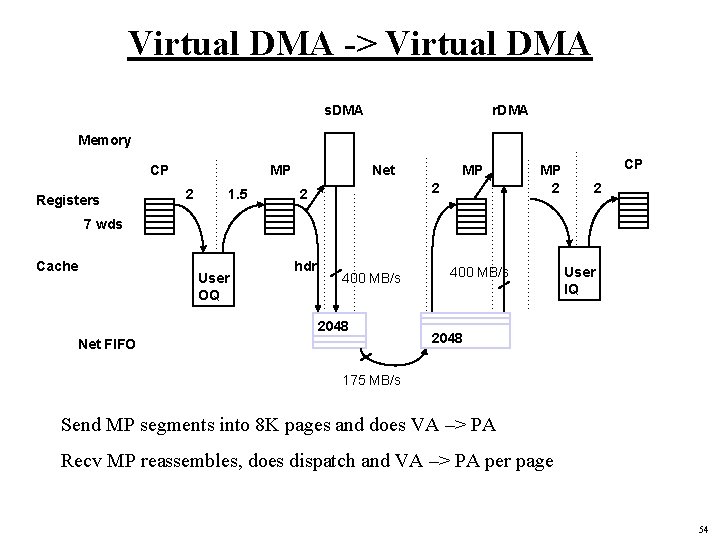
Virtual DMA -> Virtual DMA s. DMA r. DMA Memory CP Registers MP 2 1. 5 Net MP 2 2 MP 2 CP 2 7 wds Cache User OQ hdr 400 MB/s 2048 Net FIFO 400 MB/s User IQ 2048 175 MB/s Send MP segments into 8 K pages and does VA –> PA Recv MP reassembles, does dispatch and VA –> PA per page 54
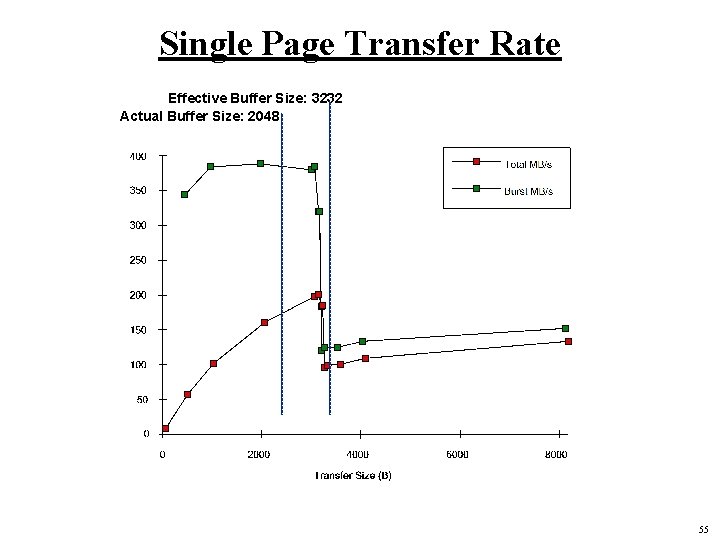
Single Page Transfer Rate Effective Buffer Size: 3232 Actual Buffer Size: 2048 55
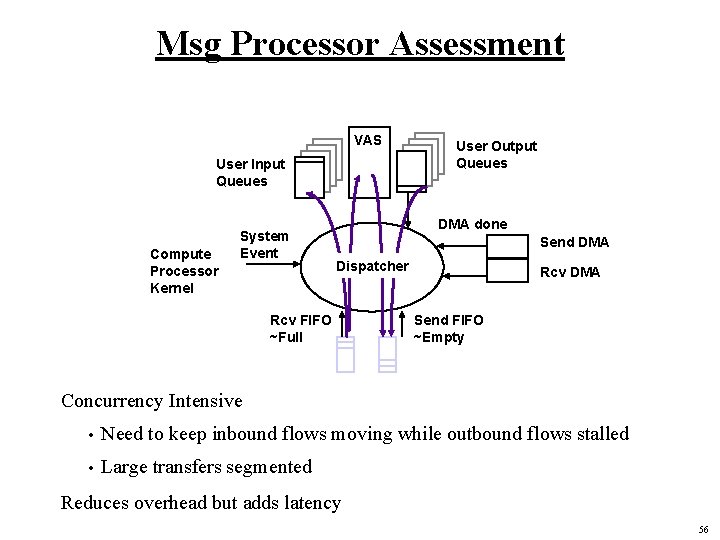
Msg Processor Assessment VAS User Input Queues Compute Processor Kernel System Event User Output Queues DMA done Send DMA Dispatcher Rcv FIFO ~Full Rcv DMA Send FIFO ~Empty Concurrency Intensive • Need to keep inbound flows moving while outbound flows stalled • Large transfers segmented Reduces overhead but adds latency 56
- Slides: 56