
Scalable Characteristics Mode Analysis Requirements and Challenges White
Scalable Characteristics Mode Analysis: Requirements and Challenges White Paper April 13, 2020 Khulud Alsultan 1, Praveen Rao 2, Anthony Caruso 1, Ahmed Hassan 1 1 University of Missouri-Kansas City 2 University of Missouri-Columbia “Distribution Statement A. – Approved for public release. Distribution is unlimited. ” This work is supported in part by the Office of Naval Research (ONR) grants: #N 00014 -17 -1 -2932 and #N 00014 -171 -3016
Background: CMA • Characteristic Modes Analysis (CMA) decomposes the current of a scatterer into a set of fundamental modes, and calculates the relative importance of each mode at each frequency • CMA has been used for the analysis and design of antennas 2
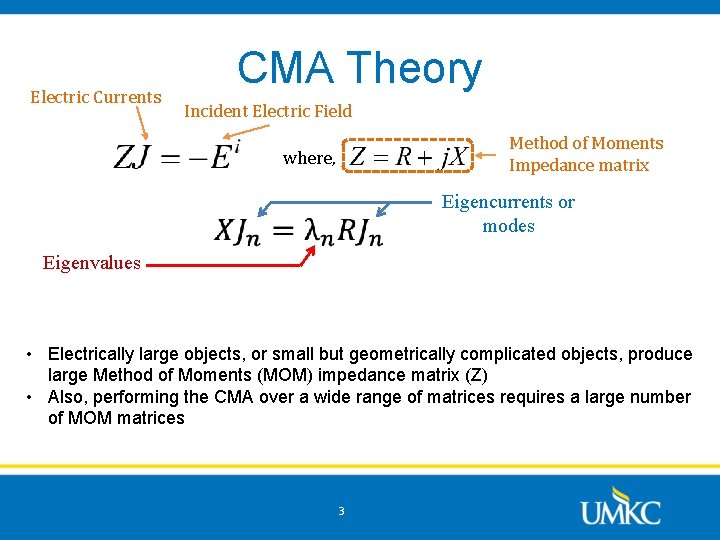
Electric Currents CMA Theory Incident Electric Field Method of Moments Impedance matrix where, Eigencurrents or modes Eigenvalues • Electrically large objects, or small but geometrically complicated objects, produce large Method of Moments (MOM) impedance matrix (Z) • Also, performing the CMA over a wide range of matrices requires a large number of MOM matrices 3
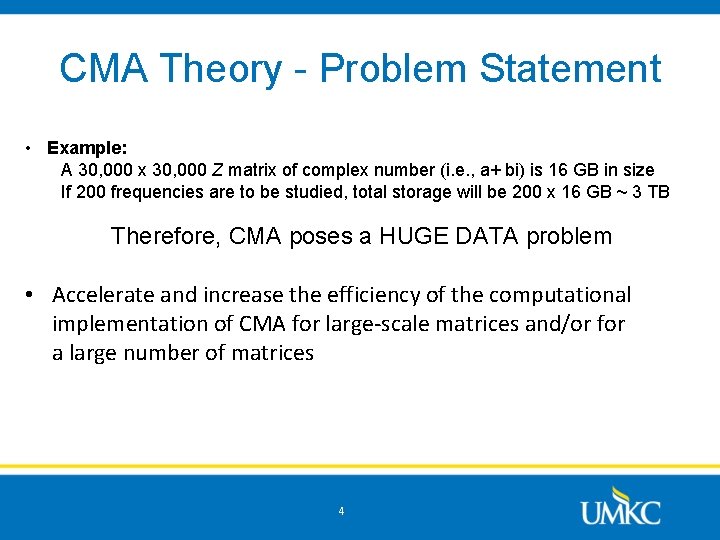
CMA Theory - Problem Statement • Example: A 30, 000 x 30, 000 Z matrix of complex number (i. e. , a+ bi) is 16 GB in size If 200 frequencies are to be studied, total storage will be 200 x 16 GB ~ 3 TB Therefore, CMA poses a HUGE DATA problem • Accelerate and increase the efficiency of the computational implementation of CMA for large-scale matrices and/or for a large number of matrices 4
CMA Computation Harrington’s Method 1 • Widely accepted and accurate method for CMA • Involves a sequence of matrix operations to compute eigenvalues and eigenvectors – SVD, multiplication, inverse, etc. 5

Requirements/Challenges Data Transfer Computation Storage • High speed networking • Complex number • SVD is the slowest • Distributed file system 6
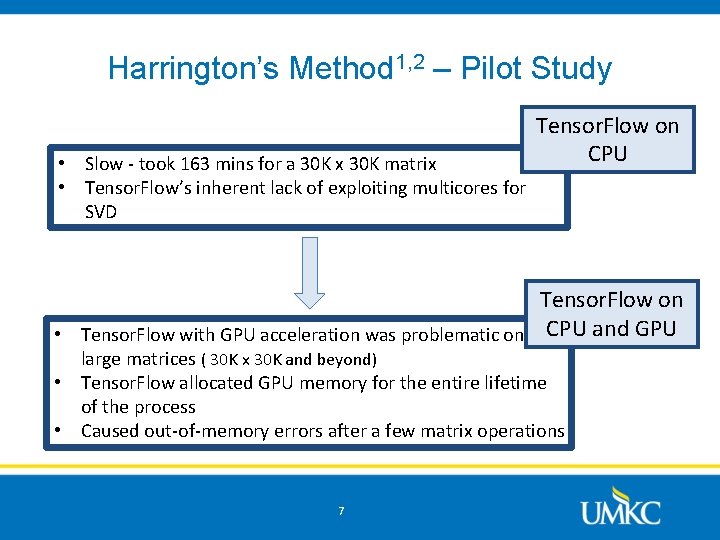
Harrington’s Method 1, 2 – Pilot Study • Slow - took 163 mins for a 30 K x 30 K matrix • Tensor. Flow’s inherent lack of exploiting multicores for SVD Tensor. Flow on CPU Tensor. Flow on • Tensor. Flow with GPU acceleration was problematic on CPU and GPU large matrices ( 30 K x 30 K and beyond) • Tensor. Flow allocated GPU memory for the entire lifetime of the process • Caused out-of-memory errors after a few matrix operations 7
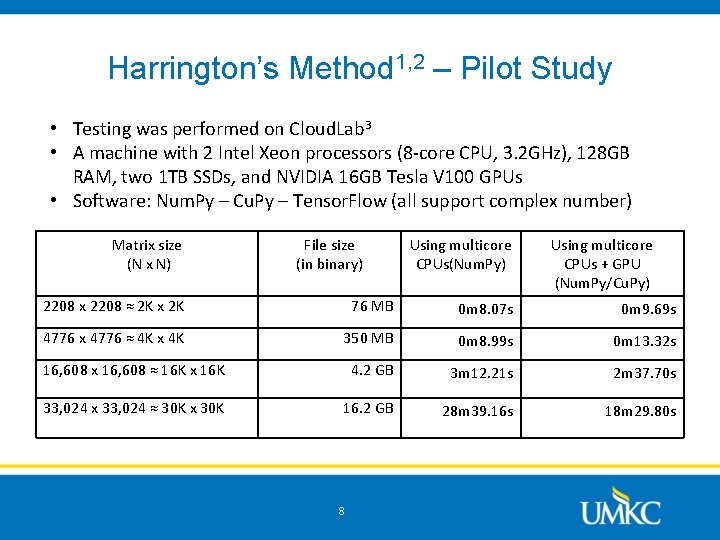
Harrington’s Method 1, 2 – Pilot Study • Testing was performed on Cloud. Lab 3 • A machine with 2 Intel Xeon processors (8 -core CPU, 3. 2 GHz), 128 GB RAM, two 1 TB SSDs, and NVIDIA 16 GB Tesla V 100 GPUs • Software: Num. Py – Cu. Py – Tensor. Flow (all support complex number) Matrix size (N x N) File size (in binary) Using multicore CPUs(Num. Py) Using multicore CPUs + GPU (Num. Py/Cu. Py) 2208 x 2208 ≈ 2 K x 2 K 76 MB 0 m 8. 07 s 0 m 9. 69 s 4776 x 4776 ≈ 4 K x 4 K 350 MB 0 m 8. 99 s 0 m 13. 32 s 16, 608 x 16, 608 ≈ 16 K x 16 K 4. 2 GB 3 m 12. 21 s 2 m 37. 70 s 33, 024 x 33, 024 ≈ 30 K x 30 K 16. 2 GB 28 m 39. 16 s 18 m 29. 80 s 8
Conclusion • The requirements and challenges for enabling scalable CMA for next-generation applications • Scalable CMA using commodity hardware • Future direction: – Investigate how cluster computing can further improve CMA performance – Use a hyperconverged infrastructure with 10’s of GPUs, TBs of flash memory storage and RAM, and gigabit networking 9
![References [1] Harrington, R. , and J. Mautz. "Computation of characteristic modes for conducting](http://slidetodoc.com/presentation_image_h2/4b8466b766240738c4ceed3a97f9de0b/image-10.jpg "References [1] Harrington, R. , and J. Mautz. \"Computation of characteristic modes for conducting")
References [1] Harrington, R. , and J. Mautz. "Computation of characteristic modes for conducting bodies. " IEEE Transactions on Antennas and Propagation 19. 5 (1971): 629 -639. [2] Alsultan, K. , Rao, P. , Caruso, T. , and Hassan, A. "Scalable Characteristic Mode Analysis Using Big Data Techniques. " In 2019 International Symposium on Electromagnetic Theory (EMTS 2019), San Diego, 1 page, CA, 2019. [3] Duplyakin, D. , Ricci, R. , Maricq, A. , Wong, G. , Duerig, J. , Eide, E. , Stoller, L. , Hibler, M. , Johnson, D. , Webb, K. , and et al. , “The design and operation of Cloud. Lab. ” In Proceedings of the 2019 USENIX Conference on Usenix Annual Technical Conference, 114 (2019). 10
- Slides: 10