
Scalability of your IEEE Membership Choices and Opportunities
Scalability of your IEEE Membership: Choices and Opportunities for Serving and Being Served Tufts University S-PAC Presentation 19 April 2013 – Boston, MA Dr. Charles Rubenstein, SMIEEE, CEng FIET; IEEE Director (2010 -2011) Pratt Institute – Graduate School of Information and Library Science Presented at S-PACs, Student and GOLD Conferences all over the World… April 2013 Revision
Career Resiliency Overview u Computer Technology Tools u Electronic Communications Tools u E-commerce u IEEE Structure/Management u Scalability u Performance u Reliability 2 and Networking requirements
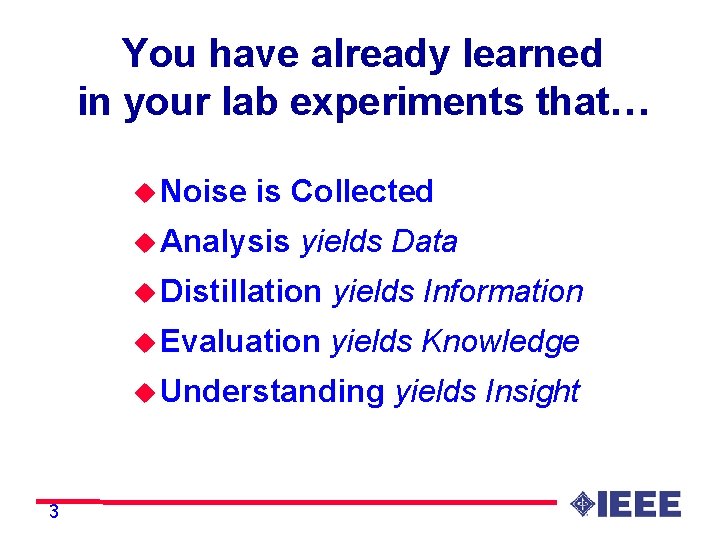
You have already learned in your lab experiments that… u Noise is Collected u Analysis yields Data u Distillation yields Information u Evaluation yields Knowledge u Understanding 3 yields Insight
You are proficient in many Electronic Communications Tools u Email, u Word Blogs, Podcasting, HTML processing u Spreadsheet u Circuit & Systems Simulation u Power. Point 4 Presentation
The E-commerce and Networking Requirements of u. Scalability u. Performance u. Reliability … are also member needs 5
Volunteer Management u. Volunteers manage all IEEE Boards and Organizational Units u IEEE Professional Activities Coordination Your 2013 Region 1 Contacts are: Ron Tabroff: PACE Chair, <r. tabroff@ieee. org> Charles Rubenstein: S-PAC Coord <c. rubenstein@ieee. org> Rob Vice: S-PAC Support Coord <vice@ieee. org> 6
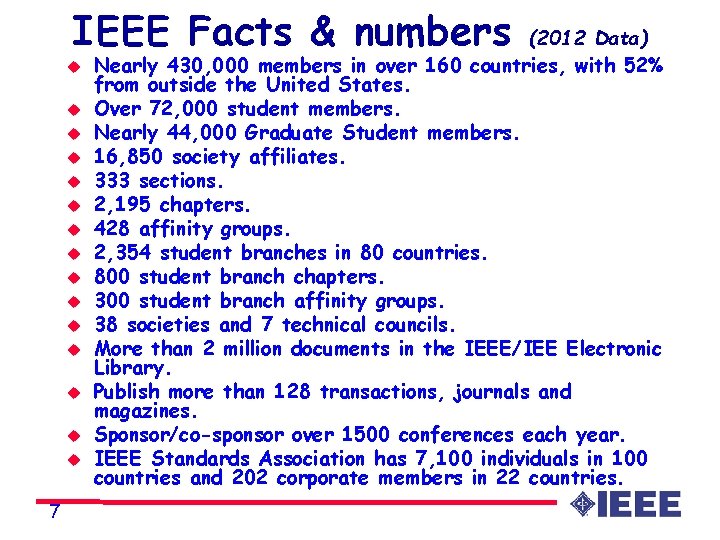
IEEE Facts & numbers u u u u 7 (2012 Data) Nearly 430, 000 members in over 160 countries, with 52% from outside the United States. Over 72, 000 student members. Nearly 44, 000 Graduate Student members. 16, 850 society affiliates. 333 sections. 2, 195 chapters. 428 affinity groups. 2, 354 student branches in 80 countries. 800 student branch chapters. 300 student branch affinity groups. 38 societies and 7 technical councils. More than 2 million documents in the IEEE/IEE Electronic Library. Publish more than 128 transactions, journals and magazines. Sponsor/co-sponsor over 1500 conferences each year. IEEE Standards Association has 7, 100 individuals in 100 countries and 202 corporate members in 22 countries.
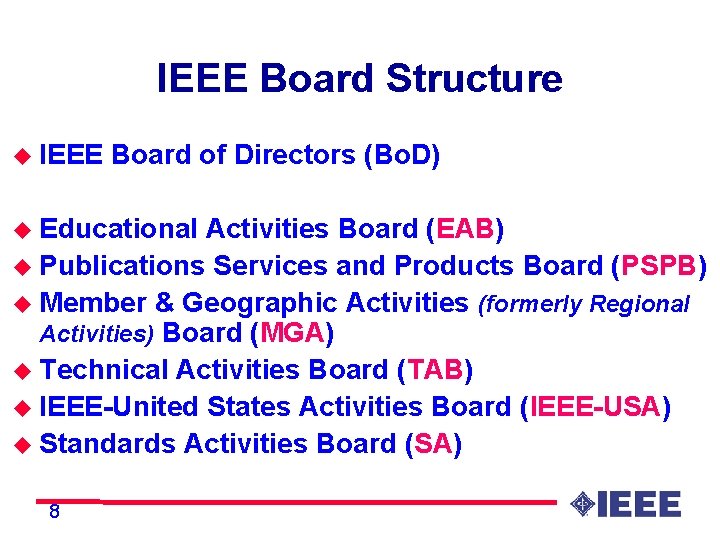
IEEE Board Structure u IEEE Board of Directors (Bo. D) u Educational Activities Board (EAB) u Publications Services and Products Board (PSPB) u Member & Geographic Activities (formerly Regional Activities) Board (MGA) u Technical Activities Board (TAB) u IEEE-United States Activities Board (IEEE-USA) u Standards Activities Board (SA) 8
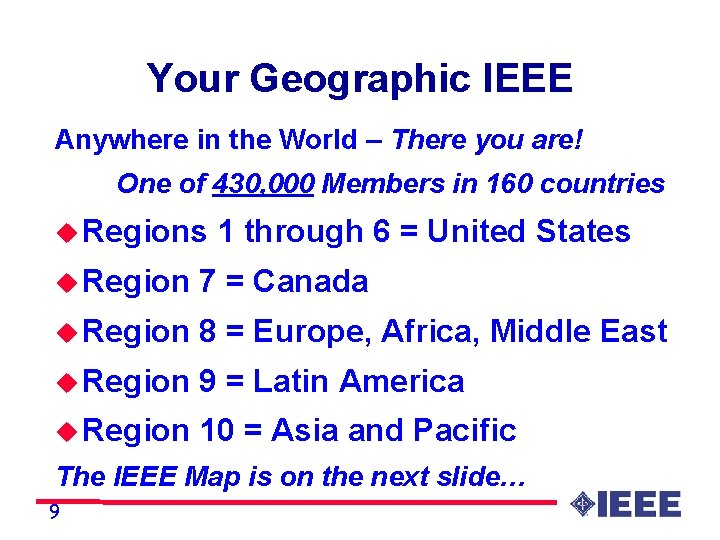
Your Geographic IEEE Anywhere in the World – There you are! One of 430, 000 Members in 160 countries u Regions 1 through 6 = United States u Region 7 = Canada u Region 8 = Europe, Africa, Middle East u Region 9 = Latin America u Region 10 = Asia and Pacific The IEEE Map is on the next slide… 9
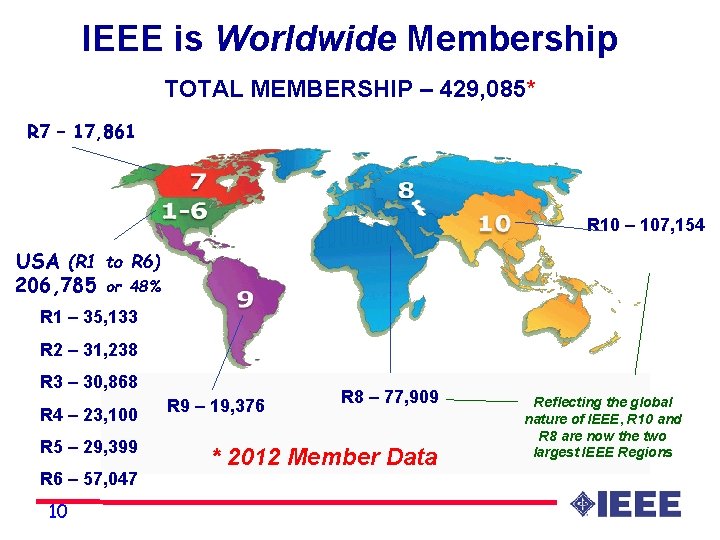
IEEE is Worldwide Membership TOTAL MEMBERSHIP – 429, 085* R 7 – 17, 861 R 10 – 107, 154 USA (R 1 to R 6) 206, 785 or 48% R 1 – 35, 133 R 2 – 31, 238 R 3 – 30, 868 R 4 – 23, 100 R 5 – 29, 399 R 6 – 57, 047 10 R 9 – 19, 376 R 8 – 77, 909 * 2012 Member Data Reflecting the global nature of IEEE, R 10 and R 8 are now the two largest IEEE Regions
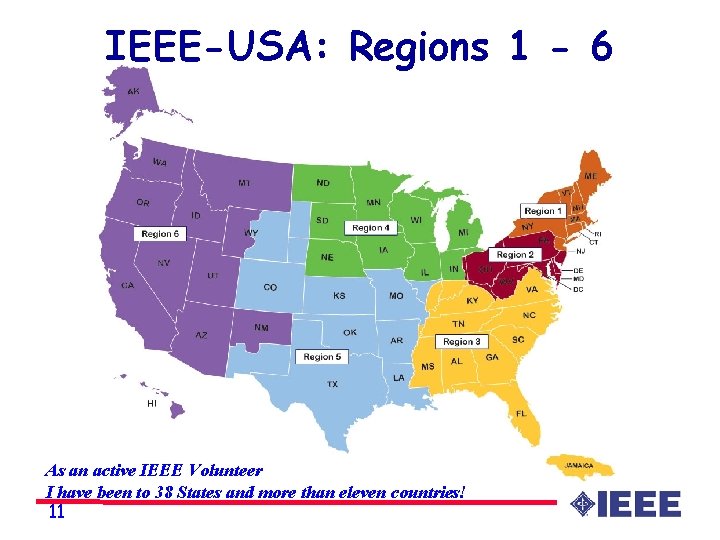
IEEE-USA: Regions 1 - 6 As an active IEEE Volunteer I have been to 38 States and more than eleven countries! 11

Local Units of the IEEE Southwest Area of Region 6 Regions Areas Sections San Diego Section of Southwest Area of Region 6 in the World 12 Student Branches Univ. of California at San Diego IEEE Student Branch Note: Not drawn to scale and boundaries are only approximate
Your Technical IEEE’s global technical activities are divided into 10 IEEE ‘Divisions’ encompassing 45 IEEE Technical Societies & Councils Your IEEE Section provides talks and presentations from one or more of these activities through local ‘Chapters’ of these technical units 13
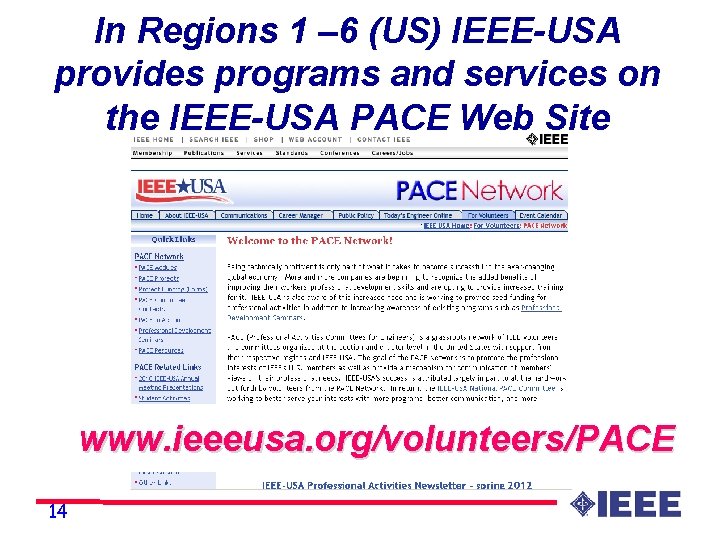
In Regions 1 – 6 (US) IEEE-USA provides programs and services on the IEEE-USA PACE Web Site www. ieeeusa. org/volunteers/PACE 14
PACE is Professional Development In the US, local PACE funding is available for u Leadership Skills Workshops u Project Management Workshops u Professional Development Seminars u Teacher-Engineer Partnerships u Teacher-in-Service Programs u Student Professional Awareness (S-PACs) u Student Professional Awareness Ventures (S -PAVes) u Future 15 City / FIRST Robotics / Lego Mindstorm
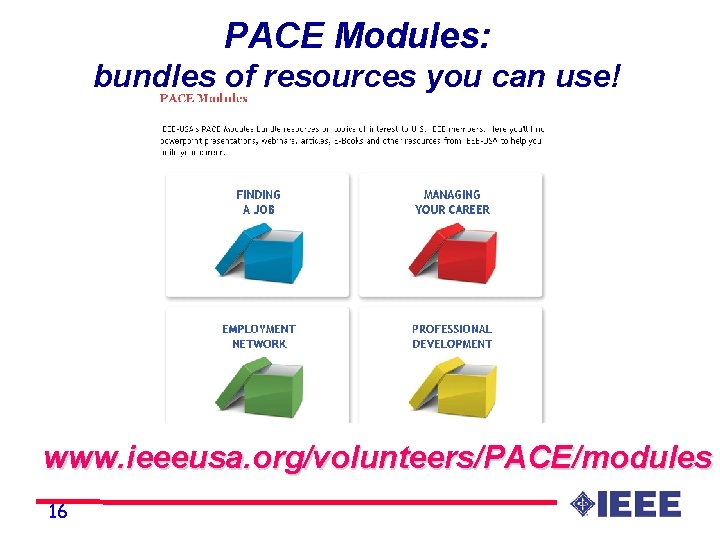
PACE Modules: bundles of resources you can use! www. ieeeusa. org/volunteers/PACE/modules 16
Model Section/Chapter Professional Activities u Awards & Recognition u Consultants Networks u Employment and Career Activities u Engineer’s Week Activities u Government and ‘Grassroots’ Activities u Professional Development Seminars (PDS) u Pre-College Activities u Student Professional Awareness (S-PACs) u Technical Policy Support and Awareness 17
Student Professional Awareness Conferences (S-PAC) Since 1979 – Bringing students and GOLD members, together with local, national and international speakers for soft skill presentations in eight topic areas u Co-Result: Student Membership Drive – Free/reduced admission for members! For more information: http: //ieeeusa. org/volunteers/committees/ spac/reg_contacts. html 18
S-PAC is … More fun than going to Octoberfest! S -PACs are student organized and managed so you can learn about: u Conference planning and budgets u How to contact speakers and industry u Making presentations u Finding funding resources u Coordination: two or three S-PACs in an area using the same speakers! 19
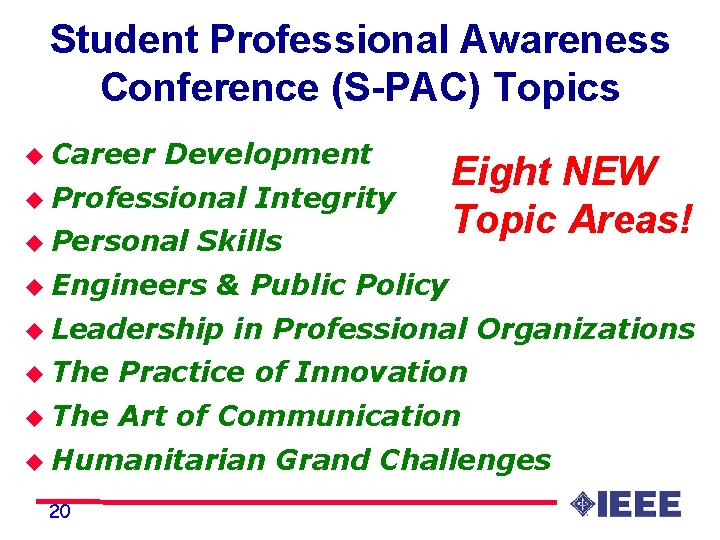
Student Professional Awareness Conference (S-PAC) Topics u Career Development u Professional u Personal Integrity Skills u Engineers Eight NEW Topic Areas! & Public Policy u Leadership in Professional Organizations u The Practice of Innovation u The Art of Communication u Humanitarian 20 Grand Challenges
S-PAC Topics in Career Development Technologists are uniquely positioned to embark on careers that are not only technical but also in various areas including business management, finance, economics, health, law, non-profit sector, consulting, journalism, public relations, entrepreneurship, government, and entertainment. u u Make the most of your career choices, career fairs and internships, and in informational and formal interviews Craft and customize your resume, curriculum vita, and cover letter for different career pathways u Be better informed for your job search and negotiations u Establish/maintain professional connections and mentors u 21 Prepare for professional registration, certifications, as well as advanced degrees
S-PAC Topics in Professional Integrity Ethics and engineering are fundamentally intertwined. Decisions made by engineers can have a profound impact on society. u u u 22 Practice ethics in a work environment that is constantly influenced by realities of globalization, financial motivation, and information overload Generate or customize a framework or set of principles for ethical conduct across differing conflicts and scenarios Balance professional integrity against corporate loyalty and other personal interests
S-PAC Topics in Personal Skills Personal skills are as crucial as technical skills for a successful career in engineering. u u 23 Develop skills that are necessary to effectively run a meeting and manage a committee. Apply the best practices for time management and priority setting of tasks Better manage your online persona and learn how it can assist or affect your career Plan your finances and investments
S-PAC Topics in Engineers & Public Policy Decision-makers are frequently looking to engineers for advice to improve public policies. u u u 24 How a legislation is drafted, introduced, and debated in Congress The major policy issues and contentions of current interest, and why you should care The role engineers play in informing and shaping public policy and how to get involved
Leadership in Professional Organizations S-PAC Topics in Staying involved in a professional society adds value to your career. However, becoming a leader improves your professional net worth and profile. u u A professional society—such as IEEE—can help you in your professional and personal growth Staying involved with a professional organization is a value to you and your profession? (The current presentation is in this topic area. . . ) 25
The Practice of Innovation S-PAC Topics in Innovation is a complex theoretical concept but can be learned by practice like any other art or science. u u u 26 Capitalize on your professional training and creativity to become an innovator Learn from the success and failure of others Incorporate elements and practices of other cultures and professions (such as arts, humanities, media, and sociology)
The Art of Communication S-PAC Topics in In a world of short attention spans, it is crucial to create and communicate a message that sticks. u Master the art of storytelling u Deliver better presentations u Improve written communication u u 27 Leverage social, traditional, and other media effectively Use these skills to help improve the public understanding of engineering and its impact
S-PAC Topics in Humanitarian Grand Challenges Engineers play a major role in advancing technology for the benefit of humanity. u u 28 Play a role in reducing poverty and hunger, improving infrastructure, and addressing environmental and economic challenges Become a global citizen and an ambassador for the engineering profession
The scalability of your local section member’s membership begins when they are a … u IEEE Member: Student, GOLD, etc. u IEEE Meeting or Conference Speaker or Organizer u Local Chapter Officer u Local Section Officer 29
Their Scalability continues as a Regional or Technical Society Board Member or Officer u u EAB, PSPB, MGA, TAB, SA. USA Board Member or Officer This year’s IEEE-USA VP Communications, Karen Panetta, is from Tufts! u 30 Technical Society President
Scalability includes service as … u Regional or Technical Division Director This year’s Region 1 Director, Peter Eckstein is from Long Island, NY u IEEE Vice-President v TAB u Even & IEEE-USA VPs are member elected as IEEE President This year’s IEEE President, Peter Staecker is from Boston! 31
You might ask… “But How do I get there? ” Encourage your Section’s u IEEE Student Members, and u IEEE Graduate Student Members, and u IEEE GOLD Members, and u IEEE EMS Members … To participate in the fun – to become VOLUNTEERS!!! 32
Performance Your service as a IEEE volunteer gives you experience in leadership, management, and presentation skills … at low risk with potentially wide exposure 33
RESPONSIBILITY! As a Graduate Student Member or GOLD Member it is your privilege and RESPONSIBILITY to VOTE! in IEEE elections To be a leader, YOU must take the lead… encourage those in your Section to VOTE 34
IEEE Reliability u 10+ years: Member Benefits Program v Life Insurance v Credit Card Programs u IEEE u 34 Years of IEEE S-PAC presentations u 129 35 Xplore online Library Resource Years of IEEE member Service
What’s the Cost? u. Student Membership Dues $32 for a full year! u. Full IEEE Membership Dues (with one Society Membership) $15/month – about 50 cents per day 36
Your Section’s GOLD Options u. Share Resources u. Network among peers u. Leadership/Management Training u. IEEE Alias Address u. IEEE Insurance 37
Your Next Steps? u Plan to Organize a Section/Chapter: u. Leadership v. Contact: u. Project c. rubenstein@ieee. org Management Workshop v. Contact: u. Plan Skills Workshop tarek. lahdhiri@gm. com an S-PAC or S-PAVe u. Professional v. Speak 38 Activities Programs to your Section PACE Chair…
Your Next Steps? u Graduate Student and GOLD Members Plan to attend IEEE-USA Leadership Workshops! This year’s will be in conjunction with the: 2013 IEEE-USA Annual Meeting 1 -4 August 2013 Portland, OR 39
IEEE-USA Professional Activities Region 1 Contacts: Ron Tabroff - PACE Chair, <r. tabroff@ieee. org> Charles Rubenstein - S-PACs <c. rubenstein@ieee. org> Leadership & Scalability Presentations: Charles Rubenstein <c. rubenstein@ieee. org> Sandra Kim, IEEE-USA Staff <sandra. kim@ieee. org> IEEE-USA Headquarters 2001 L Street NW - Suite 700 Washington, D. C. 20036 -5104 Telephone: +1 (202) 785 -0017 Fax: +1 (202) 785 -0835 40
Charles Rubenstein <c. rubenstein@ieee. org> Rocking! Networking Your World Fostering Technological Innovation Promoting Community Worldwide Enabling Members’ Careers
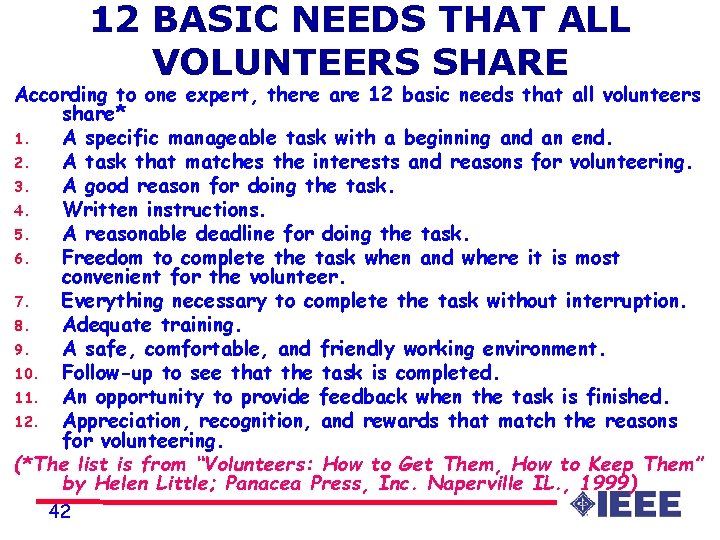
12 BASIC NEEDS THAT ALL VOLUNTEERS SHARE According to one expert, there are 12 basic needs that all volunteers share* 1. A specific manageable task with a beginning and an end. 2. A task that matches the interests and reasons for volunteering. 3. A good reason for doing the task. 4. Written instructions. 5. A reasonable deadline for doing the task. 6. Freedom to complete the task when and where it is most convenient for the volunteer. 7. Everything necessary to complete the task without interruption. 8. Adequate training. 9. A safe, comfortable, and friendly working environment. 10. Follow-up to see that the task is completed. 11. An opportunity to provide feedback when the task is finished. 12. Appreciation, recognition, and rewards that match the reasons for volunteering. (*The list is from “Volunteers: How to Get Them, How to Keep Them” by Helen Little; Panacea Press, Inc. Naperville IL. , 1999) 42
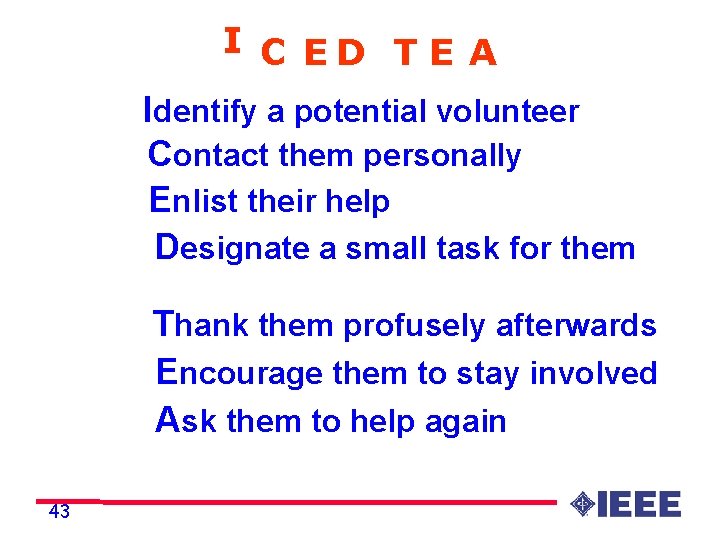
I C ED T E A Identify a potential volunteer Contact them personally Enlist their help Designate a small task for them Thank them profusely afterwards Encourage them to stay involved Ask them to help again 43
- Slides: 43