
Scalability of Grid and SubbasinBased Land Surface Modeling
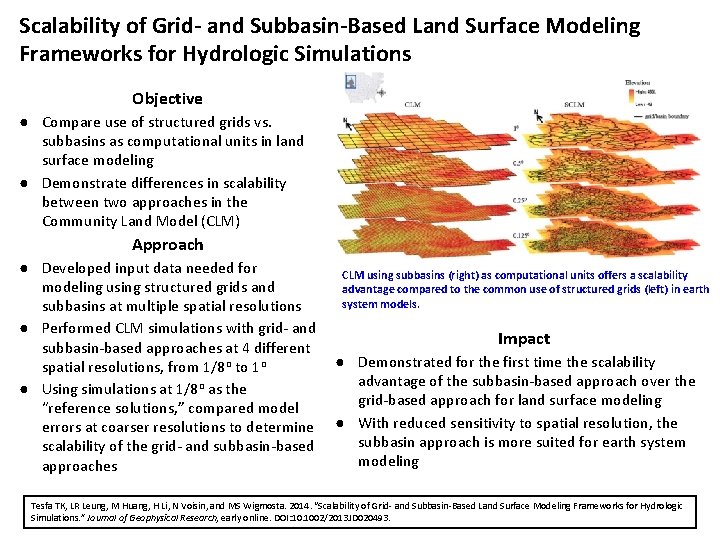
Scalability of Grid- and Subbasin-Based Land Surface Modeling Frameworks for Hydrologic Simulations Objective ● Compare use of structured grids vs. subbasins as computational units in land surface modeling ● Demonstrate differences in scalability between two approaches in the Community Land Model (CLM) Approach ● Developed input data needed for modeling using structured grids and subbasins at multiple spatial resolutions ● Performed CLM simulations with grid- and subbasin-based approaches at 4 different spatial resolutions, from 1/8 o to 1 o ● Using simulations at 1/8 o as the “reference solutions, ” compared model errors at coarser resolutions to determine scalability of the grid- and subbasin-based approaches CLM using subbasins (right) as computational units offers a scalability advantage compared to the common use of structured grids (left) in earth system models. Impact ● Demonstrated for the first time the scalability advantage of the subbasin-based approach over the grid-based approach for land surface modeling ● With reduced sensitivity to spatial resolution, the subbasin approach is more suited for earth system modeling Tesfa TK, LR Leung, M Huang, H Li, N Voisin, and MS Wigmosta. 2014. “Scalability of Grid- and Subbasin-Based Land Surface Modeling Frameworks for Hydrologic Simulations. ” Journal of Geophysical Research, early online. DOI: 10. 1002/2013 JD 020493.
- Slides: 1