
Scaff CC A Framework for Compilation and Analysis
![Classical Control Resolution module EQx. Mark (qbit b[n], qbit t[1], int t. F) {.](https://slidetodoc.com/presentation_image/9b456d496ce4757c5cb83391f8c2d495/image-10.jpg "Classical Control Resolution module EQx. Mark (qbit b[n], qbit t[1], int t. F) {.")
![Managing Scalability with QASM Format Scaffold #define n 1000 module foo(qbit q[n]) { for(int](https://slidetodoc.com/presentation_image/9b456d496ce4757c5cb83391f8c2d495/image-14.jpg "Managing Scalability with QASM Format Scaffold #define n 1000 module foo(qbit q[n]) { for(int")
- Slides: 27
Scaff. CC: A Framework for Compilation and Analysis of Quantum Computing Programs Ali Javadi. Abhari, Shruti Patil, Daniel Kudrow, Jeff Heckey, Alexey Lvov, Frederic T. Chong, Margaret Martonosi Princeton University, UC Santa Barbara, IBM
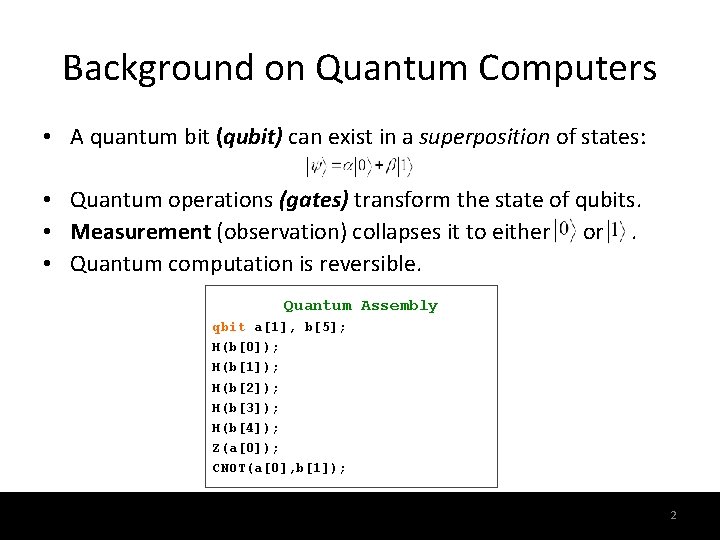
Background on Quantum Computers • A quantum bit (qubit) can exist in a superposition of states: • Quantum operations (gates) transform the state of qubits. • Measurement (observation) collapses it to either or. • Quantum computation is reversible. Quantum Assembly qbit a[1], b[5]; H(b[0]); H(b[1]); H(b[2]); H(b[3]); H(b[4]); Z(a[0]); CNOT(a[0], b[1]); 2 2
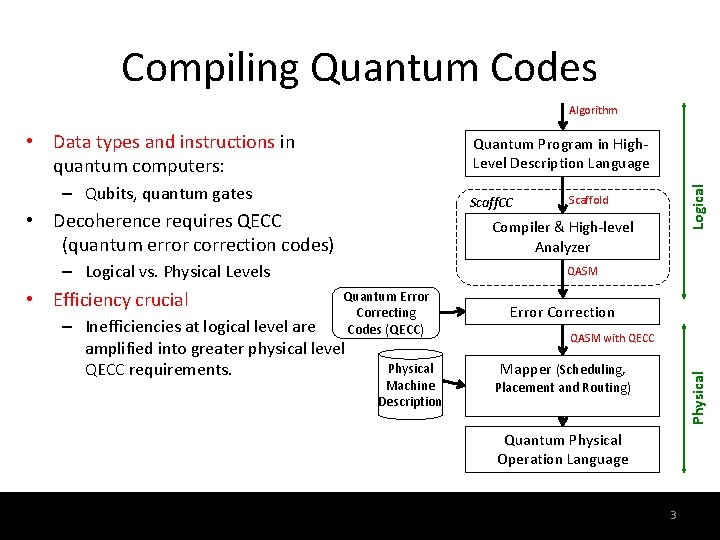
Compiling Quantum Codes Algorithm • Data types and instructions in quantum computers: – Qubits, quantum gates Scaffold Scaff. CC • Decoherence requires QECC (quantum error correction codes) Compiler & High-level Analyzer – Logical vs. Physical Levels QASM Quantum Error Correcting Codes (QECC) – Inefficiencies at logical level are amplified into greater physical level QECC requirements. Physical Machine Description Error Correction QASM with QECC Mapper (Scheduling, Physical • Efficiency crucial Logical Quantum Program in High. Level Description Language Placement and Routing) Quantum Physical Operation Language 3 3
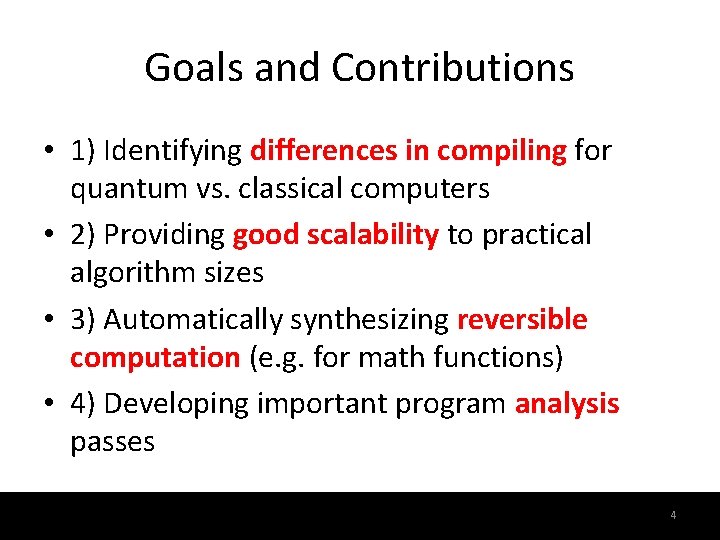
Goals and Contributions • 1) Identifying differences in compiling for quantum vs. classical computers • 2) Providing good scalability to practical algorithm sizes • 3) Automatically synthesizing reversible computation (e. g. for math functions) • 4) Developing important program analysis passes 4 4
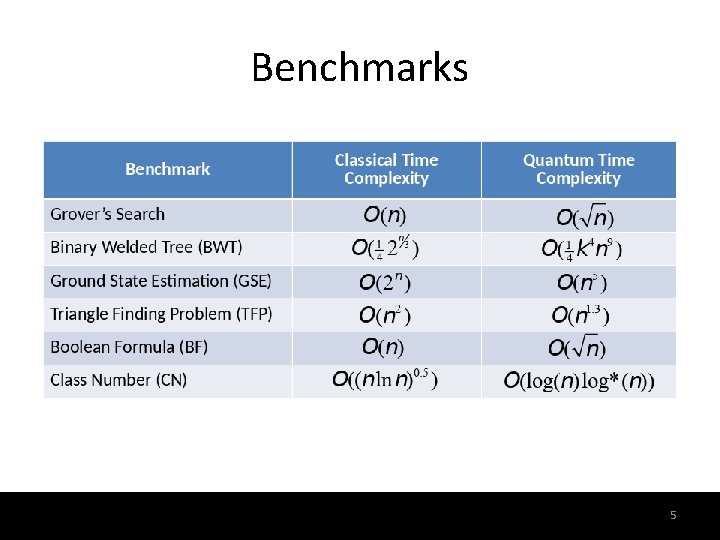
Benchmarks 5 5
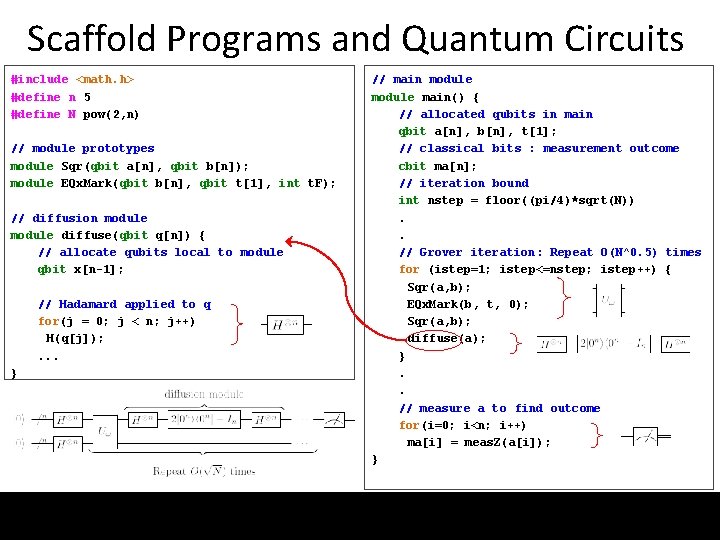
Scaffold Programs and Quantum Circuits #include <math. h> #define n 5 #define N pow(2, n) // module prototypes module Sqr(qbit a[n], qbit b[n]); module EQx. Mark(qbit b[n], qbit t[1], int t. F); // diffusion module diffuse(qbit q[n]) { // allocate qubits local to module qbit x[n-1]; // Hadamard applied to q for(j = 0; j < n; j++) H(q[j]); . . . } // main module main() { // allocated qubits in main qbit a[n], b[n], t[1]; // classical bits : measurement outcome cbit ma[n]; // iteration bound int nstep = floor((pi/4)*sqrt(N)). . // Grover iteration: Repeat O(N^0. 5) times for (istep=1; istep<=nstep; istep++) { Sqr(a, b); EQx. Mark(b, t, 0); Sqr(a, b); diffuse(a); }. . // measure a to find outcome for(i=0; i<n; i++) ma[i] = meas. Z(a[i]); } 6
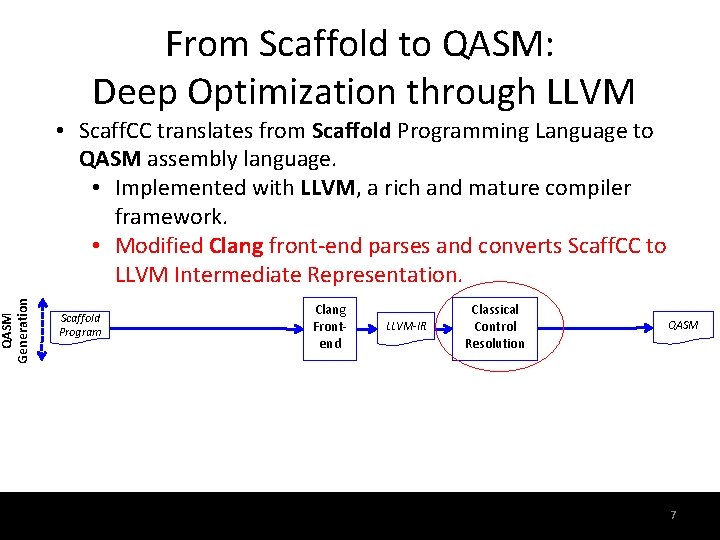
QASM Generation From Scaffold to QASM: Deep Optimization through LLVM • Scaff. CC translates from Scaffold Programming Language to QASM assembly language. • Implemented with LLVM, a rich and mature compiler framework. • Modified Clang front-end parses and converts Scaff. CC to LLVM Intermediate Representation. Scaffold Program Clang Frontend LLVM-IR Classical Control Resolution QASM 7 7
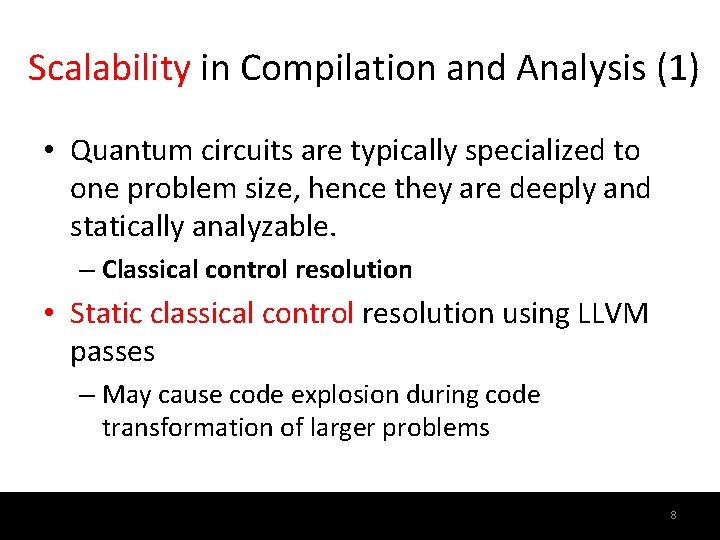
Scalability in Compilation and Analysis (1) • Quantum circuits are typically specialized to one problem size, hence they are deeply and statically analyzable. – Classical control resolution • Static classical control resolution using LLVM passes – May cause code explosion during code transformation of larger problems 8 8
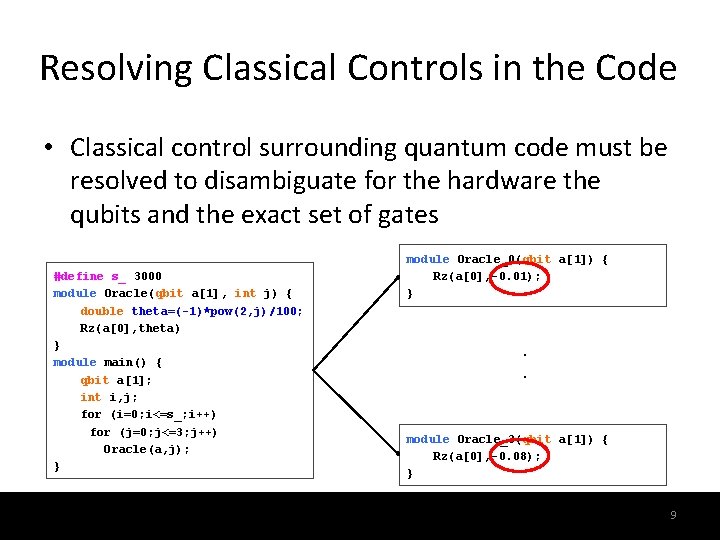
Resolving Classical Controls in the Code • Classical control surrounding quantum code must be resolved to disambiguate for the hardware the qubits and the exact set of gates #define s_ 3000 module Oracle(qbit a[1], int j) { double theta=(-1)*pow(2, j)/100; Rz(a[0], theta) } module main() { qbit a[1]; int i, j; for (i=0; i<=s_; i++) for (j=0; j<=3; j++) Oracle(a, j); } module Oracle_0(qbit a[1]) { Rz(a[0], -0. 01); } . . module Oracle_3(qbit a[1]) { Rz(a[0], -0. 08); } 9 9
Classical Control Resolution module EQx. Mark (qbit b[n], qbit t[1], int t. F) {. . if(t. F==1) CNOT(t[0], x[n-2]); else Z(x[n-2]); . . } module main (qbit b[n], qbit t[1]) {. for (i=0; i<2; i++) EQx. Mark(b, t, i); . } unroll module EQx. Mark_0 (qbit b[n], qbit t[1]) {. . Z(x[n-2]); . . clone } module EQx. Mark_1 (qbit b[n], qbit t[1]) inter-procedural { constant. propagation. CNOT(t[0], x[n-2]); . . } module main (qbit b[n], qbit t[1]) {. EQx. Mark(b, t, 0); EQx. Mark_0(b, t); EQx. Mark(b, t, 1); EQx. Mark_1(b, t); . } 10
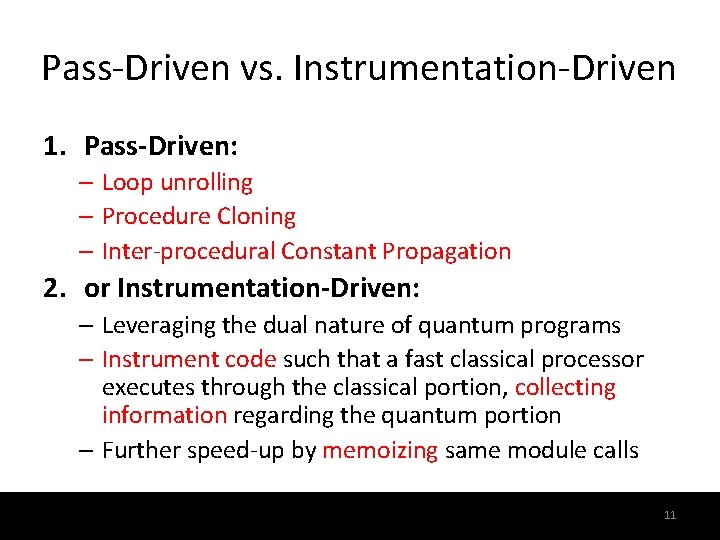
Pass-Driven vs. Instrumentation-Driven 1. Pass-Driven: – Loop unrolling – Procedure Cloning – Inter-procedural Constant Propagation 2. or Instrumentation-Driven: – Leveraging the dual nature of quantum programs – Instrument code such that a fast classical processor executes through the classical portion, collecting information regarding the quantum portion – Further speed-up by memoizing same module calls 11 11
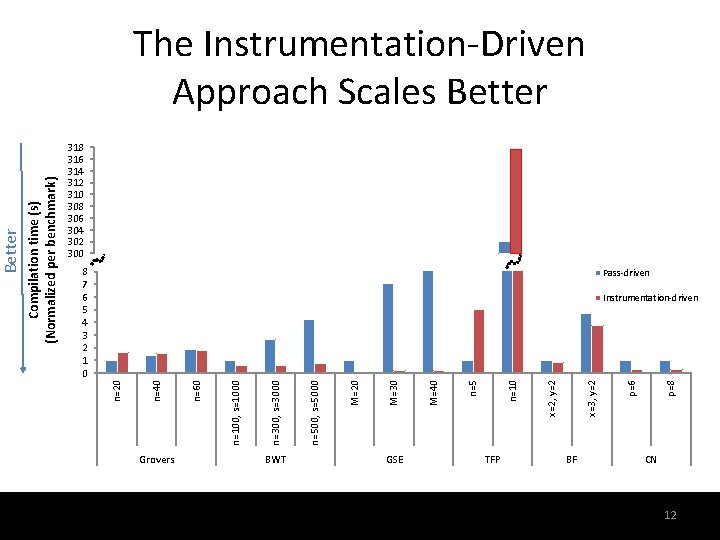
318 316 314 312 310 308 306 304 302 300 8 7 6 5 4 3 2 1 0 Pass-driven Grovers BWT GSE TFP BF 12 p=8 p=6 x=3, y=2 x=2, y=2 n=10 n=5 M=40 M=30 M=20 n=500, s=5000 n=300, s=3000 n=100, s=1000 n=60 n=40 Instrumentation-driven n=20 Compilation time (s) (Normalized per benchmark) Better The Instrumentation-Driven Approach Scales Better CN 12
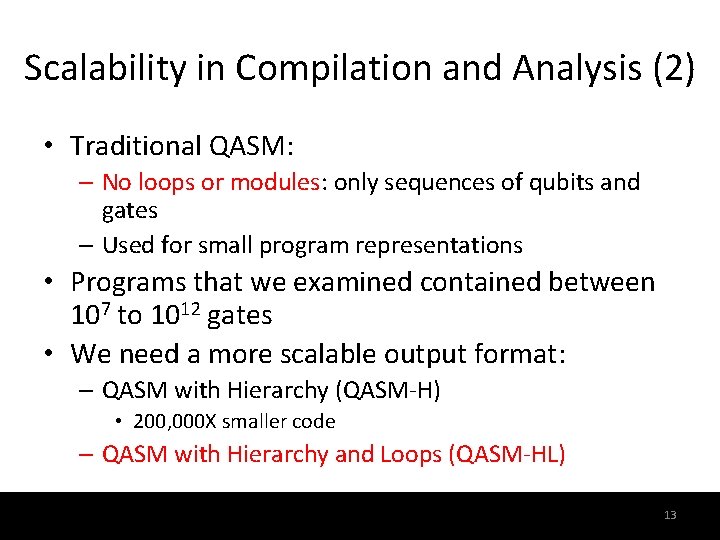
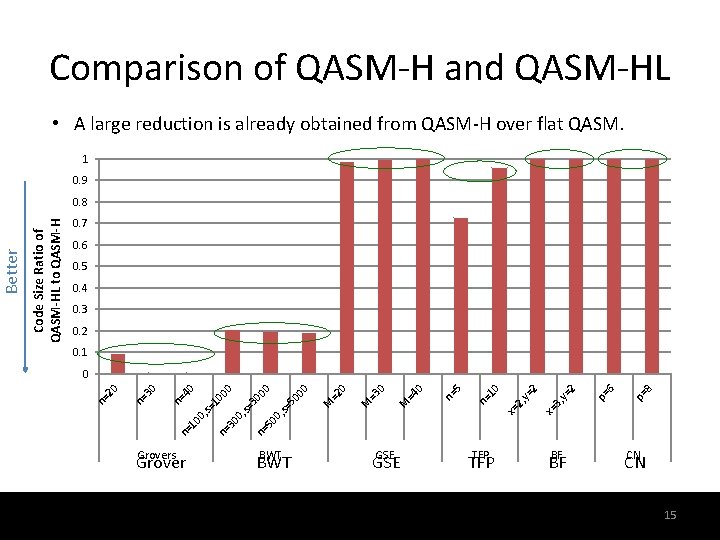
Scalability in Compilation and Analysis (2) • Traditional QASM: – No loops or modules: only sequences of qubits and gates – Used for small program representations • Programs that we examined contained between 107 to 1012 gates • We need a more scalable output format: – QASM with Hierarchy (QASM-H) • 200, 000 X smaller code – QASM with Hierarchy and Loops (QASM-HL) 13 13
Managing Scalability with QASM Format Scaffold #define n 1000 module foo(qbit q[n]) { for(int i = 0; i < n; i++) H(q[i]); CNOT(q[n-1], q[0]); } module main() { qbit b[n]; foo(b); } Flat QASM qbit b[1000]; H(b[0]); H(b[1]); . . H(b[999]); CNOT(b[999], b[0]); QASM-H module foo(qbit* q) { H(q[0]); H(q[1]); . . H(q[999]); CNOT(q[999], q[0]); } module main() { qbit b[1000]; foo(b); } QASM-HL module foo(qbit* q) { H(q[0: 999]); CNOT(q[999], q[0]); } module main() { qbit b[1000]; foo(b); } 14 14
Comparison of QASM-H and QASM-HL • A large reduction is already obtained from QASM-H over flat QASM. 1 0. 9 0. 7 0. 6 0. 5 0. 4 0. 3 0. 2 0. 1 8 p= 6 p= 2 y= x= 3, 2 y= 2, x= n= 10 5 n= M =4 0 0 =3 M 0 =2 M 00 50 0, n= 50 s= 0, 30 s= 30 10 s= n= 0, 10 n= Grovers Grover 00 00 n= 40 n= 30 0 n= 20 Code Size Ratio of QASM-HL to QASM-H Better 0. 8 BWT GSE TFP BF BF 15 CN CN 15
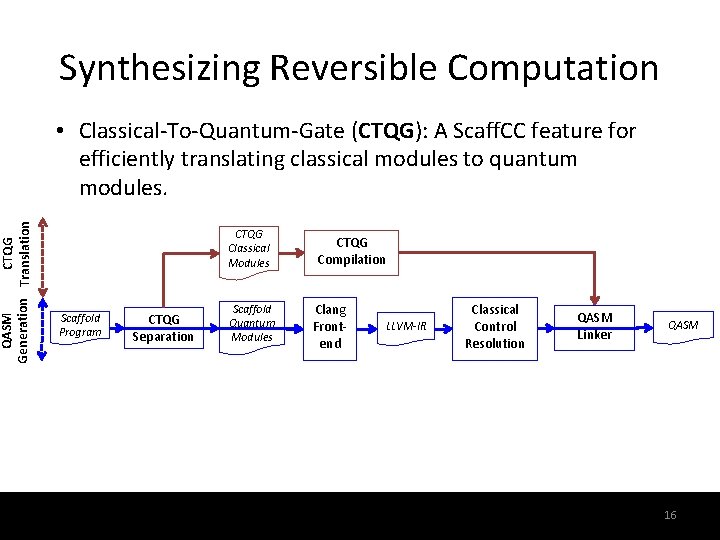
QASM CTQG Generation Translation Synthesizing Reversible Computation • Classical-To-Quantum-Gate (CTQG): A Scaff. CC feature for efficiently translating classical modules to quantum modules. CTQG Classical Modules Scaffold Program CTQG Separation Scaffold Quantum Modules CTQG Compilation Clang Frontend LLVM-IR Classical Control Resolution QASM Linker 16 QASM 16
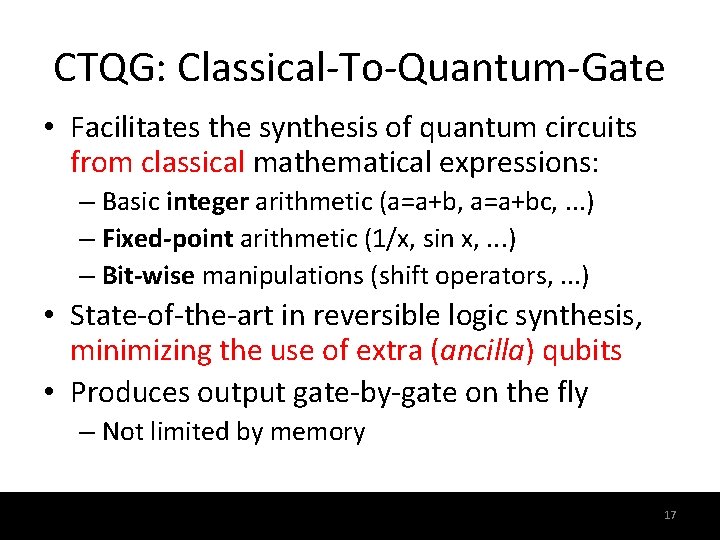
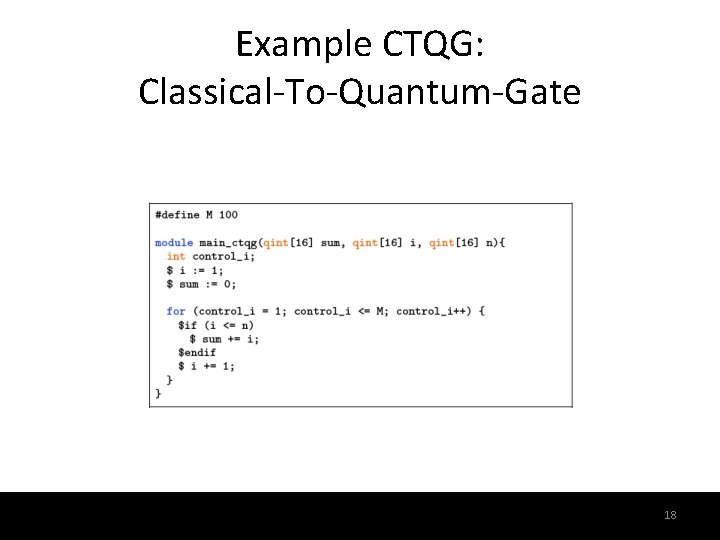
CTQG: Classical-To-Quantum-Gate • Facilitates the synthesis of quantum circuits from classical mathematical expressions: – Basic integer arithmetic (a=a+b, a=a+bc, . . . ) – Fixed-point arithmetic (1/x, sin x, . . . ) – Bit-wise manipulations (shift operators, . . . ) • State-of-the-art in reversible logic synthesis, minimizing the use of extra (ancilla) qubits • Produces output gate-by-gate on the fly – Not limited by memory 17 17
Example CTQG: Classical-To-Quantum-Gate 18 18
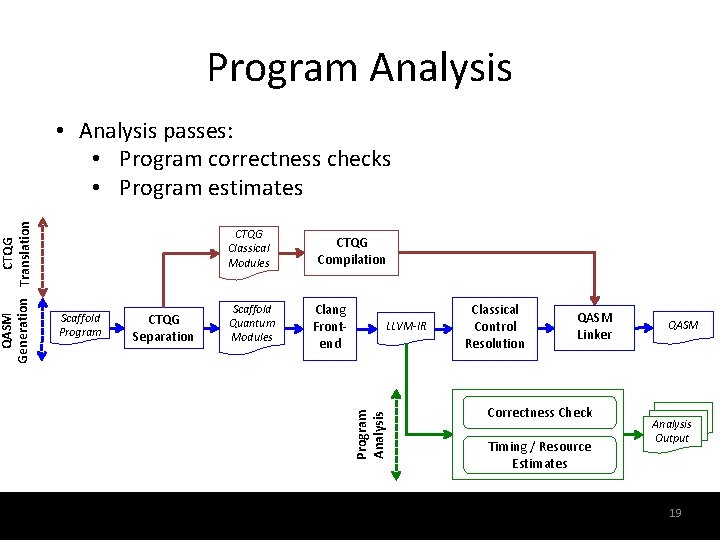
• Analysis passes: • Program correctness checks • Program estimates CTQG Classical Modules Scaffold Program CTQG Separation Scaffold Quantum Modules CTQG Compilation Clang Frontend LLVM-IR Program Analysis QASM CTQG Generation Translation Program Analysis Classical Control Resolution QASM Linker Correctness Check Timing / Resource Estimates 19 QASM Analysis Output 19
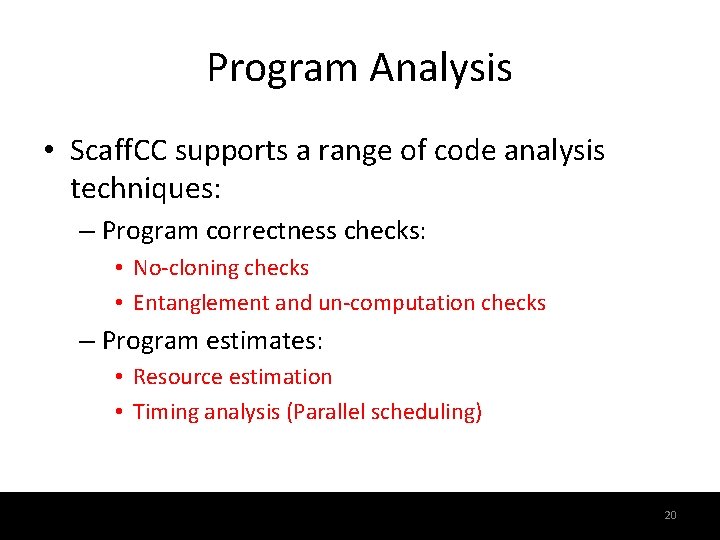
Program Analysis • Scaff. CC supports a range of code analysis techniques: – Program correctness checks: • No-cloning checks • Entanglement and un-computation checks – Program estimates: • Resource estimation • Timing analysis (Parallel scheduling) 20 20
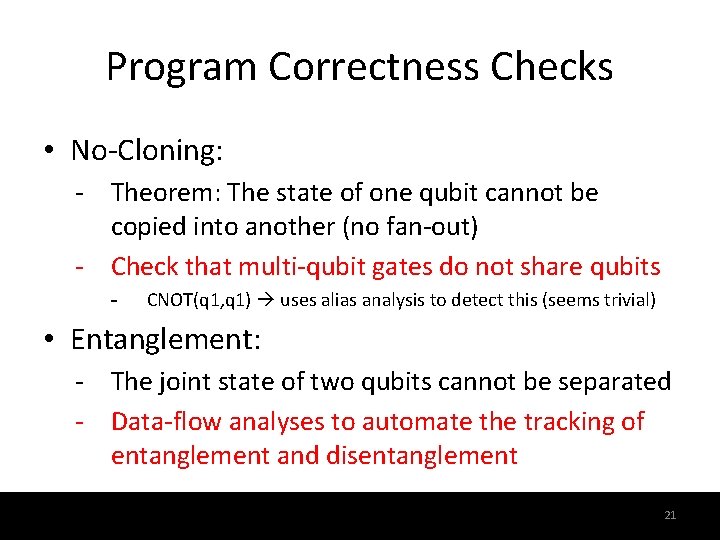
Program Correctness Checks • No-Cloning: - Theorem: The state of one qubit cannot be copied into another (no fan-out) - Check that multi-qubit gates do not share qubits - CNOT(q 1, q 1) uses alias analysis to detect this (seems trivial) • Entanglement: - The joint state of two qubits cannot be separated - Data-flow analyses to automate the tracking of entanglement and disentanglement 21 21
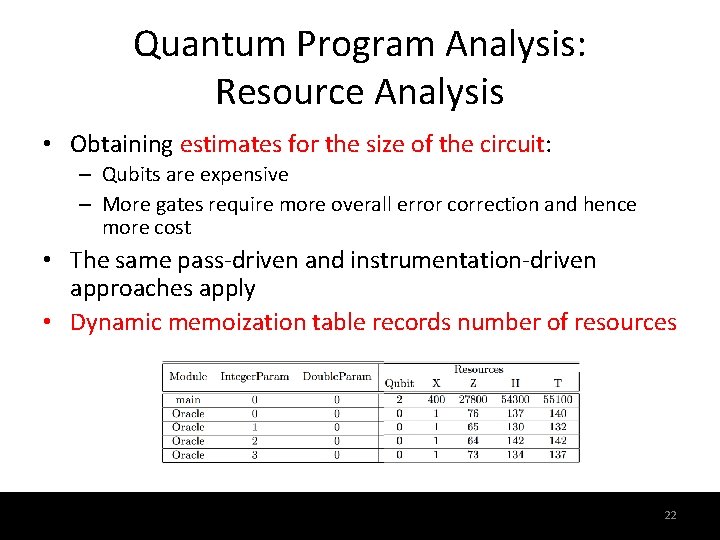
Quantum Program Analysis: Resource Analysis • Obtaining estimates for the size of the circuit: – Qubits are expensive – More gates require more overall error correction and hence more cost • The same pass-driven and instrumentation-driven approaches apply • Dynamic memoization table records number of resources 22 22
Timing Estimate • Estimates the critical path length of the program - Assuming unlimited hardware capability for parallelization • Scheduling based on qubit data dependencies between operations • Hierarchical scheduling for tractability: – Obtain module critical paths separately and then treat them as black boxes. 23 23
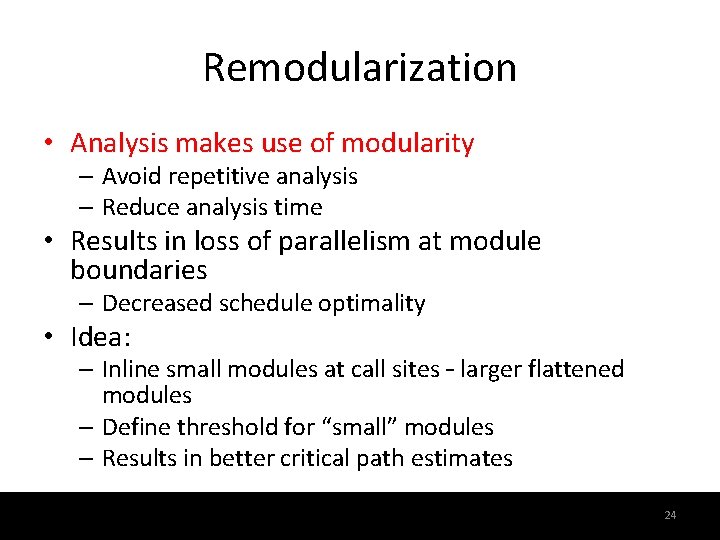
Remodularization • Analysis makes use of modularity – Avoid repetitive analysis – Reduce analysis time • Results in loss of parallelism at module boundaries – Decreased schedule optimality • Idea: – Inline small modules at call sites – larger flattened modules – Define threshold for “small” modules – Results in better critical path estimates 24 24
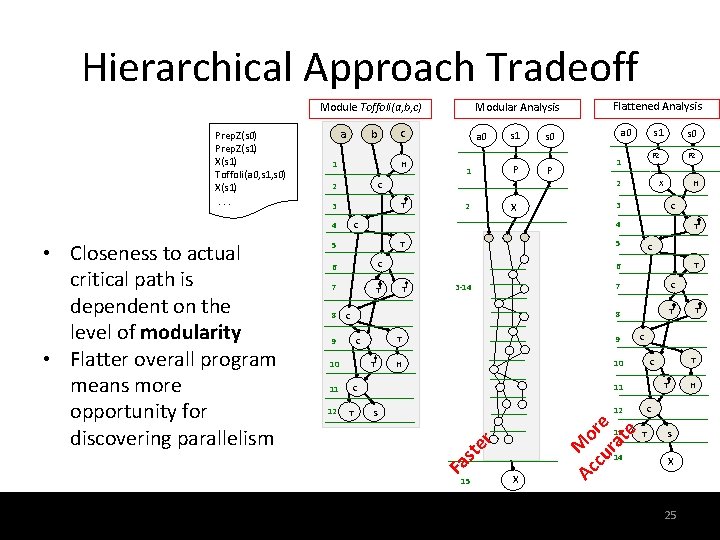
Hierarchical Approach Tradeoff Modular Analysis Module Toffoli(a, b, c) a 1 H T 3 P z 7 T C T 10 Pz Pz H X C T 6 T 3 -14 7 C 8 T T 9 H 10 12 Ac Mo cu re ra te S st er 13 15 14 X 25 T C T 11 C T s 0 2 5 C 9 1 s 1 3 X T C 12 2 P z a 0 s 0 4 6 11 1 s 1 C 5 8 a 0 C 2 4 • Closeness to actual critical path is dependent on the level of modularity • Flatter overall program means more opportunity for discovering parallelism c b Fa Prep. Z(s 0) Prep. Z(s 1) X(s 1) Toffoli(a 0, s 1, s 0) X(s 1). . . Flattened Analysis C T S X 25 H
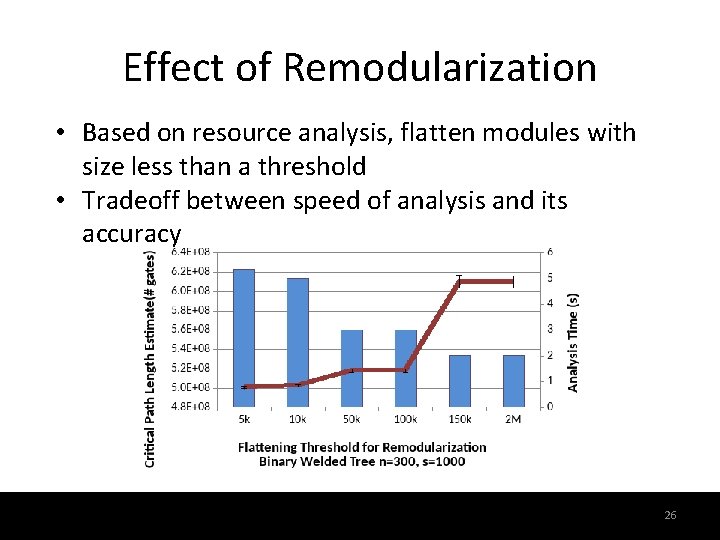
Effect of Remodularization • Based on resource analysis, flatten modules with size less than a threshold • Tradeoff between speed of analysis and its accuracy 26 26
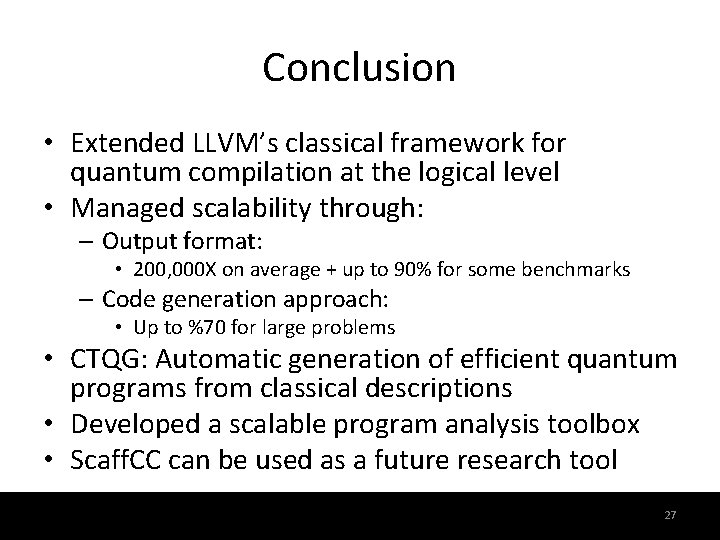
Conclusion • Extended LLVM’s classical framework for quantum compilation at the logical level • Managed scalability through: – Output format: • 200, 000 X on average + up to 90% for some benchmarks – Code generation approach: • Up to %70 for large problems • CTQG: Automatic generation of efficient quantum programs from classical descriptions • Developed a scalable program analysis toolbox • Scaff. CC can be used as a future research tool 27 27