
SCADA SYSTEM CLASSIFICATION 1 Introduction SCADA Supervisory Control



- Slides: 42
SCADA SYSTEM CLASSIFICATION 1
Introduction SCADA (Supervisory Control and Data Acquisition) System Ø History Ø Why SCADA? Ø Definition of SCADA 2
History Ø Egyptian supervisory Ø First half of the 20 th century Ø Weather predictions Ø Rail road tracks Ø Two way system Ø 1960 s idea for supervisory Ø 1970 s radio system 3
Why SCADA? Ø Saves Time and Money § Less traveling for workers (e. g. helicopter ride) § Reduces man-power needs § Increases production efficiency of a company § Cost effective for power systems § Saves energy Ø Reliable Ø Supervisory control over a particular system 4
What is SCADA? Ø Supervisory Control and Data Acquisition Ø Supervisory § Operator/s, engineer/s, supervisor/s, etc Ø Control § Monitoring § Limited § Telemetry § Remote/Local Ø Data acquisition § Access and acquire information or data from the equipment § Sends it to different sites through telemetry § Analog / Digital 5
Classifications Ø Anatomy of a SCADA system? § Elements of SCADA § Levels of SCADA Ø Where is SCADA used? § Different applications of SCADA systems? Ø What types of SCADA are there? Ø Component manufacturers and system manufacturers of the SCADA systems? § Automation Solutions § Software § Hardware 6
Elements of SCADA Elements of a SCADA system Ø Sensors and actuators Ø RTUs/PLCs Ø Communication Ø MTU § Front End Processor § SCADA server § Historical/Redundant/Safety Server § HMI computer § HMI software 7
Sensors Types of sensors: Ø Pressure sensors Ø Temperature sensors Ø Light sensors Ø Humidity sensors Ø Wind speed sensors Ø Water level sensors Ø Distance sensors 8
Actuators: Ø Valves Ø Pumps Ø Motors 9
RTUs RTU – Remote Terminal Unit Ø Intelligent to control a process and multiple processes Ø Data logging and alarm handling Ø Expandable Ø Asks the field devices for information Ø Can control IEDs (Intelligent Electronic Device) Ø Slave/Master device 10
Alarms Types of alarms: Ø Good alarms Ø Critical failure alarms 11
Safety instrumented systems Actions: Ø Override the normal control system Ø Take over the actuators 12
PLCs PLC – Programmable Logic Controller Ø Ladder logic Ø Industrial computer that replaced relays Ø Not a protocol converter Ø Cannot control IEDs Ø Communication compatibilities Ø Takes actions based on its inputs 13
Communication systems: Ø Switched Telephone Network Ø Leased lines Ø Private Network (LAN/RS-485) Ø Internet Ø Wireless Communication systems § Wireless LAN § Global System for Mobile Communication (GSM) Network § Radio modems 14
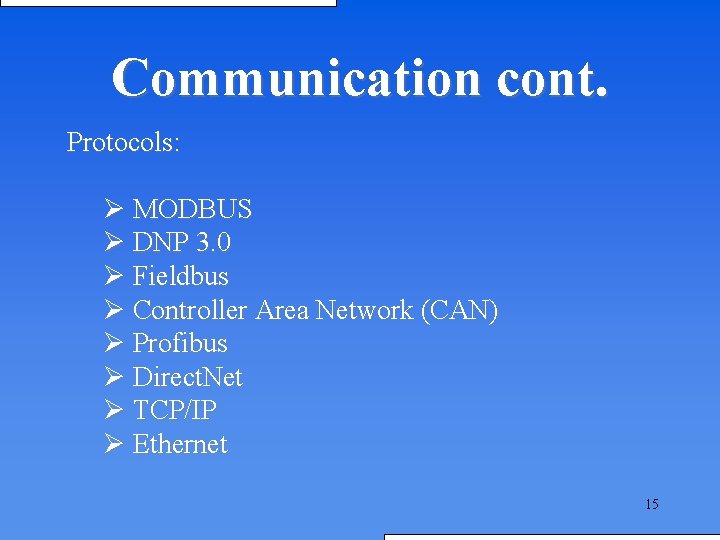
Communication cont. Protocols: Ø MODBUS Ø DNP 3. 0 Ø Fieldbus Ø Controller Area Network (CAN) Ø Profibus Ø Direct. Net Ø TCP/IP Ø Ethernet 15
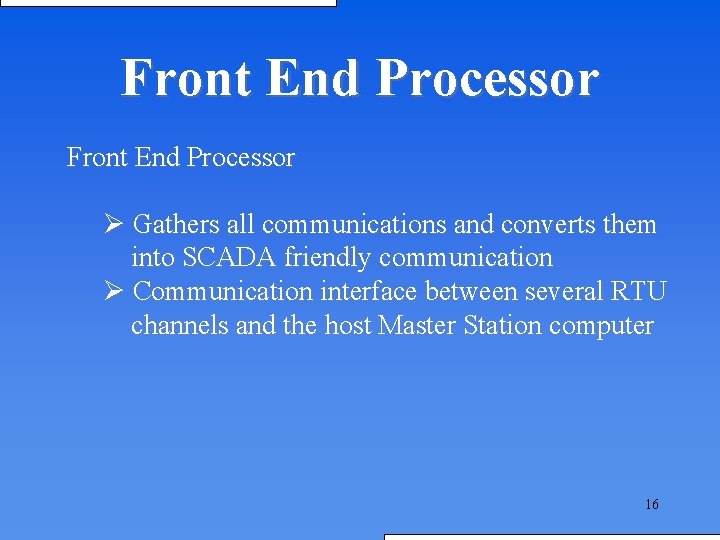
Front End Processor Ø Gathers all communications and converts them into SCADA friendly communication Ø Communication interface between several RTU channels and the host Master Station computer 16
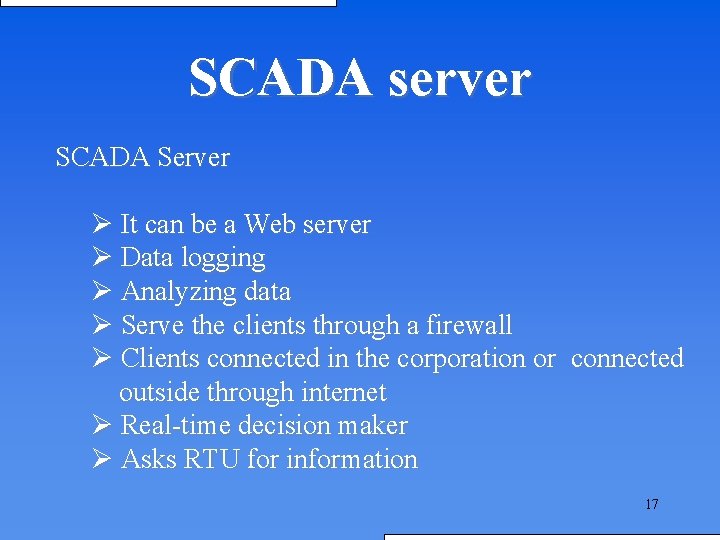
SCADA server SCADA Server Ø It can be a Web server Ø Data logging Ø Analyzing data Ø Serve the clients through a firewall Ø Clients connected in the corporation or connected outside through internet Ø Real-time decision maker Ø Asks RTU for information 17
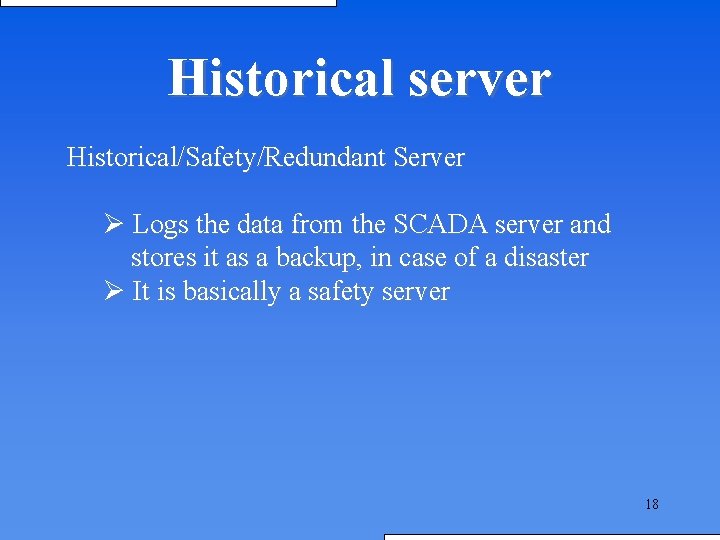
Historical server Historical/Safety/Redundant Server Ø Logs the data from the SCADA server and stores it as a backup, in case of a disaster Ø It is basically a safety server 18
HMI Computer Human Machine Interface Computer Ø Access on the SCADA Server Ø Control the system Ø Operator Interface Ø Software § User friendly § Programmable (C, C++) 19
DCS – Distributed Control System Ø Process oriented – tendency to do something Ø Not event oriented – does not depend on circumstances Ø Local control over the devices Ø Subordinate to SCADA 20
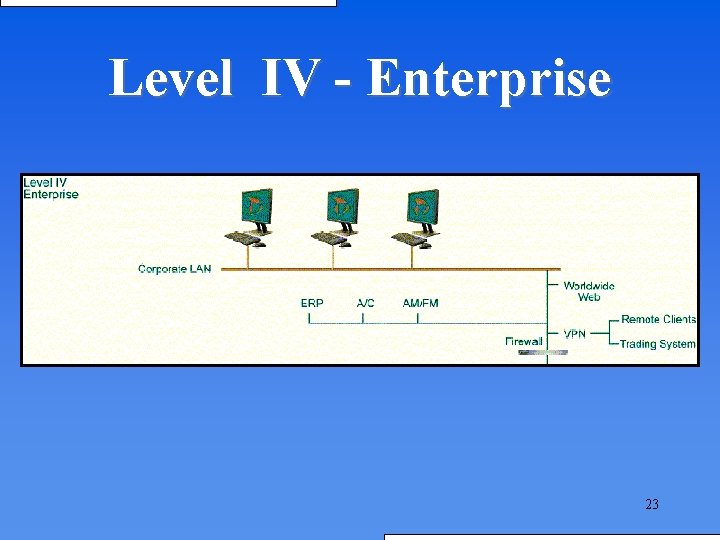
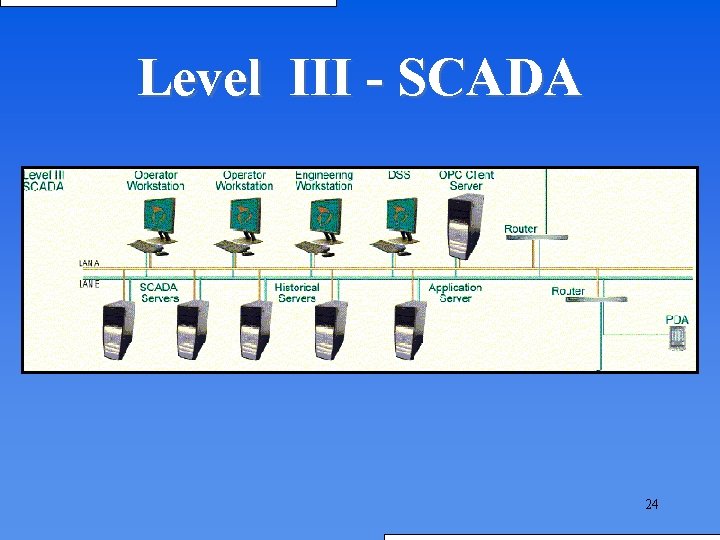
Levels of SCADA Four levels of SCADA system Ø Level IV - Enterprise § Corporate LAN/WAN § World Wide Web § Virtual Private Network § Firewall for remote users Ø Level III – SCADA / MTU § Operator Workstations § Control § Engineering Workstations § Servers – Data logging 21
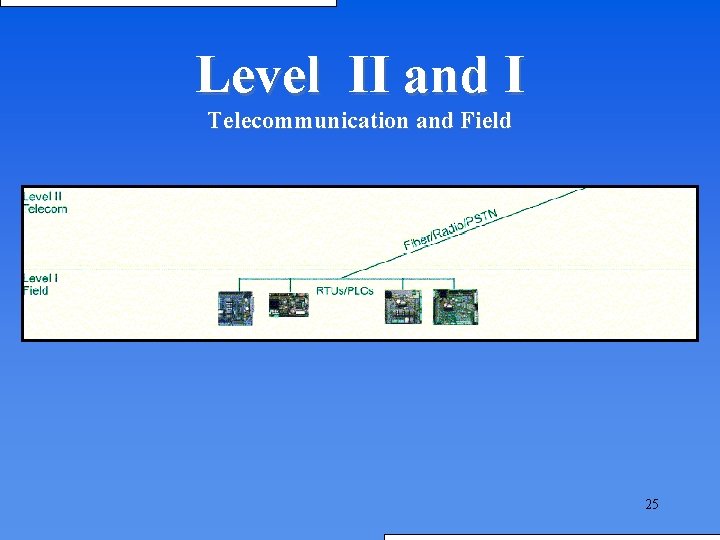
Levels of SCADA cont. Four levels of SCADA system Ø Level II – Telecommunication § Fiber § Radio § Telephone leased line § Protocols Ø Level I – Field § Devices § RTUs / PLCs § Sensors 22
Level IV - Enterprise 23
Level III - SCADA 24
Level II and I Telecommunication and Field 25
Where is SCADA used? Main SCADA applications: Ø Water and Wastewater Ø Power Ø Oil and Gas Ø Research facilities Ø Transportation Ø Security systems Ø Siren systems Ø Irrigation Ø Communication control 26
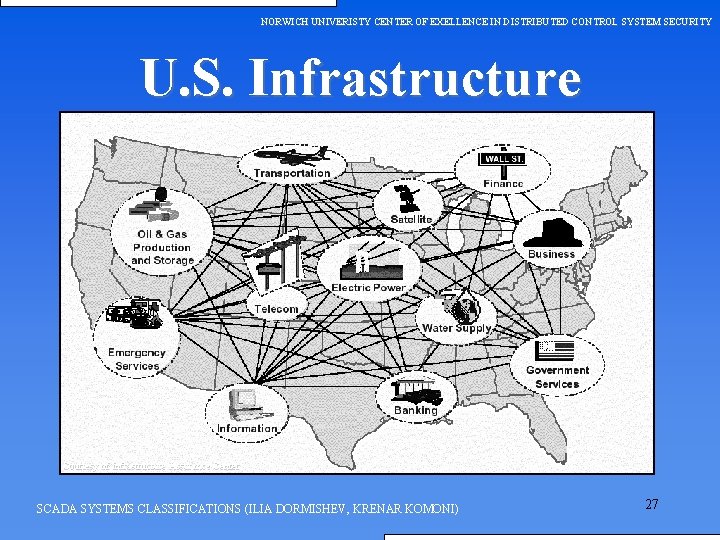
NORWICH UNIVERISTY CENTER OF EXELLENCE IN DISTRIBUTED CONTROL SYSTEM SECURITY U. S. Infrastructure Courtesy of Infrastructure Assurance Center SCADA SYSTEMS CLASSIFICATIONS (ILIA DORMISHEV, KRENAR KOMONI) 27
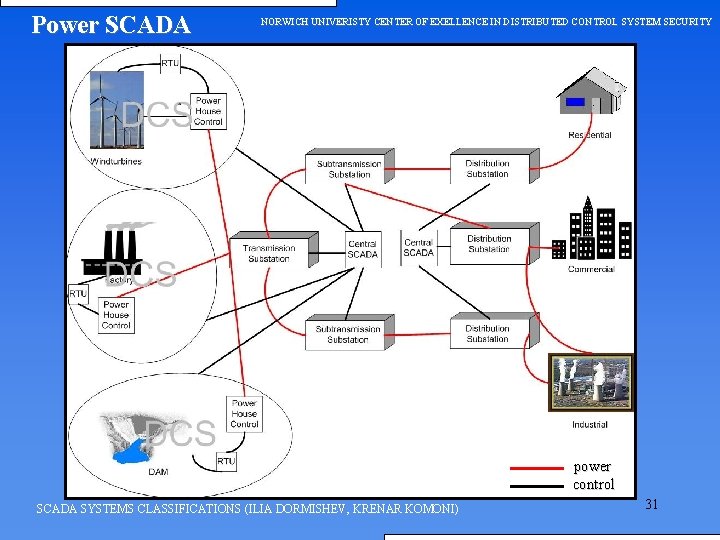
NORWICH UNIVERISTY CENTER OF EXELLENCE IN DISTRIBUTED CONTROL SYSTEM SECURITY SCADA examples: Ø Gas control systems Ø Water control systems Ø Power systems SCADA SYSTEMS CLASSIFICATIONS (ILIA DORMISHEV, KRENAR KOMONI) 28
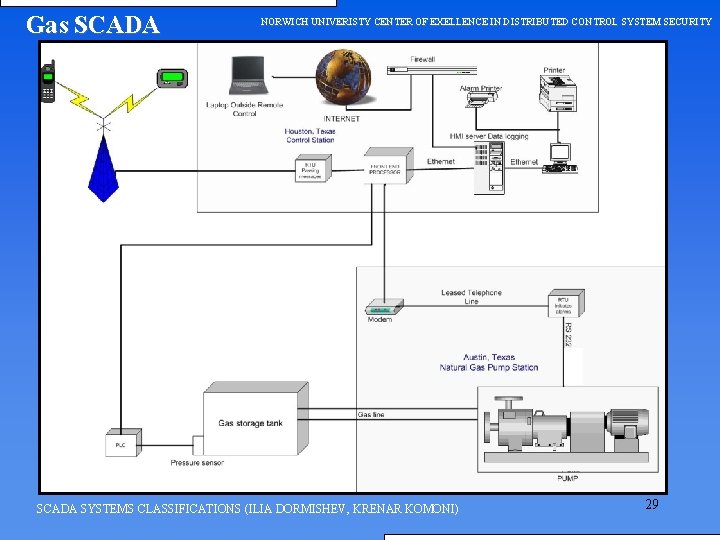
Gas SCADA NORWICH UNIVERISTY CENTER OF EXELLENCE IN DISTRIBUTED CONTROL SYSTEM SECURITY SCADA SYSTEMS CLASSIFICATIONS (ILIA DORMISHEV, KRENAR KOMONI) 29
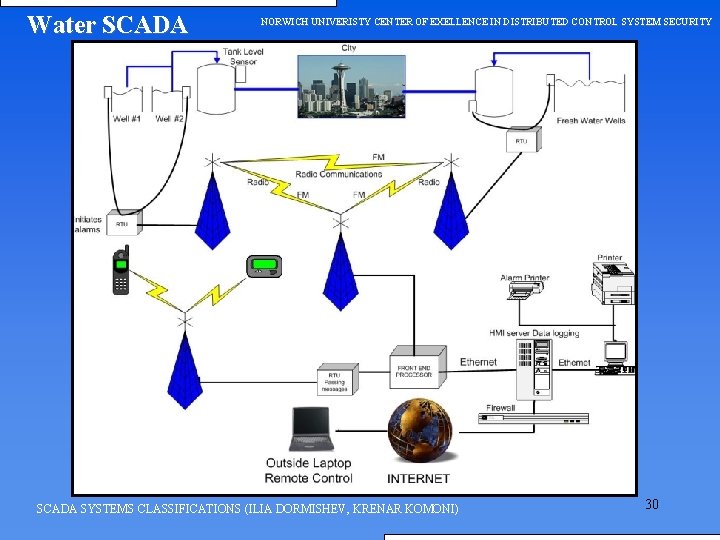
Water SCADA NORWICH UNIVERISTY CENTER OF EXELLENCE IN DISTRIBUTED CONTROL SYSTEM SECURITY SCADA SYSTEMS CLASSIFICATIONS (ILIA DORMISHEV, KRENAR KOMONI) 30
Power SCADA NORWICH UNIVERISTY CENTER OF EXELLENCE IN DISTRIBUTED CONTROL SYSTEM SECURITY power control SCADA SYSTEMS CLASSIFICATIONS (ILIA DORMISHEV, KRENAR KOMONI) 31
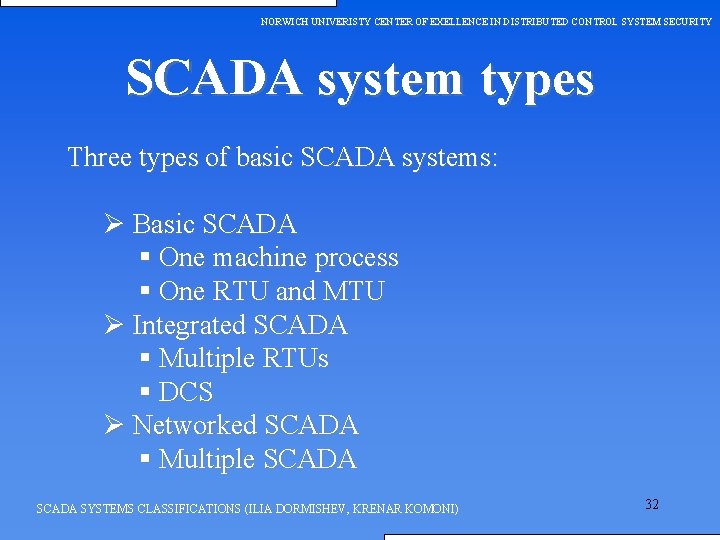
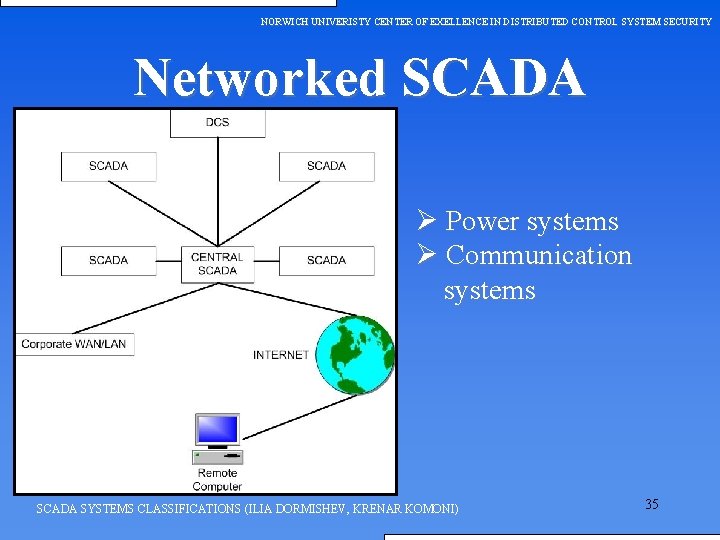
NORWICH UNIVERISTY CENTER OF EXELLENCE IN DISTRIBUTED CONTROL SYSTEM SECURITY SCADA system types Three types of basic SCADA systems: Ø Basic SCADA § One machine process § One RTU and MTU Ø Integrated SCADA § Multiple RTUs § DCS Ø Networked SCADA § Multiple SCADA SYSTEMS CLASSIFICATIONS (ILIA DORMISHEV, KRENAR KOMONI) 32
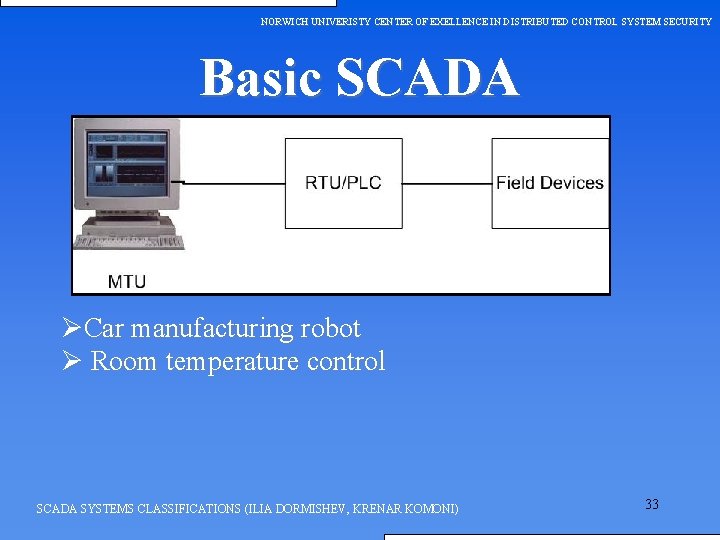
NORWICH UNIVERISTY CENTER OF EXELLENCE IN DISTRIBUTED CONTROL SYSTEM SECURITY Basic SCADA ØCar manufacturing robot Ø Room temperature control SCADA SYSTEMS CLASSIFICATIONS (ILIA DORMISHEV, KRENAR KOMONI) 33
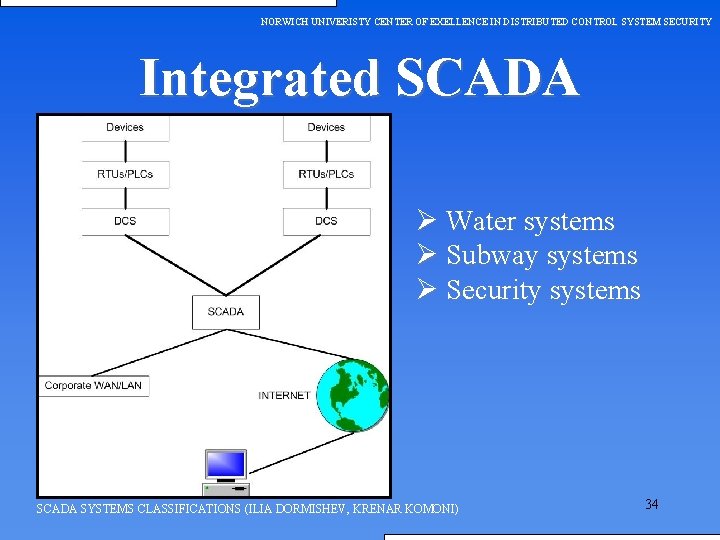
NORWICH UNIVERISTY CENTER OF EXELLENCE IN DISTRIBUTED CONTROL SYSTEM SECURITY Integrated SCADA Ø Water systems Ø Subway systems Ø Security systems SCADA SYSTEMS CLASSIFICATIONS (ILIA DORMISHEV, KRENAR KOMONI) 34
NORWICH UNIVERISTY CENTER OF EXELLENCE IN DISTRIBUTED CONTROL SYSTEM SECURITY Networked SCADA Ø Power systems Ø Communication systems SCADA SYSTEMS CLASSIFICATIONS (ILIA DORMISHEV, KRENAR KOMONI) 35
NORWICH UNIVERISTY CENTER OF EXELLENCE IN DISTRIBUTED CONTROL SYSTEM SECURITY Automation solutions SCADA system manufacturers Ø Modular SCADA, UK Ø MOSCAD, Motorola Ø Rockwell Automation Ø ABCO Ø ABB Ø Lantronix SCADA SYSTEMS CLASSIFICATIONS (ILIA DORMISHEV, KRENAR KOMONI) 36
NORWICH UNIVERISTY CENTER OF EXELLENCE IN DISTRIBUTED CONTROL SYSTEM SECURITY SCADA Hardware manufacturers Ø Rockwell Allen Bradley Ø General Electric (GE) Ø Emerson Ø Schneider Electric SCADA SYSTEMS CLASSIFICATIONS (ILIA DORMISHEV, KRENAR KOMONI) 37
NORWICH UNIVERISTY CENTER OF EXELLENCE IN DISTRIBUTED CONTROL SYSTEM SECURITY SCADA Software manufacturers Ø Intellution (Fix 32) Ø Iconics (Genesis 32 v 7. 0) Ø Wonderware (In. Touch) Ø Citect (Citect. SCADA 5. 42) Ø National Instruments (Lookout SCADA) SCADA SYSTEMS CLASSIFICATIONS (ILIA DORMISHEV, KRENAR KOMONI) 38
NORWICH UNIVERISTY CENTER OF EXELLENCE IN DISTRIBUTED CONTROL SYSTEM SECURITY Purpose of this research Ø Develop a teaching module for a general SCADA system Ø Develop a general model of a SCADA system Ø Use Lab. View and wireless communication computers to illustrate an example of the SCADA system Ø Study the vulnerabilities of the SCADA system Ø Create a freshman introduction module Ø Create an upper level course for SCADA SYSTEMS CLASSIFICATIONS (ILIA DORMISHEV, KRENAR KOMONI) 39
NORWICH UNIVERISTY CENTER OF EXELLENCE IN DISTRIBUTED CONTROL SYSTEM SECURITY What is next? Ø Use the Laptop 1 to generate the wells, tanks, servers, RTUs PLCs and the front end processor through Sub. VIs Ø Use the Laptop 2 to be the HMI Computer that connects to Laptop 1 and reads the data and also affect the devices Ø And Laptop 3 to simulate an attack at the SCADA system SCADA SYSTEMS CLASSIFICATIONS (ILIA DORMISHEV, KRENAR KOMONI) 40
NORWICH UNIVERISTY CENTER OF EXELLENCE IN DISTRIBUTED CONTROL SYSTEM SECURITY Conclusion Ø There are thousands of SCADA systems installed and they can be completely different from each other, in terms of their structures but they all have common elements and a common purpose – to supervise control and collect data. Ø There are three types of SCADA systems that describe all of the SCADA systems. Ø Communication is the most significant part of SCADA Ø Power and communication systems are most likely to get attacked by terrorists. SCADA SYSTEMS CLASSIFICATIONS (ILIA DORMISHEV, KRENAR KOMONI) 41
NORWICH UNIVERISTY CENTER OF EXELLENCE IN DISTRIBUTED CONTROL SYSTEM SECURITY Discussion SCADA SYSTEMS CLASSIFICATIONS (ILIA DORMISHEV, KRENAR KOMONI) 42