
SC Magnets at Fermilab Fast Ramping Dipole Design
SC Magnets at Fermilab Fast Ramping Dipole Design and Status Henryk Piekarz Accelerator Physics Center, FERMILAB Eu. Card LEP 3 Meeting, June 18 2012 Henryk Piekarz
Motivation SC Magnets at Fermilab Several recently proposed accelerator systems (SRCS for Project X, PS 2 and LHe. C at CERN) as well as some industrial applications, would benefit if the synchrotrons based on the dipole magnets of: B ≤ 2 T , and d. B/dt ≤ 10 T/s could be built using moderately difficult technology while featuring high-level performance with low construction and operational costs. For B ≤ 2 T , dipole field can be shaped by magnetic core and generated by a single-turn conductor – inexpensive but highly performing technology. Henryk Piekarz
SC Magnets at Fermilab Critical Elements for Rapid Cycling Dipole Design q Superconductor choice q Magnetic core and cable design for minimized power loss q Cable radiation hardness and longevity q Core lamination and operating temperature q Low complexity of quench detection and protection system q Low complexity of magnet string power system q Low cost and complexity of magnet string cryogenic system q Low cost and complexity of magnet string and assembly work Rapid cycling accelerator dipole powered with HTS transmission-line cable can satisfy all of the above Henryk Piekarz
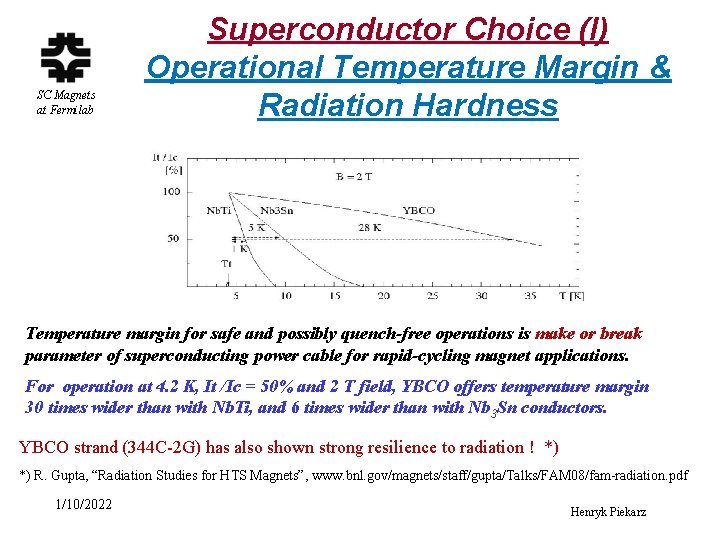
SC Magnets at Fermilab Superconductor Choice (I) Operational Temperature Margin & Radiation Hardness Temperature margin for safe and possibly quench-free operations is make or break parameter of superconducting power cable for rapid-cycling magnet applications. For operation at 4. 2 K, It /Ic = 50% and 2 T field, YBCO offers temperature margin 30 times wider than with Nb. Ti, and 6 times wider than with Nb 3 Sn conductors. YBCO strand (344 C-2 G) has also shown strong resilience to radiation ! *) *) R. Gupta, “Radiation Studies for HTS Magnets”, www. bnl. gov/magnets/staff/gupta/Talks/FAM 08/fam-radiation. pdf 1/10/2022 Henryk Piekarz
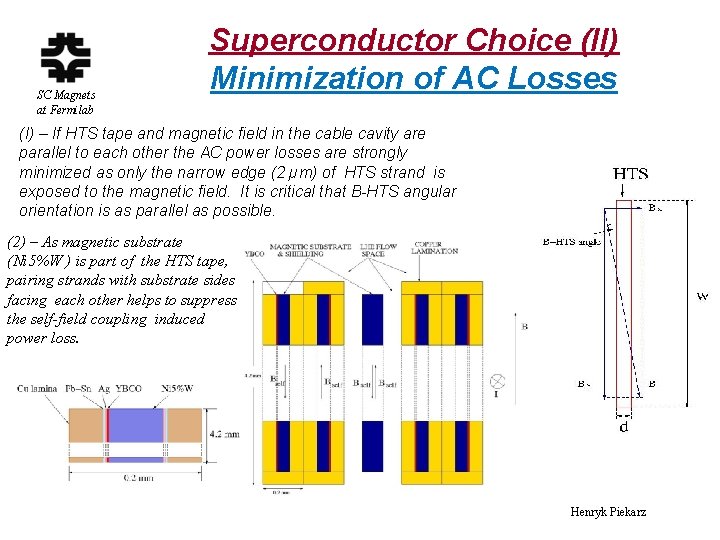
SC Magnets at Fermilab Superconductor Choice (II) Minimization of AC Losses (I) – If HTS tape and magnetic field in the cable cavity are parallel to each other the AC power losses are strongly minimized as only the narrow edge (2 µm) of HTS strand is exposed to the magnetic field. It is critical that B-HTS angular orientation is as parallel as possible. (2) – As magnetic substrate (Ni 5%W ) is part of the HTS tape, pairing strands with substrate sides facing each other helps to suppress the self-field coupling induced power loss. Henryk Piekarz
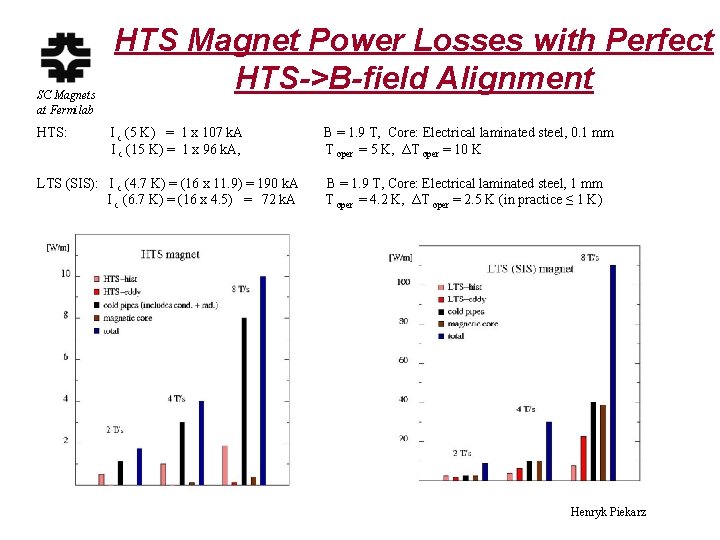
SC Magnets at Fermilab HTS: HTS Magnet Power Losses with Perfect HTS->B-field Alignment I c (5 K) = 1 x 10⁷ k. A I c (15 K) = 1 x 96 k. A, LTS (SIS): I c (4. 7 K) = (16 x 11. 9) = 190 k. A I c (6. 7 K) = (16 x 4. 5) = 72 k. A B = 1. 9 T, Core: Electrical laminated steel, 0. 1 mm T oper = 5 K, ΔT oper = 10 K B = 1. 9 T, Core: Electrical laminated steel, 1 mm T oper = 4. 2 K, ΔT oper = 2. 5 K (in practice ≤ 1 K) Henryk Piekarz
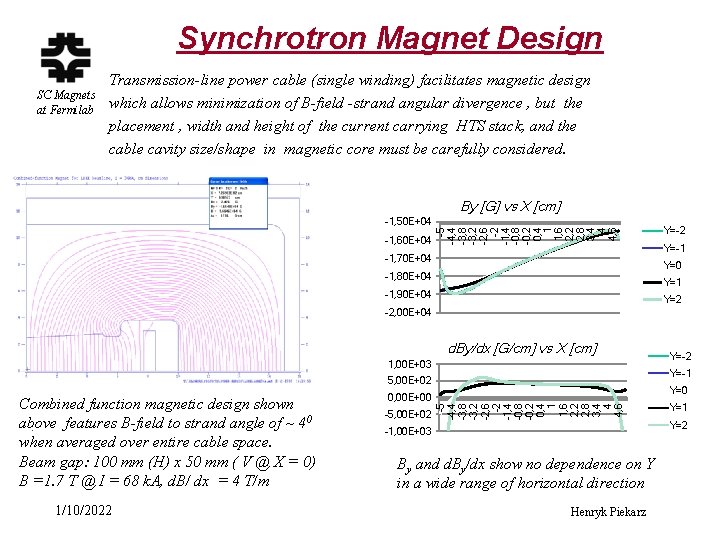
Synchrotron Magnet Design SC Magnets at Fermilab Transmission-line power cable (single winding) facilitates magnetic design which allows minimization of B-field -strand angular divergence , but the placement , width and height of the current carrying HTS stack, and the cable cavity size/shape in magnetic core must be carefully considered. -1, 50 E+04 -1, 60 E+04 -5 -4, 4 -3, 8 -3, 2 -2, 6 -2 -1, 4 -0, 8 -0, 2 0, 4 1 1, 6 2, 2 2, 8 3, 4 4 4, 6 By [G] vs X [cm] -1, 70 E+04 Y=-2 Y=-1 Y=0 -1, 80 E+04 Y=1 -1, 90 E+04 Y=2 -2, 00 E+04 d. By/dx [G/cm] vs X [cm] 1, 00 E+03 Y=-1 5, 00 E+02 1/10/2022 -5, 00 E+02 Y=0 -5 -4, 4 -3, 8 -3, 2 -2, 6 -2 -1, 4 -0, 8 -0, 2 0, 4 1 1, 6 2, 2 2, 8 3, 4 4 4, 6 Combined function magnetic design shown above features B-field to strand angle of ~ 40. when averaged over entire cable space. Beam gap: 100 mm (H) x 50 mm ( V @ X = 0) B =1. 7 T @ I = 68 k. A, d. B/ dx = 4 T/m 0, 00 E+00 Y=-2 -1, 00 E+03 By and d. By/dx show no dependence on Y in a wide range of horizontal direction Henryk Piekarz Y=1 Y=2
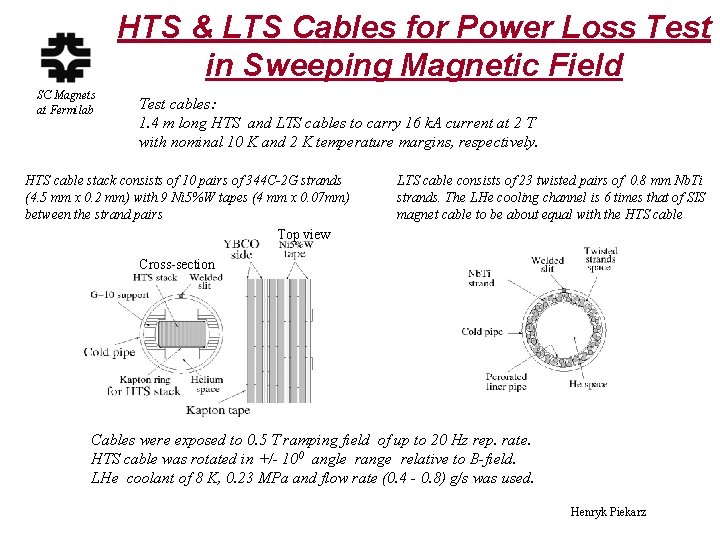
HTS & LTS Cables for Power Loss Test in Sweeping Magnetic Field SC Magnets at Fermilab Test cables: 1. 4 m long HTS and LTS cables to carry 16 k. A current at 2 T with nominal 10 K and 2 K temperature margins, respectively. HTS cable stack consists of 10 pairs of 344 C-2 G strands (4. 5 mm x 0. 2 mm) with 9 Ni 5%W tapes (4 mm x 0. 07 mm) between the strand pairs Top view LTS cable consists of 23 twisted pairs of 0. 8 mm Nb. Ti strands. The LHe cooling channel is 6 times that of SIS magnet cable to be about equal with the HTS cable Cross-section Cables were exposed to 0. 5 T ramping field of up to 20 Hz rep. rate. HTS cable was rotated in +/- 100 angle range relative to B-field. LHe coolant of 8 K, 0. 23 MPa and flow rate (0. 4 - 0. 8) g/s was used. Henryk Piekarz
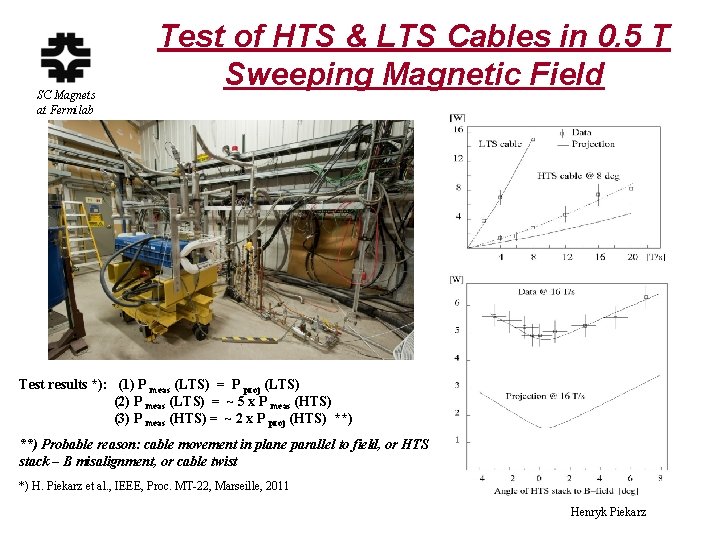
SC Magnets at Fermilab Test of HTS & LTS Cables in 0. 5 T Sweeping Magnetic Field Test results *): (1) P meas (LTS) = P proj (LTS) (2) P meas (LTS) = ~ 5 x P meas (HTS) (3) P meas (HTS) = ~ 2 x P proj (HTS) **) Probable reason: cable movement in plane parallel to field, or HTS stack – B misalignment, or cable twist *) H. Piekarz et al. , IEEE, Proc. MT-22, Marseille, 2011 Henryk Piekarz
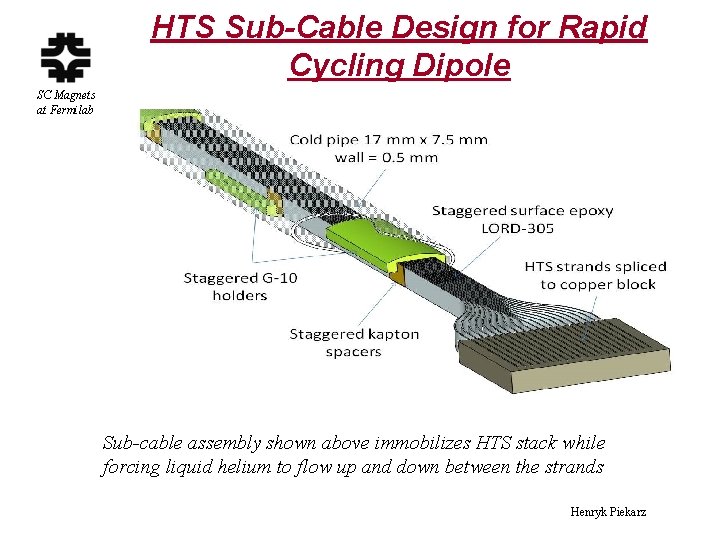
HTS Sub-Cable Design for Rapid Cycling Dipole SC Magnets at Fermilab Sub-cable assembly shown above immobilizes HTS stack while forcing liquid helium to flow up and down between the strands Henryk Piekarz
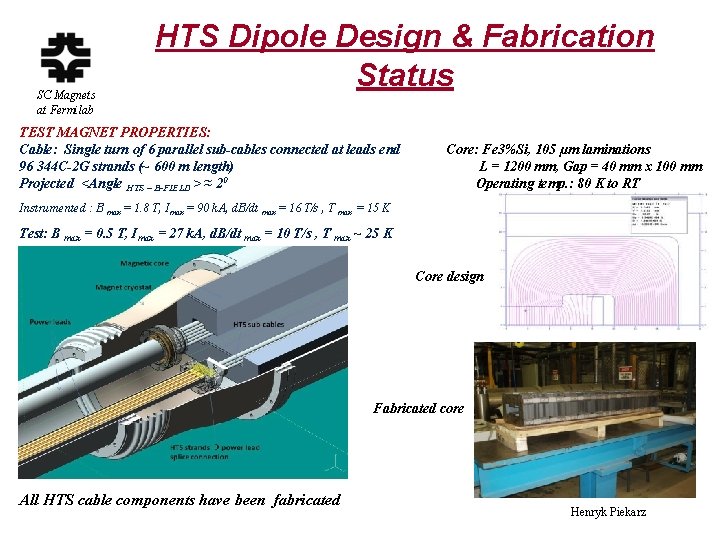
SC Magnets at Fermilab HTS Dipole Design & Fabrication Status TEST MAGNET PROPERTIES: Cable: Single turn of 6 parallel sub-cables connected at leads end 96 344 C-2 G strands (~ 600 m length) Projected <Angle HTS – B-FIELD > ≈ 20 Core: Fe 3%Si, 105 µm laminations L = 1200 mm, Gap = 40 mm x 100 mm Operating temp. : 80 K to RT Instrumented : B max = 1. 8 T, Imax = 90 k. A, d. B/dt max = 16 T/s , T max = 15 K Test: B max = 0. 5 T, Imax = 27 k. A, d. B/dt max = 10 T/s , T max ~ 25 K Core design Fabricated core All HTS cable components have been fabricated Henryk Piekarz
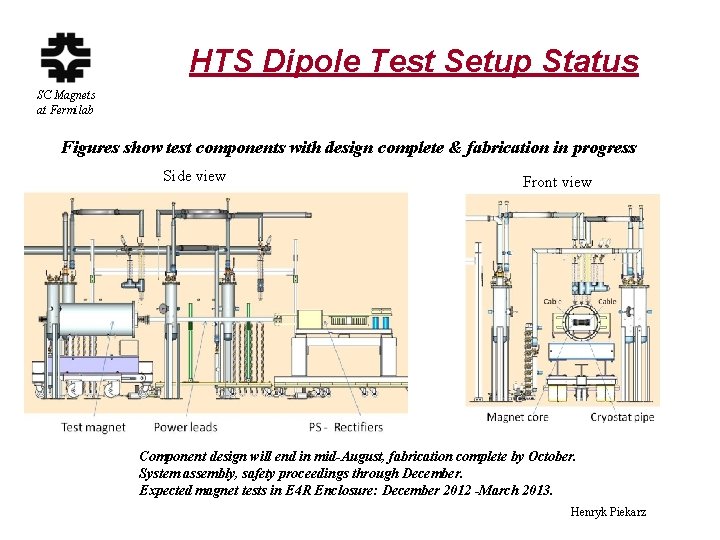
HTS Dipole Test Setup Status SC Magnets at Fermilab Figures show test components with design complete & fabrication in progress Side view Front view Component design will end in mid-August, fabrication complete by October. System assembly, safety proceedings through December. Expected magnet tests in E 4 R Enclosure: December 2012 -March 2013. Henryk Piekarz
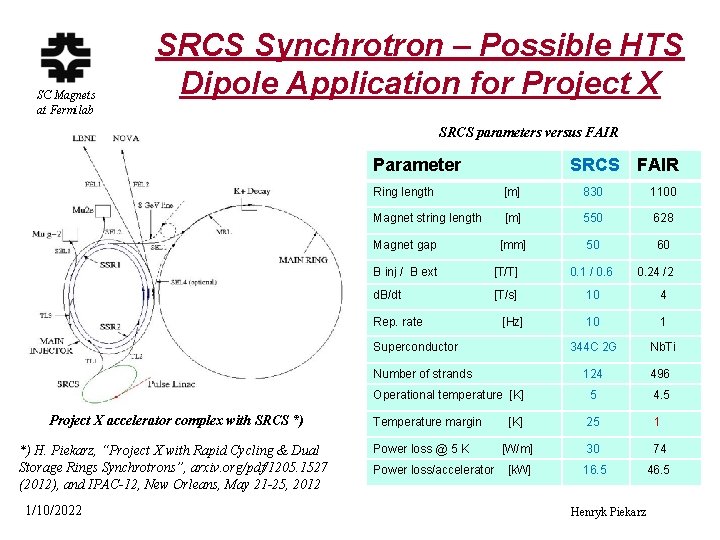
SC Magnets at Fermilab SRCS Synchrotron – Possible HTS Dipole Application for Project X SRCS parameters versus FAIR Parameter SRCS FAIR Ring length [m] 830 1100 Magnet string length [m] 550 628 [mm] 50 60 Magnet gap B inj / B ext [T/T] 0. 1 / 0. 6 d. B/dt [T/s] 10 4 10 1 344 C 2 G Nb. Ti 124 496 Operational temperature [K] 5 4. 5 Temperature margin [K] 25 1 [W/m] 30 74 [k. W] 16. 5 46. 5 Rep. rate [Hz] Superconductor Number of strands Project X accelerator complex with SRCS *) *) H. Piekarz, “Project X with Rapid Cycling & Dual Storage Rings Synchrotrons”, arxiv. org/pdf/1205. 1527 (2012), and IPAC-12, New Orleans, May 21 -25, 2012 1/10/2022 Power loss @ 5 K Power loss/accelerator 0. 24 /2 Henryk Piekarz
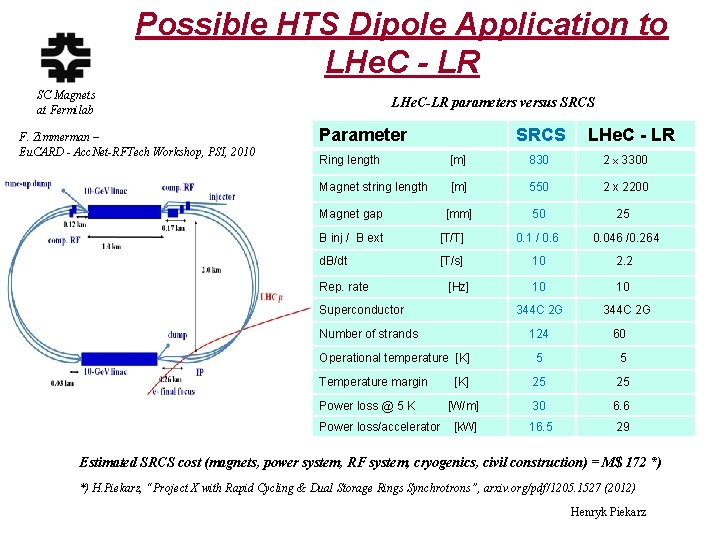
Possible HTS Dipole Application to LHe. C - LR SC Magnets at Fermilab F. Zimmerman – Eu. CARD - Acc. Net-RFTech Workshop, PSI, 2010 LHe. C-LR parameters versus SRCS Parameter SRCS LHe. C - LR Ring length [m] 830 2 x 3300 Magnet string length [m] 550 2 x 2200 [mm] 50 25 Magnet gap B inj / B ext [T/T] 0. 1 / 0. 6 0. 046 /0. 264 d. B/dt [T/s] 10 2. 2 10 10 Rep. rate [Hz] Superconductor 344 C 2 G Number of strands 344 C 2 G 124 60 Operational temperature [K] 5 5 Temperature margin [K] 25 25 [W/m] 30 6. 6 [k. W] 16. 5 29 Power loss @ 5 K Power loss/accelerator Estimated SRCS cost (magnets, power system, RF system, cryogenics, civil construction) = M$ 172 *) *) H. Piekarz, “Project X with Rapid Cycling & Dual Storage Rings Synchrotrons”, arxiv. org/pdf/1205. 1527 (2012) Henryk Piekarz
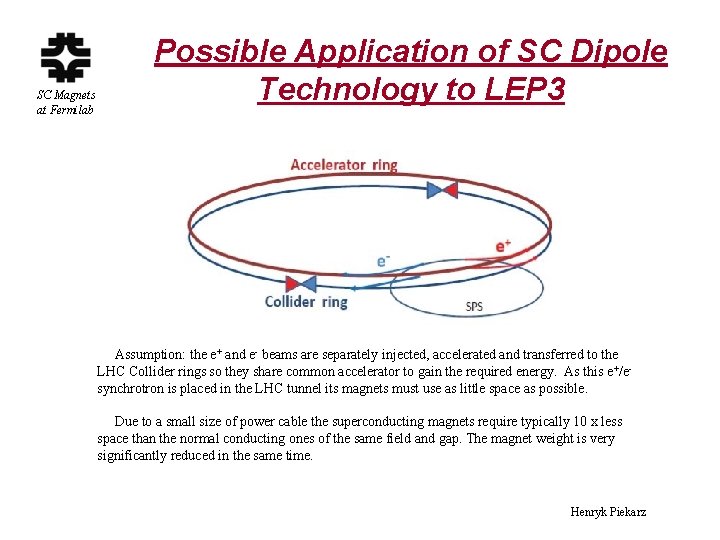
SC Magnets at Fermilab Possible Application of SC Dipole Technology to LEP 3 Assumption: the e+ and e- beams are separately injected, accelerated and transferred to the LHC Collider rings so they share common accelerator to gain the required energy. As this e +/esynchrotron is placed in the LHC tunnel its magnets must use as little space as possible. Due to a small size of power cable the superconducting magnets require typically 10 x less space than the normal conducting ones of the same field and gap. The magnet weight is very significantly reduced in the same time. Henryk Piekarz
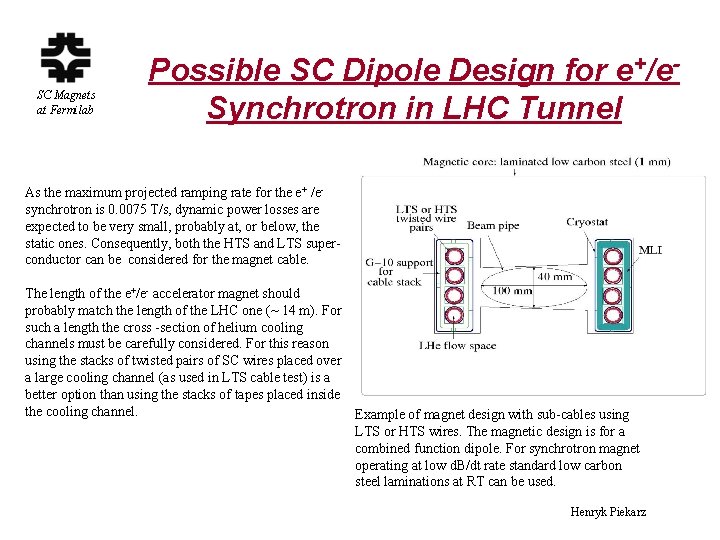
SC Magnets at Fermilab Possible SC Dipole Design for e+/e. Synchrotron in LHC Tunnel As the maximum projected ramping rate for the e+ /esynchrotron is 0. 0075 T/s, dynamic power losses are expected to be very small, probably at, or below, the static ones. Consequently, both the HTS and LTS superconductor can be considered for the magnet cable. The length of the e+/e- accelerator magnet should probably match the length of the LHC one (~ 14 m). For such a length the cross -section of helium cooling channels must be carefully considered. For this reason using the stacks of twisted pairs of SC wires placed over a large cooling channel (as used in LTS cable test) is a better option than using the stacks of tapes placed inside the cooling channel. Example of magnet design with sub-cables using LTS or HTS wires. The magnetic design is for a combined function dipole. For synchrotron magnet operating at low d. B/dt rate standard low carbon steel laminations at RT can be used. Henryk Piekarz
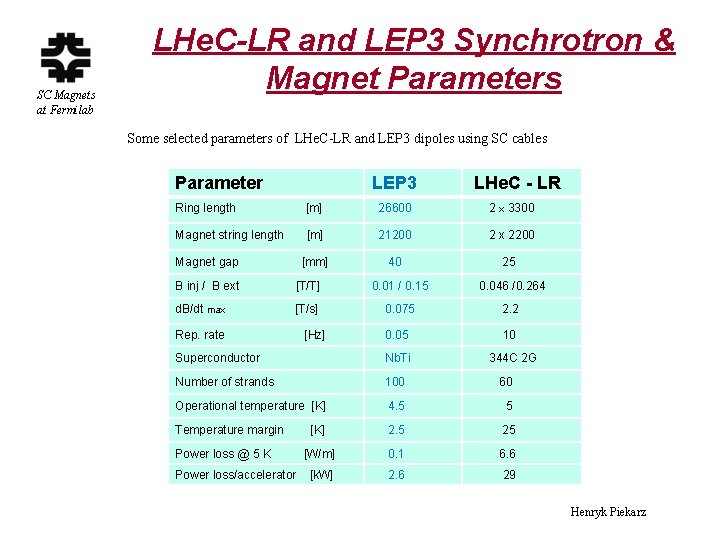
SC Magnets at Fermilab LHe. C-LR and LEP 3 Synchrotron & Magnet Parameters Some selected parameters of LHe. C-LR and LEP 3 dipoles using SC cables Parameter LEP 3 LHe. C - LR Ring length [m] 26600 2 x 3300 Magnet string length [m] 21200 2 x 2200 [mm] 40 25 Magnet gap B inj / B ext [T/T] 0. 01 / 0. 15 0. 046 /0. 264 d. B/dt max [T/s] 0. 075 2. 2 0. 05 10 Rep. rate [Hz] Superconductor Nb. Ti Number of strands 100 60 Operational temperature [K] 4. 5 5 Temperature margin [K] 2. 5 25 [W/m] 0. 1 6. 6 [k. W] 2. 6 29 Power loss @ 5 K Power loss/accelerator 344 C 2 G Henryk Piekarz
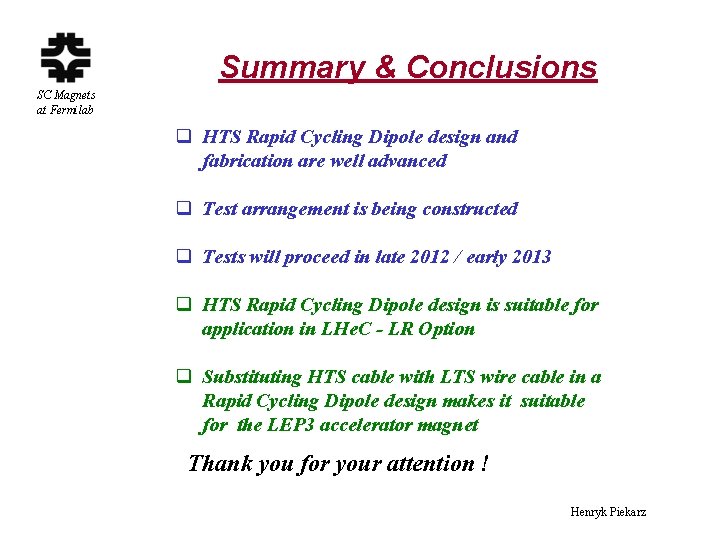
Summary & Conclusions SC Magnets at Fermilab q HTS Rapid Cycling Dipole design and fabrication are well advanced q Test arrangement is being constructed q Tests will proceed in late 2012 / early 2013 q HTS Rapid Cycling Dipole design is suitable for application in LHe. C - LR Option q Substituting HTS cable with LTS wire cable in a Rapid Cycling Dipole design makes it suitable for the LEP 3 accelerator magnet Thank you for your attention ! Henryk Piekarz
- Slides: 18