
SC Magnets at Fermilab A Double SuperFerric Ring
SC Magnets at Fermilab A Double Super-Ferric Ring (DSF-MR) in the Tevatron for a Neutrino Factory Outline 1. 2. 3. 4. 5. 6. 7. 8. 9. 10. 11. 12. Motivation Physics potential of long-baseline neutrino experiments Possible detector sites for Fermilab long-baseline neutrino beams Detector sites considered for CERN SPS neutrino beams Proposed new Fermilab accelerator complex Magnets for fast cycling DSF-MR accelerator Tevatron infrastructure for use with DSF-MR Projected cost and timeline Summary and conclusions Preliminary Note at: http: //tdserver 1. fnal. gov/project/Nu-factory/DSF-MR. doc March 7, 2007 AD meeting Henryk Piekarz
Motivation SC Magnets at Fermilab q Startup of LHC in late 2007 brings end to the Tevatron q ILC with its primary motivation to study Higgs must wait for Higgs discovery at LHC to determine mass reach q Most theorists expect Higgs, or any other EW symmetry breaking mechanism, to appear at mass order of 1 Te. V q It is likely to take few years for LHC to confirm or deny existence of SM Higgs (M Higgs < 0. 8 Te. V) q The US high-energy physics community must have an intermediate, high-profiled, accelerator based program q Intermediate program should be of moderate cost, so not to affect potential ILC construction if it becomes reality q Long baseline neutrino oscillation physics matches well the requirements of high-profile and cost effectiveness March 7, 2007 AD meeting Henryk Piekarz
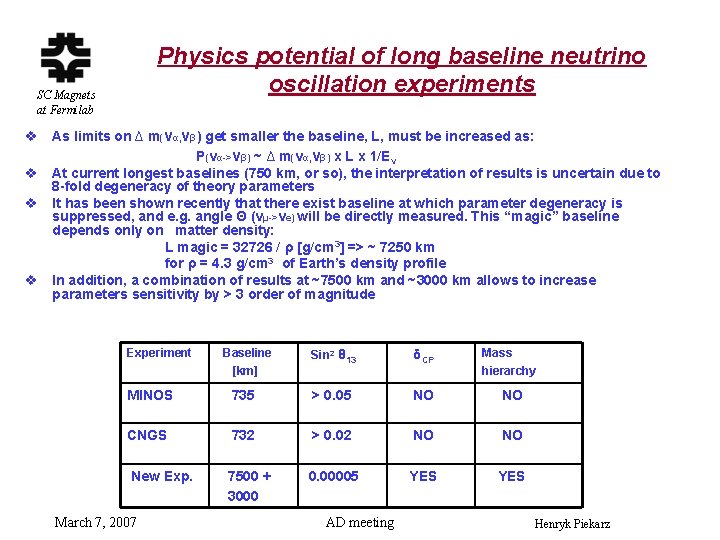
Physics potential of long baseline neutrino oscillation experiments SC Magnets at Fermilab v As limits on ∆ m(να, νβ) get smaller the baseline, L, must be increased as: P (να->νβ) ~ ∆ m(να, νβ) x L x 1/Eν v At current longest baselines (750 km, or so), the interpretation of results is uncertain due to 8 -fold degeneracy of theory parameters v It has been shown recently that there exist baseline at which parameter degeneracy is suppressed, and e. g. angle Θ (νµ->νe) will be directly measured. This “magic” baseline depends only on matter density: L magic = 32726 / ρ [g/cm 3] => ~ 7250 km for ρ = 4. 3 g/cm 3 of Earth’s density profile v In addition, a combination of results at ~7500 km and ~3000 km allows to increase parameters sensitivity by > 3 order of magnitude Experiment Baseline [km] Sin 2 θ 13 δCP Mass hierarchy MINOS 735 > 0. 05 NO NO CNGS 732 > 0. 02 NO NO New Exp. 7500 + 3000 0. 00005 YES March 7, 2007 AD meeting Henryk Piekarz
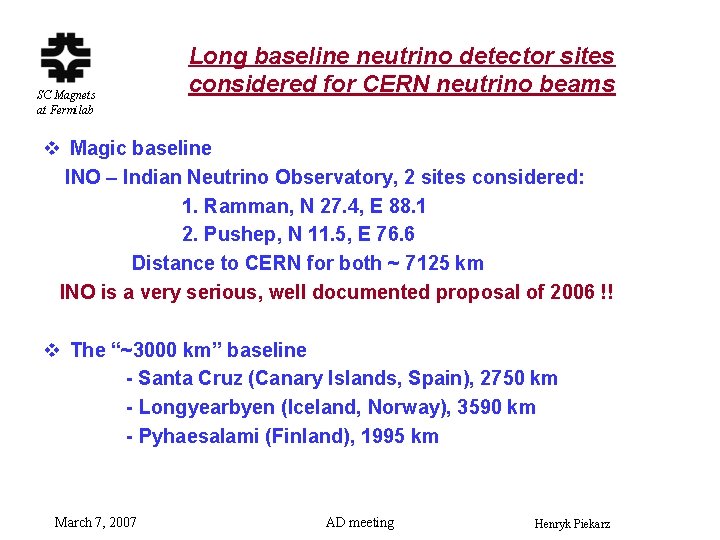
SC Magnets at Fermilab Long baseline neutrino detector sites considered for CERN neutrino beams v Magic baseline INO – Indian Neutrino Observatory, 2 sites considered: 1. Ramman, N 27. 4, E 88. 1 2. Pushep, N 11. 5, E 76. 6 Distance to CERN for both ~ 7125 km INO is a very serious, well documented proposal of 2006 !! v The “~3000 km” baseline - Santa Cruz (Canary Islands, Spain), 2750 km - Longyearbyen (Iceland, Norway), 3590 km - Pyhaesalami (Finland), 1995 km March 7, 2007 AD meeting Henryk Piekarz
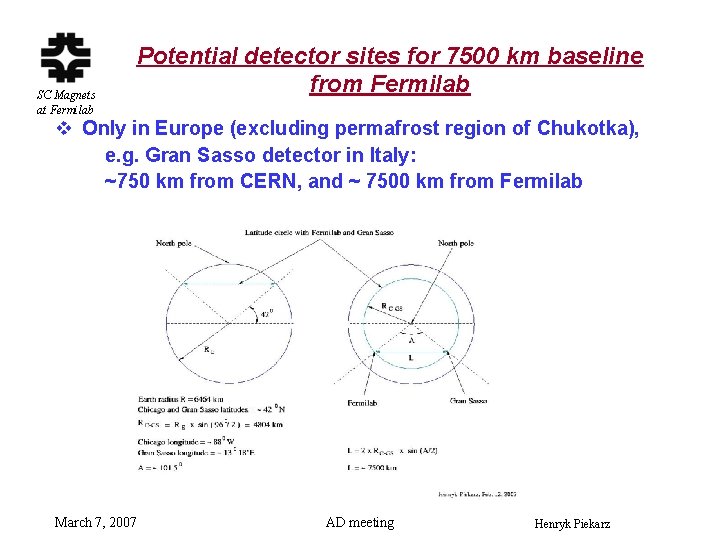
SC Magnets at Fermilab Potential detector sites for 7500 km baseline from Fermilab v Only in Europe (excluding permafrost region of Chukotka), e. g. Gran Sasso detector in Italy: ~750 km from CERN, and ~ 7500 km from Fermilab March 7, 2007 AD meeting Henryk Piekarz
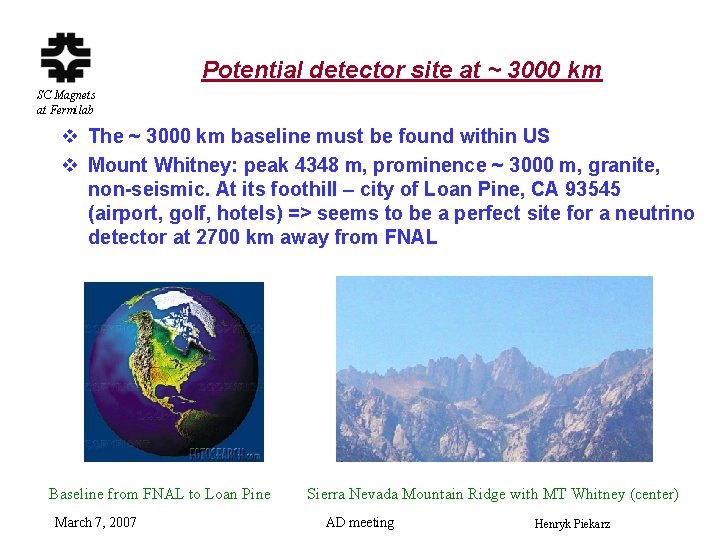
Potential detector site at ~ 3000 km SC Magnets at Fermilab v The ~ 3000 km baseline must be found within US v Mount Whitney: peak 4348 m, prominence ~ 3000 m, granite, non-seismic. At its foothill – city of Loan Pine, CA 93545 (airport, golf, hotels) => seems to be a perfect site for a neutrino detector at 2700 km away from FNAL Baseline from FNAL to Loan Pine March 7, 2007 Sierra Nevada Mountain Ridge with MT Whitney (center) AD meeting Henryk Piekarz
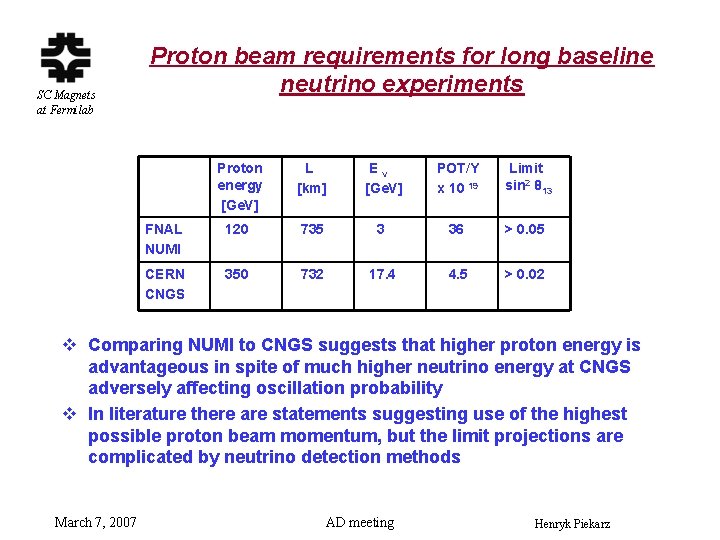
SC Magnets at Fermilab Proton beam requirements for long baseline neutrino experiments Proton energy [Ge. V] L [km] Eν [Ge. V] POT/Y x 10 19 Limit sin 2 θ 13 FNAL NUMI 120 735 3 36 > 0. 05 CERN CNGS 350 732 17. 4 4. 5 > 0. 02 v Comparing NUMI to CNGS suggests that higher proton energy is advantageous in spite of much higher neutrino energy at CNGS adversely affecting oscillation probability v In literature there are statements suggesting use of the highest possible proton beam momentum, but the limit projections are complicated by neutrino detection methods March 7, 2007 AD meeting Henryk Piekarz
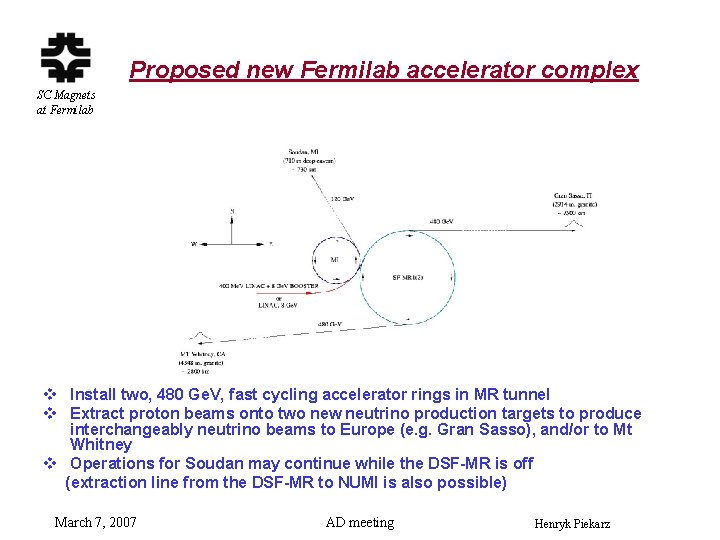
Proposed new Fermilab accelerator complex SC Magnets at Fermilab v Install two, 480 Ge. V, fast cycling accelerator rings in MR tunnel v Extract proton beams onto two new neutrino production targets to produce interchangeably neutrino beams to Europe (e. g. Gran Sasso), and/or to Mt Whitney v Operations for Soudan may continue while the DSF-MR is off (extraction line from the DSF-MR to NUMI is also possible) March 7, 2007 AD meeting Henryk Piekarz
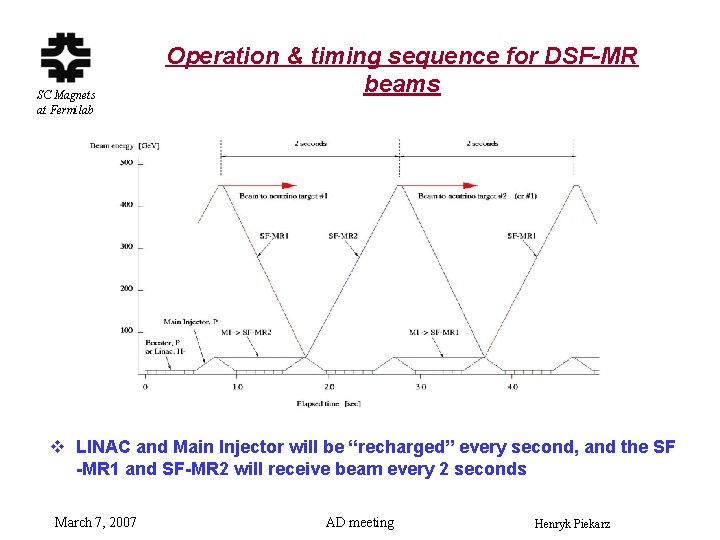
SC Magnets at Fermilab Operation & timing sequence for DSF-MR beams v LINAC and Main Injector will be “recharged” every second, and the SF -MR 1 and SF-MR 2 will receive beam every 2 seconds March 7, 2007 AD meeting Henryk Piekarz
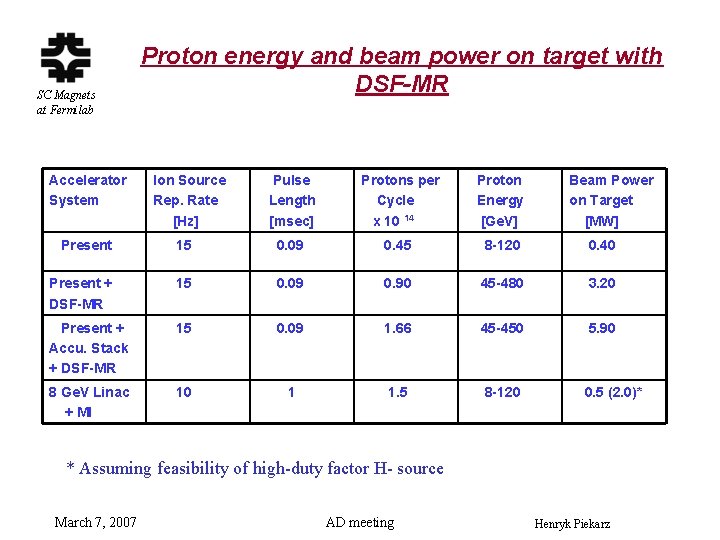
SC Magnets at Fermilab Accelerator System Proton energy and beam power on target with DSF-MR Ion Source Rep. Rate [Hz] Pulse Length [msec] Protons per Cycle x 10 14 Proton Energy [Ge. V] Beam Power on Target [MW] Present 15 0. 09 0. 45 8 -120 0. 40 Present + DSF-MR 15 0. 09 0. 90 45 -480 3. 20 Present + Accu. Stack + DSF-MR 15 0. 09 1. 66 45 -450 5. 90 8 Ge. V Linac + MI 10 1 1. 5 8 -120 0. 5 (2. 0)* * Assuming feasibility of high-duty factor H- source March 7, 2007 AD meeting Henryk Piekarz
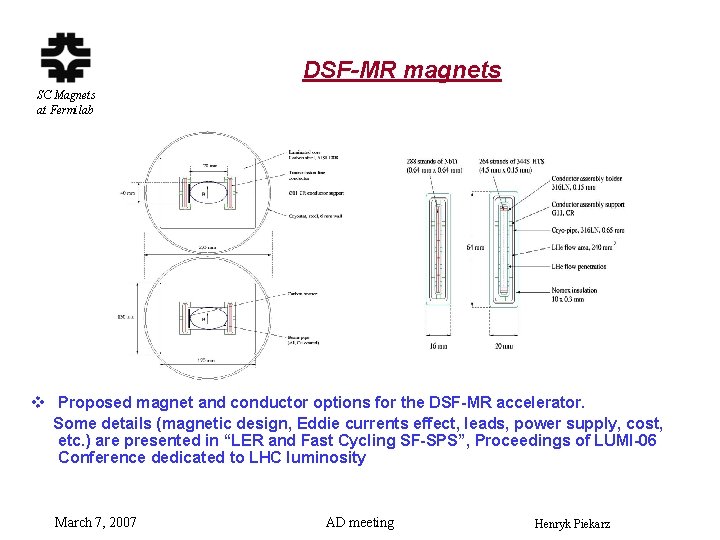
DSF-MR magnets SC Magnets at Fermilab v Proposed magnet and conductor options for the DSF-MR accelerator. Some details (magnetic design, Eddie currents effect, leads, power supply, cost, etc. ) are presented in “LER and Fast Cycling SF-SPS”, Proceedings of LUMI-06 Conference dedicated to LHC luminosity March 7, 2007 AD meeting Henryk Piekarz
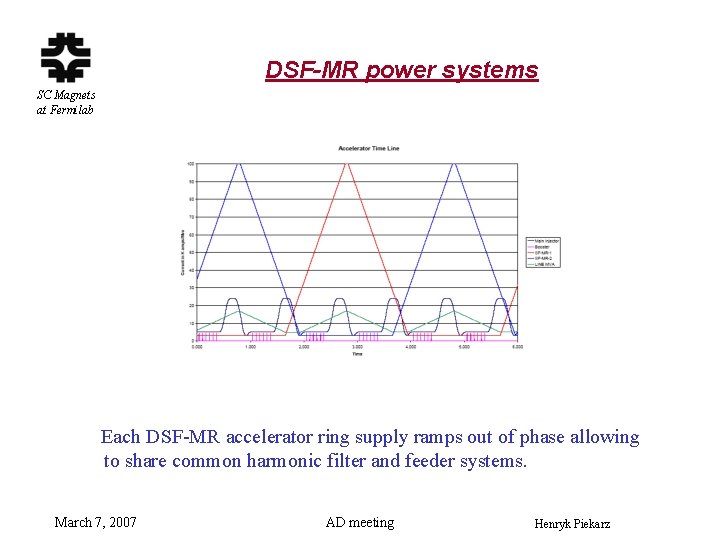
DSF-MR power systems SC Magnets at Fermilab Each DSF-MR accelerator ring supply ramps out of phase allowing to share common harmonic filter and feeder systems. March 7, 2007 AD meeting Henryk Piekarz
DSF-MR power, RF and cryogenic systems SC Magnets at Fermilab v New power system will have to be developed for DSF-MR. Each accelerator ring supply will be +/- 2000 V ramping supply at 100, 000 A current and 162 MVA peak power Some equipment exists, and the present Tevatron power transformer of 40 MVA pulsed duty can support DSF-MR v The Main Ring is already equipped with RF system for the Tevatron, but it must be seriously upgraded to meet the increased power demand for fast cycle of the DSF-MR v The existing Tevatron cryogenic system will be used (with some modifications) for the DSF-MR magnets. The expected DSF-MR required refrigeration power is at ~(10 -20)% of the Tevatron March 7, 2007 AD meeting Henryk Piekarz
Neutrino production lines SC Magnets at Fermilab v The strong descent of the proton lines to the production targets is a significant civil engineering challenge. Most of the beam path (~1000 m), however, is a decay tube of π/K -> µ + ν. With 420 descending angle the neutrino target will have to be at depth of ~700 m. For comparison the Soudan detector is at ~ 700 m below the surface. v The Tevatron may be used magnets to construct the transfer lines from DSF-MR to the neutrino production targets March 7, 2007 AD meeting Henryk Piekarz
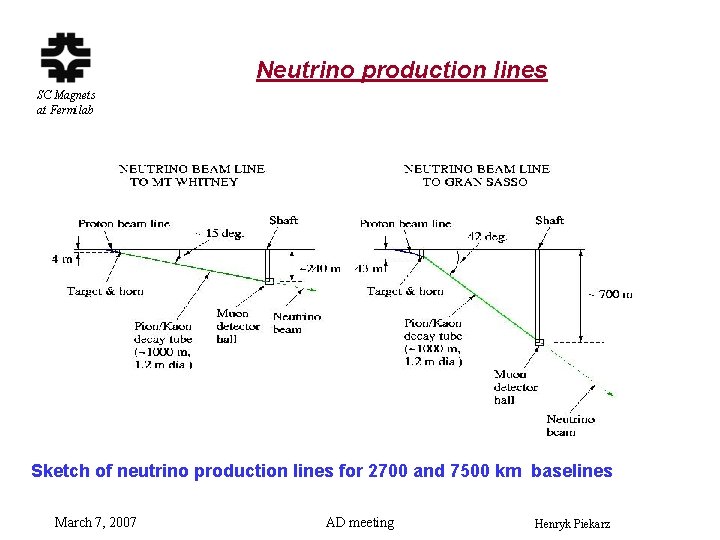
Neutrino production lines SC Magnets at Fermilab Sketch of neutrino production lines for 2700 and 7500 km baselines March 7, 2007 AD meeting Henryk Piekarz
![Cost estimate SC Magnets at Fermilab Neutrino beams subsystems [$M] DSF-MR 300 Neutrino production](http://slidetodoc.com/presentation_image_h2/2d0c0302d9ea7d8125615285b7014fad/image-16.jpg "Cost estimate SC Magnets at Fermilab Neutrino beams subsystems [$M] DSF-MR 300 Neutrino production")
Cost estimate SC Magnets at Fermilab Neutrino beams subsystems [$M] DSF-MR 300 Neutrino production lines 200 Targets and muon detection March 7, 2007 50 Total 550 Contingency 30% 165 Grand total 720 AD meeting Henryk Piekarz
![Timeline SC Magnets at Fermilab Activity Time [Y] Lapsed time [Y] DSF-MR design 1](http://slidetodoc.com/presentation_image_h2/2d0c0302d9ea7d8125615285b7014fad/image-17.jpg "Timeline SC Magnets at Fermilab Activity Time [Y] Lapsed time [Y] DSF-MR design 1")
Timeline SC Magnets at Fermilab Activity Time [Y] Lapsed time [Y] DSF-MR design 1 1 Magnet R&D 2 2 Power supply R&D 2 2 DSF-MR magnet production 3 5 Magnet rings installation 3 5 Neutrino beam lines 2 5 Neutrino targets 2 5 Neutrino detectors 2 5 DSF-MR commissioning 1 6 March 7, 2007 AD meeting Henryk Piekarz
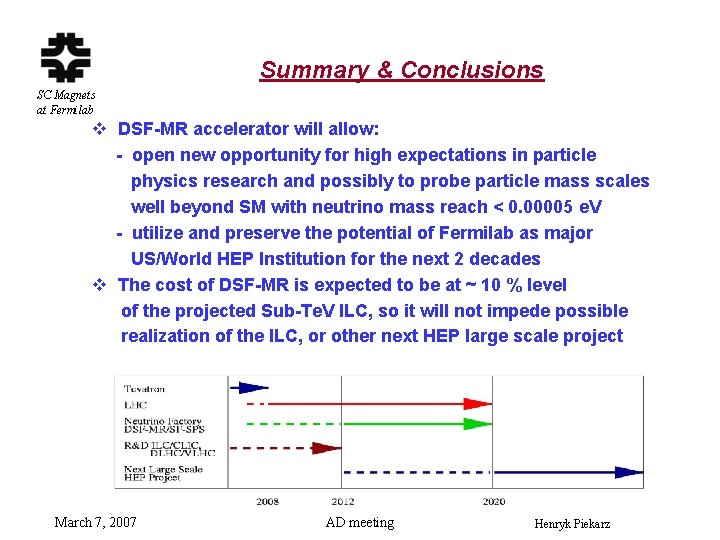
Summary & Conclusions SC Magnets at Fermilab v DSF-MR accelerator will allow: - open new opportunity for high expectations in particle physics research and possibly to probe particle mass scales well beyond SM with neutrino mass reach < 0. 00005 e. V - utilize and preserve the potential of Fermilab as major US/World HEP Institution for the next 2 decades v The cost of DSF-MR is expected to be at ~ 10 % level of the projected Sub-Te. V ILC, so it will not impede possible realization of the ILC, or other next HEP large scale project March 7, 2007 AD meeting Henryk Piekarz
- Slides: 18