
SBN Expansion 3 31 04 Requirement Deliver the
SBN Expansion 3 -31 -04
Requirement Deliver the ever increasing data volume to the field. • Data delivery requirements to the field are expected to increase by 10 fold by 2010. • A scalable delivery method is needed to keep up with the demand. • An open standard solution will allow procurement of COTS equipment.
The Plan Use Digital Video Broadcast – Satellite (DVB -S) technology to deliver high volumes of data to the field. • Use data compression to free up a SBN T-1 channel. • Use freed up T-1 to introduce DVB-S technology to 17 Test sites. • Roll out DVB-S system wide.
Benefits of DVB-S • Current SBN technology requires deployment of a new proprietary demodulator to the field for every T 1 (1. 5 Mbits/sec) increase in data capacity. • New DVB-S technology is linearly scalable to meet data requirement demands using a single demodulator up to 43 Mbits/s per demodulator (vs. 28 T-1 demodulators). • DVB-S technology is a one channel solution. – The inherently bursty data of SBN is transmitted much more efficiently over a single channel, as opposed to discrete T 1 channels. • DVB-S technology is open source, and open standard. – Interoperability and competition among vendors. – A DVB-S demodulator is a fraction of the cost of the existing proprietary SBN demodulators.
New Gateway Channel (TG 2) As part of the SBN expansion plan, the freed up SBN T 1 channel will be used to deliver additional data (using DVB-S technology) to the field, effectively doubling the existing Gateway channel data capacity.
SBN’s Future • After the DVB-S technology is proven, SBN will become a single channel carrying all SBN data using DVB-S. • Data requirements will be evaluated yearly and the SBN channel will be scaled accordingly.

Migration to high capacity, single DVB-S SBN channel TG GOES WEST OCONUS GOES EAST 1. 544 Mbits/sec 772 Kbps 1. 544 Mbits/sec OCONUS Compressed GOES EAST 1. 544 Mbits/sec Past SBN Configuration Through 8 -5 -03 Past SBN Configuration. TG 1. 544 Mbits/sec Compressed GOES WEST 1. 544 Mbits/sec 772 Kbps SBN configuration from 8 -5 -03 through 8 -12 -3 SBN configuration after compressing GOES feeds. TG 1. 544 Mbits/sec Combined GOES East/West 1. 544 Mbits/sec OCONUS 772 Kbps Combined GOES East/West 1. 544 Mbits/sec SBN configuration from 8 -1203 through 8 -19 -03 SBN configuration after combining GOES feeds. TG DVB-S Test Signals OCONUS 1. 544 Mbits/sec 772 Kbps Combined GOES East/West 1. 544 Mbits/sec Current SBN configuration transmitting test DVB-S signals On the former GOES West channel. Current SBN configuration
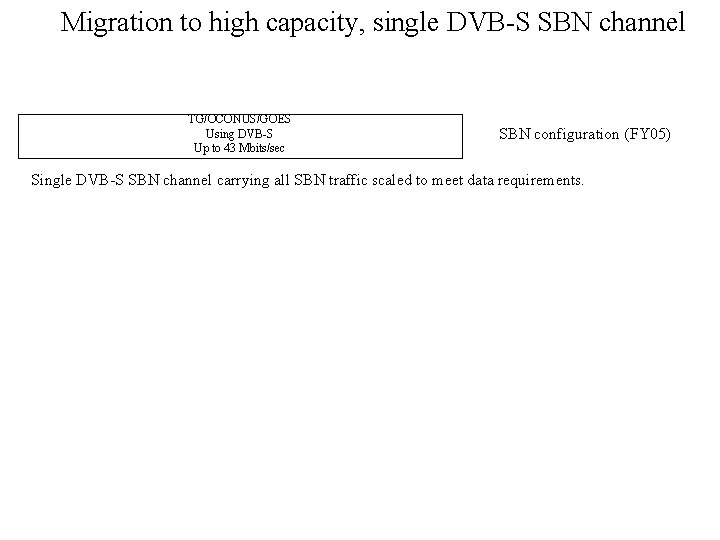
Migration to high capacity, single DVB-S SBN channel TG/OCONUS/GOES Using DVB-S Up to 43 Mbits/sec SBN configuration (FY 05) Single DVB-S SBN channel carrying all SBN traffic scaled to meet data requirements.
- Slides: 8