
SBIRT with Adolescent Patients Jim Winkle MPH Last
SBIRT with Adolescent Patients Jim Winkle, MPH Last updated: July, 2020
Outline I. Why SBIRT? - Categories of use Prevalence and morbidity Relevance to medical care II. Screening - Brief screen, AUDIT, DAST, CRAFFT, 5 Ps III. Reimbursement and EHR tools IV. Brief intervention - Styles of communication Brief intervention model Role play practice V. Referral to treatment - Harm Reduction - Treatment
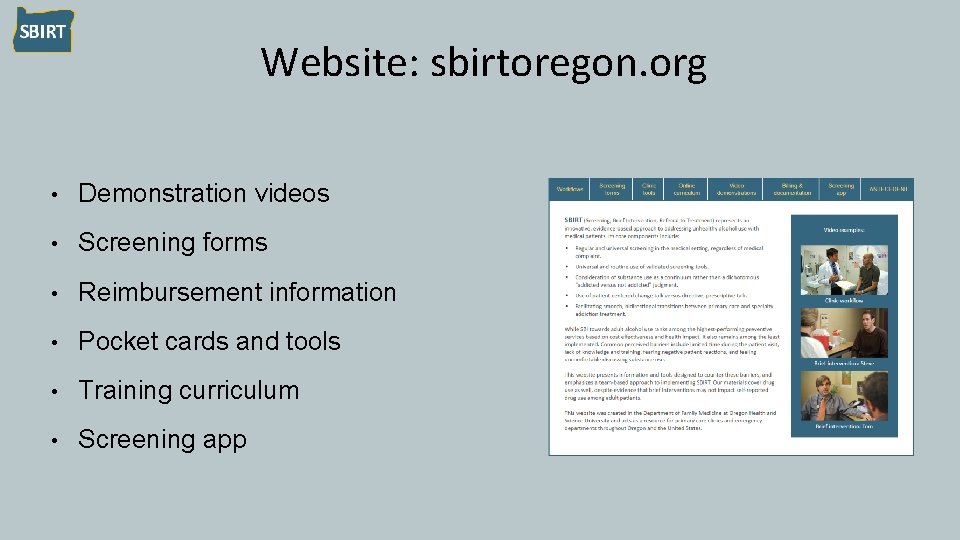
Website: sbirtoregon. org • Demonstration videos • Screening forms • Reimbursement information • Pocket cards and tools • Training curriculum • Screening app
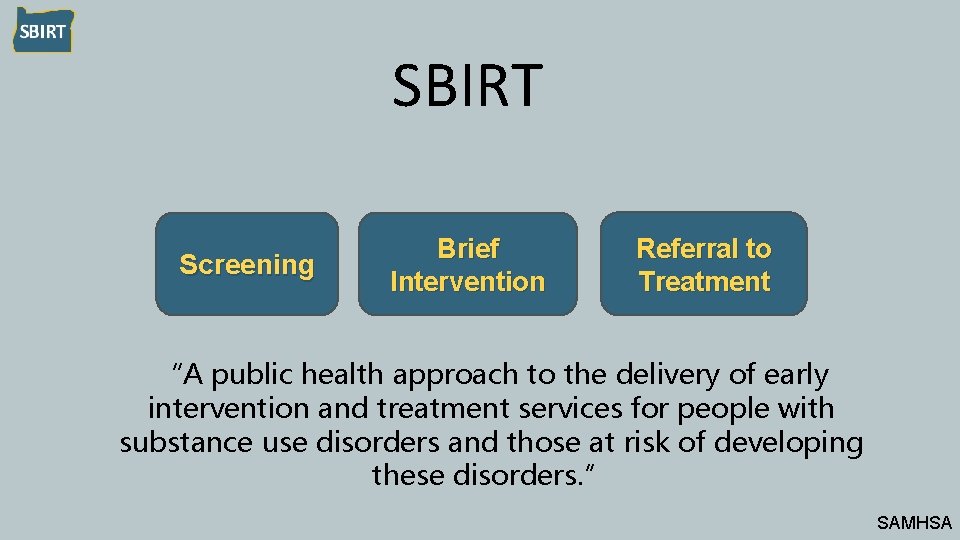
SBIRT Screening Brief Intervention Referral to Treatment “A public health approach to the delivery of early intervention and treatment services for people with substance use disorders and those at risk of developing these disorders. ” SAMHSA

SBIRT Adults Brief screen AUDIT Method DAST Adolescents Pregnancy CRAFFT 5 Ps Populations Common screening tools
I. Why SBIRT?
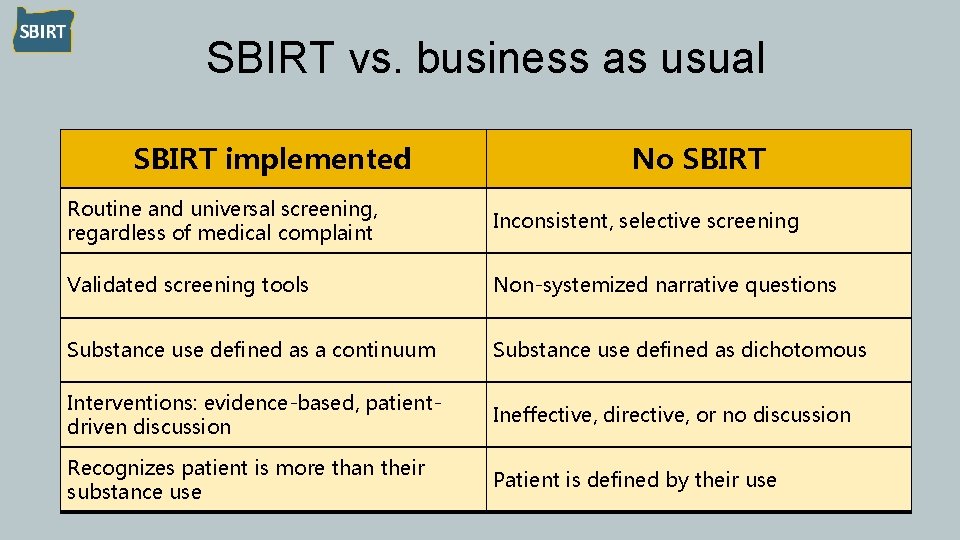
SBIRT vs. business as usual SBIRT implemented No SBIRT Routine and universal screening, regardless of medical complaint Inconsistent, selective screening Validated screening tools Non-systemized narrative questions Substance use defined as a continuum Substance use defined as dichotomous Interventions: evidence-based, patientdriven discussion Ineffective, directive, or no discussion Recognizes patient is more than their substance use Patient is defined by their use
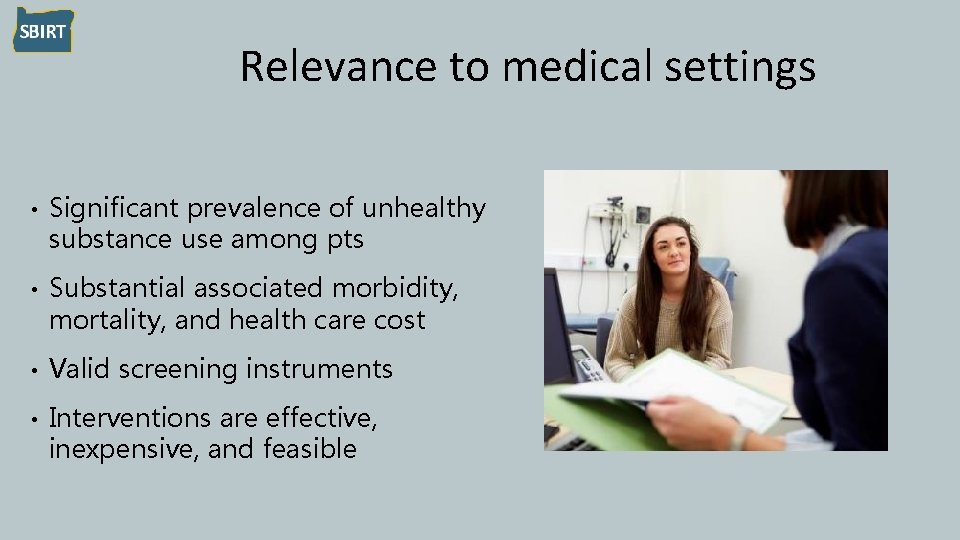
Relevance to medical settings • Significant prevalence of unhealthy substance use among pts • Substantial associated morbidity, mortality, and health care cost • Valid screening instruments • Interventions are effective, inexpensive, and feasible
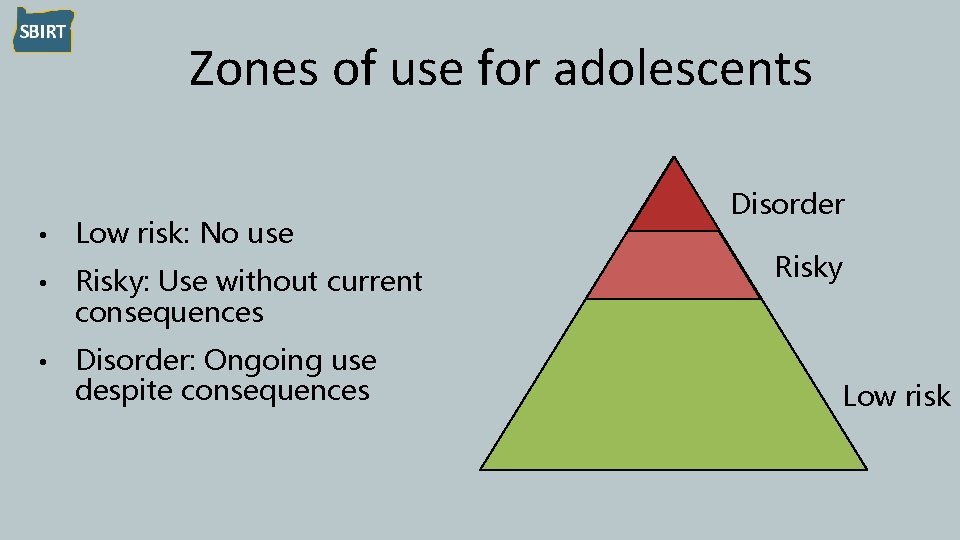
Zones of use for adolescents • Low risk: No use • Risky: Use without current consequences • Disorder: Ongoing use despite consequences Disorder Risky Low risk
Low-risk alcohol limit for adolescents: 0 • Even first use can result in tragic consequences. • Adolescence is a period of neurodevelopmental vulnerability • Earlier use increases chance of later addiction. AAP, 2016
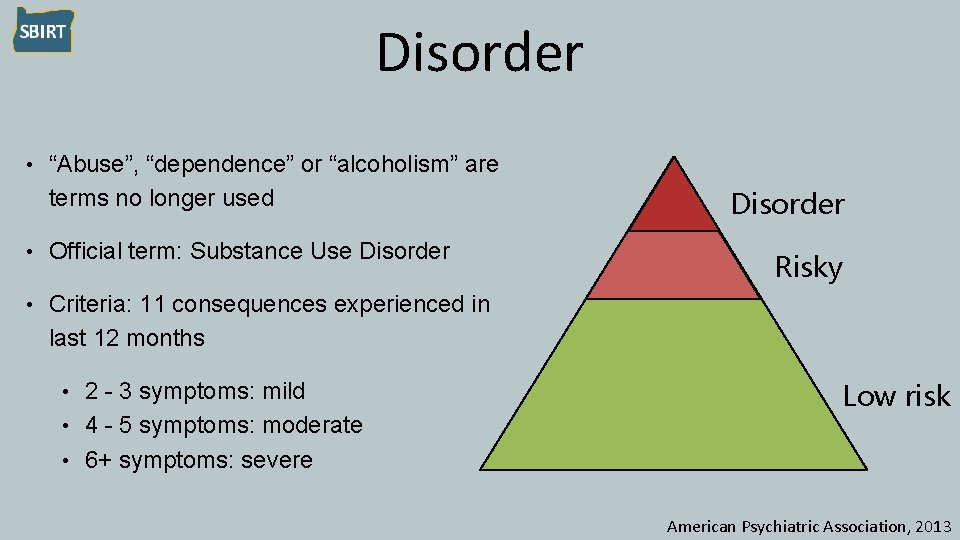
Disorder • “Abuse”, “dependence” or “alcoholism” are terms no longer used • Official term: Substance Use Disorder • Criteria: 11 consequences experienced in last 12 months 2 - 3 symptoms: mild • 4 - 5 symptoms: moderate • 6+ symptoms: severe • Disorder Risky Low risk American Psychiatric Association, 2013
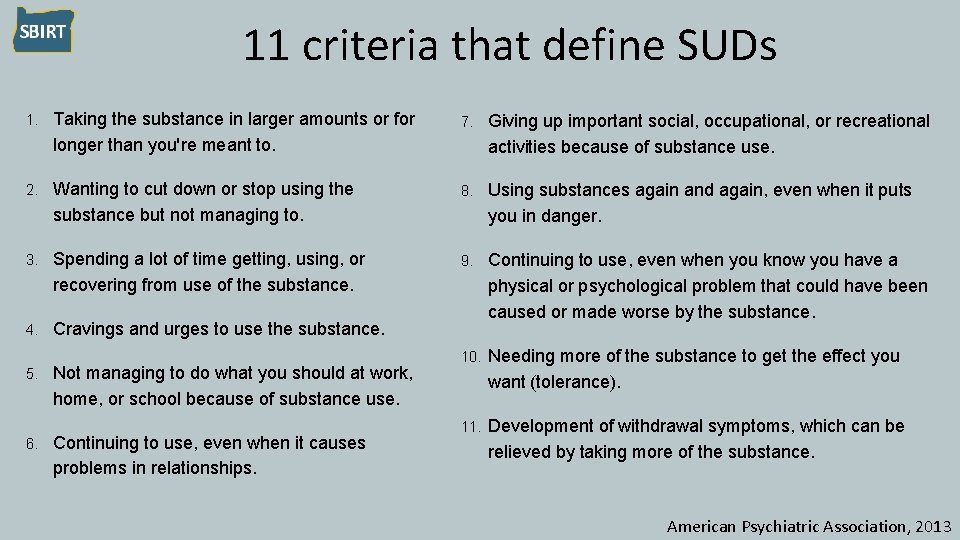
11 criteria that define SUDs 1. Taking the substance in larger amounts or for longer than you're meant to. 7. Giving up important social, occupational, or recreational activities because of substance use. 2. Wanting to cut down or stop using the substance but not managing to. 8. Using substances again and again, even when it puts you in danger. 3. Spending a lot of time getting, using, or recovering from use of the substance. 9. 4. Cravings and urges to use the substance. Continuing to use, even when you know you have a physical or psychological problem that could have been caused or made worse by the substance. 10. Needing more of the substance to get the effect you want (tolerance). 11. Development of withdrawal symptoms, which can be relieved by taking more of the substance. 5. 6. Not managing to do what you should at work, home, or school because of substance use. Continuing to use, even when it causes problems in relationships. American Psychiatric Association, 2013
Morbidity associated with adolescent drinking • Altered brain development • Depressed cognitive functioning • STDs, unplanned pregnancy • • Arrests & incarceration • Psychiatric disorders • Premature death • Alcohol poisoning • Addiction Physical and sexual assaults Ryan and Kokotailo, 2019
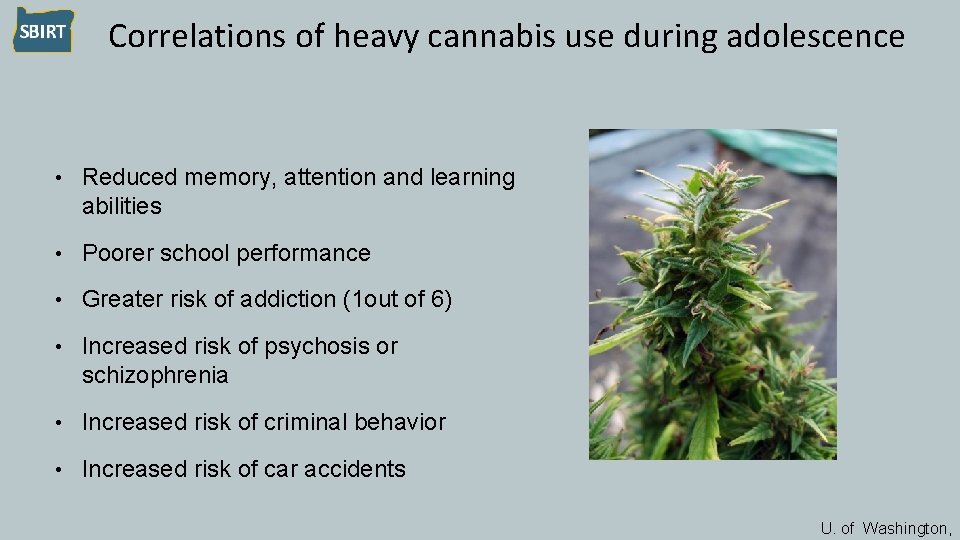
Correlations of heavy cannabis use during adolescence • Reduced memory, attention and learning abilities • Poorer school performance • Greater risk of addiction (1 out of 6) • Increased risk of psychosis or schizophrenia • Increased risk of criminal behavior • Increased risk of car accidents U. of Washington,
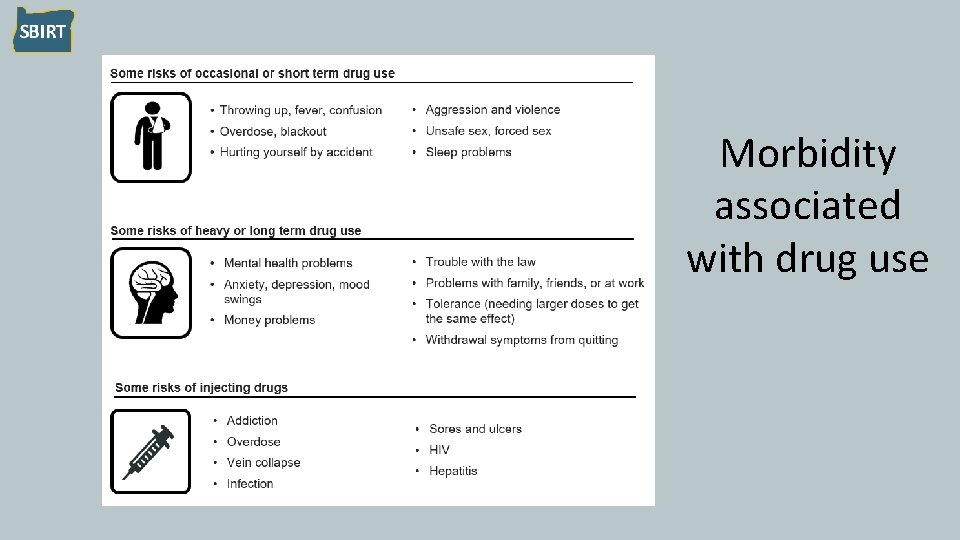
Morbidity associated with drug use
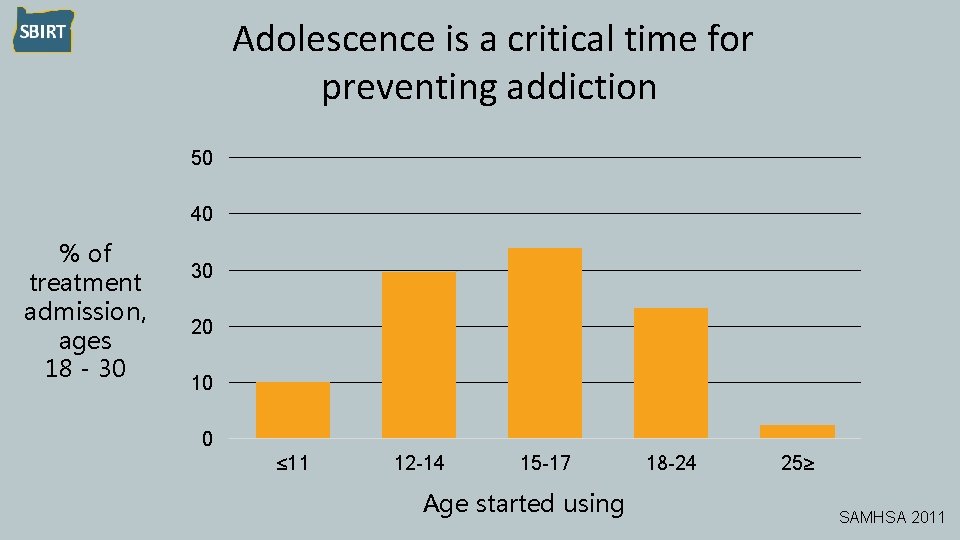
Adolescence is a critical time for preventing addiction 50 40 % of treatment admission, ages 18 - 30 30 20 10 0 ≤ 11 12 -14 15 -17 Age started using 18 -24 25≥ SAMHSA 2011
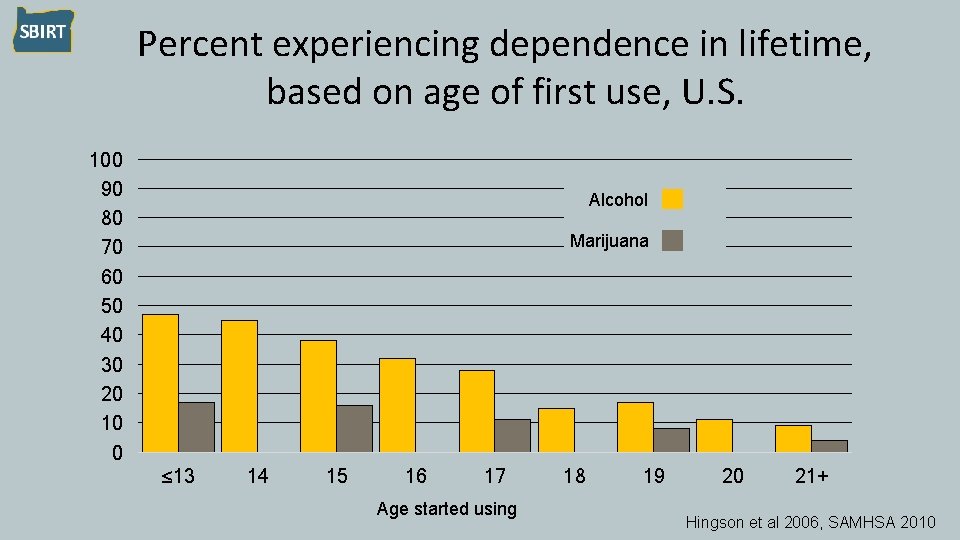
Percent experiencing dependence in lifetime, based on age of first use, U. S. 100 90 80 70 60 50 40 30 20 10 0 Alcohol Marijuana ≤ 13 14 15 16 17 Age started using 18 19 20 21+ Hingson et al 2006, SAMHSA 2010
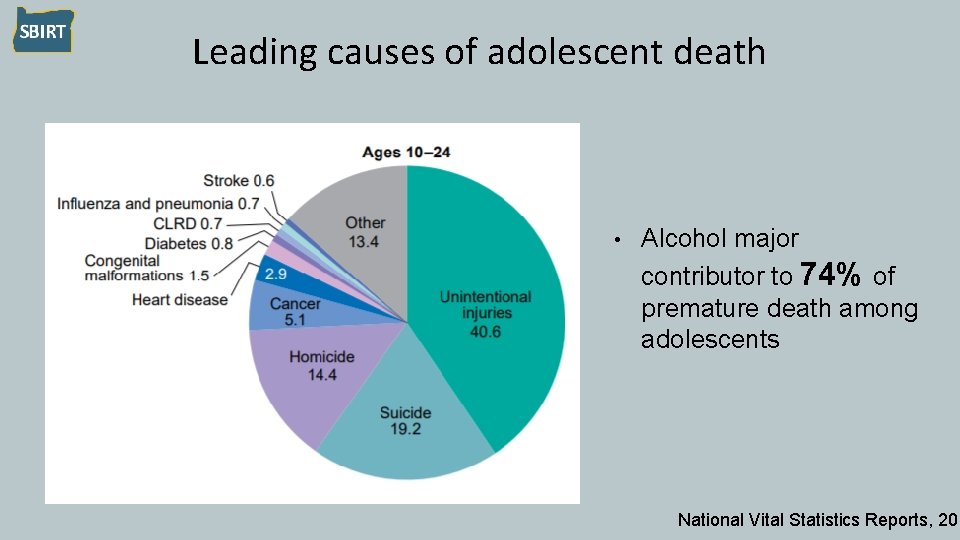
Leading causes of adolescent death • Alcohol major contributor to 74% of premature death among adolescents National Vital Statistics Reports, 201
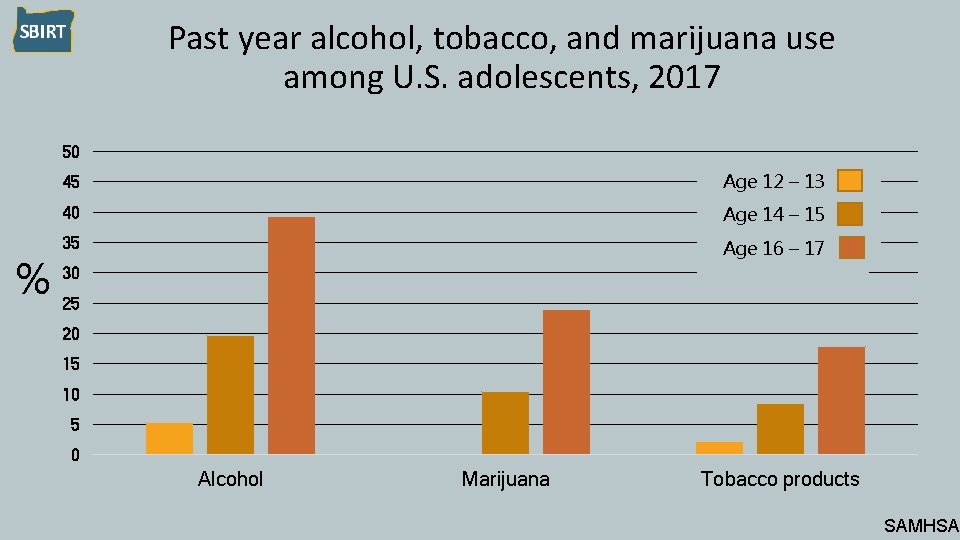
Past year alcohol, tobacco, and marijuana use among U. S. adolescents, 2017 50 % 45 Age 12 – 13 40 Age 14 – 15 35 Age 16 – 17 30 25 20 15 10 5 0 Alcohol Marijuana Tobacco products SAMHSA
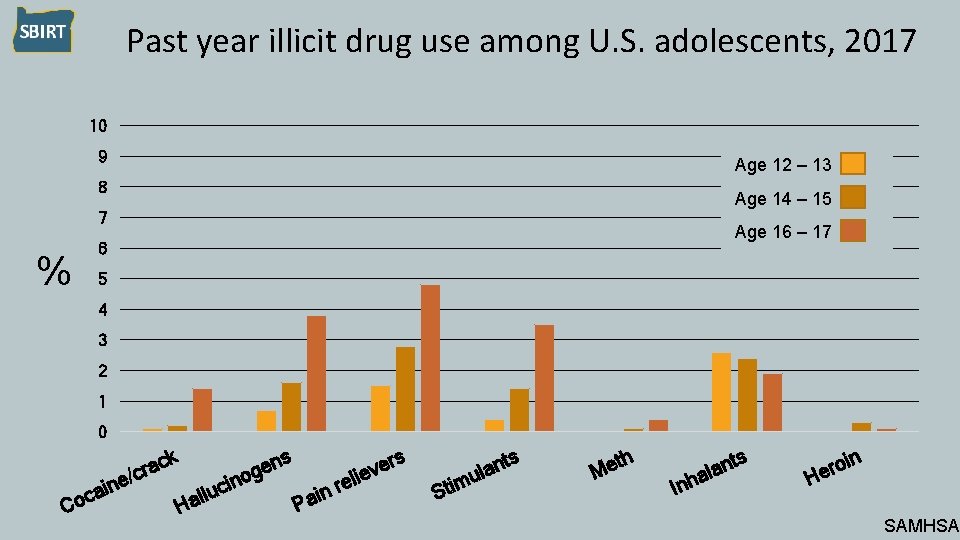
Past year illicit drug use among U. S. adolescents, 2017 10 9 Age 12 – 13 8 Age 14 – 15 7 Age 16 – 17 % 6 5 4 3 2 1 0 C i a c o ne ck a r /c s H en g o cin u l l a s P ain er v e i rel ts Stim n ula ts th Me In an l a h roin e H SAMHSA
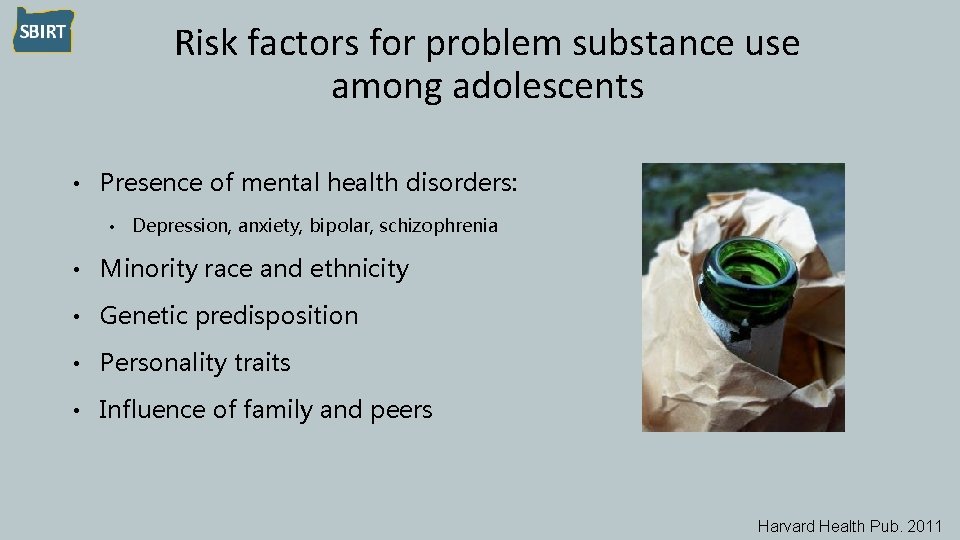
Risk factors for problem substance use among adolescents • Presence of mental health disorders: • Depression, anxiety, bipolar, schizophrenia • Minority race and ethnicity • Genetic predisposition • Personality traits • Influence of family and peers Harvard Health Pub. 2011
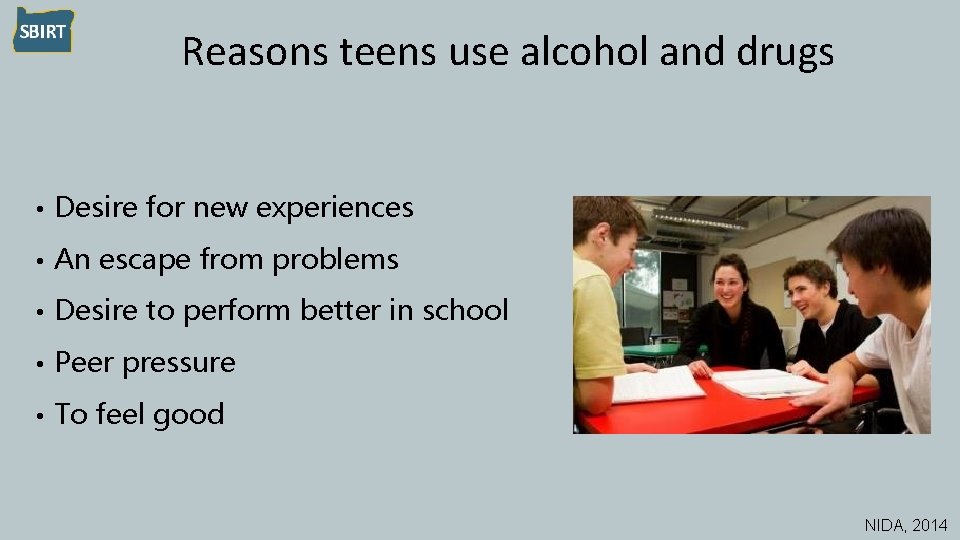
Reasons teens use alcohol and drugs • Desire for new experiences • An escape from problems • Desire to perform better in school • Peer pressure • To feel good NIDA, 2014
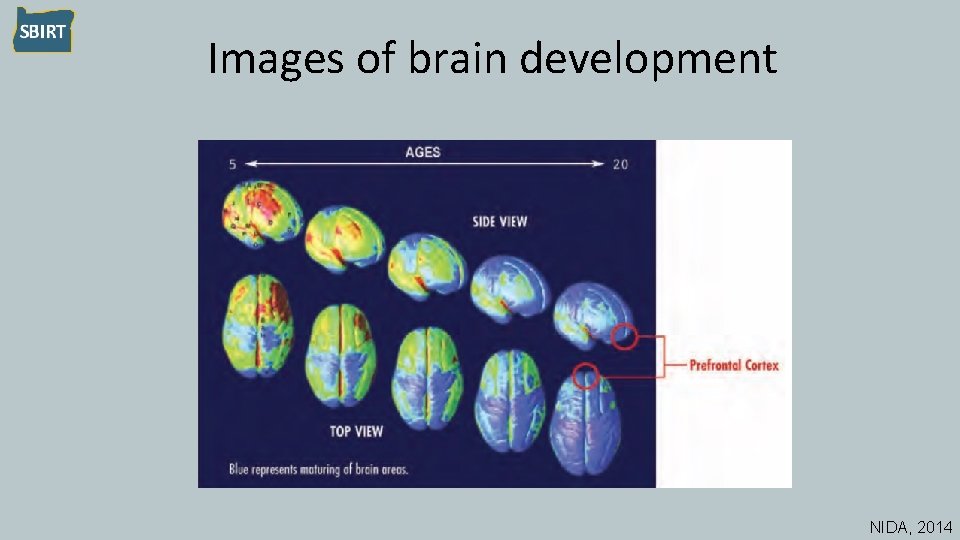
Images of brain development NIDA, 2014
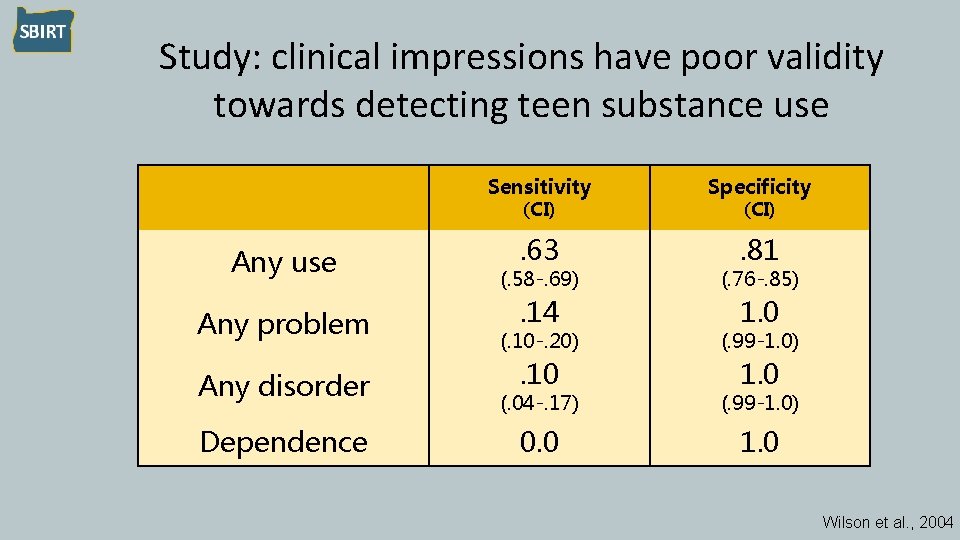
Study: clinical impressions have poor validity towards detecting teen substance use Sensitivity Specificity . 63 . 81 (CI) Any use Any problem Any disorder Dependence (CI) (. 58 -. 69) (. 76 -. 85) . 14 1. 0 (. 10 -. 20) (. 99 -1. 0) . 10 1. 0 (. 04 -. 17) (. 99 -1. 0) 0. 0 1. 0 Wilson et al. , 2004
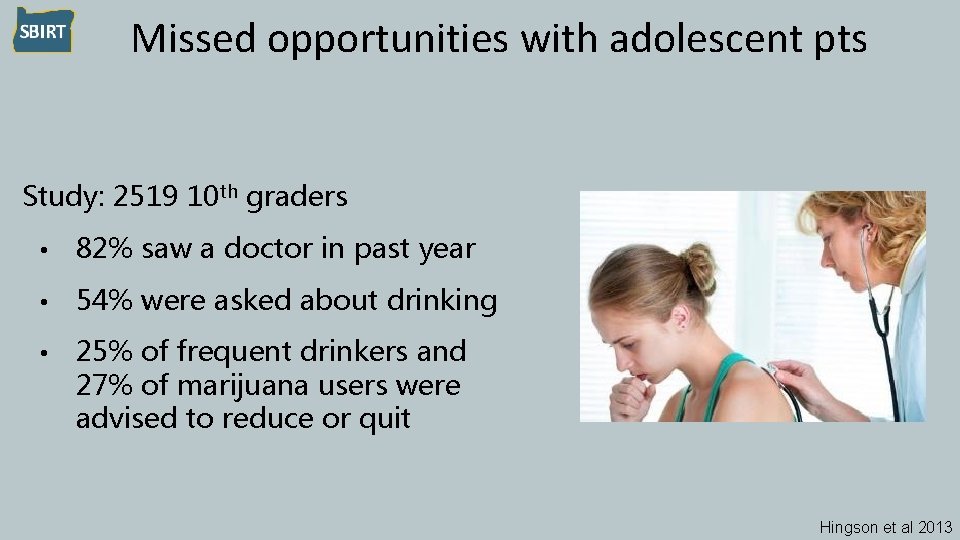
Missed opportunities with adolescent pts Study: 2519 10 th graders • 82% saw a doctor in past year • 54% were asked about drinking • 25% of frequent drinkers and 27% of marijuana users were advised to reduce or quit Hingson et al 2013
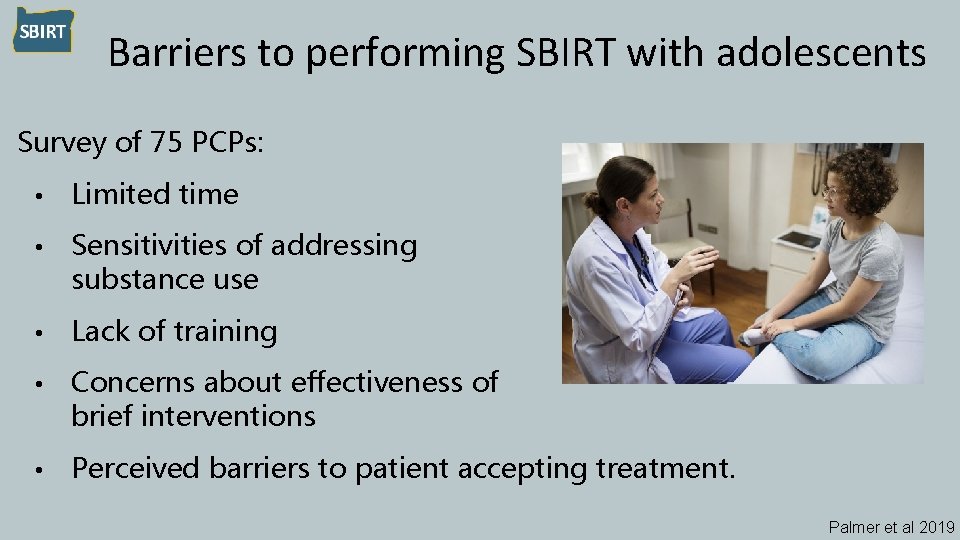
Barriers to performing SBIRT with adolescents Survey of 75 PCPs: • Limited time • Sensitivities of addressing substance use • Lack of training • Concerns about effectiveness of brief interventions • Perceived barriers to patient accepting treatment. Palmer et al 2019
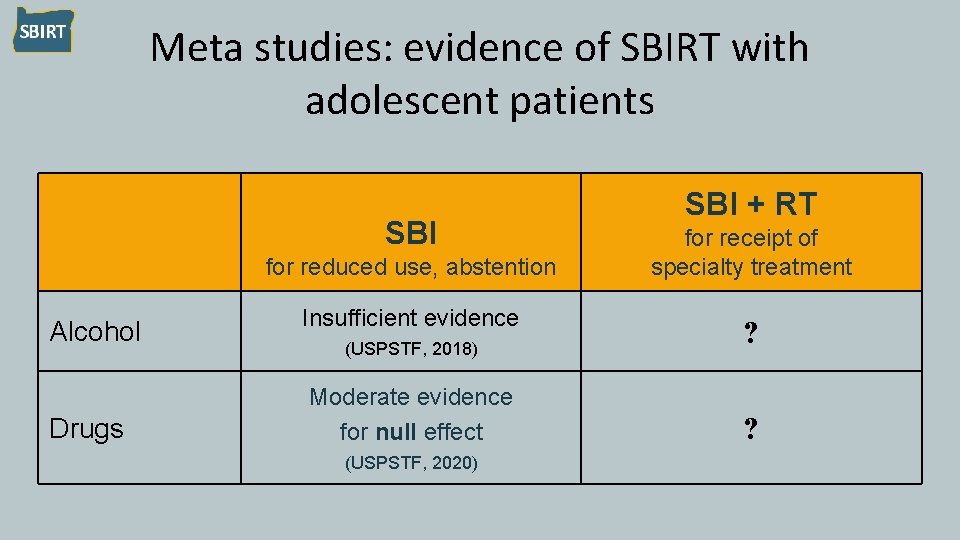
Meta studies: evidence of SBIRT with adolescent patients SBI for reduced use, abstention Alcohol Drugs Insufficient evidence (USPSTF, 2018) Moderate evidence for null effect (USPSTF, 2020) SBI + RT for receipt of specialty treatment ? ?
II. Screening
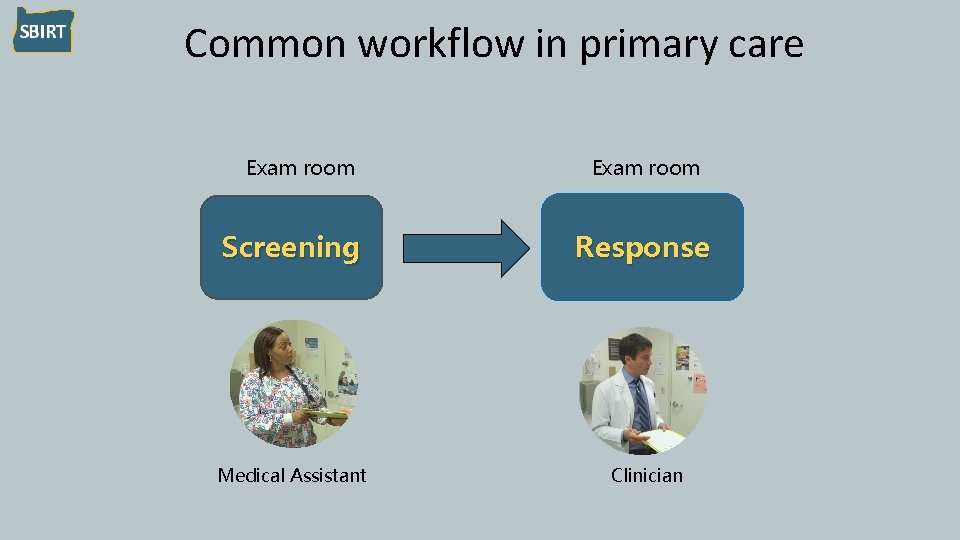
Common workflow in primary care Exam room Screening Response Medical Assistant Clinician
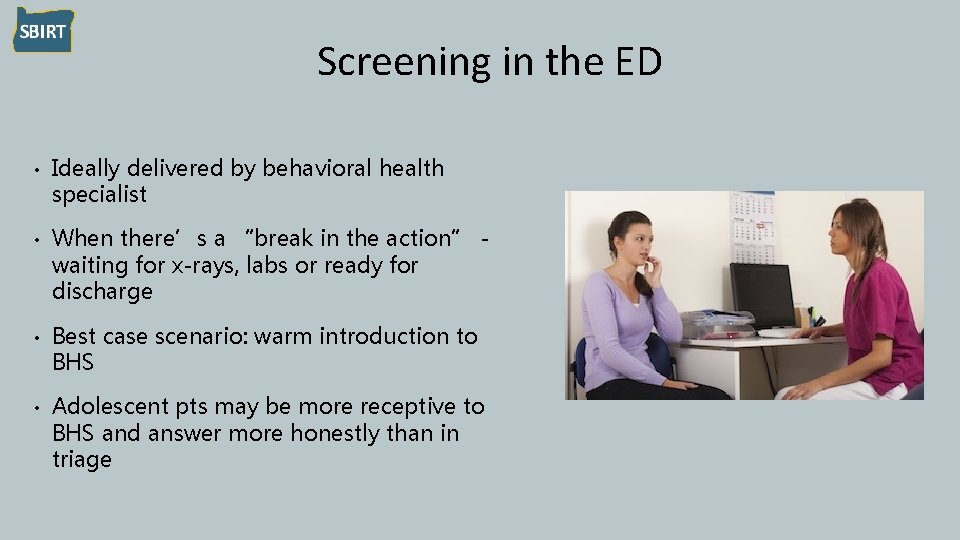
Screening in the ED • Ideally delivered by behavioral health specialist • When there’s a “break in the action” waiting for x-rays, labs or ready for discharge • Best case scenario: warm introduction to BHS • Adolescent pts may be more receptive to BHS and answer more honestly than in triage
Two options for administering a screening tool remotely Patient portal • Secure website that gives patients 24 -hour access to PHI Interview • Clinician reads screening questions to patients during tele visit
Screening via patient portal Pros: • Can be completed before visit • Questions answered in private Cons: • Results may get lost in EHR • Can’t ensure that pt privacy was ensured • Proxy accounts for younger teens break confidentiality
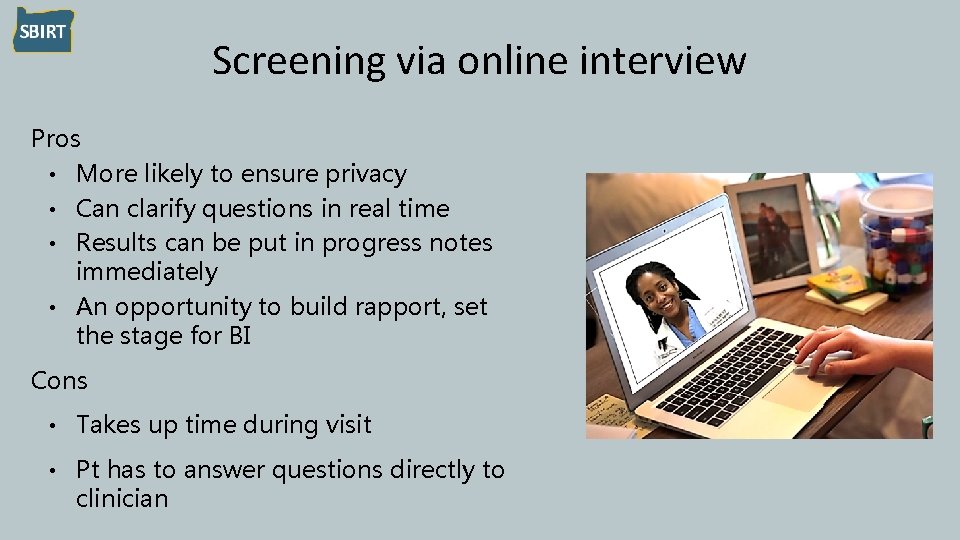
Screening via online interview Pros • More likely to ensure privacy • Can clarify questions in real time • Results can be put in progress notes immediately • An opportunity to build rapport, set the stage for BI Cons • Takes up time during visit • Pt has to answer questions directly to clinician
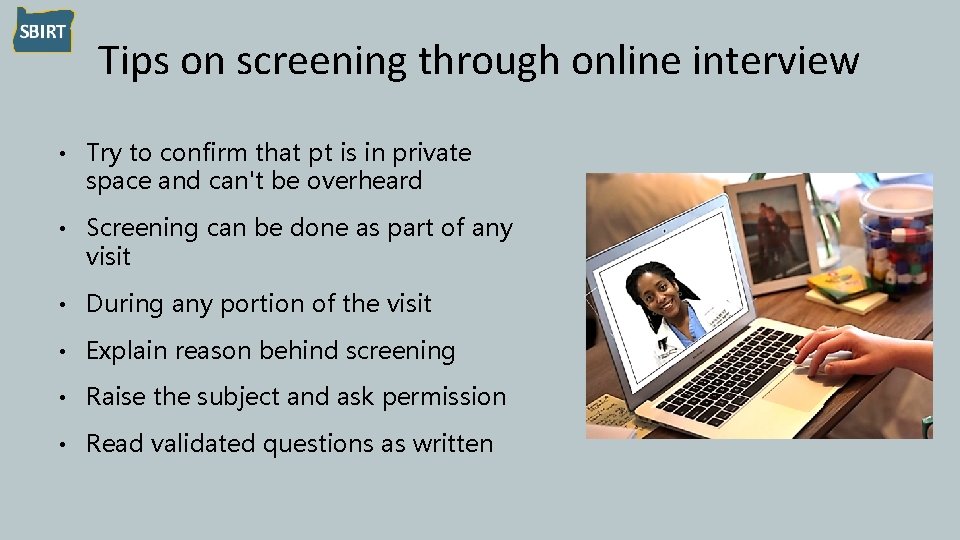
Tips on screening through online interview • Try to confirm that pt is in private space and can't be overheard • Screening can be done as part of any visit • During any portion of the visit • Explain reason behind screening • Raise the subject and ask permission • Read validated questions as written
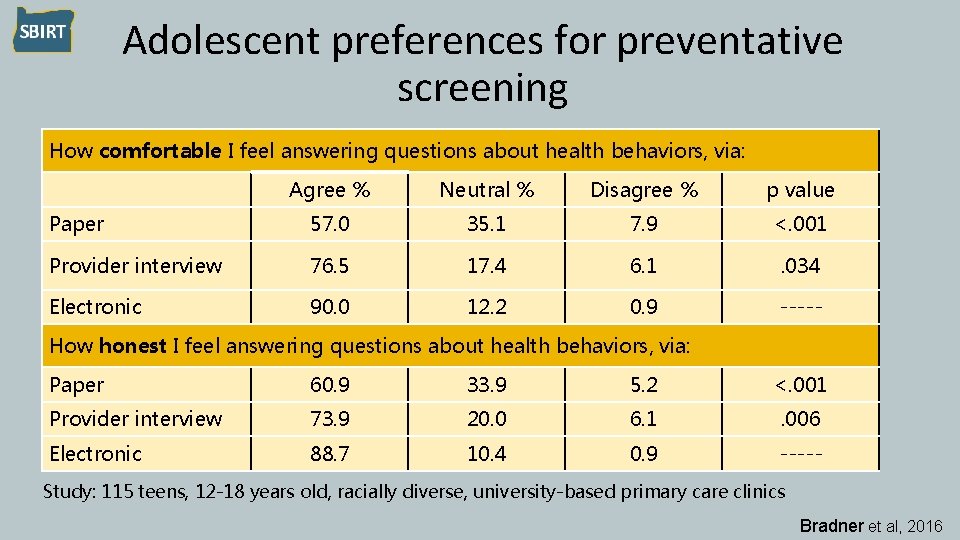
Adolescent preferences for preventative screening How comfortable I feel answering questions about health behaviors, via: Agree % Neutral % Disagree % p value Paper 57. 0 35. 1 7. 9 <. 001 Provider interview 76. 5 17. 4 6. 1 . 034 Electronic 90. 0 12. 2 0. 9 ----- How honest I feel answering questions about health behaviors, via: Paper 60. 9 33. 9 5. 2 <. 001 Provider interview 73. 9 20. 0 6. 1 . 006 Electronic 88. 7 10. 4 0. 9 ----- Study: 115 teens, 12 -18 years old, racially diverse, university-based primary care clinics Bradner et al, 2016
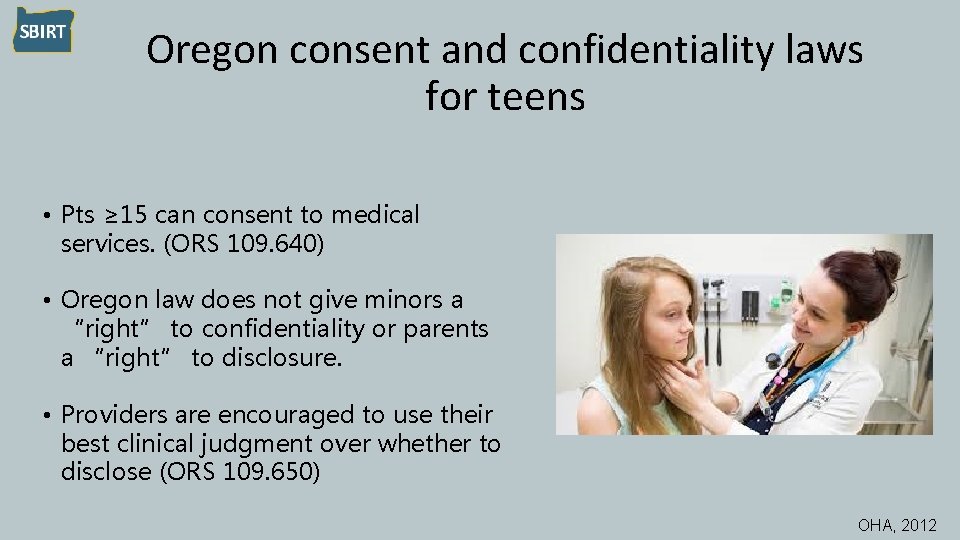
Oregon consent and confidentiality laws for teens • Pts ≥ 15 can consent to medical services. (ORS 109. 640) • Oregon law does not give minors a “right” to confidentiality or parents a “right” to disclosure. • Providers are encouraged to use their best clinical judgment over whether to disclose (ORS 109. 650) OHA, 2012
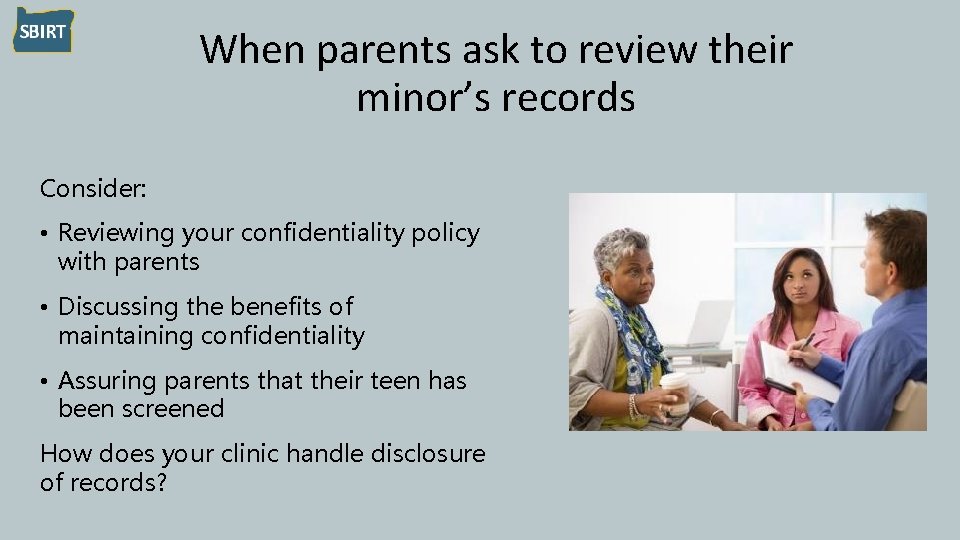
When parents ask to review their minor’s records Consider: • Reviewing your confidentiality policy with parents • Discussing the benefits of maintaining confidentiality • Assuring parents that their teen has been screened How does your clinic handle disclosure of records?
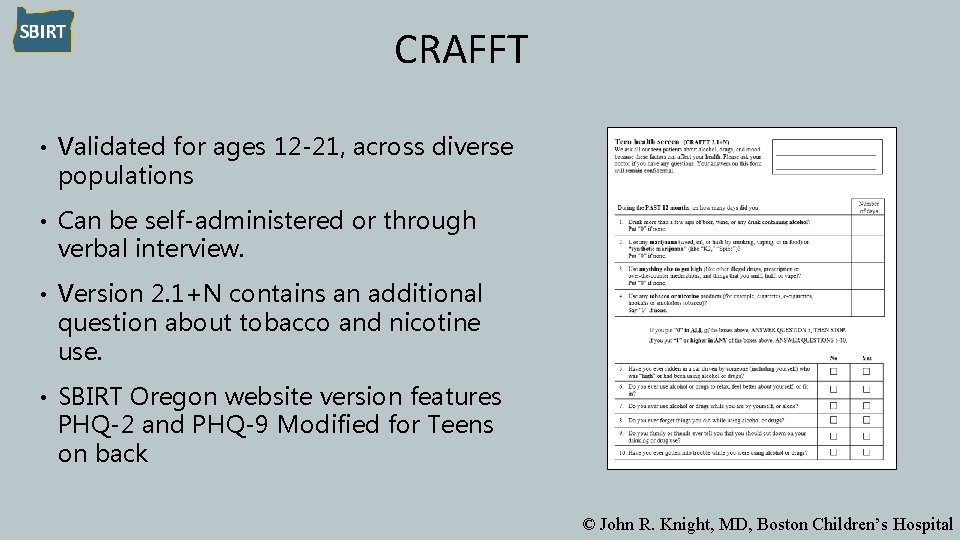
CRAFFT • Validated for ages 12 -21, across diverse populations • Can be self-administered or through verbal interview. • Version 2. 1+N contains an additional question about tobacco and nicotine use. • SBIRT Oregon website version features PHQ-2 and PHQ-9 Modified for Teens on back © John R. Knight, MD, Boston Children’s Hospital
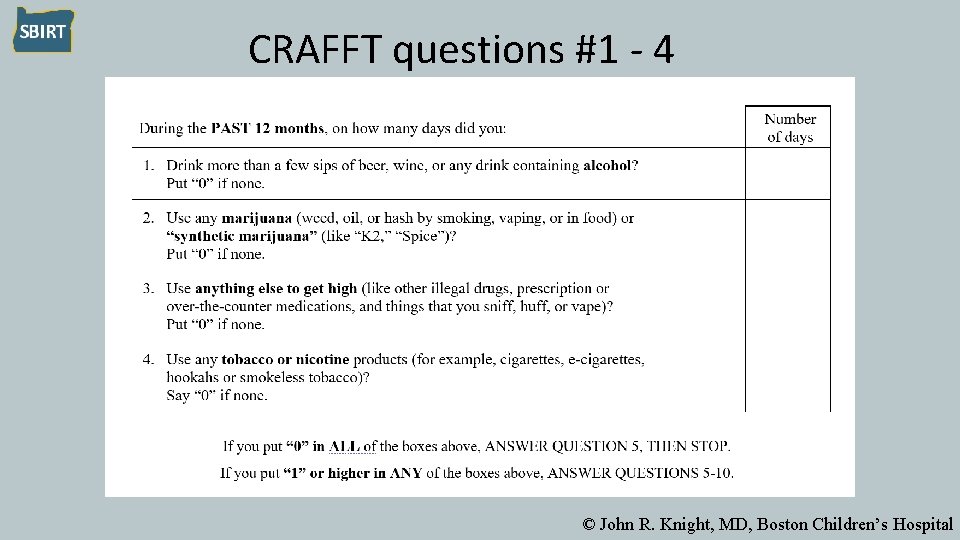
CRAFFT questions #1 - 4 © John R. Knight, MD, Boston Children’s Hospital
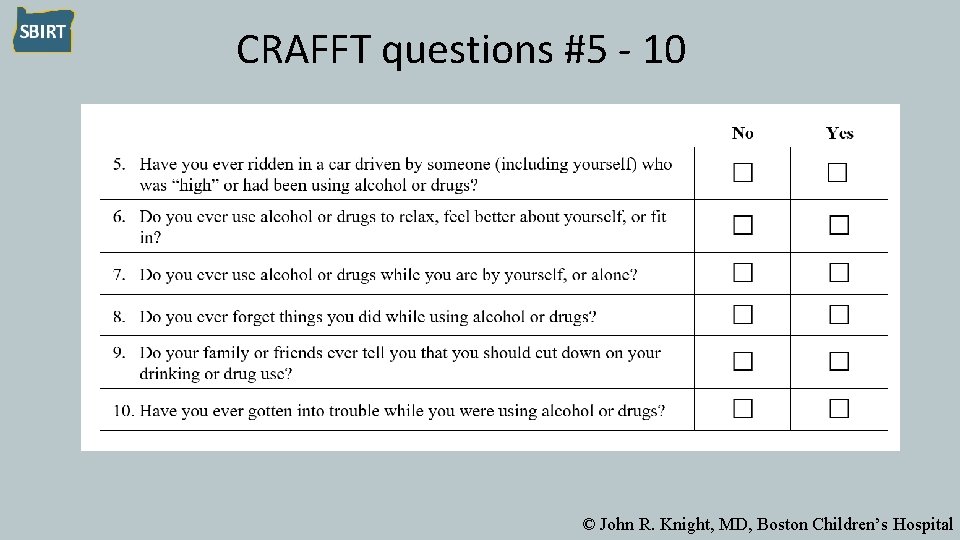
CRAFFT questions #5 - 10 © John R. Knight, MD, Boston Children’s Hospital
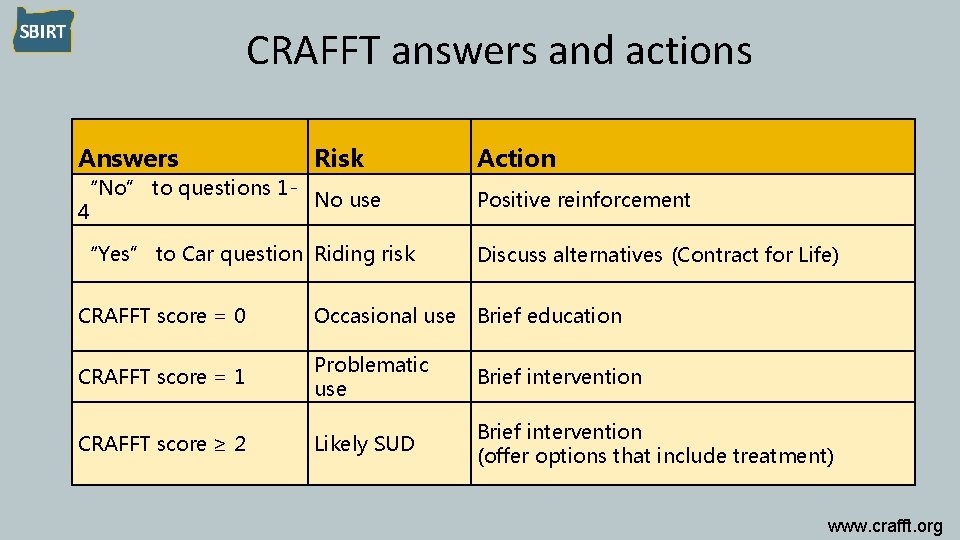
CRAFFT answers and actions Answers Risk Action “No” to questions 1 No use 4 Positive reinforcement “Yes” to Car question Riding risk Discuss alternatives (Contract for Life) CRAFFT score = 0 Occasional use Brief education CRAFFT score = 1 Problematic use Brief intervention CRAFFT score ≥ 2 Likely SUD Brief intervention (offer options that include treatment) www. crafft. org
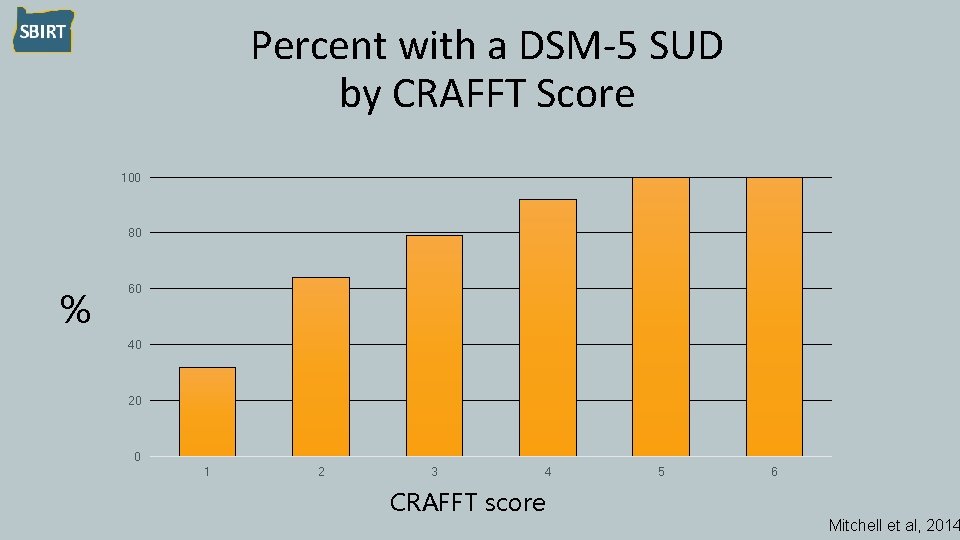
Percent with a DSM-5 SUD by CRAFFT Score 100 80 % 60 40 20 0 1 2 3 4 CRAFFT score 5 6 Mitchell et al, 2014
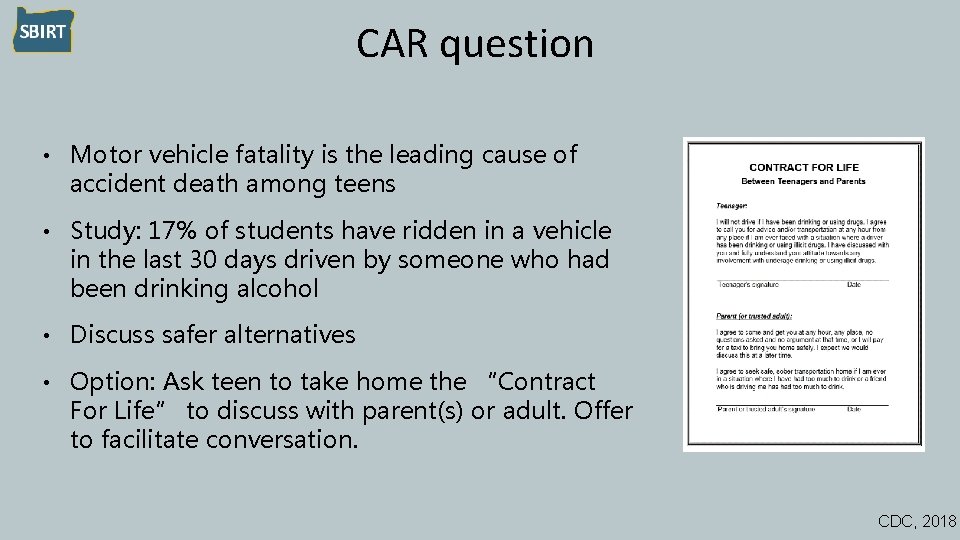
CAR question • Motor vehicle fatality is the leading cause of accident death among teens • Study: 17% of students have ridden in a vehicle in the last 30 days driven by someone who had been drinking alcohol • Discuss safer alternatives • Option: Ask teen to take home the “Contract For Life” to discuss with parent(s) or adult. Offer to facilitate conversation. CDC, 2018
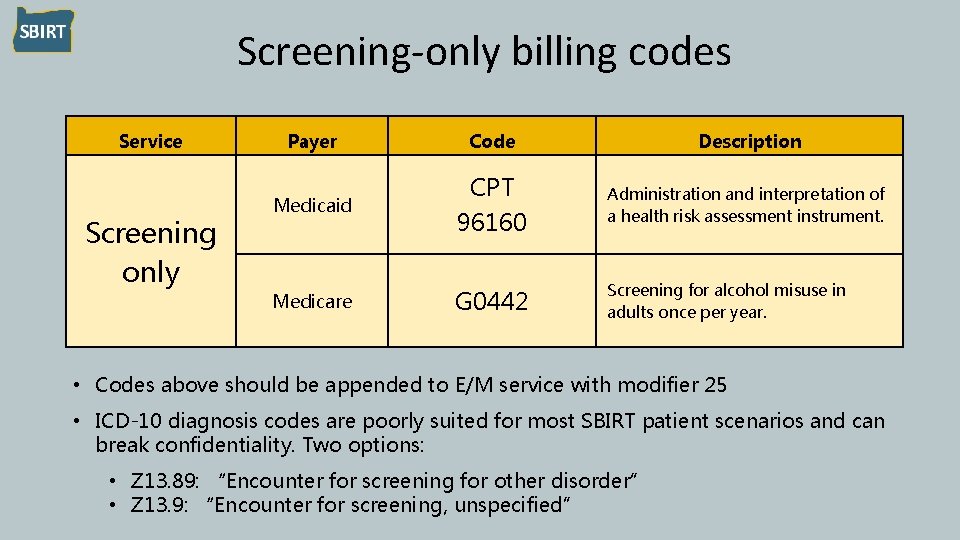
Screening-only billing codes Service Screening only Payer Code Description Medicaid CPT 96160 Administration and interpretation of a health risk assessment instrument. Medicare G 0442 Screening for alcohol misuse in adults once per year. • Codes above should be appended to E/M service with modifier 25 • ICD-10 diagnosis codes are poorly suited for most SBIRT patient scenarios and can break confidentiality. Two options: • Z 13. 89: “Encounter for screening for other disorder” • Z 13. 9: “Encounter for screening, unspecified”
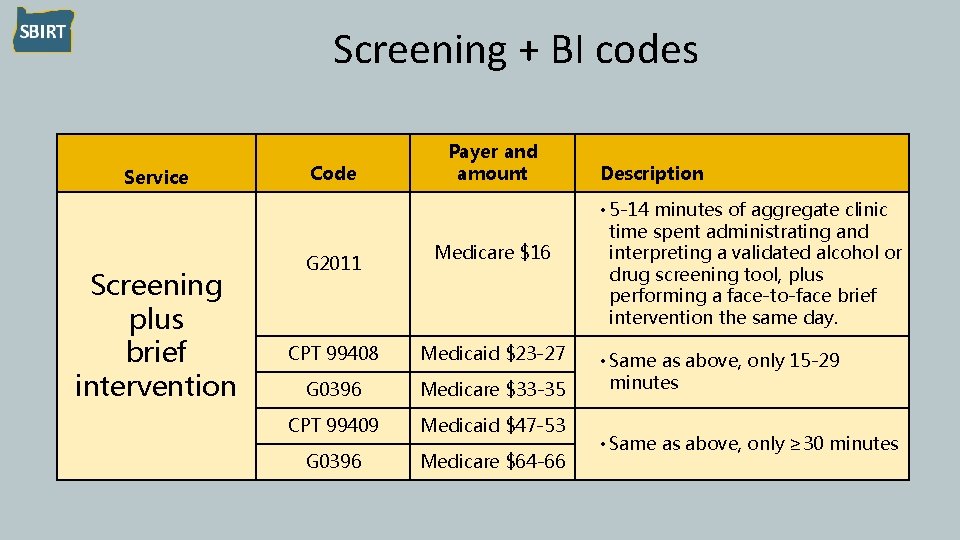
Screening + BI codes Service Screening plus brief intervention Code G 2011 Payer and amount Medicare $16 CPT 99408 Medicaid $23 -27 G 0396 Medicare $33 -35 CPT 99409 Medicaid $47 -53 G 0396 Medicare $64 -66 Description • 5 -14 minutes of aggregate clinic time spent administrating and interpreting a validated alcohol or drug screening tool, plus performing a face-to-face brief intervention the same day. • Same as above, only 15 -29 minutes • Same as above, only ≥ 30 minutes
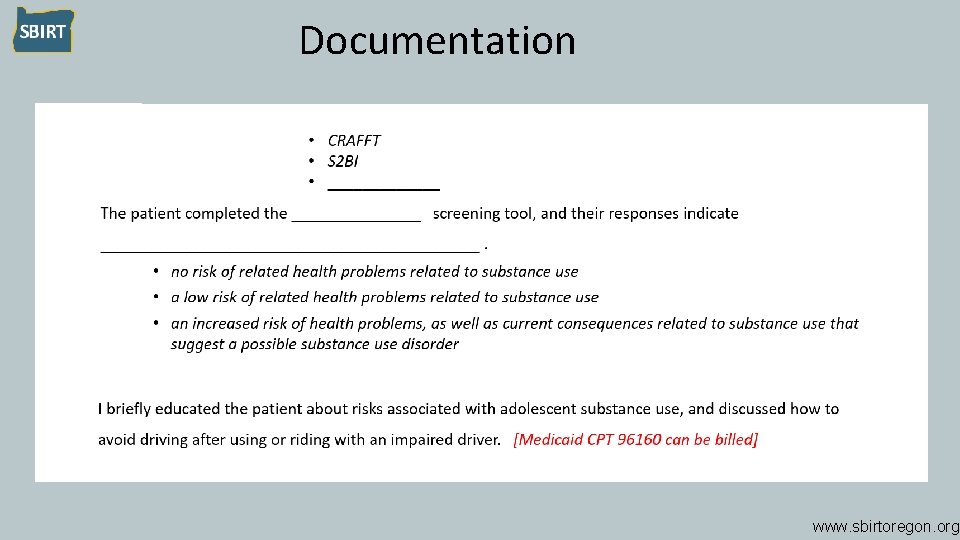
Documentation www. sbirtoregon. org
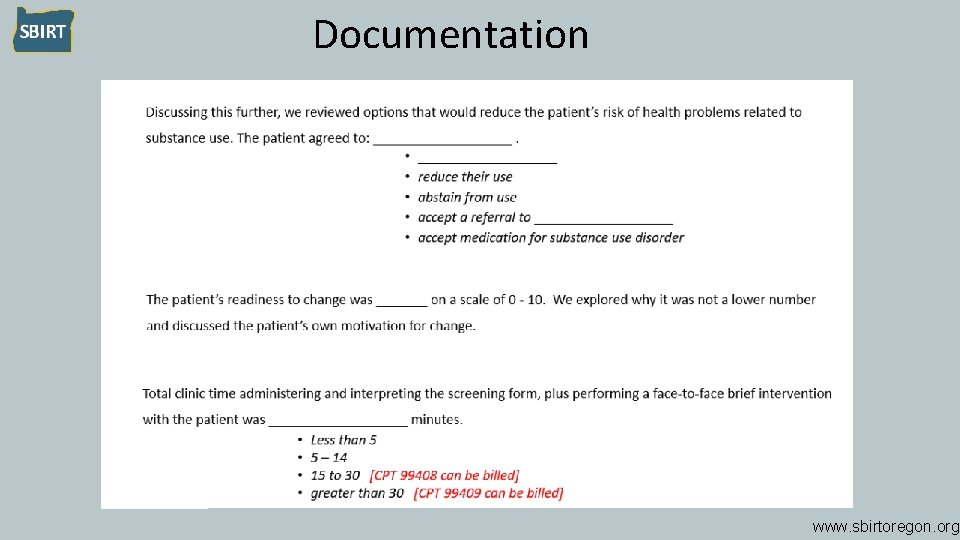
Documentation www. sbirtoregon. org
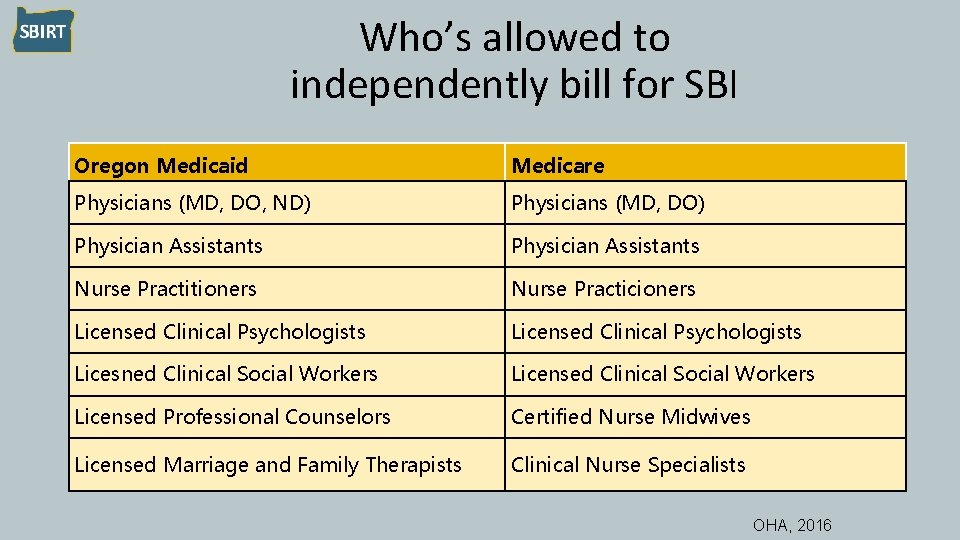
Who’s allowed to independently bill for SBI Oregon Medicaid Medicare Physicians (MD, DO, ND) Physicians (MD, DO) Physician Assistants Nurse Practitioners Nurse Practicioners Licensed Clinical Psychologists Licesned Clinical Social Workers Licensed Professional Counselors Certified Nurse Midwives Licensed Marriage and Family Therapists Clinical Nurse Specialists OHA, 2016
Incident-to billing • Any clinic employee under supervision can bill for SBI • Examples: – • CADCs, Health Educators, Registered Nurses, Clinical Nurse Specialist, Students or Graduates entering medical profession, Community Health Workers Some limitations apply to certain clinic settings OHA
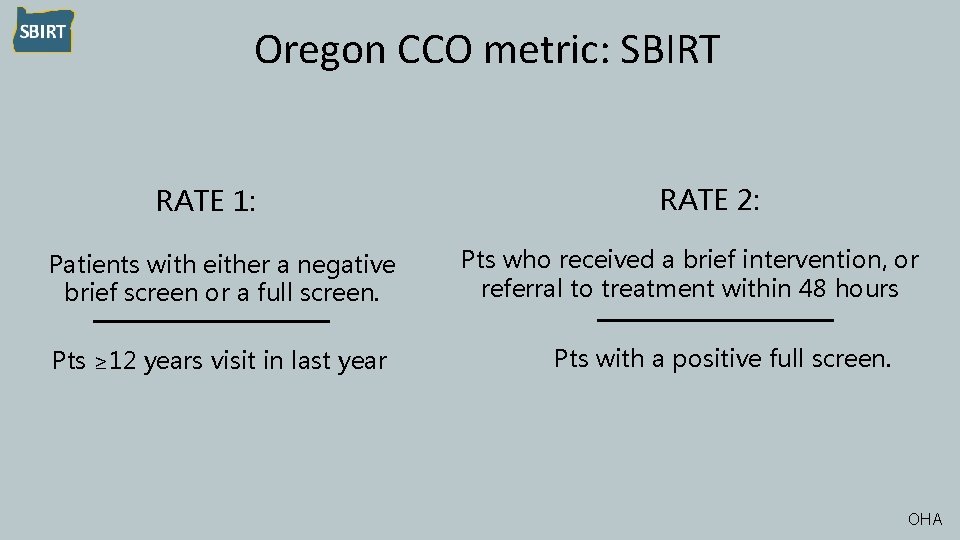
Oregon CCO metric: SBIRT RATE 1: Patients with either a negative brief screen or a full screen. Pts ≥ 12 years visit in last year RATE 2: Pts who received a brief intervention, or referral to treatment within 48 hours Pts with a positive full screen. OHA
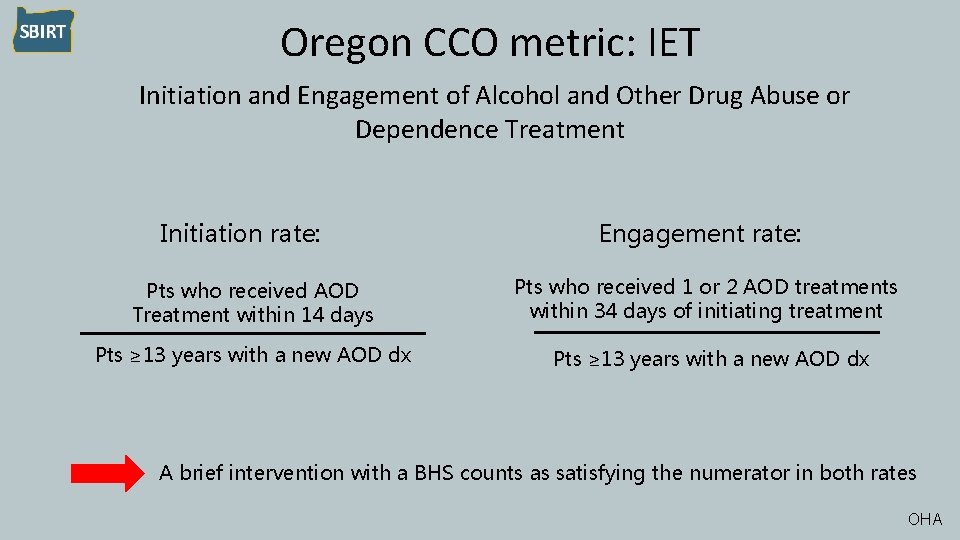
Oregon CCO metric: IET Initiation and Engagement of Alcohol and Other Drug Abuse or Dependence Treatment Initiation rate: Engagement rate: Pts who received AOD Treatment within 14 days Pts who received 1 or 2 AOD treatments within 34 days of initiating treatment Pts ≥ 13 years with a new AOD dx A brief intervention with a BHS counts as satisfying the numerator in both rates OHA
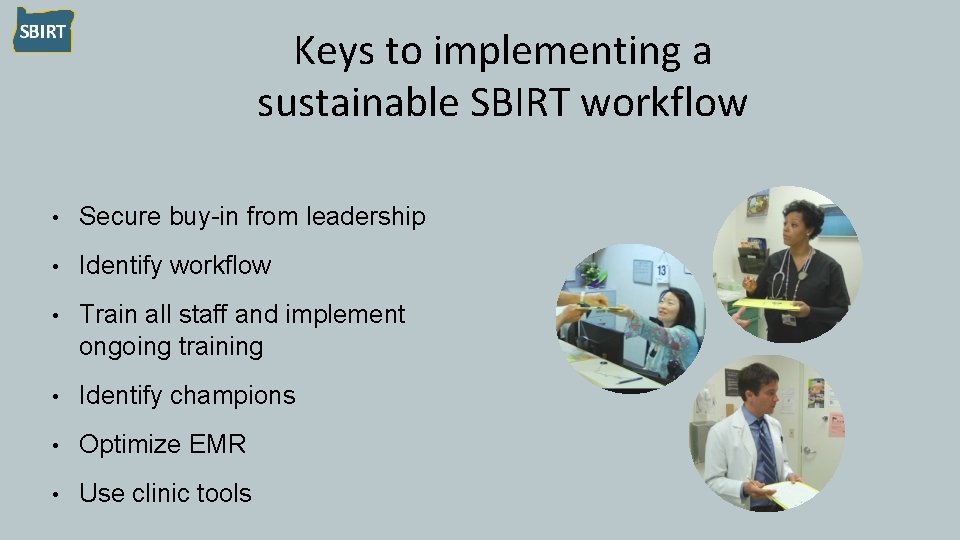
Keys to implementing a sustainable SBIRT workflow • Secure buy-in from leadership • Identify workflow • Train all staff and implement ongoing training • Identify champions • Optimize EMR • Use clinic tools
IV. Brief intervention
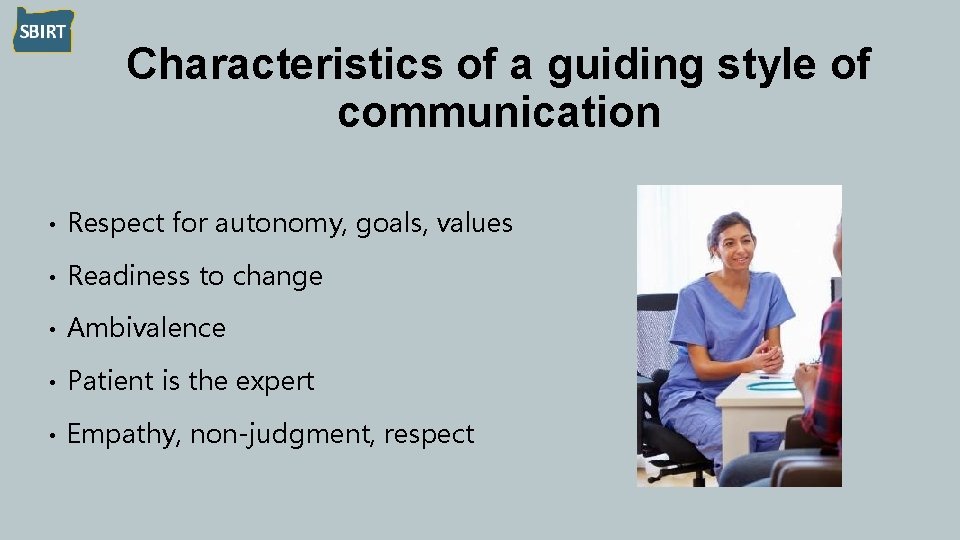
Characteristics of a guiding style of communication • Respect for autonomy, goals, values • Readiness to change • Ambivalence • Patient is the expert • Empathy, non-judgment, respect
How do you discuss behavior change with your patients?
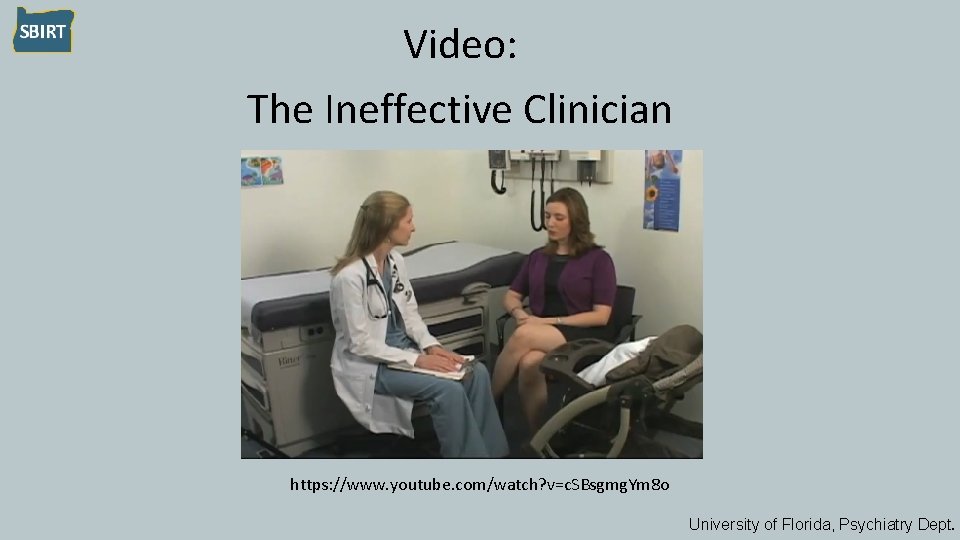
Video: The Ineffective Clinician https: //www. youtube. com/watch? v=c. SBsgmg. Ym 8 o University of Florida, Psychiatry Dept.
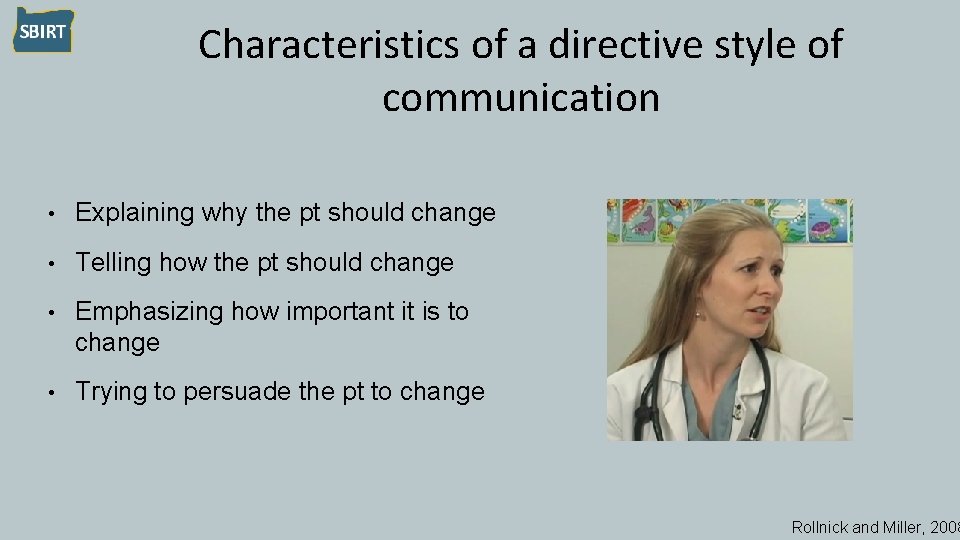
Characteristics of a directive style of communication • Explaining why the pt should change • Telling how the pt should change • Emphasizing how important it is to change • Trying to persuade the pt to change Rollnick and Miller, 2008
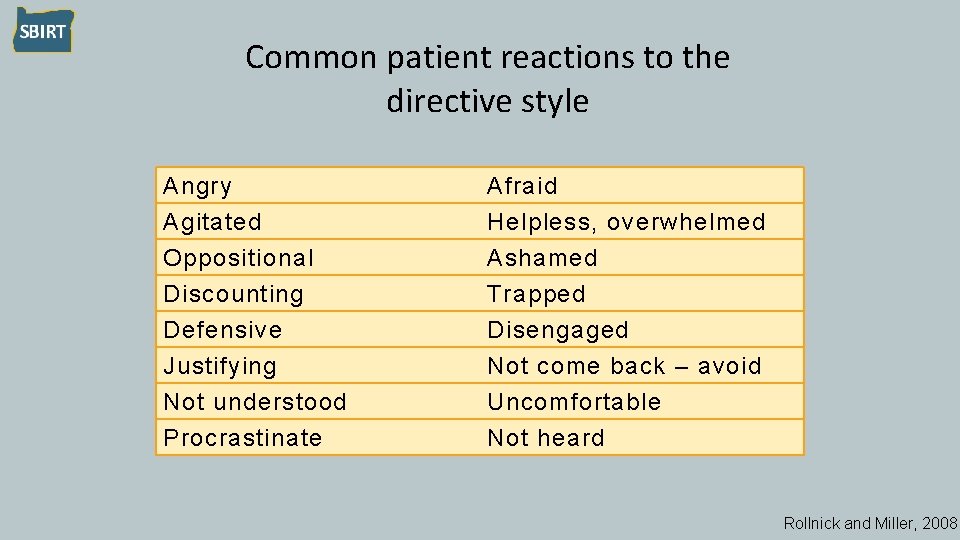
Common patient reactions to the directive style Angry Agitated Oppositional Discounting Afraid Helpless, overwhelmed Ashamed Trapped Defensive Justifying Not understood Procrastinate Disengaged Not come back – avoid Uncomfortable Not heard Rollnick and Miller, 2008
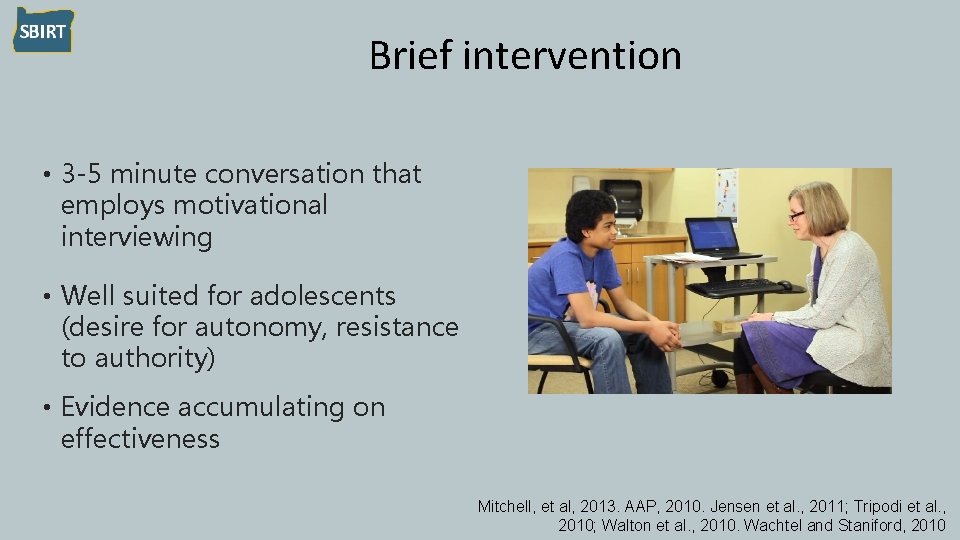
Brief intervention • 3 -5 minute conversation that employs motivational interviewing • Well suited for adolescents (desire for autonomy, resistance to authority) • Evidence accumulating on effectiveness Mitchell, et al, 2013. AAP, 2010. Jensen et al. , 2011; Tripodi et al. , 2010; Walton et al. , 2010. Wachtel and Staniford, 2010
Brief Interventions in medical settings • Should employ motivational interviewing (evidence-based) • Even three minutes can have effect • Can be performed by any trained clinic employee • 2 hours of training can make difference Humeniuk et al, 2010. Cunningham et al, 2014. Whitlock et al, 2004.
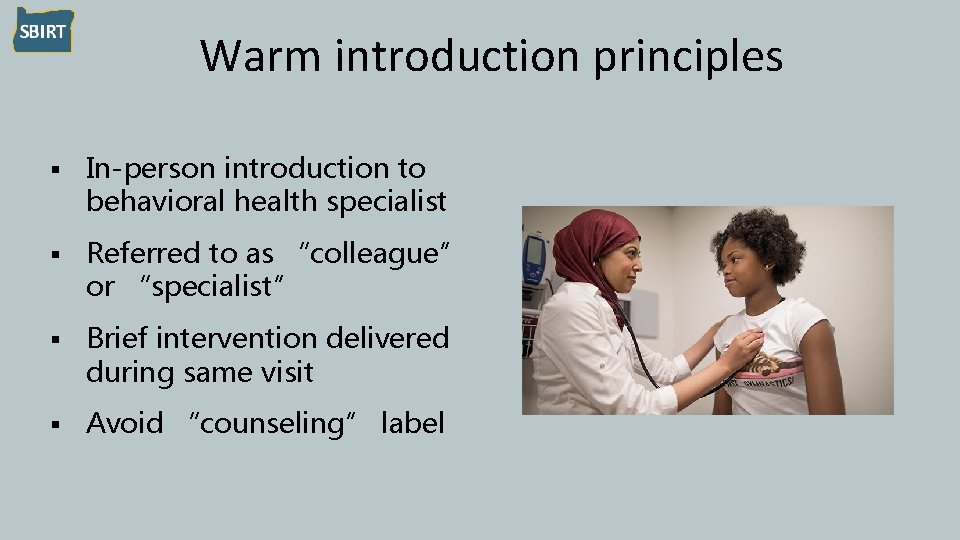
Warm introduction principles § In-person introduction to behavioral health specialist § Referred to as “colleague” or “specialist” § Brief intervention delivered during same visit § Avoid “counseling” label
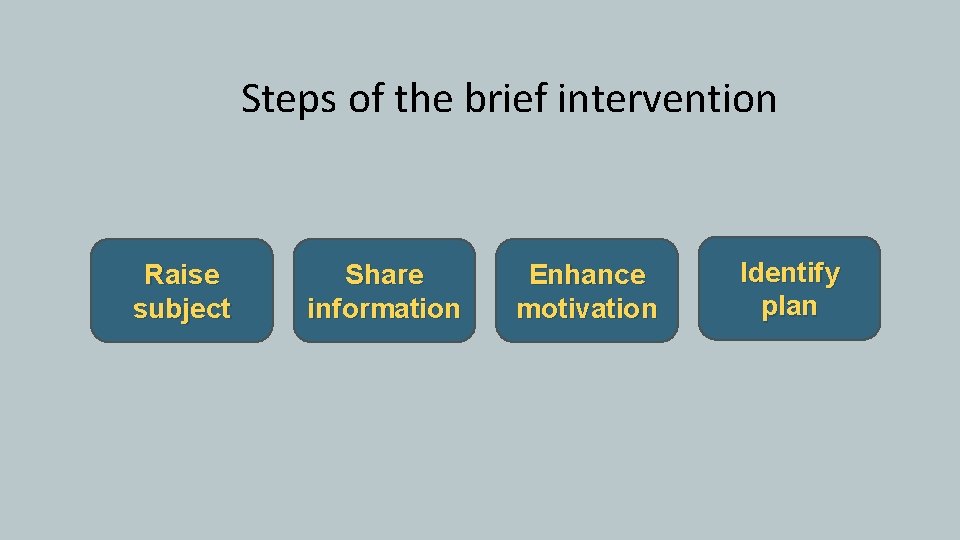
Steps of the brief intervention Raise subject Share information Enhance motivation Identify plan
Steps of the brief intervention • Ask permission to discuss patient’s Raise subject substance use • Be transparent about your role • Ask the patient to describe their use
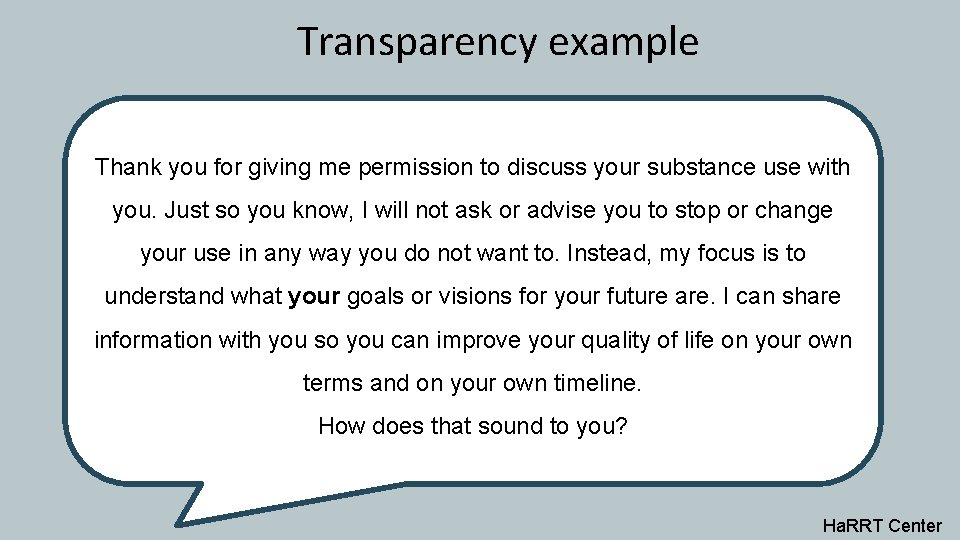
Transparency example Thank you for giving me permission to discuss your substance use with you. Just so you know, I will not ask or advise you to stop or change your use in any way you do not want to. Instead, my focus is to understand what your goals or visions for your future are. I can share information with you so you can improve your quality of life on your own terms and on your own timeline. How does that sound to you? Ha. RRT Center
Steps of the brief intervention • Explain any association between substance use and health complaint Share information • Share information about of risks of use. Ok to express concern • Ask the pt what they think of the information
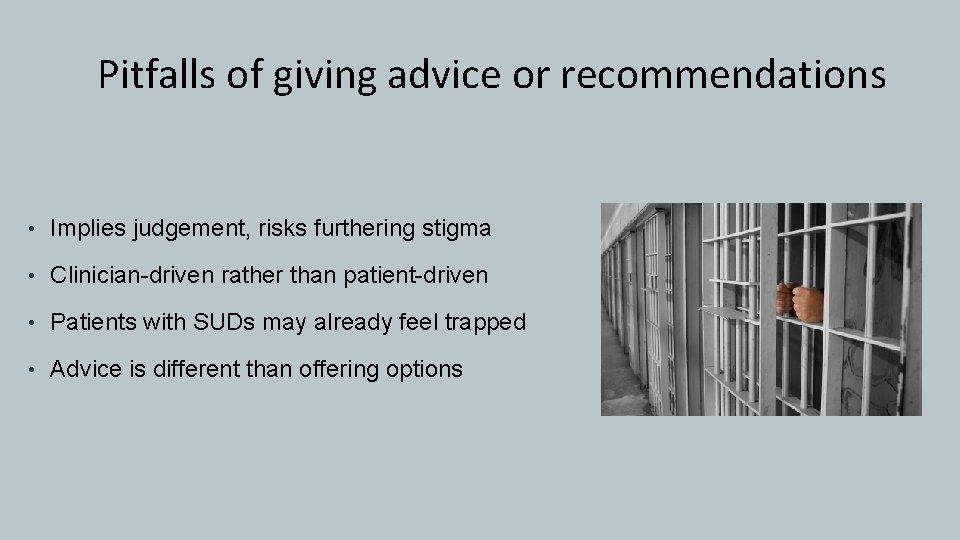
Pitfalls of giving advice or recommendations • Implies judgement, risks furthering stigma • Clinician-driven rather than patient-driven • Patients with SUDs may already feel trapped • Advice is different than offering options
Steps of the brief intervention Enhance motivation • Ask patient what they like about their use, and what they don’t like, then summarize • Ask what change the pt would like to see
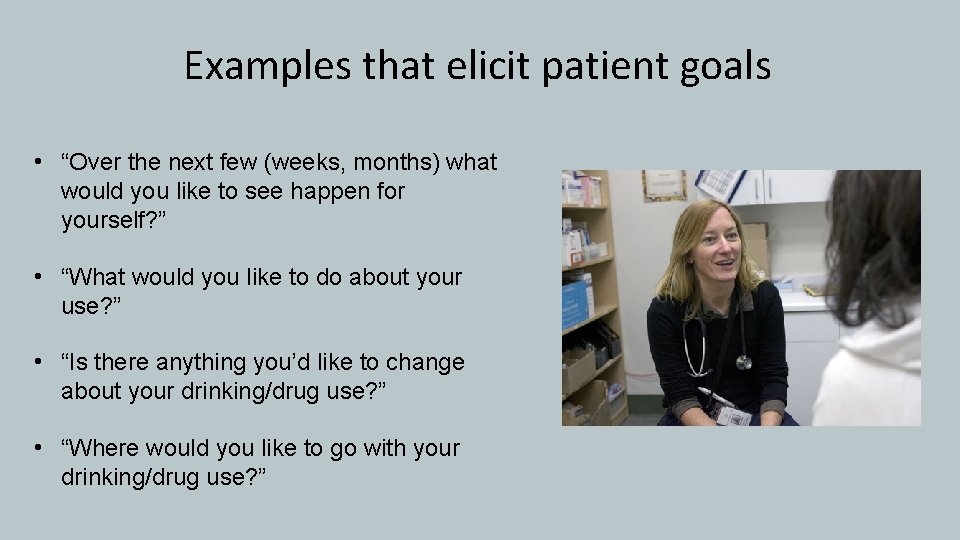
Examples that elicit patient goals • “Over the next few (weeks, months) what would you like to see happen for yourself? ” • “What would you like to do about your use? ” • “Is there anything you’d like to change about your drinking/drug use? ” • “Where would you like to go with your drinking/drug use? ”
Goals are more achievable when they are: • Well defined • Focused on reducing harm or improving quality of life • Doable in a timeframe • Patient-driven Ha. RRT Center
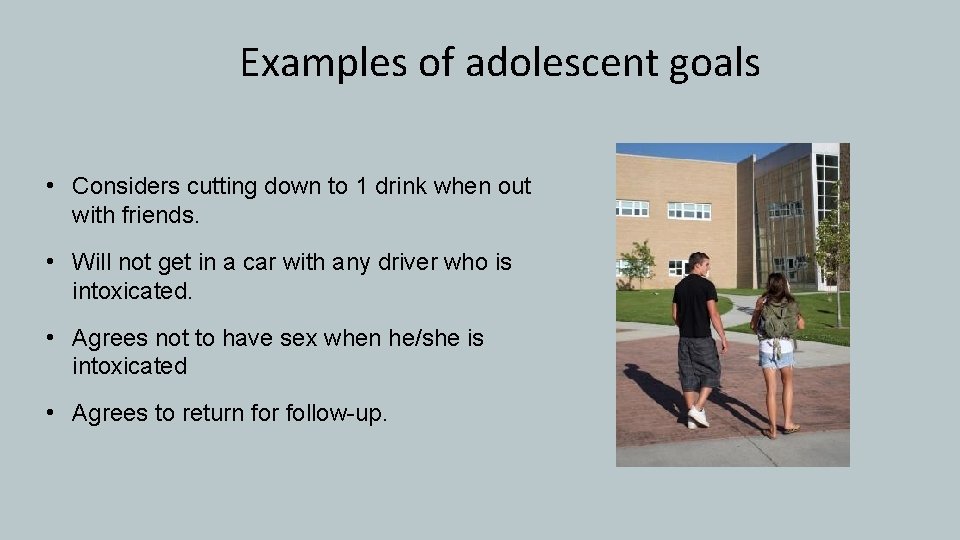
Examples of adolescent goals • Considers cutting down to 1 drink when out with friends. • Will not get in a car with any driver who is intoxicated. • Agrees not to have sex when he/she is intoxicated • Agrees to return for follow-up.
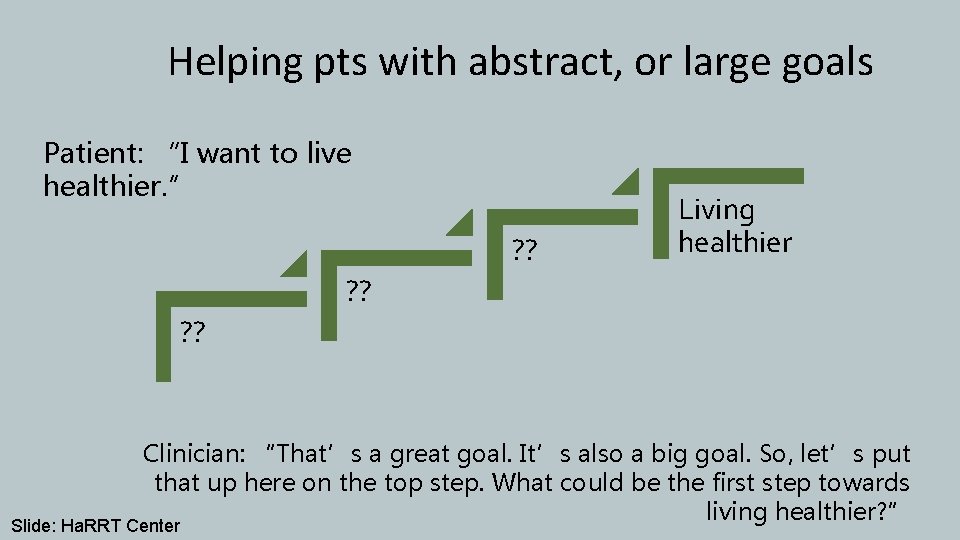
Helping pts with abstract, or large goals Patient: “I want to live healthier. ” ? ? Living healthier ? ? Clinician: “That’s a great goal. It’s also a big goal. So, let’s put that up here on the top step. What could be the first step towards living healthier? ” Slide: Ha. RRT Center
Steps of the brief intervention • Ask patient what they like about their use, and what they don’t like, then summarize Enhance motivation • Ask what change the pt would like to see • Gauge readiness/confidence to reach goal
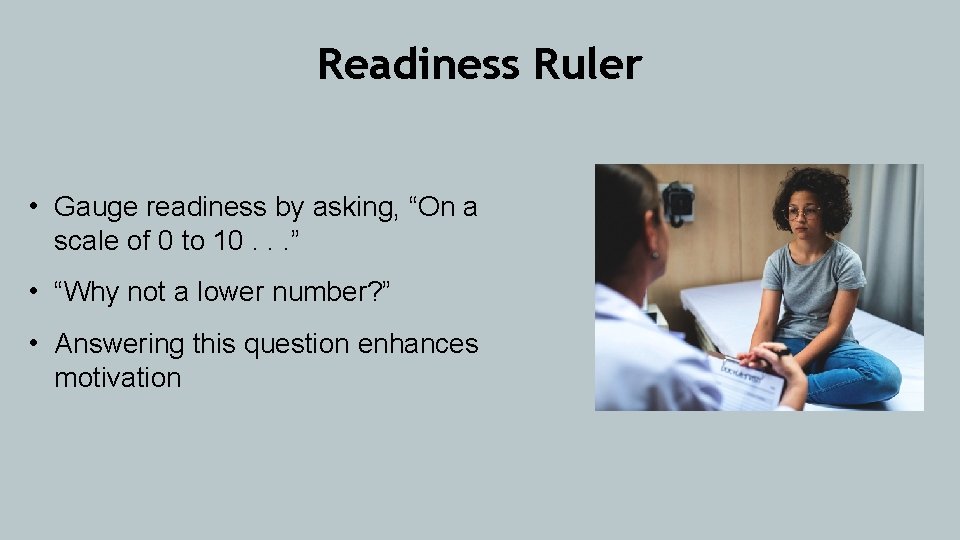
Readiness Ruler • Gauge readiness by asking, “On a scale of 0 to 10. . . ” • “Why not a lower number? ” • Answering this question enhances motivation
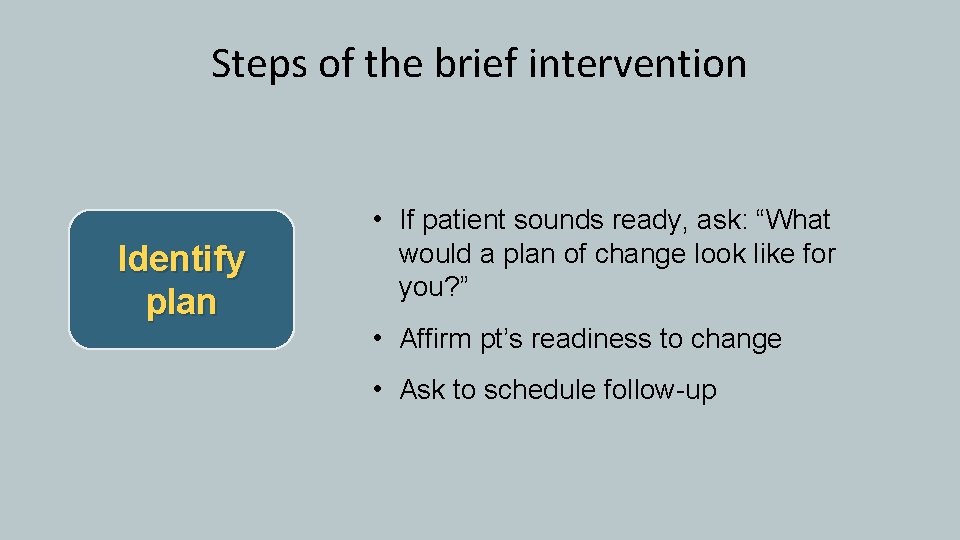
Steps of the brief intervention • If patient sounds ready, ask: “What Identify plan would a plan of change look like for you? ” • Affirm pt’s readiness to change • Ask to schedule follow-up
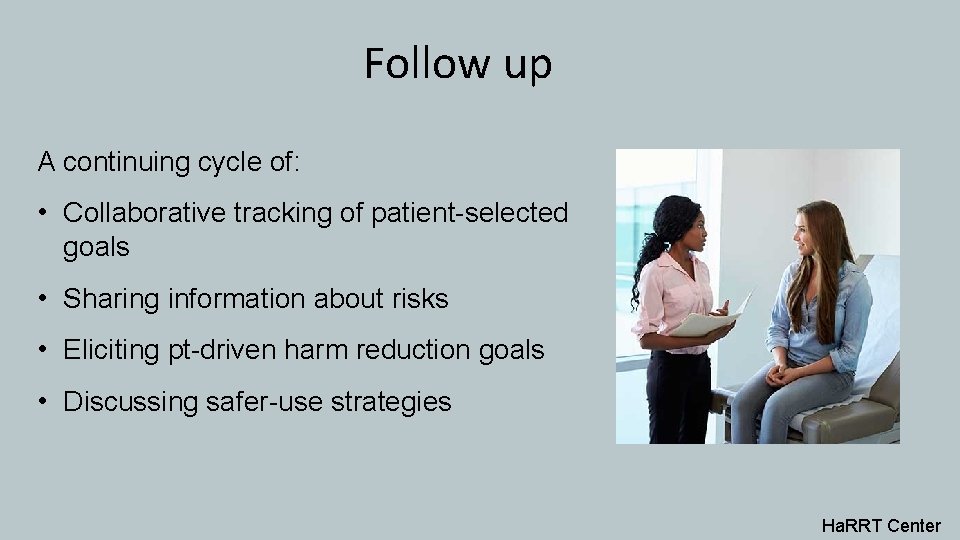
Follow up A continuing cycle of: • Collaborative tracking of patient-selected goals • Sharing information about risks • Eliciting pt-driven harm reduction goals • Discussing safer-use strategies Ha. RRT Center
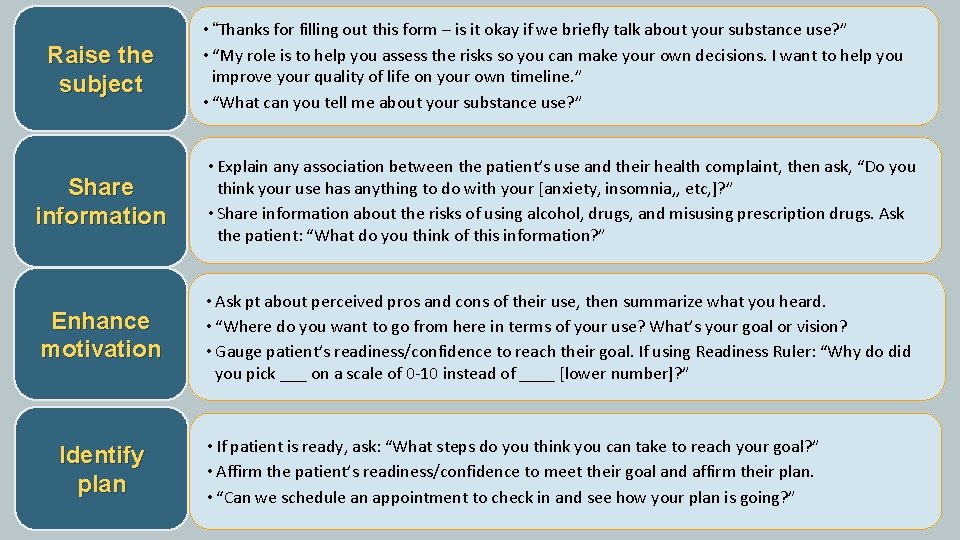
Raise the subject • “Thanks for filling out this form – is it okay if we briefly talk about your substance use? ” • “My role is to help you assess the risks so you can make your own decisions. I want to help you improve your quality of life on your own timeline. ” • “What can you tell me about your substance use? ” Share information • Explain any association between the patient’s use and their health complaint, then ask, “Do you think your use has anything to do with your [anxiety, insomnia, , etc, ]? ” • Share information about the risks of using alcohol, drugs, and misusing prescription drugs. Ask the patient: “What do you think of this information? ” Enhance motivation • Ask pt about perceived pros and cons of their use, then summarize what you heard. • “Where do you want to go from here in terms of your use? What’s your goal or vision? • Gauge patient’s readiness/confidence to reach their goal. If using Readiness Ruler: “Why do did you pick ___ on a scale of 0 -10 instead of ____ [lower number]? ” Identify plan • If patient is ready, ask: “What steps do you think you can take to reach your goal? ” • Affirm the patient’s readiness/confidence to meet their goal and affirm their plan. • “Can we schedule an appointment to check in and see how your plan is going? ”
Remember: Defer to the patient’s wisdom The more responsibility, autonomy and respect people feel they have, the more they will step up and forge their own pathway. Ha. RRT Center
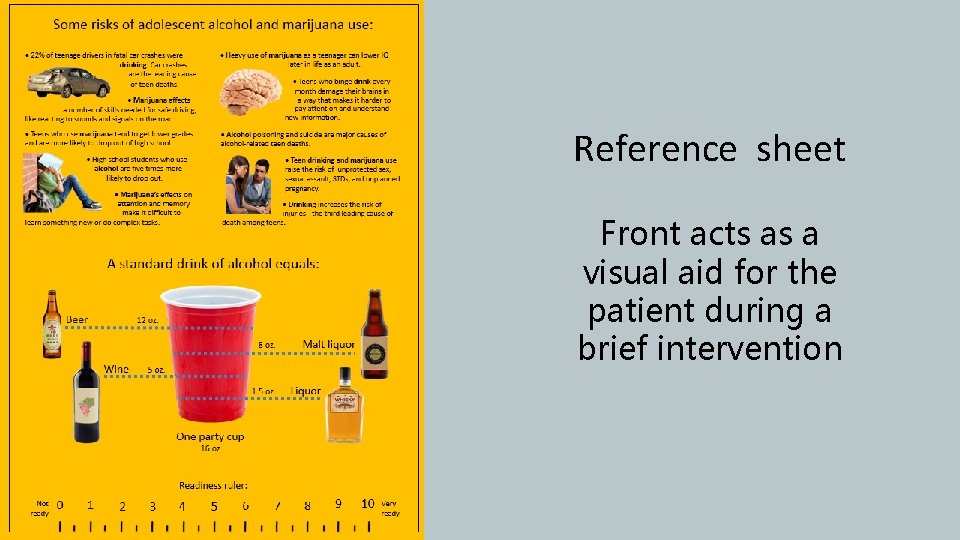
Reference sheet Front acts as a visual aid for the patient during a brief intervention
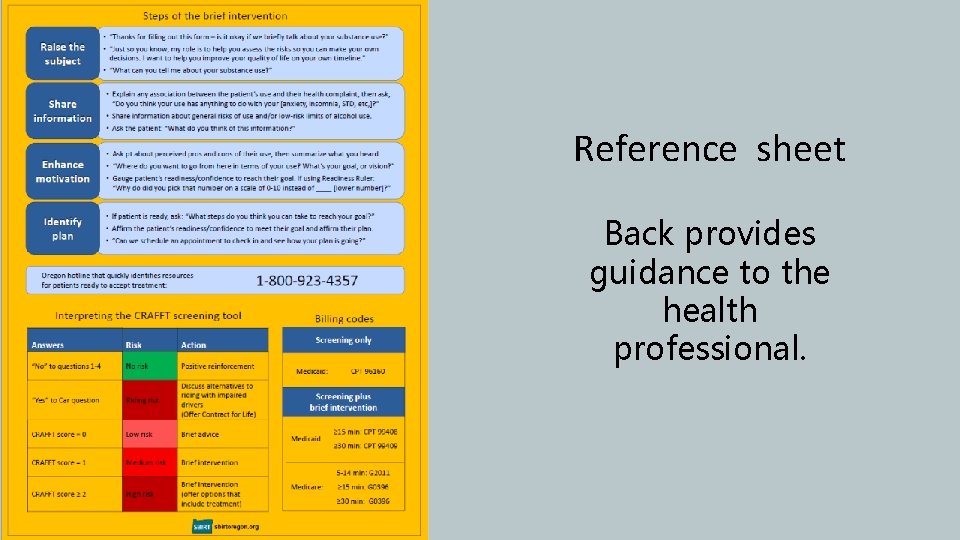
Reference sheet Back provides guidance to the health professional.
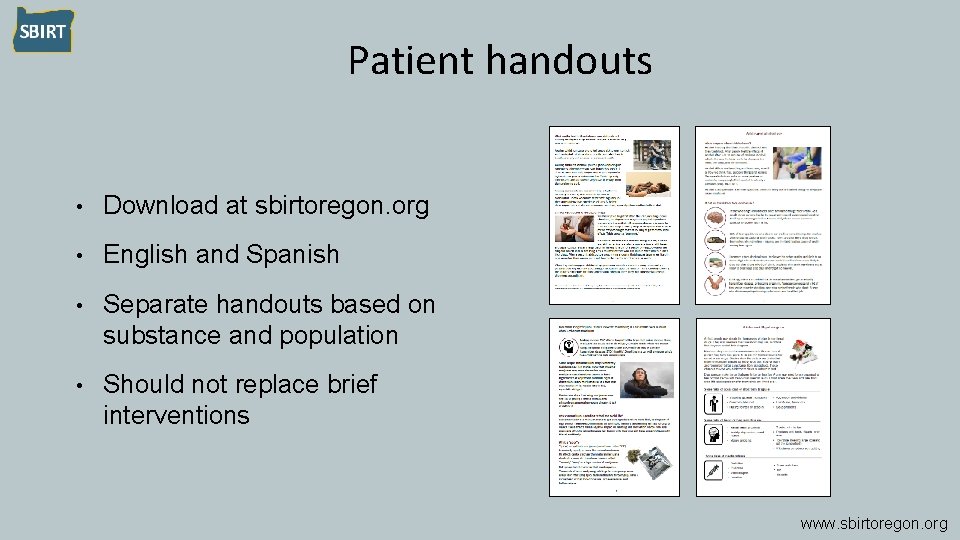
Patient handouts • Download at sbirtoregon. org • English and Spanish • Separate handouts based on substance and population • Should not replace brief interventions www. sbirtoregon. org
Role play practice Groups of three: • Clinician • Patient • Observer
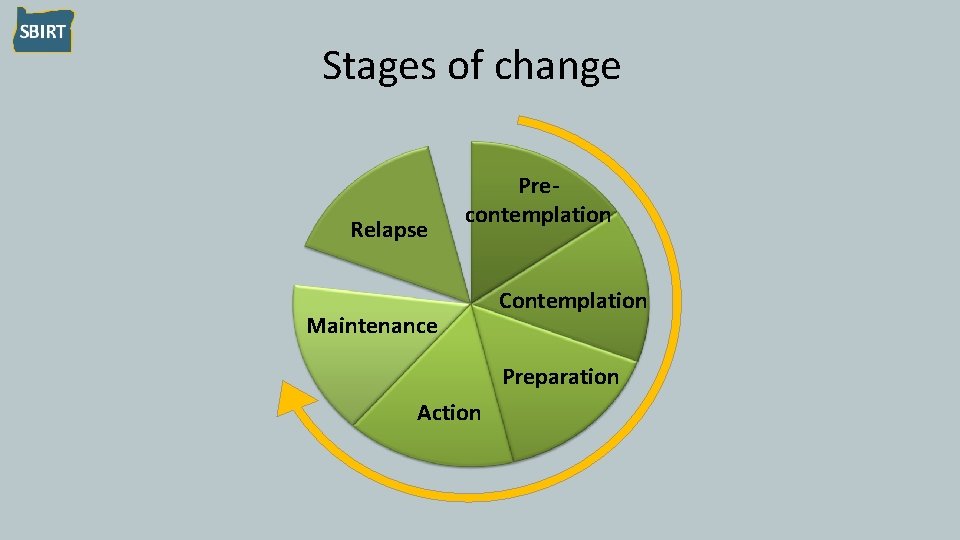
Stages of change Relapse Precontemplation Maintenance Contemplation Preparation Action
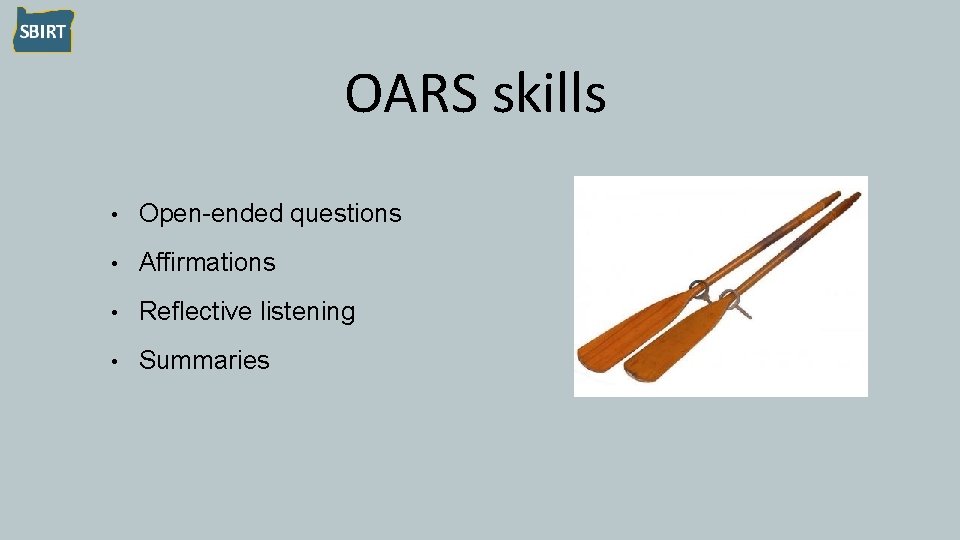
OARS skills • Open-ended questions • Affirmations • Reflective listening • Summaries
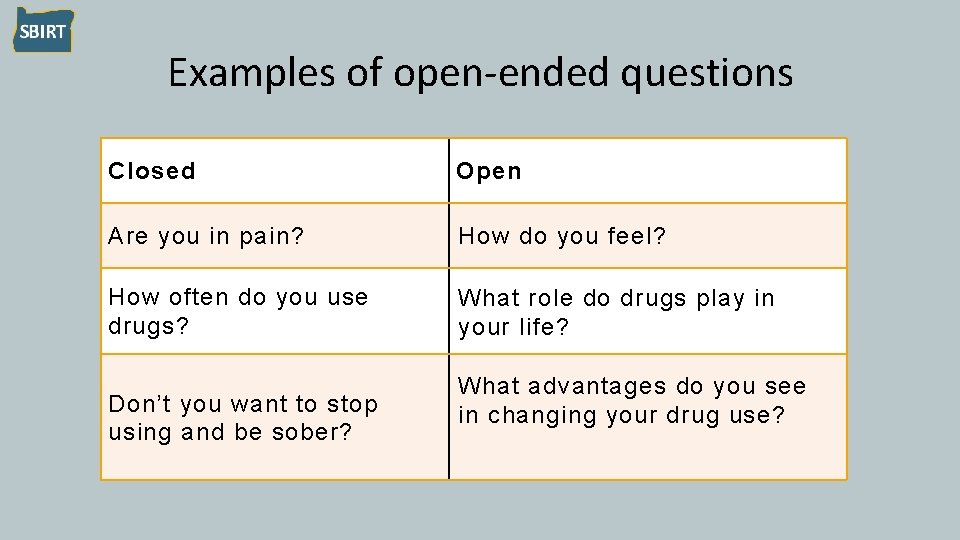
Examples of open-ended questions Closed Open Are you in pain? How do you feel? How often do you use drugs? What role do drugs play in your life? Don’t you want to stop using and be sober? What advantages do you see in changing your drug use?
Open-ended questions • Invites the patient to “tell their story” without leading them in a specific direction • Should be used often, but not exclusively • Important to listen to the person’s response
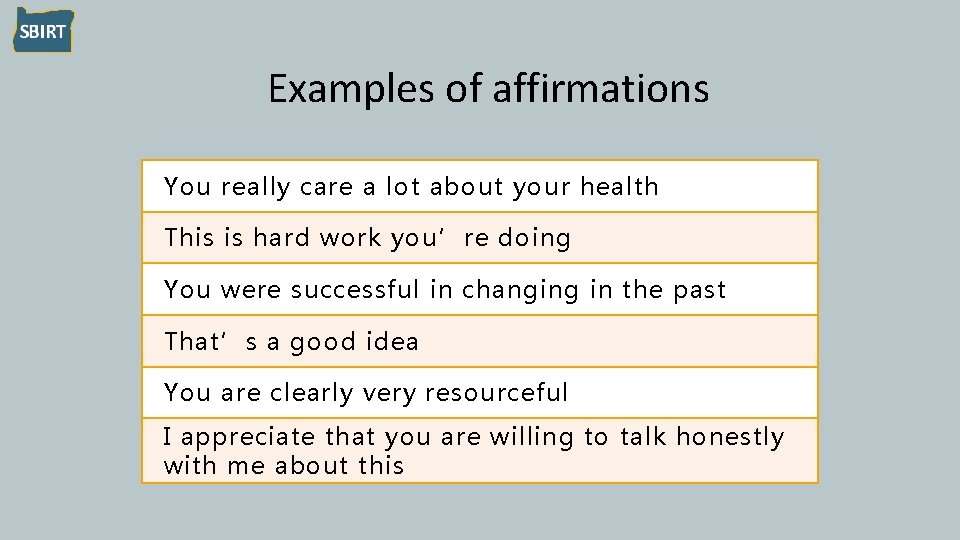
Examples of affirmations You really care a lot about your health This is hard work you’re doing You were successful in changing in the past That’s a good idea You are clearly very resourceful I appreciate that you are willing to talk honestly with me about this
Affirmations • Statements that recognize patient strengths • Acknowledging positive behaviors, no matter how big or small • Help build confidence and self-efficacy • Must be genuine
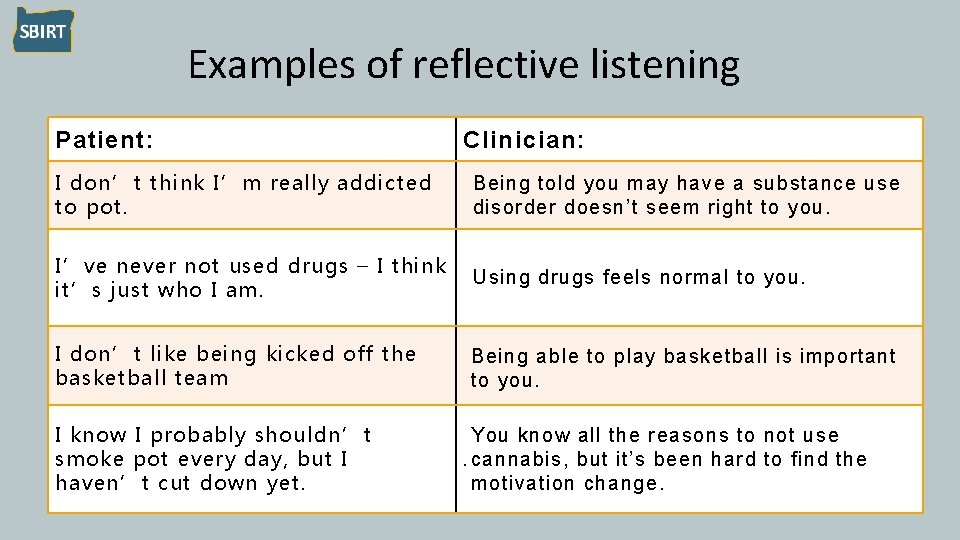
Examples of reflective listening Patient: Clinician: I don’t think I’m really addicted to pot. Being told you may have a substance use disorder doesn’t seem right to you. I’ve never not used drugs – I think it’s just who I am. Using drugs feels normal to you. I don’t like being kicked off the basketball team Being able to play basketball is important to you. I know I probably shouldn’t smoke pot every day, but I haven’t cut down yet. You know all the reasons to not use. cannabis, but it’s been hard to find the motivation change.
Reflective listening • Understanding what your patient is thinking and feeling, and then saying it back to the patient • Engages your patient, conveys empathy, builds trust, and fosters motivation to change • Allows you to see the world through your patient’s eyes
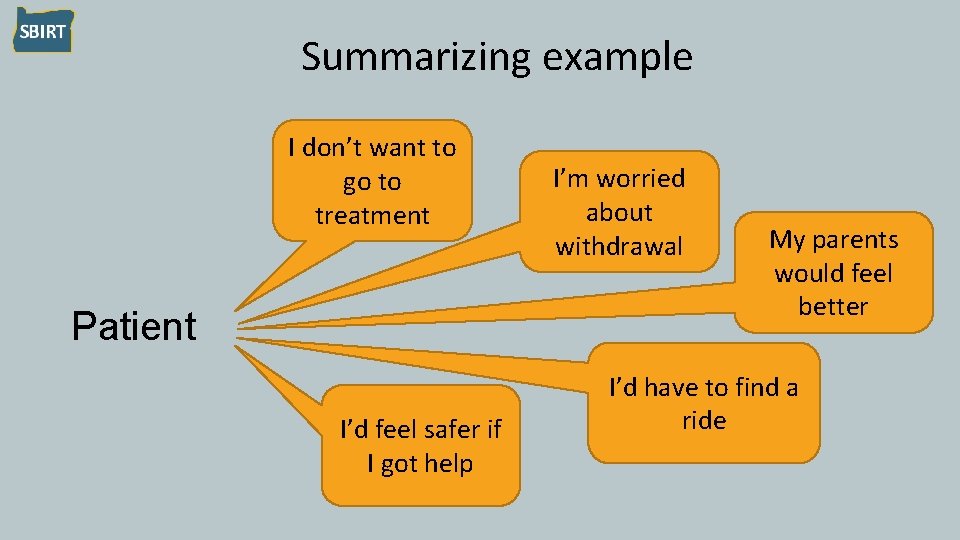
Summarizing example I don’t want to go to treatment Patient I’d feel safer if I got help I’m worried about withdrawal My parents would feel better I’d have to find a ride
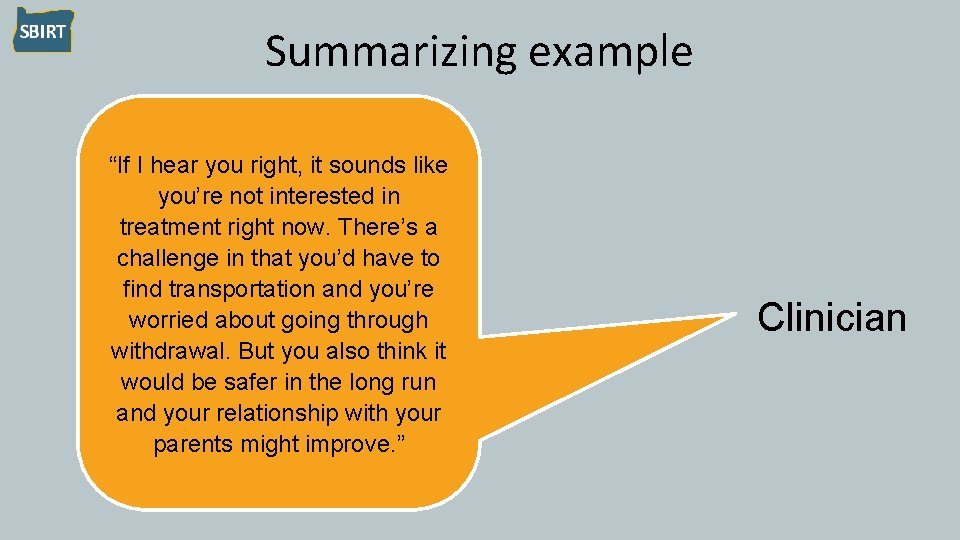
Summarizing example “If I hear you right, it sounds like you’re not interested in treatment right now. There’s a challenge in that you’d have to find transportation and you’re worried about going through withdrawal. But you also think it would be safer in the long run and your relationship with your parents might improve. ” Clinician
Summarizing • Special applications of reflective listening • Particularly helpful at transition points, or when you’re not sure what to say next • Good way to help patient analyze pros and cons
IV. Referral to Treatment
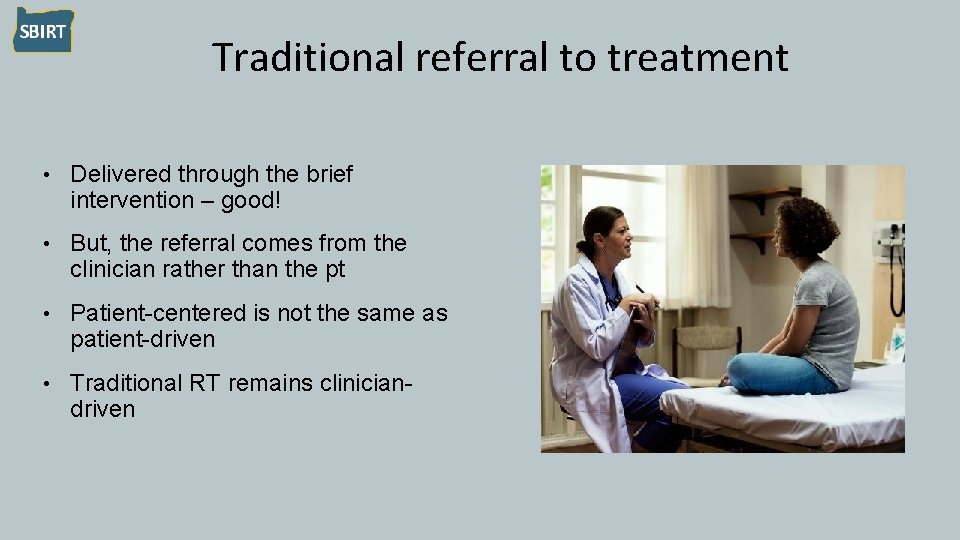
Traditional referral to treatment • Delivered through the brief intervention – good! • But, the referral comes from the clinician rather than the pt • Patient-centered is not the same as patient-driven • Traditional RT remains cliniciandriven
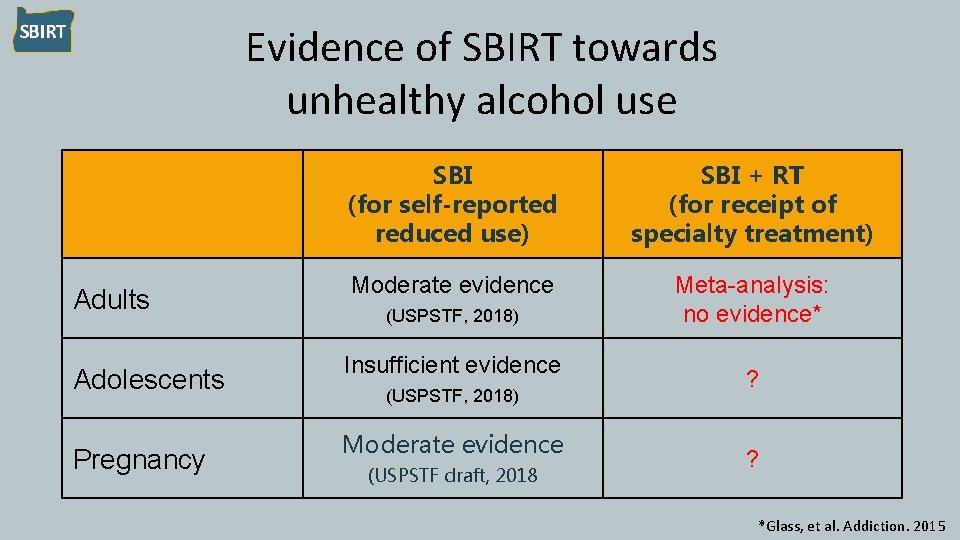
Evidence of SBIRT towards unhealthy alcohol use SBI (for self-reported reduced use) SBI + RT (for receipt of specialty treatment) Adults Moderate evidence Meta-analysis: no evidence* Adolescents Insufficient evidence Pregnancy (USPSTF, 2018) Moderate evidence (USPSTF draft, 2018 ? ? *Glass, et al. Addiction. 2015
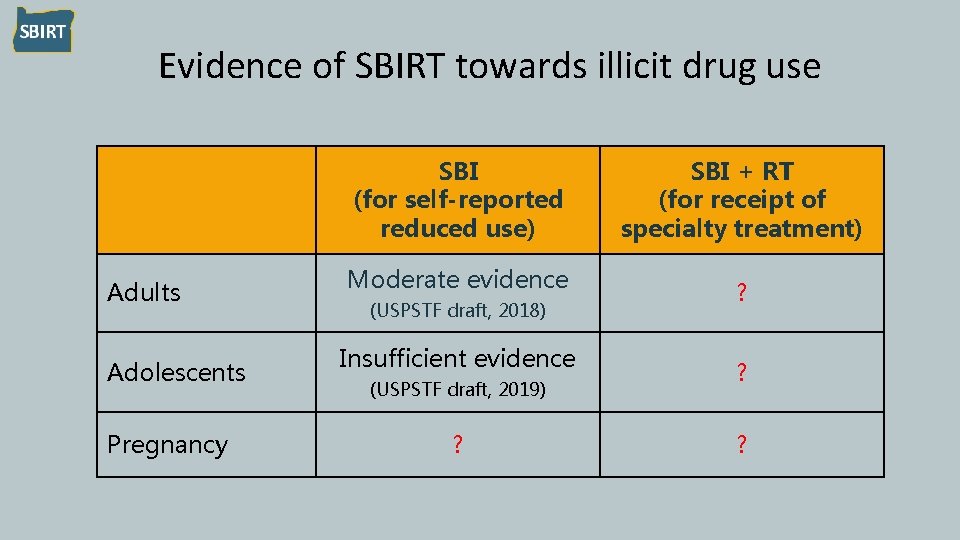
Evidence of SBIRT towards illicit drug use SBI (for self-reported reduced use) Adults Adolescents Pregnancy Moderate evidence (USPSTF draft, 2018) Insufficient evidence (USPSTF draft, 2019) ? SBI + RT (for receipt of specialty treatment) ? ? ?
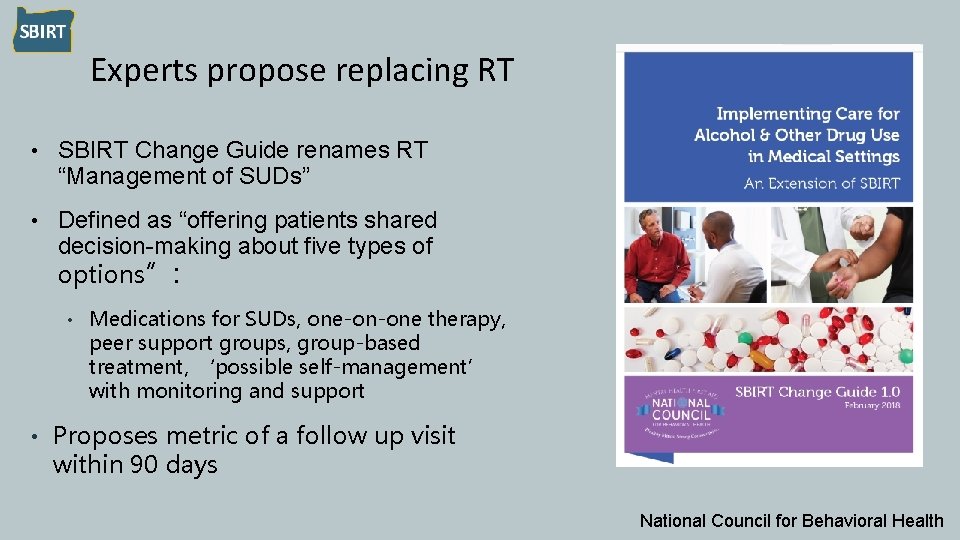
Experts propose replacing RT • SBIRT Change Guide renames RT “Management of SUDs” • Defined as “offering patients shared decision-making about five types of options”: • • Medications for SUDs, one-on-one therapy, peer support groups, group-based treatment, ‘possible self-management’ with monitoring and support Proposes metric of a follow up visit within 90 days National Council for Behavioral Health
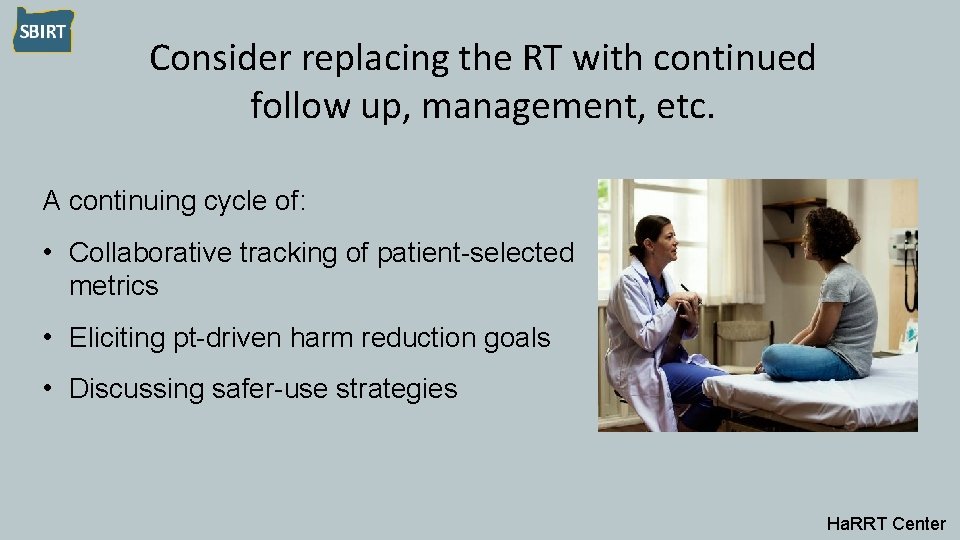
Consider replacing the RT with continued follow up, management, etc. A continuing cycle of: • Collaborative tracking of patient-selected metrics • Eliciting pt-driven harm reduction goals • Discussing safer-use strategies Ha. RRT Center
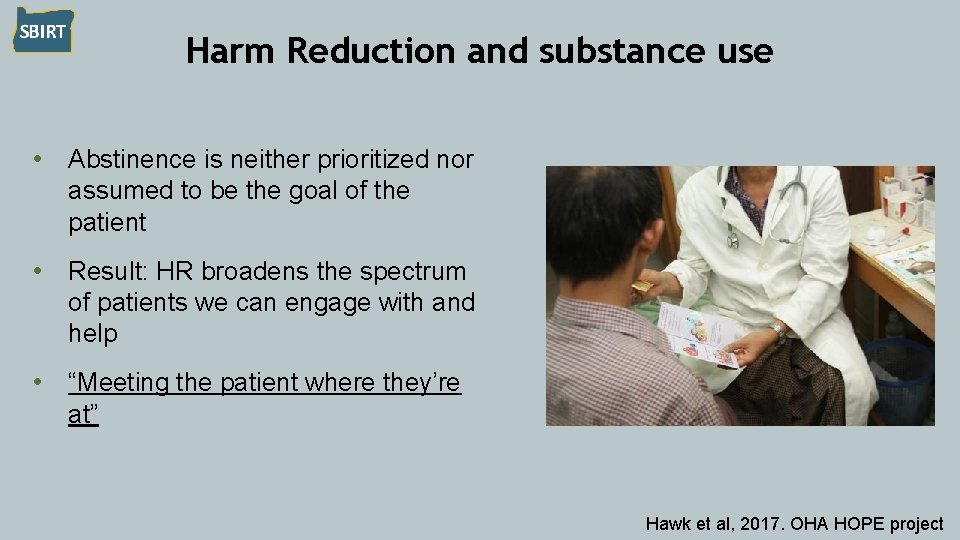
Harm Reduction and substance use • Abstinence is neither prioritized nor assumed to be the goal of the patient • Result: HR broadens the spectrum of patients we can engage with and help • “Meeting the patient where they’re at” Hawk et al, 2017. OHA HOPE project
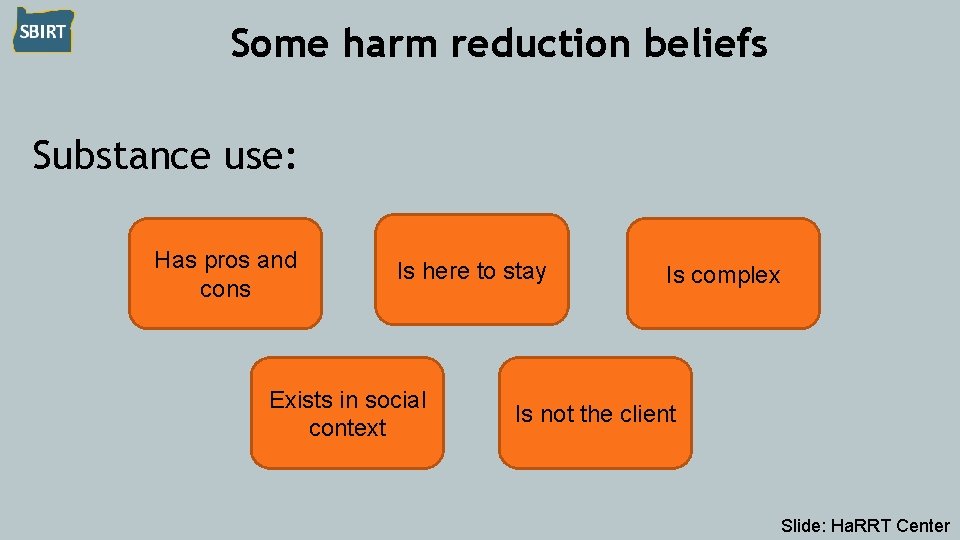
Some harm reduction beliefs Substance use: Has pros and cons Is here to stay Exists in social context Is complex Is not the client Slide: Ha. RRT Center
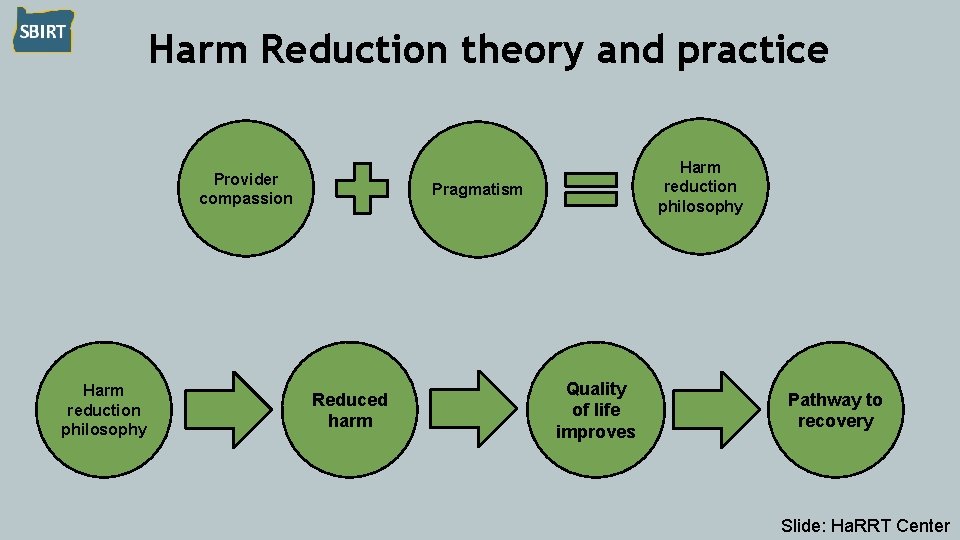
Harm Reduction theory and practice Provider compassion Harm reduction philosophy Pragmatism Reduced harm Quality of life improves Pathway to recovery Slide: Ha. RRT Center
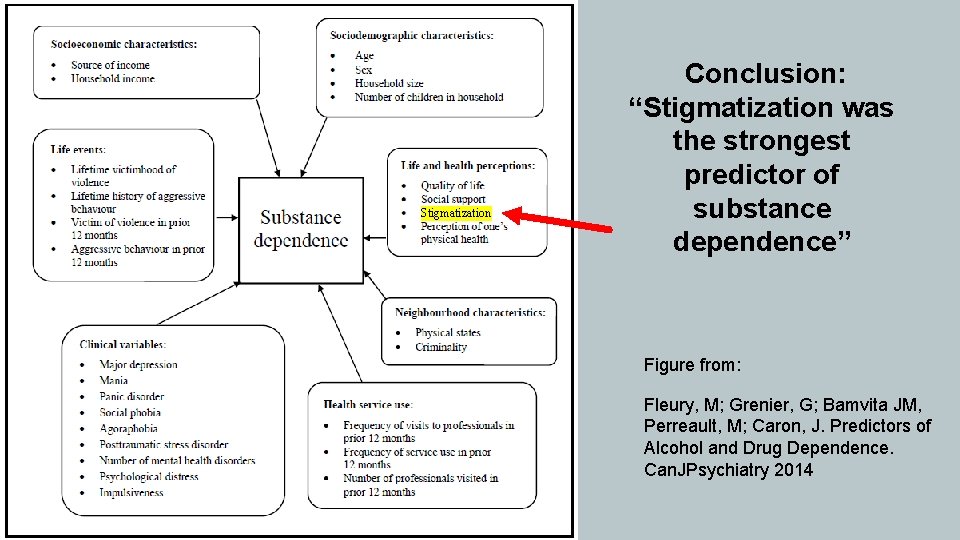
Stigmatization Conclusion: “Stigmatization was the strongest predictor of substance dependence” Figure from: Fleury, M; Grenier, G; Bamvita JM, Perreault, M; Caron, J. Predictors of Alcohol and Drug Dependence. Can. JPsychiatry 2014
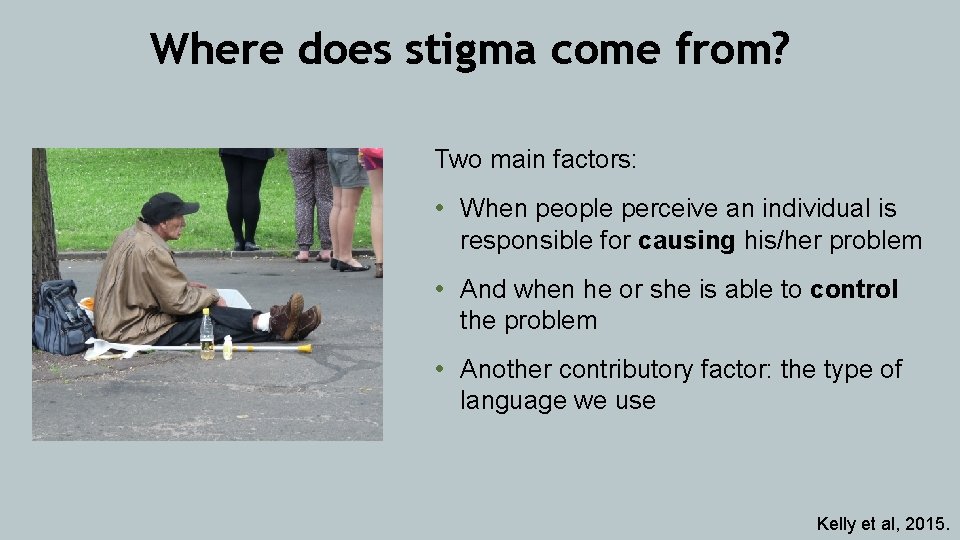
Where does stigma come from? Two main factors: • When people perceive an individual is responsible for causing his/her problem • And when he or she is able to control the problem • Another contributory factor: the type of language we use Kelly et al, 2015.
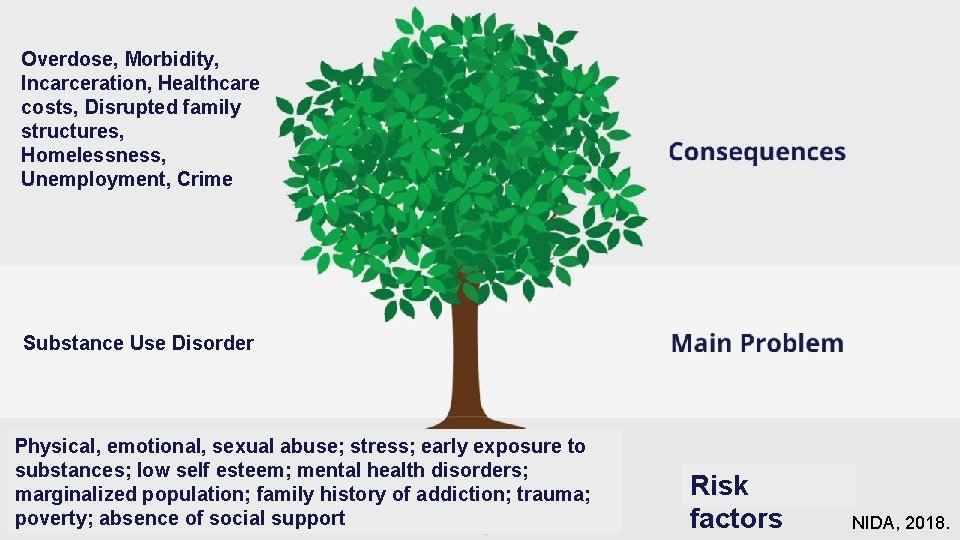
Overdose, Morbidity, Incarceration, Healthcare costs, Disrupted family structures, Homelessness, Unemployment, Crime Substance Use Disorder Physical, emotional, sexual abuse; stress; early exposure to substances; low self esteem; mental health disorders; marginalized population; family history of addiction; trauma; poverty; absence of social support Risk factors NIDA, 2018.
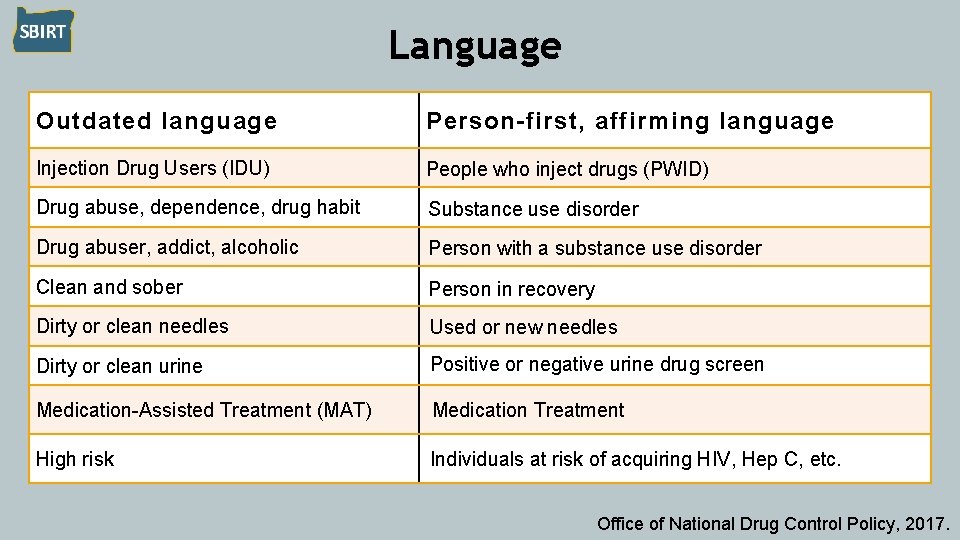
Language Outdated language Person-first, affirming language Injection Drug Users (IDU) People who inject drugs (PWID) Drug abuse, dependence, drug habit Substance use disorder Drug abuser, addict, alcoholic Person with a substance use disorder Clean and sober Person in recovery Dirty or clean needles Used or new needles Dirty or clean urine Positive or negative urine drug screen Medication-Assisted Treatment (MAT) Medication Treatment High risk Individuals at risk of acquiring HIV, Hep C, etc. Office of National Drug Control Policy, 2017.
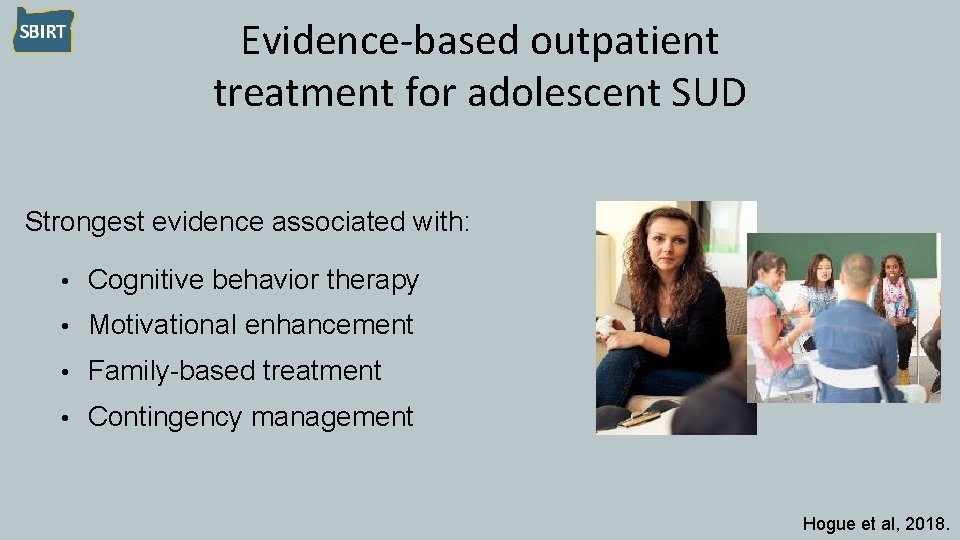
Evidence-based outpatient treatment for adolescent SUD Strongest evidence associated with: • Cognitive behavior therapy • Motivational enhancement • Family-based treatment • Contingency management Hogue et al, 2018.
Medications for SUDs • Not substitutions of one drug for another • Instead, they relieve withdrawal symptoms and psychological cravings • Effective if used alone, or with behavioral therapy • Can help pts initiate and sustain recovery from SUDs
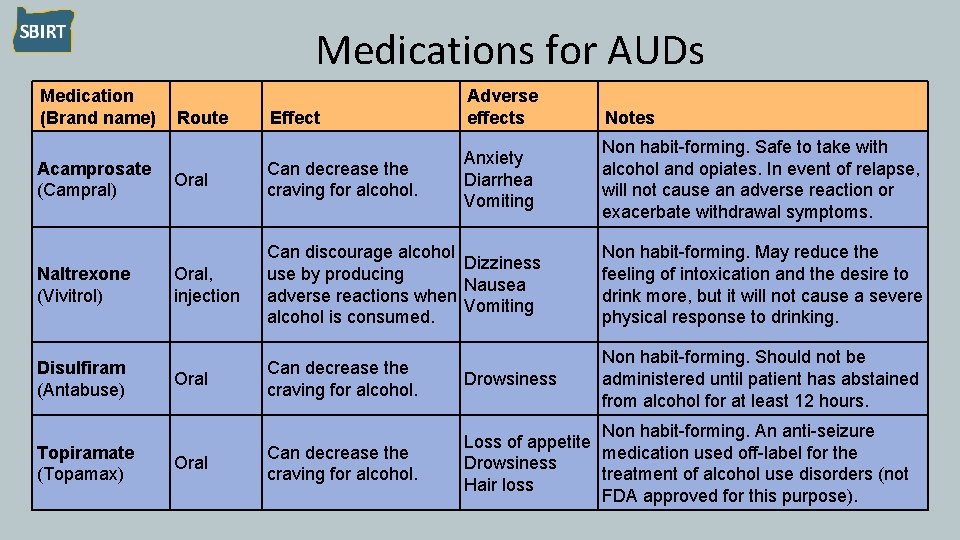
Medications for AUDs Medication (Brand name) Acamprosate (Campral) Naltrexone (Vivitrol) Disulfiram (Antabuse) Topiramate (Topamax) Route Effect Adverse effects Anxiety Diarrhea Vomiting Notes Non habit-forming. Safe to take with alcohol and opiates. In event of relapse, will not cause an adverse reaction or exacerbate withdrawal symptoms. Oral Can decrease the craving for alcohol. Oral, injection Can discourage alcohol Dizziness use by producing Nausea adverse reactions when Vomiting alcohol is consumed. Non habit-forming. May reduce the feeling of intoxication and the desire to drink more, but it will not cause a severe physical response to drinking. Oral Can decrease the craving for alcohol. Drowsiness Non habit-forming. Should not be administered until patient has abstained from alcohol for at least 12 hours. Can decrease the craving for alcohol. Non habit-forming. An anti-seizure Loss of appetite medication used off-label for the Drowsiness treatment of alcohol use disorders (not Hair loss FDA approved for this purpose). Oral
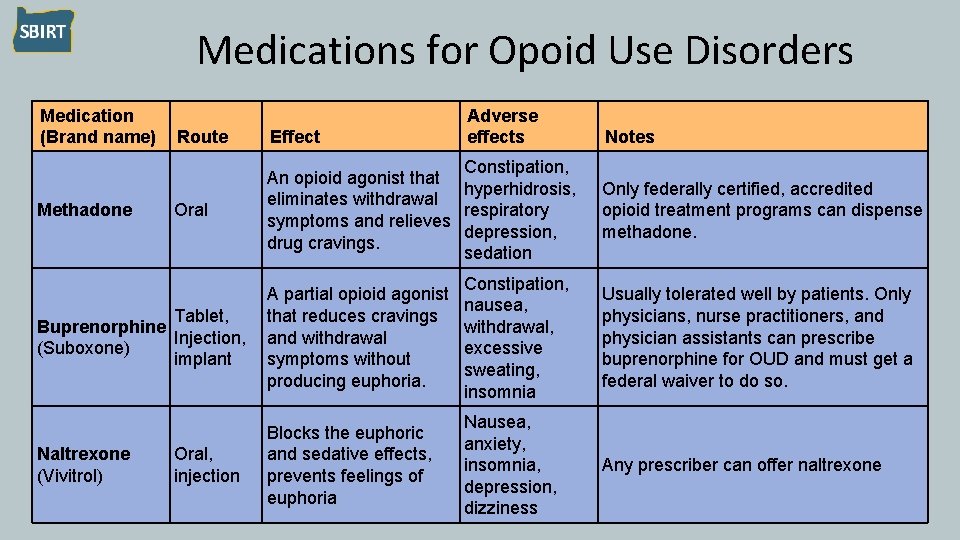
Medications for Opoid Use Disorders Medication (Brand name) Methadone Adverse effects Route Effect Oral Constipation, An opioid agonist that hyperhidrosis, eliminates withdrawal respiratory symptoms and relieves depression, drug cravings. sedation Notes Only federally certified, accredited opioid treatment programs can dispense methadone. Tablet, Buprenorphine Injection, (Suboxone) implant A partial opioid agonist that reduces cravings and withdrawal symptoms without producing euphoria. Constipation, nausea, withdrawal, excessive sweating, insomnia Usually tolerated well by patients. Only physicians, nurse practitioners, and physician assistants can prescribe buprenorphine for OUD and must get a federal waiver to do so. Naltrexone (Vivitrol) Blocks the euphoric and sedative effects, prevents feelings of euphoria Nausea, anxiety, insomnia, depression, dizziness Any prescriber can offer naltrexone Oral, injection
Oregon laws towards minor consent and treatment • Youth 14 years or older may initiate treatment without parental consent (ORS 109. 6750) • Providers are to involve the parents before end of treatment unless parents refuse or there are indications not to involve parents (ORS 109. 6750) • Providers may advise the parent /guardian of diagnosis of treatment of chemical dependency or mental disorder when clinically appropriate and if condition has deteriorated (ORS 109. 680)
Referral to treatment • Should be delivered through the brief intervention • Offered as an option • Followed through if the pt agress to accept treatment • Patient-centered is not the same as patient-driven
Confidentiality and the referral Consider: • May be difficult for teen to manage treatment requirements without parent knowledge. • Teens respond better to treatment when parents are involved. • Insurance carrier may notify parent if insurance is under their name.
Involving parents or trusted adults • An adolescent who discloses heavy drug use may be looking for help. • Ask patient if parents or trusted adults are aware of drug use. If so, inviting parents into conversation may be easy. • Special considerations when parents themselves use substances
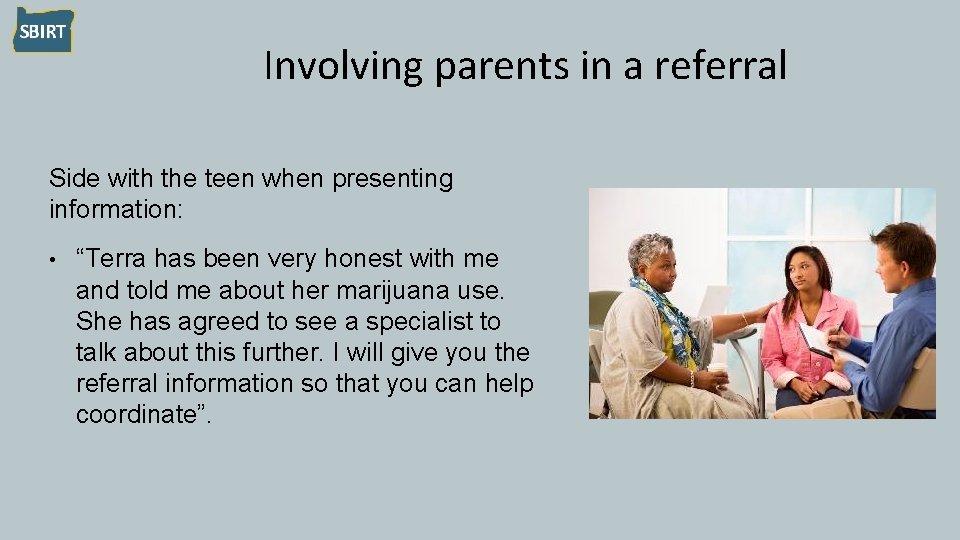
Involving parents in a referral Side with the teen when presenting information: • “Terra has been very honest with me and told me about her marijuana use. She has agreed to see a specialist to talk about this further. I will give you the referral information so that you can help coordinate”.
Thank you Jim Winkle, MPH jimwinkle@gmail. com
- Slides: 115