
SBIRT in EDs for AUDsSUDs A review of
SBIRT in EDs for AUDs/SUDs: A review of intervention design, outcomes, implementation, and cost benefits Daniel J. Fischer, M. Ed. Dennis Donovan, Ph. D. Michael P. Bogenschutz, M. D. Alyssa A. Forcehimes, Ph. D.
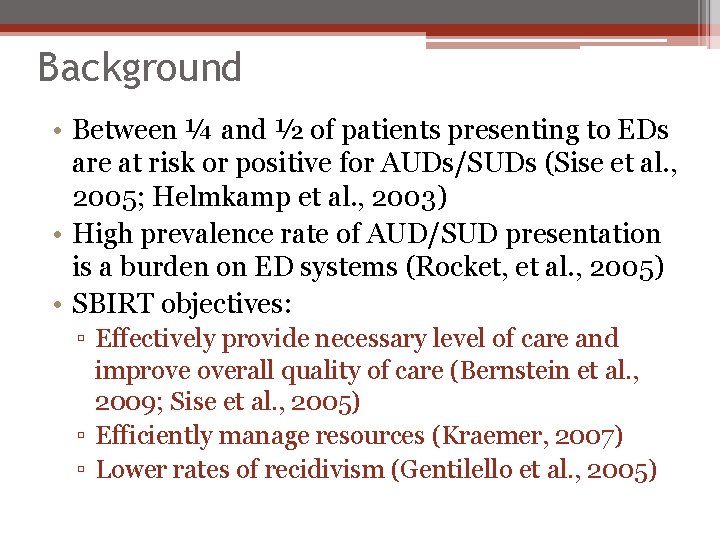
Background • Between ¼ and ½ of patients presenting to EDs are at risk or positive for AUDs/SUDs (Sise et al. , 2005; Helmkamp et al. , 2003) • High prevalence rate of AUD/SUD presentation is a burden on ED systems (Rocket, et al. , 2005) • SBIRT objectives: ▫ Effectively provide necessary level of care and improve overall quality of care (Bernstein et al. , 2009; Sise et al. , 2005) ▫ Efficiently manage resources (Kraemer, 2007) ▫ Lower rates of recidivism (Gentilello et al. , 2005)
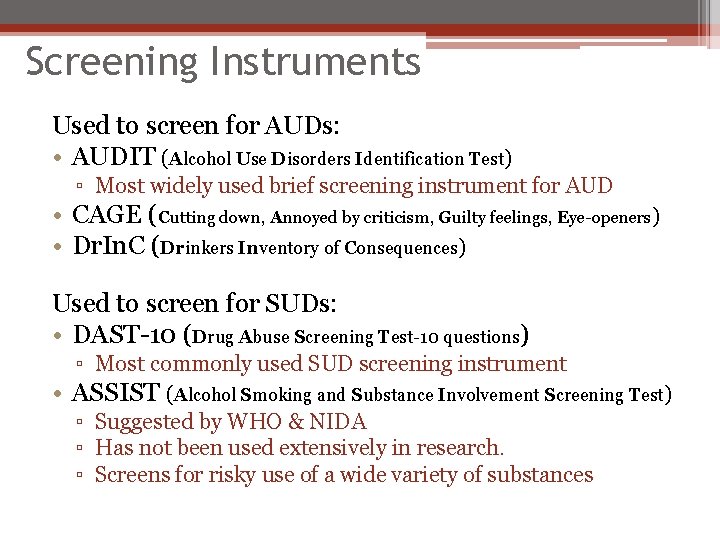
Screening Instruments Used to screen for AUDs: • AUDIT (Alcohol Use Disorders Identification Test) ▫ Most widely used brief screening instrument for AUD • CAGE (Cutting down, Annoyed by criticism, Guilty feelings, Eye-openers) • Dr. In. C (Drinkers Inventory of Consequences) Used to screen for SUDs: • DAST-10 (Drug Abuse Screening Test-10 questions) ▫ Most commonly used SUD screening instrument • ASSIST (Alcohol Smoking and Substance Involvement Screening Test) ▫ Suggested by WHO & NIDA ▫ Has not been used extensively in research. ▫ Screens for risky use of a wide variety of substances
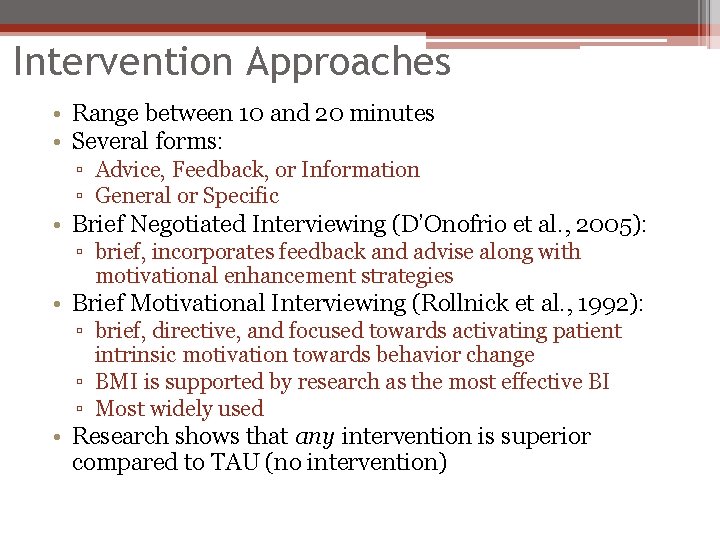
Intervention Approaches • Range between 10 and 20 minutes • Several forms: ▫ Advice, Feedback, or Information ▫ General or Specific • Brief Negotiated Interviewing (D’Onofrio et al. , 2005): ▫ brief, incorporates feedback and advise along with motivational enhancement strategies • Brief Motivational Interviewing (Rollnick et al. , 1992): ▫ brief, directive, and focused towards activating patient intrinsic motivation towards behavior change ▫ BMI is supported by research as the most effective BI ▫ Most widely used • Research shows that any intervention is superior compared to TAU (no intervention)
Referral to Treatment • A weak point in the SBIRT model ▫ Minimal research explores this stage of SBIRT • Success depends on: ▫ Available resources in local community ▫ Relationship between ED team and treatment sites. ▫ Patient’s ability/desire to follow-through with referral • Using boosters sessions: ▫ Research suggests that even minimal follow-up referrals can increase the effectiveness of the BI(Bernstein et al. , 2007; Longabaugh, 2001) ▫ Booster can be administered in-person or by telephone
Outcome Research - Overview • 22 studies published AUD/SUD related outcomes for SBIRT in ED ▫ 15 studies reported AUD outcomes alone ▫ 6 studies reported both AUD and SUD outcomes ▫ 1 study reported only SUD related outcomes • Reported Outcome Criteria: ▫ Quantity/Frequency measures ▫ Reduction in AUD/SUD related negative consequences ▫ Reduction in AUD/SUD assessment scores ▫ Increased rates of entry into treatment
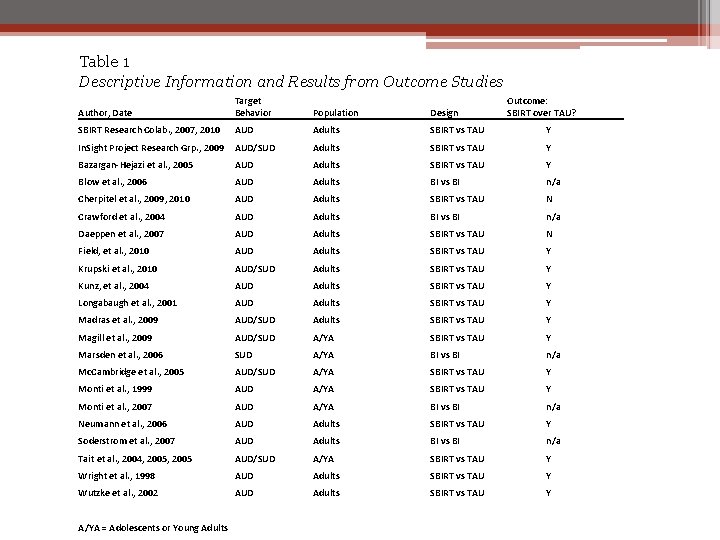
Table 1 Descriptive Information and Results from Outcome Studies Author, Date Target Behavior Population Design SBIRT Research Colab. , 2007, 2010 AUD Adults SBIRT vs TAU Y In. Sight Project Research Grp. , 2009 AUD/SUD Adults SBIRT vs TAU Y Bazargan-Hejazi et al. , 2005 AUD Adults SBIRT vs TAU Y Blow et al. , 2006 AUD Adults BI vs BI n/a Cherpitel et al. , 2009, 2010 AUD Adults SBIRT vs TAU N Crawford et al. , 2004 AUD Adults BI vs BI n/a Daeppen et al. , 2007 AUD Adults SBIRT vs TAU N Field, et al. , 2010 AUD Adults SBIRT vs TAU Y Krupski et al. , 2010 AUD/SUD Adults SBIRT vs TAU Y Kunz, et al. , 2004 AUD Adults SBIRT vs TAU Y Longabaugh et al. , 2001 AUD Adults SBIRT vs TAU Y Madras et al. , 2009 AUD/SUD Adults SBIRT vs TAU Y Magill et al. , 2009 AUD/SUD A/YA SBIRT vs TAU Y Marsden et al. , 2006 SUD A/YA BI vs BI n/a Mc. Cambridge et al. , 2005 AUD/SUD A/YA SBIRT vs TAU Y Monti et al. , 1999 AUD A/YA SBIRT vs TAU Y Monti et al. , 2007 AUD A/YA BI vs BI n/a Neumann et al. , 2006 AUD Adults SBIRT vs TAU Y Soderstrom et al. , 2007 AUD Adults BI vs BI n/a Tait et al. , 2004, 2005 AUD/SUD A/YA SBIRT vs TAU Y Wright et al. , 1998 AUD Adults SBIRT vs TAU Y Wutzke et al. , 2002 AUD Adults SBIRT vs TAU Y A/YA = Adolescents or Young Adults Outcome: SBIRT over TAU?
AUD Outcomes – SBIRT vs. TAU • 4 categories of SBIRT vs TAU outcomes: ▫ SBIRT showed greater reductions in follow-up quantity/frequency than TAU (n = 6) ▫ SBIRT showed greater reductions in AUD related negative consequences, although SBIRT and TAU groups had similar reductions in follow-up quantity/frequency (n = 5) ▫ No quantity/frequency data was reported, but SBIRT showed greater reductions in assessment scores than TAU (n = 4) ▫ No significant difference between SBIRT and TAU groups on any outcome criteria (n = 2) �Both looked at 6 -mo or 12 -mo F/U �Neither study included booster sessions
AUD Outcomes – BI vs. BI • 5 studies reported AUD related outcomes for different BI models • Several studies found that information-alone interventions were minimally effective • Advice or information with counseling was superior to information-alone (Blow et al. , 2006) • MI-based interventions were superior to information or feedback based interventions (Monti et al. , 1999; Monti et al. , 2007; Soderstrom et al. , 2007)
Outcomes - SUDs • 7 studies reported SUD related outcome • 6 of 7 studies found statistically significant improvements in SUD related outcomes ▫ 4 of 5 studies that reported SUD related quantity/frequency data found significant results in favor of SBIRT ▫ 2 of 2 studies that reported SUD related levels of treatment engagement found significant results in favor of SBIRT
Outcomes - Population • Research includes a diverse population base, both in ethnic diversity and age diversity. ▫ 4 out of 4 studies find SBIRT to be an effective intervention program across ethnically diverse population groups ▫ 4 out of 5 studies find SBIRT to be an effective intervention program with adolescent patients at risk for AUDs/SUDs.
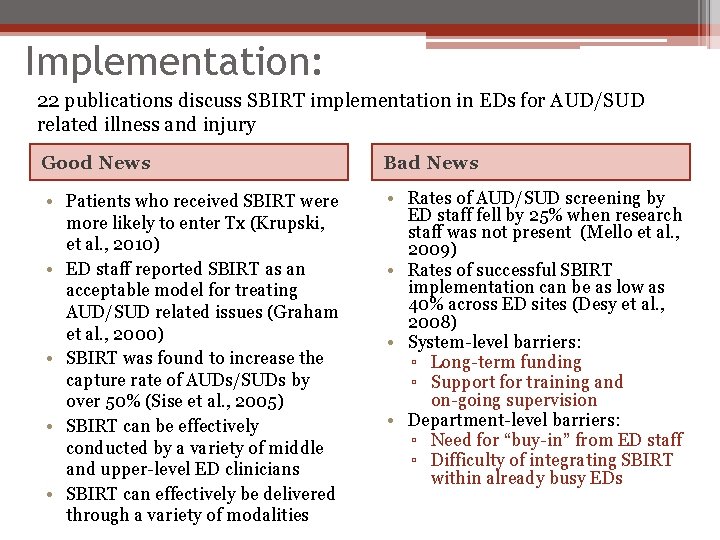
Implementation: 22 publications discuss SBIRT implementation in EDs for AUD/SUD related illness and injury Good News Bad News • Patients who received SBIRT were more likely to enter Tx (Krupski, et al. , 2010) • ED staff reported SBIRT as an acceptable model for treating AUD/SUD related issues (Graham et al. , 2000) • SBIRT was found to increase the capture rate of AUDs/SUDs by over 50% (Sise et al. , 2005) • SBIRT can be effectively conducted by a variety of middle and upper-level ED clinicians • SBIRT can effectively be delivered through a variety of modalities • Rates of AUD/SUD screening by ED staff fell by 25% when research staff was not present (Mello et al. , 2009) • Rates of successful SBIRT implementation can be as low as 40% across ED sites (Desy et al. , 2008) • System-level barriers: ▫ Long-term funding ▫ Support for training and on-going supervision • Department-level barriers: ▫ Need for “buy-in” from ED staff ▫ Difficulty of integrating SBIRT within already busy EDs
Costs & Benefits • Statistical prediction support the likelihood of SBIRT leading to cost savings (Barrett, et al. , 2006; Gentilello et al. , 2005) • Costs of SBIRT implementation ▫ ranged between $15 and $205 per patient (Barrett et al. , 2006; Estee et al. , 2007; Fleming et al. , 2000; Kunz et al. , 2004)) • Benefits of SBIRT implementation ▫ ranged between $95 and $366 per patient (Estee et al. , 2007; Fleming et al. , 2000; Gentilello et al. , 2005) • Projected annual savings of a nation-wide SBIRT program are estimated to be $1. 82 billion (Gentilello, et al. , 2005) • Medicare/Medicaid programs are a possible funding source for SBIRT in EDs (Fornili et al. , 2007)
Future Direction • Further research into SBIRT in EDs for SUDs • Focus on SBIRT targeting at-risk alcohol and substance use, not just dependency • Develop and support standardized models for training, implementing, and evaluating SBIRT within busy ED settings • Explore best practices for connecting patients with community resources/treatment options • Continue to explore cost-saving potential of SBIRT models in ED settings
- Slides: 14